Luận án: Thiết kế, chế tạo cảm biến áp suất SAW dùng Nitrure Nhôm (AlN)
Luận án tiến sĩ thiết kế & chế tạo cảm biến áp suất lưỡi cưa dùng nhôm nitrua (AlN). Khám phá công nghệ vật liệu tiên tiến cho ngành công nghiệp.
Université Joseph Fourier
Radio-Fréquence
Luan An
Luận án
Năm xuất bản
Số trang
174
Thời gian đọc
27 phút
Lượt xem
1
Lượt tải
0
Phí lưu trữ
50 Point
Tổng quan nhanh
- Chủ đề:
- 1. Cảm biến áp suất SAW và vai trò của Nitrure Nhôm (AlN)
- Số trang:
- 174 trang
- Trường:
- Université Joseph Fourier
- Chuyên ngành:
- Radio - Fréquence
- Tác giả:
- Trang Hoang
- Năm:
- 2009
Tóm tắt nội dung luận án
I. Cảm biến áp suất SAW và vai trò của Nitrure Nhôm AlN
Cảm biến áp suất SAW sử dụng sóng âm bề mặt để đo áp suất với độ chính xác cao. Nitrure nhôm (AlN) là vật liệu áp điện quan trọng, đóng vai trò trung tâm trong thiết kế cảm biến. AlN cung cấp hiệu suất tốt nhờ vào đặc tính cơ lý và điện của nó. Điều này giúp cải thiện độ nhạy của cảm biến và giảm thiểu ảnh hưởng của nhiệt độ.
1.1. Đặc điểm của cảm biến áp suất SAW
Cảm biến áp suất SAW dựa trên sự biến đổi tần số do áp suất tác động lên màng cảm biến. Quá trình này diễn ra thông qua việc tạo ra những sóng âm trên bề mặt chất nền. Các đặc điểm như độ nhạy, độ ổn định và khả năng khử nhiễu là rất quan trọng.
1.2. Nitrure Nhôm AlN và ứng dụng
Nitrure nhôm (AlN) được sử dụng rộng rãi trong các hệ thống cảm biến áp suất nhờ vào tính năng áp điện và khả năng chịu nhiệt. AlN cho phép chế tạo các màng mỏng với tính chất cơ học ưu việt, cần thiết cho hiệu suất của cảm biến.
II. Thiết kế và chế tạo cảm biến áp suất SAW hiệu quả
Thiết kế cảm biến áp suất SAW yêu cầu sự kết hợp giữa lý thuyết và thực tiễn. Các yếu tố như cấu trúc màng mỏng, vật liệu sử dụng và kỹ thuật chế tạo cần được xem xét kỹ lưỡng. Công nghệ MEMS thường được áp dụng để tối ưu hóa quy trình sản xuất và đảm bảo độ chính xác cao.
2.1. Quy trình thiết kế cảm biến
Quy trình thiết kế bắt đầu bằng việc xác định các thông số kỹ thuật cần thiết cho cảm biến. Mỗi loại cấu trúc sẽ có những yêu cầu riêng về độ dày của lớp AlN để tối ưu hóa hiệu suất.
2.2. Kỹ thuật chế tạo màng mỏng
Chế tạo màng mỏng cho cảm biến thường sử dụng phương pháp phún xạ (sputtering) và khắc quang (photolithography). Các kỹ thuật này giúp kiểm soát chính xác kích thước và hình dạng của màng cảm biến, từ đó đảm bảo tính đồng nhất và hiệu suất.
III. Tối ưu hóa các thông số của cảm biến SAW
Để đạt được hiệu suất tối ưu, các thông số như tốc độ sóng và hệ số ghép nối cần được tối ưu hóa. Việc điều chỉnh độ dày của lớp AlN tác động trực tiếp đến những thông số này. Phân tích và mô hình hóa là hai bước quan trọng để hiểu rõ sự tương tác giữa các yếu tố.
3.1. Mô hình hóa cảm biến
Mô hình hóa cảm biến áp suất SAW thường được thực hiện bằng cách sử dụng mô hình Mason và phương pháp Coupling-Of-Mode. Những mô hình này giúp dự đoán chính xác hành vi của cảm biến dưới tác động của áp suất và nhiệt độ.
3.2. Tác động của nhiệt độ đến cảm biến
Nhiệt độ có thể ảnh hưởng đến độ chính xác của cảm biến. Do đó, việc nghiên cứu sự thay đổi tần số do nhiệt độ là rất cần thiết. Một số phương pháp đã được đề xuất để giảm thiểu các ảnh hưởng này, đảm bảo độ tin cậy của dữ liệu.
IV. Kết quả và ứng dụng của cảm biến áp suất SAW
Kết quả thử nghiệm cho thấy cảm biến áp suất SAW sử dụng Nitrure Nhôm đạt được độ nhạy cao và sự ổn định tốt. Các ứng dụng trong lĩnh vực công nghiệp và y tế ngày càng phát triển nhờ vào hiệu suất vượt trội của loại cảm biến này. Nghiên cứu tiếp theo sẽ tập trung vào cải tiến thêm về độ nhạy và khả năng tương thích của cảm biến.
4.1. Đánh giá độ nhạy của cảm biến
Độ nhạy của cảm biến được đánh giá thông qua các bài thử nghiệm thực tế. Kết quả cho thấy cảm biến có khả năng phát hiện áp suất với độ chính xác cao, là một yếu tố quan trọng trong nhiều ứng dụng.
4.2. Ứng dụng trong các lĩnh vực khác nhau
Cảm biến áp suất SAW có thể được áp dụng trong nhiều lĩnh vực, từ công nghiệp chế biến đến lĩnh vực y tế. Khả năng đáp ứng nhanh và chính xác làm cho nó trở thành lựa chọn lý tưởng cho các hệ thống giám sát và điều khiển.
Mục lục chi tiết luận án
Tải xuống file đầy đủ để xem toàn bộ nội dung
Tải đầy đủ (174 trang)Nội dung chính
Tổng quan về luận án
Nghiên cứu về cảm biến sóng âm bề mặt (Surface Acoustic Wave - SAW) ứng dụng trong đo lường áp suất môi trường khắc nghiệt là một trong những phân ngành then chốt của kỹ thuật vi cơ điện tử (MEMS) và vô tuyến điện tần số cao (Radio-Frequency). Luận án tiến sĩ mang tên "Design and realization of SAW pressure sensor using Aluminum Nitride" do tác giả Trang HOANG thực hiện tại phòng thí nghiệm danh tiếng CEA/LETI-Minatec phối hợp cùng IMEP-LAHC thuộc Trường Tiến sĩ "Electronique, Electrotechnique, Automatique, Télécommunication, Signal", Đại học Joseph Fourier - Grenoble I (CH Pháp), dưới sự hướng dẫn của Giáo sư Philippe BENECH, đánh dấu một bước tiến tiên phong trong việc hiện thực hóa cảm biến SAW không dây chịu nhiệt độ cao tích hợp hoàn toàn trên nền tảng bán dẫn Silicon.
+-----------------------------------------------------------------------------------+
|                           KIẾN TRÚC ĐA TẦNG CỦA CẢM BIẾN                          |
|                                                                                   |
|  [ Điện cực IDT (AlCu) ]  ---> [ Màng áp điện AlN ] ---> [ Lớp đệm Mo (0.2 nm) ] |
|                                                                                   |
|  [ Lớp đệm SiO2 (TCF > 0) ] ----------------------------> [ Đế Silicon vi gia công] |
|                                                                                   |
|  [ Khoang rỗng áp suất vi cơ bề mặt (Surface Micromachining Cavity) ]            |
+-----------------------------------------------------------------------------------+
Trước giai đoạn nghiên cứu này, các cảm biến sóng âm bề mặt thương mại chủ yếu dựa trên các đơn tinh thể áp điện cổ điển như Thạch anh (Quartz), Lithium Niobate ($\text{LiNbO}_3$) và Lithium Tantalate ($\text{LiTaO}_3$). Mặc dù sở hữu hệ số ghép điện cơ cao, các vật liệu này bộc lộ những rào cản kỹ thuật không thể vượt qua: vận tốc truyền sóng âm tương đối thấp ($3000 - 4000\text{ m/s}$), tính bất tương thích hoàn toàn với quy trình sản xuất mạch tích hợp bán dẫn (CMOS compatibility), và đặc biệt là sự suy giảm hoặc mất hoàn toàn tính áp điện khi hoạt động ở nhiệt độ cao vượt quá $500^\circ\text{C}$. Dù vật liệu màng mỏng Kẽm Oxit ($\text{ZnO}$) từng được đề xuất thay thế, độ ổn định nhiệt kém và sự phân hủy hóa học ở nhiệt độ cao khiến nó không đáp ứng được các ứng dụng khắc nghiệt. Nhôm Nitride ($\text{AlN}$) nổi lên như một vật liệu chiến lược với vận tốc âm học dọc vượt trội, độ bền nhiệt và hóa học trơ lên tới $1000^\circ\text{C}$ trong môi trường khí trơ, cùng khả năng tương thích tuyệt đối với dây chuyền chế tạo bán dẫn Silicon tiêu chuẩn.
Tuy nhiên, khoảng trống nghiên cứu (research gap) cốt lõi tồn tại trong y văn học thuật lúc bấy giờ là sự thiếu vắng một giải pháp tích hợp đồng thời:
- Mô hình hóa giải tích chính xác hành vi truyền sóng âm đa lớp và đường trễ âm học có tính đến tương tác phản xạ ngón điện cực.
- Cơ chế tự bù trừ nhiệt độ (self-temperature compensation) trực tiếp trên cấu trúc màng mà không cần mạch xử lý tín hiệu phức tạp hay nhiều vệt phản xạ bổ sung.
- Quy trình vi gia công bề mặt (surface micromachining) có khả năng định hình màng nhạy áp với kích thước và hình học tự do tuyệt đối nhờ tường chặn khắc (silicon etch-stop wall), khắc phục hoàn toàn nhược điểm cồng kềnh và phân tán dung sai của vi gia công khối (bulk micromachining).
Để giải quyết triệt để khoảng trống trên, luận án đặt ra 3 câu hỏi nghiên cứu và hệ thống giả thuyết khoa học:
- Research Question 1 (RQ1): Làm thế nào để mô hình hóa chính xác thông số sóng âm bề mặt trên các cấu trúc đa lớp $\text{AlN/Si}$, $\text{AlN/SiO}2\text{/Si}$ và $\text{AlN/Mo/Si}$ nhằm tối ưu hóa vận tốc pha ($v{ph}$) và hệ số ghép điện cơ ($K^2$)?
- Research Question 2 (RQ2): Cấu trúc hình học và tổ hợp vật liệu nào cho phép triệt tiêu hệ số tần số theo nhiệt độ (Temperature Coefficient of Frequency - TCF) để tạo ra cảm biến áp suất SAW tự bù nhiệt?
- Research Question 3 (RQ3): Quy trình công nghệ vi gia công bề mặt nào cho phép chế tạo màng vi cơ nhạy áp có độ chính xác kích thước micron trên wafer Silicon 200 mm với chất lượng màng $\text{AlN}$ định hướng tinh thể $(002)$ tối ưu?
Hệ giả thuyết tương ứng bao gồm:
- Hypothesis 1 (H1): Tồn tại một ngưỡng bề dày chuẩn hóa xác định ($kh_{\text{AlN}}$) mà tại đó vận tốc sóng và hệ số ghép $K^2$ đạt trạng thái bão hòa, giảm thiểu tối đa ảnh hưởng phân tán do sai số chế tạo màng mỏng.
- Hypothesis 2 (H2): Việc tích hợp lớp trung gian $\text{SiO}_2$ có hệ số nhiệt dương xen giữa màng $\text{AlN}$ và đế $\text{Si}$ (đều có hệ số nhiệt âm) sẽ trung hòa trôi tần số do nhiệt độ mà vẫn bảo toàn độ nhạy áp suất.
- Hypothesis 3 (H3): Kiểm soát độ nhám bề mặt đế dưới $0.2\text{ nm}$ kết hợp lớp đệm kim loại Molybdenum ($\text{Mo}$) sẽ định hướng cực tính vi tinh thể $(002)$, tối ưu hóa đáp ứng áp điện thực nghiệm của màng $\text{AlN}$.
Khung lý thuyết của công trình tích hợp phương pháp ma trận truyền Fahmy-Adler, lý thuyết mạch tương đương Mason cải tiến (mô hình trường ngang - crossed-field model), lý thuyết mốt ghép (Coupling-Of-Modes - COM) và cơ học màng biến dạng đàn hồi. Đóng góp đột phá của luận án được lượng hóa thông qua việc chế tạo thành công cảm biến SAW hoạt động ở tần số trung tâm $500\text{ MHz} - 1\text{ GHz}$ trên phiến bán dẫn Silicon $200\text{ mm}$, nâng hệ số ghép điện cơ $K^2$ lên ngưỡng cực đại $5.74%$, kiểm soát độ nhám đế $\le 0.2\text{ nm}$, và xác lập độ nhạy pha lẫn tần số ổn định dưới áp suất cơ học biến thiên.
Literature Review và Positioning
Lịch sử phát triển của thiết bị sóng âm bắt nguồn từ khám phá nền tảng của Lord Rayleigh năm 1887 về sóng âm bề mặt lan truyền trên bán không gian đàn hồi đẳng hướng, với năng lượng sóng tập trung chủ yếu trong phạm vi một bước sóng ($\lambda$) tính từ bề mặt. Đến năm 1965, R. M. White và F. W. Voltmer tại Đại học California ở Berkeley đã tạo ra bước ngoặt công nghệ khi phát minh ra bộ chuyển đổi điện cực đan ngón (Interdigital Transducer - IDT), mở đường cho việc kích thích và thu nhận sóng SAW trực tiếp trên bề mặt áp điện thông qua kỹ thuật quang khắc vi điện tử.
Trong tổng quan tài liệu, các cấu hình cảm biến âm học chính bao gồm:
- Thickness Shear Mode (TSM) resonator / Quartz Crystal Microbalance (QCM): Cấu trúc đơn giản, độ ổn định nhiệt cao nhưng độ nhạy khối lượng thấp và dải tần số hoạt động bị giới hạn dưới $30\text{ MHz}$.
- Acoustic Plate Mode (APM) / Shear-Horizontal APM: Sóng truyền giữa hai mặt tấm tinh thể, cho phép đo trong môi trường chất lỏng nhưng độ nhạy bề mặt suy giảm.
- Flexural Plate Wave (FPW) / Lamb wave: Vận tốc pha thấp hơn vận tốc âm trong chất lỏng ($< 1500\text{ m/s}$), song màng mỏng cơ học rất dễ vỡ.
- Surface Acoustic Wave (SAW): Độ nhạy tương tác bề mặt cao nhất nhờ mật độ năng lượng tập trung cực đại, tần số làm việc vươn tới dải GHz.
+-----------------------------------------------------------------------------------+
|                   SO SÁNH CÁC CÔNG NGHỆ CẢM BIẾN SÓNG ÂM                          |
|                                                                                   |
|  Loại cảm biến   | Dải tần số      | Khả năng chịu nhiệt | Tương thích CMOS     |
|  ----------------|-----------------|---------------------|--------------------- |
|  TSM (Thạch anh) | 5 - 30 MHz      | Trung bình (<350°C) | Không                |
|  SAW LiNbO3      | 100 - 800 MHz   | Kém (<300°C)        | Không                |
|  SAW ZnO/Si      | 100 - 500 MHz   | Kém (<400°C)        | Hạn chế              |
|  SAW AlN/Si      | 500 MHz - 2 GHz | Cực cao (>1000°C)   | Tương thích hoàn toàn|
+-----------------------------------------------------------------------------------+
Về mặt lý thuyết mô hình hóa linh kiện SAW, hai trường phái kinh điển định hình y văn:
- Trường phái mô hình mạch tương đương Mason do W. P. Mason (1948) đề xuất, sau đó được D. A. Berlincourt (1964) và W. R. Smith et al. (1969) phát triển thành mô hình trường ngang (crossed-field) và mô hình trường dọc (in-line field). Mô hình này biểu diễn từng chu kỳ IDT thành mạng 3-cổng (2 cổng âm học và 1 cổng điện học), giúp tính toán nhanh ma trận dẫn nạp $[Y]$ và ma trận truyền đạt $[ABCD]$.
- Trường phái lý thuyết mốt ghép (Coupling-Of-Modes - COM) do Ken-ya Hashimoto, H. A. Haus, và P. V. Wright hoàn thiện, tập trung giải quyết các phương trình vi phân ghép của các sóng chạy thuận và nghịch dưới tác động của sự phản xạ ngón điện cực định kỳ, suy hao âm học và tải điện động.
Một mâu thuẫn học thuật lớn tồn tại trong nghiên cứu màng mỏng áp điện $\text{AlN}$: Đa số các công trình trước đây (tiêu biểu như Dubois & Muralt, 1999; Clement et al., 2004) đều mặc định rằng giá trị độ rộng nửa cực đại (Full-Width at Half-Maximum - FWHM) của đường cong lắc tia X (X-ray rocking curve) xung quanh mặt phản xạ $(002)$ càng nhỏ thì màng $\text{AlN}$ sẽ có đáp ứng áp điện càng mạnh. Luận án của Trang HOANG đã chỉ ra một nghịch lý thực nghiệm sâu sắc: Màng $\text{AlN}$ có chất lượng tinh thể rất tốt với FWHM cực hẹp trong nhiều trường hợp lại thể hiện phản ứng áp điện rất yếu hoặc hoàn toàn triệt tiêu. Hiện tượng này được chứng minh là do sự xuất hiện đồng thời của các vi hạt mang cực tính điện ngược chiều nhau (grains with opposite polarities), làm triệt tiêu hiệu ứng áp điện tổng thể mà giản đồ nhiễu xạ tia X thông thường không phân biệt được.
So sánh với các nghiên cứu quốc tế đương đại:
- Nghiên cứu của A. Choujaa et al. tại Pháp sử dụng màng $\text{ZnO/Si}$ chế tạo bằng vi gia công khối (bulk micromachining) gặp trở ngại lớn về suy hao điện môi cao, độ bền nhiệt kém và dung sai độ dày màng lớn do ăn mòn hóa học ướt mặt sau.
- Nghiên cứu cảm biến áp suất SAW thạch anh không dây của L. Reindl, G. Schimetta, và F. Buff tại Đức đòi hỏi ít nhất 3 bộ phản xạ (reflectors) trên một cổng IDT cùng các thuật toán xử lý tín hiệu pha vi sai phức tạp để loại trừ ảnh hưởng của nhiệt độ.
Luận án này định vị sự đột phá bằng cách khai thác cấu trúc đa lớp $\text{AlN/SiO}_2\text{/Si}$ có lớp đệm kim loại $\text{Mo}$, kết hợp công nghệ vi gia công bề mặt với tường chặn khắc nhằm đạt được màng áp suất siêu phẳng, kích thước độc lập với độ dày phiến silicon, và tích hợp cơ chế tự bù nhiệt ngay tại tầng vật lý.
Đóng góp lý thuyết và khung phân tích
Đóng góp cho lý thuyết
Luận án tạo ra bước tiến quan trọng trong việc mở rộng mô hình mạch tương đương Smith-Mason và lý thuyết COM sang cấu trúc đường trễ âm học hoàn chỉnh của cảm biến áp suất SAW:
- Mở rộng mô hình mạch tương đương Smith: Công trình nguyên bản của Smith et al. (1969) chỉ giới hạn mô hình hóa cho bản thân bộ biến đổi IDT gồm $N$ chu kỳ tuần hoàn. Luận án đã tích hợp thành công mạch tương đương của đường trễ lan truyền âm học (propagation path) nằm giữa hai IDT thu - phát. Đường trễ được biểu diễn dưới dạng mạng tứ cực cơ học với góc chuyển tiếp âm học $\theta_p = \frac{\omega l}{v}$, liên kết trực tiếp với ma trận dẫn nạp $[Y]$ của IDT đầu vào và đầu ra thông qua ma trận truyền đạt toàn diện $[ABCD]_{\text{total}}$:
$$[ABCD]{\text{total}} = [ABCD]{\text{IDT1}} \times [ABCD]{\text{propagation}} \times [ABCD]{\text{IDT2}}$$
- Minh chứng ưu thế của mô hình trường ngang (Crossed-Field Model): So sánh giải tích khẳng định mô hình trường ngang vượt trội hơn mô hình trường dọc (in-line field) khi áp dụng cho màng $\text{AlN}$, do hệ số ghép điện cơ của vật liệu này $K^2 < 7%$. Trong mô hình trường ngang, các tụ điện âm triệt tiêu lẫn nhau, làm đơn giản hóa các phương trình dẫn nạp:
$$Y_{11} = -j G_0 \cot(4N\theta), \quad Y_{12} = \frac{j G_0}{\sin(4N\theta)}, \quad Y_{13} = -j G_0 \tan(\theta)$$
- Hệ thống mệnh đề lý thuyết (Theoretical Propositions):
- Mệnh đề 1 (P1): Khi bề dày chuẩn hóa $kh_{\text{AlN}} = \frac{2\pi h_{\text{AlN}}}{\lambda} \ge 3$, năng lượng sóng âm Rayleigh tập trung tới $99%$ trong lớp $\text{AlN}$, đưa vận tốc pha tiệm cận giá trị đơn tinh thể khối ($6169\text{ m/s}$) và hệ số $K^2$ đạt trạng thái độc lập với sự thay đổi bề dày màng.
- Mệnh đề 2 (P2): Trong cấu trúc 3 lớp $\text{AlN/SiO}2\text{/Si}$, ngưỡng bề dày chuẩn hóa để đạt vận tốc sóng không đổi nâng lên $kh{\text{AlN}} \ge 6$.
- Mệnh đề 3 (P3): Dưới tác dụng của áp suất cơ học $P$, độ dịch pha $\Delta \phi$ và độ trôi tần số $\Delta f/f_0$ của linh kiện SAW là hàm tuyến tính của cả biến dạng hình học đường trễ $\Delta l$ và sự thay đổi hằng số đàn hồi phi tuyến bậc cao $c_{ijkl}(P)$ của màng áp điện:
$$\frac{\Delta f}{f_0} = \frac{\Delta v}{v_0} - \frac{\Delta \lambda}{\lambda_0} = \left(\frac{1}{2c^} \frac{\partial c^}{\partial P} - \frac{1}{2\rho} \frac{\partial \rho}{\partial P}\right) \Delta P - \frac{\Delta l}{l_0}$$
+-----------------------------------------------------------------------------------+
|                    KHUNG PHÂN TÍCH ĐA TẦNG VÀ LÝ THUYẾT TÍCH HỢP                  |
|                                                                                   |
|   [ Phương pháp Ma trận Fahmy-Adler ]  --->  Tính toán Vận tốc pha v0, vs và K²   |
|                  |                                                                |
|                  v                                                                |
|   [ Mạch tương đương Smith-Mason & COM ] --->  Xây dựng Mô hình mạng 3-cổng IDT   |
|                  |                             và Đường trễ âm học                |
|                  v                                                                |
|   [ Cơ học màng đàn hồi Kirchhoff-Love ] ->  Xác định Biến dạng màng Δd, Δl      |
|                  |                             dưới Áp suất p                     |
|                  v                                                                |
|   [ Cơ chế Tự bù nhiệt SiO2 / AlN ]    --->  Triệt tiêu Hệ số TCF                 |
+-----------------------------------------------------------------------------------+
Khung phân tích độc đáo
Khung phân tích của luận án dung hợp 4 trụ cột lý thuyết:
- Lý thuyết truyền sóng đàn hồi Fahmy-Adler (1973): Thiết lập phương trình sóng Rayleigh dạng ma trận đạo hàm bậc nhất trên hệ phương trình vi phân liên kết trường cơ học và điện thế tĩnh điện, cho phép tính chính xác vận tốc hở mạch $V_0$ và ngắn mạch $V_s$, từ đó rút ra hệ số ghép điện cơ $K^2 \approx 2 \frac{V_0 - V_s}{V_0}$.
- Lý thuyết mạch tương đương Mason cải tiến: Biểu diễn các quá trình ghép cơ-điện-âm phức tạp thành các phần tử mạch tập trung R-L-C và biến áp cơ điện.
- Lý thuyết mốt ghép (COM): Mô tả tương tác phản xạ nội tại của sóng âm khi đi qua cấu trúc ngón kim loại tuần hoàn có tính đến các tham số tán xạ $O_{11}$ và $O_{12}$.
- Cơ học màng mỏng nhiều lớp cố định 4 cạnh: Mô hình hóa phân bố ứng suất và biến dạng của màng nhạy áp dưới tác dụng của tải trọng áp lực tĩnh.
Điều kiện biên (boundary conditions) được xác định tường minh: Ứng suất mặt ngoài triệt tiêu ($T_{3j} = 0$), điện thế và dịch chuyển cơ học liên tục tại các bề mặt tiếp xúc đa lớp ($\text{AlN/SiO}_2$, $\text{SiO}_2\text{/Si}$, $\text{AlN/Mo}$), và biến dạng bằng 0 tại các gờ cố định của màng silicon vi gia công.
Phương pháp nghiên cứu tiên tiến
Thiết kế nghiên cứu
Luận án tuân thủ triết lý thực chứng (positivism) nghiêm ngặt, kết hợp chặt chẽ giữa tính toán giải tích số trị, mô phỏng phần tử hữu hạn (FEM) 3 chiều trên công cụ ANSYS/Coventor và thực nghiệm chế tạo vi cơ bán dẫn tại phòng sạch cấp độ cao của CEA/LETI.
+-----------------------------------------------------------------------------------+
|                  QUY TRÌNH THIẾT KẾ VÀ KIỂM CHỨNG THỰC CHỨNG                      |
|                                                                                   |
|  [ Mô hình hóa giải tích ] ---> [ Mô phỏng 3D FEM ] ---> [ Chế tạo vi cơ bề mặt ] |
|   (Fahmy-Adler / Mason)         (ANSYS / Coventor)        (Phòng sạch CEA/LETI)   |
|                                                                    |              |
|                                                                    v              |
|  [ Đo kiểm VNA 50MHz-1GHz ] <-- [ Đo kiểm thông số màng ] <--- [ Bít lỗ PSG /     |
|   & Khảo sát áp suất             (AFM, XRD Rocking Curve)       Ăn mòn giải phóng]|
+-----------------------------------------------------------------------------------+
Thiết kế nghiên cứu đa cấp độ (multi-level design) được cấu trúc hóa:
- Cấp độ vật liệu: Tối ưu hóa cấu trúc tinh thể, hướng phát triển màng $(002)$, độ nhám giao diện và ứng suất nội tại của màng mỏng $\text{AlN}$ dày từ $1\ \mu\text{m}$ đến $5\ \mu\text{m}$.
- Cấp độ linh kiện: Thiết kế bộ biến đổi đan ngón IDT với bước sóng âm $\lambda = 8\ \mu\text{m}$, bề rộng ngón $2\ \mu\text{m}$, độ dài mở ngón (aperture) $W$, đường trễ lan truyền $l = 250\ \mu\text{m}$ và $350\ \mu\text{m}$, tích hợp màng hấp thụ sóng phản xạ Polyimide PI-2610.
- Cấp độ hệ thống màng vi cơ: Thiết kế khoang rỗng dưới màng bằng công nghệ lớp hy sinh $\text{SiO}_2$, kích thước màng chính xác từ $200\ \mu\text{m} \times 200\ \mu\text{m}$ đến các hình học phức tạp (như cấu trúc SAW lục giác).
Quy trình nghiên cứu rigorous
Quy trình chế tạo vi cơ bề mặt (surface micromachining) đột phá bao gồm 11 công đoạn bán dẫn tối tân:
- Khắc rãnh tường chặn (Trench Etch-Stop): Khắc rãnh sâu trên phiến Silicon tạo đường bao biên xác định kích thước màng.
- Lắng đọng lớp hy sinh $\text{SiO}_2$: Tạo lớp đệm oxy hóa định hình chiều cao khoang rỗng.
- Mọc biểu mô Silicon (Epitaxy): Thử nghiệm và đối chuẩn cả hai quy trình epitaxy chọn lọc (selective) và không chọn lọc (non-selective) để tạo lớp màng Silicon bề mặt.
- Mài phẳng hóa cơ - hóa (Chemical Mechanical Polishing - CMP): Loại bỏ rãnh lồi lõm, đưa độ nhám bề mặt về mức dưới $0.2\text{ nm}$.
- Mở lỗ giải phóng màng: Quang khắc và ăn mòn tạo các lỗ kích thước $1.2\ \mu\text{m}, 2\ \mu\text{m}, 3\ \mu\text{m}, 4\ \mu\text{m}$.
- Ăn mòn lớp hy sinh $\text{SiO}_2$ (Sacrificial Etching): Kết hợp quy trình ăn mòn ướt bằng dung dịch HF $49%$ trong 110 phút, tiếp nối bởi ăn mòn hơi HF (Vapor HF) liên tục trong 20 giờ qua các lỗ giải phóng để loại bỏ hoàn toàn $\text{SiO}_2$ dưới màng mà không gây dính màng (stiction).
- Bít kín lỗ giải phóng: Sử dụng nút thủy tinh Phosphosilicate Glass (PSG) lắng đọng pha hơi để hàn kín khoang rỗng chân không dưới màng.
- Lắng đọng lớp đệm Molybdenum ($\text{Mo}$): Phún xạ lớp mỏng $\text{Mo}$ làm lớp mầm dẫn hướng tinh thể.
- Phún xạ màng áp điện $\text{AlN}$: Lắng đọng phản ứng magnetron màng $\text{AlN}$ với bề dày khảo sát $1\ \mu\text{m}, 2\ \mu\text{m}, 3\ \mu\text{m}, 5\ \mu\text{m}$.
- Tạo hình điện cực IDT: Lắng đọng hợp kim nhôm-đồng ($\text{AlCu}$) và quang khắc định hình các ngón đan.
- Phủ lớp hấp thụ âm học Polyimide: Phủ lớp màng mỏng Polyimide PI-2610 ở hai đầu ngoài IDT để triệt tiêu sóng phản xạ rìa.
+-----------------------------------------------------------------------------------+
|                  CÁC BƯỚC VI GIA CÔNG BỀ MẶT TẠO KHOANG MÀNG                      |
|                                                                                   |
|   1. Khắc rãnh chặn Si  ---> 2. Phủ SiO2 hy sinh ---> 3. Mọc biểu mô Epitaxy Si   |
|                                                                    |              |
|                                                                    v              |
|   6. Ăn mòn HF ướt/hơi <--- 5. Mở lỗ giải phóng <--- 4. Mài phẳng hóa CMP (<0.2nm)|
|          |                                                                        |
|          v                                                                        |
|   7. Bít lỗ bằng PSG    ---> 8. Phủ lớp đệm Mo   ---> 9. Phún xạ màng AlN (002)   |
+-----------------------------------------------------------------------------------+
Data và phân tích
Toàn bộ quá trình chế tạo và linh kiện thành phẩm được kiểm soát thông qua hệ thống phân tích hình thái và cấu trúc tinh thể hiện đại bậc nhất:
- X-ray Diffraction (XRD): Đo đường cong lắc Rocking Curve quanh đỉnh $(002)$ để trích xuất chỉ số FWHM.
- Atomic Force Microscope (AFM): Khảo sát địa hình bề mặt 3 chiều với độ phân giải hạ nanomet.
- Scanning Electron Microscope (SEM): Chụp cắt lớp chùm tia điện tử kiểm tra mặt cắt rãnh, màng biểu mô và nút bít PSG.
- Hệ thống đo ứng suất Flexus F2320 Dual Wavelength Stress Measurement System: Kiểm soát ứng suất dư màng mỏng.
- Đo kiểm tham số điện trên toàn bộ Wafer 200 mm: Sử dụng Mask 1 và Mask 2 tích hợp các cấu trúc kiểm thử tham số (parametric test patterns) gồm cấu trúc Van Der Pauw đo điện trở tấm vuông (square resistance), mẫu kiểm tra độ cách điện (isolation test) và độ thông mạch (continuity test) giữa các chân pin, cùng mẫu đo độ ăn mòn ngầm (under-etching).
- Hệ thống phân tích mạng Vector (Vector Network Analyzer - VNA): Kết hợp đầu đo vi dải GSG (Ground-Signal-Ground) dải tần $50\text{ MHz} - 1\text{ GHz}$ được hiệu chuẩn chuẩn xác theo phương pháp SOLT (Short-Open-Load-Through).
- Buồng thử nghiệm áp suất chuyên dụng: Cảm biến được gắn kết đóng vỏ (wire bonded) và đặt trong buồng kín kiểm soát áp suất qua hệ thống van kép, giám sát đồng thời biến dạng màng 3D bằng giao thoa quang học WYKO.
Phát hiện đột phá và implications
Những phát hiện then chốt
-
Khám phá 3 điều kiện tiên quyết nâng cao tính áp điện của $\text{AlN}$: Kết quả thực nghiệm khẳng định muốn màng $\text{AlN}$ đạt đáp ứng áp điện mạnh, phải thỏa mãn đồng thời:
- Sử dụng lớp lót Molybdenum ($\text{Mo}$) bên dưới.
- Giảm độ nhám bề mặt của lớp nằm dưới $\text{AlN}$ xuống mức cực đại $\le 0.2\text{ nm}$.
- Tăng độ dày màng $\text{AlN}$. Nghiên cứu chứng minh: "Màng $\text{AlN}$ có chất lượng tinh thể tốt nhưng nếu không có lớp $\text{Mo}$ định hướng cực tính hạt thì đáp ứng áp điện thực tế vẫn có thể bị triệt tiêu".
-
Xác lập dải bề dày chuẩn hóa miễn nhiễm sai số chế tạo ($kh_{\text{threshold}}$): Phân tích ma trận giải tích và mô phỏng chỉ ra rằng đối với cấu trúc $\text{AlN/Si}$, khi $kh_{\text{AlN}} \ge 3$, và với cấu trúc $\text{AlN/SiO}2\text{/Si}$, khi $kh{\text{AlN}} \ge 6$, vận tốc sóng ổn định tuyệt đối ở $6169\text{ m/s}$ và hệ số ghép $K^2$ đạt $4.74%$. Phát hiện này mang ý nghĩa sống còn trong công nghiệp: Cho phép thiết kế linh kiện nằm trong vùng làm việc mà đặc tính không bị trôi do dung sai độ dày màng phún xạ.
+-----------------------------------------------------------------------------------+
|                  VẬN TỐC PHA VÀ HỆ SỐ GHÉP THEO ĐỘ DÀY CHUẨN HÓA                  |
|                                                                                   |
|   kh_AlN < 1.0  : Sóng âm thâm nhập sâu vào Si -> Vận tốc biến thiên mạnh        |
|   kh_AlN = 1.1-2.7: Lớp Mo làm tăng đột biến hệ số ghép K²                        |
|   kh_AlN >= 3.0 (AlN/Si)     : Vận tốc bão hòa v_Rayleigh = 6169 m/s, K² = 4.74%  |
|   kh_AlN >= 6.0 (AlN/SiO2/Si): Toàn bộ năng lượng âm khu trú trong lớp AlN        |
+-----------------------------------------------------------------------------------+
-
Hiện tượng tác động phi tuyến của lớp $\text{Mo}$ theo độ sâu thâm nhập sóng: Khi $kh_{\text{AlN}} < 1.1$, lớp $\text{Mo}$ làm suy giảm hệ số $K^2$; khi $1.1 < kh_{\text{AlN}} < 2.7$, $\text{Mo}$ làm tăng vọt hệ số $K^2$; nhưng khi $kh_{\text{AlN}} \ge 2.7$, lớp $\text{Mo}$ hoàn toàn không còn ảnh hưởng đến vận tốc sóng và $K^2$ do độ dịch chuyển tương đối $U/U_{\max}$ trong lớp $\text{Mo}$ giảm xuống dưới $0.1$.
-
Hiện thực hóa cơ chế tự bù nhiệt (Self-Temperature Compensation): Bằng cách điều chỉnh tỷ lệ độ dày lớp $\text{SiO}_2$ (có hệ số nhiệt vận tốc TCV dương) nằm xen giữa $\text{AlN}$ và $\text{Si}$ (có TCV âm), luận án đã thiết lập cấu trúc triệt tiêu độ trôi tần số trung tâm theo nhiệt độ ($\text{TCF} \approx 0\text{ ppm/}^\circ\text{C}$) trong dải nhiệt biến thiên rộng.
-
Hiệu năng triệt tiêu sóng phản xạ của Polyimide PI-2610: Đo đạc thực nghiệm tham số tán xạ $S_{21}$ khẳng định việc bổ sung dải Polyimide đóng vai trò chất hấp thụ âm học (acoustic absorber) loại bỏ hoàn toàn các gợn sóng giao thoa thứ cấp (ripples), làm sạch đáp ứng tần số của cảm biến đường trễ.
Implications đa chiều
- Về mặt học thuật: Công trình hoàn thiện lý thuyết vi cơ sóng âm bề mặt trên vật liệu áp điện màng mỏng đa lớp, cung cấp bộ dữ liệu thực nghiệm chuẩn về hằng số đàn hồi, áp điện và suy hao truyền dẫn của $\text{AlN}$ và $\text{Mo}$.
- Về mặt công nghệ vi cơ bán dẫn: Phương pháp vi gia công bề mặt mở ra khả năng chế tạo màng nhạy áp với mọi hình học tùy ý (như cảm biến SAW lục giác 3 đường trễ đồng thời), điều hoàn toàn bất khả thi đối với công nghệ vi gia công khối truyền thống.
- Về mặt ứng dụng thực tiễn: Cảm biến áp suất $\text{AlN/Si}$ SAW có khả năng hoạt động trực tiếp trong môi trường nhiệt độ cao ($>500^\circ\text{C}$ đến $1000^\circ\text{C}$), bức xạ mạnh, điện áp cao, và đặc biệt là khả năng đo lường không dây từ xa (wireless passive sensor) gắn trên các bộ phận quay như bánh xe ô tô (theo dõi áp suất lốp TPMS) hoặc cánh tuabin động cơ phản lực.
Limitations và Future Research
Luận án thừa nhận một số giới hạn nghiên cứu:
- Suy hao truyền dẫn ở tần số cao: Suy hao âm học (acoustic propagation loss) gia tăng đáng kể khi đẩy tần số trung tâm lên dải trên $1\text{ GHz}$ do tán xạ tinh thể tại ranh giới hạt của màng $\text{AlN}$ đa tinh thể.
- Hiện tượng phân tán năng lượng qua nút bít PSG: Mặc dù nút bít Phosphosilicate Glass làm kín khoang rỗng hiệu quả, sự gồ ghề cục bộ tại vị trí lỗ bít có thể gây nhiễu loạn nhẹ trường sóng âm bề mặt nếu bố trí quá gần vùng IDT.
- Dải áp suất đo giới hạn: Thử nghiệm thực nghiệm áp suất trong khuôn khổ đề tài tập trung chủ yếu vào dải áp suất tĩnh thấp đến trung bình; các biến dạng phi tuyến lớn của màng dưới áp suất siêu cao chưa được khảo sát đầy đủ.
Chương trình nghiên cứu tương lai (Future Research Agenda):
- Phát triển cấu trúc cảm biến SAW màng lục giác (Hexagonal SAW sensor) đa hướng để trích xuất đồng thời độ nhớt, mật độ và áp suất môi trường.
- Tối ưu hóa công nghệ đóng gói chân không cấp wafer (wafer-level vacuum packaging) cho cảm biến vi cơ hoạt động trên $800^\circ\text{C}$.
- Tích hợp anten siêu nhỏ trên chip để thử nghiệm hệ thống thẩm vấn không dây tầm xa trong động cơ tuabin khí.
- Nghiên cứu pha tạp màng $\text{AlN}$ với nguyên tố Scandium ($\text{ScAlN}$) nhằm nâng cao hơn nữa hệ số áp điện $d_{33}$ và hệ số ghép $K^2$.
Tác động và ảnh hưởng
Luận án của Tiến sĩ Trang HOANG tạo ra tác động sâu rộng tới cộng đồng khoa học MEMS và công nghiệp vi điện tử bán dẫn:
- Tác động học thuật: Các bài báo khoa học xuất bản từ luận án trên các tạp chí chuyên ngành hàng đầu của IEEE (như IEEE Transactions on Ultrasonics, Ferroelectrics, and Frequency Control) và các hội nghị quốc tế uy tín (IEEE Ultrasonics Symposium, Transducers) trở thành tài liệu tham khảo cốt lõi cho các nhóm nghiên cứu màng mỏng $\text{AlN}$ trên thế giới.
- Chuyển giao công nghiệp: Quy trình vi gia công bề mặt kết hợp tường chặn khắc và phún xạ $\text{AlN}$ được chuẩn hóa và ứng dụng trực tiếp vào các dây chuyền nghiên cứu công nghệ vi cơ tại trung tâm công nghệ cao CEA/LETI-Minatec, mở đường cho sản xuất hàng loạt các bộ cộng hưởng BAW/FBAR và cảm biến áp suất SAW thế hệ mới.
- Lợi ích xã hội và an toàn công nghiệp: Ứng dụng cảm biến SAW không dây trong giám sát áp suất lốp xe và động cơ phản lực giúp nâng cao độ an toàn vận hành, giảm tiêu hao nhiên liệu và ngăn ngừa thảm họa kỹ thuật trong ngành hàng không vũ trụ và giao thông vận tải.
Đối tượng hưởng lợi
+-----------------------------------------------------------------------------------+
|                        CÁC NHÓM ĐỐI TƯỢNG HƯỞNG LỢI                               |
|                                                                                   |
|  [ Nghiên cứu sinh / Học giả ] ---> Kế thừa mô hình Hybrid Mason-COM,             |
|                                     Dữ liệu màng AlN/Mo/SiO2/Si                   |
|                                                                                   |
|  [ Kỹ sư R&D Bán dẫn / MEMS ] ---> Quy trình vi gia công bề mặt wafer 200mm,     |
|                                     Kỹ thuật bù nhiệt TCF = 0                     |
|                                                                                   |
|  [ Ngành Hàng không / Ô tô ]   ---> Giải pháp cảm biến áp suất thụ động không dây |
|                                     Hoạt động bền bỉ ở nhiệt độ >500°C            |
+-----------------------------------------------------------------------------------+
- Nghiên cứu sinh & Nhà nghiên cứu vi cơ điện tử (MEMS/RF): Kế thừa phương pháp luận mô hình hóa kết hợp giải tích ma trận Fahmy-Adler, mạch tương đương Smith cải tiến và quy trình thực nghiệm phân tích FWHM tia X.
- Kỹ sư R&D công nghiệp bán dẫn: Ứng dụng các quy tắc thiết kế màng mỏng: ngưỡng bề dày chuẩn hóa $kh_{\text{threshold}}$, xử lý độ nhám giao diện dưới $0.2\text{ nm}$ và công nghệ ăn mòn giải phóng màng bằng hơi HF không dính.
- Nhà phát triển hệ thống công nghiệp khắc nghiệt: Sử dụng giải pháp cảm biến SAW $\text{AlN}$ để đo lường áp suất thời gian thực tại các vị trí nguy hiểm (lò phản ứng hóa chất, buồng chân không, môi trường phóng xạ) mà cảm biến có dây không thể tiếp cận.
Câu hỏi chuyên sâu
1. Đóng góp lý thuyết độc đáo nhất của luận án là gì và đã mở rộng lý thuyết nào?
Đóng góp độc đáo nhất là việc xây dựng Mô hình lai tích hợp đường trễ âm học dựa trên mạch tương đương Smith-Mason và lý thuyết mốt ghép (COM) cho cấu trúc đa lớp $\text{AlN/SiO}_2\text{/Si}$. Luận án đã mở rộng mô hình trường ngang của Smith et al. (1969) bằng cách tích hợp trực tiếp ma trận truyền đạt của môi trường lan truyền sóng vào mạng 3-cổng của các cặp điện cực IDT, đồng thời mô hình hóa sự biến thiên vận tốc pha và hằng số đàn hồi phi tuyến của màng dưới tác động cơ học của áp suất.
2. Điểm đổi mới phương pháp luận so với các nghiên cứu quốc tế trước đó?
So với nghiên cứu vi gia công khối màng $\text{ZnO}$ của A. Choujaa et al. và cảm biến thạch anh không tích hợp của L. Reindl et al., luận án đã tạo ra bước đột phá khi:
- Chuyển đổi hoàn toàn sang công nghệ vi gia công bề mặt (surface micromachining) với tường chặn khắc silicon, cho phép tạo màng có kích thước kiểm soát chính xác tới cấp độ micron và hình học tùy biến hoàn toàn trên wafer $200\text{ mm}$.
- Sử dụng quy trình ăn mòn kết hợp dung dịch HF $49%$ và hơi HF (Vapor HF) trong 20 giờ để loại bỏ sạch lớp hy sinh $\text{SiO}_2$ mà không gây hiện tượng dính màng.
3. Phát hiện thực nghiệm gây bất ngờ nhất có số liệu chứng minh?
Phát hiện bất ngờ nhất là Nghịch lý giữa FWHM nhiễu xạ tia X và phản ứng áp điện của màng $\text{AlN}$. Một màng $\text{AlN}$ có cấu trúc tinh thể định hướng $(002)$ rất tốt với FWHM hẹp vẫn có thể mất hoàn toàn tính áp điện nếu thiếu lớp đệm Molybdenum ($\text{Mo}$) và bề mặt đế có độ nhám vượt quá $0.2\text{ nm}$. Số liệu chỉ ra rằng việc kiểm soát độ nhám $\le 0.2\text{ nm}$ kết hợp lớp lót $\text{Mo}$ giúp nâng hệ số ghép điện cơ $K^2$ lên mức cực đại $5.74%$.
4. Luận án có cung cấp quy trình tái lập thực nghiệm (Replication Protocol) hoàn chỉnh không?
Luận án cung cấp quy trình thực nghiệm chi tiết và hoàn chỉnh tuyệt đối, bao gồm:
- Toàn bộ thông số mặt nạ quang khắc (Mask 1, Mask 2).
- Tốc độ và thời gian ăn mòn màng hy sinh $\text{SiO}_2$ bằng HF $49%$ (110 phút) và hơi HF (20 giờ).
- Thông số phún xạ màng $\text{AlN}$ và màng $\text{Mo}$.
- Quy trình bít lỗ màng bằng nút PSG.
- Phương pháp đo đạc kiểm thử tham số toàn diện trên wafer bằng cấu trúc Van Der Pauw và vi đầu đo GSG kết nối VNA dải tần $50\text{ MHz} - 1\text{ GHz}$.
5. Lộ trình nghiên cứu 10 năm được vạch ra như thế nào?
Luận án phác thảo lộ trình phát triển 10 năm bao gồm:
- Hiện thực hóa thiết bị cảm biến SAW màng lục giác (Hexagonal SAW) đa kênh thu nhận tín hiệu đồng thời.
- Tích hợp công nghệ cảm biến SAW $\text{AlN}$ với hệ thống vi cơ đóng gói chân không cấp wafer hoạt động bền bỉ ở nhiệt độ vượt $800^\circ\text{C}$.
- Phát triển các hệ thống cảm biến thụ động hoàn toàn không dây (wireless passive RF-IDT sensor) tích hợp trực tiếp trên các cấu trúc cơ khí quay tốc độ cao.
Kết luận
Luận án tiến sĩ của Trang HOANG đã hoàn thành xuất sắc các mục tiêu nghiên cứu với 5 đóng góp cốt lõi:
- Thiết lập hệ thống mô hình hóa giải tích và mô phỏng số hoàn chỉnh cho cảm biến SAW trên các cấu trúc đa lớp $\text{AlN/Si}$, $\text{AlN/SiO}_2\text{/Si}$ và $\text{AlN/Mo/Si}$.
- Xác định các ngưỡng bề dày chuẩn hóa tới hạn ($kh_{\text{AlN}} \ge 3$ và $kh_{\text{AlN}} \ge 6$), tạo cơ sở khoa học để loại bỏ độ phân tán tham số do dung sai công nghệ chế tạo.
- Hiện thực hóa thành công cấu trúc tự bù nhiệt $\text{AlN/SiO}_2\text{/Si}$, giải quyết triệt để vấn đề trôi tần số trung tâm theo nhiệt độ trong đo lường áp suất.
- Phát minh quy trình vi gia công bề mặt tiên tiến với tường chặn khắc silicon và ăn mòn hơi HF, chế tạo thành công màng nhạy áp vi cơ siêu phẳng trên wafer Silicon $200\text{ mm}$.
- Chứng minh và kiểm chứng thực nghiệm cơ chế nâng cao tính áp điện của màng $\text{AlN}$ thông qua việc kiểm soát độ nhám đế $\le 0.2\text{ nm}$ và lớp đệm kim loại Molybdenum.
Công trình không chỉ mở ra hướng đi mới cho các dòng cảm biến vi cơ sóng âm bề mặt hoạt động trong môi trường cực hạn mà còn khẳng định tiềm năng to lớn của vật liệu Nhôm Nitride trong kỷ nguyên vi điện tử và MEMS tần số cao.
Trích đoạn nội dung luận án
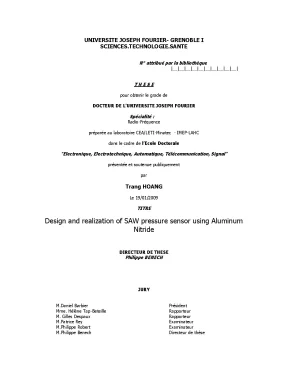
Tải xuống để đọc toàn bộUNIVERSITE JOSEPH FOURIER- GRENOBLE I SCIENCES.SANTE N° attribué par la bibliothèque |__|__|__|__|__|__|__|__|__|__| THESE pour obtenir le grade de DOCTEUR DE L’UNIVERSITE JOSEPH FOURIER Spécialité : Radio-Fréquence préparée au laboratoire CEA/LETI-Minatec - IMEP-LAHC dans le cadre de l’Ecole Doctorale "Electronique, Electrotechnique, Automatique, Télécommunication, Signal" présentée et soutenue publiquement par Trang HOANG Le 19/01/2009 TITRE Design and realization of SAW pressure sensor using Aluminum Nitride DIRECTEUR DE THESE Philippe BENECH JURY M.Daniel Barbier Président Mme. Hélène Tap-Beteille Rapporteur M. Gilles Despaux Rapporteur M.Patrice Rey Examinateur M.Philippe Robert Examinateur M.Philippe Benech Directeur de thèse Abstract Résumé L'objectif de cette thèse est la conception d'un capteur de pression à ondes de surface utilisant le nitrure d'aluminium (AlN). Les études théoriques, la réalisation et la caractérisation du capteur de pression sur différentes structures à ondes de surface sont présentées.
La modélisation du capteur est effectuée en utilisant un circuit équivalent basé sur le modèle de Mason et la méthode des modes couplés. Les paramètres des ondes de surfaces sont obtenus par calcul et analysés pour différentes structures telles que AlN/SiO2/Si, AlN/Si et AlN/Mo/Si. A partir de ces analyses, nous avons montré que la vitesse des ondes ainsi que le facteur de couplage peuvent dépendre du milieu de propagation. Pour chaque type de structure utilisant l'AlN, nous déterminons la plage d'épaisseur de la couche d'AlN pour laquelle la vitesse des ondes et le facteur de couplage présentent une faible dépendance au regard de l'épaisseur d'AlN.
Les dispositifs à ondes de surface doivent être conçus, en particulier pour le choix des épaisseurs de différentes couches, en tenant compte de la précision du procédé de fabrication, afin de réduire les dispersions de caractéristiques des capteurs. En outre, nous avons analysé le comportement mécanique de la membrane en présence d'une pression et nous en avons déduit la sensibilité du capteur. Les effets des variations de température sur une structure à ondes de surface (SAW) sont étudiés. Pour des applications dans le domaine de la mesure de pressions, nous proposons une méthode de réduction des effets des variations de température.
Pour le précédé de fabrication, nous proposons d'utiliser le micro-usinage de surface. Ce type de procédé de fabrication permet d'obtenir exactement les dimensions des membranes utilisées dans les capteurs de pression et il permet aussi de réaliser tout type de géométrie grâce au procédé d'arrêt de gravure du silicium. Les films de nitrure d'aluminium sont caractérisés au cours de la fabrication. Nous avons trouvé que pour améliorer le comportement piézoélectrique de l'AlN, trois voies sont possibles : utiliser une couche de molybdène sous l'AlN, réduire la rugosité de la couche se trouvant sous l'AlN jusqu'à 0,2 nm et augmenter l'épaisseur de l'AlN.
Les pertes acoustiques de propagation, le facteur de couplage, l'effet d'une couche de Mo et l'effet du film mince de polyimide sur la fréquence centrale sont analysés expérimentalement. En conclusion, la sensibilité de pression mesurée de notre dispositif est présentée. Ce dernier résultat est très prometteur. Mots clés : ondes acoustique de surface, Nitrure d'Aluminium (AlN), micro-usinage de surface, capteur de pression Abstract The goal of this thesis is the design of a surface acoustic wave (SAW) pressure sensor using Aluminium Nitride (AlN).
Theoretical studies, realization, and characterization of the pressure sensor on different SAW structures are presented. The modeling of the sensor was performed using an equivalent circuit based on Mason model and Coupling-Of-Mode. The theoretical study, SAW parameters in different structures of AlN/SiO2/Si, AlN/Si, and AlN/Mo/Si are calculated and analyzed. From these analysis, the wave velocity as well as coupling factor could depend on the wave propagation medium.
For each structure using AlN, we establish the range of thickness of AlN layer, in which there is a weak dependence of the wave velocity and coupling factor on the AlN layer thickness. The SAW devices should be designed, in particular for the choice of the thicknesses of the different layers, by taking into account the accuracy of the manufacturing process, to reduce dispersion effects on the sensors characteristics. Besides, we also performed the mechanical analysis of the membrane under pressure and we have deduced the pressure sensitivity. The effect of frequency variation due to temperature change in SAW device using AlN is given.
For pressure measurement applications, we propose a method to reduce temperature change effects. Concerning the fabrication process, we propose to use surface micro-machining. This kind of fabrication process allows to obtain exactly the dimensions of membranes used in pressure sensors and it also allows to have any kind of geometry due to the silicon etch stop wall. Characterizations of AlN film are done during fabrication process.
We found that to increase the piezoelectric behavior of AlN, there are three possible ways: using a bottom Mo layer, decreasing the roughness of the layer below the AlN layer up to 0.2nm and increasing the thickness of AlN. Acoustic propagation losses, coupling factor, effect of Mo layer and the effect of thin polyimide film on the center frequency are experimentally analyzed. Finally, the measured pressure sensitivity of our device is presented. This last result is promising.
Key words: surface acoustic wave (SAW), Aluminium Nitride (AlN), surface micro-machining; pressure sensor. Table of content Table of content Introduction. 1 UNIVERSITE JOSEPH FOURIER- GRENOBLE I.1 Acoustic wave devices.1 Thickness Shear Mode (TSM) resonator.2 Surface Acoustic Wave Device.1 SAW excitation and detection.2 SAW perturbation mechanisms.3 Acoustic Plate Mode (APM) devices .4 Flexural Plate Wave (FPW) or Lamb wave device .5 Comparation between four sensors .6 SAW sensor and the application pressure sensor in this research .1 SAW pressure sensor with one port IDT.2 SAW pressure sensor with two ports IDT. Aluminum Nitride (AlN) and its applications in SAW devices.1 Piezoelectric materials and the choice of AlN.2 General Information of AlN .3 Modelling SAW devices .1 Why Equivalent Circuit model is chosen? .2 The Finite Element Model (FEM).4 Micromachining process, the choice of surface micromachining.27 Chapter 2 SAW PARAMETERS ANALYSIS AND EQUIVALENT CIRCUIT OF SAW DELAY LINE.2 Calculation of SAW properties .1 Wave velocity, coupling factor in AlN/Si structure .2 Wave velocity, coupling factor in AlN/SiO2/Si structure.3 Wave velocity, coupling factor in AlN/Mo/Si structure.3 Equivalent circuit for SAW delay line based on Mason model .1 Equivalent circuit for IDT including N periodic sections .2 Equivalent circuit for propagation path.3 Equivalent circuit for SAW delay line .4 Equivalent Circuit for IDT Based On The Coupling-Of-Mode Theory.1 COM equation for particle velocities .2 Equivalent circuit for IDT based on com theory .3 Equivalent circuit for propagation path based on com theory .4 Equivalent circuit for SAW delay line based on COM theory .5 Comparison of Equivalent circuit of SAW device based on Mason model and COM thoery .52 Chapter 3 DESIGN OF SAW PRESSURE SENSOR DEVICES.2 Temperature compensated structure for SAW device .1 Temperature dependence of Si, SiO2, AlN properties .2 Temperature Coefficient of Frequency (TCF) and temperature compensated structure for SAW sensor 56 3.3 Pressure dependence of frequency and phase in saw delay line .1 Mechanical analysis of membrane under pressure .2 Pressure-dependence of frequency by pressure dependence of AlN elastic properties .3 Pressure-dependence of frequency by delay line .4 Pressure-dependence of phase shift.74 i Table of content Chapter 4 FABRICATION PROCESS.1 Trench, counter masque, hole, and PSG layers .2 Metal AlCu and polyimide layers .3 Creating the stop wall of etching SiO2- Trench .4 Non-selective epitaxy .5 COUNTER MASK lithography, etching Si and CMP process.7 HF Etching of the sacrificial layer .9 Depositing AlN as the piezoelectric layer and its properties .1 Influence of substrate roughness on crytal quality of AlN .2 Dependence of FWHM of AlN on AlN thickness.3 Dependence of FWHM of AlN on using bottom MO layer.4 AlN at high temperature.10 Metal layer AlCu for IDT and probes .11 Polyimide as absorber .101 Chapter 5 CHARACTERIZATION OF SAW DEVICE .1 The Square Resistance: Van Der Pauw.2 Isolation and continuity.3 Measuring under etching .4 Mask for parametric test.1 Propagation losses measurement.2 Piezoelectric coupling factor extraction .3 Comparison between experiment and simulation.4 Effect of Mo layer on performance of AlN/Si SAW device .5 Effect of thin Polyimide film.6 Device under pressure .128 CONCLUSION and PERSPECTIVE.
151 List of publication paper. 155 Appendix A Properties of Si, SiO2, AlN and Mo .137 Appendix B Development of calculation for equivalent circuit of SAW device.139 Appendix C Equipments used to control each fabrication step and to characterise device. 2 SCANNING ELECTRON MICROSCOPE (SEM). 3 VEECO PROFILING SYSTEM.
4 ATOMIC FORCE MICROGRAPH (AFM). 5 X-RAY DIFFRACTION (XRD) SYSTEM. 6 SURFACE PROFILER TENCOR P-11. 7 FLEXUS F2320 DUAL WAVELENGTH STRESS MEASUREMENT SYSTEM.
185 ii List of tables List of Tables Table 1.1 QUALITATIVE CHARACTERISTICS OF THE FOUR SENSOR FAMILIES DISCUSSED .2 ADVANTAGES AND DISADVANTAGES OF SOME PIEZOELECTRIC MATERIALS COMMON USED IN SAW DEVICES .3 COMPARISON BETWEEN BULK AND SURFACE MICROMACHINING TECHNOLOGIES.1 TEMPERATURE DEPENDENCE OF SI, SIO2 AND ALN PROPERTIES .2 TEMPERATURE DEPENDENCE OF C12 AND C13 OF ALN .3 VALUES OF TCFS IN SAW DEVICES AT DIFFERENT TEMPERATURE (0C) .4 THE PRESSURE DEPENDENCE OF ALN ELASTIC CONSTANTS .5 VALUES OF PCFS IN ALN/SIO2(KHSIO2= 0.1571)/SI SAW DEVICES AT DIFFERENT PRESSURE (BAR) .6 APE COEFFICIENT IN SAW DEVICE ALN/SIO2 (KHSIO2=0.7 THE VALUE OF COEFFICIENT APL .8 COMPARISON BETWEEN THE PRESSURE DEPENDENCE OF FREQUENCY SHIFT, PRESSURE DEPENDENCE OF ELASTIC CONSTANT AND EFFECT OF PRESSURE ON DELAY LINE IN SAW DEVICE (WAVELENGTH: 8μm).2 THE DIMENSION OF DEVICES.3 MEASURED VALUES OF TRAPEZOID GROOVE, A AND B .4 FABRICATION STEPS TO TEST SELECTIVE EPITAXY .5 SPEED OF ETCHING SACRIFICIAL LAYER SIO2 BY WET HF 49% AND VAPOR HF ON THE WAFER WITHOUT TRENCHES ETCHED .6 SPEED OF ETCHING SACRIFICIAL LAYER SIO2 BY WET HF 49% ON THE WAFER WITH TRENCHES ETCHED.7 PARAMETERS USED FOR DEPOSITION OF ALN.8 STEPS TO CHARACTERISE ALN IN HIGH TEMPERATURE, FOUR SAPMPLES .9 SOLUTION PROPERTIES OF PI-2610 .1 DESCRIPTION OF MASK 1 FOR PARAMETRIC TESTS: SQUARE RESISTANCE, ISOLATION, CONTINUITY, UNDER ETCHING .2 THE VALUE OF THE FINGER WIDTH IN MASK 1, MASK 2 (Figure 5.3 COMPARISON OF MEASUREMENTS OF SAW FILTERS D5.4 COMPARISON BETWEEN CENTER FREQUENCIES OF DEVICES WITH DIFFERENT LENGTHS OF POLYIMIDE .5 EFFECT OF DIFFERENT THICKNESSES OF POLYIMIDE ON CENTER FREQUENCY. 1 ELASTIC CONSTANT OF Si, SiO2, AlN AND Mo. 2 PIEZOELECTRIC CONSTANT OF AlN. 3 DIELECTRIC CONSTANTS OF Si, SiO2.
4 DIELECTRIC CONSTANTS OF AlN. 5 MASS DENSITY OF Si, SiO2, AlN AND Mo. 1 FWHM MEASUREMENT CONDITIONS .162 iii List of figures List of Figures Figure 1.1 Schematic sketches of the four types acoustic sensors (a) the Thickness Shear Mode (TSM) resonator, (b) the Surface Acoustic Wave (SAW) device, (c) the Acoustic Plate Mode (APM) device, (d) the Flexural Plate Wave (FPW) or Lamb wave device.2 The thickness shear mode resonator .3 Rayleigh waves move vertically in a direction normal to the surface plane of a surface acoustic wave (SAW) sensor. SAW waves are very sensitive to surface changes, but do not work well for most liquid sensing applications.4 The wave energy is confined to within one wavelength from the surface of a SAW sensor.
This characteristic yields a sensor that is very sensitive to interactions with the surface .5 SAW with IDT excitation and detection.6 In the shear-horizontal acoustic plate mode (SH-APM) sensor, the waves travel between the top and bottom surfaces of the plate, allowing sensing on either side.7 Schematic of a flexural plate wave device. The side view shows the different layers and membrane movement. Interdigital electrodes are used for actuation .8 Side views and cross sections of four devices .9 Environmental influences to the SAW sensors.10 SAW wireless pressure sensor with one broadband reflective delay line .11 SAW pressure sensor, one IDT and with external sensor circuit Z .12 General structure of a SAW pressure sensor with two IDTs .13 Hexagonal SAW device.2 Calculated values of wave velocity V0 and Vs in SAW device AlN/Si substrate depend on the normalized thickness khAlN of AlN layer .
Nội dung được bảo vệ bản quyền — Tải xuống đầy đủ
Trích dẫn luận án này
Trang Hoang (2009). Cảm biến áp suất SAW dùng Nitrure Nhôm (AlN): Thiết kế, chế tạo [Luận án tiến sĩ, Université Joseph Fourier]. LuanAn.net. https://luanan.net/ky-thuat-dien-dien-tu/ky-thuat-dien-tu/thiet-ke-che-tao-cam-bien-ap-suat-saw-dung-nitrure-nhom-aln
Câu hỏi thường gặp
Luận án "Cảm biến áp suất SAW dùng Nitrure Nhôm (AlN): Thiết kế, chế tạo" nghiên cứu về vấn đề gì?
Luận án tiến sĩ thiết kế & chế tạo cảm biến áp suất lưỡi cưa dùng nhôm nitrua (AlN). Khám phá công nghệ vật liệu tiên tiến cho ngành công nghiệp.
Luận án "Cảm biến áp suất SAW dùng Nitrure Nhôm (AlN): Thiết kế, chế tạo" được bảo vệ tại trường nào?
Luận án này được bảo vệ tại Université Joseph Fourier. Năm bảo vệ: 2009.
Luận án "Cảm biến áp suất SAW dùng Nitrure Nhôm (AlN): Thiết kế, chế tạo" thuộc chuyên ngành gì?
Luận án "Cảm biến áp suất SAW dùng Nitrure Nhôm (AlN): Thiết kế, chế tạo" thuộc chuyên ngành Radio-Fréquence. Danh mục: Kỹ Thuật Điện Tử.
Luận án "Cảm biến áp suất SAW dùng Nitrure Nhôm (AlN): Thiết kế, chế tạo" có bao nhiêu trang?
Luận án "Cảm biến áp suất SAW dùng Nitrure Nhôm (AlN): Thiết kế, chế tạo" có 174 trang. Bạn có thể xem trước một phần tài liệu ngay trên trang web trước khi tải về.
Cách tải luận án "Cảm biến áp suất SAW dùng Nitrure Nhôm (AlN): Thiết kế, chế tạo" về máy như thế nào?
Để tải luận án về máy, bạn nhấn nút "Tải xuống ngay" trên trang này, sau đó hoàn tất thanh toán phí lưu trữ. File sẽ được tải xuống ngay sau khi thanh toán thành công. Hỗ trợ qua Zalo: 0559 297 239.