Luận án Hành vi Tổ chức 2019: Điều kiện thuận lợi và kết quả phối hợp của đội nhóm động
Luận án Hành vi Tổ chức 2019: Phân tích sâu về đội nhóm động, động lực, hiệu suất và chiến lược làm việc hiệu quả.
Carnegie Mellon University
Organizational Behavior & Theory
Luan An
Luận án tiến sĩ
Năm xuất bản
Số trang
114
Thời gian đọc
18 phút
Lượt xem
0
Lượt tải
0
Phí lưu trữ
40 Point
Tổng quan nhanh
- Chủ đề:
- Đội nhóm động: Thách thức & Điều kiện hiệu suất nhóm
- Số trang:
- 114 trang
- Trường:
- Carnegie Mellon University
- Chuyên ngành:
- Organizational Behavior & Theory
- Tác giả:
- Anna T. Mayo
- Năm:
- 2019
Tóm tắt nội dung luận án
I.Đội nhóm động Thách thức Điều kiện hiệu suất nhóm
Cấu trúc tổ chức ngày càng năng động. Ranh giới nhóm ngày càng linh hoạt. Ví dụ điển hình là các Đội nhóm động. Các nhóm này có thời gian tồn tại ngắn. Ranh giới thành viên dễ thay đổi. Điều này hứa hẹn sự linh hoạt và khả năng thích ứng cao. Tuy nhiên, nó cũng làm suy yếu các đặc điểm truyền thống của nhóm. Các đặc điểm này từng được coi là yếu tố cốt lõi cho sự điều phối. Do đó, Đội nhóm động phải đối mặt với nhiều thách thức điều phối nghiêm trọng. Việc hiểu rõ các điều kiện để chúng hoạt động hiệu quả là rất quan trọng. Nghiên cứu này đặt câu hỏi: "Các điều kiện nào cần thiết để Đội nhóm động hoạt động hiệu quả?" Các quan sát định tính và tài liệu hiện có được sử dụng để phát triển lý thuyết. Sau đó, hai biện pháp can thiệp được kiểm tra trong một thử nghiệm thực địa. Các biện pháp này tập trung vào việc tạo ra các điều kiện cần thiết. Nghiên cứu cũng xem xét tác động của chúng đối với học tập cá nhân và hiệu suất nhóm.
1.1. Bản chất Đội nhóm động hiện đại Định nghĩa và thách thức
Đội nhóm động có vòng đời ngắn. Ranh giới nhóm dễ thay đổi. Đây là xu hướng phổ biến trong Hành vi tổ chức hiện nay. Điều kiện này mang lại lợi ích về sự thích nghi. Tuy nhiên, nó làm mất đi sự ổn định. Sự ổn định từng là yếu tố quan trọng cho sự gắn kết nhóm. Các nhóm truyền thống có cấu trúc rõ ràng. Đội nhóm động thiếu cấu trúc đó. Điều này tạo ra thách thách lớn trong quản lý nhóm. Cần có cách tiếp cận mới để phát triển nhóm.
1.2. Thách thức điều phối trong các nhóm năng động
Các nhóm năng động khó đạt được sự điều phối hiệu quả. Việc thiếu sự ổn định gây ra rào cản. Thành viên mới liên tục gia nhập hoặc rời đi. Điều này làm gián đoạn dòng chảy thông tin. Việc thiết lập vai trò và trách nhiệm cũng khó khăn hơn. Điều này ảnh hưởng đến động lực làm việc. Để duy trì hiệu suất làm việc nhóm, cần có chiến lược rõ ràng. Các tổ chức phải tìm cách hỗ trợ các mô hình đội ngũ này.
1.3. Nhu cầu nghiên cứu về Đội nhóm động hiệu quả
Sự hiểu biết về Đội nhóm động còn hạn chế. Nghiên cứu tập trung vào các điều kiện thành công. Cần xác định các yếu tố giúp nhóm đạt hiệu suất cao. Điều này bao gồm việc khám phá các biện pháp can thiệp. Các biện pháp này giúp cải thiện sự điều phối. Mục tiêu là thúc đẩy cả học tập cá nhân và hiệu suất nhóm. Kết quả nghiên cứu có ý nghĩa lớn cho lý thuyết và thực tiễn quản lý. Nó định hình cách các tổ chức quản lý nhóm linh hoạt.
II.Khởi động nhóm Nền tảng điều phối Hành vi tổ chức
Khởi động nhóm đóng vai trò quan trọng. Chúng có thể phục vụ như "giàn giáo nhận thức". Giàn giáo này neo giữ sự chú ý của các thành viên cốt lõi. Sự chú ý có thể hướng tới thành viên cốt lõi khác hoặc thành viên ngoại vi. Khi chú ý ban đầu tập trung vào thành viên cốt lõi, sự phụ thuộc lẫn nhau có thể tăng cường. Điều này cũng làm rõ vai trò của từng người. Ngược lại, việc chú ý đến thành viên ngoại vi giúp họ hòa nhập. Họ được tích hợp tốt hơn vào công việc nhóm. Dù Đội nhóm động thiếu cấu trúc ổn định. Chúng vẫn có thể dựa vào giàn giáo nhận thức. Giàn giáo này hỗ trợ điều phối. Nghiên cứu này tập trung vào các biện pháp can thiệp cụ thể. Chúng được thiết kế để cải thiện sự điều phối trong Hành vi tổ chức. Việc khởi động nhóm hiệu quả là chìa khóa.
2.1. Vai trò của việc khởi động nhóm trong Hành vi tổ chức
Khởi động nhóm định hình kỳ vọng ban đầu. Chúng cung cấp cấu trúc cho Đội nhóm động. Cấu trúc này ban đầu có thể thiếu. Hoạt động khởi động giúp thành viên hiểu rõ mục tiêu. Chúng cũng xác định vai trò. Điều này thiết lập nền tảng cho sự điều phối. Khởi động nhóm là cơ hội để thiết lập văn hóa doanh nghiệp. Nó khuyến khích sự tương tác ngay từ đầu. Điều này quan trọng cho sự gắn kết nhóm.
2.2. Xây dựng sự tập trung ban đầu cho thành viên cốt lõi
Khởi động nhóm tập trung vào thành viên cốt lõi. Điều này tăng cường sự phụ thuộc lẫn nhau. Sự làm rõ vai trò thúc đẩy tính chủ động. Các thành viên cốt lõi thiết lập nền tảng. Họ là xương sống của Đội nhóm động. Việc hiểu rõ nhau từ đầu giúp giảm thiểu xung đột. Nó cải thiện hiệu suất làm việc nhóm. Lãnh đạo nhóm cần đảm bảo quá trình này diễn ra hiệu quả.
2.3. Mở rộng sự chú ý đến thành viên ngoại vi
Khởi động nhóm không chỉ dành cho thành viên cốt lõi. Việc chú ý đến thành viên ngoại vi rất quan trọng. Nó giúp họ hòa nhập nhanh chóng. Điều này mở rộng định nghĩa về nhóm. Tất cả thành viên cảm thấy được bao gồm. Sự tích hợp này cải thiện khả năng điều phối tổng thể. Nó cũng thúc đẩy động lực làm việc. Điều này rất cần thiết cho mô hình đội ngũ năng động.
III.Học tập Hiệu suất làm việc nhóm trong Đội nhóm động
Nghiên cứu này chỉ ra điều bất ngờ. Học tập cá nhân và hiệu quả nhóm không phải là sự đánh đổi. Thực tế, học tập cá nhân thúc đẩy hiệu suất nhóm. Sự kết hợp của hai hành vi điều phối giúp tăng cường học tập. Các thành viên cốt lõi học hỏi nhiều hơn. Điều này xảy ra khi có sự chú ý đồng thời. Cụ thể, chú ý đến thành viên cốt lõi và ngoại vi. Điều này mâu thuẫn với niềm tin phổ biến. Niềm tin đó cho rằng phải cân bằng giữa học tập và hiệu quả. Kết quả nghiên cứu cung cấp bằng chứng mới. Hiệu suất làm việc nhóm được nâng cao. Điều này nhờ vào sự phát triển của cá nhân. Việc hiểu mối liên hệ này quan trọng cho Hành vi tổ chức. Nó định hình cách chúng ta quản lý nhóm và phát triển nhóm.
3.1. Mối liên hệ giữa học tập cá nhân và Hiệu suất làm việc nhóm
Học tập cá nhân là yếu tố then chốt. Nó đóng góp trực tiếp vào Hiệu suất làm việc nhóm. Khi cá nhân học hỏi, họ mang kiến thức mới vào nhóm. Kiến thức này cải thiện quy trình làm việc. Nó cũng nâng cao chất lượng quyết định. Điều này tạo ra một vòng lặp tích cực. Nhóm trở nên hiệu quả hơn. Tổ chức cần đầu tư vào phát triển cá nhân.
3.2. Cải thiện học tập thông qua hành vi điều phối
Các hành vi điều phối tốt thúc đẩy học tập. Ví dụ, việc làm rõ vai trò giúp cá nhân hiểu rõ hơn. Chú ý đến thành viên ngoại vi mở rộng góc nhìn. Điều này tạo ra môi trường học tập phong phú. Thành viên nhóm học hỏi lẫn nhau. Họ cũng học từ các tương tác. Điều này đặc biệt có giá trị trong Đội nhóm động.
3.3. Tối ưu hóa hiệu quả nhóm Không có sự đánh đổi
Nhiều người tin rằng học tập và hiệu quả là đối lập. Nghiên cứu này bác bỏ quan điểm đó. Học tập cá nhân thực sự là yếu tố hỗ trợ. Nó không phải là rào cản cho hiệu quả. Bằng cách khuyến khích học tập, nhóm tăng cường năng suất. Điều này dẫn đến Hiệu suất làm việc nhóm cao hơn. Quản lý nhóm nên ưu tiên cả hai yếu tố này.
IV.Quản lý nhóm hiệu quả Ứng dụng mô hình Đội nhóm động
Kết quả nghiên cứu có ý nghĩa lớn. Chúng định hình lại lý thuyết và nghiên cứu. Đặc biệt liên quan đến khởi đầu nhóm. Chúng ảnh hưởng đến thiết kế tổ chức. Khái niệm về giàn giáo nhận thức cũng được làm rõ. Học tập cá nhân và quản lý Đội nhóm động cũng là trọng tâm. Nghiên cứu khuyến nghị các nhà quản lý. Họ cần áp dụng các chiến lược đặc biệt. Chiến lược này giúp thúc đẩy sự điều phối. Nó cũng tăng cường hiệu suất trong các nhóm linh hoạt. Hiểu rõ các yếu tố hỗ trợ là cần thiết. Điều này giúp xây dựng mô hình đội ngũ bền vững. Nó cũng góp phần vào văn hóa doanh nghiệp tích cực.
4.1. Thiết kế tổ chức Cơ cấu hỗ trợ nhóm linh hoạt
Tổ chức cần thiết kế cấu trúc linh hoạt. Cấu trúc này hỗ trợ Đội nhóm động. Giàn giáo nhận thức là một ví dụ. Nó giúp định hướng sự chú ý. Điều này tạo điều kiện cho điều phối. Các quy trình làm việc cần được thiết kế mềm dẻo. Điều này phù hợp với ranh giới nhóm thay đổi. Nó đảm bảo hiệu suất làm việc nhóm.
4.2. Lãnh đạo nhóm Hướng dẫn gắn kết và phát triển nhóm
Lãnh đạo nhóm đóng vai trò quan trọng. Họ cần tạo điều kiện cho sự gắn kết nhóm. Đặc biệt trong môi trường năng động. Việc khởi động nhóm hiệu quả là trách nhiệm của lãnh đạo. Họ cần hướng sự chú ý của thành viên. Điều này thúc đẩy sự phát triển nhóm. Lãnh đạo cũng khuyến khích động lực làm việc. Điều này giúp nhóm vượt qua thách thức.
4.3. Phát triển nhóm bền vững trong văn hóa doanh nghiệp
Để Đội nhóm động thành công. Cần xây dựng một văn hóa doanh nghiệp hỗ trợ. Văn hóa này phải khuyến khích học tập liên tục. Nó cũng thúc đẩy sự hợp tác. Các cơ chế phản hồi cần được thiết lập. Điều này giúp nhóm điều chỉnh nhanh chóng. Phát triển nhóm không chỉ là hoạt động một lần. Nó là quá trình liên tục. Điều này đảm bảo hiệu suất làm việc nhóm lâu dài.
Mục lục chi tiết luận án
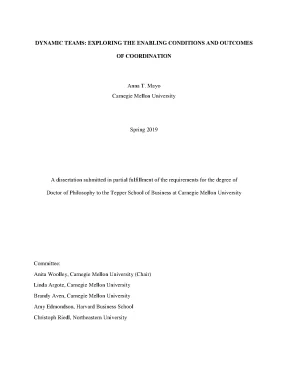
Tải xuống file đầy đủ để xem toàn bộ nội dung
Tải đầy đủ (114 trang)Trích đoạn nội dung luận án
Tải xuống để đọc toàn bộDYNAMIC TEAMS: EXPLORING THE ENABLING CONDITIONS AND OUTCOMES OF COORDINATION Anna T. Mayo Carnegie Mellon University Spring 2019 A dissertation submitted in partial fulfillment of the requirements for the degree of Doctor of Philosophy to the Tepper School of Business at Carnegie Mellon University Committee: Anita Woolley, Carnegie Mellon University (Chair) Linda Argote, Carnegie Mellon University Brandy Aven, Carnegie Mellon University Amy Edmondson, Harvard Business School Christoph Riedl, Northeastern University TABLE OF CONTENTS Acknowledgements. iii Chapter 1: Introduction. 1 Chapter 2: Team Launches and Initial Attention: Enabling Coordination in Dynamic Teams.
5 Chapter 3: Attentional Scaffolds and Anchors in Dynamic Teams: Using Team Launches to Improve Coordination, Individual Learning, and Team Efficiency. 45 Chapter 4: General Discussion. 107 i ACKNOWLEDGEMENTS I would like to thank the healthcare providers who volunteered their time and energy to participate in this research. Without them this work would not have been possible.
Additional thanks to my advisor and dissertation chair, Anita Woolley, who offered support, guidance, and encouragement throughout my doctoral studies. Her insights and input helped this dissertation come to fruition, and I cannot thank her enough for the training she has given me. I would also like to thank my committee members, Linda Argote, Brandy Aven, Amy Edmondson, and Christoph Riedl, who offered helpful feedback on this work, and whose own research has profoundly shaped my own. Thank you to Selma Witchel, Andrew Nowalk, Christine March, and Liny John, who introduced me to the important and complex world of healthcare delivery.
Their partnership has been invaluable. Thank you also to the Organizational Behavior & Theory faculty and students at the Tepper School of Business who offered comments on the many iterations of this work. Thank you to the dear friends I’ve met through research, especially Matt Cronin, Jerry Guo, Leah Clark, Zhe Zhang, Esther Sackett, and Ninja Janardhanan for their constant support. And finally, thank you to my parents, Patricia and John Mayo, my siblings, Jessie and Kirby Mayo, and my partner, Sophie Choukas-Bradley.
I would never have thought this endeavor possible if not for their unwavering support and the love of learning they inspire in me. ii ABSTRACT Organizational structures are increasingly dynamic, boundaryless, and fluid. One example of this trend is the use of highly dynamic teams—teams with short lifespans and permeable team boundaries. These conditions can offer the promise of flexible, adaptive work, but simultaneously undercut the characteristics of teams that were considered definitional in the past and are thought to be critical for facilitating coordination.
Dynamic teams thus should face serious coordination challenges, and we are just beginning to understand the conditions needed for them to be effective. I begin by asking “What are the conditions necessary for dynamic teams to operate effectively?” and derive theory from qualitative observations coupled with existing literature. I then test two interventions focused on putting some of those conditions in place in a field experiment, and I examine their implications for both individual learning and team effectiveness. The emergent grounded theory and field experiment results suggest that team launches, conducted only with a dynamic team’s core team members, can serve as cognitive scaffolds to anchor core team members’ attention either towards core team members or periphery team members.
While initial attention to fellow core members and the clarification of roles can promote more emergent interdependence among those core members, initial attention to periphery members and expansion of the definition of the team can promote more integration of those periphery members into the work. That is, while dynamic teams lack the structure afforded by stability and an impermeable boundary, they can still rely on cognitive scaffolding to enable coordination. Finally, the combination of these two coordination behaviors, together, is what enhances core team members’ learning; and, counter to beliefs that individual learning and team efficiency present a tradeoff to be balanced, individual learning is shown to facilitate team efficiency. I conclude by discussing implications of these findings for theory and research related to team beginnings, organizational design and scaffolds, learning, and the management of dynamic teams.
iii CHAPTER 1: INTRODUCTION It’s Monday morning. You have been assigned to work this week as a medical intern on the “blue” team in the Kids’ Hospital General Pediatric Inpatient Unit. Your team is tasked with making and executing decisions about patient care for a set of patients – it has both the authority to do this and the expectation that it will. You receive a message stating that you should meet your team at 9am at a patient’s room.
When you get there, you note that you’ve never worked with the other blue team members. Your supervising physician is worried about the first patient you are planning to see and before you know it your team is heading to the patient’s room. As you are walking in, you realize you aren’t sure who is going to input the medical orders that your team decides on as you discuss what to do for this patient – should you be doing that? Last week the senior resident input orders, but this senior resident is busy talking with the patient family. Just as your team decides on a care plan and leaves the patient’s room, the patient’s nurse sees you and asks why no one called him, then he shares information he heard from the consulting Infectious Disease group that leads to completely revising the care plan.
This scenario above is based on observations of medical inpatient teams, and it highlights some realities of much work today—realities that stems from a broader shift to organizing work in forms that are increasingly more dynamic and decentralized (Malone, 2004; Powell, 1987). In particular, the scenario highlights how the shift toward dynamic organizations has come with a common distribution of authority to teams (Moreland & Argote, 2003; Thomas-Hunt & Phillips, 2003), with often constantly membership. More specifically, teams are often temporary in nature (e., Klein, Ziegert, Knight, & Xiao, 2006; Valentine & Edmondson, 2015) and face permeable boundaries (Cummings & Pletcher, 2011; Mortensen & Haas, 2018). These two dimensions— short lifespans and highly permeable boundaries—are definition to what I refer to as dynamic teams.1 for a visual display of how dynamic teams relate to other team forms and phenomena.) As discussed more fully in Chapter 2, dynamic teams often exhibit a core-periphery network structure, whereby the team’s core members (those more central to the work and decision making, Humphrey, Morgeson, & Mannor, 2009) work together for a brief amount of 1 time, and during that time must manage a permeable boundary that allows for more periphery members to join the work as their expertise is needed.
Researchers are increasingly acknowledging the existence of dynamic teams in contexts ranging from healthcare to consulting, product development, and disaster response (Arrow, McGrath, & Berdahl, 2000; Edmondson, 2012; Edmondson & Harvey, 2018; Hackman & Wageman, 2005; Majchrzak, Jarvenpaa, & Hollingshead, 2007; Mathieu, Maynard, Rapp, & Gilson, 2008; Mortensen & Haas, 2018). This trend toward increasingly fluid collaborations can offer more adaptive, flexible work that can meet the demands of a changing environment (Mortensen & Haas, 2018). Yet, the conditions of an extremely short lifespan and a highly permeable boundary undercut the characteristics of teams that were considered definitional in the past and are thought to be critical for facilitating coordination. As hinted at in the opening scenario, the short lifespans of teams can create uncertainty about how to work with teammates, while boundary permeability can create uncertainty about with whom to work.
And both of these challenges are likely to undermine emergent coordination (Mortensen & Haas, 2018; Okhuysen & Bechky, 2009). In other words, while team stability and boundary impermeability have been acknowledged as providing structure that can guide attention and facilitate coordination (e., Hackman, 2011), their absence is likely to inhibit coordination. Current research on overcoming the challenges inherent to dynamic teams suggests that temporary teams can rely on impermeable boundaries to guide work (e., Valentine & Edmondson, 2015), while teams with permeable boundaries can rely on some membership stability among core team members (e., O’Leary, Mortensen, & Woolley, 2011). But neither of those solutions will work for dynamic teams as they are both temporary and have permeable boundaries.
Moreover, research suggests that current theories may need to be adapted in such 2 dynamic contexts (Majchrzak et al. As elaborated on in Chapter 2, this gap in our understanding is a critical one given the prevalence of highly dynamic teams in organizations today. In this dissertation, I, therefore, explore conditions that can enable coordination in dynamic teams. In Chapter 2, I begin by asking “What are the conditions necessary for dynamic teams to coordinate effectively?” Using qualitative observations and interviews in the setting of medical inpatient teams, coupled with existing literature, I derive grounded theory of conditions that enable dynamic teams to coordinate.
Given the fluid nature of membership in these teams, I adopt a hybrid team-network perspective to identify the team in terms of core and periphery members. I find that key to effective coordination is a team launch conducted with only the core team members and that directs their initial attention in ways that develop team cognition and thereby enable emergent coordination. Findings also point to potential benefits of this emergent coordination: both individual learning and team efficiency. In sum, these findings suggest that, although dynamic teams lack the structure afforded by stability and an impermeable boundary, they can rely on attentional scaffolding to enable effective coordination.
In Chapter 3 (work conducted with Anita Woolley, Liny John, Christine March, Selma Witchel, and Andrew Nowalk), we build on that qualitative work and use a field experiment to test two interventions focused on putting into place some of the cognitive scaffolding that is theorized to anchor core team members’ attention and thus facilitate coordination in dynamic teams. Continuing in the context of medical inpatient teams, we find support for our prediction that team launches that direct attention to core team members’ roles lead to greater emergent interdependence among those core members. At the same time, we also find support for the prediction that team launches that direct attention to the team’s permeable boundary and expand 3 core members’ view of who is on the team lead to greater integration of periphery members. In this way, we find empirical evidence to support the theory that attentional scaffolds can foster coordination in dynamic teams.
Further, we find that it is the combination of the two coordination behaviors—emergent interdependence and periphery integration, together—that most enhances core members’ learning. Finally, contrary to expectations that individual learning and team efficiency present a trade-off, we find that the two go hand-in-hand. In Chapter 4, I conclude by considering the qualitative study and the field experiment as a whole to offer a general discussion of the resulting developing theory of dynamic team coordination. I also discuss implications of this research for theory related to team beginnings, organizational design and scaffolds, learning, and the management of dynamic teams.
4 CHAPTER 2: TEAM LAUNCHES AND INITIAL ATTENTION: ENABLING COORDINATION IN DYNAMIC TEAMS Organizational structures have evolved dramatically from the centralized forms that became predominant centuries ago (Chandler Jr, 1962; Malone, 2004). While researchers have developed a canon of knowledge around what is needed for these centralized organizations, and the teams within them, to operate effectively (Mathieu, Hollenbeck, Knippenberg, & Ilgen, 2017), organizational structures today reflect a different landscape. In the face of changing environments that demand adaptation, and with the rise of knowledge-based work, specialization, and communication technology that allows for rapidly sharing and gathering information, organizational structures have evolved into “hybrid organizational forms” (Shane, 1996),“boundaryless organizations” (Ashkenas, Ulrich, Jick, & Kerr, 2002) and “dynamic organizations” (e. In short, organizational forms have shifted toward a decentralization of authority (Malone, 2004; Powell, 1987) and less hierarchical organizing (Lee & Edmondson, 2017) that can allow for more flexible, adaptive work.
Nội dung được bảo vệ bản quyền — Tải xuống đầy đủ
Trích dẫn luận án này
Anna T. Mayo (2019). Luận án Hành vi Tổ chức 2019: Đội nhóm động [Luận án tiến sĩ, Carnegie Mellon University]. LuanAn.net. https://luanan.net/quan-tri-kinh-doanh/hieu-ung-to-chuc-luat-moi-2019-mayo-luan-an
Câu hỏi thường gặp
Luận án "Luận án Hành vi Tổ chức 2019: Đội nhóm động" nghiên cứu về vấn đề gì?
Luận án Hành vi Tổ chức 2019: Phân tích sâu về đội nhóm động, động lực, hiệu suất và chiến lược làm việc hiệu quả.
Luận án "Luận án Hành vi Tổ chức 2019: Đội nhóm động" được bảo vệ tại trường nào?
Luận án này được bảo vệ tại Carnegie Mellon University. Năm bảo vệ: 2019.
Luận án "Luận án Hành vi Tổ chức 2019: Đội nhóm động" thuộc chuyên ngành gì?
Luận án "Luận án Hành vi Tổ chức 2019: Đội nhóm động" thuộc chuyên ngành Organizational Behavior & Theory. Danh mục: Quản Trị Kinh Doanh.
Luận án "Luận án Hành vi Tổ chức 2019: Đội nhóm động" có bao nhiêu trang?
Luận án "Luận án Hành vi Tổ chức 2019: Đội nhóm động" có 114 trang. Bạn có thể xem trước một phần tài liệu ngay trên trang web trước khi tải về.
Cách tải luận án "Luận án Hành vi Tổ chức 2019: Đội nhóm động" về máy như thế nào?
Để tải luận án về máy, bạn nhấn nút "Tải xuống ngay" trên trang này, sau đó hoàn tất thanh toán phí lưu trữ. File sẽ được tải xuống ngay sau khi thanh toán thành công. Hỗ trợ qua Zalo: 0559 297 239.