Exploring organizational factors that influence resilience and pe
Khám phá yếu tố tổ chức tác động đến khả năng phục hồi. Nghiên cứu này phân tích các khía cạnh then chốt giúp doanh nghiệp vượt qua khủng hoảng.
California State University, San Bernardino
Luan An
Luận án tiến sĩ
Năm xuất bản
Số trang
203
Thời gian đọc
31 phút
Lượt xem
0
Lượt tải
0
Phí lưu trữ
50 Point
Tổng quan nhanh
- Chủ đề:
- Xây dựng Khả năng Thích ứng Tổ chức Hiệu quả
- Số trang:
- 203 trang
- Trường:
- California State University, San Bernardino
- Chuyên ngành:
- Educational Leadership
- Tác giả:
- Stephen Louis Franklin
- Năm:
- 2017
Tóm tắt nội dung luận án
I.Xây dựng Khả năng Thích ứng Tổ chức Hiệu quả
Khả năng thích ứng là yếu tố sống còn của mọi tổ chức. Nó giúp doanh nghiệp vượt qua thách thức. Nghiên cứu này, dù tập trung vào học sinh, vẫn cung cấp cái nhìn sâu sắc. Các trường học là tổ chức, có thể học hỏi cách thúc đẩy sự kiên cường. Doanh nghiệp phải đối mặt với thị trường biến động. Việc phát triển khả năng thích ứng của tổ chức là cần thiết. Khả năng này đảm bảo sự tồn tại. Nó còn thúc đẩy sự phát triển bền vững. Một tổ chức linh hoạt có thể thay đổi nhanh chóng. Điều này giúp ứng phó với bất kỳ khủng hoảng nào. Điều này cũng củng cố tính linh hoạt trong kinh doanh.
1.1. Khái niệm và tầm quan trọng của khả năng thích ứng.
Khả năng thích ứng của tổ chức không chỉ là phản ứng. Nó là khả năng dự đoán, chuẩn bị và phục hồi. Nghiên cứu chỉ ra sự kiên cường của học sinh. Học sinh đối mặt với nghịch cảnh vẫn kiên trì. Đây là bài học cho doanh nghiệp. Doanh nghiệp cần xây dựng đội ngũ có tinh thần tương tự. Khả năng thích ứng của tổ chức là động lực. Nó giúp duy trì hoạt động trong mọi điều kiện. Một tổ chức kiên cường sẽ đứng vững trước những cú sốc.
1.2. Vai trò của môi trường nội bộ trong khả năng thích ứng.
Môi trường nội bộ quyết định khả năng thích ứng. Nghiên cứu nhấn mạnh khí hậu trường học hỗ trợ. Khí hậu này tạo cảm giác thuộc về cho học sinh. Đối với doanh nghiệp, điều này tương đương với văn hóa doanh nghiệp tích cực. Một môi trường làm việc cởi mở khuyến khích sự đổi mới. Nó hỗ trợ nhân viên đối mặt với áp lực. Điều này trực tiếp củng cố tính linh hoạt trong kinh doanh. Nó giúp tổ chức nhanh chóng điều chỉnh.
II.Văn hóa Doanh nghiệp Kiến tạo Bền vững Phục hồi
Văn hóa doanh nghiệp là nền tảng cho sự kiên cường. Nghiên cứu chỉ ra tầm quan trọng của một khí hậu hỗ trợ. Khí hậu này giúp học sinh phát triển. Đối với doanh nghiệp, văn hóa tích cực là tài sản lớn. Nó thúc đẩy sự gắn kết. Nó cũng tăng cường khả năng phục hồi. Một văn hóa đề cao sự học hỏi, hỗ trợ sẽ giúp tổ chức. Tổ chức sẽ ứng phó tốt hơn với thách thức. Điều này đảm bảo tính bền vững của tổ chức.
2.1. Tầm quan trọng của văn hóa hỗ trợ trong tổ chức.
Văn hóa hỗ trợ tạo ra môi trường an toàn. Môi trường này khuyến khích nhân viên vượt qua khó khăn. Giống như mối quan hệ thầy-trò trong nghiên cứu. Nó tạo điều kiện cho sự phát triển cá nhân. Một văn hóa doanh nghiệp coi trọng sự quan tâm sẽ tăng cường lòng trung thành. Nó cũng củng cố tinh thần tập thể. Điều này rất cần thiết cho phục hồi sau khủng hoảng. Nó giúp tổ chức duy trì sự ổn định.
2.2. Xây dựng môi trường thúc đẩy sự kiên cường nội bộ.
Để thúc đẩy sự kiên cường, cần xây dựng môi trường phù hợp. Nghiên cứu cho thấy tập trung vào thành công chung. Doanh nghiệp cần tạo cơ hội học hỏi. Cần có các chương trình đào tạo kỹ năng đối phó. Việc này nâng cao khả năng của nhân viên. Nó giúp họ thích nghi với thay đổi. Một môi trường tích cực thúc đẩy khả năng thích ứng của tổ chức. Nó biến thách thức thành cơ hội phát triển. Điều này cũng hỗ trợ quản lý sự thay đổi hiệu quả hơn.
III.Lãnh đạo Kiên cường Nền tảng Quản lý Khủng hoảng
Lãnh đạo kiên cường là trụ cột trong mọi tổ chức. Vai trò của họ càng rõ nét trong bối cảnh khó khăn. Nghiên cứu nhấn mạnh ảnh hưởng của thầy cô và cố vấn. Những người này đóng vai trò quan trọng trong sự kiên cường của học sinh. Tương tự, lãnh đạo doanh nghiệp cần thể hiện sự mạnh mẽ. Họ phải truyền cảm hứng cho đội ngũ. Một lãnh đạo kiên cường không chỉ vượt qua khủng hoảng. Họ còn dẫn dắt tổ chức phục hồi sau khủng hoảng. Điều này củng cố niềm tin trong toàn bộ hệ thống.
3.1. Vai trò của lãnh đạo trong môi trường biến động.
Trong thời kỳ bất ổn, lãnh đạo cần thể hiện sự ổn định. Nghiên cứu chỉ ra các mối quan hệ hỗ trợ. Điều này giúp học sinh đối mặt với áp lực. Lãnh đạo cần là nguồn động viên. Họ phải cung cấp hướng dẫn rõ ràng. Điều này là cốt lõi trong quản lý khủng hoảng. Sự rõ ràng từ lãnh đạo giúp giảm bớt lo lắng. Nó cho phép nhân viên tập trung vào công việc. Điều này duy trì tính linh hoạt trong kinh doanh của tổ chức.
3.2. Phát triển năng lực kiên cường cho đội ngũ nhân sự.
Lãnh đạo cần phát triển khả năng kiên cường cho toàn bộ đội ngũ. Nghiên cứu đề xuất các ví dụ về khí hậu hỗ trợ. Lãnh đạo có thể tạo ra các chương trình mentorship. Họ có thể cung cấp tài nguyên đào tạo. Việc này giúp nhân viên phát triển kỹ năng đối phó. Nó cũng tăng cường khả năng phục hồi cá nhân. Đội ngũ kiên cường là yếu tố then chốt. Nó giúp tổ chức duy trì tính bền vững của tổ chức.
IV.Tối ưu Hóa Quản lý Rủi ro Doanh nghiệp Tính Linh hoạt
Quản lý rủi ro doanh nghiệp hiệu quả là cần thiết. Nó giúp tổ chức đối phó với các mối đe dọa. Nghiên cứu chỉ ra trường học như một yếu tố bảo vệ. Điều này tương đương với các biện pháp phòng ngừa trong kinh doanh. Cần nhận diện sớm các yếu tố rủi ro. Cần xây dựng chiến lược ứng phó phù hợp. Tính linh hoạt trong kinh doanh là yếu tố quan trọng. Nó cho phép điều chỉnh kế hoạch nhanh chóng. Điều này giúp giảm thiểu thiệt hại. Nó cũng tăng cường khả năng phục hồi của tổ chức.
4.1. Nhận diện các yếu tố bảo vệ và hỗ trợ.
Mọi tổ chức đều có các yếu tố bảo vệ. Nghiên cứu nêu bật mối quan hệ gia đình và cộng đồng. Đây là nguồn hỗ trợ bên ngoài cho học sinh. Doanh nghiệp cần xác định mạng lưới hỗ trợ tương tự. Nó có thể là đối tác, nhà cung cấp hoặc khách hàng. Các yếu tố nội bộ như quy trình vận hành vững chắc cũng quan trọng. Việc này giúp tổ chức duy trì hoạt động. Nó hỗ trợ phục hồi sau khủng hoảng một cách hiệu quả.
4.2. Kết hợp chiến lược linh hoạt để ứng phó rủi ro.
Khả năng linh hoạt là chìa khóa trong quản lý rủi ro. Nghiên cứu tập trung vào bối cảnh xã hội, kinh tế. Những yếu tố này ảnh hưởng đến học sinh. Doanh nghiệp cần xem xét bối cảnh thị trường rộng lớn. Cần có kế hoạch dự phòng cho nhiều kịch bản. Quản lý rủi ro doanh nghiệp đòi hỏi sự chủ động. Cần liên tục đánh giá và điều chỉnh. Điều này giúp tổ chức duy trì tính linh hoạt trong kinh doanh. Nó đảm bảo khả năng phản ứng nhanh.
V.Chiến lược Kinh doanh Liên tục Chìa khóa Phát triển
Chiến lược kinh doanh liên tục là kế hoạch đảm bảo hoạt động không bị gián đoạn. Nghiên cứu nhấn mạnh sự kiên trì của học sinh để hoàn thành cấp học. Đây là mục tiêu dài hạn. Tương tự, doanh nghiệp cần đảm bảo mục tiêu kinh doanh. Chiến lược này không chỉ đối phó với khủng hoảng. Nó còn là kim chỉ nam cho sự phát triển bền vững. Một kế hoạch kinh doanh liên tục mạnh mẽ giúp duy trì lợi thế cạnh tranh. Nó củng cố tính bền vững của tổ chức.
5.1. Đảm bảo hoạt động không gián đoạn trong mọi tình huống.
Mục tiêu chính của chiến lược này là duy trì vận hành. Ngay cả khi đối mặt với sự cố lớn. Nghiên cứu mô tả sự kiên trì dẫn đến hoàn thành. Doanh nghiệp cần các quy trình dự phòng. Cần có hệ thống khôi phục dữ liệu. Cần đào tạo nhân sự cho tình huống khẩn cấp. Điều này giúp tổ chức phản ứng nhanh chóng. Nó hạn chế tối đa thời gian ngừng hoạt động. Điều này cực kỳ quan trọng cho phục hồi sau khủng hoảng.
5.2. Lợi ích dài hạn của sự bền vững và kiên trì.
Sự kiên trì mang lại thành công lâu dài. Đối với học sinh, đó là hoàn thành trung học. Đối với doanh nghiệp, đó là tăng trưởng liên tục. Một chiến lược kinh doanh liên tục mạnh mẽ xây dựng niềm tin. Niềm tin từ khách hàng, nhà đầu tư. Nó giúp tổ chức vượt qua các chu kỳ kinh tế khó khăn. Điều này khẳng định tính bền vững của tổ chức. Nó tạo ra giá trị lâu dài cho tất cả các bên liên quan.
VI.Thúc đẩy Quản lý Sự Thay Đổi để Phát triển Tổ chức
Quản lý sự thay đổi là yếu tố không thể thiếu. Nó giúp tổ chức thích nghi với môi trường liên tục biến đổi. Nghiên cứu chỉ ra tầm quan trọng của việc phát triển khả năng kiên cường. Khả năng này bao gồm các khía cạnh học thuật, xã hội, cảm xúc. Đối với doanh nghiệp, quản lý sự thay đổi là quá trình chủ động. Nó giúp nhân viên chấp nhận điều mới. Nó đảm bảo sự chuyển đổi suôn sẻ. Điều này tăng cường khả năng thích ứng của tổ chức.
6.1. Hỗ trợ quá trình chuyển đổi và thích nghi liên tục.
Tổ chức cần có cơ chế hỗ trợ nhân viên. Đặc biệt khi đối mặt với thay đổi. Nghiên cứu gợi ý các khí hậu hỗ trợ trong trường học. Doanh nghiệp có thể áp dụng điều này. Cần cung cấp thông tin rõ ràng. Cần lắng nghe phản hồi từ nhân viên. Các chương trình đào tạo kỹ năng mới giúp họ thích nghi. Điều này giảm thiểu sự kháng cự. Nó giúp quá trình quản lý sự thay đổi diễn ra thuận lợi hơn.
6.2. Nâng cao năng lực thích nghi và phát triển cá nhân.
Mục tiêu của quản lý sự thay đổi là nâng cao năng lực thích nghi. Nghiên cứu khuyến nghị phát triển khả năng kiên cường toàn diện. Tổ chức cần đầu tư vào phát triển con người. Cần tạo điều kiện cho nhân viên học hỏi. Cần khuyến khích sự tự chủ. Điều này xây dựng một lực lượng lao động mạnh mẽ. Một đội ngũ linh hoạt sẽ đóng góp vào tính linh hoạt trong kinh doanh. Nó đảm bảo tổ chức luôn sẵn sàng cho tương lai. Điều này cũng củng cố tính bền vững của tổ chức.
Mục lục chi tiết luận án
Tải xuống file đầy đủ để xem toàn bộ nội dung
Tải đầy đủ (203 trang)Trích đoạn nội dung luận án
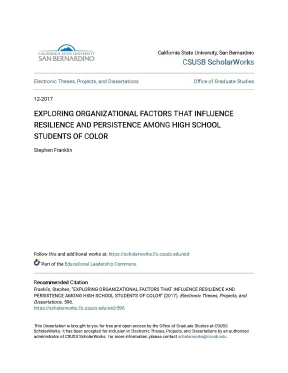
Tải xuống để đọc toàn bộCalifornia State University, San Bernardino CSUSB ScholarWorks Electronic Theses, Projects, and Dissertations Office of Graduate Studies 12-2017 EXPLORING ORGANIZATIONAL FACTORS THAT INFLUENCE RESILIENCE AND PERSISTENCE AMONG HIGH SCHOOL STUDENTS OF COLOR Stephen Franklin Follow this and additional works at: https://scholarworks.edu/etd Part of the Educational Leadership Commons Recommended Citation Franklin, Stephen, "EXPLORING ORGANIZATIONAL FACTORS THAT INFLUENCE RESILIENCE AND PERSISTENCE AMONG HIGH SCHOOL STUDENTS OF COLOR" (2017). Electronic Theses, Projects, and Dissertations.edu/etd/596 This Dissertation is brought to you for free and open access by the Office of Graduate Studies at CSUSB ScholarWorks. It has been accepted for inclusion in Electronic Theses, Projects, and Dissertations by an authorized administrator of CSUSB ScholarWorks. For more information, please contact scholarworks@csusb.
EXPLORING ORGANIZATIONAL FACTORS THAT INFLUENCE RESILIENCE AND PERSISTENCE AMONG HIGH SCHOOL STUDENTS OF COLOR A Dissertation Presented to the Faculty of California State University, San Bernardino In Partial Fulfillment of the Requirements for the Degree Doctor of Education in Educational Leadership by Stephen Louis Franklin December 2017 EXPLORING ORGANIZATIONAL FACTORS THAT INFLUENCE RESILIENCE AND PERSISTENCE IN HIGH SCHOOL STUDENTS OF COLOR A Dissertation Presented to the Faculty of California State University, San Bernardino by Stephen Louis Franklin December 2017 Approved by: Donna Schnorr, Ph., Committee Chair, CSUSB Doris Wilson, Ed., Committee Member, CSUSB Sherri Franklin-Guy, Ph., Committee Member, CSUSB © 2017 Stephen Louis Franklin ABSTRACT This study sought to examine how schools influenced and promoted student resilience through the lens of persistence, leading to high school completion. The focus of this study was significant because there are few studies that focus on student resiliency as it relates to high school completion through the lens of persistence. Previous studies have generally identified at-risk factors for non-high school completion and either qualify or quantify the results. They have not taken into account the social and economic contexts of school and the communities and their influence on student resiliency.
This study utilized a phenomenological methodology that identified the lived experiences of twenty-six 11th - grade students of color at an urban high school in Southern California that manifested resilience and persistence. Semi-structured interviews of participants drawn from a stratified variation sampling were utilized. A CRT framework was applied to examine the role of high school as a protective factor, the interactions of faculty and staff, and the perceptions of participants as it relates to school culture and climate. External factors such as supportive relationships in the familial and community context were also examined and discussed.
The results of this study highlighted school climate that promotes belonging along with a collective focus on the study of student success, the role of teacher-student and counselor relationships as being pivotal to the development of resilience in students of color. The findings from this study provide examples for schools to develop supportive climates that focus on promoting and developing academic, social, and emotional resiliency in students of color with specific next step recommendations. iii ACKNOWLEDGMENTS One cannot possibly take on an endeavor of this magnitude by oneself. There are many people that I would like to acknowledge for their support along the way.
First, I want to thank my sisters Janet and Michelle, through this journey I was not always available, and missed out on a few family events and trips. Second, I would like to thank my cohort at California State University, San Bernardino. My cohort, cohort 8, or as well liked to refer to ourselves, “The Ocho”, bonded in a way I could not imagine and became a second family. Throughout our coursework, and individual efforts to complete our dissertations, “The Ocho” remained strong and always supportive of each other, never competitive.
Third, I would like to thank my family, friends, and co-workers who were supportive during this journey, and kept reminding me this would soon be over, and that it would all be worth it. Their patience, encouragement, and absolute support provided me with the motivation to continue and achieve my goals. Finally, I must express my sincere appreciation to my Dissertation Committee: Dr. Donna Schnorr who served as my Dissertation Chair, Dr.
Doris Wilson, and Dr. Sherri Franklin-Guy for providing guidance with their feedback and expertise. iv DEDICATION I would like to dedicate this dissertation to three amazing women, whom without their support and guidance, this day would not be possible. First, my mother.
My mother always voiced her expectations that all three of her children would have a college education, and pursue happiness. It was my mother who encouraged me to enter the field of education, when at the age of 32, I experienced a “mid-life” crisis. Thank you mom, for pushing into the field that I should have been in all along. Second, my godmother Sissy.
Sissy passed away in March of 2017, so she is not here to see me reach this point. Though not here physically, Sissy walks with me every day. When I was considering pursuing my doctorate, it was Sissy, who gave me the final push and encouragement. Finally, my grandmother.
Her given name was Edna, but we all called her “Mom”. Mom was the quiet force that ensured that education was taken seriously, and that respect for self, ranked with respect for others. It was this triumvirate of Mommy, Sissy, and Mom that ensured, that as a young black male growing up without a father figure that I did not succumb to the streets. Of these three, only my mother is still with me.
Sissy and Mom, however, I am sure are looking down and beaming with pride. v TABLE OF CONTENTS ABSTRACT. iv LIST OF TABLES. x LIST OF FIGURES.
xi CHAPTER ONE: INTRODUCTION Introduction. 4 Significance of the Study. 9 Definitions of Key Terms. 11 CHAPTER TWO: LITERATURE REVIEW Background.
13 Facets of Resilience.16 Academic Resilience and the Four C’s .19 vi Distal and Proximal Risk Factors. 23 School as Protective Factors. 25 Transition to High School. 30 Cultures of Success.
37 The Role of the Counselor and Academic Ethic. 43 CHAPTER THREE: RESEARCH DESIGN AND METHODOLOGY Introduction. 58 Positionality of the Researcher. 63 CHAPTER FOUR: RESULTS Results.
65 vii Family Support and Expressed Academic Expectations. 67 Instability and Community Safety. 79 Perceptions of School and Relationships. 95 Student Experiences with Success and Challenges.
108 High Risk Factors/High Academic Resilience. 117 Social and Emotional Resilience. 119 Academic Supports and Sense of Belonging. 123 CHAPTER FIVE: RECOMMENDATIONS AND CONCLUSIONS Overview .129 Recommendations for Educational Leaders.
134 Next Steps for Educational Reform. 143 Recommendations for Future Research. 156 Limitations of Study .158 viii APPENDIX A: INSTITUTIONAL REVIEW BOARD APPROVAL LETTER.160 APPENDIX B: STUDENT SELECTION CRITERIA. 163 APPENDIX C: HOUSTON INTERVIEW GUIDE 2010.
165 APPENDIX D: HOUSTON LETTER OF CONSENT. 172 APPENDIX E: INTERVIEW PROTOCOL. 178 ix LIST OF TABLES Table 1. Three Waves of Resiliency Inquiry.
High Risk Factors/High Academic Resilience. High Risk Factors/Low Academic Resilience. Low Risk Factors/High Academic Resilience. Low Risk Factors/Low Academic Resilience.
54 x LIST OF FIGURES Figure 1. Engagement Process Model. Actual and Projected Enrollment in Elementary and Secondary School through Fall 2022. Actual and Projected Enrollment in Elementary and Secondary School by Race/Ethnicity through Fall 2022.
Potential Responses to Trauma. Two Concepts of Adaptation. Dimensions of Belonging. 116 xi CHAPTER ONE INTRODUCTION American adolescents are exposed to significant levels of dysfunction and risk on a near daily basis.
The proliferation of violence and secondary traumatization, combined with increases in levels of poverty and societal moral distress, contribute to declines in academic performance and the negative outcomes of stress experienced by American children and adolescents (Condly, 2006). Adolescence is an inherently stressful stage of life, given the myriad associated biological, cognitive and social changes (Conger & Petersen, 1984; Hall, 2007; Licitra-Kleckler & Wass, 1993, Munsch & Wampler, 1993). For high school students of color, living in inner-city or low socioeconomic status (SES) communities, the exposure to risk and victimization is compounded by depleted or minimal resources (Meyers & Taylor, 1998). This suggests that, in addition to navigating all of the changes inherent to this stressful developmental stage, high school students of color must also navigate the unique stressors found in their daily environments.
These high-risk circumstances serve to amplify the increased need for supportive roles of schools as protective factors and as vehicles for promoting resilience through the lens of persistence for high-risk high school students of color. 1 Problem Statement This study aims to address the problem of increased dropout rates and decreased graduation rates experienced by high school students of color, English learners, and the socioeconomically disadvantaged, as compared to other subgroups of high school students (Stark and Noel, 2015). The notion of recovering after an academic setback has often been referred to as academic resilience. Need achievement and self-worth motivation theories posited by (Covington, 1992; Covington & Omelich, 1991; McClelland, 1965) examine student motives to avoid failure and strive for success.
These theories tell us a) why students do what they do; b) how they do it; c) their confidence in being able to do it; d) their ability to surmount obstacles and challenges; and e) their capacity to recover after an academic setback. The role of schools will be examined as it relates to promoting resilience through the lens of persistence among high school students of color. This, in turn, will inform school based practice in terms of supporting students to overcome aversive situations and permits students to surmount academic and personal challenges without catastrophizing or perpetuating the circumstance. Purpose Statement The objective of this study is to examine how schools foster student resilience through the lens of persistence.
Given various societal barriers, the 2 overarching question is, how do schools support students of color to remain resilient through the lens of persistence by remaining in school and academic achievement, ultimately leading to high school completion? A school climate that centers on the study of failure utilizes distorted data to promote negative stereotypes (Harper & Kuykendall, 2012). Pessimism perpetuates an attitude of defeatism, and learned helplessness. Luthar (1991) asserts that when children and even adults, believe they are powerless through learned helplessness, they become passive and restricted in coping abilities. Conversely, a school climate centered on the study of success helps adolescents thrive in a manner that seeks to avoid learned helplessness.
Rather than seeing their students as failing, teacher-student relationships and other personal relationships within the school context exhibit the role of respect and the power of encouragement-support dynamics (Rodriguez, 2007). School climate and school culture are often used interchangeably to address the environment of the school itself. While related, they have two distinct meanings and impact on the actual school environment. Climate is used to describe people’s perceptions of an organization or work unit (school).
On the other hand, culture relates to the assumptions, values and beliefs that define an organization’s identity (Stolp & Smith, 1995; Keefe, Schmitt, Kelley & Miller, 1993). To put it more succinctly, school climate refers mostly to the schools’ effect on students, whereas school culture refers more to how teachers and staff work together. For the development of academic resiliency, a school climate that establishes high expectations for all 3 students must be espoused, along with the supports necessary to live up to high expectations (Bernard, 1993). This combination of expressed expectations along with appropriate supports results in resiliency manifested through persistence of effort.
Research Questions Inductive reasoning will be employed, based on the author’s use of the theoretical framework of critical race theory (CRT), in conjunction with patterns that arise from the data. The research questions that will inform this study are: 1. How do 11th- grade students of color describe the ways in which they persisted by remaining in school, when they encountered various barriers? 2.
Nội dung được bảo vệ bản quyền — Tải xuống đầy đủ
Trích dẫn luận án này
Stephen Louis Franklin (2017). Exploring organizational factors that influence resilience a [Luận án tiến sĩ, California State University, San Bernardino]. LuanAn.net. https://luanan.net/quan-tri-kinh-doanh/exploring-organizational-factors-that-influence-resilience-and-pe
Câu hỏi thường gặp
Luận án "Exploring organizational factors that influence resilience a" nghiên cứu về vấn đề gì?
Khám phá yếu tố tổ chức tác động đến khả năng phục hồi. Nghiên cứu này phân tích các khía cạnh then chốt giúp doanh nghiệp vượt qua khủng hoảng.
Luận án "Exploring organizational factors that influence resilience a" được bảo vệ tại trường nào?
Luận án này được bảo vệ tại California State University, San Bernardino. Năm bảo vệ: 2017.
Luận án "Exploring organizational factors that influence resilience a" thuộc chuyên ngành gì?
Luận án "Exploring organizational factors that influence resilience a" thuộc chuyên ngành Educational Leadership. Danh mục: Quản Trị Kinh Doanh.
Luận án "Exploring organizational factors that influence resilience a" có bao nhiêu trang?
Luận án "Exploring organizational factors that influence resilience a" có 203 trang. Bạn có thể xem trước một phần tài liệu ngay trên trang web trước khi tải về.
Cách tải luận án "Exploring organizational factors that influence resilience a" về máy như thế nào?
Để tải luận án về máy, bạn nhấn nút "Tải xuống ngay" trên trang này, sau đó hoàn tất thanh toán phí lưu trữ. File sẽ được tải xuống ngay sau khi thanh toán thành công. Hỗ trợ qua Zalo: 0559 297 239.