The university of st thomas doctorate in leadership program imp
Chương trình Tiến sĩ Lãnh đạo tại University of St. Thomas: Nâng tầm kỹ năng lãnh đạo, phát triển chiến lược, và tạo ảnh hưởng tích cực.
University of St. Thomas
Leadership / Education
Luan An
Luận án tiến sĩ
Năm xuất bản
Số trang
148
Thời gian đọc
23 phút
Lượt xem
0
Lượt tải
0
Phí lưu trữ
40 Point
Tổng quan nhanh
- Chủ đề:
- Tác động Chương trình Tiến sĩ Lãnh đạo Đại học St. Thomas
- Số trang:
- 148 trang
- Trường:
- University of St. Thomas
- Chuyên ngành:
- Leadership / Education
- Tác giả:
- James A. Sturdevant
- Năm:
- 2012
Tóm tắt nội dung luận án
I. Thomas
Tài liệu "Chương trình Tiến sĩ Lãnh đạo Đại học St. Thomas: Tác động lên Cựu sinh viên" khám phá những ảnh hưởng sâu sắc của chương trình đối với cựu học viên. Nghiên cứu tình huống từ năm 2012 của James A. Sturdevant đào sâu vào nhận thức của các cựu sinh viên. Nó xem xét cách University of St. Thomas doctorate định hình cuộc sống và sự nghiệp. UST Leadership program là trọng tâm chính. Các phát hiện cho thấy sự chuyển đổi cá nhân và chuyên nghiệp đáng kể. Nghiên cứu này cung cấp cái nhìn toàn diện về giá trị được mang lại. Nó góp phần vào sự hiểu biết về Doctoral leadership studies. Nghiên cứu nhấn mạnh di sản lâu dài của các theo đuổi học thuật cao cấp.
1.1. Tổng quan về Tiến sĩ Lãnh đạo UST
Chương trình Tiến sĩ Lãnh đạo Đại học St. Thomas là một khóa học chuyên sâu. Nó hướng tới việc phát triển các nhà lãnh đạo tương lai. Đây là một phần của Trường Giáo dục tại Đại học St. Thomas, Minnesota. Chương trình tập trung vào lý thuyết và thực hành lãnh đạo. Nó chuẩn bị học viên cho các vai trò lãnh đạo cấp cao. Bằng cấp này thường là Doctor of Education (Ed.D.). Nó cung cấp một nền tảng vững chắc cho Ed.D. Organizational Leadership. Chương trình là nguồn tài nguyên học thuật quan trọng.
1.2. Mục đích Nghiên cứu Tác động Chương trình
Nghiên cứu này có mục đích rõ ràng. Nó khám phá nhận thức của các cựu sinh viên. Nghiên cứu xem xét tác động của Chương trình Tiến sĩ Lãnh đạo Đại học St. Thomas lên cuộc sống họ. Các câu hỏi chính bao gồm ảnh hưởng đến quan điểm về bản thân, vai trò trong thế giới và tính năng của chương trình. Nó cũng xem xét động lực hoàn thành bằng cấp. Mục tiêu là thu thập thông tin định tính. Nghiên cứu cung cấp bằng chứng cụ thể về giá trị của Doctoral leadership studies.
1.3. Phương pháp tiếp cận Case Study
Nghiên cứu áp dụng phương pháp case study. Nó sử dụng thông tin định tính từ các cuộc phỏng vấn sâu. 21 cựu sinh viên được chọn tham gia. Mẫu này cân bằng giới tính, năm tốt nghiệp và nghề nghiệp. Các chủ đề chính nổi lên từ dữ liệu thu thập. Phương pháp này cung cấp cái nhìn sâu sắc về trải nghiệm của học viên. Nó làm phong phú ý nghĩa tập thể của trải nghiệm tốt nghiệp. Phương pháp luận này đảm bảo tính đáng tin cậy của phát hiện.
II.Phát triển Bản thân Vai trò Lãnh đạo qua UST Doctorate
Chương trình Tiến sĩ Lãnh đạo Đại học St. Thomas đóng vai trò là chất xúc tác cho sự chuyển đổi cá nhân. Học viên trải nghiệm một sự thay đổi sâu sắc trong nhận thức về bản thân. Khả năng lãnh đạo được nâng cao đáng kể. Sự tự tin tăng lên. Kỹ năng tư duy phản biện được mài giũa. Các quan điểm đa dạng được chấp nhận. Chương trình thúc đẩy sự phát triển toàn diện. Nó chuẩn bị các cá nhân cho các thách thức lãnh đạo phức tạp. Đây là một nền tảng vững chắc cho Executive Leadership Doctorate Minnesota. Các cựu sinh viên báo cáo sự thay đổi trong cách họ tương tác với thế giới.
2.1. Nâng cao Tự tin Tự hiểu biết
Chương trình làm tăng sự tự tin của cựu sinh viên. Họ có được sự hiểu biết sâu sắc hơn về bản thân. Quá trình học tập giúp họ khám phá điểm mạnh và lĩnh vực cần cải thiện. Điều này dẫn đến một cảm giác bản thân được cải thiện. Sự tự tin mới này hỗ trợ họ trong các vai trò lãnh đạo. Nó trang bị cho họ để đưa ra quyết định khó khăn. Sự phát triển cá nhân này là một lợi ích chính của Doctoral leadership studies.
2.2. Kỹ năng Tư duy Phản biện Nghiên cứu Chuyên sâu
Các cựu sinh viên phát triển khả năng tư duy phản biện. Kỹ năng nghiên cứu của họ được nâng cao đáng kể. Chương trình đòi hỏi phân tích sâu sắc. Nó yêu cầu giải quyết vấn đề phức tạp. Những kỹ năng này rất quan trọng trong môi trường chuyên nghiệp. Chúng cho phép họ tiếp cận các vấn đề với nhiều quan điểm. Sự phát triển này là dấu hiệu của một Advanced leadership degree.
2.3. Mở rộng Quan điểm Khả năng Hợp tác
Chương trình mở ra cho học viên nhiều quan điểm. Họ học cách hiểu và trân trọng sự đa dạng. Sự tập trung vào các mối quan hệ tăng lên. Khả năng hợp tác với người khác được cải thiện. Điều này nâng cao khả năng lãnh đạo. Họ có thể truyền cảm hứng và động viên đội nhóm hiệu quả hơn. Đây là một khía cạnh quan trọng của Strategic leadership education. Học viên trở thành những nhà lãnh đạo toàn diện hơn.
III.Chương trình Lãnh đạo Tiến sĩ UST Đặc điểm Nổi bật
Chương trình Tiến sĩ Lãnh đạo Đại học St. Thomas được thiết kế độc đáo. Nó đáp ứng nhu cầu của người học trưởng thành. Các tính năng nổi bật của chương trình bao gồm định dạng phi truyền thống. Đội ngũ giảng viên đóng vai trò hỗ trợ quan trọng. Cohort học tập tạo ra một môi trường an toàn và thoải mái. Những đặc điểm này góp phần vào trải nghiệm học tập chuyển đổi. Chúng định hình chương trình Ed.D. Organizational Leadership thành một mô hình hiệu quả.
3.1. Định dạng Phi truyền thống cho Người học Trưởng thành
Chương trình có định dạng và lịch trình phi truyền thống. Điều này phù hợp với nhu cầu của người học trưởng thành. Nó cho phép các chuyên gia đang làm việc theo đuổi bằng cấp tiến sĩ. Sự linh hoạt này là một yếu tố thành công chính. Nó giúp học viên cân bằng công việc, cuộc sống và học tập. Định dạng này là một phần quan trọng của Leadership program curriculum. Nó tối ưu hóa quá trình học tập cho đối tượng mục tiêu.
3.2. Vai trò Hỗ trợ của Giảng viên Cohort Học tập
Giảng viên thực hiện vai trò hỗ trợ và tạo điều kiện. Họ hướng dẫn học viên qua quá trình học tập. Cohort là một diễn đàn thoải mái và an toàn. Học viên chia sẻ kinh nghiệm và học hỏi lẫn nhau. Mối quan hệ trong cohort rất mạnh mẽ. Đây là một nguồn học tập có giá trị. Sự hỗ trợ này là trọng tâm của UST Leadership program. Nó thúc đẩy một môi trường học tập hợp tác.
3.3. Các Nguồn học tập Mạnh mẽ từ Trải nghiệm Cohort
Trải nghiệm của các thành viên cohort là nguồn học tập mạnh mẽ. Học viên học từ các tình huống thực tế của đồng nghiệp. Các cuộc thảo luận và phản hồi xây dựng được khuyến khích. Điều này tăng cường hiểu biết. Nó mở rộng quan điểm. Học tập chuyển đổi xảy ra thông qua tương tác này. Các giá trị của Organizational development doctorate được thể hiện rõ.
IV. Thomas
Việc hoàn thành Bằng Tiến sĩ Lãnh đạo St. Thomas đòi hỏi sự cam kết đáng kể. Các cựu sinh viên duy trì động lực để hoàn thành bằng cấp. Một số yếu tố đóng góp vào sự kiên trì này. Cam kết học tập và phát triển liên tục là cốt lõi. Hỗ trợ từ cộng đồng học viên và gia đình cũng rất quan trọng. Mục tiêu học thuật rõ ràng là động lực mạnh mẽ. Chương trình University of St. Thomas doctorate nuôi dưỡng sự kiên trì.
4.1. Cam kết Học tập Phát triển Liên tục
Các cựu sinh viên thể hiện cam kết mạnh mẽ. Họ muốn học tập và phát triển liên tục. Động lực nội tại này giúp họ vượt qua thử thách. Họ tìm kiếm sự hiểu biết sâu sắc hơn. Họ muốn cải thiện kỹ năng lãnh đạo. Sự cam kết này là một đặc điểm của những người theo đuổi Advanced leadership degree. Nó thúc đẩy họ hoàn thành hành trình học thuật.
4.2. Hỗ trợ Từ Cộng đồng Học viên Gia đình
Sự hỗ trợ từ cohort rất quan trọng. Mạng lưới này cung cấp sự khích lệ và động viên. Gia đình cũng đóng một vai trò thiết yếu. Họ cung cấp sự hiểu biết và hỗ trợ trong suốt quá trình. Những mối quan hệ này giúp duy trì động lực. Chúng là một phần không thể thiếu của trải nghiệm UST Leadership program.
4.3. Sự Kiên trì Đạt được Mục tiêu Học thuật
Cựu sinh viên thể hiện sự kiên trì đáng nể. Họ quyết tâm đạt được mục tiêu học thuật của mình. Quá trình làm luận án đòi hỏi sự bền bỉ. Niềm tin vào giá trị của bằng cấp là một động lực. Họ hiểu rằng Ph.D. in Leadership St. Thomas sẽ mở ra cánh cửa mới. Sự kiên trì này là chìa khóa để hoàn thành chương trình.
V.Kết quả Chuyển đổi Sau Tiến sĩ Lãnh đạo Tổ chức
Chương trình Tiến sĩ Lãnh đạo Đại học St. Thomas mang lại kết quả đáng kể. Học viên trải nghiệm học tập chuyển đổi. Điều này ảnh hưởng đến nhiều khía cạnh trong cuộc sống của họ. Khả năng lãnh đạo chiến lược được tăng cường. Tác động của chương trình kéo dài suốt sự nghiệp và cuộc sống cá nhân. Đây là minh chứng cho giá trị của Doctoral leadership studies. Chương trình tạo ra các nhà lãnh đạo có tầm nhìn xa.
5.1. Học tập Chuyển đổi Phát triển Toàn diện
Học viên trải nghiệm học tập chuyển đổi. Quá trình này thay đổi nhận thức cốt lõi. Nó ảnh hưởng đến hành vi và thế giới quan. Sự phát triển này là toàn diện. Nó vượt ra ngoài kiến thức hàn lâm. Học tập chuyển đổi là một đặc điểm nổi bật của UST Leadership program. Nó chuẩn bị học viên cho những vai trò có tác động lớn.
5.2. Tăng cường Khả năng Lãnh đạo Chiến lược
Chương trình tăng cường khả năng lãnh đạo chiến lược. Học viên phát triển khả năng nhìn nhận bức tranh lớn. Họ có thể xây dựng và thực hiện các kế hoạch hiệu quả. Điều này bao gồm khả năng tư duy dài hạn. Nó cũng bao gồm việc điều hướng các môi trường phức tạp. Kỹ năng này rất quan trọng cho Strategic leadership education. Nó cho phép họ dẫn dắt tổ chức thành công.
5.3. Tác động Lâu dài đến Sự nghiệp Cuộc sống
Tác động của chương trình là lâu dài. Nó ảnh hưởng đến sự nghiệp của cựu sinh viên. Nó cũng định hình cuộc sống cá nhân của họ. Nhiều cơ hội mới xuất hiện. Vị trí lãnh đạo cấp cao được đảm nhận. Cuộc sống được làm phong phú bởi sự hiểu biết và kỹ năng mới. Đây là một lợi ích đáng kể của Executive Leadership Doctorate Minnesota. Nó tạo ra một di sản lâu dài cho cá nhân và tổ chức.
Tải xuống file đầy đủ để xem toàn bộ nội dung
Tải đầy đủ (148 trang)Trích đoạn nội dung luận án
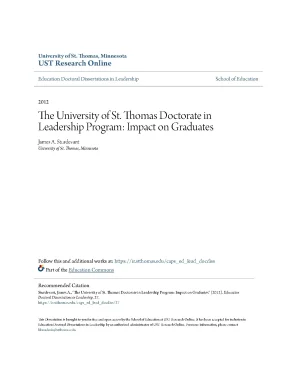
Tải xuống để đọc toàn bộUniversity of St. Thomas, Minnesota UST Research Online Education Doctoral Dissertations in Leadership School of Education 2012 The University of St. Thomas Doctorate in Leadership Program: Impact on Graduates James A. Sturdevant University of St.
Thomas, Minnesota Follow this and additional works at: https://ir.edu/caps_ed_lead_docdiss Part of the Education Commons Recommended Citation Sturdevant, James A., "The University of St. Thomas Doctorate in Leadership Program: Impact on Graduates" (2012). Education Doctoral Dissertations in Leadership.edu/caps_ed_lead_docdiss/27 This Dissertation is brought to you for free and open access by the School of Education at UST Research Online. It has been accepted for inclusion in Education Doctoral Dissertations in Leadership by an authorized administrator of UST Research Online.
For more information, please contact libroadmin@stthomas. The University of St. Thomas Doctorate in Leadership Program: Impact on Graduates A DISSERTATION SUBMITTED TO THE FACULTY OF THE SCHOOL OF EDUCATION OF THE UNIVERSITY OF ST. PAUL, MINNESOTA By James A.
Sturdevant IN PARTIAL FULFILLMENT OF THE REQUIREMENTS FOR THE DEGREE OF DOCTOR OF EDUCATION 2012 ii UNIVERSITY OF ST. THOMAS, MINNESOTA The University of St. Thomas Doctorate in Leadership Program: Impact on Graduates We certify that we have read this dissertation and approved it as meeting departmental criteria for graduating with honors in scope and quality. We have found that it is complete and satisfactory in all respects, and that any and all revisions required by the final examining committee have been made.
Dissertation Committee _________________________________ Thomas L., Committee Chair _________________________________ Kathleen M., Committee Member _________________________________ Sarah Noonan, Ed., Committee Member May 7, 2012 _________________________________ Final Approval Date iii ACKNOWLEDGMENTS I am eternally grateful to my wife, Diane, for her love and understanding throughout our lives together, and especially throughout my doctoral experience. This dissertation is dedicated to her. Also, I thank our children, Anna and David, for their unquestioning support of my need to learn. Finally, I am forever indebted to Dr.
Tom Fish, my Dissertation Committee Chair, for his patience, guidance, and faith in me. iv ABSTRACT The purpose of this case study was to explore with a sample of doctoral graduates their perceptions of the impact of the University of St. Thomas Doctorate in Leadership Program on their lives. Major research questions were: 1) How did the program affect the graduates’ views of self? 2) How did the program affect the graduates’ roles in the world? 3) How did features of the program affect the graduates? 4) How were the graduates able to stay motivated and complete their degrees? Qualitative information was gathered from in-depth interviews of 21 graduates selected for a balance of gender, year graduated, and occupation.
Themes emerged and added meaning to the collective graduate experiences. The program changed the graduates’ sense of self, specifically increasing self-confidence, improving self-understanding, enhancing critical thinking abilities and research skills, and opening participants to multiple perspectives and diversity. Graduates reported an increased focus on relationships and ability to collaborate with others, enhancing their ability to offer leadership to others. The program’s non-traditional format and schedule fit the needs of the adult learner.
The faculty performed facilitation and support roles, the cohort was a comfortable and secure forum, and experiences of cohort members were powerful sources of learning. The result was transformational learning among study participants. Sturdevant ALL RIGHTS RESERVED vi TABLE OF CONTENTS ACKNOWLEDGEMENTS. iv TABLE OF TABLES.
viii LIST OF INCIDENT TABLES. ix CHAPTER ONE: INTRODUCTION .1 The UST Program and the Cohort Model.3 Statement of Problem.5 Significance of the Problem.6 Definition of Terms.7 CHAPTER TWO: REVIEW OF LITERATURE .9 Trends in Doctoral Leadership Programs .9 Setting the Stage .17 Impact of Doctoral Programs on Graduates.19 Theory Related to Identity, Adult Education, Change, and Leadership .23 Identity Theory and Social Identity Theory.24 Adult Education Theory.26 Transformation Theory of Adult Learning .32 Transformational Leadership Theory .33 CHAPTER THREE: METHODOLOGY .36 Qualitative Research Design.36 Case Study Methodology.37 The Research Sample.38 Overview of Research Design .41 Data Collection Methods .42 Methods for Data Analysis and Synthesis .………………………………47 Issues of Trustworthiness.48 vii Limitations of the Study.50 CHAPTER FOUR: A NEW VIEW OF SELF AND OTHERS.51 A New View of Inner Self .58 An Equity Vision .62 Respecting, Trusting, and Valuing Others.65 Driven to Finish .73 CHAPTER FIVE: FOUR SOURCES OF LEARNING.76 Instructive and Nurturing Cohort.90 CHAPTER SIX: DISCUSSIONS, CONCLUSIONS, AND RECOMMENDATIONS .115 Appendix A: Draft Letter to Graduates .116 Appendix B: Consent Form .118 Appendix C: Confidentiality Form – Transcriber.119 Appendix D: Application to the UST Institutional Review Board .121 Appendix E: Incident Tables .129 viii TABLE OF TABLES Table 2. Doctoral degrees in education awarded by U. colleges and universities,.2: Doctorate recipients, by sex and education subfield of study: 2008 .3: Doctoral education leadership program reform elements identified by at least .19 two referenced articles Table 3.1: Demographics of study participants.
Data compilation and analysis frameworks for survey responses and .44 my derived framework Table 3. Codes used in the study. Relationships among program features and study participant demographics. Relationships between gender and participant acceptance of multiple .99 perspectives, and the impact of the cohort and dissertation ix LIST OF INCIDENT TABLES Table E.
Incident table for sense of inner self. Incident table for becoming critical. Incident table for equity vision. Incident table for respecting, trusting, and valuing others.
Incident table for driven to finish. Incident table for supportive faculty. Incident table for instructive and nurturing cohort. Incident table for robust curriculum.
Incident table for dissertation passion. Incident table for gender and profession with respect to findings. Incident table for timing with respect to themes. Incident table for overall doctoral experience.138 1 INTRODUCTION Background I witnessed the profound impact of leadership education throughout my life on individuals and organizations.
I witnessed how leadership education influenced a variety of people. For example, members of a large, traditional church accepted new ministry practices because of leadership workshops and mentoring offered by progressive clergy and lay leaders. Hundreds of government employees embraced servant leadership principles as a result of their participation in a series of workshops. My colleagues’ professional lives changed through participation in a formal leadership-mentoring program sponsored by my employer.
A team of 13 year-old female soccer players from the U. achieved their vision of playing soccer in England because of the leadership lessons taught by a few parents. Finally, many of my classmates, including me, made major life changes due at least in part to our education in the University of St. Thomas (UST) Doctorate in Leadership Program.
I have a strong interest in learning more about the impact of leadership education on individuals and organizations. There are many forms of leadership education. Some colleges and universities offer degrees in leadership. Consultants offer leadership workshops.
Business schools offer courses in various aspects of leadership. Some governmental organizations and businesses provide their own in-house leadership training. I chose to study the impact of the UST Doctorate in Leadership Program because of its significance to me. I enrolled in this program in 2005.
My experience caused me to challenge many previously held assumptions constraining the way I perceived the world. I made a major career change in the midst of the program, and I believe the program informed and enabled the change. The University of St. Thomas describes its Doctorate in Leadership Program as follows: 2 Leaders in a rapidly changing world know how to turn possibilities into strategies that enhance lives and transform organizations.
They are practical visionaries who collaborate with others to develop sound policies during times of ambiguity and conflict. They listen well to diverse points of view. Their belief in the potential of education is mirrored in their own love of learning. They think critically and act ethically.
Leadership practitioners make a difference within their organization and are committed to human growth and development. They apply advanced research methods to issues central to leadership. Leading practices meet the day-to-day and strategic needs of an organization. (University of St.
Thomas, 2008) I began to wonder about the impact of this program, especially about the perceptions and experiences of program graduates. Successful graduates share the experience of having completed the program, perhaps applying their education in the world after earning the doctoral degree. Did the program give them greater abilities to “enhance lives and transform organizations” and “think critically and act ethically?” In this study, I asked a sample of graduates to describe the meaning and value of their doctoral education, assuming this meaning would be informed by their practical work and personal experiences. I gathered information from some program graduates to discover their experience of doctoral education and its value to them.
I believe doctoral education does more than prepare people to conduct research. Too often people measure the value of the doctorate by counting research grants, awards, and publications, and ignoring personal change experienced by people in doctoral education. Neither training nor learning is directly addressed by [these] indicators….only the intellectual and cognitive aspects of education are studied or evaluated. The emotional, moral, ethical, and even behavioral outcomes of graduate study are left unexamined.
Often they are considered irrelevant. (Stevens-Long & Barner, 2006, p. 456) I examined the impact of the program on the whole person, going beyond the graduates’ professional record to their personal accomplishments. I assumed doctoral study might touch the whole person, and potentially change attitudes, behaviors, emotional states, and views of the world.
I also believed certain program elements, such as faculty and curriculum, may have more 3 powerful impact than others. I also wondered about the struggle involved in completing the degree. “Doctoral studies usually are accompanied by intense periods of personal discomfort, emotional turmoil, cognitive struggle, and transformation” (p. Thus, I was also interested in how graduates were able to stay motivated and complete their degrees.
Information on motivation may offer additional insights into program impact. I next provide a brief introduction of the doctoral program and describe two case studies on the UST program. The UST Program and the Cohort Model The general approach and curriculum of the UST Doctorate in Leadership Program has changed little since its inception. It is a mix of theory and application, and open to people across disciplines.
Content includes leadership and organizational theories, problem solving, ethics in leadership, and analysis of critical leadership issues such as “equity, global interdependence, conflicting cultural values, and accelerating social and technological change” (University of St. Scheduling of courses is designed to meet the needs of working professionals. The curriculum has four components: core courses, collateral courses, research courses, and dissertation. Students may concurrently take collateral and research courses.
The required core courses are: Leaders and Organizations: Multidisciplinary Perspectives 1 and 2; Critical Issues in their Political, Social and Economic Contexts; Power, Freedom and Change; Ethical Dimensions of Leadership; and Leadership Narrative Seminar. Three research courses are also required: Survey Research, Qualitative Methods of Research and Evaluation, and one of the following: Educational Statistics, Historical Methodology in Education, and Analysis of Qualitative Data (University of St. The program employs the cohort model for core courses. Through 2010, the program included 26 cohorts and over 550 students (University of St.
In this cohort 4 model, the same student group takes the core courses together. “The program’s cohort component fosters respectful and critical conversation, a diversity of perspectives and camaraderie among learners. Because members of each cohort come from a variety of backgrounds, discussions are rich and experiences are deep” (University of St. Cohorts have been used in other graduate-level programs for many years, and much about their advantages and disadvantages can be found in the literature.
The advantages of cohorts are inter-student support, trusting relationships among members, professional networking, depth of student connections, strength of support structures, depth of discussions, feelings of community, and ease in scheduling. The cohort model allows for multiple learning perspectives, student- based support systems, and skills enhancement. The disadvantages of cohorts are disruptions from dominant members, lack of commitment from some members, and failure among some to meet group expectations.
Nội dung được bảo vệ bản quyền — Tải xuống đầy đủ
Trích dẫn luận án này
James A. Sturdevant (2012). The university of st thomas doctorate in leadership program [Luận án tiến sĩ, University of St. Thomas]. LuanAn.net. https://luanan.net/quan-ly-giao-duc/the-university-of-st-thomas-doctorate-in-leadership-program-imp
Câu hỏi thường gặp
Luận án "The university of st thomas doctorate in leadership program" nghiên cứu về vấn đề gì?
Chương trình Tiến sĩ Lãnh đạo tại University of St. Thomas: Nâng tầm kỹ năng lãnh đạo, phát triển chiến lược, và tạo ảnh hưởng tích cực.
Luận án "The university of st thomas doctorate in leadership program" được bảo vệ tại trường nào?
Luận án này được bảo vệ tại University of St. Thomas. Năm bảo vệ: 2012.
Luận án "The university of st thomas doctorate in leadership program" thuộc chuyên ngành gì?
Luận án "The university of st thomas doctorate in leadership program" thuộc chuyên ngành Leadership / Education. Danh mục: Quản Lý Giáo Dục.
Luận án "The university of st thomas doctorate in leadership program" có bao nhiêu trang?
Luận án "The university of st thomas doctorate in leadership program" có 148 trang. Bạn có thể xem trước một phần tài liệu ngay trên trang web trước khi tải về.
Cách tải luận án "The university of st thomas doctorate in leadership program" về máy như thế nào?
Để tải luận án về máy, bạn nhấn nút "Tải xuống ngay" trên trang này, sau đó hoàn tất thanh toán phí lưu trữ. File sẽ được tải xuống ngay sau khi thanh toán thành công. Hỗ trợ qua Zalo: 0559 297 239.