Lãnh đạo chuyển đổi: Phụ nữ Mỹ gốc Á trong quản lý cao đẳng cộng lập California - Nghiên cứu của Amy Leung
Khám phá vai trò lãnh đạo chuyển đổi của phụ nữ Mỹ gốc Á trong quản lý cao đẳng cộng lập California. Nghiên cứu đột phá.
California State University, Sacramento
Luan An
Luận án
Năm xuất bản
Số trang
253
Thời gian đọc
38 phút
Lượt xem
0
Lượt tải
0
Phí lưu trữ
50 Point
Tổng quan nhanh
- Chủ đề:
- Lãnh đạo chuyển đổi: Phụ nữ Mỹ gốc Á trong quản lý
- Số trang:
- 253 trang
- Trường:
- California State University, Sacramento
- Chuyên ngành:
- Educational Leadership
- Tác giả:
- Amy Leung
- Năm:
- 2020
Tóm tắt nội dung luận án
I.Lãnh đạo chuyển đổi Phụ nữ Mỹ gốc Á trong quản lý
Nghiên cứu này khám phá vai trò phụ nữ Mỹ gốc Á với tư cách lãnh đạo chuyển đổi trong quản lý cao đẳng cộng lập California. Nghiên cứu này tập trung vào các nhà lãnh đạo hướng giá trị bình đẳng, dân chủ, công bằng xã hội. Giáo dục giải phóng là mục tiêu trọng tâm. Khám phá này làm nổi bật kinh nghiệm sống, quan điểm của họ. Đây là một phân tích định tính chuyên sâu. Nó sử dụng lý thuyết nữ quyền chủng tộc phê phán để định hình. Nghiên cứu thúc đẩy việc suy nghĩ lại về sự hình thành lãnh đạo.
1.1. Định nghĩa lãnh đạo chuyển đổi
Lãnh đạo chuyển đổi định hình bởi các giá trị cốt lõi. Chúng bao gồm công bằng, dân chủ, công lý xã hội. Mục tiêu là tạo ra giáo dục giải phóng. Những nhà lãnh đạo này thách thức hiện trạng. Họ thúc đẩy thay đổi hệ thống. Sự phát triển cá nhân, tổ chức được khuyến khích. Tầm nhìn chiến lược dài hạn được xây dựng. Lãnh đạo chuyển đổi hướng tới trao quyền cho cộng đồng.
1.2. Vai trò phụ nữ Mỹ gốc Á trong lãnh đạo
Phụ nữ Mỹ gốc Á đóng vai trò quan trọng. Họ mang đến góc nhìn độc đáo cho lãnh đạo giáo dục. Kinh nghiệm sống của họ định hình phong cách lãnh đạo. Họ thường tập trung vào cộng đồng. Việc này thúc đẩy sự tham gia, trao quyền. Họ đối mặt với nhiều định kiến. Họ tạo ra sự khác biệt tích cực trong hệ thống cao đẳng cộng lập California.
1.3. Bối cảnh quản lý cao đẳng cộng lập
Hệ thống cao đẳng cộng lập California là bối cảnh nghiên cứu. Các nhà quản lý nữ Mỹ gốc Á hoạt động trong môi trường này. Họ đối mặt thách thức độc đáo. Các trường cao đẳng cộng lập phục vụ cộng đồng đa dạng. Lãnh đạo cần sự nhạy bén văn hóa. Họ cần tầm nhìn chiến lược mạnh mẽ. Họ định hướng sự phát triển của sinh viên. Quản lý cao đẳng cộng lập đòi hỏi cam kết công bằng.
II.Kinh nghiệm lãnh đạo phụ nữ Mỹ gốc Á tại California
Nghiên cứu đào sâu vào kinh nghiệm sống phụ nữ Mỹ gốc Á. Những nhà lãnh đạo này làm việc tại các trường cao đẳng cộng lập California. Nghiên cứu sử dụng phương pháp điều tra tường thuật phê phán. Nó xem xét cách họ định hình ý nghĩa lãnh đạo. Đặc biệt, ảnh hưởng của các bản sắc giao thoa được phân tích. Đây là yếu tố then chốt để hiểu về lãnh đạo giáo dục. Nghiên cứu tập trung vào quan điểm, kinh nghiệm, cuộc sống của họ.
2.1. Phân tích kinh nghiệm sống lãnh đạo
Kinh nghiệm sống cá nhân là nền tảng lãnh đạo. Những trải nghiệm này hình thành quan điểm. Chúng ảnh hưởng đến phong cách lãnh đạo. Các nhà lãnh đạo phản ánh về hành trình của mình. Họ biến thách thức thành cơ hội phát triển. Học hỏi từ quá khứ định hướng tương lai. Đây là cốt lõi của phát triển lãnh đạo. Nó củng cố khả năng lãnh đạo chuyển đổi.
2.2. Ảnh hưởng của bản sắc giao thoa
Bản sắc chủng tộc, giới tính, tầng lớp giao thoa. Những yếu tố này ảnh hưởng sâu sắc đến lãnh đạo. Phụ nữ Mỹ gốc Á trải nghiệm thực tế phức tạp. Họ đối mặt với định kiến kép. Sự giao thoa bản sắc này mang lại sức mạnh. Nó cung cấp góc nhìn đa chiều. Đây là trọng tâm của lý thuyết nữ quyền chủng tộc phê phán. Nó định hình cách họ thực hành lãnh đạo giáo dục.
2.3. Giá trị cốt lõi lãnh đạo giáo dục
Lãnh đạo giáo dục dựa trên các giá trị. Công bằng, dân chủ, công lý xã hội là nền tảng. Các nhà lãnh đạo này ưu tiên sự phát triển của sinh viên. Họ thúc đẩy môi trường học tập hòa nhập. Tầm nhìn chiến lược của họ hướng tới toàn diện. Họ tạo ra sự thay đổi tích cực trong cộng đồng. Những giá trị này hướng dẫn mọi quyết định quản lý cao đẳng cộng lập.
III.Khám phá rào cản sự nghiệp Bình đẳng giới giáo dục
Nghiên cứu này xem xét các rào cản. Phụ nữ Mỹ gốc Á đối mặt trên con đường sự nghiệp. Đặc biệt là trong lĩnh vực quản lý cao đẳng cộng lập. Bình đẳng giới trong giáo dục vẫn là một thách thức. Nghiên cứu làm sáng tỏ những trở ngại này. Nó đề xuất các chiến lược vượt qua. Việc này nhằm mục đích tạo ra con đường sự nghiệp công bằng hơn. Hiểu rõ rào cản là bước đầu tiên để thay đổi.
3.1. Rào cản định hình sự nghiệp
Rào cản định hình sự nghiệp đa dạng. Chúng bao gồm định kiến văn hóa, kỳ vọng giới. Thiếu cơ hội phát triển là một vấn đề. Môi trường tổ chức không hỗ trợ. Điều này cản trở sự thăng tiến. Phụ nữ Mỹ gốc Á thường đối mặt với 'trần kính'. Họ ít có cơ hội tiếp cận vị trí cấp cao trong hệ thống cao đẳng cộng lập California.
3.2. Thiếu bình đẳng giới trong giáo dục
Hệ thống giáo dục vẫn còn bất bình đẳng. Phụ nữ, đặc biệt phụ nữ Mỹ gốc Á, chịu thiệt thòi. Họ ít được công nhận, đánh giá cao. Khoảng cách lương, cơ hội vẫn tồn tại. Bình đẳng giới trong giáo dục là mục tiêu cần đạt. Cần có chính sách hỗ trợ mạnh mẽ hơn. Việc này đảm bảo công bằng cơ hội trong lãnh đạo giáo dục.
3.3. Chiến lược vượt qua rào cản
Nhiều chiến lược được sử dụng. Các nhà lãnh đạo xây dựng mạng lưới hỗ trợ. Họ tham gia chương trình phát triển lãnh đạo. Mentorship và sponsorship rất quan trọng. Họ cũng sử dụng tiếng nói của mình. Họ thách thức các cấu trúc hiện có. Tầm nhìn chiến lược rõ ràng giúp họ kiên trì. Việc này thúc đẩy sự thay đổi tích cực trong quản lý cao đẳng cộng lập.
IV.Đa dạng hòa nhập Tầm nhìn chiến lược giáo dục
Đa dạng và hòa nhập là trọng tâm. Các nhà lãnh đạo chuyển đổi ưu tiên các giá trị này. Họ xây dựng tầm nhìn chiến lược cho giáo dục. Mục tiêu là tạo ra môi trường công bằng. Nơi mọi cá nhân đều có cơ hội phát triển. Hệ thống cao đẳng cộng lập California hưởng lợi từ sự đa dạng. Sự hòa nhập thúc đẩy đổi mới, tăng cường công bằng xã hội.
4.1. Tầm quan trọng của đa dạng lãnh đạo
Đa dạng trong lãnh đạo mang lại nhiều lợi ích. Nó cung cấp các góc nhìn phong phú. Quyết định trở nên toàn diện hơn. Đa dạng giúp phản ánh cộng đồng phục vụ. Nó truyền cảm hứng cho thế hệ tiếp theo. Đa dạng hóa lãnh đạo giáo dục là cần thiết. Nó thúc đẩy sự đổi mới. Việc này đặc biệt quan trọng trong quản lý cao đẳng cộng lập.
4.2. Hòa nhập thúc đẩy thay đổi tích cực
Hòa nhập không chỉ là sự hiện diện. Nó là việc tạo ra môi trường an toàn. Mọi người cảm thấy được tôn trọng, thuộc về. Môi trường hòa nhập khuyến khích sự tham gia. Nó thúc đẩy đối thoại cởi mở. Hòa nhập là động lực thay đổi tích cực. Nó củng cố cam kết công bằng xã hội. Đây là yếu tố cốt lõi của lãnh đạo chuyển đổi.
4.3. Xây dựng tầm nhìn chiến lược hiệu quả
Tầm nhìn chiến lược phải rõ ràng, có thể đạt được. Nó phải bao gồm các mục tiêu đa dạng, hòa nhập. Các nhà lãnh đạo chuyển đổi phát triển tầm nhìn này. Họ dẫn dắt các trường cao đẳng cộng lập. Họ đảm bảo mọi chính sách, thực tiễn đều phản ánh. Việc này tạo ra một hệ thống công bằng. Tầm nhìn đó hướng tới bình đẳng giới trong giáo dục.
V.Phát triển lãnh đạo Đánh giá tác động bền vững
Phát triển lãnh đạo là chìa khóa. Nó giúp phụ nữ Mỹ gốc Á thăng tiến. Nghiên cứu này xem xét tác động. Nó phân tích các chương trình, hỗ trợ. Mục tiêu là tạo ra sự thay đổi bền vững. Việc này củng cố năng lực quản lý. Nó thúc đẩy một thế hệ lãnh đạo mới. Các khuyến nghị được đưa ra để cải thiện. Đây là bước quan trọng để đạt được bình đẳng giới trong giáo dục.
5.1. Chương trình phát triển lãnh đạo
Các chương trình phát triển lãnh đạo rất quan trọng. Chúng cung cấp kỹ năng, kiến thức cần thiết. Việc này giúp các nhà lãnh đạo tương lai. Họ chuẩn bị cho vai trò quản lý cấp cao. Các chương trình này thường bao gồm cố vấn, đào tạo. Chúng tập trung vào lãnh đạo chuyển đổi. Chúng hỗ trợ phụ nữ Mỹ gốc Á phát triển sự nghiệp.
5.2. Tác động tới hệ thống giáo dục
Lãnh đạo chuyển đổi có tác động sâu rộng. Họ cải thiện chất lượng giáo dục. Họ thúc đẩy văn hóa tổ chức tích cực. Hệ thống cao đẳng cộng lập California hưởng lợi. Nền giáo dục trở nên công bằng hơn. Họ tạo ra môi trường học tập tốt hơn. Sự phát triển bền vững được đảm bảo. Điều này củng cố đa dạng và hòa nhập.
5.3. Khuyến nghị cho tương lai
Cần có chính sách hỗ trợ cụ thể. Các tổ chức nên ưu tiên đa dạng lãnh đạo. Phát triển lãnh đạo cần tiếp tục. Cần có thêm nghiên cứu về phụ nữ Mỹ gốc Á. Việc này đảm bảo bình đẳng giới trong giáo dục. Tầm nhìn chiến lược dài hạn cần được duy trì. Những khuyến nghị này thúc đẩy sự thay đổi tích cực trong quản lý cao đẳng cộng lập.
Mục lục chi tiết luận án
Tải xuống file đầy đủ để xem toàn bộ nội dung
Tải đầy đủ (253 trang)Trích đoạn nội dung luận án
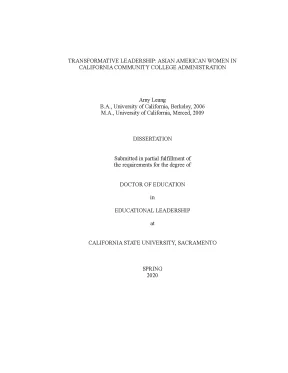
Tải xuống để đọc toàn bộTRANSFORMATIVE LEADERSHIP: ASIAN AMERICAN WOMEN IN CALIFORNIA COMMUNITY COLLEGE ADMINISTRATION Amy Leung B., University of California, Berkeley, 2006 M., University of California, Merced, 2009 DISSERTATION Submitted in partial fulfillment of the requirements for the degree of DOCTOR OF EDUCATION in EDUCATIONAL LEADERSHIP at CALIFORNIA STATE UNIVERSITY, SACRAMENTO SPRING 2020 Copyright © 2020 Amy Leung All rights reserved ii TRANSFORMATIVE LEADERSHIP: ASIAN AMERICAN WOMEN IN CALIFORNIA COMMUNITY COLLEGE ADMINISTRATION A Dissertation by Amy Leung Approved by Dissertation Committee: _________________________________ Dr. Caroline Turner, Chair _________________________________ Dr. LeAnn Fong-Batkin _________________________________ Dr. Man Phan SPRING 2020 iii TRANSFORMATIVE LEADERSHIP: ASIAN AMERICAN WOMEN IN CALIFORNIA COMMUNITY COLLEGE ADMINISTRATION Student: Amy Leung I certify that this student has met the requirements for format contained in the University format manual, and this dissertation is suitable for electronic submission to the library and credit is to be awarded for the dissertation.
___________________________, Graduate Coordinator _________________ Dr. Rose Borunda Date iv DEDICATION To the all the community educators working to bring real change. We are the leaders we’ve been looking for. v ACKNOWLEDGEMENTS First and foremost, I’d like to acknowledge my committee for all their positivity and support in helping me reach my full potential.
Caroline Turner, it’s been my pleasure working with you all these years and I am honored to be your student. You motivate me to strive higher as a researcher, educator, and leader. Your qualitative skills are, of course, unmatched. Thank you for inspiring my topic and my methodology.
LeAnn Fong-Batkin for reliably providing thoughtful guidance that strengthened me as an educational researcher and leader. Thank you for taking my phone calls and generously answering all my questions! To Dr. Man Phan for being a pillar of support and encouragement throughout my entire doctoral process. I am definitely standing on the shoulders of giants.
I could not have asked for a better committee. I’d like to thank all of my professors over the course of this program. Particularly, to Dr. Maiyoua Vang, for shaping my critical thinking.
To my cohort 11 colleagues, I have learned from each and every one of you, and as a result, I am a better human being. I am so grateful and proud to have grown up in this program with you all. To Patrick Hayashi, Nadia Wong, Regina Ip, and Frank Kobayashi for their thoughtful advice, help, and friendship throughout my dissertation process. Finally, I’d like to acknowledge my family for their love and support through this process.
I am particularly grateful for my parents for always being there as my number one cheerleaders. To Fa, thank you for being you every single day. To V, I hope this inspires you. I love you all very much.
vi CURRICULUM VITAE Education Ed. California State University Sacramento, Educational Leadership May 2020 M. University of California, Merced, Economics August 2009 B. University of California, Berkeley, Economics May 2006 Professional Employment Professor of Economics, Los Rios Community College District 2011-Present Graduate Research Assistant, Sacramento State College of Education 2018-Present Publications “Review of Transformative Leadership in Education by Shields, C.” 2019 Journal of Transformative Leadership and Policy Studies Fields of Study Community Colleges, Transformative Leadership, Stratification Economics, Cultural Political Economy, Critical Race Theory, Critical Race Feminism, Critical Pedagogy, Students of Color, Faculty of Color, Asian American Identity vii Abstract of TRANSFORMATIVE LEADERSHIP: ASIAN AMERICAN WOMEN IN CALIFORNIA COMMUNITY COLLEGE ADMINISTRATION by Amy Leung This qualitative study uplifts the narratives of eight Asian American women in California community college administration who practice transformative leadership.
Through critical narrative inquiry, this study examines the lived experiences of these leaders as they (re)defined and mediated meaning as transformative leaders, or leaders guided by values of equity, democracy, social justice, and emancipatory education. The influence of individual background, significant life experiences, and the overlapping identities of race, gender, and class upon leadership style is especially explored. Critical race feminism (CRF) theory, intersectionality, and multiplicity are used in an interactive framework to ground the lived experiences of the leaders. By centralizing Asian American woman perspectives, experiences, and lives, this study prompts a more complex rethinking of their leadership formation, one that centers their standpoint, epistemology, and praxis.
This study specifically seeks to understand how the lived experiences of these leaders and transformative change co-exist within community college education. Through this process, this study identifies specific leadership tools and practices by listening to their narratives and uncovering any viii experiential knowledge Asian American women have contributed in their transformative leadership. Findings contribute toward a more complicated understanding of the Asian American woman identity, suggesting an evolving definition. The narrative data reveal a pioneering, politically activated, and intrepid spirit that is deeply embedded in who they are.
Findings also point to specific transformative leadership elements that are emphasized by the participants including strategic leading for social justice, community leading, activism, and authenticity. These findings produce new leadership epistemology through a humanistic, value-added, and expansive way to view educational leaders and diverse perspectives, which ultimately enriches the relationship between leadership theory and practice within community colleges. Keywords: community college, transformative leadership, diversity, equity, inclusion ix TABLE OF CONTENTS Page Dedication. vi Curriculum Vitae.
vii List of Tables. xiii List of Figures .4 Significance of the Study…………………………………………………………….9 Nature of the Study……………………………………………………………………. REVIEW OF RELATED LITERATURE………………………………………………….24 Asian American Women.24 Racialization Through a Gendered Lens.24 Asian American Women in Higher Education.28 Overview of Community Colleges.44 Faculty and Administrator Diversity.46 x Encroachment of Neoliberalism……………………………………………………….49 Conceptual Framework…………………………………………………………………61 Transformative Leadership.61 Critical Race Feminism Theory.84 Role of Researcher…………………………………………………………………….87 Research Setting, Population, and Sample…………………………………………….89 Data Collection Process.90 Instrumentation and Data Analysis…………………………………………………….92 Protection of Participants……………………………………………………………….93 Validity and Trustworthiness………………………………………………………. ANALYSIS OF THE DATA……………………………………………………………….107 Pioneering the First Generation………………………………………………….107 (Re)defining the Asian American Woman Identity…………………………………….115 Pushing Back on Hegemonic Narratives……………………………………………….131 Transformative Leadership: Community, Social Justice, and Activism………….136 xi Strategic Leading for Social Justice…………………………………………………….161 Authentic Leading: I Am Who I Am………………………….……167 Advice for the Emerging Transformative Leader………………………………………171 5.
SUMMARY AND CONCLUSIONS……………………………………………………….182 Interpretation of the Findings…………………………….206 Recommendation for Future Research.207 Reflections of the Researcher………. APPENDICES………………………………………………………………………………212 Interview Guide/Protocol……………………………………………………………….213 Invitation Letter to Participants……………………………………………………….216 Informed Consent Form……………………………………………………………….221 xii LIST OF TABLES Table Page 1. Educational Administrators in the California Community Colleges. Overview of Transformative Leadership…….
Research Questions and Interview Questions……………………………………………. Interview Location and Duration…………………………………………………….91 xiii LIST OF FIGURES Figure Page 1. California Community College Student Profile………………………………………………42 2. California Community College Student Completion…………………………………………44 3.
California Community College System Data for the School Year, 2016-2017………………47 4. California Community College System Data for the School Year, 2016-2017………………49 5. Model of Transformative Leadership Theory………………………………. Conceptual Model of Theoretical Framework Informing Leadership Praxis.
Findings Model of Identity Themes and Leadership Themes……………….205 xiv 1 Chapter 1 INTRODUCTION The imbrication of race and gender with class hierarchy in higher educational leadership scholarship is reifying what is known about leadership and how leadership is defined. Yet, the dominant scholarship still rests upon habits of positivist framing and the identification of outcomes that befall those in small numbers. Less recognized is the narrative that privileges Asian American women’s perspectives, experiences, and lives. A more complex rethinking of their leadership formation that centers their standpoint, epistemology, and praxis is often kept in the margins.
Further, not widely acknowledged or documented are Asian American women’s campaigns as transformative educational leaders: skilled activist educators who work tirelessly toward a true, liberatory education for all, and courageous human beings who unequivocally leave imprints upon their students and communities. This study addresses this missing piece in the literature by problematizing that little is known about the individual stories of these women. Underrepresentation is the master narrative in Asian American women educational leadership scholarship. Demographic data point to shortfall in college presidencies, administration, and faculty positions across the United States.
The American Council on Education (ACE) (2017), for example, reported that women of color, including Asian American women, were the most underrepresented group in the college presidency across the country at only 5%. 2 Hardship and burden also rule the master narrative of Asian American women educational leaders. In the face of underrepresentation, education scholars attempt to study workplace challenges, systemic discrimination, gender parity, and other factors that may explain the scarcity of Asian American women in these leadership positions. For their race and gender, they are “tokenized” at the workplace (Turner, 2002) and viewed as “strangers” (Li & Beckett, 2006) and “outsiders” (Hune, 1998) in their faculty and administrative positions.
As they attempt to climb the ranks in academe, they experience unique workplace discrimination that is classed, raced, gendered, and sexualized (Cho, 1997). It is recognized in educational research that the Asian American woman’s career journey through higher education has been a hazardous one, fraught with explicit and implicit discrimination and disproportionate numerical outcomes. While documenting workplace challenges holds value, this study moves the narrative forward to document the campaigns of Asian American women as they successfully lead their higher education institutions. Specifically, this study captures the narratives of those Asian American women who exercise transformative leadership at their community college campus.
Transformative leadership is guided by values of equity, democracy, and social justice, and engages with communities in emancipatory education, or education that aims to redress social and material inequities (Freire, 1970; Nevarez, Wood, & Penrose, 2013; Shields, 2010, 2018; Weiner, 2003). In her book Transformative Leadership in Education, Shields (2018) suggests that modern educational leadership faces the problem of fixating upon a singular person in leadership, “[a]nd for the most part, historically, that single person has been a White male” (p. 3 As a result, leadership scholarship tends to ignore more recent and collaborative approaches from, for instance, indigenous and non-Eurocentric leadership perspectives (Shields, 2018, p. This study attempts to search deeper for the next layer in the Asian American woman higher education leadership experience.
As leaders, who are they? Specifically, as those who bravely identify as leading their college with social transformation in mind, how did they get to this point? And, what have they accomplished in their leadership role? This study argues that the answers can only be unearthed by positioning the participants as narrators of their own explanation and their own story. In developing a theory of Asian American Pacific Islander feminist epistemology, or “culturally specific, gender-equity-seeking ways of knowing, feeling, being, and doing” (Yee, 2009, p. 49), Yee (2009) listened to the critical narratives of her participants. By doing so, she observed that acts of resistance against oppressive systems catalyzed critical consciousness in these women such that they rewrote the script “to alter how they engage in these ‘sites of interaction’ by seeking fairness in relationships and equality of treatment” (Yee, 2009, p.
A transformative educator herself, Yee presented justification for narrative exploration methodologies and encouraged research that recognized epistemology developed by these women. Therefore, it is with purposeful and careful intention that this study attempts to humanize through narrative inquiry these living Asian American women who are transformative leaders in higher education. Czarniawska (2004) stated that narrative stories pay special attention to an individual’s negotiation of meaning and within this is a 4 dialectical tension that “thrives on the contrast between the ordinary, what is ‘normal’, usual, and expected, and the ‘abnormal’, unusual, and unexpected” (p. Then, from this dialectical mode of discourse, dynamically moving from one factor to another, a bigger picture, a building comprehension, of the participant’s story can be woven.
In the process, this study specifically seeks to understand how critical leaders, provocative voices, lived experiences, and transformative change live and breathe within community college education. Problem Statement This study problematizes the dearth of narratives of Asian American women as transformative leaders in educational research. Who are these leaders? How do they lead? By centering their voices and exploring knowledge production by Asian American women transformative leaders in the California community college administration, this study challenges the deficit framework that views them as incompetent educational leaders. Instead, it uses critical narrative inquiry to determine how the constellation of individual backgrounds, significant life experiences, and overlapping identities influence their higher educational leadership styles as transformative leaders.
Their socially transformative visions, goals, and accomplishments will be documented in this study.
Nội dung được bảo vệ bản quyền — Tải xuống đầy đủ
Trích dẫn luận án này
Amy Leung (2020). Lãnh đạo chuyển đổi: Phụ nữ Mỹ gốc Á trong quản lý cao đẳng cộng lập California [Luận án tiến sĩ, California State University, Sacramento]. LuanAn.net. https://luanan.net/quan-ly-giao-duc/lanh-dao-chuyen-doi-phu-nu-my-goc-a-trong-quan-ly-cao-dang-cong-lap-california
Câu hỏi thường gặp
Luận án "Lãnh đạo chuyển đổi: Phụ nữ Mỹ gốc Á trong quản lý cao đẳng cộng lập California" nghiên cứu về vấn đề gì?
Khám phá vai trò lãnh đạo chuyển đổi của phụ nữ Mỹ gốc Á trong quản lý cao đẳng cộng lập California. Nghiên cứu đột phá.
Luận án "Lãnh đạo chuyển đổi: Phụ nữ Mỹ gốc Á trong quản lý cao đẳng cộng lập California" được bảo vệ tại trường nào?
Luận án này được bảo vệ tại California State University, Sacramento. Năm bảo vệ: 2020.
Luận án "Lãnh đạo chuyển đổi: Phụ nữ Mỹ gốc Á trong quản lý cao đẳng cộng lập California" thuộc chuyên ngành gì?
Luận án "Lãnh đạo chuyển đổi: Phụ nữ Mỹ gốc Á trong quản lý cao đẳng cộng lập California" thuộc chuyên ngành Educational Leadership. Danh mục: Quản Lý Giáo Dục.
Luận án "Lãnh đạo chuyển đổi: Phụ nữ Mỹ gốc Á trong quản lý cao đẳng cộng lập California" có bao nhiêu trang?
Luận án "Lãnh đạo chuyển đổi: Phụ nữ Mỹ gốc Á trong quản lý cao đẳng cộng lập California" có 253 trang. Bạn có thể xem trước một phần tài liệu ngay trên trang web trước khi tải về.
Cách tải luận án "Lãnh đạo chuyển đổi: Phụ nữ Mỹ gốc Á trong quản lý cao đẳng cộng lập California" về máy như thế nào?
Để tải luận án về máy, bạn nhấn nút "Tải xuống ngay" trên trang này, sau đó hoàn tất thanh toán phí lưu trữ. File sẽ được tải xuống ngay sau khi thanh toán thành công. Hỗ trợ qua Zalo: 0559 297 239.