Hội nhập Đại học và Kiệt sức Sinh viên: So sánh Sinh viên Chuyển tiếp và Nội trú
Khám phá thách thức hội nhập và nguy cơ kiệt sức của sinh viên chuyển tiếp và nội trú đại học. Tìm hiểu chiến lược hỗ trợ và quản lý căng thẳng hiệu quả.
University of Georgia
Transfer students, college adjustment, student burnout, college student retention
Luan An
Luận án
Số trang
112
Thời gian đọc
17 phút
Lượt xem
0
Lượt tải
0
Phí lưu trữ
40 Point
Tổng quan nhanh
- Chủ đề:
- Nghiên cứu Kiệt Sức và Thích Nghi Đại Học Sinh Viên
- Số trang:
- 112 trang
- Trường:
- University of Georgia
- Chuyên ngành:
- Transfer students, college adjustment, student burnout, college student retention
- Tác giả:
- Eckart Werther
Tóm tắt nội dung luận án
I.Nghiên cứu Kiệt Sức và Thích Nghi Đại Học Sinh Viên
Nghiên cứu này khám phá sự khác biệt trong việc thích nghi và mức độ kiệt sức giữa sinh viên chuyển tiếp và sinh viên bản xứ. Mục tiêu chính là hiểu rõ hơn các yếu tố ảnh hưởng đến quá trình thích nghi của sinh viên. Nghiên cứu cũng tìm mối liên hệ giữa sự thích nghi với đại học và hiện tượng kiệt sức học đường. Ba trăm sáu mươi lăm sinh viên đại học đã tham gia. Họ đến từ một trường cao đẳng nông nghiệp tại một cơ sở công lập lớn ở phía đông nam. Công cụ khảo sát gồm Bảng câu hỏi Thích nghi Sinh viên Đại học (SACQ) và Khảo sát Sinh viên Maslach Burnout Inventory (MBI-SS). Kết quả cung cấp thông tin quý giá cho các nhà quản lý và giảng viên. Thông tin này giúp phát triển các chương trình hỗ trợ. Chương trình nhằm giúp sinh viên giảm căng thẳng sinh viên đại học và cải thiện thích nghi môi trường đại học.
1.1. Mục tiêu và phạm vi nghiên cứu
Nghiên cứu đặt ra mục tiêu phân tích sự khác biệt về khả năng thích nghi và mức độ kiệt sức. Sinh viên chuyển tiếp được so sánh với sinh viên bản xứ. Nghiên cứu cũng xem xét các biến số cụ thể ảnh hưởng đến sự thích nghi của sinh viên chuyển tiếp. Phạm vi nghiên cứu tập trung vào sinh viên đại học trong ngành nông nghiệp. Địa điểm là một trường công lập lớn. Kết quả sẽ hỗ trợ việc cải thiện trải nghiệm học tập. Việc duy trì sinh viên là ưu tiên hàng đầu.
1.2. Phương pháp khảo sát sinh viên
Ba trăm sáu mươi lăm sinh viên tham gia khảo sát. Họ được yêu cầu hoàn thành hai công cụ đánh giá chính. SACQ đo lường mức độ thích nghi với môi trường đại học. MBI-SS đánh giá các triệu chứng kiệt sức học đường. Phương pháp này giúp thu thập dữ liệu định lượng. Dữ liệu sau đó được phân tích để xác định các mối quan hệ và sự khác biệt đáng kể. Dữ liệu hỗ trợ nhận diện các nhóm sinh viên cần hỗ trợ đặc biệt.
1.3. Khái niệm điều chỉnh và kiệt sức
Điều chỉnh (adjustment) đề cập đến khả năng của sinh viên để thích nghi với các yêu cầu học thuật, xã hội và thể chế của môi trường đại học. Kiệt sức (burnout) được định nghĩa là một trạng thái mệt mỏi về cảm xúc, giảm hiệu suất cá nhân và cảm giác hoài nghi. Những khái niệm này là trọng tâm của nghiên cứu. Việc hiểu rõ chúng rất quan trọng. Nó giúp nhà trường xây dựng môi trường học tập lành mạnh. Nó cũng hỗ trợ sức khỏe tâm thần sinh viên.
II.Đánh Giá Khó Khăn Thích Nghi Sinh Viên Chuyển Tiếp
Nghiên cứu chỉ ra rằng sinh viên chuyển tiếp đối mặt với nhiều khó khăn hơn. Họ gặp vấn đề trong việc thích nghi với các yêu cầu xã hội và thể chế của trường đại học. So với sinh viên bản xứ, nhóm này cần nhiều thời gian hơn để hòa nhập sinh viên chuyển tiếp. Các thách thức bao gồm việc làm quen với hệ thống mới, tìm kiếm bạn bè, và hiểu các quy tắc không chính thức. Sự thiếu hụt các mối quan hệ xã hội ban đầu có thể làm tăng cảm giác cô lập. Áp lực sinh viên nội trú cũng là một yếu tố. Sinh viên cần quản lý thời gian học tập hiệu quả. Họ cũng phải cân bằng cuộc sống sinh viên khi ở trong môi trường mới.
2.1. So sánh sinh viên chuyển tiếp và bản xứ
Kết quả nghiên cứu cho thấy sự khác biệt rõ rệt. Sinh viên chuyển tiếp trải nghiệm khó khăn thích nghi môi trường đại học nhiều hơn. Sinh viên bản xứ thường đã quen thuộc với trường. Họ có mạng lưới hỗ trợ xã hội vững chắc hơn. Điều này giúp họ dễ dàng hơn trong việc hòa nhập. Sinh viên chuyển tiếp phải xây dựng lại tất cả. Điều này tạo ra căng thẳng sinh viên đại học đáng kể.
2.2. Thách thức hòa nhập sinh viên chuyển tiếp
Sinh viên chuyển tiếp phải đối mặt với nhiều rào cản. Họ phải thích nghi với chương trình học mới. Họ cần làm quen với giảng viên và bạn bè mới. Việc tìm kiếm cộng đồng và cảm giác thuộc về là rất quan trọng. Sự khác biệt về văn hóa học thuật giữa các trường cũng là một thách thức. Những yếu tố này góp phần vào áp lực tâm lý. Chúng ảnh hưởng đến sức khỏe tâm thần sinh viên.
2.3. Áp lực sinh viên nội trú và môi trường mới
Mặc dù nghiên cứu không tập trung riêng vào sinh viên nội trú, những phát hiện có liên quan. Việc chuyển đến một môi trường sống mới, như ký túc xá, tạo ra áp lực tương tự. Sinh viên phải thích nghi với không gian sống chung. Họ cần quản lý sự độc lập. Kinh nghiệm sống ký túc xá đòi hỏi kỹ năng mới. Các thách thức này có thể làm tăng nguy cơ kiệt sức học đường. Hỗ trợ đầy đủ từ trường là cần thiết.
III.Mối Quan Hệ Giữa Kiệt Sức Học Đường và Thích Nghi
Nghiên cứu đã xác định một mối tương quan đáng kể. Mối tương quan này tồn tại giữa sự thích nghi với đại học và hiện tượng kiệt sức học đường. Điều này có nghĩa là sinh viên thích nghi tốt hơn sẽ ít có khả năng phát triển các triệu chứng kiệt sức. Sự thích nghi kém có thể là một yếu tố nguy cơ. Nó làm tăng khả năng mệt mỏi về cảm xúc, giảm hiệu suất và hoài nghi. Kết quả này nhấn mạnh tầm quan trọng của việc hỗ trợ sinh viên trong quá trình thích nghi. Cải thiện khả năng thích nghi môi trường đại học là một biện pháp phòng ngừa hiệu quả. Nó giúp giảm căng thẳng sinh viên đại học và bảo vệ sức khỏe tâm thần sinh viên.
3.1. Sự tương quan giữa thích nghi và kiệt sức
Có một mối liên hệ chặt chẽ. Khi sinh viên cảm thấy khó thích nghi với cuộc sống đại học, họ có xu hướng trải qua nhiều triệu chứng kiệt sức hơn. Ngược lại, những sinh viên hòa nhập tốt hơn thể hiện mức độ kiệt sức thấp hơn. Mối quan hệ này là một phát hiện quan trọng. Nó chỉ ra một con đường rõ ràng để can thiệp.
3.2. Ảnh hưởng của thích nghi đến kiệt sức
Khả năng thích nghi tốt giúp sinh viên đối phó hiệu quả hơn với áp lực học tập và xã hội. Sinh viên đã thích nghi có thể quản lý thời gian học tập tốt hơn. Họ cũng có khả năng xây dựng mạng lưới hỗ trợ. Điều này giảm gánh nặng tâm lý. Nó ngăn chặn sự phát triển của kiệt sức học đường. Cân bằng cuộc sống sinh viên là chìa khóa.
3.3. Các yếu tố tăng cường kiệt sức học đường
Nhiều yếu tố có thể làm tăng nguy cơ kiệt sức. Áp lực học tập quá mức là một yếu tố. Thiếu ngủ, thiếu hỗ trợ xã hội cũng vậy. Khó khăn trong việc hòa nhập sinh viên chuyển tiếp cũng đóng góp. Khi sinh viên gặp nhiều yếu tố tiêu cực cùng lúc, nguy cơ kiệt sức tăng lên đáng kể. Việc nhận diện và giải quyết các yếu tố này là cần thiết.
IV.Tác Động Sức Khỏe Tâm Thần Sinh Viên Nông Nghiệp
Nghiên cứu đã phát hiện một điều đáng chú ý. Sinh viên trong trường cao đẳng nông nghiệp trải qua mức độ kiệt sức cảm xúc tăng cao vừa phải. Điều này gợi ý một thách thức đặc biệt trong nhóm sinh viên này. Các yêu cầu học thuật của ngành nông nghiệp có thể góp phần vào điều này. Ví dụ, công việc thực địa, giờ học dài, và áp lực về kết quả. Đây có thể là những yếu tố gây ra căng thẳng sinh viên đại học. Việc nhận biết mức độ kiệt sức này là bước đầu tiên. Sau đó, cần phát triển các chiến lược hỗ trợ tâm lý sinh viên phù hợp. Mục tiêu là giúp họ duy trì sức khỏe tinh thần tốt.
4.1. Mức độ kiệt sức cảm xúc ở sinh viên
Kết quả khảo sát chỉ ra rằng sinh viên nông nghiệp có mức độ kiệt sức cảm xúc cao. Kiệt sức cảm xúc là một thành phần chính của hội chứng kiệt sức. Nó biểu hiện qua cảm giác mệt mỏi và kiệt sức tinh thần. Điều này ảnh hưởng đến khả năng học tập. Nó cũng tác động đến chất lượng cuộc sống của sinh viên.
4.2. Đặc thù ngành học và căng thẳng
Ngành nông nghiệp thường đòi hỏi kiến thức chuyên sâu và kỹ năng thực hành. Sinh viên có thể đối mặt với lịch trình bận rộn. Các dự án thực tế và yêu cầu về tư duy phản biện là phổ biến. Áp lực từ việc học lý thuyết và thực hành cùng lúc có thể gây ra căng thẳng sinh viên đại học. Việc này ảnh hưởng đến cân bằng cuộc sống sinh viên.
4.3. Nhu cầu hỗ trợ tâm lý sinh viên
Với mức độ kiệt sức cảm xúc tăng cao, nhu cầu hỗ trợ tâm lý là rõ ràng. Các dịch vụ tư vấn, các buổi workshop về quản lý căng thẳng là cần thiết. Trường học cần cung cấp tài nguyên đầy đủ. Mục tiêu là giúp sinh viên nông nghiệp đối phó với áp lực. Điều này giúp họ duy trì sức khỏe tâm thần sinh viên tốt.
V.Chiến Lược Hỗ Trợ Sinh Viên Giảm Kiệt Sức Học Tập
Phát hiện của nghiên cứu có ý nghĩa quan trọng. Chúng cung cấp thông tin cho các quản trị viên, giảng viên và nhân viên. Những người này làm việc với sinh viên chuyển tiếp và các nhóm sinh viên khác. Các kết quả này có thể định hướng việc phát triển các chương trình. Các chiến lược can thiệp cần thiết để hỗ trợ sinh viên gặp khó khăn thích nghi. Chúng cũng giúp sinh viên có triệu chứng kiệt sức học đường. Mục tiêu là cải thiện tổng thể trải nghiệm đại học của sinh viên. Việc này bao gồm cả việc nâng cao sức khỏe tâm thần sinh viên và khả năng giữ chân sinh viên.
5.1. Phát triển chương trình can thiệp hiệu quả
Cần thiết kế các chương trình hỗ trợ phù hợp. Các chương trình này có thể bao gồm tư vấn cá nhân và nhóm. Nó cũng có thể là các buổi workshop về kỹ năng sống. Ví dụ về quản lý thời gian học tập, kỹ năng đối phó với căng thẳng. Việc này giúp sinh viên phát triển khả năng tự quản lý. Nó cũng cải thiện khả năng thích nghi môi trường đại học.
5.2. Cải thiện thích nghi môi trường đại học
Trường học nên tập trung vào việc tạo điều kiện cho sự thích nghi. Đặc biệt là cho sinh viên chuyển tiếp và sinh viên mới. Các chương trình định hướng ban đầu cần được củng cố. Các hoạt động xã hội và cơ hội kết nối cần được tăng cường. Điều này giúp hòa nhập sinh viên chuyển tiếp dễ dàng hơn. Nó giảm áp lực sinh viên nội trú.
5.3. Quản lý thời gian và cân bằng cuộc sống
Giáo dục sinh viên về quản lý thời gian học tập hiệu quả là rất quan trọng. Các khóa học hoặc tài liệu hướng dẫn về kỹ năng tổ chức có thể hữu ích. Khuyến khích cân bằng cuộc sống sinh viên cũng vậy. Sinh viên cần duy trì các hoạt động giải trí. Họ cần thời gian nghỉ ngơi đầy đủ. Điều này giúp giảm căng thẳng sinh viên đại học. Nó cũng ngăn chặn kiệt sức. Kinh nghiệm sống ký túc xá cũng có thể được cải thiện qua các hoạt động này.
Tải xuống file đầy đủ để xem toàn bộ nội dung
Tải đầy đủ (112 trang)Trích đoạn nội dung luận án
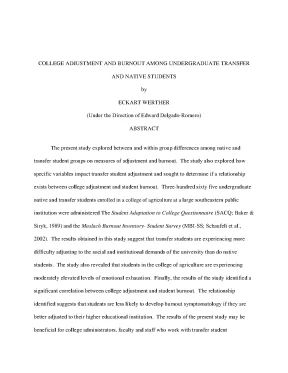
Tải xuống để đọc toàn bộCOLLEGE ADJUSTMENT AND BURNOUT AMONG UNDERGRADUATE TRANSFER AND NATIVE STUDENTS by ECKART WERTHER (Under the Direction of Edward Delgado-Romero) ABSTRACT The present study explored between and within group differences among native and transfer student groups on measures of adjustment and burnout. The study also explored how specific variables impact transfer student adjustment and sought to determine if a relationship exists between college adjustment and student burnout. Three-hundred sixty five undergraduate native and transfer students enrolled in a college of agriculture at a large southeastern public institution were administered The Student Adaptation to College Questionnaire (SACQ; Baker & Siryk, 1989) and the Maslach Burnout Inventory- Student Survey (MBI-SS; Schaufeli et al. The results obtained in this study suggest that transfer students are experiencing more difficulty adjusting to the social and institutional demands of the university than do native students.
The study also revealed that students in the college of agriculture are experiencing moderately elevated levels of emotional exhaustion. Finally, the results of the study identified a significant correlation between college adjustment and student burnout. The relationship identified suggests that students are less likely to develop burnout symptomatology if they are better adjusted to their higher educational institution. The results of the present study may be beneficial for college administrators, faculty and staff who work with transfer student populations.
The results could inform the development of programs and intervention strategies to use with students experiencing adjustment difficulties and/or symptoms of burnout. INDEX WORDS: Transfer students, college adjustment, student burnout, college student retention. COLLEGE ADJUSTMENT AND BURNOUT AMONG UNDERGRADUATE TRANSFER AND NATIVE STUDENTS by ECKART WERTHER B., University of North Alabama, 2001 M., Alabama A&M University, 2006 COLLEGE ADJUSTMENT AND BURNOUT AMONG UNDERGRADUATE TRANSFER AND NATIVE STUDENTS by ECKART WERTHER Major Professor: Edward A. Delgado-Romero Committee: Rosemary E.
Bertrand TABLE OF CONTENTS Page CHAPTER 1 INTRODUCTION .1 Statement of the Problem .13 Purpose of the Study .16 Definition of Terms.19 Research Questions and Hypotheses .22 Student Integration Model .22 Adjustment to College .26 College Student Adjustment and Burnout .30 College Student Enrollment Patterns .33 Reasons Students Transfer .35 Two-Year Institutions and Vertical Transfers .36 Transfer Student Adjustment and Burnout .39 3 METHODOLOGY AND PROCEDURES .44 iv Target Population .45 Data Collection Procedures.47 Methods of Data Analysis .53 Description of the Sample .59 5 SUMMARY, IMPLICATIONS, & COCLUSIONS .65 Summary of Findings.74 Recommendations for Future Research .100 D Informed Consent Statement .104 vi LIST OF TABLES Page Table 1 Gender of Participants .54 Table 2 Ethnic/Racial make-up of Participants .54 Table 3 Participant time at UGA and Class Standing .55 Table 4 Academic Probation Status of Participants .55 Table 5 Student Employment and Mean Hours Worked .55 Table 6 Transfer Status of Participants .56 Table 7 Transfer Student Gender, Race/Ethnicity, and Class Standing .57 Table 8 Transfer Student Time at UGA, Transfer Credit, and Transfer GPA .57 Table 9 Transfer Student Employment and Mean Hours Worked .58 Table 10 Means, Standard Deviations, and Alpha Values for SACQ and MBI-SS .59 Table 11 Adjustment and Burnout Differences Based on Student Type .61 Table 12 Adjustment and Burnout Differences Based on Academic Probation Status .63 Table 13 Correlation Coefficients for SACQ and MBI-SS .64 vii CHAPTER 1 INTRODUCTION Policymakers, institutional personnel, employers, and educational researchers at various levels in higher education have become increasingly concerned with the retention of students (Wlazelek & Coulter, 1999; Bean, 2001; Ishitani, 2008). Although there have been increases in undergraduate college enrollment and various retention strategies implemented, low rates of academic achievement and high levels of attrition persist (Devonport & Lane, 2006; Lloyd, Tienda, & Zajacova, 2001; Tinto, 1993, as cited in Hsieh, Sullivan, & Guerra, 2007). Academic achievement refers to a student’s performance in scholarly related activities, a student’s ability to obtain a high grade point average (GPA), and may include accomplishments such as graduation (Brown, Lent, & Larkin, 1989; Armstrong, 2006; Answers. In an effort to assure continued institutional support and flow of revenue from the payment of tuition, institutions of higher education seek to have low rates of attrition (Bean, 2001).
Twenty-to-thirty percent of students do not return following their first year in college and an additional 20-30 percent will not return after their second year (Grayson & Grayson ,2003; Hamilton & Hamilton, 2006). Some estimates suggest that as many as 50 percent of students who enter higher education never earn a degree (Seidman, 2005) and that attrition rates as high as 20 percent are not uncommon at many institutions (Gerds & Mallinckrodt, 1994). Attrition Student attrition in higher education is a complex problem involving the interaction of numerous variables. Due to the many different causes and forms of attrition, it is difficult to 1 clearly define (Edwards, Cangemi, & Kowalski, 1990; Polansky, Horan, & Hanish, 1993; McGrath & Braunstein, 1997).
Voluntary withdrawals, non-continuous enrollment, transferring to another institution, and/or academic failure are all considered to be a type of attrition (Wintre, Bowers, Gordner, & Lange, 2006; Ishitani, 2008). Due to these numerous forms of departure, attrition rates may group a diverse set of factors and/or populations which have very little in common. Tinto (1975) asserted that the inadequate definition of student departure has led to the lumping together of behaviors that are very different in character. Due to the many variables involved, attrition rates are misleading and may vary from one institution to the next (Astin, 1997; Grayson et al, 2003).
A better understanding of the factors that contribute to college success (and failure) is needed (Proctor et al, 2006). Factors impacting attrition Although high school GPA and standardized test scores have been traditionally used as predictors of college performance (Proctor et al., 2006), researchers have identified numerous factors that impact attrition and a student’s ability to succeed in college (Petry & Craft, 1976; Edwards, Cangemi, & Kowalski, 1990; Proctor, Prevatt, Adams, Hurst, & Petscher, 2006). Some have suggested that attrition rates may be attributed to one of three general factors: the failings of the student, the failing of the university, and/or a combination of both (Wintre et al, 2006).d) suggested that some of the key factors involved in attrition include: academic problems, lack of interest in the academic material, and psychological adjustment problems. Other factors that have been identified include self-efficacy, stress, anxiety, low motivation, emotional problems, and academic burnout (Moneta, 2011; Caballero-Domínguez, Hederich, & Palacio-Sañudo, 2010; Arias, Justo, & Mañas, 2010; Ong & Cheong, 2009; Pisarik, 2009; Ngai & Cheung, 2009; Asberg, Bowers, Renk & McKinney, 2008; Schwitzer & Choate, 2007; 2 Ramos-Sánchez & Nichols, 2007; Zajacova, Lynch, & Espenshade, 2005; Chemers, Hu & Garcia, 2001; Hirose, Wada & Watanabe, 1999; Anderson & Cole, 1988).
Edwards and colleagues, (1990) condensed the numerous factors believed to impact attrition into five general domains: personal, financial, emotional/psychological, environmental, and academic. Personal factors include personality characteristics, immaturity, attitude towards the institution, and low motivation. Solberg Nes and colleagues, (2009) as well as Balduf (2009) suggest that a student’s motivation and goal valuation are crucial factors in determining success. Lack of family or social/emotional support and other personal problems have also been suggested as factors that impact attrition rates (Mohr, Eiche, & Sedlacek, 1998; Dewitz, Woolsey, & Walsh, 2009).
Smith & Winterbottom (1970) found personality characteristics that seemed to be relevant factors involved in a college student’s academic success. In their study, students who experienced academic problems seemed indifferent to their plight and did not avail themselves to remedial services. In a separate examination of non-intellectual factors, it was suggested that students experiencing academic problems experienced difficulty accepting responsibility for their academic circumstances, were unwilling to accept that they were doing poorly, and lacked enthusiasm for their courses (Smith et al, 1970). Hsieh et al (2007) found that students experiencing difficulty expressed goals that were counterproductive to their efforts to succeed.
Financial factors in college such as tuition, financial aid, employment, student fees, and book and supply expenses are not uncommon in the lives of many college students. The cost of attending an institution of higher education has steadily risen over the past two decades (Bozick, 2007). Although college students have a number of options for financing their higher educational expenses, many don’t take full advantage of options such as government-sponsored 3 financial aid programs. Many times, college students rely on family, personal savings, and employment to fund their college education as opposed to federal grants and loans (Bozick, 2007).
There are various reasons why college students underutilize financial aid resources (American Council on Education, 2004). Some college students do not apply for financial aid despite being eligible, others may be unaware of the different types of financial aid available to them, and some do not apply because they believe that a college education is not affordable despite financial assistance (Bozick, 2007). Additionally, despite increases in funding to federal and state financial aid programs, these increases have not kept up with the pace of rising tuition and fees. Financial aid programs play a vital role in many students ability to pay for their education.
If the funding provided by these programs is not sufficient or if students are not able to access them, they many times turn to alternative resources to fund their educational and related expenses. One way that many students address their financial issues while in college is through employment. Riggert and colleagues (2006) reported that an estimated 80 percent of college students are employed while completing their undergraduate education. Students may take advantage of many on and off campus employment opportunities while in college.
While on- campus employment is federally funded and regulates the number of hours that students can work, off campus employment such as restaurants, department stores, and fast food locations do not. Pike and colleagues (2008) found a significant relationship between student employment and academic performance. Their study suggests that the number of hours a student spends working each week is correlated with their academic achievement. Pike and colleagues (2008) found that students who worked more than 20 hours per week earned substantially lower grades than students who did not work that many hours.
4 Emotional and psychological factors are also key variables that impact a college student’s ability to succeed. Factors such as feelings of homesickness, loneliness, low self-esteem, indecisiveness, reduced self-efficacy, stress, and high levels of anxiety have been found to impact attrition of college students (Gerdes et al., 1994; Daugherty & Lane,1999; Twenge, 2001; Brissette, Scheier, & Carver, 2002). Research suggests that students who struggle academically display increased levels of anxiety, problems with concentration, and many experience adjustment difficulties as they encounter the stressors of college (Proctor, Prevatt, Adams, Hurst, & Petscher, 2006; Pittman & Richmond, 2008). Elevated levels of stress is common among college student populations (Ong et al., 2009) and has been linked to various negative psychological symptoms such as anxiety and burnout (Moneta, 2011, Salanova, Schaufeli, Martínez, & Bresó, 2010, Pissarik, 2009).
Environmental factors are also considered to be instrumental due to the role they play in college student success (Astin, 1997). College students many times experience various difficulties as they engage with the organizational and pedagogical demands of the academic environment (Duchesne, Ratelle, Larose, & Guay, 2007). The literature provides an overwhelming amount of evidence regarding the environmental difficulties experienced by students enrolled in higher education and the potential negative consequences these difficulties may produce (Compas, Wagner, Salvin, & Vannatta, 1986; Pascarella & Terenzini, 1991; Rieke & Conn, 1994; Gerdes & Mallinckrodt, 1994; Brooks & DuBois, 1995; Pratt, Hunsberger, Pancer, Alisat, Bowers, Mackey, Osteniewicz, Rog, Terzian, & Thomas, 2000; Jackson & Finney, 2002; Lidy &Kahn, 2006). Some of the difficulties experienced many times include separation and restructuring of family or social networks; time management issues, adjustment problems, and conflicts between study and leisure activities.
These barriers may impact a 5 student’s social integration which has been cited as being a vital component of college student success (Braxton, Sullivan, & Johnson, 1997; Belch, Gebel, & Maas, 2001; Pascarella & Terenzini, 2005).
Nội dung được bảo vệ bản quyền — Tải xuống đầy đủ
Trích dẫn luận án này
Eckart Werther (n.d.). Hội nhập & Kiệt sức: Sinh viên Đại học Chuyển tiếp và Nội trú [Luận án tiến sĩ, University of Georgia]. LuanAn.net. https://luanan.net/quan-ly-giao-duc/hoi-nhap-kiet-suc-sinh-vien-dai-hoc-chuyen-tiep-noi-tru
Câu hỏi thường gặp
Luận án "Hội nhập & Kiệt sức: Sinh viên Đại học Chuyển tiếp và Nội trú" nghiên cứu về vấn đề gì?
Khám phá thách thức hội nhập và nguy cơ kiệt sức của sinh viên chuyển tiếp và nội trú đại học. Tìm hiểu chiến lược hỗ trợ và quản lý căng thẳng hiệu quả.
Luận án "Hội nhập & Kiệt sức: Sinh viên Đại học Chuyển tiếp và Nội trú" được bảo vệ tại trường nào?
Luận án này được bảo vệ tại University of Georgia.
Luận án "Hội nhập & Kiệt sức: Sinh viên Đại học Chuyển tiếp và Nội trú" thuộc chuyên ngành gì?
Luận án "Hội nhập & Kiệt sức: Sinh viên Đại học Chuyển tiếp và Nội trú" thuộc chuyên ngành Transfer students, college adjustment, student burnout, college student retention. Danh mục: Quản Lý Giáo Dục.
Luận án "Hội nhập & Kiệt sức: Sinh viên Đại học Chuyển tiếp và Nội trú" có bao nhiêu trang?
Luận án "Hội nhập & Kiệt sức: Sinh viên Đại học Chuyển tiếp và Nội trú" có 112 trang. Bạn có thể xem trước một phần tài liệu ngay trên trang web trước khi tải về.
Cách tải luận án "Hội nhập & Kiệt sức: Sinh viên Đại học Chuyển tiếp và Nội trú" về máy như thế nào?
Để tải luận án về máy, bạn nhấn nút "Tải xuống ngay" trên trang này, sau đó hoàn tất thanh toán phí lưu trữ. File sẽ được tải xuống ngay sau khi thanh toán thành công. Hỗ trợ qua Zalo: 0559 297 239.