Ba bài tiểu luận về tác động của chính sách phân bổ học sinh - Sun Jung Oh, Syracuse University
Luận án: Three essays on the impact of student assignment policies. Xem tóm tắt và tải về tại LuanAn.net
Năm xuất bản
Số trang
184
Thời gian đọc
28 phút
Lượt xem
1
Lượt tải
0
Phí lưu trữ
50 Point
Tổng quan nhanh
- Chủ đề:
- 1. Tác động chính sách phân bổ học sinh: Tổng quan nghiên cứu
- Số trang:
- 184 trang
- Trường:
- Syracuse University
- Chuyên ngành:
- Social Science
- Tác giả:
- Sun Jung Oh
- Năm:
- 2015
Tóm tắt nội dung luận án
I. Tác động chính sách phân bổ học sinh Tổng quan nghiên cứu
Luận văn này nghiên cứu chính sách phân bổ học sinh. Nó phân tích các tác động cụ thể. Luận văn gồm ba tiểu luận. Chúng xem xét cách các quy định định hình môi trường giáo dục. Nghiên cứu tập trung vào cả Hoa Kỳ và Hàn Quốc. Nó đưa ra cái nhìn đa chiều về chính sách giáo dục. Phân tích này rất quan trọng. Nó giúp hiểu rõ hơn về phân luồng học sinh và công bằng giáo dục.
1.1. Mục tiêu và phạm vi luận văn
Luận văn này bao gồm ba tiểu luận. Chúng nghiên cứu sâu rộng về chính sách phân bổ học sinh. Hai bài đầu tập trung vào bối cảnh Hoa Kỳ. Bài thứ ba phân tích chính sách ở Seoul, Hàn Quốc. Nghiên cứu đánh giá ảnh hưởng của các quy định tuyển sinh đầu cấp. Nó xem xét các thay đổi trong hệ thống giáo dục. Mục tiêu là cung cấp bằng chứng thực nghiệm.
1.2. Ba tiểu luận trọng tâm Phân tích sâu sắc
Tiểu luận 1 và 2 điều tra tác động của việc loại bỏ kế hoạch giải trừ phân biệt trường học tại Mỹ. Chúng kiểm tra sự phân biệt chủng tộc. Chúng cũng đánh giá tỷ lệ lưu ban lớp chín. Tiểu luận 3 xem xét chính sách lựa chọn trường học ở Seoul. Nó tập trung vào sự phân hóa năng lực học sinh. Các tiểu luận này cung cấp phân tích chi tiết. Chúng làm rõ nhiều khía cạnh của quản lý giáo dục.
1.3. Bối cảnh nghiên cứu Mỹ và Hàn Quốc
Mỹ đã chứng kiến nhiều khu học chánh được miễn lệnh tòa về giải trừ phân biệt. Điều này dẫn đến các điều chỉnh chính sách. Seoul, Hàn Quốc thay thế việc phân bổ ngẫu nhiên bằng lựa chọn trường học. Các bối cảnh khác nhau này cung cấp dữ liệu phong phú. Chúng cho phép so sánh các tác động chính sách. Mỗi bối cảnh có đặc điểm riêng. Điều này làm tăng giá trị của nghiên cứu.
II. Thay đổi chính sách giáo dục Mỹ Phân biệt chủng tộc
Hoa Kỳ đã trải qua nhiều thay đổi lớn trong chính sách giáo dục. Một nửa số khu học chánh từng chịu lệnh tòa về giải trừ phân biệt đã được miễn. Điều này dẫn đến việc sửa đổi các kế hoạch phân bổ học sinh. Những kế hoạch này trước đây nhằm mục đích tích hợp các trường công. Các thay đổi này có tác động rõ rệt đến sự phân hóa chủng tộc. Nghiên cứu đánh giá các hệ quả này. Nó quan trọng cho công bằng giáo dục.
2.1. Bãi bỏ lệnh giải trừ phân biệt trường học
Trong hai thập kỷ qua, nhiều khu học chánh Hoa Kỳ đã được giải tỏa. Họ không còn chịu các lệnh tòa về giải trừ phân biệt. Điều này cho phép họ thay đổi chính sách phân luồng học sinh. Các kế hoạch ban đầu được thiết lập để hội nhập chủng tộc. Việc loại bỏ các lệnh này tạo ra các chính sách tuyển sinh mới.
2.2. Ảnh hưởng đến sự phân hóa chủng tộc
Phân tích dữ liệu từ năm 1988 đến 2012 cho thấy. Các thay đổi gần đây trong kế hoạch phân bổ học sinh gây ra sự tăng nhẹ. Sự tăng này là về phân biệt chủng tộc tại trường học. Khoảng 100 khu học chánh đã được nghiên cứu. Kết quả này đặt ra câu hỏi về tiến bộ công bằng giáo dục. Nó ảnh hưởng đến chất lượng giáo dục cho các nhóm khác nhau.
2.3. Các loại thay đổi chính sách phân luồng học sinh
Kết quả phân tích bổ sung chỉ ra. Hiệu ứng tổng thể đến sự phân biệt trường học do các khu học chánh. Các khu này thay thế kế hoạch giải trừ phân biệt bằng kế hoạch phân bổ theo khu vực lân cận. Các khu áp dụng yếu tố kinh tế xã hội không tăng phân biệt. Việc mở rộng lựa chọn trường học cũng không làm tăng sự phân biệt. Điều này cung cấp hướng đi cho tiêu chí tuyển sinh trong tương lai.
III. Hậu quả chính sách tuyển sinh Tỷ lệ lưu ban lớp 9
Chính sách phân bổ học sinh không chỉ ảnh hưởng đến sự phân biệt. Nó còn có tác động đáng kể đến kết quả học tập của học sinh. Một trong những chỉ số quan trọng là tỷ lệ lưu ban. Nghiên cứu này tập trung vào tỷ lệ lưu ban lớp chín ở Hoa Kỳ. Nó khám phá mối liên hệ giữa việc loại bỏ các chính sách giải trừ phân biệt và tỷ lệ lưu ban. Các phát hiện có ý nghĩa lớn đối với chất lượng giáo dục và hệ thống giáo dục.
3.1. Phân tích dữ liệu học sinh Hoa Kỳ
Nghiên cứu sử dụng dữ liệu từ năm 1988 đến 2012. Nó kiểm tra tác động của việc thay đổi kế hoạch giải trừ phân biệt. Kết quả cho thấy việc loại bỏ các kế hoạch này gây ra sự tăng đáng kể về mặt thống kê. Sự tăng này là tỷ lệ lưu ban lớp chín. Tỷ lệ tăng khoảng 0.1 điểm phần trăm. Đây là một vấn đề quan trọng trong quản lý giáo dục.
3.2. Mối liên hệ với sự phân biệt chủng tộc
Tác động đến tỷ lệ lưu ban lớp chín chủ yếu do các khu học chánh. Đó là những nơi sự phân biệt trường học tăng đáng kể. Điều này do các thay đổi trong chính sách giải trừ phân biệt. Điều này gợi ý một mối liên hệ chặt chẽ. Sự phân hóa học sinh có thể dẫn đến kết quả học tập kém hơn. Nó ảnh hưởng trực tiếp đến chất lượng giáo dục.
3.3. Không ảnh hưởng di chuyển học sinh
Nghiên cứu không tìm thấy bằng chứng. Các thay đổi chính sách giải trừ phân biệt không ảnh hưởng sự di chuyển của học sinh. Học sinh không chuyển từ các khu vực khác. Học sinh cũng không chuyển từ trường tư thục. Điều này cho thấy tác động chủ yếu là nội tại. Nó tác động đến các học sinh hiện có trong hệ thống giáo dục công.
IV. Chính sách tuyển sinh đầu cấp Seoul Phân hóa năng lực
Seoul, Hàn Quốc đã trải qua một sự thay đổi đáng kể trong chính sách tuyển sinh. Từ hệ thống phân bổ ngẫu nhiên, thành phố chuyển sang chính sách lựa chọn trường học. Thay đổi này cung cấp một cơ hội độc đáo để nghiên cứu. Nó đánh giá tác động của lựa chọn trường. Nó tập trung vào sự phân hóa học sinh theo cấp độ năng lực học tập. Phát hiện này có ý nghĩa rộng lớn. Nó áp dụng cho các hệ thống giáo dục trên toàn thế giới.
4.1. Chuyển đổi từ phân bổ ngẫu nhiên sang lựa chọn
Năm 2010, Seoul, Hàn Quốc thay thế chính sách phân bổ ngẫu nhiên. Chính sách lựa chọn trường học được áp dụng. Điều này cho phép học sinh và phụ huynh có tiếng nói. Họ chọn trường phù hợp. Sự thay đổi này tạo ra một mô hình tuyển sinh mới. Nó ảnh hưởng đến cấu trúc học sinh của các trường.
4.2. Tác động đến sự phân hóa học lực học sinh
Sau khi thực hiện chính sách lựa chọn trường học, các trường học trở nên phân hóa. Sự phân hóa này dựa trên cấp độ năng lực học tập của học sinh. Học sinh có kết quả cao có xu hướng tập trung. Học sinh có kết quả thấp cũng vậy. Điều này tạo ra sự khác biệt rõ rệt giữa các trường. Nó ảnh hưởng đến chất lượng giáo dục tổng thể.
4.3. Trường hợp quốc gia đồng nhất về chủng tộc
Kết quả nghiên cứu này rất quan trọng. Nó cho thấy lựa chọn trường học làm tăng sự phân hóa. Sự phân hóa này dựa trên năng lực học tập. Điều này xảy ra ngay cả ở một quốc gia đồng nhất về chủng tộc như Hàn Quốc. Phát hiện này gợi ý các vấn đề tiềm ẩn. Nó liên quan đến công bằng giáo dục và phân luồng học sinh. Nó cần được quản lý giáo dục xem xét cẩn thận.
V. Hàm ý chính sách giáo dục Công bằng và chất lượng
Các kết quả từ ba tiểu luận này cung cấp những hiểu biết sâu sắc. Chúng có ý nghĩa quan trọng đối với việc xây dựng chính sách giáo dục. Mục tiêu của mọi hệ thống giáo dục là đảm bảo công bằng và chất lượng. Các nhà hoạch định chính sách cần xem xét cẩn thận các tác động. Các tác động của chính sách phân bổ học sinh cần được đánh giá kỹ lưỡng. Điều này đặc biệt đúng với tiêu chí tuyển sinh và phân bổ nguồn lực giáo dục.
5.1. Thách thức phân bổ nguồn lực giáo dục công bằng
Kết quả nghiên cứu chỉ ra sự phân hóa học sinh. Sự phân hóa này có thể tăng lên do chính sách. Điều này đặt ra thách thức lớn. Nó liên quan đến việc phân bổ nguồn lực giáo dục một cách công bằng. Các nguồn lực phải được sử dụng hiệu quả. Chúng phải hỗ trợ tất cả các nhóm học sinh. Mục tiêu là giảm thiểu khoảng cách giáo dục.
5.2. Vai trò tiêu chí tuyển sinh trong quản lý giáo dục
Tiêu chí tuyển sinh đóng một vai trò trung tâm. Chúng định hình cấu trúc học sinh của từng trường. Chính sách cần cân nhắc kỹ lưỡng các tiêu chí này. Ví dụ, việc sử dụng yếu tố kinh tế xã hội có thể thay thế yếu tố chủng tộc. Lựa chọn trường học cần có giới hạn nhất định. Điều này nhằm đảm bảo công bằng giáo dục. Quản lý giáo dục cần có sự linh hoạt.
5.3. Định hướng cải cách hệ thống giáo dục quốc gia
Các chính sách phân bổ học sinh cần được thiết kế cẩn thận. Mục tiêu là giảm thiểu sự phân hóa. Đồng thời duy trì hoặc cải thiện chất lượng giáo dục. Hệ thống giáo dục cần hướng tới toàn diện. Các cải cách phải đảm bảo cơ hội bình đẳng cho mọi học sinh. Điều này rất quan trọng cho sự phát triển bền vững của quốc gia.
Tải xuống file đầy đủ để xem toàn bộ nội dung
Tải đầy đủ (184 trang)Trích đoạn nội dung luận án
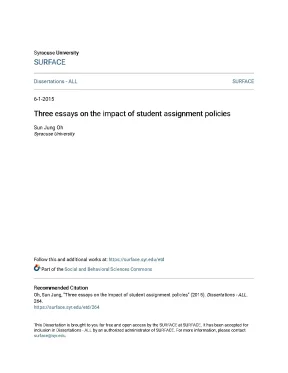
Tải xuống để đọc toàn bộSyracuse University SURFACE Dissertations - ALL SURFACE 6-1-2015 Three essays on the impact of student assignment policies Sun Jung Oh Syracuse University Follow this and additional works at: https://surface.edu/etd Part of the Social and Behavioral Sciences Commons Recommended Citation Oh, Sun Jung, "Three essays on the impact of student assignment policies" (2015).edu/etd/264 This Dissertation is brought to you for free and open access by the SURFACE at SURFACE. It has been accepted for inclusion in Dissertations - ALL by an authorized administrator of SURFACE. For more information, please contact surface@syr. Abstract This dissertation is comprised of three essays, which study the impact of student assignment policies.
The first two papers investigate the impacts of the removal of school desegregation plans on school racial segregation and on ninth grade repetition rates in the U. The third paper examines the impact of the school choice policy in Seoul, Korea on school segregation by academic performance levels. Over the last two decades, half of school districts that were subject to court desegregation orders in the U. were released from those court orders.
In response, many school districts modified student assignment plans that had been adopted to integrate public schools. Chapter 1 documents the changes in school desegregation plans and examines the effect of the changes on racial school segregation in approximately 100 school districts. Analysis of student enrollment data from 1988 to 2012 suggests that recent changes in student assignment plans caused a moderate increase in school racial segregation. The results of additional analysis of the types of policy changes suggest that the overall effect on school segregation is driven by the school districts that replaced school desegregation plans with neighborhood-based assignment plans.
Districts that replaced race considerations with socioeconomic factors and that expanded school choice options did not experience an increase in school segregation. Chapter 2 examines the impact of the changes in school desegregation plans documented in the Chapter 1 on ninth grade repetition rates in the same districts. Analysis of data from 1988 to 2012 suggests that the removal of school desegregation plans caused a statistically significant increase in the ninth grade repetition rates of about 0. I also find that the impact on the ninth grade repetition rates is driven by the school districts where school segregation was substantially increased due to the changes in desegregation policies.
The impact on the ninth grade repetition rate is driven by the school districts where school segregation was substantially increased by the changes in desegregation policies. In addition, I find no evidence that the desegregation policy changes affect student movements from other districts or private schools. Chapter 3 examines the impact of school choice policy in Seoul, Korea on school segregation by student performance levels. Seoul, Korea replaced random assignment of schools with school choice in 2010.
By exploiting the policy change, this paper examines the effect of school choice on student sorting by ability. I find that schools became segregated by student performance levels following the implementation of the school choice policy in Seoul. The results of this paper suggest that school choice increases school segregation by academic performance levels even in a racially homogenous country. THREE ESSAYS ON THE IMPACT OF STUDENT ASSIGNMENT POLICIES by Sun Jung Oh M., Syracuse University, 2011 Dissertation Submitted in partial fulfillment of the requirements for the degree of Doctor of Philosophy in Social Science.
Syracuse University June 2015 Copyright © Sun Jung Oh 2015 All Rights Reserved Acknowledgements This research was supported by a grant from the American Educational Research Association which receives funds for its "AERA Grants Program" from the National Science Foundation under Grant #DRL-0941014. Opinions reflect those of the author and do not necessarily reflect those of the granting agencies. I thank faculty members and friends at Syracuse University and my family and friends in Korea for their support. I especially thank Dr.
Robert Bifulco Jr. Yinger for their comments on my dissertation. All errors are my own. v Table of Contents Chapter 1.
The end of school desegregation plans: Policy changes and school segregation 1.3 Types of Policy changes ………………………………………………………………….2 School Segregation by School Types ……………………………………………….3 Robustness and Sensitivity Checks …………………………………………………. The impact of ending school desegregation plans on ninth grade repetition rates 2.2 School Segregation and Ninth Grade Repetition Rates……………………………….3 Ruling out Alternative Explanations ………………………………………………… 69 2. Effects of school choice on student sorting by ability: Evidence from Seoul, Korea 3.1 Test of Within-Attendance Zone Balance in Student Distribution in 2009………….2 Effects of Autonomous School Opening on Elite Students’ Movement ……………. 123 Appendix A Bibliography and Details of Changes in School Desegregation Plans ……….… 138 vii List of Tables Table 1-1 List of Sample Districts and Major Policy Changes since 1990 …………….
36 Table 1-2 Baseline Statistics of Sample Districts …………………………………………. 38 Figure 1-1 Trends in School Segregation ……………………………………………………. 39 Table 1-3 Estimated Effects on School Segregation ………………………………………. 40 Table 1-4 Estimated Effects on School Segregation by School Types …………………….
41 Table 1-5 Estimated Effects on School Segregation: Within-group Analysis ………………. 42 Table 1-6 Estimated Effects on School Segregation – Sensitivity Checks …………………. 43 Table 1-7 Estimated Effects on School Segregation – Alternative Classification …………… 44 Table 1-8 Estimated Effects on School Segregation with Alternative Length of Time Period .45 Table 2-1 List of Sample Districts and Major Policy Changes since 1990 …………………. 81 Table 2-2 Baseline Statistics of Sample Districts …………………………………………….
83 Table 2-3 Estimated Effects on 9th Grade Repetition Rates …………………………………. 84 Table 2-4 Estimated Effects on 9th Grade Repetition Rates – Alternative Specification ….… 85 Table 2-5 Estimated Effects on 9th Grade Repetition Rates by School Segregation Impact. 86 Table 2-6 Estimated Effects on Public School Enrollment by Race …………………………. 87 Table 2-7 Estimated Effects on Public School Enrollment by Grade ……………………….
88 Table 2-8 Estimated Effects on Private School Enrollment by Grade ……………………. 89 Table 2-9 Estimated Effects on 9th Grade Repetition Rates by the Number of Schools …. 90 Table 2-10 Estimated Effects on 9th Grade Repetition Rates – Tests of Bias by Other Events. 91 Figure 3-1 School and Administrative Districts in Seoul (2009).
125 Figure 3-2 Student Random Assignment Mechanisms (2009) ……………………. 126 Table 3-1 List of Attendance Zones in Seoul and High School Characteristics in 2009 .…… 127 Table 3-2 Changes in School Segregation ……………………. 128 Table 3-3 Average Oversubscription Rates of Each Attendance Zone by School Types (2010) 129 Table 3-4 Tests of Within-Attendance Zone Balance in Baseline Achievement (2009) ……. 130 Table 3-5 Changes in Proportions of the Upper-ranked Students between 2009 and 2010.
131 Table 3-6 Estimated Effects on School Segregation by Student Academic Performance …. 132 Table 3-7 Estimated Effects on School Segregation using Greater Attendance Zones …….… 133 Table 3-8 Estimated Effects on School Segregation using Smaller Attendance Zones …. 134 Table 3-9 Estimated Effects on School Segregation by Free Lunch Eligibility ……………… 135 Table 3-10 School Characteristics by High School Attendance Zones in Seoul (2009). 136 Table 3-11 Estimated Effects on Oversubscription Rates ………….
The end of school desegregation plans: Policy changes and school segregation 1. Introduction Over the last two decades, half of the school districts that were ever under court desegregation orders have been released from their obligation to maintain desegregated schools (Reardon, Grewal, Kalogrides, & Greenberg, 2012).1 A number of studies have found racial segregation across schools within a district tends to increase following the district’s release from desegregation court orders (Clotfelter, Vigdor, & Ladd, 2006; Lutz, 2011; Orfield & Eaton, 1996; Reardon et al. A small number of studies have also examined the effect of these changes on residential location patterns (Billings, Deming, & Rockoff, 2014; Liebowitz & Page, 2014; Lutz, 2011; Weinstein, 2013). No studies find any impact of these changes on residential segregation, but Lutz (2011) and Liebowitz and Page (2014) find residential movements of whites into the districts that removed desegregation plans and into whiter school attendance zones within the same district, respectively.
In addition to the impact on segregation, studies have found that the recent changes in school desegregation plans negatively affect student outcomes. Billings et al. (2014) find that the end of race-based busing in Charlotte-Mecklenburg, North Carolina negatively affects high school test scores for both white and minority students, high school graduation and four-year college attendance for whites, and crime rates for minority males in majority-minority schools. Using approximately 100 school districts, Lutz (2011) also finds that dismissal of a court order leads to small increases in black dropout rates in non-Southern districts.
Oh (2015) finds that the 1 According to Reardon et al. (2012), 754 districts with enrollments greater than 2,000 were subject to court desegregation orders. Among these districts, 372 were released from the orders. Four school districts that were identified as being under court orders as of early 2009 by Reardon et al.
2 recent changes in school desegregation increase the ninth grade repetition rate which is closely related to high school dropout rates. Previous studies that examined a large number of districts focus solely on court rulings that release districts from desegregation requirements, so they may provide a limited view of the effects of changes in school desegregation plans. First, the changes in school desegregation plans associated with court rulings have been quite varied, and subsequent effects on segregation are likely to depend on the nature of these changes. Examining the average effect of being released from school desegregation orders ignores the differences in student assignment plans adopted by school districts, so focusing on the average effect may miss important policy implications.
Second, because the timing of court rulings is often not contemporaneous with changes in school desegregation plans, focusing on court rulings can provide misleading estimates of the effects of these changes. There can be a substantial time gap between the year of the court decision and the changes in school desegregation plans. Initial desegregation plans were often implemented closely after desegregation court orders. Nonetheless, most studies use variation in the years that major school desegregation plans were implemented rather than the years of initial desegregation orders in order to identify the effect of school desegregation (Baum-Snow & Lutz, 2011; Guryan, 2004; Reber, 2005; Weiner, Lutz, & Ludwig, 2009).
However, despite a much weaker connection between the timing of court decisions that release a district from school desegregation obligations and the removal of desegregation plans, studies that examined re-segregation have relied solely on variation in the year of the court decision to identify policy effects (Clotfelter et al., 2006; Lutz, 2011; Reardon et al. This paper extends previous studies examining the effects of ending court desegregation orders on school segregation in two ways. First, based on in-depth archival research of roughly 3 100 school districts, I document the year of the major changes in school desegregation plans and classify the types of the policy changes that occurred following release from court-ordered desegregation plans or under continuing desegregation obligations. Second, I examine how ending school desegregation plans has affected school segregation, and whether these effects depend on the type of school assignment policies adopted.
In the sample districts examined here, the most common change to student assignment policies is that school districts ended cross-town busing plans and started assigning students to neighborhood schools. A second, smaller set of school districts have replaced student assignment plans designed to promote racial balance across schools with the plans designed to promote balance on socioeconomic (SES) factors. A third set of districts have responded to being released from desegregation obligations by expanding parent’s opportunities to choose the public school their child attends (e., open enrollment plans, interdistrict transfers, and specialized magnet schools). Existing research does not tell us how these various types of changes in student assignment policies are likely to influence racial segregation across schools.
Many have feared that a return to neighborhood assignment policies would lead to the re-segregation of schools by race (Orfield & Eaton, 1996). Studies, however, have tended not to clearly distinguish neighborhood assignment policies from other types of policy changes.
Nội dung được bảo vệ bản quyền — Tải xuống đầy đủ
Trích dẫn luận án này
Sun Jung Oh (2015). Ba bài tiểu luận về chính sách phân bổ học sinh [Luận án tiến sĩ, Syracuse University]. LuanAn.net. https://luanan.net/quan-ly-giao-duc/ba-bai-tieu-luan-tac-dong-chinh-sach-phan-bo-hoc-sinh
Câu hỏi thường gặp
Luận án "Ba bài tiểu luận về chính sách phân bổ học sinh" nghiên cứu về vấn đề gì?
Luận án: Three essays on the impact of student assignment policies. Xem tóm tắt và tải về tại LuanAn.net
Luận án "Ba bài tiểu luận về chính sách phân bổ học sinh" được bảo vệ tại trường nào?
Luận án này được bảo vệ tại Syracuse University. Năm bảo vệ: 2015.
Luận án "Ba bài tiểu luận về chính sách phân bổ học sinh" thuộc chuyên ngành gì?
Luận án "Ba bài tiểu luận về chính sách phân bổ học sinh" thuộc chuyên ngành Social Science. Danh mục: Quản Lý Giáo Dục.
Luận án "Ba bài tiểu luận về chính sách phân bổ học sinh" có bao nhiêu trang?
Luận án "Ba bài tiểu luận về chính sách phân bổ học sinh" có 184 trang. Bạn có thể xem trước một phần tài liệu ngay trên trang web trước khi tải về.
Cách tải luận án "Ba bài tiểu luận về chính sách phân bổ học sinh" về máy như thế nào?
Để tải luận án về máy, bạn nhấn nút "Tải xuống ngay" trên trang này, sau đó hoàn tất thanh toán phí lưu trữ. File sẽ được tải xuống ngay sau khi thanh toán thành công. Hỗ trợ qua Zalo: 0559 297 239.