How global are global history teachers secondary social studie
Khám phá phạm vi toàn cầu của giáo viên lịch sử thế giới ở bậc trung học. Tìm hiểu cách họ giảng dạy môn khoa học xã hội.
Teaching and Curriculum (Education)
Luan An
Luận án tiến sĩ
Năm xuất bản
Số trang
253
Thời gian đọc
38 phút
Lượt xem
0
Lượt tải
0
Phí lưu trữ
50 Point
Tổng quan nhanh
- Chủ đề:
- Đánh giá Năng lực Giáo viên Lịch sử Toàn cầu THPT
- Số trang:
- 253 trang
- Trường:
- Syracuse University
- Chuyên ngành:
- Teaching and Curriculum (Education)
- Tác giả:
- Ardyth L. Watson
- Năm:
- 2015
Tóm tắt nội dung luận án
I.Đánh giá Năng lực Giáo viên Lịch sử Toàn cầu THPT
Nghiên cứu này đánh giá mức độ nhận thức toàn cầu của giáo viên lịch sử cấp trung học. Tài liệu gốc chỉ ra rằng giáo dục và kỹ năng toàn cầu vẫn còn hạn chế trong chương trình môn xã hội học, dù lịch sử toàn cầu đã được đưa vào. Sự thiếu hụt này gây ảnh hưởng tiêu cực đến nhận thức toàn cầu của học sinh Mỹ. Giáo viên lịch sử toàn cầu đóng vai trò then chốt trong việc truyền đạt nội dung toàn cầu. Tuy nhiên, bản thân giáo viên có thể thiếu nhận thức toàn cầu và kinh nghiệm liên văn hóa. Những hạn chế này trực tiếp tác động đến phương pháp giảng dạy lịch sử toàn cầu. Nghiên cứu khảo sát cách tám giáo viên lịch sử toàn cầu ở vùng thượng New York xây dựng nhận thức toàn cầu và nội dung giảng dạy của họ.
1.1. Thực trạng nhận thức toàn cầu của giáo viên
Mức độ nhận thức toàn cầu của giáo viên lịch sử trung học còn chưa đồng đều. Giáo viên đóng vai trò quan trọng trong việc tăng cường nhận thức toàn cầu của học sinh. Tuy nhiên, nhiều giáo viên có thể có nhận thức toàn cầu và kinh nghiệm liên văn hóa hạn chế. Những hạn chế này trực tiếp tác động đến cách giảng dạy. Đây là một thách thức lớn đối với teacher preparedness trong bối cảnh secondary social studies education.
1.2. Mối liên hệ giữa kinh nghiệm và cách giảng dạy
Kinh nghiệm cá nhân của giáo viên định hình sâu sắc quan điểm thế giới của họ. Các yếu tố như giáo dục, tương tác đa văn hóa, trải nghiệm du lịch, ảnh hưởng từ truyền thông và trách nhiệm nghề nghiệp đều đóng góp. Những yếu tố này ảnh hưởng đến việc lựa chọn nội dung và cách tiếp cận giảng dạy. Mối liên hệ này cho thấy tầm quan trọng của việc mở rộng trải nghiệm cho giáo viên nhằm nâng cao pedagogy for global history.
1.3. Khoảng trống trong kỹ năng giáo dục toàn cầu
Mặc dù một số yếu tố giáo dục toàn cầu được lồng ghép, nhưng sự hiểu biết của giáo viên về giáo dục toàn cầu và nhận thức văn hóa thường chưa đầy đủ. Ngôn ngữ mà giáo viên sử dụng trong nhiều trường hợp bộc lộ sự hiểu biết chưa hoàn thiện. Khoảng trống này cần được khắc phục thông qua các chương trình phát triển chuyên môn. Điều này là cần thiết để đảm bảo học sinh phát triển đầy đủ global competencies.
II.Nâng cao Hiểu biết Toàn cầu và Nhận thức Giáo dục
Nghiên cứu làm rõ cách giáo viên xây dựng nhận thức toàn cầu và tác động của nó. Quan điểm thế giới của giáo viên là những cấu trúc đang phát triển. Chúng bị ảnh hưởng bởi nhiều yếu tố từ kinh nghiệm cá nhân đến trách nhiệm nghề nghiệp. Các yếu tố giáo dục toàn cầu được tích hợp vào giảng dạy, nhưng không đồng đều. Điều này bao gồm các kết nối địa phương/toàn cầu, ý thức về các quan điểm và sự nhạy cảm văn hóa. Tuy nhiên, ngôn ngữ của giáo viên thường bộc lộ sự hiểu biết chưa đầy đủ về giáo dục toàn cầu và nhận thức văn hóa. Cần có những nỗ lực để nâng cao hiểu biết này.
2.1. Quá trình hình thành quan điểm thế giới của giáo viên
Quan điểm thế giới của giáo viên là một cấu trúc động. Nó được định hình bởi upbringing, tương tác đa văn hóa, trải nghiệm du lịch, ảnh hưởng truyền thông và trách nhiệm nghề nghiệp. Những yếu tố này tạo nên nền tảng cho sự hiểu biết của giáo viên về thế giới. Chúng ảnh hưởng đến cách họ tiếp cận các chủ đề toàn cầu, đặc biệt là trong global citizenship education.
2.2. Sự lồng ghép yếu tố giáo dục toàn cầu
Các yếu tố giáo dục toàn cầu được lồng ghép vào giảng dạy, bao gồm các kết nối địa phương/toàn cầu, ý thức về các quan điểm và sự nhạy cảm văn hóa. Điều này hỗ trợ phát triển intercultural competence. Tuy nhiên, sự lồng ghép này không nhất quán giữa các giáo viên, cho thấy sự cần thiết của hướng dẫn rõ ràng hơn về pedagogy for global history.
2.3. Hạn chế trong cách diễn đạt và nhận thức
Ngôn ngữ của giáo viên thường bộc lộ sự hiểu biết chưa hoàn chỉnh về giáo dục toàn cầu và nhận thức văn hóa. Những hạn chế này có thể ảnh hưởng đến cách học sinh tiếp thu và hiểu các khái niệm phức tạp. Việc đào tạo chuyên sâu là cần thiết để củng cố nhận thức và kỹ năng. Điều này giúp đảm bảo giáo viên truyền đạt kiến thức một cách chính xác, hỗ trợ phát triển global competencies.
III.Ảnh hưởng Thừa kế Thuộc địa trong Giáo dục Lịch sử
Nghiên cứu sử dụng khung lý thuyết về chủ nghĩa thuộc địa và hậu thuộc địa để phân tích quan điểm của giáo viên. Kết quả chỉ ra rằng các yếu tố của chủ nghĩa thuộc địa, chủ nghĩa bản chất và chủ nghĩa đặc biệt Mỹ được thách thức và củng cố đồng thời. Điều này thể hiện sự phức tạp trong cách giáo viên hiểu và trình bày lịch sử toàn cầu. Những quan điểm này ảnh hưởng đến nội dung lịch sử được chọn và cách học sinh tiếp thu. Cần có sự nhận thức rõ ràng về những thành kiến tiềm ẩn này để đảm bảo một nền giáo dục công bằng và toàn diện.
3.1. Phân tích quan điểm giáo viên về chủ nghĩa thuộc địa
Khung lý thuyết về chủ nghĩa thuộc địa và hậu thuộc địa giúp phân tích cách giáo viên nhìn nhận lịch sử. Giáo viên phải đối mặt với việc giảng dạy một lịch sử thường được viết từ góc độ phương Tây. Điều này đòi hỏi sự suy nghĩ sâu sắc về cách trình bày các sự kiện. Việc này góp phần vào việc decolonizing history trong chương trình giảng dạy.
3.2. Hiện diện của chủ nghĩa bản chất và đặc biệt Mỹ
Các yếu tố của chủ nghĩa bản chất và chủ nghĩa đặc biệt Mỹ xuất hiện trong cách giáo viên nói về hiểu biết toàn cầu. Chủ nghĩa bản chất đơn giản hóa các nền văn hóa. Chủ nghĩa đặc biệt Mỹ định vị trải nghiệm của Mỹ là vượt trội. Những quan điểm này ảnh hưởng đến nội dung lịch sử và cách truyền đạt. Giáo viên cần nhận thức về những thành kiến tiềm ẩn này để giảng dạy hiệu quả trong secondary social studies education.
3.3. Tác động đến nội dung lịch sử và học sinh
Những quan điểm này có tác động trực tiếp đến nội dung lịch sử và sự hiểu biết của học sinh. Việc thiếu xem xét kỹ lưỡng các thành kiến này có thể dẫn đến hiểu lầm. Học sinh có thể bỏ lỡ những sắc thái quan trọng của lịch sử thế giới. Điều này ảnh hưởng đến khả năng phát triển global competencies. Curriculum development cần tập trung vào việc tạo ra một cái nhìn cân bằng và đa chiều.
IV.Phát triển Năng lực Toàn cầu qua Chương trình Giảng dạy
Nghiên cứu nhận thấy giáo viên đã lồng ghép các kết nối địa phương và toàn cầu vào giảng dạy. Cách tiếp cận này giúp học sinh thấy sự liên quan của các sự kiện toàn cầu đối với cuộc sống hàng ngày, thúc đẩy hiểu biết sâu sắc hơn. Giáo viên khuyến khích học sinh phát triển ý thức về các quan điểm khác nhau, từ đó thúc đẩy tư duy phản biện và intercultural competence. Sự nhạy cảm văn hóa cũng là một yếu tố được tích hợp. Điều này bao gồm việc nhận thức và tôn trọng sự đa dạng văn hóa. Những nỗ lực này là nền tảng để xây dựng global competencies cho học sinh.
4.1. Lồng ghép kết nối địa phương và toàn cầu
Giáo viên lồng ghép các kết nối giữa địa phương và toàn cầu. Điều này giúp học sinh thấy mối liên hệ của các sự kiện toàn cầu với cuộc sống hàng ngày. Cách tiếp cận này thúc đẩy sự hiểu biết sâu sắc hơn về thế giới. Nó củng cố nhận thức về sự phụ thuộc lẫn nhau, một khía cạnh quan trọng của pedagogy for global history.
4.2. Khuyến khích ý thức về các quan điểm
Việc khuyến khích học sinh phát triển ý thức về các quan điểm khác nhau là thiết yếu. Giáo viên tạo cơ hội cho học sinh xem xét các sự kiện từ nhiều góc độ. Điều này thúc đẩy tư duy phản biện và intercultural competence. Hiểu rằng các nền văn hóa khác nhau có quan điểm riêng là cần thiết cho global citizenship education.
4.3. Nâng cao sự nhạy cảm văn hóa
Sự nhạy cảm văn hóa được lồng ghép vào giảng dạy. Điều này bao gồm nhận thức và tôn trọng sự đa dạng văn hóa. Giáo viên giúp học sinh phát triển lòng trắc ẩn và hiểu biết. Mục tiêu là để học sinh tương tác hiệu quả hơn trong một thế giới đa dạng. Nâng cao sự nhạy cảm văn hóa là một phần không thể thiếu của việc xây dựng global competencies.
V.Cải thiện Chương trình Lịch sử Thế giới Chuẩn bị Giáo viên
Nghiên cứu chỉ ra những thiếu sót trong việc tích hợp giáo dục toàn cầu. Cần có các chiến lược cụ thể để khắc phục những khoảng trống này. Điều này bao gồm việc cập nhật liên tục world history curriculum. Giáo dục toàn cầu cần được coi là một yếu tố cốt lõi, không phải là một phần bổ sung. Nghiên cứu cũng đưa ra bằng chứng cho thấy sự cần thiết của đào tạo chuyên sâu cho giáo viên. Các chương trình phát triển chuyên môn nên tập trung vào việc nâng cao nhận thức toàn cầu và intercultural competence. Kết quả nghiên cứu cung cấp định hướng cho việc phát triển chương trình giảng dạy toàn diện hơn. Chương trình cần tích hợp mạnh mẽ hơn các yếu tố giáo dục toàn cầu và global competencies.
5.1. Khắc phục thiếu sót trong giáo dục toàn cầu
Cần có các chiến lược cụ thể để khắc phục những thiếu sót trong giáo dục toàn cầu. Đảm bảo giáo viên có kiến thức và kỹ năng toàn diện là rất quan trọng. Việc cập nhật world history curriculum liên tục là cần thiết. Giáo dục toàn cầu phải là một yếu tố cốt lõi. Nỗ lực tập trung vào curriculum development có thể giải quyết vấn đề này.
5.2. Đề xuất đào tạo chuyên sâu cho giáo viên
Nghiên cứu nhấn mạnh sự cần thiết của đào tạo chuyên sâu cho giáo viên. Các chương trình professional development for teachers nên nâng cao nhận thức toàn cầu và intercultural competence. Điều này giúp giáo viên truyền đạt kiến thức hiệu quả hơn. Đào tạo nên bao gồm các phương pháp giảng dạy mới (pedagogy for global history) và cách tiếp cận đa chiều. Nó chuẩn bị cho giáo viên đối phó với sự phức tạp của lịch sử thế giới.
5.3. Định hướng cho phát triển chương trình toàn diện
Kết quả nghiên cứu định hướng phát triển chương trình giảng dạy toàn diện hơn. Chương trình cần tích hợp mạnh mẽ các yếu tố giáo dục toàn cầu và global competencies. Cần xem xét cách decolonizing history để đảm bảo một cái nhìn cân bằng. Việc điều chỉnh curriculum development phải dựa trên nghiên cứu thực tế. Điều này nâng cao chất lượng secondary social studies education và chuẩn bị học sinh cho tương lai.
Mục lục chi tiết luận án
Tải xuống file đầy đủ để xem toàn bộ nội dung
Tải đầy đủ (253 trang)Trích đoạn nội dung luận án
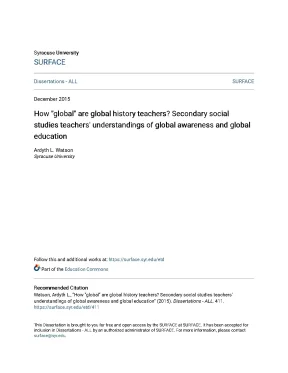
Tải xuống để đọc toàn bộSyracuse University SURFACE Dissertations - ALL SURFACE December 2015 How "global" are global history teachers? Secondary social studies teachers' understandings of global awareness and global education Ardyth L. Watson Syracuse University Follow this and additional works at: https://surface.edu/etd Part of the Education Commons Recommended Citation Watson, Ardyth L., "How "global" are global history teachers? Secondary social studies teachers' understandings of global awareness and global education" (2015).edu/etd/411 This Dissertation is brought to you for free and open access by the SURFACE at SURFACE. It has been accepted for inclusion in Dissertations - ALL by an authorized administrator of SURFACE. For more information, please contact surface@syr.
Abstract Although global history has been a part of the discipline of social studies in New York State for a number of years, the inclusion of global education and skills has been less prevalent in the discipline. This lack of global perspectives in education has proven to be detrimental to the global awareness of American students. Global history teachers play a key role in the dissemination of global content that may contribute to increasing global awareness of students. Yet teachers, themselves, may have limited global awareness and intercultural experiences that impact the ways in which they teach global history.
Therefore, this dissertation examined how global history teachers in upstate New York construct their global awareness and the content they teach, and how their understandings of global education impact their teaching. Eight global history teachers in five school districts took part in this study. Data were collected using semi-structured interviews and observations, and was informed by theoretical work around colonialism and post-colonialism/post-nationalism. Results of this study revealed that these teachers saw their worldviews as evolving constructs, shaped by upbringing, cross- cultural interactions, travel experiences, media influences, and professional responsibilities.
Certain global education elements infused their teaching, such as local/global connections, perspectives consciousness, and cultural sensitivity, but the inclusion of such elements was uneven. Furthermore, their language in many cases revealed an incomplete understanding of global education and cultural awareness. Elements of colonialism, essentialism, and American exceptionalism were both challenged and reinforced in the ways in which these teachers spoke about their global understandings, and the history content and students they taught. HOW “GLOBAL” ARE GLOBAL HISTORY TEACHERS? SECONDARY SOCIAL STUDIES TEACHERS’ UNDERSTANDINGS OF GLOBAL AWARENESS AND GLOBAL EDUCATION by Ardyth L., State University College at Geneseo, 1992 M., State University College at New Paltz, 1999 Dissertation Submitted in partial fulfillment of the requirements for the degree of Doctor of Philosophy in Teaching and Curriculum Syracuse University December 2015 Copyright © Ardyth L.
Watson 2015 All Rights Reserved Acknowledgements First and foremost, I would like to thank the teachers who generously donated their time, expertise, and perspectives that form the basis of this work. I am forever grateful for their enthusiasm and willingness to take part in this research. My tremendous thanks and immense gratitude go to Dr. Jeffrey Mangram, who was with me from the beginning and served as coach, therapist, friend, critic, and cheerleader throughout this entire process.
My deepest thanks also to my committee members, Dr. George Theoharis and Dr. Marcelle Haddix, whose unfailing support, helpful advice, perspicacity, and intelligence broadened my perspectives and enabled me to craft a better dissertation. Also, thanks to my sister, Dr.
April Watson, who gave me inspiration and advice over the course of this endeavor. Santa Fe awaits us. And finally, most of all, thank you to my family, Rob, Ella, and Ewan, who saw me with patience, understanding, love, and laughter to the finish. This dissertation is dedicated to my parents, Alvin and Sheila Watson, who would have been proud.
iv Table of Contents Chapter 1: Introduction .1 Statement of the Problem .3 Background: The Discipline of Social Studies and Global Education .5 Background in Global Education .7 Recent Initiatives in Global Education .9 Global Education Resources .11 A Note on State Mandates .14 Overview of Dissertation Chapters .19 Chapter 2: Literature Review .21 Theoretical Lens: Colonialism and Imperialism .22 Discourses and Essentialism .25 Neocolonialism and American Hegemony .28 Legacies of Colonialism and Neocolonialism in Education .32 What is Global Education? Defining the Phrase.33 The Purposes of Global Education .34 Research on Global Education and Teachers.36 Scholarship on Teachers and Multiculturalism.41 Challenges to Implementation of Global Education .43 Gaps and Limitations of the Literature .47 Chapter 3: Methodology and Methods .50 Why Qualitative Research?.53 Data Collection and Analysis.58 Participants and Setting.61 Description of Participants .62 Table of Participants .65 A Note About Reflexivity, Bias, and Situating the Researcher .66 Situating Myself in the Research .67 Issues of Bias and Subjectivity .69 Chapter 4: “There’s a whole other world out there:” Constructing Global Awareness and Perspectives.74 Impact of Diversity in Teachers’ Backgrounds .75 Diversity in Teachers’ Upbringings .75 Using Color-Blind Discourse.82 Experiences with Multicultural Diversity in College .85 vi Teachers’ Development of Global Awareness .88 From “Growing” to “Very Aware:” Teachers’ Descriptions of Global Awareness .89 Global Awareness as Professional Responsibility .92 Global Awareness Through Life Experiences .94 Impact of Travel on Global Awareness: The “Traveler” versus the “Tourist”.97 Teachers’ Understandings of the World .107 Media Representations and Influence on Global Thinking .107 Challenging or Reinforcing Colonialism?: Teachers’ Perceptions of other Places .111 Challenging Notions of American Exceptionalism .119 The Role of the United States in the Twenty-First Century .128 Chapter 5: “The rest of the world matters:” Implementing Global Perspectives in Teaching.133 The Meaning of “Global Education”: Just a Buzzword? .135 Definitions of Global Education .135 The Purpose of Global Education: Cooperation or Competition? .139 Skills and Opportunities of Globally Aware Students .145 Teaching with Global Perspectives .150 Local/Global Connections .151 Prejudice Reduction and Attention to Inequalities .159 vii Cross-Cultural Competence .166 The cultural festival: Promoting tourism, not competence .167 Fostering cross-cultural awareness in the classroom: Transnational students .171 Cross-cultural awareness in the classroom: Teaching about Islam .173 Additional cross-cultural learning opportunities in the classroom .179 Challenges to Global Education in the Classroom .182 The Regents Exam and Annual Professional Performance Review .182 The Challenge of Time .196 Summary of Findings and Further Connections to Literature .198 Limitations and Next Steps in the Field .206 Implications and Recommendations: Decolonizing Social Studies and Global Education .208 Appendix A: School District Information.214 Appendix B: Semi-Structured Interview Questions .215 Appendix C: Email Recruitment Message .216 Appendix D: Informed Consent Form: Interview .217 Appendix E: Informed Consent Form: Observation .218 Appendix F: Principal Notification Letter .220 viii 1 Chapter 1: Introduction When I was about twenty-three years old, I had an opportunity to live in Scotland and travel throughout Europe for about a year, before returning to the United States and embarking on a teaching career. I remember one occasion in which my Scottish friend and I, while staying in a youth hostel somewhere in central France, befriended the young man who ran the hostel. He was English, but had been living in France for a number of years. We were speaking together in a local cafe about what I am sure we thought were very important topics of conversation at the time, such as politics, history, and culture.
In the course of this conversation, I remember the discussion turned to the history of McCarthyism in the United States and the perceived American1_ aversion to socialism in all of its manifestations. Yet as the conversation unfolded, I recall being somewhat sidelined by it; my Scottish friend and English acquaintance essentially rejected my input in favor of their own interpretations of United States history. I remember feeling irked because, while I was the only person from the United States in the room, I was not asked about my opinions and views of my own country’s history on this topic. Some years later, as a new social studies teacher working in a relatively affluent downstate suburban public school district, I had a student in class from a Mexican migrant family.
She had only been in the country a few years and was in the process of learning English. I remember thinking about her quite often as I was teaching United States history. Having some background in Second Language Education, I understood the principles of language acquisition. But my coursework had not prepared me for the cultural aspects of teaching transnational students.
Yet 1 I use the term “American” to refer to citizens of the United States of America, with the understanding that the term may be used elsewhere in reference to other places in the Western Hemisphere. 2 my experiences living abroad raised my awareness to such issues and I often wondered how this student understood the history content that was being taught to her from an American perspective. For example, I was acutely aware of my own lack of understanding about the Mexican War from a Mexican perspective when the topic arose. Furthermore, how did the curriculum I was teaching impact all of the students in the classroom? To what extent was I perpetuating the metanarrative of United States history in my teaching? I recount these stories as personal examples to illustrate how the United States and “the West” historically create the discourses to which others are subjected.
In the conversation between my European friends, I felt personally irritated by people not from the United States directing the conversation, but soon realized that, both historically and presently, the United States’ government, media, and society inflict the same treatment on other countries regularly. The legacies of American exceptionalism, colonialism, and neo-imperialism likely impact the ways in which Americans view the world and devalue the perspectives of other countries. Even the term “American,” referring exclusively to people from the United States and not from other areas within the Americas, for example, represents these entrenched attitudes. Thus, these ideas about colonialism, neoimperialism, and American exceptionalism frame this research in relation to global education and history teaching, and will be defined at more length later in the dissertation.
My interest in such ideas, combined with my reflections from living and traveling abroad and my background with international students, led me to this dissertation. In particular, I wanted to investigate how global history teachers, given the nature of the content that they teach, frame their understanding of the world and its peoples, and how their understandings impact their pedagogy. The field of global education, as will be discussed, aims to challenge and 3 overcome persistent paradigms within education that situate the world in an Us/Them and/or North/South dichotomy (Pike, 2008; Merryfield, 2005; Burack, 2003; Nyambe & Shipena, 1998). Such binaries arose from decades-old discourses of colonialism, neoimperialism, and American exceptionalism that position the United States as the global hegemon and privilege “the West,” politically, culturally, and economically (Rizvi, Lingard, & Lavia, 2006).
Therefore, I wanted to understand the extent to which those ideas continue to persist with, or are challenged by, social studies teachers who teach global history content and how they understand global education. Statement of the Problem Although global history has been a part of the discipline of social studies in many states for a number of years, the inclusion of global education and global awareness skills has been less prevalent in the discipline. These limitations of incorporating global perspectives in education have proven to be detrimental to the global awareness of American students. The results of a 2006 National Geographic – Roper Survey, for example, illustrate a critical lack of global knowledge among 18-24 year-olds in the United States, suggesting that, "young people in the United States…are unprepared for an increasingly global future.
Far too many lack even the most basic skills for …understanding the relationships among people and places that provide critical context for world events" (Roper for National Geographic Foundation, 2006, p. Other recent studies have shown a similar lack of global awareness among American students.
Nội dung được bảo vệ bản quyền — Tải xuống đầy đủ
Trích dẫn luận án này
Ardyth L. Watson (2015). How global are global history teachers secondary social stud [Luận án tiến sĩ, Syracuse University]. LuanAn.net. https://luanan.net/lich-su/how-global-are-global-history-teachers-secondary-social-studie
Câu hỏi thường gặp
Luận án "How global are global history teachers secondary social stud" nghiên cứu về vấn đề gì?
Khám phá phạm vi toàn cầu của giáo viên lịch sử thế giới ở bậc trung học. Tìm hiểu cách họ giảng dạy môn khoa học xã hội.
Luận án "How global are global history teachers secondary social stud" được bảo vệ tại trường nào?
Luận án này được bảo vệ tại Syracuse University. Năm bảo vệ: 2015.
Luận án "How global are global history teachers secondary social stud" thuộc chuyên ngành gì?
Luận án "How global are global history teachers secondary social stud" thuộc chuyên ngành Teaching and Curriculum (Education). Danh mục: Lịch Sử.
Luận án "How global are global history teachers secondary social stud" có bao nhiêu trang?
Luận án "How global are global history teachers secondary social stud" có 253 trang. Bạn có thể xem trước một phần tài liệu ngay trên trang web trước khi tải về.
Cách tải luận án "How global are global history teachers secondary social stud" về máy như thế nào?
Để tải luận án về máy, bạn nhấn nút "Tải xuống ngay" trên trang này, sau đó hoàn tất thanh toán phí lưu trữ. File sẽ được tải xuống ngay sau khi thanh toán thành công. Hỗ trợ qua Zalo: 0559 297 239.