Giáo dục hòa nhập thực tiễn: Vai trò lãnh đạo của hành chính viên giáo dục đặc biệt cấp khu vực
Hành chính viên giáo dục đặc biệt: Khám phá thực tiễn giáo dục hòa nhập hiệu quả. Nâng cao kỹ năng quản lý, hỗ trợ học sinh hòa nhập thành công.
Special Education
Luan An
Luận án tiến sĩ
Năm xuất bản
Số trang
413
Thời gian đọc
1 giờ 2 phút
Lượt xem
0
Lượt tải
0
Phí lưu trữ
60 Point
Tổng quan nhanh
- Chủ đề:
- Lãnh đạo hành chính giáo dục hòa nhập: Thực tiễn
- Số trang:
- 413 trang
- Trường:
- Syracuse University
- Chuyên ngành:
- Special Education
- Tác giả:
- Chelsea P. Tracy-Bronson
- Năm:
- 2018
Tóm tắt nội dung luận án
I.Lãnh đạo hành chính giáo dục hòa nhập Thực tiễn
Giáo dục hòa nhập là nền tảng cho sự phát triển toàn diện của học sinh. Hiện có hàng triệu trẻ em nhận dịch vụ giáo dục đặc biệt. Vai trò lãnh đạo của hành chính viên giáo dục đặc biệt rất quan trọng. Họ đảm bảo cung cấp giáo dục công bằng cho học sinh khuyết tật. Nghiên cứu này khám phá kinh nghiệm lãnh đạo. Nó tập trung vào những người cam kết thực hiện các thực tiễn giáo dục hòa nhập. Mục tiêu là hiểu rõ cách họ định hình và triển khai giáo dục hòa nhập.
1.1. Tầm quan trọng lãnh đạo giáo dục hòa nhập
Hơn sáu triệu trẻ em Hoa Kỳ từ 6 đến 21 tuổi nhận dịch vụ giáo dục đặc biệt. Điều này đòi hỏi vai trò lãnh đạo mạnh mẽ. Lãnh đạo đảm bảo giáo dục công bằng cho học sinh khuyết tật. Công việc này rất quan trọng. Nó tạo ra môi trường học tập hỗ trợ học sinh khuyết tật hiệu quả.
1.2. Phương pháp nghiên cứu hành chính viên giáo dục
Nghiên cứu sử dụng phương pháp định tính. Các cuộc phỏng vấn sâu được tiến hành. Bảy hành chính viên giáo dục đặc biệt cấp quận tham gia. Họ cam kết thực hiện giáo dục hòa nhập. Dữ liệu được phân tích bằng phần mềm NVIVO và mã hóa thủ công. Các bản ghi nhớ phân tích và kiểm tra thành viên cũng được sử dụng.
1.3. Mục tiêu câu hỏi nghiên cứu giáo dục hòa nhập
Nghiên cứu khám phá kinh nghiệm lãnh đạo. Câu hỏi tập trung vào khái niệm hóa và cam kết với giáo dục hòa nhập. Các chiến lược vận động cũng được xem xét. Hành động và quyết định triển khai giáo dục hòa nhập là một trọng tâm khác. Phân tích sử dụng khung lý thuyết công bằng xã hội và nghiên cứu về khuyết tật.
II.Khái niệm cam kết giáo dục hòa nhập thực tiễn
Các hành chính viên giáo dục đặc biệt có một khái niệm sâu sắc về giáo dục hòa nhập. Họ hiểu giáo dục hòa nhập không chỉ là tuân thủ quy định. Đó còn là một triết lý về công bằng xã hội. Cam kết của họ thường bắt nguồn từ những trải nghiệm cá nhân sâu sắc. Điều này định hình cách họ lãnh đạo và thực hiện các chính sách giáo dục hòa nhập tại địa phương.
2.1. Định nghĩa giáo dục hòa nhập hành chính viên
Các hành chính viên định nghĩa giáo dục hòa nhập thông qua ba cách tiếp cận. Đó là góc nhìn hiện tượng học, cấu trúc xã hội và truy vấn chuyển đổi. Các quan điểm này định hình cam kết của họ. Điều này cho thấy sự hiểu biết đa chiều về giáo dục hòa nhập.
2.2. Nguồn gốc cam kết giáo dục hòa nhập
Động lực thực hiện giáo dục hòa nhập đến từ trải nghiệm cá nhân. Kinh nghiệm gia đình hoặc sự kiện nghề nghiệp quan trọng thúc đẩy. Cam kết này là một hành động công bằng xã hội. Nó nhằm mục đích tạo ra một xã hội hòa nhập hơn.
2.3. Tư duy xã hội công bằng giáo dục
Mục tiêu là chuẩn bị học sinh khuyết tật và không khuyết tật. Họ cần tham gia vào xã hội hòa nhập rộng lớn hơn. Lãnh đạo hành chính giáo dục đặc biệt thúc đẩy tư duy này. Họ xem công việc của mình là hành động công bằng xã hội có chủ đích. Thực tiễn triển khai giáo dục hòa nhập hướng tới mục tiêu này.
III.Chiến lược vận động giáo dục hòa nhập hiệu quả
Các nhà lãnh đạo hành chính giáo dục đặc biệt áp dụng nhiều chiến lược vận động. Những chiến lược này không chỉ giới hạn trong việc tuân thủ pháp luật. Họ sử dụng phong thái lãnh đạo cá nhân và xây dựng năng lực. Mục tiêu là tạo ra môi trường hỗ trợ học sinh khuyết tật tốt nhất. Phối hợp liên ngành cũng là một phần quan trọng của chiến lược này. Họ đảm bảo các Kế hoạch giáo dục cá nhân (IEP) được thực hiện hiệu quả.
3.1. Phong thái lãnh đạo cá nhân vận động
Dữ liệu cho thấy các chiến lược vận động gắn liền với phong thái lãnh đạo. Các nhà lãnh đạo thể hiện sự kiên trì và tầm nhìn. Họ truyền cảm hứng cho việc hỗ trợ học sinh khuyết tật. Phong thái này rất quan trọng để thay đổi văn hóa giáo dục.
3.2. Vận động cho học sinh khuyết tật
Các hành chính viên vận động mạnh mẽ cho quyền lợi học sinh. Họ đảm bảo cơ hội giáo dục hòa nhập. Cung cấp dịch vụ phù hợp là ưu tiên hàng đầu. Điều này bao gồm việc giám sát Kế hoạch giáo dục cá nhân (IEP) và đảm bảo các hỗ trợ cần thiết.
3.3. Xây dựng năng lực trong giáo dục hòa nhập
Lãnh đạo tập trung vào việc xây dựng năng lực. Họ nâng cao kỹ năng cho giáo viên và nhân viên. Điều này hỗ trợ việc triển khai thực tiễn giáo dục hòa nhập. Các chương trình đào tạo và phát triển chuyên môn là cốt lõi. Phối hợp liên ngành cũng được tăng cường thông qua việc xây dựng năng lực.
IV.Hành động quyết định triển khai giáo dục hòa nhập
Để duy trì cam kết với giáo dục hòa nhập, các nhà lãnh đạo thực hiện nhiều hành động và quyết định cụ thể. Họ tập trung vào quá trình phát triển liên tục, không ngừng tìm kiếm cách cải thiện. Sự kết nối mạnh mẽ với cộng đồng cũng được chú trọng. Đồng thời, việc tuân thủ nghiêm ngặt các quy định pháp lý là ưu tiên hàng đầu. Điều này đảm bảo tính hợp pháp và công bằng trong mọi quy trình hành chính giáo dục và quản lý hồ sơ học sinh.
4.1. Đề cao quá trình phát triển liên tục
Các nhà lãnh đạo thực hiện cải tiến thông qua quá trình phát triển. Họ không ngừng tìm kiếm giải pháp mới. Mục tiêu là nâng cao chất lượng giáo dục hòa nhập. Việc này đòi hỏi sự đổi mới và thích ứng liên tục với các thách thức. Thực tiễn triển khai giáo dục hòa nhập được đánh giá thường xuyên.
4.2. Kết nối cộng đồng giáo dục hòa nhập
Sự kết nối với cộng đồng là yếu tố then chốt. Lãnh đạo xây dựng mạng lưới hỗ trợ. Họ khuyến khích sự tham gia của phụ huynh và các bên liên quan. Phối hợp liên ngành diễn ra thường xuyên. Điều này tạo ra một hệ sinh thái hỗ trợ toàn diện cho học sinh khuyết tật.
4.3. Tuân thủ quy định pháp lý giáo dục
Việc tuân thủ các quy định pháp lý rất quan trọng. Lãnh đạo đảm bảo mọi hoạt động phù hợp luật pháp. Chính sách giáo dục hòa nhập được áp dụng đúng đắn. Quản lý hồ sơ học sinh và Kế hoạch giáo dục cá nhân (IEP) cũng được chú trọng. Quy trình hành chính giáo dục phải minh bạch và đúng quy định.
V.Phát triển năng lực và chính sách giáo dục hòa nhập
Nghiên cứu này có ý nghĩa sâu rộng đối với việc phát triển năng lực cho các hành chính viên và giáo viên. Các chương trình đào tạo cần được cải thiện để trang bị kiến thức về lãnh đạo công bằng xã hội và thực tiễn giáo dục hòa nhập. Ngoài ra, cần có những điều chỉnh trong chính sách giáo dục ở cấp tiểu bang và liên bang. Mục tiêu là hỗ trợ tốt hơn cho việc triển khai giáo dục hòa nhập, đồng thời đơn giản hóa quy trình hành chính giáo dục.
5.1. Nâng cao năng lực hành chính viên
Kết quả nghiên cứu gợi ý các yêu cầu về đào tạo. Đào tạo hành chính viên cần được cải thiện. Các khóa học cần tập trung vào lãnh đạo công bằng xã hội. Vận động chính sách và thực tiễn triển khai giáo dục hòa nhập cũng quan trọng. Điều này giúp các hành chính viên giáo dục đặc biệt hiệu quả hơn.
5.2. Chuẩn bị giáo viên giáo dục hòa nhập
Chương trình đào tạo giáo viên cũng cần điều chỉnh. Giáo viên cần được trang bị kỹ năng cho môi trường hòa nhập. Họ cần hiểu về hỗ trợ học sinh khuyết tật. Điều này đảm bảo giáo viên có thể đáp ứng đa dạng nhu cầu của học sinh.
5.3. Điều chỉnh chính sách giáo dục liên bang
Nghiên cứu có ý nghĩa đối với chính sách cấp tiểu bang và liên bang. Chính sách cần hỗ trợ đổi mới cấp quận. Quy trình hành chính giáo dục cần được linh hoạt hóa. Các thay đổi chính sách sẽ thúc đẩy giáo dục hòa nhập toàn diện hơn.
VI.Lý thuyết lãnh đạo giáo dục hòa nhập hệ thống
Luận án đề xuất một lý thuyết lãnh đạo giáo dục hòa nhập mới. Lý thuyết này cung cấp một khuôn khổ để hiểu cách tạo ra thay đổi hệ thống ở cấp quận. Nó nhấn mạnh sự kết hợp giữa thực tiễn và phản tư phê phán. Mục tiêu là xây dựng các trường học công lập có khả năng giáo dục và hòa nhập tất cả học sinh. Các chiến thuật kháng cự tinh tế và thay đổi gia tăng đóng vai trò quan trọng trong quá trình này.
6.1. Xây dựng lý thuyết lãnh đạo hòa nhập
Nghiên cứu đề xuất một lý thuyết mới. Lý thuyết này làm sáng tỏ quá trình thay đổi hệ thống. Nó tập trung vào việc tạo ra các hệ thống hòa nhập. Đây là một đóng góp quan trọng cho lĩnh vực giáo dục hòa nhập.
6.2. Thay đổi hệ thống cấp quận
Lý thuyết này nhấn mạnh sự thay đổi cấp quận. Các chiến thuật kháng cự tinh tế và thay đổi gia tăng được sử dụng. Các chuẩn mực quận sáng tạo được thiết lập. Điều này giúp các quận dần dần thích nghi với mô hình giáo dục hòa nhập.
6.3. Thực hành phản tư lãnh đạo
Lý thuyết bao gồm thực tiễn và phản tư phê phán. Điều này giúp các nhà lãnh đạo tạo ra các trường học công lập. Các trường này tìm cách giáo dục và hòa nhập tất cả học sinh. Đây là một lộ trình cho lãnh đạo mong muốn thay đổi.
Mục lục chi tiết luận án
Tải xuống file đầy đủ để xem toàn bộ nội dung
Tải đầy đủ (413 trang)Trích đoạn nội dung luận án
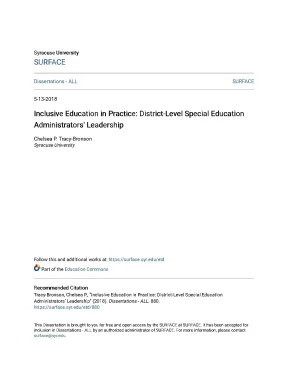
Tải xuống để đọc toàn bộSyracuse University SURFACE Dissertations - ALL SURFACE 5-13-2018 Inclusive Education in Practice: District-Level Special Education Administrators' Leadership Chelsea P. Tracy-Bronson Syracuse University Follow this and additional works at: https://surface.edu/etd Part of the Education Commons Recommended Citation Tracy-Bronson, Chelsea P., "Inclusive Education in Practice: District-Level Special Education Administrators' Leadership" (2018).edu/etd/880 This Dissertation is brought to you for free and open access by the SURFACE at SURFACE. It has been accepted for inclusion in Dissertations - ALL by an authorized administrator of SURFACE. For more information, please contact surface@syr.
ABSTRACT Considering six million children ages six through 21 receive special education services in the United States (Department of Education, 2017), it is critical to examine the leadership it takes to provide equitable education to students with disabilities. This study employs a qualitative research methodology utilizing in-depth interviewing to understand the leadership experiences of seven district-level special education administrators who are committed to enacting inclusive educational practices using the following three paradigms or ideological approaches: phenomenological perspective, social construction perspective, and transformative inquiry. The following research questions guide this dissertation: 1) How do district-level special education leaders articulate their conceptualization of and commitment to inclusive education? 2) What strategies of advocacy are evident in the ways that district-level special education leaders make sense of their enactment of inclusive educational opportunities and service delivery for students with disabilities? 3) What actions and decisions have district-level special education leaders implemented in order to remain committed to their district’s enactment of inclusive education? A philosophical approach of inclusive education and theoretical frameworks of social justice leadership and disability studies in education provide the analysis lens in which to understand participants’ resistive actions and leadership practices. The data were analyzed using NVIVO, a digital research software, followed by hand-coding, analytic memos, and member checks.
Data demonstrated that participants’ drive for inclusive educational practices stemmed from family experiences or a poignant career event. Another finding was participants’ work in the field of inclusive education was an intentional social justice action to prepare students with and without disabilities to engage in the larger inclusive society. In addition, themes emerged in the data that demonstrate advocacy strategies linked to: 1) personal leadership disposition; 2) 2 advocacy for students with disabilities; 3) capacity building; and 4) actions. Finally, themes demonstrated that leaders worked toward improvement through: 1) an emphasis on the growth process; 2) connectedness with community; and, 3) compliance with legal regulations.
I conclude by discussing social justice leadership, advocacy tactics, and district practices that participants have implemented and describe implications for administrator preparation, teacher preparation, and state and federal policy. I propose a theory of inclusive education leadership that illuminates the process for creating systems change at the district level that involves praxis and critical reflection. It is my hope that participants’ subtle resistive tactics, incremental changes, and methods to set innovative district norms provide an exemplar for leaders who feel called and have an opportunity to enact inclusive educational services with a vision of constructing public school districts that seek to educate and include all learners. 3 INCLUSIVE EDUCATION IN PRACTICE: DISTRICT-LEVEL SPECIAL EDUCATION ADMINISTRATORS’ LEADERSHIP By Chelsea P., Syracuse University, 2014 Dissertation Submitted in partial fulfillment of the requirements for the Degree of Doctor of Philosophy in Special Education Syracuse University May 2018 4 Copyright © Chelsea Page Tracy-Bronson 2018 All Rights Reserved 5 ACKNOWLEDGEMENTS I have the deepest gratitude for the individuals in my personal, teaching, consultant, and academic spheres who have shared this doctoral journey with me.
This work grows out of the experiences I have had throughout my career that have spanned the many aspects of inclusive schooling and are sprinkled throughout this work. I am appreciative of the district-level leaders who participated in this research. It is through your stories and experiences of cultivating district inclusive education that other educational leaders can understand the advocacy and practices needed to make this a reality across the country. Several mentors have shaped my thinking about inclusive education, inclusive school reform, leadership for inclusive education, and designing accessible curriculum.
I am incredibly grateful for my Syracuse University dissertation committee members who believed in me and who planted the seeds of inspiration for this work. Julie Causton, whose work was infused into every lesson in my classrooms in both New York City and Upstate New York. Your vision has been the inspiring force behind so much of what I have accomplished and, more importantly, the ways I make an impact in the field of inclusive education. I am blessed that such a mentor has transformed into my co-author and collaborative colleague—let alone a true friend! George Theoharis always demonstrated that a compassionate disposition is the key ingredient for any leadership recipe.
Your work in leading inclusive schools has strongly influenced and made a lasting impact on the direction of my scholarly contributions. Christy Ashby who stressed the importance of access and communication for students with disabilities and modeled incorporating disability studies into inclusive education teacher preparation has empowered me. Your mentorship and strong feedback has been remarkable throughout my journey. I hope you know, Julie, George, and Christy, the impact that you have had on my life.
To know that you v 6 each value and respect my research and this final stage of the PhD means the most to me! I hope to follow in your paths with my own Scholarship in Action. I do not take this gift lightly, for “with great power comes great responsibility.” I am ready to stand alongside the Syracuse University greats and use this gift to enact and lead the next wave of inclusive education. Thank you to my colleagues at Syracuse University for your continued support during the writing of this dissertation—Michelle Damiani, Eun Young Jung, and Kate MacLeod—and during the earlier stages of my graduate degree—Danielle Cowley, Jessica Bacon, Fernanda Orsati, Carrie Rood Gotham, Casey Woodfield, and Melanie Carroll. Thank you to my colleagues at Stockton University.
A special thank you to the top-notch mentorship of Mary Lou Galantino, Shelly Meyers, and Kimberly Lebak. I wish to also thank Claudine Keenan, John Gray, Pamela Vaughan, Priti Haria, Susan Cydis, Lois Spitzer, Darrell Cleveland, Norma Boakes, John Quinn, Ron Caro, Ron Tinsley, Doug Harvey, Meg White, George Sharp, Merydawilda Colon, Stacey Culleny, Amy Ackerman, Jung Lee, and Kate Juliani. Your advice, encouragement, and constructive feedback during this process of completing this Ph. has been valuable.
I am grateful for my students and families from Syracuse, Owego-Apalachin, NYC, and NJ—the experts who taught me the true meaning of inclusion in schools and communities. I wish to acknowledge my first students who helped me conceptualize inclusive education. Quin taught me that the best teachers are compassionate and deeply embedded into the lives of our students. Michael convinced me that facilitating social interdependence is gift that does not stop giving.
I am also especially grateful to James, Tyler, Neleah, Camryn, Shantell, Maylee, Aaliyah, Emma, Amber, Hunter, Adam, Ella, and Mikayla who taught me to think and teach in different ways, create exciting learning experiences, and to be passionate about teaching. To vi 7 Mark, Julia, Gabi, Juliana, Tara, Grace, Sabrina, Kevin, Eric, and Yuvika—may we continue to collaborate with your administrative team and transform educational structures so that you can be fully included in your neighborhood districts! This work started with all of you, my students, who taught me that passionate inclusive educators and leaders can truly change lives and make a difference. The findings from this research were enacted as I collaborated with incredible administrators in inclusive school reform partnerships. These colleagues are creating inclusive opportunities in their districts for all students—Alyson Nechamkin, Eric Siegel, Vanessa Jones, Hector Alvarez, Meg Pribyl, and Sylvia Zircher—and are using the tactics, strategies, and practices within this dissertation study.
May we continue our work in inclusive education! I am fortunate to have had incredibly loving support of family and best friends to cheer me on during my entire Ph. I am appreciative of my mom and dad who have encouraged me to chase my wildest dream and supported me personally, academically, and in business. You have modeled that family comes first and with that, given me wings to soar in my own life. Your daily love, holiday meals, and family vacations have shaped and left footprints in my heart! Heith, Holly, and Lillyanna have been constant loving and caring souls.
Heith, your willingness to pursue your business has been nothing short of astonishing to watch, and this has reminded me the importance of doing my life’s work. Holly, you are my fun-loving, fantastic sister-in-law, not to mention an amazing wife and mom for your family. Inga, my wiser sister, thank you for being my biggest fan, being a strong exemplar of an independent woman paving the way on the corporate ladder and in business, and giving the sweetest meaningful toast at our doctoral celebration. Thank you to my extended family of the best group of cousins, little cousins, aunts, and uncles who have relentlessly cheered for me.
Thank you to my best friends, vii 8 Aaryn, Erin, and Katie for your compassion, interest, and fierce love. Thank you to J. for waiting for me, supporting me, and loving me during this journey. I am thankful for the sense of adventure that fills our life.
There are no words to accurately express how grateful I am for you, but I do know that I am beyond excited for the next chapter of our life. I love you! Your love has been the anchor for my soul through the waves and the wind of this Ph.! viii 9 TABLE OF CONTENTS Abstract……………………………………………………………………………………………i Title Page…………………………………………………………………………………….iii Copyright Page………………………………………………………………………………….v Table of Contents…………………………………………………………………………………ix List of Illustrative Materials.x Chapter 1: Introduction……………………………………………………………………………1 Chapter 2: Literature Review: Promising Practices in Leadership for Inclusive Education…….27 Chapter 3: Methodology…………………………………………………………………………72 Chapter 4: Leaders’ Commitment to Inclusive Educational Practices…………………………133 Chapter 5: Leaders’ Moments of Advocacy to Enact Inclusive Educational Practices……….146 Chapter 6: District Policy Leaders’ Construct to Sustain Inclusive Educational Practices…….212 Chapter 7: Conclusion: Toward District-level Leadership for Inclusive Education……………254 Appendices .……………………………………………………………………………………281 References………………………………………………………………………………………348 Curriculum Vitae……………………………………………………………………………….378 ix 10 LIST OF ILLUSTRATIVE MATERIALS LIST OF TABLES Table 3.1: Paradigms and Ideological Approaches………………………………………………80 Table 3.3: Selection Criteria of Leaders…………………………………………………….5: District Demographics………………………………………………………………128 LIST OF FIGURES Figure 1.1: Educational Environments for Students Ages 6-21 served under IDEA, Part B……10 Figure 2.1: Literature Review……………………………………………………………………30 Figure 3.1: History of Study Graphic……………………………………………………………83 Figure 3.2: Recruitment Strategies Graphic…………………………………………………….3: Visual Data Representation……………………………………………………….4: Social Justice Findings…………………………………………………………….6: District Practice Findings……………………….8: Data Collection and Analysis………………………………………………………123 Figure 4.1: Leaders’ Commitment to Inclusive Educational Practices…………………………134 Figure 5.1: Complex Advocacy Tactics……………………………………………………….2: Advocacy Tactics Themes and Sub-Themes……………………………………….1: District Practices and Procedures ………………………………………………….1: District-Level Inclusive School Leadership ……………………………………….2 Praxis Process Used to Create Inclusive Districts ………………………………….271 LIST OF APPENDICIES Appendix 3. National and Regional Organizations………………………. Inclusion Survey-Praisner Original………………………….
Description of Survey Changes…………………………………………………309 Appendix 3. Inclusion Survey-Praisner-Modified for District-Level Administrators……. Recruitment Screen Procedure………………………………………………. Interview 1: Recruitment Screening Protocol…………………………………317 Appendix 3.
Interview 2: Categories and Questions Protocol………………………………319 Appendix 3. Interview 3: Open Conversation, Clarification, and Member Check Protocol. Researcher’s Memo……………………………………………………………327 Appendix 3. Researcher’s Memo……………………………………………………………328 Appendix 3.…329 xi 1 CHAPTER 1: INTRODUCTION Inclusive education means that students with and without disabilities have full-time membership and access to learning in heterogeneous general education classrooms within their neighborhood districts.
In school districts where administrators have adopted inclusion, leaders explicitly focus on establishing a sense of belonging, participation, social interactions, and progress in academics for all learners. Inclusive education relies on collaborative teaching between special and general educators, such that learning experiences, materials, accommodations, and modifications meet the needs of every student. Implementing it requires administrators to value diversity, differences, and disabilities as well as analyzing structural inequities. Administrators in inclusive districts make organizational decisions to ensure students districts might otherwise marginalize have access to learning in grade-level classrooms, special area subjects, friendships with general education peers, and recreational opportunities.
Inclusive education involves administrators interrogating and adjusting practices and structures to include all learners (Causton-Theoharis, Theoharis, Bull, Cosier, & Dempf-Aldrich, 2011; DeMatthews & Mawhinney, 2014; Theoharis, Causton, & Tracy-Bronson, 2016).
Nội dung được bảo vệ bản quyền — Tải xuống đầy đủ
Trích dẫn luận án này
Chelsea P. Tracy-Bronson (2018). Giáo dục hòa nhập thực tiễn: Hành chính viên giáo dục đặc biệt [Luận án tiến sĩ, Syracuse University]. LuanAn.net. https://luanan.net/giao-duc-chuyen-biet/giao-duc-hoa-nhap-thuc-tien-hanh-chinh-vien-giao-duc-dac-biet
Câu hỏi thường gặp
Luận án "Giáo dục hòa nhập thực tiễn: Hành chính viên giáo dục đặc biệt" nghiên cứu về vấn đề gì?
Hành chính viên giáo dục đặc biệt: Khám phá thực tiễn giáo dục hòa nhập hiệu quả. Nâng cao kỹ năng quản lý, hỗ trợ học sinh hòa nhập thành công.
Luận án "Giáo dục hòa nhập thực tiễn: Hành chính viên giáo dục đặc biệt" được bảo vệ tại trường nào?
Luận án này được bảo vệ tại Syracuse University. Năm bảo vệ: 2018.
Luận án "Giáo dục hòa nhập thực tiễn: Hành chính viên giáo dục đặc biệt" thuộc chuyên ngành gì?
Luận án "Giáo dục hòa nhập thực tiễn: Hành chính viên giáo dục đặc biệt" thuộc chuyên ngành Special Education. Danh mục: Giáo Dục Chuyên Biệt.
Luận án "Giáo dục hòa nhập thực tiễn: Hành chính viên giáo dục đặc biệt" có bao nhiêu trang?
Luận án "Giáo dục hòa nhập thực tiễn: Hành chính viên giáo dục đặc biệt" có 413 trang. Bạn có thể xem trước một phần tài liệu ngay trên trang web trước khi tải về.
Cách tải luận án "Giáo dục hòa nhập thực tiễn: Hành chính viên giáo dục đặc biệt" về máy như thế nào?
Để tải luận án về máy, bạn nhấn nút "Tải xuống ngay" trên trang này, sau đó hoàn tất thanh toán phí lưu trữ. File sẽ được tải xuống ngay sau khi thanh toán thành công. Hỗ trợ qua Zalo: 0559 297 239.