My training wheels are off how first generation college studen
"Bỏ dây tập đi: Hành trình sinh viên đại học thế hệ đầu. Khám phá thách thức, cơ hội và con đường thành công."
Higher Postsecondary Education
Luan An
Luận án
Năm xuất bản
Số trang
305
Thời gian đọc
46 phút
Lượt xem
0
Lượt tải
0
Phí lưu trữ
60 Point
Tổng quan nhanh
- Chủ đề:
- Exploring First-Generation College Students' Journeys
- Số trang:
- 305 trang
- Trường:
- Syracuse University
- Chuyên ngành:
- Higher Postsecondary Education
- Tác giả:
- Staci Allison Weber
- Năm:
- 2016
Tóm tắt nội dung luận án
I.Exploring First Generation College Students Journeys
This research investigates how first-generation college students navigate their educational paths. It explores their experiences at a private university in the Northeast. The study focuses on how these students utilize non-profit and government-funded programs. These programs help students make sense of their college-going journeys. Understanding these journeys is crucial for higher education. The research addresses specific questions about skill acquisition and application. This work highlights the unique first-gen experience.
1.1. Research Focus Key Questions Explored
The study's core examines what skills and knowledge first-generation college students gain. It then analyzes how students apply these learnings. This application helps them navigate complex college pathways. Programs prepare students for college entry and persistence. They facilitate access to selective institutions directly after high school. This exploration provides insights into their unique academic success strategies.
1.2. Pivotal Role of College Access Programs
College access programs serve as vital resources. They equip students with necessary tools for postsecondary education. These programs contribute to preparation, admission, and retention. They are critical for students from non-traditional college backgrounds. Programs bridge information gaps for these students. Effective student support services are foundational.
1.3. Theoretical Frameworks Guiding the Analysis
The research employs robust theoretical frameworks. Communities of Cultural Wealth (Yosso, 2005, 2006) provides one lens. Critical theory (Kincheloe & McLaren, 2002) offers another. These frameworks analyze student 'counterstories.' They reveal how programs help navigate a historically stratified education system. This approach centers the first-gen experience.
II.Developing Essential Skills for First Gen College Students
First-generation college students acquire crucial skills and knowledge. This learning occurs through college access and support programs. These programs are designed to empower students. They foster readiness for academic and social demands. The development of these skills is fundamental for success. Students learn to advocate for themselves. These academic success strategies are transformative.
2.1. Comprehensive Preparation for Postsecondary Success
Programs provide comprehensive preparation. This includes academic readiness and college-specific information. Students learn about application processes and financial aid. They develop study habits and time management skills. These foundational elements are critical for a smooth transition. Preparation reduces initial anxieties. Student support services play a key role.
2.2. Fostering Independent College Navigation Abilities
A key program outcome is fostering independent navigation. Students learn to seek out resources on campus. They develop self-reliance in academic and personal matters. This autonomy is vital for the first-gen experience. Programs equip students to manage challenges without familial precedent. Students build confidence in unfamiliar environments, navigating college independently.
2.3. Building Academic and Social Competence
Programs build both academic and social competencies. Students gain confidence in classroom settings. They learn to interact with faculty and peers. Social integration skills are taught. This holistic development supports overall well-being. It prepares students for a diverse university environment. Strong academic success strategies are cultivated.
III.Transformative Impact of First Gen Support Programs
College access and support programs create significant impact. They provide more than just information. These programs become a form of capital for first-generation college students. This capital is invaluable for their college journey. It equips them with tangible and intangible resources. The support system mitigates various barriers. Student support services are critical for the first-gen experience.
3.1. Programs Functioning as a Form of Capital
The study reveals programs act as cultural and social capital. They offer access to networks and knowledge bases. This capital is often missing for first-generation students. It helps level the playing field. Students gain insights into university culture and expectations. They learn informal rules of engagement. Mentorship for first-gen students is often embedded here.
3.2. Providing Essential Resources for Persistence
Programs furnish essential resources for success. These include academic counseling and financial literacy. They also provide emotional support. Such resources are critical for students to matriculate and persist. They reduce dropout rates among first-generation students. Consistent student support services foster resilience.
3.3. Addressing Post Freshman Year Challenges Effectively
The influence of programs extends beyond freshman year. They help students navigate post-freshman year challenges. These can include advanced coursework or career planning. Programs offer continuous guidance. This ensures sustained academic and personal growth. Support reduces feelings of isolation and imposter syndrome in college.
IV.Promoting Educational Equity for First Gen Students
The research critically examines college access programs. It questions their role in closing the educational gap. These programs aim to provide equitable opportunities. Their success impacts national educational reform efforts. Ensuring equity for first-generation college students is paramount. This contribution affects broader societal outcomes. Student support services are key to this equity.
4.1. Contribution to Closing the Educational Gap
Programs strive to reduce disparities in higher education. They provide resources to underrepresented groups. This effort is crucial for social mobility. The study evaluates the effectiveness of these interventions. Findings suggest a positive influence on student trajectories. Educational equity remains a key goal for the first-gen experience.
4.2. Implications for Higher Education Reform Initiatives
The study's insights inform policy and practice. They highlight successful strategies for student support. These findings can guide future educational reform initiatives. Programs demonstrate the need for sustained, comprehensive interventions. Reforms should prioritize tailored support for first-generation college students, enhancing academic success strategies.
4.3. Fostering Career Readiness for First Gen Graduates
Beyond academic persistence, programs support career readiness first-gen. They introduce career exploration and professional development. This includes internship guidance and networking opportunities. Preparing students for post-graduation life is essential. It ensures long-term success and economic mobility, often involving mentorship for first-gen students.
V.Understanding First Gen College Student Experiences
The dissertation centers the narratives of first-generation students. Their unique first-gen experience provides rich data. These counterstories offer deep insights into their journey. They reveal triumphs and struggles in a selective institution. Understanding these perspectives is vital for effective support. Student voices drive the findings and highlight imposter syndrome in college.
5.1. Centering Student Narratives Personal Perspectives
The research prioritizes student-shared experiences. Personal accounts illuminate program effectiveness. They detail challenges like imposter syndrome in college. Students articulate how programs empower them. Their stories reveal resilience and determination. This approach gives agency to the participants.
5.2. Overcoming Unique Challenges in the College Journey
First-generation students often face distinct obstacles. Lack of familial college experience is one challenge. Navigating complex university systems can be daunting. Programs help students overcome these hurdles. They provide a roadmap for success. Students learn to leverage available support structures and develop student autonomy.
5.3. Importance of Mentorship and Supportive Community
Mentorship for first-gen students is a critical component. Programs often facilitate these connections. Mentors provide guidance and encouragement. Building a supportive community reduces feelings of isolation. Shared experiences foster a sense of belonging. This network is invaluable for persistence and leverages student support services effectively.
Mục lục chi tiết luận án
Tải xuống file đầy đủ để xem toàn bộ nội dung
Tải đầy đủ (305 trang)Trích đoạn nội dung luận án
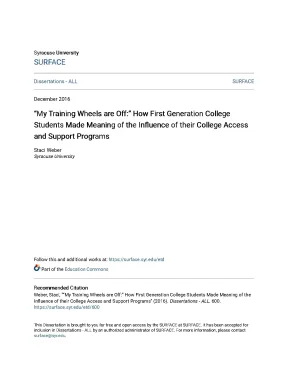
Tải xuống để đọc toàn bộSyracuse University SURFACE Dissertations - ALL SURFACE December 2016 “My Training Wheels are Off:” How First Generation College Students Made Meaning of the Influence of their College Access and Support Programs Staci Weber Syracuse University Follow this and additional works at: https://surface.edu/etd Part of the Education Commons Recommended Citation Weber, Staci, "“My Training Wheels are Off:” How First Generation College Students Made Meaning of the Influence of their College Access and Support Programs" (2016).edu/etd/600 This Dissertation is brought to you for free and open access by the SURFACE at SURFACE. It has been accepted for inclusion in Dissertations - ALL by an authorized administrator of SURFACE. For more information, please contact surface@syr. Abstract This research explored how 47 first generation college students at a private university in the Northeast used non-profit and government-funded college access and support programs to make meaning of their college-going journeys.
The participants used college access programs to prepare themselves for, gain access to, and persist at a selective postsecondary institution directly after high school. This research asked what skills and knowledge do first generation college students learn through their college access and support programs? How do first generation college students use the skills and knowledge they obtained through their college access and support programs to help navigate their college-going journeys? Using the theoretical frameworks of Communities of Cultural Wealth (Yosso, 2005, 2006) and critical theory (Kincheloe & McLaren, 2002), I analyzed the participants’ counterstories and uncovered how first generation college students used college access and success programs to navigate a historically classed and raced education system. The findings centered the students’ stories, showed how college access programs became a form of capital within themselves for first generation college students, and provided students with the resources they needed to matriculate and persist in college. I then critically examined whether or not college access programs contributed to closing the educational gap in the United States and educational reform.
Keywords: First generation college students, college access, college experience, college access programs, college success programs, higher education “My Training Wheels are Off:” How First Generation College Students Made Meaning of the Influence of their College Access and Support Programs by Staci Allison Weber B., Franklin & Marshall College, 2001 M., University of Delaware, 2004 Dissertation Submitted in partial fulfillment of the requirements for the degree of Doctor of Philosophy in Higher Postsecondary Education Syracuse University December 2016 Copyright © Staci A. Weber 2016 All Rights Reserved “[My younger sister] was in an after school [program], and they had ‘dress-like-a-hero’ day and she wore [my university’s] shirt.” (Joy, Spring 2012) *** I dedicate this dissertation to all the heroes and those dressed like the heroes. Acknowledgements The juxtaposition of this dissertation between my professional, scholarly self and my personal self comes through memories. My dissertation is dependent upon them.
Through 47 first generation college students sharing their past experiences on their college-going journey, I gained data for my research. Their stories, their experiences, and their memories are the heart of this paper. The students in this study and those I have worked with have made themselves vulnerable to me. They opened up about their challenges and their triumphs.
They have exemplified perseverance and determination. They let me learn from them and asked for little in return. I am forever grateful to the participants in this study and the students that have touched my heart. Thank you, mom and dad, for the investment you have made in my education from an early age; the values you have instilled in me to continuously learn, dedicate myself to social justice, and making this world a better place; and, for your unconditional love, support, advice, and encouragement throughout life’s journey.
I am beyond thankful and fortunate. Thank you, Nikki. You have shown me what it means to persevere, be strong, and be brave. Your optimism, laughter, and love of life and people are contagious.
Thank you for being my role model, friend, and sister. Thank you to my auntie, my sunshine. A day with your laughter, shenanigans, and phone calls is a better day. I am so grateful for your endless support and advice.
I am the woman I am today from watching you. Through my work and my life experiences, I have learned that a supportive family is a privilege, a luxury, and not something to take for granted. From my family in England to my Aunt Helen in Long Island to other aunts, uncles, cousins, and neighbors, your support and encouragement throughout this process has motivated me to keep going. I am so lucky for the love and laughter that surrounds me.
Thank you, Karri. There are few people in the world where I am my total honest, emotional self. Thank you for your patience, listening ear, advice, and great memories over the past years. I am so thankful to have such a good friend in you.
If I described my doctoral journey by the strong, smart, thoughtful, and sincere people I met (and re-connected with) during the process, everyone would want to earn their Ph. Ashley, Robin, Fernanda, Lynn, Ellen, and Jeff, thank you for keeping me grounded, motivated, writing, and smiling. While my Syracuse friends saw me through the first part of my doctoral journey, Sara and Karen, brought up the rear! I am so lucky to have made such great friends in Boston. You have been my cheerleaders and confidants for the past three years.
You are my home away from home. v Thank you, Annie, for the time, the encouragement, and the friendship you have provided throughout this entire process and over the last 20 (gulp) years. Every “who” rather than “that” and “like” in this dissertation is dedicated to you! This dissertation research builds on other research that shows the power of mentorship; my personal experience certainly echoes these findings. Mara Daniel gave me the confidence to share my passions and helped me find my voice.
The late Barbara Brummett allowed me to continue the work of Helping Hands in college through encouragement and empowerment. Glen Gross then introduced me to Student Activities and imparted on me two great insights, “you don’t need to be in a leadership position to lead” and “you seem to really like leadership development, you should look into higher education.” Both have made all the difference. Ralph Taber and John Bishop have given me countless advice during graduate school, job application processes, and my career. I cannot even count the number of times Bishop has said to me to be patient (I’m still learning this life lesson.) Kris Clarkson, Don Saleh, and Tom Wolfe each taught me about being true to my passions and myself.
They showed me how to lead, how to listen, and how to institute change. Their support and mentorship continuously influences my work. Lastly, I would be remiss to not mention Merris Hollingsworth, who left this world all too soon. As my master’s thesis advisor, Merris gave me the confidence to know I could write a dissertation.
She introduced me to qualitative research, writing, and presenting, for which I am grateful. My mentors have given me their time, advice, and support. They have fostered in me a passion, a scholarship, and an ability to collaborate with others to challenge systems of injustice, and see the best in people. The foundation of a dissertation comes from experiences, coursework, readings, and people believing in your scholarship.
From there, a dissertation grows thanks to a village of faculty, mentors, family, and friends along the way. In the end, though, a dissertation is a reflection of the commitment, the conversations, and the feedback of a dissertation chair and committee. Cathy, Dawn, and Gretchen, thank you for your wisdom, your insight, and your scholarship. I know that you each have many demands on your time; I am so fortunate to have such a strong, thoughtful, and brilliant committee.
Your readings of my dissertation, your honest and detailed critiques, and our conversations about the work have pushed me to think in new ways, delve deeper into my data and analysis, and made me a better person, educator, and scholar. Thank you for being role models and teachers. vi TABLE OF CONTENTS Chapter One: INTRODUCTION. 1 Purpose of Study and Theoretical Perspective.
8 First Generation College Students. 9 College Access and Support Programs. 9 Description of Study. 10 Significance of this Research.
12 Overview of Dissertation. 13 Chapter Two: LITERATURE REVIEW. 15 Defining and Understanding Current Research on First Generation College Students. 15 First Generation College Students and College Preparation and Choice.
21 College Choice Models. 27 College Experience and Persistence. 32 A Background on College Access and Success Programs. 39 A History of College Access and Support Programs.
42 Research on College Access and Support Programs. 43 Examples of College Access and Success Programs. 47 Communities of Cultural Wealth. 51 Chapter Three: METHODOLOGY.
53 Positionality and Role of as a Researcher. 70 Chapter Four: COLLEGE PREPARATION AND COLLEGE-GOING MINDSET. 77 Students’ Connections to College Access Programs. 77 Students’ and Families’ Social Networks.
77 College Access Program Networks. 84 Navigating Secondary Education with the Support of College Access Programs. 89 College Access Programs as a Conduit to Secondary Education. 89 Additional High School and College Courses.
93 Supplemental Academic Assistance. 96 College Access Programs and Career Exploration. 98 College Access Programs and Standardized Test Preparation. 104 College Access Programs Establish and Encourage a College-Going Mindset.
105 College Access Programs and Lifelong Skills. 121 Chapter Five: COLLEGE ACCESS. 123 viii College Access Programs and the College Search Process. 123 Getting a Feel for College Life.
123 Connections Between College Access Programs and the University. 127 Applying to College Strategically. 130 Financial Literacy and Support. 137 College Access Programs and the College Choice Process.
157 Chapter Six: COLLEGE TRANSITION AND EXPERIENCE. 159 Transition and Retention Strategies. 160 On-line Mentoring. 164 Peer-to-Peer Support.
168 Volunteering, Giving Back, and College Uplift. 171 Missed Opportunities and Faded Connections. 175 Transitioning from Community-Based to University-Based Support Services. 188 Chapter Seven: DISCUSSION.
191 Expanding on Communities of Cultural Wealth. 192 A Pathway for Education Reform. 196 Re-envisioning College Choice Models. 197 Creating an Inclusive College Admissions Process.
199 The Future of College Access Programs and Education. 201 Limitations of this Study. 204 Location of the Research. 205 Definitions and Language.
205 Conducting Interviews and Focus Groups. 206 University Support Programs. 207 Recommendations for Improving College Access and Success. 207 Suggestions for Future Research.
First Generation, Low-Income College Students Graduation Rates. High School and College Enrollment of 12th Grade Students. Degrees Students Received Based on Parents’ Education Attainment. 217 Appendix A: Participants’ College Access Programs.
218 Appendix B: Solicitation Email. 224 Appendix C: Participant Overview. 226 Appendix E: Informed Consent. 238 Appendix F: Interview and Focus Group Scripts.
239 Appendix G: Transcriber Protocol. 247 Appendix H: Focus Group Codes. 248 Appendix I: Interview Codes. 264 x 1 Chapter One: INTRODUCTION There’s also a book I read, I got from a teacher of mine, a Dean of mine, who actually went to Prep [Prep for Prep, a college access and support program], he was a Dean at [my preparatory school].
It’s called The Other Wes Moore, and it’s about two [Black] kids from the same socioeconomic background. Pretty poor, pretty bad neighborhoods. They’re both named Wes Moore, but one ended up going to jail for murder, and then one ended up going to private school, going to college, becoming just successful. Just that thought of, the White guilt or whatever, it just makes me think of just how at liberty people are to the system.
Nội dung được bảo vệ bản quyền — Tải xuống đầy đủ
Trích dẫn luận án này
Staci Allison Weber (2016). My training wheels are off how first generation college stud [Luận án tiến sĩ, Syracuse University]. LuanAn.net. https://luanan.net/giao-duc-hoc/my-training-wheels-are-off-how-first-generation-college-studen
Câu hỏi thường gặp
Luận án "My training wheels are off how first generation college stud" nghiên cứu về vấn đề gì?
"Bỏ dây tập đi: Hành trình sinh viên đại học thế hệ đầu. Khám phá thách thức, cơ hội và con đường thành công."
Luận án "My training wheels are off how first generation college stud" được bảo vệ tại trường nào?
Luận án này được bảo vệ tại Syracuse University. Năm bảo vệ: 2016.
Luận án "My training wheels are off how first generation college stud" thuộc chuyên ngành gì?
Luận án "My training wheels are off how first generation college stud" thuộc chuyên ngành Higher Postsecondary Education. Danh mục: Giáo Dục Học.
Luận án "My training wheels are off how first generation college stud" có bao nhiêu trang?
Luận án "My training wheels are off how first generation college stud" có 305 trang. Bạn có thể xem trước một phần tài liệu ngay trên trang web trước khi tải về.
Cách tải luận án "My training wheels are off how first generation college stud" về máy như thế nào?
Để tải luận án về máy, bạn nhấn nút "Tải xuống ngay" trên trang này, sau đó hoàn tất thanh toán phí lưu trữ. File sẽ được tải xuống ngay sau khi thanh toán thành công. Hỗ trợ qua Zalo: 0559 297 239.