Luận án: Cơ thể Nội tại - Nghiên cứu về Tính Nội tại trong Giáo hội học, Triết học và Thẩm mỹ
Nghiên cứu "Cơ thể Nội tại" khám phá tính nội tại trong Giáo hội học, làm rõ bản chất và vai trò của sự phát triển bên trong.
Năm xuất bản
Số trang
408
Thời gian đọc
1 giờ 2 phút
Lượt xem
0
Lượt tải
0
Phí lưu trữ
60 Point
Tổng quan nhanh
- Chủ đề:
- Khái niệm Thân thể Nội tại và Lý luận cơ bản
- Số trang:
- 408 trang
- Trường:
- Syracuse University
- Chuyên ngành:
- Religion
- Tác giả:
- Francis J. Sanzaro III
- Năm:
- 2012
Tóm tắt nội dung luận án
I.Khái niệm Thân thể Nội tại và Lý luận cơ bản
Luận văn này khám phá "Thân thể Nội tại," một nghiên cứu về logic của tính nội tại trong Kitô học, triết học và mỹ học. Mục tiêu là phân tích các điều kiện để tính nội tại có thể được nhận thức liên quan đến các thân thể. Luận văn chia thành hai phần chính, mỗi phần đóng góp vào sự hiểu biết toàn diện về tính nội tại. Nó sử dụng khái niệm "nhân cách quan niệm" của Gilles Deleuze và Félix Guattari để định hướng mối quan hệ phức tạp giữa thân thể và bản thể luận. Nghiên cứu này mở ra những hiểu biết sâu sắc về sự hiện diện thần linh và ý nghĩa của Nội tại luận.
1.1. Luận đề chính về Tính nội tại và cơ thể
Luận đề nhấn mạnh rằng các điều kiện để tính nội tại trở nên khả tư trong mối liên hệ với các thân thể được tìm thấy trong các nhân cách quan niệm. Điều này tạo cơ sở cho việc xem xét các biểu hiện khác nhau của tính nội tại. Luận văn đặc biệt chú trọng cách các ý tưởng về thân thể và sự hiện diện thần linh phát triển xuyên suốt lịch sử tư tưởng. Nó cung cấp một khung nhìn mới về Thần học hệ thống.
1.2. Vai trò của khái niệm nhân cách quan niệm
Khái niệm nhân cách quan niệm là một công cụ phân tích quan trọng. Nó giúp điều hướng mối quan hệ phức tạp giữa thân thể và bản thể luận, đặc biệt là trong các nghiên cứu về ba nhà tư tưởng cổ đại. Công cụ này cho phép khám phá sâu sắc cách các khái niệm thần học và triết học về thân thể được hình thành. Nó liên kết trực tiếp với các ý tưởng về Nhiệm thể Chúa Kitô.
II.Tính Nội tại trong Kitô học Cổ đại và Triết học
Phần đầu tiên của luận văn mang tên "Thân thể Nội tại trong Giai đoạn Cổ đại Muộn." Phần này phân tích Kitô học Cổ đại muộn, chủ nghĩa khắc kỷ và triết học. Nó khám phá cách các nhà tư tưởng cổ đại nhìn nhận về thân thể và sự hiện diện thần linh. Nghiên cứu này đặt nền tảng cho việc hiểu bản chất Giáo hội qua lăng kính Kitô học.
2.1. Phân tích Kitô học giai đoạn Cổ đại muộn
Để hiểu sự hình thành nhân cách quan niệm của Chúa Kitô trong giai đoạn Cổ đại muộn, cần trở lại với các tác phẩm của Irenaeus, Tertullian và Athanasius. Các tác phẩm này cung cấp cái nhìn sâu sắc về các cuộc tranh luận thần học về Chúa Kitô. Chúng cũng làm rõ cách Kitô học hình thành quan niệm về Thân thể Kitô.
2.2. Ảnh hưởng của Chủ nghĩa Khắc kỷ và Triết học
Luận văn xem xét ảnh hưởng của chủ nghĩa khắc kỷ và triết học đối với các khái niệm về thân thể. Các ý tưởng triết học này đã góp phần định hình cách tư duy về sự tồn tại và tính nội tại. Chúng cung cấp bối cảnh quan trọng để hiểu các phát triển trong Giáo hội học.
2.3. Sự hình thành nhân cách quan niệm của Chúa Kitô
Nghiên cứu đi sâu vào cách nhân cách quan niệm của Chúa Kitô được hình thành trong bối cảnh lịch sử và thần học phức tạp của Cổ đại muộn. Sự hình thành này có ý nghĩa quan trọng đối với sự hiểu biết về Nhiệm thể Chúa Kitô và vai trò của Ngài. Nó làm rõ mối liên hệ giữa các tín điều Kitô học và triết học về thân thể.
III.Nghệ thuật Thân thể Đan tu và Hiện thân Nội tại
Phần thứ hai của dự án, "Thân thể Mở rộng: Mỹ học," bắt đầu với Loạt tác phẩm Antony. Đây là một tập hợp các tác phẩm nghệ thuật thời Phục hưng với chủ đề chung. Chúng thể hiện Thánh Antony, người được coi là nhà ẩn tu sa mạc đầu tiên. Phần này khám phá cách các quan niệm về thân thể đan tu liên kết rõ ràng với nghệ thuật Phục hưng. Nó cho thấy một sự hiện diện thần linh thông qua nghệ thuật.
3.1. Hình ảnh thân thể đan tu trong nghệ thuật
Các nghệ sĩ Phục hưng đã hướng đến một mỹ học về thân thể đan tu. Điều này nhằm cách mạng hóa hội họa. Các thân thể biểu cảm đã được tạo ra vào cuối thế kỷ 13. Những thân thể này đã đưa hội họa tiến tới thời Phục hưng. Sự miêu tả này liên quan chặt chẽ đến khái niệm Thân thể Kitô.
3.2. Loạt tác phẩm Antony Series và ý nghĩa
Loạt tác phẩm Antony Series đóng vai trò trung tâm trong phần này. Nó minh họa cách các hình tượng đan tu được sử dụng để thể hiện sự nội tại. Các tác phẩm này cung cấp một cái nhìn sâu sắc về mối liên hệ giữa đời sống tu viện và biểu đạt nghệ thuật. Chúng làm nổi bật ý nghĩa của tính nội tại trong trải nghiệm tôn giáo.
3.3. Cuộc cách mạng thẩm mỹ qua thân thể biểu cảm
Luận văn phân tích điểm chuyển tiếp chính xác này. Nó thông qua sự hiểu biết Kitô học (tức là đan tu) về hình tượng được vẽ. Sự chuyển đổi này đánh dấu một bước tiến quan trọng trong nghệ thuật. Nó khám phá cách mỹ học ảnh hưởng đến nhận thức về Nhiệm thể Chúa Kitô.
IV.Bản chất Giáo hội Từ Kitô học đến Thẩm mỹ
Nghiên cứu này bắc cầu giữa Kitô học và mỹ học, cung cấp một góc nhìn độc đáo về bản chất Giáo hội. Nó cho thấy cách các quan niệm về thân thể và tính nội tại, dù trong thần học hay nghệ thuật, đều đóng góp vào sự hiểu biết về cộng đồng Kitô giáo. Sự hiện diện thần linh được khám phá qua nhiều lăng kính.
4.1. Kết nối giữa Kitô học và nghệ thuật
Luận văn thiết lập mối liên hệ giữa các khái niệm Kitô học về thân thể và cách chúng được miêu tả trong nghệ thuật. Sự kết nối này nhấn mạnh tầm quan trọng của mỹ học trong việc diễn giải các chân lý thần học. Nó mở rộng phạm vi của Giáo hội học.
4.2. Khám phá bản chất Giáo hội thông qua Nội tại luận
Tính nội tại được xem xét như một lăng kính để hiểu bản chất Giáo hội. Điều này vượt ra ngoài các hình thức tổ chức truyền thống, tập trung vào sự hiện diện sâu sắc của thần linh. Nó khám phá cách Giáo hội tồn tại như một Thân thể Kitô sống động.
4.3. Đánh giá toàn diện về sự hiện diện thần linh
Luận văn cung cấp một đánh giá toàn diện về sự hiện diện thần linh, không chỉ trong các văn bản thần học mà còn trong các biểu hiện văn hóa. Cách tiếp cận này làm phong phú sự hiểu biết về cả Thần học hệ thống và các trải nghiệm tín ngưỡng.
V.Ảnh hưởng của Nội tại luận lên Thần học hệ thống
Nghiên cứu này có tác động sâu rộng đến Thần học hệ thống, đặc biệt trong các lĩnh vực như Kitô học và Thánh Thần học. Nó đề xuất một cách hiểu mới về sự hiện diện của thần linh trong thế giới và trong bản thân Giáo hội. Nội tại luận được chứng minh là một công cụ mạnh mẽ để diễn giải các khía cạnh cốt lõi của đức tin.
5.1. Tác động của Nội tại luận lên Thần học
Tính nội tại cung cấp một khung lý thuyết để xem xét lại các học thuyết thần học truyền thống. Nó thách thức những quan niệm siêu việt thuần túy, thay vào đó nhấn mạnh sự gắn bó của thần linh với thực tại trần thế. Điều này mở ra các cuộc thảo luận mới về bản chất thần linh.
5.2. Góc nhìn về Thân thể Kitô và Nhiệm thể
Luận văn làm sâu sắc thêm sự hiểu biết về Thân thể Kitô và Nhiệm thể Chúa Kitô. Bằng cách khám phá tính nội tại của chúng, nghiên cứu tiết lộ sự sống động và hiện thực của Giáo hội như một thực thể mang tính thần linh. Nó liên kết chặt chẽ các yếu tố Kitô học với trải nghiệm cộng đồng.
5.3. Mở rộng hiểu biết về Thánh Thần học
Luận văn gián tiếp đóng góp vào Thánh Thần học bằng cách làm nổi bật sự hiện diện và hoạt động của Thánh Thần trong thân thể và nghệ thuật. Nó cho thấy Thánh Thần không chỉ là một khái niệm trừu tượng mà là một lực lượng nội tại, thúc đẩy sự biến đổi và biểu cảm. Điều này làm phong phú thêm quan điểm về sự hiện diện thần linh.
Tải xuống file đầy đủ để xem toàn bộ nội dung
Tải đầy đủ (408 trang)Trích đoạn nội dung luận án
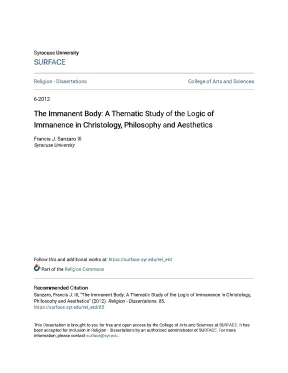
Tải xuống để đọc toàn bộSyracuse University SURFACE Religion - Dissertations College of Arts and Sciences 6-2012 The Immanent Body: A Thematic Study of the Logic of Immanence in Christology, Philosophy and Aesthetics Francis J. Sanzaro III Syracuse University Follow this and additional works at: https://surface.edu/rel_etd Part of the Religion Commons Recommended Citation Sanzaro, Francis J. III, "The Immanent Body: A Thematic Study of the Logic of Immanence in Christology, Philosophy and Aesthetics" (2012).edu/rel_etd/85 This Dissertation is brought to you for free and open access by the College of Arts and Sciences at SURFACE. It has been accepted for inclusion in Religion - Dissertations by an authorized administrator of SURFACE.
For more information, please contact surface@syr. Abstract This dissertation is comprised of two sections: 1) “The Immanent Body in Late Antiquity”: an analysis of late ancient christology, Stoicism and philosophy; 2) “The Extended Body: Aesthetics”: depictions of monastic bodies in late medieval, Renaissance and contemporary art. The thesis of this dissertation can be stated as follows: the conditions under which immanence is thinkable in relation to bodies are found in conceptual personae. Contemporary philosopher Gilles Deleuze’s concept of conceptual personae, developed in conjunction with French theorist Felix Guattari, helps navigate the complex relationship between bodies and ontology developed by these three ancient thinkers.
In order to understand the formation of the conceptual persona of Christ in late antiquity, it was necessary to return to the work of Irenaeus, Tertullian, and Athanasius. The second part of the project begins with the Antony Series, which is a cluster of Renaissance works of art designated by a common theme. They represent St. Antony, who, being the first deep desert monastic, was the subject of my previous chapters.
Therefore, the link between late antique conceptions of the monastic body and Renaissance art becomes explicit. Early Renaissance artists turned to an aesthetics of the monastic body in order to revolutionize painting, for it was during the late thirteenth century that expressive bodies were being created, bodies that would move painting towards the Renaissance. This dissertation analyzes the precise point of this transition through a christological (i., monastic) understanding of the painted figure. THE IMMANENT BODY: A THEMATIC STUDY OF THE LOGIC OF IMMANENCE IN CHRISTOLOGY, PHILOSOPHY AND AESTHETICS By Francis J.
Colorado State University 2001 M., Philosophy, University of Denver 2005 M., Religious Studies, University of Denver 2005 M. Syracuse University 2008 DISSERTATION Submitted in partial fulfillment of the requirements for the degree of Doctor of Philosophy in Religion in the Graduate School of Syracuse University June 2012 Copyright 2012 Francis J. Sanzaro III All rights reserved. Acknowledgements This text would not exist without the support of my committee.
A book is always the product of many difference experiences, and Jack Caputo not only advised this dissertation, but influenced the manner in which I explored the topic. The strategy of innovation within classical modalities of scholarship I owe to Caputo’s guidance, pedagogy and steering. One could not ask for a better advisor, friend or intellectual confidant. An acute thinker across numerous disciplines, Gail Hamner’s willingness to follow a thought wherever it goes, and her eagerness to work alongside students in making theoretical connections, both in a seminar setting and informally, will forever exert a lasting influence not only on how I address ideas in theoretical works but also the manner in which I address the classroom.
To Carl Raschke I owe my deepest thanks for introducing me not only to the spirit of contemporary philosophy, but what it takes to think in this discipline. As the person who first put French philosophy in front of me, I am very fortunate to have had Carl’s friendship and support across the entirety of my graduate career. Patricia Cox Miller has been a profound influence on the ideas and trajectories of thought found here. Her work in antiquity introduced me to entire discourses, and just as important, she taught me how to theoretically and practically navigate writing about late antiquity, which comprises more than half of this dissertation.
Without my exposure to her writings on the ascetic body, and without her having me read Life of Antony for a comprehensive exam I fear iv this dissertation may have taken an entirely different course. Zachary Braiterman’s work in contemporary thought and aesthetics provided a crucial link between my interest in art, the body and philosophy. Zak’s insistence on the aesthetics of thought and the materiality of the image has undeniably played a crucial role in how bodies, especially the figure of Christ, have been conceived in this dissertation. Lastly, to my wife Christy, whose patience and companionship have literally held me together at times, I owe more thanks than is possible to put in words.
The same goes to my parents—they know how much their support has meant to me. And to Amelia, my daughter, who has put everything in perspective. v Table of Contents Abstract i Title Page ii Copyright Page iii Acknowledgements iv Figures vii Preface 1 Introduction: Creation, Christ and the Body of Frankenstein 8 Part I. The Immanent Body in Late Antiquity 28 Chapter 1 – Conceptual Personae 29 Chapter 2 – Flesh, Body, Earth: Tertullian 63 Chapter 3 – The Whole and the Part: Athanasius’ 104 Ontological Movement in On the Incarnation Chapter 4 – Body Parts: From Recapitulated Body to Immanent Body 141 Part II.
The Extended Body: Aesthetics 207 An Introduction to Renaissance Aesthetics 208 Chapter 5 – Christological Aesthetics: The Antony Series 216 Chapter 6 – Istoria: Da Vinci’s Renaissance Bodies 281 Chapter 7 – Conclusion: Body and Concept 342 Bibliography 389 Vitae 399 vi Figures: 1 - Martin Schongauer. The Temptation of St. Stigmatization of St. Francis, Bardi Chapel, Florence, 1319-28.
3 - Catalogue cover for the Bel Ami International Competition. 5 - Video still from one Hermann Nitsch’s 1960’s blood rituals, which were part of the Orgien Mysterien Theater. 6 - Photo of Hermann Nitsch by Sven Eisermann. 7 - Photograph of dancer Amanda Wooden.
Photo by Jordan Matter, 2012. 8 - Discobolus of Myron. Roman marble copy of a fifth century Greek bronze. 9 - Detail from Grunewald’s Isenheim Altarpiece.
Antony is central and in Blue. Photo, Art Resource, NY. The Temptation of St. The Temptation of St.
The Temptation of St. The Temptation of St. The Temptation of St. Martin Schongauer, Saint Anthony Tormented by Demons, ca.
Photo courtesy of the British Museum. Temptations of St. 17 - Joos Van Craesbeeck. The Many Temptations of St.
Bardi Chapel, Florence. Santa Maria Novella, Florence. Tempera on Panel, 1300. Crucifix, 1270’s, San Domenico, Arezzo.
21 - Lucas Cranach the Elder. The Temptation of St. The Temptation of St. 23 - Stefano de Giovanni.
Antony the Hermit Tortured by the Devils, 1423. Michael’s Fight Against the Dragon, 1498. 25 - John Charles Dollman. The Temptations of St.
The Temptation of St. The Temptation of St. Oil on canvas. Baptism of Christ.
The Massacre of the Innocents. School of Athens, 1510-15. Rome, Vatican City. Self-Portrait with Beret and Turned up Collar, 1659.
The Star, Dancer on Stage. Detail of the Last Supper, 1986. Be Somebody with a Body, 1985. Betrayal of Christ, Arena Chapel, 1304-6.
37 - Duccio di Buoninsegna’s The Betrayal by Judas. Tempera on wood panel. Les Demoiselles d'Avignon, 1907. Thesis The thesis of this dissertation can be stated as follows: the conditions under which immanence is thinkable in relation to bodies are found in conceptual personae.
The thesis is philosophical, but has historical consequences. This philosophical thesis has as its application late antique christology. As a concept developed by Deleuze and Guattari in their last collaborative work, a conceptual persona is the image philosophical thought presupposes before it begins to philosophize. Conceptual personae are neither historical nor psychosocial types, but the image thought presupposes.1 Conceptual personae provide movement and style to philosophy, and ought to be conceived as virtual landscapes guiding the trajectories of concepts.
The historical consequence of this thesis is that the development of late antique orthodox thinking gave birth not only to strong theories of transcendence and episcopal hierarchy, as it is usually thought, but also to immanent bodies. The articulation of these politically charged bodies, and the analysis of their relation to the ontologies supporting them, remains relevant to contemporary continental thought as this genre of thinking continues to interrogate the relation between ontology and bodies, thinking and practice. 1 Deleuze and Guattari, What is Philosophy? (New York: Columbia Press, 1994), p. 2 Aristotle’s simple definition of immanent causality—the quality of an action that begins and ends inside an agent—as it has been adapted and applied by Deleuze in his interpretation of Spinoza, has been employed here to specify the meaning of immanence.2 Deleuze defines “immanence” by differentiating it from “emanation,” where the One produces effects that remains outside itself (as in the Neo-Platonism of Plotinus), while immanent causality is defined by an ontology whose effects remain within (immanent) to the cause and do not fall outside it (as in the God of Spinoza).
In ancient and medieval thought, Aristotle’s definition was used to justify transcendence, since the more immanent the life of a being (for example, Aristotle’s self-thinking thought), the more perfect it is. That is why the thinkers addressed here—Irenaeus, Tertullian, Athanasius—are not philosophers of immanence who reject transcendence. In a manner that parallels Deleuze’s use of Aristotle’s definition in respect to Spinoza, I am using it in christology to justify God’s immanence in the world. As the first immanent body within the Christian tradition, the immanent causality of the mystical body of Christ is used by these three thinkers to collapse the distinction between transcendence and immanence, a loss of distinction marked by the theology of the incarnation.
For Athanasius's “christic metaphysics,” Christ is literally the “cosmos” and “all of existence.” The acts of Christ had cosmological significance, and it was only through this conception of Christ's immanent activity that an incarnate God was thinkable, a God that was active in the world. All of Christ's action begin and end in his mystical body, and God is the other name of this immanent action. The immanent causality of Christ—the conceptual persona—makes an immanent transcendence thinkable, and yet, historically speaking, the persona of Christ has consequences beyond the reach of 2 See chapter one, section titled “Two Problems.3 Here the task is different in thinking the conditions of immanence as they relate to bodies. This study therefore uses a philosophical theory to argue for the historical existence of what has been termed immanent bodies.
The existence of these types of bodies within history confirm the philosophical theory that conceptual personae provide the conditions in which immanence is thinkable in relation to bodies. A body is an immanent body when its actions are understood to have immediate effects within the “cosmos.” The body of Christ is immanent because its effects are contained within his body. Ascetic bodies are immanent within the body of Christ because everything they do remains within his body as its effects, modes or attributes. Though Deleuze and Guattari’s notion of conceptual personae form the analytical structure of this analysis, this text does make immanence an attribute of bodies.
Immanence does not belong to these bodies in the sense of possession, as if immanence were a noun. Since Deleuze would also use the category of immanent causality in order to identify philosophies of immanence, this text has rather spoken of immanent causality and not ventured into further defining immanence itself.4 Bodies are considered to be immanent bodies when their acts are said to have immanent causality within the cosmic body of Christ, and the acts and effects are immanent because their bodies are likewise considered to be the cosmos itself. The immanent body is a literal embodiment of the cosmic Christ body. 3 In Difference and Repetition, Deleuze conducted a similar analysis of thought’s presuppositions when he distilled the eight postulates of the image of philosophical thinking.
See chapter three of Difference and Repetition, titled “The Image of Thought.
Nội dung được bảo vệ bản quyền — Tải xuống đầy đủ
Trích dẫn luận án này
Francis J. Sanzaro III (2012). Cơ thể Nội tại: Nghiên cứu về Tính Nội tại trong Giáo hội học [Luận án tiến sĩ, Syracuse University]. LuanAn.net. https://luanan.net/nghien-cuu-van-hoa/ton-giao-hoc/co-the-noi-tai-giao-hoi-hoc-triet-hoc-tham-my
Câu hỏi thường gặp
Luận án "Cơ thể Nội tại: Nghiên cứu về Tính Nội tại trong Giáo hội học" nghiên cứu về vấn đề gì?
Nghiên cứu "Cơ thể Nội tại" khám phá tính nội tại trong Giáo hội học, làm rõ bản chất và vai trò của sự phát triển bên trong.
Luận án "Cơ thể Nội tại: Nghiên cứu về Tính Nội tại trong Giáo hội học" được bảo vệ tại trường nào?
Luận án này được bảo vệ tại Syracuse University. Năm bảo vệ: 2012.
Luận án "Cơ thể Nội tại: Nghiên cứu về Tính Nội tại trong Giáo hội học" thuộc chuyên ngành gì?
Luận án "Cơ thể Nội tại: Nghiên cứu về Tính Nội tại trong Giáo hội học" thuộc chuyên ngành Religion. Danh mục: Tôn Giáo Học.
Luận án "Cơ thể Nội tại: Nghiên cứu về Tính Nội tại trong Giáo hội học" có bao nhiêu trang?
Luận án "Cơ thể Nội tại: Nghiên cứu về Tính Nội tại trong Giáo hội học" có 408 trang. Bạn có thể xem trước một phần tài liệu ngay trên trang web trước khi tải về.
Cách tải luận án "Cơ thể Nội tại: Nghiên cứu về Tính Nội tại trong Giáo hội học" về máy như thế nào?
Để tải luận án về máy, bạn nhấn nút "Tải xuống ngay" trên trang này, sau đó hoàn tất thanh toán phí lưu trữ. File sẽ được tải xuống ngay sau khi thanh toán thành công. Hỗ trợ qua Zalo: 0559 297 239.