Luận án: Giảng dạy Khoa học dựa trên Cải cách - Tiếp cận hỗn hợp để giải thích sự biến đổi
Phân tích và đề xuất cải tiến phương pháp giáo dục khoa học dựa trên học tập dựa trên sự thay đổi, sử dụng phương pháp kết hợp để giải thích.
Năm xuất bản
Số trang
332
Thời gian đọc
50 phút
Lượt xem
0
Lượt tải
0
Phí lưu trữ
60 Point
Tổng quan nhanh
- Chủ đề:
- Khám phá giảng dạy khoa học cải cách: Tiếp cận hỗn hợp
- Số trang:
- 332 trang
- Trường:
- Syracuse University
- Chuyên ngành:
- Science Education
- Tác giả:
- Lauren E. Jetty
- Năm:
- 2014
Tóm tắt nội dung luận án
I.Khám phá giảng dạy khoa học cải cách Tiếp cận hỗn hợp
Nghiên cứu này khám phá sự khác biệt trong thực hành giảng dạy khoa học dựa trên cải cách của giáo viên cấp trung học. Mục đích là hiểu rõ các yếu tố định hình việc áp dụng các phương pháp đổi mới. Tầm quan trọng của giáo dục khoa học đổi mới được nhấn mạnh. Phương pháp tiếp cận hỗn hợp được sử dụng để cung cấp cái nhìn toàn diện. Nghiên cứu xác định ảnh hưởng của nền tảng, kinh nghiệm của giáo viên. Nó cũng xem xét sự phát triển nghề nghiệp của họ. Các chương trình đào tạo giáo viên định hướng cải cách được phân tích. Kết quả giúp giải thích phạm vi thực hành dạy học đa dạng. Đây là một đóng góp quan trọng vào lĩnh vực sư phạm khoa học.
1.1. Mục tiêu nghiên cứu về thực hành cải cách
Mục tiêu chính là giải thích sự khác biệt trong việc áp dụng các phương pháp dạy học cải cách. Nghiên cứu tập trung vào giáo viên khoa học cấp trung học. Các yếu tố ảnh hưởng đến việc thực hiện thực hành giảng dạy đổi mới được tìm hiểu. Điều này giúp nâng cao chất lượng giáo dục khoa học đổi mới. Hiểu rõ lý do tại sao một số giáo viên thành công hơn trong việc áp dụng các phương pháp này.
1.2. Lý thuyết nền tảng và phương pháp tiếp cận
Nghiên cứu dựa trên lý thuyết xã hội hóa giáo viên. Phương pháp tiếp cận hỗn hợp (mixed-methods) được áp dụng. Nó kết hợp phân tích định lượng và định tính. Mục đích là xác định ảnh hưởng của đặc điểm cá nhân, nền tảng chuyên môn, và kinh nghiệm. Các yếu tố này được xem xét trong suốt quá trình phát triển nghề nghiệp của giáo viên. Nghiên cứu thu thập dữ liệu từ các chương trình đào tạo giáo viên định hướng cải cách.
II.Phương pháp nghiên cứu hỗn hợp giải thích thực hành
Nghiên cứu áp dụng thiết kế hỗn hợp hai giai đoạn tuần tự. Giai đoạn đầu là định lượng, tiếp theo là định tính. Dữ liệu được lấy từ Dự án IMPPACT. Đây là một nghiên cứu dọc, đa trường đại học, do NSF tài trợ. Việc thu thập dữ liệu diễn ra liên tục. Phương pháp này cho phép phân tích sâu sắc. Nó giúp hiểu rõ sự phức tạp của thực hành giảng dạy. Các yếu tố ảnh hưởng đến giáo dục khoa học đổi mới được khám phá kỹ lưỡng.
2.1. Giai đoạn định lượng ban đầu
Dữ liệu được thu thập từ 120 giáo viên. Ba khảo sát từ cơ sở dữ liệu Dự án IMPPACT được sử dụng. Phân tích hồi quy đa cấp bậc được thực hiện. Nó kiểm tra ảnh hưởng riêng lẻ và kết hợp của các yếu tố. Các yếu tố bao gồm nền tảng cá nhân, chuyên môn, niềm tin về dạy học khám phá. Cảm giác sẵn sàng dạy khoa học, bối cảnh trường học cũng được xem xét. Văn hóa trường học, môi trường chính sách ảnh hưởng đến thực hành dạy học. Kết quả định lượng cung cấp một bức tranh tổng thể.
2.2. Giai đoạn định tính sâu sắc
Sáu giáo viên được chọn làm nghiên cứu điển hình. Việc lựa chọn dựa trên mức độ thực hành dạy học cải cách của họ. Các trường hợp được chọn bao gồm mức độ thấp, trung bình và cao. Giai đoạn này sử dụng nhiều nguồn phỏng vấn. Nó giúp giải thích sâu hơn sự khác biệt đã thấy ở giai đoạn định lượng. Các chủ đề liên quan đến nền tảng giáo viên, bối cảnh địa phương, và môi trường chính sách được phát triển. Điều này làm rõ kinh nghiệm xã hội hóa của giáo viên.
III.Yếu tố định hình thực hành giảng dạy khoa học đổi mới
Phân tích định lượng đã xác định các yếu tố chính. Ba khối biến số đóng góp đáng kể vào việc giải thích sự khác biệt. Kết quả này cung cấp cái nhìn sâu sắc. Nó giúp hiểu rõ hơn về các tác động. Các yếu tố này ảnh hưởng trực tiếp đến việc áp dụng phương pháp dạy học cải cách. Chúng định hình cách giáo viên tiếp cận việc dạy học khám phá và dạy học định hướng dự án. Việc hiểu rõ các biến số này là cần thiết để phát triển năng lực học sinh hiệu quả.
3.1. Các yếu tố định lượng ảnh hưởng đáng kể
Ba khối biến số có đóng góp đáng kể. Chúng bao gồm nền tảng chuyên môn, niềm tin/hiệu quả bản thân, và bối cảnh trường học địa phương. Các khối này giải thích gần 38% sự khác biệt. Sự khác biệt này là trong việc giáo viên khoa học cấp trung học sử dụng các phương pháp dạy học cải cách. Điều này cho thấy tầm quan trọng của bối cảnh và niềm tin cá nhân.
3.2. Biến số chính giải thích sự khác biệt
Năm biến số chính đóng góp đáng kể vào việc giải thích sự khác biệt. Đó là trường đại học đào tạo giáo viên, cảm giác chuẩn bị cho việc dạy khoa học. Chất lượng phát triển chuyên môn, phát triển chuyên môn tập trung vào nội dung khoa học. Cuối cùng là mức độ tự chủ chuyên môn được nhận thức. Các yếu tố này đặc biệt quan trọng. Chúng định hình khả năng của giáo viên trong việc triển khai giáo dục khoa học đổi mới.
IV.Hiểu rõ giáo dục khoa học đổi mới qua nghiên cứu định tính
Phân tích định tính đã làm rõ các yếu tố phân biệt. Những yếu tố này giải thích tại sao một số giáo viên áp dụng phương pháp dạy học cải cách hiệu quả hơn. Các phát hiện tập trung vào kinh nghiệm cá nhân và bối cảnh chuyên môn. Chúng cung cấp cái nhìn chi tiết hơn về quá trình xã hội hóa của giáo viên. Nghiên cứu này bổ sung chiều sâu cho các phát hiện định lượng. Nó giúp hiểu rõ hơn về tư duy phản biện trong khoa học được hình thành như thế nào.
4.1. Các yếu tố cá nhân và chuyên môn khác biệt
Giáo viên áp dụng thực hành cải cách thường có kinh nghiệm. Họ có kinh nghiệm nghiên cứu khoa học sâu rộng trước khi đào tạo giáo viên. Họ phát triển và coi trọng hiểu biết dựa trên nghiên cứu về dạy và học. Điều này là kết quả từ kinh nghiệm đào tạo giáo viên của họ. Những trải nghiệm này hình thành niềm tin và năng lực của họ.
4.2. Bối cảnh trường học và hỗ trợ chuyên môn
Cấu trúc và chất lượng các đợt thực tập đóng vai trò quan trọng. Văn hóa chuyên môn của trường học hỗ trợ mức độ tự chủ cao. Giáo viên nhận được sự hỗ trợ từ 'đồng nghiệp giáo dục'. Hỗ trợ này tập trung vào sư phạm để hỗ trợ phát triển năng lực học sinh. Môi trường hợp tác này khuyến khích áp dụng dạy học khám phá và dạy học định hướng dự án.
4.3. Năng lực tự chủ và chính sách giáo dục
Giáo viên áp dụng cải cách có ý thức tự chủ cao hơn. Điều này giúp họ điều hướng việc giải thích và thực hiện các chính sách của bang. Họ có khả năng ảnh hưởng đến môi trường làm việc của mình. Năng lực này cho phép họ vượt qua các rào cản. Nó giúp họ kiên trì với các phương pháp dạy học cải cách.
V.Tăng cường năng lực giáo viên Hướng đến giáo dục khoa học
Nghiên cứu đưa ra các hàm ý quan trọng cho các bên liên quan. Các kết quả có thể định hình các chương trình đào tạo giáo viên. Chúng cũng ảnh hưởng đến chính sách giáo dục. Việc hiểu rõ các yếu tố ảnh hưởng là cần thiết. Nó giúp tạo ra môi trường hỗ trợ cho giáo dục khoa học đổi mới. Các khuyến nghị giúp phát triển năng lực học sinh và tư duy phản biện trong khoa học. Nghiên cứu này mở ra hướng đi mới cho các cuộc điều tra trong tương lai.
5.1. Hàm ý cho các bên liên quan
Kết quả nghiên cứu có ý nghĩa sâu sắc cho các chương trình đào tạo giáo viên. Nó cũng quan trọng cho các nhà phát triển chuyên môn và nhà hoạch định chính sách. Việc xây dựng các chương trình hỗ trợ tự chủ giáo viên là cần thiết. Cần cung cấp cơ hội nghiên cứu khoa học cho giáo viên. Điều này tăng cường khả năng của họ trong việc triển khai phương pháp dạy học cải cách.
5.2. Định hướng nghiên cứu tương lai
Cần có thêm nghiên cứu để làm rõ các mối quan hệ nhân quả. Nghiên cứu sâu hơn có thể khám phá vai trò của công nghệ trong giáo dục khoa học. Điều này bao gồm việc tích hợp dạy học kết hợp và học tập lai ghép. Cần tập trung vào thiết kế chương trình giảng dạy khoa học mới. Các chương trình này dựa trên các yếu tố đã xác định. Mục tiêu là tối ưu hóa việc áp dụng các thực hành cải cách.
Tải xuống file đầy đủ để xem toàn bộ nội dung
Tải đầy đủ (332 trang)Trích đoạn nội dung luận án
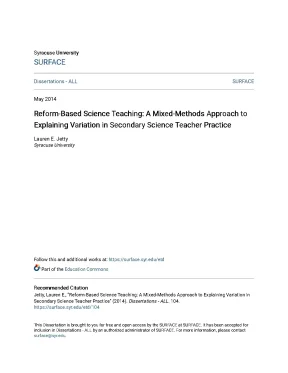
Tải xuống để đọc toàn bộSyracuse University SURFACE Dissertations - ALL SURFACE May 2014 Reform-Based Science Teaching: A Mixed-Methods Approach to Explaining Variation in Secondary Science Teacher Practice Lauren E. Jetty Syracuse University Follow this and additional works at: https://surface.edu/etd Part of the Education Commons Recommended Citation Jetty, Lauren E., "Reform-Based Science Teaching: A Mixed-Methods Approach to Explaining Variation in Secondary Science Teacher Practice" (2014).edu/etd/104 This Dissertation is brought to you for free and open access by the SURFACE at SURFACE. It has been accepted for inclusion in Dissertations - ALL by an authorized administrator of SURFACE. For more information, please contact surface@syr.
ABSTRACT The purpose of this two-phase, sequential explanatory mixed-methods study was to understand and explain the variation seen in secondary science teachers’ enactment of reform- based instructional practices. Utilizing teacher socialization theory, this mixed-methods analysis was conducted to determine the relative influence of secondary science teachers’ characteristics, backgrounds and experiences across their teacher development to explain the range of teaching practices exhibited by graduates from three reform-oriented teacher preparation programs. Data for this study were obtained from the Investigating the Meaningfulness of Preservice Programs Across the Continuum of Teaching (IMPPACT) Project, a multi-university, longitudinal study funded by NSF. In the first quantitative phase of the study, data for the sample (N=120) were collected from three surveys from the IMPPACT Project database.
Hierarchical multiple regression analysis was used to examine the separate as well as the combined influence of factors such as teachers’ personal and professional background characteristics, beliefs about reform-based science teaching, feelings of preparedness to teach science, school context, school culture and climate of professional learning, and influences of the policy environment on the teachers’ use of reform- based instructional practices. Findings indicate three blocks of variables, professional background, beliefs/efficacy, and local school context added significant contribution to explaining nearly 38% of the variation in secondary science teachers’ use of reform-based instructional practices. The five variables that significantly contributed to explaining variation in teachers’ use of reform-based instructional practices in the full model were, university of teacher preparation, sense of preparation for teaching science, the quality of professional development, science content focused professional, and the perceived level of professional autonomy. Using the results from phase one, the second qualitative phase selected six case study teachers based on their levels of reform-based teaching practices to highlight teachers across the range of practices from low, average, to high levels of implementation.
Using multiple interview sources, phase two helped to further explain the variation in levels of reform-based practices. Themes related to teachers' backgrounds, local contexts, and state policy environments were developed as they related to teachers’ socialization experiences across these contexts. The results of the qualitative analysis identified the following factors differentiating teachers who enacted reform-based instructional practices from those who did not: 1) extensive science research experiences prior to their preservice teacher preparation; 2) the structure and quality of their field placements; 3) developing and valuing a research-based understanding of teaching and learning as a result of their preservice teacher preparation experiences; 4) the professional culture of their school context where there was support for a high degree of professional autonomy and receiving support from “educational companions” with a specific focus on teacher pedagogy to support student learning; and 5) a greater sense of agency to navigate their districts’ interpretation and implementation of state polices. Implications for key stakeholders as well as directions for future research are discussed.
REFORM-BASED SCIENCE TEACHING: A MIXED-METHODS APPROACH TO EXPLAINING VARIATION IN SECONDARY SCIENCE TEACHER PRACTICE By Lauren E. Pennsylvania State University, 2001 M.S SUNY Environmental Science and Forestry, 2006 M. Syracuse University, 2006 Dissertation Submitted in partial fulfillment of the requirements for the degree of Doctor of Philosophy in Science Education Syracuse University May 2014 Copyright © 2014 Lauren E. Jetty All Rights Reserved ACKNOWLEDGMENTS A popular saying states “it takes a village to raise a child” and I think the same could be said of a PhD candidate.
I could not have embarked on and completed this five year journey to PhD without a village behind me. I would like to acknowledge and show gratitude to my amazing family, friends, and colleagues whose encouragement and support throughout this process have been essential to my completion of this dissertation. I would like to thank my advisor, Dr. John Tillotson, who served as chair for this dissertation.
My work for him as a research associate on the IMPPACT project provided some of the strongest influences to my professional growth during my PhD program. I am grateful for opportunity to utilize this valuable dataset to pursue the research questions for my dissertation. John, you are an incredible mentor, providing advice and support freely, investing so much time in the professional development of your doctoral students. Your availability and willingness to help, whether through a simple chat, Skype calls, or lunches at the diner, helped to keep me focused on my goals.
All doctoral students should be so lucky to have an advisor like you. I would also like to thank my committee members whose support for this research project along with their knowledge and expertise helped me to more easily navigate this process and my dissertation is much richer due to their influence. Jeff Rozelle, I have always admired your intellect, and greatly value the mentorship you have provided to me as a science educator. Qiu Wang, your enthusiasm for this research, valuable feedback, and encouragement helped me greatly throughout this process.
I had the privilege to work and share an office with three fellow IMMPACT colleagues- our fearless director, Dr. Monica Young, and fellow associates Dr. Glenn Dolphin, and Dr. I am grateful for the friendships we have developed and the personal and professional support you have provided me.
Your shared enthusiasm for margaritas, and eagerness to celebrate each other’s milestones along the way made my experience in graduate school much more enjoyable. I would like to acknowledge that none of this would have been possible without the patience and endless support from my family. To my parents who have always supported my dreams and academic pursuits, I am so lucky to have had your guidance throughout life and your constant reassurance that I can do anything. To my wonderful in-laws, you not only provided me with an immeasurable amount of emotional support, but your willingness to provide countless hours of childcare so I could get more writing accomplished made the completion of this dissertation possible.
To my delightfully curious, funny, and loving son Ryder, being your mama has been my greatest accomplishment yet. Your presence in my life motivates me to the best person I can. You have only ever known a mama who is researching, writing, and fretting about a dissertation. I am so thankful to have had your snuggles throughout this process.
I look forward to splashing in more puddles, collecting rocks, and continuing to exploring the world with you. And finally to my husband Robb, who I love more than words can express. Your love and support have helped me to persevere through the long road to dissertation, particularly when doubts and worries clouded my vision. I am eternally grateful for the confidence you have in me, your positive approach to life, and your ability to make the impossible seem possible.
Thank you for always valuing my dreams and aspirations and backing me up as I work towards them. vi TABLE OF CONTENTS CHAPTER ONE: INTRODUCTION. 1 Reforms for Science Learning and Teaching. 4 Statement of the Problem.
9 Purpose of the Study. 12 Significance of the Study. 15 CHAPTER TWO: REVIEW OF THE LITERATURE. 18 Sphere One: Teachers’ Backgrounds.
28 Sphere Two: The Local Context. 38 Transition from Preservice to In-service. 39 Influence of School Climate/Culture. 42 Sphere Three: State Policy Environment.
45 Current Policy Environment. 46 Policy and Practice. 47 Conceptual Model of Teacher Socialization: Three Spheres of Influence. 51 CHAPTER THREE: METHODOLOGY.
54 Rationale for a Mixed-methods Design. 58 Description of Data Source. 59 Phase One: Quantitative Study. 64 Design and Instrumentation.
81 Sequential Regression Analysis. 82 Phase Two: Qualitative Study. 88 Data and instrumentation. 92 Qualitative Data Analysis.
94 CHAPTER FOUR: QUANTITATIVE DATA ANALYSIS AND RESULTS. 98 Descriptive and Exploratory Data Analysis. 99 Sample Demographic Characteristics. 100 Descriptive Statistics for Key Study Variables.
101 Findings for Research Questions. 103 Hierarchical multiple regression results and analysis. 114 CHAPTER FIVE: QUALITATIVE DATA ANALYSIS AND RESULTS. 117 Case Study Teacher Profiles.
119 Teachers with Low Levels of Reform-based Practices. 120 Teachers with Mean Levels of Reform-based Practices. 121 Teachers with High Levels of Reform-based Practices. 123 Patterns of Talk about Practice.
146 Summary Teachers’ Backgrounds. 166 The Local Context. 170 Summary Local Context. 194 State Policy Environment.
197 Summary State Policy Environment. 206 Chapter Five Summary. 207 CHAPTER SIX: DISCUSSION. 212 Summary of Integration of Quantitative and Qualitative Results.
217 Teachers’ Personal Backgrounds. 217 Teachers’ Professional Preparation. 222 viii Local School Context. 250 Recommendations for Future Research.
299 ix LIST OF TABLES Table 1. Sense of Preparedness to Teach Science Scale. Policy Related Instructional Influences Scale. School Culture and Climate Scale.
Quality of Professional Development Scale. Amount of Science Content Specific Professional Development Scale. Description of Independent Variables. Teachers Use of Reform-based Instructional Practices Scale.
Phase Two Study Sample. Descriptive Statistics for Secondary Science Teachers and School Settings. Descriptive Statistics for Study Variables. Pearson Correlation of Variables.
Five-Step Hierarchical Multiple Regression Model for Variables Predicting Reform-Based Instructional Practices. Case Study Teacher Profiles. Field Placement Requirements by University (# of hours). 147 x LIST OF FIGURES Figure 1.
Changing Emphasis of Science Teaching. Sequential Explanatory Mixed-Methods Design. Visual Model for Sequential Explanatory Study Design Procedures. List of Interventions by University.
Phase Two Possible Sample Participants. 91 xi 1 CHAPTER ONE: INTRODUCTION National concerns about the quality of science education continue to rise as the United States falls behind other countries in international comparisons of science and mathematics performance. Results from the 2011 Trends in International Mathematics and Science Study (TIMSS) show that students from the United States rank seventh in the world at the fourth grade level and tenth in the world at the eighth grade level in their science achievement (Martin, Mullis, Foy, & Stanco, 2012). Additionally, the most recent results from the Program for International Student Assessment (PISA) show average scores in science literacy for 15 year olds in the United States are lower than 22 other countries (Kelly, Xie, Nord, Jenkins, Chan, & Kastberg, 2013).
Findings from both of these longitudinal studies echo results of the previous TIMSS and PISA studies, which indicate US students have made little progress in closing the gap between the leading nations. This lagging performance heightens concerns about the United States’ ability to remain competitive in the global marketplace and to deal with scientific and technological challenges of the 21st century. The President’s Council of Advisors on Science and Technology (PCAST, 2010) report on the future of Science, Technology, Engineering, and Mathematics (STEM) education argues “STEM education will determine whether the United States will remain a leader among nations…the country’s need for a world-leading STEM workforce and scientifically, mathematically, and technologically literate populace has become even greater and will continue to grow – particularly as other nations continue to make rapid advances in science and technology” (p. These assertions regarding the significant role that science education plays in increasing scientific literacy, and in shaping the success of the nation have permeated the discourse on science education for the last two decades (National Research Council [NRC], 2 1996; Rutherford & Ahlgren, 1991).
Though national attention to this issue has spurred reform efforts increasing standards and accountability, there has been relatively little improvement in the quality of science education (NRC, 2007).
Nội dung được bảo vệ bản quyền — Tải xuống đầy đủ
Trích dẫn luận án này
Lauren E. Jetty (2014). Giảng dạy Khoa học dựa trên Cải cách: Tiếp cận hỗn hợp [Luận án tiến sĩ, Syracuse University]. LuanAn.net. https://luanan.net/giao-duc-hoc/phuong-phap-giang-day/giang-day-khoa-hoc-dua-tren-cai-cach-tiep-can-hon-hop
Câu hỏi thường gặp
Luận án "Giảng dạy Khoa học dựa trên Cải cách: Tiếp cận hỗn hợp" nghiên cứu về vấn đề gì?
Phân tích và đề xuất cải tiến phương pháp giáo dục khoa học dựa trên học tập dựa trên sự thay đổi, sử dụng phương pháp kết hợp để giải thích.
Luận án "Giảng dạy Khoa học dựa trên Cải cách: Tiếp cận hỗn hợp" được bảo vệ tại trường nào?
Luận án này được bảo vệ tại Syracuse University. Năm bảo vệ: 2014.
Luận án "Giảng dạy Khoa học dựa trên Cải cách: Tiếp cận hỗn hợp" thuộc chuyên ngành gì?
Luận án "Giảng dạy Khoa học dựa trên Cải cách: Tiếp cận hỗn hợp" thuộc chuyên ngành Science Education. Danh mục: Phương Pháp Giảng Dạy.
Luận án "Giảng dạy Khoa học dựa trên Cải cách: Tiếp cận hỗn hợp" có bao nhiêu trang?
Luận án "Giảng dạy Khoa học dựa trên Cải cách: Tiếp cận hỗn hợp" có 332 trang. Bạn có thể xem trước một phần tài liệu ngay trên trang web trước khi tải về.
Cách tải luận án "Giảng dạy Khoa học dựa trên Cải cách: Tiếp cận hỗn hợp" về máy như thế nào?
Để tải luận án về máy, bạn nhấn nút "Tải xuống ngay" trên trang này, sau đó hoàn tất thanh toán phí lưu trữ. File sẽ được tải xuống ngay sau khi thanh toán thành công. Hỗ trợ qua Zalo: 0559 297 239.