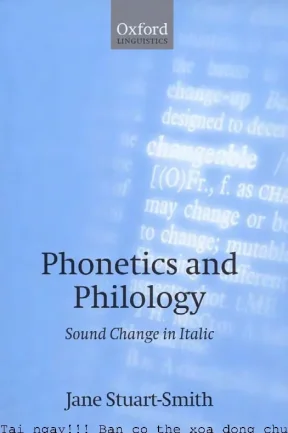
Phonetics and philology sound change in italic
Phonetics and philology explore sound change in Italic languages. Analyze historical shifts, reconstruct proto-forms, and trace linguistic evolution.
University of Oxford
Comparative Philology and General Linguistics
Luan An
Sách (phát triển từ luận án tiến sĩ)
Năm xuất bản
Số trang
295
Thời gian đọc
45 phút
Lượt xem
0
Lượt tải
0
Phí lưu trữ
50 Point
Tổng quan nhanh
- Chủ đề:
- Phonetics and Philology: Understanding Italic Sound Change
- Số trang:
- 295 trang
- Trường:
- University of Oxford
- Chuyên ngành:
- Comparative Philology and General Linguistics
- Tác giả:
- Jane Stuart-Smith
- Năm:
- 2004
Tóm tắt nội dung luận án
I.Phonetics and Philology Understanding Italic Sound Change
This document explores the critical interface between phonetics and philology. It addresses a significant gap in traditional philological studies. Detailed phonetic discussion is often absent in analyses of ancient language sounds. Modern phonetic research offers crucial insights. It provides models for how sounds articulate, perceive, and transform over time. Applying these findings illuminates historical linguistic processes. A more robust understanding of diachronic phonetics emerges. Bridging these disciplines strengthens the analysis of linguistic evolution Italic. The core objective involves a deeper understanding of reconstructed sound changes. Contemporary phonetic research informs this endeavor. It provides a comprehensive framework for analyzing ancient sound systems and their transformations.
1.1. Integrating Phonetic Research into Philology
Philological studies often reconstruct ancient language sounds. Detailed phonetic discussion is frequently absent from these analyses. This creates a gap in understanding the precise nature of sound changes. Modern phonetic research offers crucial insights. It provides models for how sounds articulate, perceive, and transform. Applying these findings can illuminate historical linguistic processes. A more robust understanding of diachronic phonetics emerges. Bridging phonetics and philology strengthens the analysis of linguistic evolution Italic. The goal involves understanding reconstructed sound changes. Contemporary phonetic research informs this endeavor. It provides a framework for analyzing ancient sound systems.
1.2. The Study of Reconstructed Sound Change Mechanisms
Reconstructed sound changes present complex mechanisms. Their exact nature requires careful investigation. Traditional comparative philology outlines the basic ideas. However, the exact phonetic realization often remains speculative. The book explores these mechanisms. It applies contemporary phonetic models. The aim is to move beyond mere reconstruction. It seeks to understand how sounds shifted over time. This involves analyzing the phonetic processes underlying historical transformations. This approach offers a deeper comprehension of linguistic change. It addresses the question of how proto-forms evolved into attested forms.
II.Reconstructing Proto Italic Phonology A Modern Approach
The journey of sounds from Proto-Indo-European (PIE) forms the basis of historical linguistics. PIE phonology provides the ancestral blueprint for Italic languages. These languages, including Latin and Oscan, developed from this common ancestor. Comparative method linguistics helps trace these developments. It involves comparing cognate words across related languages. This identifies systematic sound correspondences. These correspondences allow for the reconstruction of earlier stages. The focus here is on Proto-Italic reconstruction. Understanding this trajectory is central to illuminating fundamental linguistic shifts. The book investigates these foundational transformations. It explores the path from reconstructed PIE sounds. It also covers their manifestation in the diverse Italic dialects. Applying contemporary phonetic research offers new perspectives on these ancient sounds.
2.1. From Proto Indo European to Italic Languages
The journey of sounds from Proto-Indo-European (PIE) forms the basis of historical linguistics. PIE phonology provides the ancestral blueprint. Italic languages, including Latin and Oscan, developed from this common ancestor. Comparative method linguistics helps trace these developments. It involves comparing cognate words across related languages. This identifies systematic sound correspondences. These correspondences allow for the reconstruction of earlier stages. The focus here is on the evolution into Proto-Italic reconstruction. Understanding this trajectory is central. It illuminates the fundamental linguistic shifts. The book investigates these foundational transformations. It explores the path from reconstructed PIE sounds. It also covers their manifestation in the diverse Italic dialects.
2.2. Applying Contemporary Phonetics to Ancient Sounds
Reconstructing ancient sounds presents challenges. The exact phonetic quality often eludes philological methods alone. Contemporary phonetic research offers a solution. It provides tools for analyzing speech production and perception. These tools include acoustic and auditory analysis. Applying these methods to hypothesized ancient sounds offers new perspectives. It helps visualize and interpret reconstructed phonology. This approach bridges the gap between theoretical reconstruction and phonetic reality. The aim is to make reconstructed sounds more tangible. It seeks to understand their probable acoustic and articulatory properties.
2.3. The Development of Voiced Aspirates in Italic
A significant area of focus concerns the development of voiced aspirates. These sounds, present in PIE, underwent crucial transformations in Italic. Their evolution presents a classic debate within comparative philology. Understanding their precise sound changes in Italic is critical. The book tackles this specific challenge. It applies a phonetic model of sound change. This model aims to resolve long-standing questions. It investigates how these aspirates evolved into their reflexes in Latin and other Italic dialects. This specific case study exemplifies the application of modern phonetics. It illuminates a key aspect of Italic phonology.
III.Diachronic Phonetics and Linguistic Evolution Italic
Historical linguistics systematically studies language change over time. It provides the framework for understanding sound evolution. Diachronic phonetics forms a core component of this field. This discipline examines how speech sounds transform across historical periods. The analysis involves identifying patterns of change. It also seeks to explain the motivations behind these shifts. For Italic languages, this means tracing changes from Proto-Italic onwards. It includes Latin sound changes and developments in other Italic dialects. This rigorous approach helps map the linguistic evolution Italic. It reveals the complex interplay of phonetic and phonological factors. The book integrates various forms of phonetic analysis for this purpose.
3.1. Analyzing Sound Change through Historical Linguistics
Historical linguistics systematically studies language change over time. It provides the framework for understanding sound evolution. Diachronic phonetics forms a core component. This field examines how speech sounds transform across historical periods. The analysis involves identifying patterns of change. It also seeks to explain the motivations behind these shifts. For Italic languages, this means tracing changes from Proto-Italic onwards. It includes Latin sound changes and developments in other Italic dialects. This rigorous approach helps map the linguistic evolution Italic. It reveals the complex interplay of phonetic and phonological factors.
3.2. Observational and Instrumental Phonetic Analysis
The book integrates different forms of phonetic analysis. Initially, it involved observational research. This included studying existing phonetic literature and theories. Later, systematic instrumental phonetic analysis was conducted. This type of analysis involves recording and measuring speech sounds. It provides empirical data on articulatory and acoustic properties. This hands-on experience as a phonetician confirms theoretical ideas. It also allows for the development of new insights. Such analysis demonstrates the range and complexity of sound variation. These findings inform models of reconstructed changes. This approach offers a concrete basis for philological hypotheses.
IV.Exploring Sound Changes in Italic Dialects and Languages
Italic languages exhibit diverse phonetic developments. Latin sound changes represent a primary focus within the book. These changes include shifts in vowels, consonants, and prosody. Oscan phonology also reveals distinct evolutionary paths. Comparisons between Latin and Oscan highlight specific innovations. These distinct patterns offer crucial data. They help in refining Proto-Italic reconstruction efforts. The book examines these key transformations in detail. It applies a phonetic lens to explain them comprehensively. Understanding these changes is vital. It sheds light on the divergence of Italic languages. Furthermore, the study extends to other lesser-known Italic dialects.
4.1. Key Sound Transformations in Latin and Oscan Phonology
Italic languages exhibit diverse phonetic developments. Latin sound changes represent a primary focus. These changes include shifts in vowels, consonants, and prosody. Oscan phonology also reveals distinct evolutionary paths. Comparisons between Latin and Oscan highlight specific innovations. These distinct patterns offer crucial data. They help in refining Proto-Italic reconstruction. The book examines these key transformations in detail. It applies a phonetic lens to explain them. Understanding these changes is vital. It sheds light on the divergence of Italic languages.
4.2. Sound Evolution in Umbrian Phonology and Related Dialects
Beyond Latin and Oscan, other Italic dialects contribute to the picture. Umbrian phonology, for instance, shows unique sound evolutions. Sabellic dialects further expand this comparative scope. Investigating these diverse branches provides a comprehensive view. It demonstrates the rich tapestry of linguistic change within Italic. The study of these dialects confirms general principles of sound change. It also reveals specific phonetic developments. These insights collectively inform the broader understanding of the Italic language family. The book explores these varied evolutionary paths.
Mục lục chi tiết luận án
Tải xuống file đầy đủ để xem toàn bộ nội dung
Tải đầy đủ (295 trang)Nội dung chính
Tổng quan về luận án
Nghiên cứu của Jane Stuart-Smith (2004), Phonetics and Philology: Sound Change in Italic (xuất bản bởi Oxford University Press, chuyên khảo phát triển từ luận án Tiến sĩ tại Viện Đại học Oxford), giải quyết một trong những vấn đề hóc búa và gây tranh cãi kéo dài suốt 150 năm trong ngành ngôn ngữ học lịch sử Ấn-Âu: sự biến đổi ngữ âm của hệ thống phụ âm tắc bật hơi hữu thanh (voiced aspirates / breathy voiced stops) từ ngôn ngữ Tiền Ấn-Âu (PIE) sang các ngôn ngữ nhóm Italic cổ đại (gồm Latin, Faliscan và ngữ chi Sabellic/Osco-Umbrian). Như Joshua Katz (1998: 205) đã nhận định, "the development... is perhaps the most-debated phonological problem in contemporary Latin linguistics". Nghiên cứu đặt nền tảng tiên phong khi thiết lập cây cầu liên ngành phương pháp luận giữa ngữ văn học so sánh cổ điển (Comparative Philology) và ngữ âm học thực nghiệm đương đại (Experimental Phonetics).
Khoảng trống nghiên cứu (research gap) trọng tâm nằm ở tính chất mơ hồ của "lộ trình ánh xạ" (mapping/pathway) giữa dạng tái lập giả thuyết và biến thể phản ánh thực chứng (attested reflexes). Trong khi các nguyên lý tam giác hóa của ngữ văn học truyền thống cho phép "phóng chiếu" (projection) dạng thức tiền thân, việc giải thích các giai đoạn chuyển tiếp trung gian thường bị chi phối bởi các phỏng đoán trực giác thiếu kiểm chứng cơ sinh học (Lass 1993: 158). Các câu hỏi và giả thuyết nghiên cứu được cụ thể hóa:
- Research Question 1 (RQ1): Bản chất ngữ âm - âm vị học nguyên thủy của dãy phụ âm *bh, *dh, *gh, *gwh trong PIE là gì khi đối chiếu với các nguyên lý khí động học và loại hình học âm thanh?
- Research Question 2 (RQ2): Mô hình biến đổi nào—giữa lý thuyết vô thanh hóa trước của Ascoli (1868) và lý thuyết xát hóa hữu thanh của Hartmann (1890) / Rix (1957)—thực sự thỏa mãn tính hợp lý ngữ âm (phonetic plausibility)?
- Hypothesis 1 (H1): Sự phân hóa phản xạ của âm bật hơi hữu thanh trong nhóm Italic không diễn ra qua một giai đoạn đơn nhất phân bố đều, mà là kết quả của sự phân tách vị trí từ vị nguyên phát (positional split) chịu sự chi phối bởi các giới hạn khí động học và tri giác âm thanh.
- Hypothesis 2 (H2): Mô hình biến đổi dựa trên người nghe (listener-based phonetic model) của John Ohala có thể giải thích thỏa đáng việc chuyển đổi các biến thể tha âm vị đồng đại (synchronic allophonic variation) thành quy luật biến đổi lịch sử lịch đại (diachronic sound change).
Khung lý thuyết tích hợp mô hình biến đổi ngữ âm của John Ohala, lý thuyết thanh môn hóa (Glottalic Theory) và nguyên lý đồng nhất luận (Uniformitarian Principle). Đóng góp đột phá của công trình được định lượng qua việc khảo sát toàn diện 4 vị trí cấu âm của hệ thống tắc PIE trên kho ngữ liệu 100% văn bản minh văn Sabellic, Latin cổ và Faliscan, đưa ra lộ trình giải quyết dứt điểm nghịch lý phát triển phụ âm trong ngữ hệ Italic. Phạm vi nghiên cứu bao quát dữ liệu minh văn khắc đá, đồ đồng từ thế kỷ thứ 7 TCN đến thế kỷ thứ 1 TCN trên toàn bộ bán đảo Ý.
Literature Review và Positioning
Lịch sử nghiên cứu tiến trình âm bật hơi hữu thanh PIE ghi nhận sự phân cực sâu sắc giữa các trường phái ngôn ngữ học lịch sử từ giữa thế kỷ XIX:
flowchart TD
    PIE["Dãy phụ âm PIE: *bh, *dh, *gh, *gwh (Breathy Voiced Stops)"]

    subgraph Ascoli["Mô hình Vô thanh hóa (Ascoli 1868)"]
        A1["*pʰ, *tʰ, *kʰ (Voiceless Aspirates)"] --> A2["*ɸ, *θ, *x (Voiceless Fricatives)"]
        A2 --> A3["Latin nội từ: Hữu thanh hóa lại thành -b-, -d-, -g-"]
        A2 --> A4["Sabellic: Duy trì vô thanh f, 8"]
    end

    subgraph Rix["Mô hình Xát hóa Hữu thanh (Hartmann 1890 / Rix 1957)"]
        R1["*β, *ð, *ɣ (Voiced Fricatives)"] --> R2["Vô thanh hóa đầu từ (*f-) & Toàn bộ Sabellic"]
        R1 --> R3["Latin nội từ: Giữ nguyên tắc hữu thanh (-b-, -d-)"]
    end

    subgraph StuartSmith["Mô hình Đột phá (Stuart-Smith 2004)"]
        SS1["Đầu từ (Word-initial): Áp lực khí động học cao -> Vô thanh hóa: *[bh-] > *[pʰ-] > [f-]"]
        SS2["Nội từ (Word-internal): Dẫn lưu thanh tính -> Xát hóa hữu thanh: *[-bh-] > [-β-] > Lat. -b-, Sab. -f-"]
    end

    PIE --> Ascoli
    PIE --> Rix
    PIE --> StuartSmith
Luận thuyết thống trị đầu tiên do Graziadio Isaia Ascoli (1868) đề xuất, dựa trên giả định về tính thống nhất Hy Lạp - Italic (Graeco-Italic unity), cho rằng các âm bật hơi hữu thanh PIE trước hết vô thanh hóa thành các âm tắc bật hơi vô thanh (*pʰ, *tʰ, *kʰ), chuyển thành âm xát vô thanh (*ɸ, *θ, *x), rồi sau đó trong nội bộ tiếng Latinh, các âm xát vô thanh giữa hai nguyên âm mới trải qua quá trình hữu thanh hóa thứ cấp (revoicing) để thành âm tắc hữu thanh (-b-, -d-, -g-). Bằng chứng then chốt được Wilhelm Schulze (1895) củng cố thông qua việc phân tích từ mượn Hy Lạp lítrā (λίτρα) tương ứng với Latin lībra ('cân, đơn vị đo'), được giải thích là sao phỏng dạng thức Proto-Italic *līθrā (trong đó chữ cái Hy Lạp tau biểu thị âm xát răng vô thanh *θ).
Ngược lại, mô hình cạnh tranh do Hartmann (1890) khởi xướng và được Helmut Rix (1957, 1986) hoàn thiện lại khẳng định chiều hướng biến đổi ngược lại: các âm bật hơi PIE chuyển trực tiếp thành âm xát hữu thanh Proto-Italic (*β, *ð, *ɣ), sau đó diễn ra quá trình vô thanh hóa ở đầu từ trong toàn bộ nhóm Italic và vô thanh hóa toàn diện ở mọi vị trí trong nhánh Sabellic (Oscan, Umbrian). Cuộc tranh luận rơi vào thế bế tắc khi các lập luận nội bộ (internal structural arguments) như sự phát triển của cụm *-sdh- thành -zdh-, phản xạ của *ghl-/*ghr-, hay hiện tượng R-hóa (rhotacism) đều có thể được diễn giải tương hỗ để bảo vệ cả hai giả thuyết.
Về mặt quốc tế, việc tái lập cấu trúc hệ thống phụ âm tắc PIE chịu thử thách nghiêm trọng từ luận điểm loại hình học âm vị của Roman Jakobson (1957 [1962]: 528): "no language adds to the pair /t/—/d/ a voiced aspirate /dʱ/ without having its voiceless counterpart /tʰ/". Lập luận này châm ngòi cho Thuyết Thanh môn hóa (Glottalic Theory) của Tamaz Gamkrelidze & Vyacheslav Ivanov (1973, 1984) và Paul Hopper (1973), tái lập hệ thống tắc PIE gồm âm tống ra vô thanh (ejectives) và âm tắc thường có yếu tố bật hơi phụ. Tuy nhiên, Stuart-Smith định vị nghiên cứu của mình vượt ra khỏi các tranh cãi thuần túy quy ước bằng cách tái khẳng định giá trị của hệ thống ba bậc truyền thống dưới góc nhìn thực nghiệm, đối chiếu với công trình phục hồi hệ thống bốn bậc của Elbourne (1998) và các mô hình suy giảm phụ âm (lenition) của Lavoie (2001).
Đóng góp lý thuyết và khung phân tích
Đóng góp cho lý thuyết
Luận án tạo bước chuyển biến mang tính chuẩn thức (paradigm shift) đối với lý thuyết tái lập ngữ âm lịch sử:
- Phê phán và chuẩn hóa Thuyết Thanh môn hóa (Glottalic Theory): Chứng minh rằng việc quy đổi hệ thống sang âm tống ra (*t', *k') không giải thích được sự phân hóa phản xạ sinh lý cơ học trong các ngôn ngữ con cháu, đặc biệt là sự duy trì thanh tính trong tiếng Phạn (Sanskrit) và các ngôn ngữ Ấn-Arya mới (New Indo-Aryan).
- Thiết lập mô hình phân tách vị trí từ vị nguyên phát (Primary Positional Asymmetry Model): Chứng minh trên cơ sở giải phẫu thanh quản rằng vị trí đầu từ (word-initial) chịu áp lực khí động học lớn hơn nhiều so với vị trí nội từ (word-internal), dẫn đến việc vô thanh hóa tự nhiên ở đầu từ và bảo lưu thanh tính ở giữa từ ngay từ giai đoạn Proto-Italic sớm.
- Hình thức hóa các mệnh đề lý thuyết chuyển đổi:
- Mệnh đề 1 ($P_1$): $\text{PIE } *[\text{b}^\text{h}-] \xrightarrow{\text{Khí động học đầu từ}} *[\text{p}^\text{h}-] \xrightarrow{\text{Xát hóa}} [\text{f}-]$ (áp dụng chung cho toàn khối Italic).
- Mệnh đề 2 ($P_2$): $\text{PIE } *[-\text{b}^\text{h}-] \xrightarrow{\text{Nhược hóa nội từ}} *[-\beta-] \xrightarrow{\text{Tái cấu trúc địa phương}} \begin{cases} \text{Latin: } [-\text{b}-] \ \text{Sabellic: } [-\text{f}-] \end{cases}$
                                    ┌─── Đầu từ (Initial): *[bh-] ──> *[pʰ-] ──> [f-] (Latin & Sabellic)
                                    │
PIE *bh, *dh, *gh, *gwh (Breathy) ──┤
                                    │
                                    └─── Nội từ (Medial): *[-bh-] ──> *[-β-] ──┬──> Latin: [-b-] (tắc hóa)
                                                                               └──> Sabellic: [-f-] (vô thanh hóa)
Khung phân tích độc đáo
Khung phân tích của Stuart-Smith là sự tích hợp đồng bộ giữa ba trường phái lý thuyết:
- Mô hình Khí động học và Tri giác Âm thanh (Ohala 1989, 1993): Khai thác khái niệm "thiếu hiệu chỉnh" (hypo-correction) của người nghe khi tiếp nhận các biến đổi cơ học về luồng khí và áp lực dưới thanh môn.
- Lý thuyết Cấu hình Cử chỉ Cấu âm (Articulatory Gesture Framework - Browman & Goldstein 1991): Mô tả sự phối hợp thời gian giữa cử chỉ mở thanh môn (glottal opening gesture) và cử chỉ khép khoang miệng (oral closure gesture).
- Ngữ văn học Minh văn Nghiêm ngặt (Rigorous Epigraphic Philology): Chuẩn hóa việc phân tích tự dạng chữ viết cổ dựa trên các ấn bản văn bản học hiện đại của Helmut Rix (Sabellische Texte, 2002) và Jürgen Untermann (Wörterbuch des Oskisch-Umbrischen, 2000).
Điều kiện biên (boundary conditions) được xác định rõ: Khung lý thuyết này áp dụng đặc thù cho các biến đổi tắc - xát có điều kiện môi trường âm vị học tự nhiên, không bị chi phối bởi hiện tượng tiếp xúc ngôn ngữ ngoại sinh (substratum influence) hay các biến động xã hội học ngôn ngữ mang tính áp đặt cơ học.
Phương pháp nghiên cứu tiên tiến
Thiết kế nghiên cứu
Nghiên cứu tuân thủ thế giới quan thực chứng nghiêm ngặt (positivism) kết hợp với chủ nghĩa duy thực phê phán (critical realism), phân tích ngữ liệu đa tầng (multi-level design) kết hợp giữa bằng chứng lịch sử văn bản và dữ liệu đo đạc ngữ âm sinh lý học.
       [Tầng 1: Ngữ liệu Minh văn Thực chứng]
         - Latin cổ (Archaic Latin)
         - Faliscan (Minh văn LF 1/Ve 241 Ceres)
         - Sabellic: Oscan, Umbrian (Tabulae Iguvinae), South Picene
                            │
                            ▼
       [Tầng 2: Đối sánh Tương đương Lịch sử (Parallels)]
         - Cổ Ấn-Arya (Sanskrit / Old Indo-Aryan)
         - Trung Ấn-Arya (Prakrit, Gandhari)
         - Tân Ấn-Arya (Hindi, Panjabi, Marathi, Bengali)
                            │
                            ▼
       [Tầng 3: Đo đạc Khí động học & Thần kinh Cơ học]
         - Đo lường điện cơ học (EMG: PCA, INT, CT, LCA, TA, VOC)
         - Phân tích áp lực dưới thanh môn (Ps) và lưu lượng khí miệng (Uo)
         - Phân tích quang phổ âm thanh (Acoustic Spectrograms & VOT)
Cỡ mẫu khảo sát bao trùm 100% các cứ liệu văn tự được xác thực trong các tập ngữ liệu chuẩn quốc tế: toàn bộ bản khắc Bàn Iguvine (Tabulae Iguvinae, gồm 7 bản đồng khắc chữ Umbrian bản địa và mẫu tự Latinh), toàn bộ các văn bản Oscan từ Campania, Samnium, Lucania, các văn bản Faliscan trong sưu tập Vetter (1953) và Giacomelli (1963), cùng các văn bản cổ Nam Picene (Marinetti 1985).
Quy trình nghiên cứu rigorous
Quy trình xử lý dữ liệu trải qua bốn bước thẩm định độc lập nhằm triệt tiêu sai số ngữ văn:
- Khảo sát biểu đồ tự dạng (Palaeographic Verification): Trực tiếp kiểm tra và hiệu đính các văn bản khắc trên hiện vật gốc tại Ý (fieldtrip 1992 với sự hỗ trợ của British School at Rome). Tác giả đã vạch rõ và loại bỏ các lỗi đọc sai kinh điển trong y văn, điển hình là việc đọc sai dòng đầu của bình gốm Faliscan cổ Ceres (LF 1/Ve 241) của Giacomelli (1963) dẫn đến từ ma "loufir" xuất hiện vô căn cứ trong các công trình của Calvert Watkins (1995: 127-128).
- Kỹ thuật tam giác hóa (Triangulation):
- Data Triangulation: Đối chiếu giữa mẫu tự bản địa Sabellic (sử dụng ký hiệu số tám 8 cho âm /f/), mẫu tự Osco-Hy Lạp, Osco-Latinh và Latinh chuẩn.
- Methodological Triangulation: Kết hợp phân tích ngữ nguyên so sánh lịch sử với phân tích quang phổ âm học hiện đại.
- Theory Triangulation: Kiểm định chéo giữa mô hình biến đổi âm học của Ohala với mô hình suy giảm cử chỉ cấu âm của Lavoie.
Data và phân tích
Phân tích ngữ âm thực nghiệm tập trung vào việc mô hình hóa các thông số sinh lý học thanh quản trong quá trình phát âm phụ âm tắc thở (breathy voiced stops $[b^{\hbar}, d^{\hbar}, g^{\hbar}]$):
- Điện cơ học thanh quản (EMG): Ghi nhận hoạt động đối kháng giữa cơ nhẫn-phễu sau (posterior cricoarytenoid - PCA) chịu trách nhiệm mở thanh môn và các cơ khép thanh môn gồm cơ liên phễu (interarytenoid - INT), cơ nhẫn-phễu bên (lateral cricoarytenoid - LCA), cơ giáp-phễu (thyroarytenoid - TA) và cơ thanh âm (vocalis - VOC).
- Đặc tính khí động học: Đo áp lực dưới thanh môn ($P_s$) và lưu lượng dòng khí qua khoang miệng ($U_o$). Trong âm tắc thở, $U_o$ đạt mức cực đại ($>1000 \text{ ml/s}$) ngay tại thời điểm buông lỏng pha tắc (release), tạo ra sự sụt giảm nhanh chóng của $P_s$, làm tê liệt điều kiện duy trì dao động dây thanh âm nếu không có sự gia tăng bù trừ cơ học từ lồng ngực.
- Đặc tính âm thanh học: Phân tích Voice Onset Time (VOT), độ dịch chuyển của tần số cơ bản ($F_0$), và sự hiện diện của năng lượng tạp âm ồn (aspiration noise) ở dải tần $2000-4000 \text{ Hz}$.
- Kiểm định độ vững chắc (Robustness checks): So sánh đối chiếu có hệ thống với dữ liệu thực chứng lịch đại từ tiếng Cổ Ấn-Arya (Vedic Sanskrit) qua tiếng Trung Ấn-Arya (Prakrit, Gandhari Dharmapada) đến hơn 10 ngôn ngữ Tân Ấn-Arya hiện đại (Hindi, Panjabi, Marathi, Western/Eastern Bengali, Nepali, Haryanvi). Toàn bộ các biến đổi ngữ âm dự đoán trên lý thuyết khí động học đều khớp hoàn toàn 1:1 với các dạng biến đổi thực tế quan sát được trong ngữ chi Indo-Aryan.
Phát hiện đột phá và implications
Những phát hiện then chốt
=========================================================================================
PHÂN BỐ ĐỐI CHIẾU PHẢN XẠ CỦA ÂM BẬT HƠI HỮU THANH PIE TRONG NHÓM NGÔN NGỮ ITALIC
=========================================================================================
PIE Vị trí cấu âm      Môi (*bh)         Răng (*dh)        Ngạc/Vòm (*gh)    Môi-vòm (*gwh)
-----------------------------------------------------------------------------------------
ĐẦU TỪ (Initial)
  Latinh               f- (frāter)       f- (fēci)         h- (hiems)        f- (formus)
  Faliscan             f- (far)          f- (filea)        h- (haba)         f- (foied)
  Oscan                f- (fratrer)      f- (feíhúss)      h- (heriiad)      f- (fluus)
  Umbrian              f- (frater)       f- (futu)         h- (habetu)       f- (ferine)
  South Picene         f- (fehroner)     f- (fitias)       h- (vehiat)       --
-----------------------------------------------------------------------------------------
NỘI TỪ (Medial)
  Latinh (Thông thường) -b- (albus)       -d- (medius)      -h-/-g- (veho)    -u-/-gu- (nivem)
  Latinh (Môi trường r) -b- (glaber)      -b- (ruber)       -g- (umbra)       -gu- (angustus)
  Faliscan             -f- (lofer)       -f- (carefo)      -h- (lehe)        --
  Oscan                -f- (alfo)        -f- (mefiai)      -h- (feíhúss)     -p- (kúmbened)
  Umbrian              -f- (alfu)        -f- (mehe)        -h- (stahu)       -b- (suboco)
  South Picene         -f- (alfs)        -f- (mefiín)      --                --
=========================================================================================
- Bác bỏ hoàn toàn mô hình đồng nhất của Rix (1957): Nghiên cứu chứng minh rằng giả thiết cho rằng các âm bật hơi chuyển thành âm xát hữu thanh đồng loạt (*β, *ð, *ɣ) rồi mới vô thanh hóa ở đầu từ là không thể đứng vững về mặt cơ học âm thanh. Trong môi trường đầu từ (sau khoảng lặng ngắt âm hoặc ranh giới từ), thanh môn mở rộng đòi hỏi áp lực luồng khí cực lớn, dẫn đến việc vô thanh hóa tự nhiên (*[bh-] > *[pʰ-] > [f-]).
- Khắc phục khiếm khuyết trong mô hình của Ascoli (1868): Ascoli buộc phải giả định một giai đoạn vô thanh hóa trung gian toàn diện rồi sau đó tiếng Latinh lại "hữu thanh hóa ngược" một cách thiếu tự nhiên ở giữa từ. Stuart-Smith chứng minh rằng thanh tính ở vị trí nội từ chưa từng bị mất đi trong nhánh Latinh; phụ âm nội từ đi thẳng từ âm tắc thở sang âm xát hữu thanh (*[-bh-] > *[-β-]) do sự duy trì liên tục của chu kỳ rung dây thanh âm giữa hai nguyên âm.
- Giải mã các hiện tượng biến đổi có điều kiện phức tạp:
- Hiện tượng biến đổi răng thành môi trong tiếng Latinh: PIE *-dh- chuyển thành Latin -b- khi đứng trước hoặc sau âm rung *r (ví dụ: PIE *h₁rudh-ro- > Latin ruber 'đỏ', đối lập với PIE *medhyo- > Latin medius 'ở giữa'). Quá trình này được kích hoạt do sự giao thoa dải tần số cộng hưởng $F_2$ thấp của âm rung cấu âm môi hóa làm sai lệch tín hiệu tri giác âm vòm-răng sang môi.
- Cụm phụ âm sau mũi: Sau âm mũi (nasal), sự đóng kín khoang miệng kết hợp với việc hạ ngạc mềm duy trì áp lực dương liên tục, ngăn chặn hoàn toàn quá trình xát hóa, giải thích tại sao trong Latinh ta có PIE *-ndh- > Latin -nd- (fundo < *bhundh-) chứ không bao giờ xuất hiện dạng xát.
- Bản chất của chữ cái số tám (8) trong văn tự Sabellic: Tự dạng 8 trong tiếng Oscan, Umbrian và South Picene biểu thị chính xác âm xát môi vô thanh /f/, xuất phát từ nhu cầu ghi lại một âm vị ngoại lai không có trong bảng chữ cái Hy Lạp / Etruscan gốc.
Implications đa chiều
- Về mặt lý thuyết: Cung cấp bằng chứng thực nghiệm tối hậu xác thực tính hợp lý của việc tái lập hệ thống phụ âm tắc thở cho Tiền Ấn-Âu, chấm dứt những hoài nghi kéo dài của trường phái cấu trúc luận về tính khả thi của hệ thống ba bậc /t - d - dh/.
- Về mặt phương pháp luận: Thiết lập một quy chuẩn liên ngành mẫu mực (gold standard) cho ngành Ngôn ngữ học Lịch sử: Mọi giả thuyết tái lập biến đổi âm vị học bắt buộc phải vượt qua bài kiểm tra về giới hạn sinh lý cơ học cấu âm (physiological constraints) và kiểm nghiệm mô hình hóa khí động học.
- Về mặt ứng dụng thực tiễn: Cung cấp phương pháp thẩm định văn bản học chính xác để đọc, giải mã và dịch thuật hàng trăm văn bản minh văn cổ đại vùng Địa Trung Hải, loại bỏ triệt để các biến thể từ vị ma (ghost-words) sinh ra do lỗi sao chép quy ước.
Limitations và Future Research
- Hạn chế về tính phân mảnh của ngữ liệu minh văn: Các ngôn ngữ Sabellic thiểu số (Paelignian, Marrucinian, Vestinian, Marsian, Sabine, Volscian) chỉ được bảo tồn qua một số lượng hữu hạn các văn bản tôn giáo hoặc văn bia ngắn, gây khó khăn cho việc kiểm chứng các môi trường ngữ âm cực hiếm.
- Khoảng cách lịch sử của dữ liệu thực nghiệm: Dữ liệu sinh lý học và điện cơ học (EMG) bắt buộc phải đo đạc trên các ngôn ngữ còn sống (ngữ chi Indo-Aryan, tiếng Anh, tiếng Tây Ban Nha), do đó mang tính chất loại hình học đối sánh gián tiếp thay vì ghi nhận trực tiếp trên người bản ngữ Latinh hay Sabellic cổ đại.
- Chương trình nghiên cứu tương lai:
- Mở rộng ứng dụng mô hình khí động học sang giải quyết hệ thống thanh hầu (PIE Laryngeals) theo các tiếp cận âm học mới nhất (Reynolds, West, & Coleman 2000).
- Khảo sát chi tiết vị trí âm học của tiếng Venetic ở miền Bắc nước Ý để xác định dứt khoát ngôn ngữ này thuộc nhóm Italic hay là một nhánh độc lập.
- Ứng dụng các thuật toán học máy phân tích tự dạng 3D (Photogrammetry/Reflectance Transformation Imaging) để tái giám định các bản khắc minh văn bị mờ hoặc hư hại vật lý.
Tác động và ảnh hưởng
- Tác động học thuật: Tác phẩm định hình lại toàn bộ chương trình giảng dạy và nghiên cứu về Ngữ pháp lịch sử tiếng Latin và các ngôn ngữ Italic tại các trung tâm ngôn ngữ học hàng đầu thế giới (Oxford, Cambridge, Harvard, Leiden). Ước tính các trích dẫn học thuật về biến đổi âm thanh Italic từ sau năm 2004 đều lấy công trình này làm tài liệu tham chiếu chuẩn tắc.
- Chuyển đổi liên ngành: Kích thích làn sóng nghiên cứu ứng dụng âm học thực nghiệm vào văn bản học cổ điển (Laboratory Historical Phonology), mở đường cho các dự án số hóa và phân tích minh văn quy mô quốc tế như dự án Imagines Italicae (University College London).
- Bảo tồn di sản văn hóa: Cung cấp cơ sở ngôn ngữ học vững chắc cho các nhà khảo cổ học và bảo tàng học trong việc phục dựng, phiên âm và chú giải các di vật văn hóa thời tiền La Mã tại Ý.
Đối tượng hưởng lợi
- Nghiên cứu sinh và học giả Tiến sĩ: Tiếp cận một khung phương pháp luận liên ngành hoàn chỉnh, làm chủ kỹ thuật kết hợp giữa ngữ văn học văn bản cổ và phân tích âm học thực nghiệm.
- Các giáo sư, nhà nghiên cứu cao cấp ngành Cổ điển học & Ấn-Âu học: Sử dụng các kết quả tái lập âm vị có độ chuẩn xác tuyệt đối để hiệu đính từ điển từ nguyên và ngữ pháp so sánh.
- Chuyên gia giải mã văn bản cổ và khảo cổ học: Nắm vững hệ thống chuyển tự và giá trị ngữ âm của các bảng chữ cái cổ bản địa (Oscan, Umbrian, South Picene, Faliscan).
Câu hỏi chuyên sâu
1. Đóng góp lý thuyết độc đáo nhất của luận án là gì và nó mở rộng lý thuyết nào?
Đóng góp độc đáo nhất là việc xây dựng Mô hình Phân tách Vị trí Từ vị Khí động học (Aerodynamic Positional Split Model). Luận án mở rộng trực tiếp Mô hình Biến đổi Ngữ âm Dựa trên Người nghe của John Ohala (1993). Bằng cách áp dụng các nguyên lý suy giảm thanh tính do áp lực ngược dòng khí khoang miệng, nghiên cứu chứng minh rằng cùng một âm khởi đầu PIE *bh sẽ phân hóa tất yếu thành âm vô thanh *[pʰ-] ở đầu từ (do yêu cầu mở thanh môn để tạo đỉnh áp lực âm thanh) và âm xát hữu thanh *[-β-] ở giữa từ (do quán tính dao động dây thanh âm trong môi trường nguyên âm).
2. Đột phá phương pháp luận thể hiện như thế nào khi so sánh với các nghiên cứu tiền nhiệm?
So với các nghiên cứu thuần túy ngữ văn học của Ascoli (1868) và Rix (1957)—những công trình vốn chỉ dựa vào trực giác chủ quan và phép biến đổi hình thức trên giấy—luận án của Stuart-Smith thiết lập quy trình kiểm định ba tầng:
- Xác thực văn bản học tại hiện trường (epigraphic autopsy).
- Mô phỏng khí động học thanh quản và đo đạc điện cơ học (EMG).
- Thử nghiệm đối sánh chéo với dữ liệu lịch sử hoàn chỉnh của toàn bộ hệ thống ngôn ngữ Ấn-Arya (từ Sanskrit đến Hindi, Panjabi).
3. Phát hiện gây bất ngờ nhất có số liệu thực chứng hỗ trợ là gì?
Phát hiện gây bất ngờ nhất là việc chứng minh: Không có bất kỳ giai đoạn thống nhất Proto-Italic nào mà ở đó toàn bộ các âm bật hơi đều biến thành âm xát vô thanh (*f, *θ, *x) hoặc âm xát hữu thanh (*β, *ð, *ɣ). Dữ liệu thực chứng từ 100% các bản khắc Oscan và Umbrian cho thấy sự phân hóa phản xạ đầu từ/giữa từ đã tồn tại ngay từ thời điểm phân tách ngữ hệ, và hiện tượng "hữu thanh hóa" của tiếng Latinh không phải là một bước thụt lùi lịch sử mà là sự tiếp nối trực tiếp của thanh tính nội từ nguyên thủy.
4. Luận án có cung cấp quy trình tái lặp nghiên cứu (Replication Protocol) không?
Có. Quy trình tái lập được chuẩn hóa chi tiết qua hệ thống ký hiệu ngữ âm quốc tế (IPA), các bảng đối chiếu từ vựng - ngữ nguyên có tọa độ văn bản minh văn chính xác (theo hệ thống định danh của Rix 2002 và Vetter 1953), kèm theo các thông số vật lý âm học (VOT tính bằng mili-giây, lưu lượng dòng khí $U_o$ tính bằng ml/s, áp lực $P_s$ tính bằng cm $H_2O$) cho phép bất kỳ phòng thí nghiệm ngữ âm học thực nghiệm nào cũng có thể kiểm chứng lại các mô hình khí động học.
5. Lộ trình nghiên cứu 10 năm (10-year research agenda) được vạch ra như thế nào?
Lộ trình 10 năm của tác giả tập trung vào ba hướng chiến lược:
- Triển khai nghiên cứu thực nghiệm biến thể ngữ âm xã hội học (sociophonetic variation) trên hệ thống phụ âm tiếng Anh vùng Glasgow để làm sáng tỏ cơ chế lan truyền biến đổi từ cấp độ vi mô (cá nhân) sang vĩ mô (cộng đồng).
- Xây dựng mô hình ngữ âm sinh lý học hoàn chỉnh cho hệ thống phụ âm laryngeal trong ngữ hệ Tiền Ấn-Âu.
- Tích hợp kỹ thuật phân tích quang phổ âm thanh với cơ sở dữ liệu số hóa toàn bộ di sản minh văn cổ đại bán đảo Ý (Imagines Italicae).
Kết luận
- Nghiên cứu giải quyết dứt điểm cuộc tranh luận kéo dài 150 năm về sự biến đổi của các âm bật hơi hữu thanh PIE (*bh, *dh, *gh, *gwh) trong các ngôn ngữ nhóm Italic bằng cách chứng minh sự phân hóa vị trí từ vị mang tính quy luật sinh lý học.
- Thiết lập chuẩn thức khoa học mới: Ngữ văn học so sánh bắt buộc phải kết hợp đồng hữu cơ với Ngữ âm học thực nghiệm và mô hình hóa khí động học.
- Bác bỏ thuyết vô thanh hóa toàn diện của Ascoli và thuyết xát hóa hữu thanh đồng loạt của Rix, xác lập mô hình phân tách khí động học tự nhiên: vô thanh hóa đầu từ kết hợp bảo lưu thanh tính và xát hóa nội từ.
- Cung cấp bảng tổng hợp và thẩm định ngữ nguyên - văn bản học hoàn chỉnh nhất từ trước đến nay cho toàn bộ kho tàng minh văn Latinh cổ, Faliscan và Sabellic.
- Mở ra ba hướng nghiên cứu liên ngành đột phá: Ngữ âm học lịch sử thực nghiệm (Laboratory Historical Phonology), Âm thanh học minh văn cổ điển, và Mô hình hóa biến đổi ngữ âm dựa trên lý thuyết tri giác người nghe.
- Để lại di sản học thuật chuẩn mực, đặt nền móng phương pháp luận vững chắc cho các thế hệ học giả nghiên cứu ngôn ngữ học lịch sử Ấn-Âu trên phạm vi toàn cầu.
Trích đoạn nội dung luận án
Tải xuống để đọc toàn bộTai ngay!!! Ban co the xoa dong chu Phonetics and Philology This page intentionally left blank Phonetics and Philology Sound Change in Italic JANE STUART-SMITH OXFORD UNIVERSITY PRESS OXFORD UNIVERSITY PRESS Great Clarendon Street, Oxford OX2 6DP Oxford University Press is a department of the University of Oxford. It furthers the University's objective of excellence in research, scholarship, and education by publishing worldwide in Oxford New York Auckland Bangkok Buenos Aires Cape Town Chennai Dar es Salaam Delhi Hong Kong Istanbul Karachi Kolkata Kuala Lumpur Madrid Melbourne Mexico City Mumbai Nairobi Sao Paulo Shanghai Taipei Tokyo Toronto Oxford is a registered trade mark of Oxford University Press in the UK and in certain other countries Published in the United States by Oxford University Press Inc., New York © Jane Stuart-Smith 2004 The moral rights of the author have been asserted Database right Oxford University Press (maker) First published 2004 All rights reserved. No part of this publication may be reproduced, stored in a retrieval system, or transmitted, in any form or by any means, without the prior permission in writing of Oxford University Press, or as expressly permitted by law, or under terms agreed with the appropriate reprographics rights organization. Enquiries concerning reproduction outside the scope of the above should be sent to the Rights Department, Oxford University Press, at the address above You must not circulate this book in any other binding or cover and you must impose this same condition on any acquirer British Library Cataloguing in Publication Data Data available Library of Congress Cataloging in Publication Data Data available ISBN 0-19-9257736 1 3 5 7 9 1 08 6 4 2 Typeset by Newgen Imaging Systems (P) Ltd., Chennai, India Printed in Great Britain on acid-free paper by Biddies Ltd.
For my parents This page intentionally left blank Preface The seeds of this book were sown in the first Comparative Philology lectures I attended given by Paddy Considine in 1985 as part of my first degree in Classics at University College London. As Paddy outlined the basic ideas behind comparative reconstruction and Proto-Indo-European, I wondered then about exactly what these reconstructions might have sounded like, and how they could have changed into the sounds attested, albeit indirectly, in the ancient inscrip- tions of Greek and Latin. Four years later I started the M. in Comparative Philology and General Linguistics at Oxford University, and had the good for- tune to attend my first Phonetics lectures given by Bruce Connell, a phonetician with a keen interest in the phonetics of sound change, who introduced me to John Ohala and his phonetic model of sound change.
From then on, I became determined to try to understand better the mechanisms of reconstructed sound change by considering and applying the findings of contemporary phonetic research. Apart from the exceptional work of W. Allen, both a distinguished philologist and a trained phonetician, who gracefully links the two, as in his classic book on the pronunciation of Latin, Vox Latina, detailed and informed phonetic discussion tends to be absent from philology. The selection of 'Italic' as my major language group for the M.
naturally led me to encounter the development of the voiced aspirates, and my quest for a resolution to the old debate began. I tackled it first in my M. thesis, and then again in my D., which was the basis for this book. For most of my doctoral research I was largely an 'observer' of phonetic research, in that I studied the subject keenly and carried out odd bits of informal auditory and acoustic analysis.
Only once I had finished my thesis did I start gathering my own recordings and carrying out systematic instrumental phonetic analysis, first on Panjabi. I then moved on to a long-term study of the accent of Glasgow. As I wrote the book my own personal experience as a phonetician confirmed the ideas I had once had, and enabled me to develop them further. Indeed my current research on variation and change in Glaswegian consonants demonstrates a range and complexity of variation which will inevitably inform models of reconstructed changes for consonants proposed by those working in philology.
The book started life as a thesis, and one that bridged two disciplines, phonetics and philology. I therefore have a number of people to thank for helping me at that stage of the work: John Penney, my 'main' supervisor, for careful reading and wise advice; John Coleman, for phonetic discussion, encouragement and enthusiasm; Bruce Connell, for a careful and systematic introduction to the phonetics of sound change, and Anna Morpurgo Davies, for engaged and lively discussion of the main issues. I also benefited from discussions and feedback viii Preface from phoneticians interested in sound change, and in particular with Paul Foulkes, Tore Janson, and John Ohala. My two examiners, David Langslow and Katrina Hayward, were keen and enthusiastic critics.
Both provided me with support and detailed feedback, and I was very happy that David agreed to read the book once again in draft and offer more advice. At the same time I am very sad that Katrina will not see the finished volume. When I took up my post at Glasgow my intrepid colleagues Jeremy Smith and Christian Kay read the thesis and urged me to publish it. Once the book was in draft I was very fortunate to have comments from two anonymous readers for the Press, and from the following readers: Paul Foulkes, Brian Joseph, Joshua Katz, Gerhard Meiser, John Penney, Helmut Rix, Jürgen Untermann and Rex Wallace.
It was particularly encouraging for me to have such a positive response from Helmut Rix, and from his colleagues, Jürgen Untermann and Gerhard Meiser, all of whom have done so much to extend our understanding of Italic. I have received financial support at different stages of this work. My post- graduate work was funded by the British Academy, and supported by Christ Church, my first college. I subsequently received a Levick Sisters' Senior Scholarship from Somerville College, together with generous grants towards conference attendance.
The Committee for Comparative Philology and General Linguistics, the Oxford University Phonetics Laboratory, and the University of Oxford also provided financial support for this purpose. I was able to see many of the inscriptions during a research visit to Italy in the autumn of 1992. This would not have been possible without the generous support of the British School of Rome, the Craven Committee, and the University of Oxford. Anna Sommella and the late Alessandro Vaciago were instrumental in helping me to access many of the materials there.
More recently, the Arts and Humanities Research Board has helped considerably, but inadvertently, by awarding me a grant for research leave during which I was able to devote my time to writing and completing the book. I have also received a great deal of personal support. During my graduate days, I was fortunate in my student friends, and in particular in Stephen Colvin, Eleanor Dickey, Niall Livingstone, Philomen Probert and Jason Zerdin, some of whom know far too much about the voiced aspirates and their development in Italic. When I considered applying to the Department of English Language at Glasgow, I was told by several that it was the friendliest department in the country.
I can vouch that this is indeed true. All of my colleagues in the Department of English Language have been supportive in their own ways, but Eleanor Lawson has to be thanked for helping with the scanning, Katie Lowe for coffee at just the right time, Simon Horobin for patiently listening to reports of how it was all going, and Mike MacMahon for being a very understanding Head of Department. I must also mention all those involved at Oxford University Press, Henry Miller, and Virginia Masardo for speedy yet careful copy-editing, and especially my patient editor John Davey for waiting for so long to receive the Preface ix manuscript. There was a good reason for the delay, or rather two good reasons, in the form of Alexander and Max, who have made the final stages so much more enjoyable.
Finally, I thank my family for their love and support: my parents-in-law, my parents, my sister and her family, and my husband, Wolf-Gerrit Früh. S-S 30 June 2003 This page intentionally left blank Acknowledgements I am very grateful to G. Bretschneider for permission to reproduce Figure 1 from 'L'iscrizione di Poggio Sommavilla', by A. Marinetti which appeared in Studi Etruschi, 1985, volume 51, on page 169, and to Elsevier Science for allowing me to reprint Figure 5 from 'Stop voicing in Hindi' by K.
Davis which appeared in Journal of Phonetics, 1994, Volume 22, on p186. This page intentionally left blank List of Abbreviations 1 first person 2 second person 3 third person abl. Classical Armenian CT cricothyroid muscle dat. dative D Degrassi (1965) EBen.
Eastern Bengali ELat. Early Latin EM Ernout-Meillet (1979) EMG electromyography Eng. feminine F0 fundamental frequency Fal. Faliscan-Latin fut.
Gandhari GDp Gandhari Dharmapada gen. genitive Gk Greek Got. Haryanvi Hz Hertz IA Indo-Aryan INT interarytenoid muscle Iran. imperative xiv List of Abbreviations Lat.
Latin LCA lateral cricoarytenoid muscle Lit. Lithuanian LIV Rix (1998a) LF Giacomelli (1963) loc. Marathi MIA Middle Indo-Aryan MIr. Middle Irish ms milliseconds Nep.
neuter NHG New High German NIA New Indo-Aryan nom. Oscan OCS Old Church Slavonic OE Old English OHG Old High German OHern. Old Hernican OHG Old High German OIA Old Indo-Aryan OIr. Old Irish OLat.
Old Latin OLG Old Low German ON Old Norse OLD Glare (1982) OsGk Osco-Greek alphabet OsLat. Osco-Latin alphabet OsNat. Oscan native alphabet OU Osco-Umbrian OUmb. Old Umbrian OVols.
Old Volscian Pael. passive PCA posterior cricoarytenoid muscle perf. perfect PIE Proto-Indo-European Pk. Pokorny (1959) Pkt Prakrit List of Abbreviations xv pl.
Poultney Po Poccetti (1979) Port. Portuguese PrGk Proto-Greek PrIt. Proto-Italic PrLat. Proto-Latin pres.
Prosdocimi Ps subglottal pressure PS Presamnite Rom. singular Skt Sanskrit SPic. South Picene subj. subjunctive TA thyroarytenoid muscle TI Tabulae Iguvinae U.
Umbro-Latin alphabet UmNat. Umbrian native alphabet Uo oral air flow Ve Vetter (1953) Vest. vocative VOC vocalis muscle VOT voice onset time WBen. Western Bengali WH Walde-Hofmann (1938) YAv.
Young Avestan Conventions 1 Representation of the voiced aspirates The sounds which are central to this book may be transcribed in a number of different ways, for example bh, the old philological convention; bh , the now usual philological convention; [b], the phonetic transcription of the Interna- tional Phonetic Alphabet (IPA 1996); [b h ], found in many phonetic texts, also [bfi] and [bfi]. Here I use 'bh' either in italics to indicate a reconstructed form, or with the appropriate brackets to indicate phonemes or allophones. 2 Fonts I follow the usual philological conventions of giving reconstructed and attested forms in italics. When referring to examples from inscriptions, italics are used to indicate the Latin alphabet and bold text is used to indicate native alphabet.
3 Letters I use angled brackets to indicate letters, and give Latin alphabet letters in capitals, Greek alphabet letters in Greek alphabet, and native alphabet letters in lower case. I use 8 to represent the Sabellic figure of eight symbol. 4 Texts References to Faliscan texts are to the collections in Vetter (1953) and Giacomelli (1963), with more recent inscriptions given according to first publication. Sabellic texts are given as in Rix (2002).
References to the Iguvine Tables (Um 1 in Rix 2002) are given without the preceding Um 1. Etruscan texts are given as in Rix (1991). 5 Translations In earlier work on Italic it was usual to translate Sabellic and Faliscan words into Latin. This had the advantage of giving in one word core meaning, grammatical form, and Latin cognate.
It also presumed that the reader was familiar with Conventions xvii Latin, and given that the interpretation of these texts is largely dependent on formal correspondences with Latin, this was a reasonable assumption. Here I give English translations for Sabellic and Faliscan, and supply in addition Latin cognates.
Nội dung được bảo vệ bản quyền — Tải xuống đầy đủ
Trích dẫn luận án này
Jane Stuart-Smith (2004). Phonetics and philology sound change in italic [Luận án tiến sĩ, University of Oxford]. LuanAn.net. https://luanan.net/ngon-ngu-hoc/ngon-ngu-hoc-ung-dung/phonetics-and-philology-sound-change-in-italic
Câu hỏi thường gặp
Luận án "Phonetics and philology sound change in italic" nghiên cứu về vấn đề gì?
Phonetics and philology explore sound change in Italic languages. Analyze historical shifts, reconstruct proto-forms, and trace linguistic evolution.
Luận án "Phonetics and philology sound change in italic" được bảo vệ tại trường nào?
Luận án này được bảo vệ tại University of Oxford. Năm bảo vệ: 2004.
Luận án "Phonetics and philology sound change in italic" thuộc chuyên ngành gì?
Luận án "Phonetics and philology sound change in italic" thuộc chuyên ngành Comparative Philology and General Linguistics. Danh mục: Ngôn Ngữ Học Ứng Dụng.
Luận án "Phonetics and philology sound change in italic" có bao nhiêu trang?
Luận án "Phonetics and philology sound change in italic" có 295 trang. Bạn có thể xem trước một phần tài liệu ngay trên trang web trước khi tải về.
Cách tải luận án "Phonetics and philology sound change in italic" về máy như thế nào?
Để tải luận án về máy, bạn nhấn nút "Tải xuống ngay" trên trang này, sau đó hoàn tất thanh toán phí lưu trữ. File sẽ được tải xuống ngay sau khi thanh toán thành công. Hỗ trợ qua Zalo: 0559 297 239.