Nguyễn Thị Trung's Doctoral Thesis: Discourse Features of IELTS Sample Essays from a Functional Grammar Perspective
"Phân tích đặc điểm ngữ điệu của bài luận IELTS từ góc độ ngữ pháp chức năng. Đề xuất các đặc điểm ngữ điệu quan trọng ảnh hưởng đến kết quả đánh giá."
The University of Danang - University of Foreign Language Studies
Luan An
Luận án tiến sĩ
Năm xuất bản
Số trang
201
Thời gian đọc
31 phút
Lượt xem
0
Lượt tải
0
Phí lưu trữ
50 Point
Tổng quan nhanh
- Chủ đề:
- 1. Tổng quan Ngữ pháp chức năng hệ thống trong IELTS
- Số trang:
- 201 trang
- Trường:
- The University of Danang - University of Foreign Language Studies
- Chuyên ngành:
- English Linguistics
- Tác giả:
- Nguyễn Thị Trung
- Năm:
- 2021
Tóm tắt nội dung luận án
I. Tổng quan Ngữ pháp chức năng hệ thống trong IELTS
Lý thuyết Ngữ pháp chức năng hệ thống (Systemic Functional Linguistics - SFL) do M.A.K. Halliday phát triển là nền tảng phân tích ngôn ngữ hiện đại. Khung lý thuyết này xem ngôn ngữ là phương tiện kiến tạo ý nghĩa trong đời sống xã hội. Nghiên cứu của Nguyễn Thị Trung (2021) áp dụng lý thuyết này vào việc giải mã 180 bài luận mẫu IELTS Academic đạt điểm cao từ band 7.5 đến 9.0. Bài thi viết IELTS đòi hỏi sự chính xác cao về ngữ pháp cùng khả năng tổ chức lập luận chặt chẽ. Luận án phân tích sâu ba siêu chức năng ngôn ngữ: siêu chức năng văn bản, siêu chức năng liên cá nhân và siêu chức năng tư tưởng. Kết quả nghiên cứu làm sáng tỏ các đặc trưng ngôn ngữ học thuật cốt lõi. Hiểu rõ các nguyên lý này giúp định hình phương pháp viết luận logic và đáp ứng chuẩn mực khảo thí quốc tế.
1.1. Khung lý thuyết Systemic Functional Linguistics SFL
Khung lý thuyết Systemic Functional Linguistics (SFL) định nghĩa ngôn ngữ như một hệ thống các lựa chọn tiềm năng về nghĩa. Mỗi sự lựa chọn về từ vựng hay ngữ pháp đều phản ánh một mục đích giao tiếp cụ thể trong ngữ cảnh. SFL không đánh giá câu từ thuần túy qua các quy tắc ngữ pháp hình thức tĩnh tại. Lý thuyết tập trung phân tích cách thức văn bản vận hành để truyền tải thông điệp trọn vẹn. Trong văn cảnh bài thi IELTS Academic, SFL cung cấp các tiêu chí khoa học để khảo sát chất lượng bài viết. Ba nhân tố ngữ cảnh gồm trường từ vựng, mối quan hệ giao tiếp và phương thức diễn đạt được kết nối chặt chẽ. Mô hình này giúp đánh giá toàn diện năng lực học thuật của thí sinh.
1.2. Mẫu nghiên cứu 180 bài thi luận IELTS điểm cao
Dữ liệu nghiên cứu bao gồm 180 bài luận mẫu IELTS Academic đạt thang điểm từ band 7.5 đến band 9.0. Phương pháp nghiên cứu kết hợp giữa miêu tả định tính và thống kê định lượng chi tiết. Toàn bộ các mệnh đề trong bài luận được phân tách và mã hóa theo hệ thống ký hiệu SFL chuẩn mực. Quy trình này đảm bảo tính khách quan và độ tin cậy của các kết quả phân tích. Nhóm bài viết đạt điểm tuyệt đối 9.0 thể hiện sự vượt trội về mật độ cấu trúc ngữ pháp nâng cao. Dữ liệu thực nghiệm chứng minh mối quan hệ mật thiết giữa các lựa chọn chức năng ngôn ngữ và thang điểm chấm thi của giám khảo.
II. Phân tích Textual metafunction và cấu trúc Đề Thuyết
Textual metafunction (Siêu chức năng văn bản) giữ vai trò chủ đạo trong việc tổ chức các đơn vị ngôn ngữ thành một chỉnh thể hoàn chỉnh. Chức năng này kết nối các câu đơn lẻ thành một văn bản mạch lạc và thống nhất. Trong hệ thống SFL, cấu trúc Đề - Thuyết (Theme - Rheme) là công cụ nền tảng để phân phối thông tin. Đề ngữ (Theme) đóng vai trò là điểm xuất phát của thông điệp trong mệnh đề. Thuyết ngữ (Rheme) chứa đựng phần thông tin trọng tâm được phát triển tiếp theo. Các bài luận IELTS band điểm cao luôn duy trì sự cân bằng tinh tế trong việc sắp xếp Đề ngữ. Sự phân bố này dẫn dắt người đọc tiếp cận nội dung bài viết một cách tự nhiên và mạch lạc.
2.1. Phân loại Theme and Rheme progression trong văn bản
Mô hình Theme and Rheme progression (Tiến trình Đề - Thuyết) điều phối luồng vận động của thông tin trong toàn bộ bài luận. Các bài viết IELTS band 8.0 và 9.0 thường phối hợp nhịp nhàng giữa tiến trình Đề ngữ liên tục và tiến trình Đề ngữ phái sinh từ Thuyết ngữ. Cấu trúc này giúp bài viết duy trì trọng tâm chủ đề xuyên suốt mà không gây cảm giác lặp lại nhàm chán. Mỗi câu văn đều kế thừa thông tin đã biết và giới thiệu thông tin mới một cách logic. Sự biến hóa trong tiến trình Đề - Thuyết loại bỏ hoàn toàn tình trạng rời rạc giữa các câu. Dòng chảy tư duy học thuật nhờ đó luôn giữ được sự liền mạch và thuyết phục.
2.2. Ứng dụng Marked Themes và Multiple Themes linh hoạt
Các bài luận đạt band điểm cao thể hiện tần suất sử dụng Marked Themes (Đề ngữ đánh dấu) và Multiple Themes (Đề ngữ phức hợp) vượt trội. Đề ngữ đánh dấu thường khởi đầu bằng các cụm trạng ngữ chỉ thời gian, nơi chốn hoặc điều kiện giả định. Cách mở đầu này giúp thiết lập khung ngữ cảnh rõ ràng trước khi nêu chủ ngữ chính. Đề ngữ phức hợp kết hợp đồng thời Đề ngữ liên kết văn bản, Đề ngữ liên cá nhân và Đề ngữ biểu hiện. Sự đan xen này củng cố mối liên kết ngữ nghĩa giữa các luận điểm phức tạp. Đây là yếu tố cốt lõi giúp bài thi đạt điểm xuất sắc ở tiêu chí Coherence and Cohesion.
III. Ý nghĩa liên cá nhân qua Modality and hedging IELTS
Interpersonal metafunction (Siêu chức năng liên cá nhân) phản ánh cách tác giả tương tác và định vị vai trò đối với độc giả. Trong bài thi IELTS Academic, chức năng này quy định giọng điệu học thuật khách quan và chuẩn mực. Tác giả cần trình bày quan điểm cá nhân một cách thận trọng, tránh các khẳng định chủ quan thiếu căn cứ. Nghiên cứu phân tích sâu hệ thống Thức (Mood) và hệ thống Tình thái (Modality) trong 180 bài luận mẫu. Kết quả cho thấy các bài viết band cao kiểm soát rất tốt mức độ chắc chắn của các luận điểm. Lựa chọn ngữ pháp liên cá nhân chính xác giúp tạo dựng uy tín học thuật đối với giám khảo chấm thi.
3.1. Kỹ thuật Modality and hedging in academic essays
Kỹ thuật Modality and hedging in academic essays (Tình thái hóa và rào đón học thuật) là chuẩn mực biểu đạt bắt buộc trong văn viết học thuật. Các bài viết band điểm cao sử dụng linh hoạt các trợ động từ tình thái như 'may', 'could', 'might' cùng các trạng từ hạn định như 'likely', 'presumably', 'substantially'. Kỹ thuật này giúp giảm tính võ đoán cho các luận điểm khái quát hóa. Nhờ đó, các lập luận khoa học trở nên thuyết phục và khách quan hơn. Các bài viết band 9.0 luôn hạn chế tối đa các phán đoán cực đoan như 'always', 'never' hay 'completely'. Sự chuẩn xác trong việc sử dụng phương tiện tình thái phản ánh tư duy phản biện sắc bén của tác giả.
3.2. Thiết lập tương tác học thuật qua Interpersonal metafunction
Hệ thống Interpersonal metafunction hỗ trợ duy trì khoảng cách học thuật tối ưu giữa người viết và hội đồng khảo thí. Thể trần thuật (Declarative Mood) chiếm vị trí thống trị trong toàn bộ các bài luận điểm cao. Các dạng câu hỏi tu từ hoặc câu cảm thán biểu cảm hoàn toàn không được sử dụng. Bên cạnh đó, Đề ngữ liên cá nhân (Interpersonal Themes) như 'Evidently', 'Arguably' hoặc 'Undeniably' được cài cắm rất chừng mực. Cách phân bổ này định hướng thái độ người đọc đối với luận chứng mà vẫn bảo tồn tính trang trọng. Thái độ học thuật đúng mực giúp bài luận ghi điểm cao trong tiêu chí Task Response.
IV. Khảo sát Ideational metafunction và hệ thống chuyển tác
Ideational metafunction (Siêu chức năng ý niệm) thể hiện cách ngôn ngữ mã hóa và phản ánh các trải nghiệm thực tế cũng như thế giới nội tâm. Chức năng này được hiện thực hóa thông qua hệ thống chuyển tác (Transitivity system) và các quan hệ logic - ngữ nghĩa giữa các mệnh đề. Khảo sát 180 bài luận IELTS chỉ ra rằng các bài viết điểm cao biểu đạt hiện thực rất phong phú và chính xác. Sự kết hợp linh hoạt giữa các tiến trình ngữ nghĩa cho phép tác giả trình bày các vấn đề kinh tế, xã hội phức tạp một cách súc tích. Việc làm chủ siêu chức năng ý niệm là yếu tố then chốt để xây dựng hệ thống luận cứ sâu sắc và vững chắc.
4.1. Cấu trúc Transitivity system Hệ thống chuyển tác
Transitivity system (Hệ thống chuyển tác) phân loại kinh nghiệm con người thành sáu tiến trình ngữ nghĩa cơ bản: Vật chất (Material), Tinh thần (Mental), Quan hệ (Relational), Lời nói (Verbal), Ứng xử (Behavioural) và Tồn tại (Existential). Bài luận IELTS band 8.0 đến 9.0 tập trung ưu tiên tiến trình Quan hệ và tiến trình Vật chất. Tiến trình Quan hệ đóng vai trò định nghĩa, phân loại và gán đặc tính trừu tượng cho các luận điểm. Tiến trình Vật chất mô tả các hành động cụ thể, nguyên nhân và tác động thực tiễn. Sự cân đối giữa hai tiến trình này tạo nên chiều sâu phân tích và tính học thuật vượt trội cho bài thi viết.
4.2. Vai trò Clause complexes trong lập luận học thuật
Kết quả nghiên cứu cho thấy các bài luận điểm cao sử dụng Clause complexes (Phức hợp mệnh đề) với tần suất cao hơn hẳn Clause simplexes (Mệnh đề đơn). Phức hợp mệnh đề giúp mở rộng nội dung thông qua ba quan hệ logic ngữ nghĩa: giải thích (Elaboration), mở rộng (Extension) và nâng cao (Enhancement). Tác giả thiết lập chuỗi quan hệ nguyên nhân - kết quả và tương phản chặt chẽ giữa các sự kiện. Cấu trúc câu đa tầng thể hiện năng lực tổng hợp thông tin phức tạp. Điều này đóng góp trực tiếp vào việc nâng cao điểm số ở tiêu chí Grammatical Range and Accuracy.
V. Chiến lược tối ưu Cohesion and coherence bài viết IELTS
Cohesion and coherence in IELTS writing (Tính liên kết và mạch lạc) là một trong bốn tiêu chí chấm điểm mang tính quyết định. Sự liên kết hình thức bề mặt và tính mạch lạc về mặt ý nghĩa được tối ưu hóa thông qua các nguyên lý SFL. Nghiên cứu của Nguyễn Thị Trung (2021) khẳng định sự phối hợp giữa cấu trúc Đề - Thuyết, hệ thống từ vựng và các phép liên kết quyết định trực tiếp band điểm bài thi. Bài viết xuất sắc không lạm dụng các từ nối cơ học đơn điệu. Thay vào đó, bài viết xây dựng mạng lưới ngữ nghĩa tương hỗ chặt chẽ, tạo nên cấu trúc văn bản vững chắc và uyển chuyển.
5.1. Ứng dụng phương tiện liên kết ngữ pháp và từ vựng
Các phương tiện liên kết văn bản bao gồm phép chiếu (Reference), phép thay thế (Substitution), phép tỉnh lược (Ellipsis), phép nối (Conjunction) và liên kết từ vựng (Lexical cohesion). Trong các bài thi IELTS band 8.5 - 9.0, liên kết từ vựng và kỹ thuật danh từ hóa (Nominalisation) được sử dụng rất triệt để. Danh từ hóa biến đổi các động từ hành động thành các khái niệm danh từ tĩnh. Kỹ thuật này giúp cô đọng mật độ thông tin và tăng tính khái quát cho câu văn. Văn bản nhờ đó đạt được tính súc tích, trang trọng và thể hiện phong cách viết học thuật ở trình độ cao cấp nhất.
5.2. Khuyến nghị sư phạm cho người học và giảng dạy IELTS
Từ các kết quả nghiên cứu, luận án đề xuất nhiều định hướng ứng dụng thực tiễn trong công tác giảng dạy và luyện thi IELTS Writing. Thí sinh cần chú trọng thực hành cấu trúc Đề ngữ phức hợp và Đề ngữ đánh dấu để đa dạng hóa cách diễn đạt. Việc nắm vững kỹ thuật tình thái hóa giúp bài viết đạt độ khách quan và tránh các khẳng định giáo điều. Đối với người dạy, việc tích hợp lý thuyết SFL vào giáo trình giúp học viên hiểu rõ cơ chế tạo nghĩa của ngữ pháp. Phương pháp tiếp cận này loại bỏ cách học vẹt theo mẫu câu, nâng cao thực chất năng lực viết học thuật.
Mục lục chi tiết luận án
Tải xuống file đầy đủ để xem toàn bộ nội dung
Tải đầy đủ (201 trang)Trích đoạn nội dung luận án
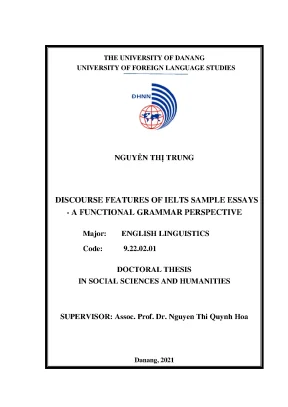
Tải xuống để đọc toàn bộTHE UNIVERSITY OF DANANG UNIVERSITY OF FOREIGN LANGUAGE STUDIES NGUYỄN THỊ TRUNG DISCOURSE FEATURES OF IELTS SAMPLE ESSAYS - A FUNCTIONAL GRAMMAR PERSPECTIVE Major: ENGLISH LINGUISTICS Code: 9.01 DOCTORAL THESIS IN SOCIAL SCIENCES AND HUMANITIES SUPERVISOR: Assoc. Nguyen Thi Quynh Hoa Danang, 2021 luan an i STATEMENT OF AUTHORSHIP Except where reference is made in the text, this thesis contains no material published elsewhere or extracted in whole or in part from a thesis by which I have qualified for or been awarded another degree or diploma. No other person's work has been used without due acknowledgements in the thesis. This thesis has not been submitted for the award of any degree or diploma in any other tertiary institution.
Da Nang, November 2021 Nguyen Thi Trung luan an ii ACKNOWLEDGEMENTS Above all, I would like to express my deepest gratitude to my supervisor, Associate Professor Nguyễn Thị Quỳnh Hoa, for her understanding, encouragement, helpful comments and professional guidance at every stage of this thesis. I am also deeply indebted to Associate Professor Trần Văn Phước for his constructive feedback, distribution of materials, and continuing support. My special thanks goes to Professor Hoàng Văn Vân, and Associate Professor Phan Văn Hòa for their advice in the first steps of the research paper, saving me from confusion. My heartfelt gratitude goes to Associate Professor Tôn Nữ Mỹ Nhật for her astute comments and encouragement.
I would like to express my deepest appreciation to the University of Foreign Language Studies, The University of Danang and the Faculty of English for their generous support and timely assistance. Finally, I am indebted to my family for their love, care and sacrifice; and to my colleagues and friends for all their encouragement and untiring assistance. luan an iii ABSTRACT Over the past three decades, the International English Language Testing System (IELTS) has been considered as the preferred test to assess English language proficiency of non-native English speakers. With a view to improving the quality of IELTS candidates’ answers to the academic writing test, the thesis addresses three aspects of meaning, namely textual, interpersonal and experiential meaning in formulating IELTS Academic essays based on the Systemic Functional Theory developed by Halliday (1994), and Halliday and Matthiessen (2004, 2014).
A descriptive method accompanied by qualitative and quantitative approaches was used to give a detailed description of three kinds of meaning in relation to the band descriptors. 180 sample essays with band scores of 7.5 and others rated 9 were selected as data for text analysis. The findings revealed that the prevailing types of Themes deployed in the essays were multiple Themes, demonstrating high levels of English proficiency among IELTS writers in constituting a message. It is also noticeable that more successful IELTS writers favoured marked topical Themes and exhibited tactical manipulation of thematic progression to arrange information logically in the text.
From the perspective of interpersonal metafunction, successful writers were good at building up and maintaining appropriate relationships with examiners thanks to appropriate modality and mood choice. In terms of experiential meaning, the writers employed more clause complexes than clause simplexes to specify the type of interdependency in the texts. From the findings, it is recommended that IELTS writers should choose clause complexes over clause simplexes, make good use of cohesive devices, modality and mood choice, different types of interdependency as well as deploy multiple Themes. In particular, more marked Themes, and subtly a few interpersonal Themes are suggested to be deployed in order to create logical connections between experiential events and to make the writing more academic.
It is obvious that IELTS test-takers with better insights into the salient linguistic features of IELTS essays in terms of thematic structure, cohesion, mood, modality, logico-semantic relation and transitivity can produce a piece of writing in accordance with the IELTS community expectation, thus reaching the perceived and desired IELTS band score. luan an iv TABLE OF CONTENTS CHAPTER ONE. Aims and Objectives of the Study. Scope of the Study.
Significance of the Study. Organization of the Thesis. 11 LITERATURE REVIEW AND THEORETICAL BACKGROUND. Review of Systemic Functional Linguistics.
Review of Studies Related to Academic Writing in the light of Systemic Functional Linguistics. Review of IELTS Academic Writing Studies. IELTS Writing as Academic Writing. The IELTS Test.
IELTS Writing as Academic Writing. Discourse Analysis through Systemic Functional Linguistics. Context: Culture and Situation. The Three Metafunctions.
62 luan an v RESEARCH METHODOLOGY. Criteria for Collecting Data. Description of Sampling. Clause and Above the Clause.
The Coding Scheme. Reliability and Validity. 76 TEXTUAL MEANING IN IELTS ACADEMIC SAMPLE ESSAYS. Types of Themes.
Marked and Unmarked Theme. Topical, Interpersonal and Textual Theme. Simple and Multiple Theme. The Use of Reference.
The Use of Substitution. The Use of Ellipsis. The Use of Conjunction. The Use of Reiteration.
The Use of Collocation. Textual Meaning in Relation to the IELTS Band Descriptors. 112 INTERPERSONAL MEANING IN IELTS ACADEMIC SAMPLE ESSAYS. 112 luan an vi 5.
Interpersonal Meaning in Relation to the IELTS Band Descriptors. 125 EXPERIENTIAL MEANING IN IELTS ACADEMIC SAMPLE ESSAYS. Logico-Semantic Relation Analysis. Logico-Semantic System.
Experiential Meaning in Relation to the IELTS Band Descriptors. Suggestions for Further Research. 156 APPENDIX A: SOURCES OF DATA. 175 APPENDIX B: SUMMARY OF TABLE OF CONJUNCTIVE RELATIONS.
188 luan an vii LIST OF ABBREVIATIONS AND SYMBOLS CEFR Common European Framework of Reference IELTS The International English Language Testing System MOET Ministry of Education and Training NFL Vietnam’s National Foreign Language Project SFG Systemic Functional Grammar SFL Systemic Functional Linguistics TOEFL Test of English as a Foreign Language || clause divider ||| clause complex divider ^ clause conjunction α , β, Ɣ hypotactic related clauses 1, 2, 3,… paratactic related clauses ’ Idea ” Locution + Extension = Elaboration X Enhancement […] Embedding luan an viii LIST OF TABLES Table 2. IELTS Task 2 Writing band descriptors (public version). Types of grammatical and lexical cohesion. Giving or demanding.
Realization of modality in English. Examples of verbs serving as Process in material clauses. Examples of verbs serving as Process in mental clauses. Examples of verbs serving as Process in relational clauses.
Examples of verbs serving as Process in behavioural clauses. Examples of verbs serving as Process in verbal clauses. Examples of verbs serving as Process in existential clauses. Clauses in paratactic and hypotatic clause complexes.
Basic types of clause complexes. Abbreviation for data analysis. Textual meaning in relation to the IELTS band descriptors. Interpersonal meaning in relation to the IELTS band descriptors.
Distribution of clause simplexes and clause complexes. Distribution of logico-semantic relation. Distribution of logico-semantic relation (Corpus 1). Distribution of logico-semantic relation (Corpus 1- Discussion essays).
Distribution of logico-semantic relation (Corpus 1- Exposition essays) .133 luan an ix Table 6. Distribution of logico-semantic relation (Corpus 2). Distribution of logico-semantic relation (Corpus 2- Discussion essays). Distribution of logico-semantic relation (Corpus 2- Exposition essays).
Experiential meaning in relation to the IELTS band descriptors .145 luan an x LIST OF FIGURES Figure 2. Common European Framework of Reference. Genre and register in relation to language. Field, tenor and mode in relation to metafunctions.
The MOOD system network (Halliday & Matthiessen, 2014, p. The mood system. System network of Modality (Halliday & Matthiessen, 2014, p. The modality system.
Types of process in English. The system of the clause complex. Distribution of topical, interpersonal and textual Themes. Distribution of marked and unmarked Themes.
Distribution of marked and unmarked Themes (Corpus 1). Distribution of marked and unmarked Themes (Corpus 2). Distribution of topical, interpersonal and textual Themes. Distribution of simple and multiple Themes.
Distribution of each type of modality. Distribution of modality of Corpus 1 & 2. Distribution of modal values. Distribution of modality orientation.
Distribution of taxis. Distribution of taxis (Corpus 1). Distribution of taxis (Corpus 2). Transitivity in IELTS sample essays.
Transitivity in IELTS sample essays (Corpus 1). Transitivity in IELTS sample essays (Corpus 2) .139 luan an 1 CHAPTER ONE INTRODUCTION 1. Rationale Foreign language competence has been identified as essential for young Vietnamese graduates to be able to work effectively and make a significant contribution to the international integration of the country. Recognising the importance of foreign languages in human resource, the Prime Minister has approved the document ‘The scheme on foreign language teaching and learning in the national education system in the 2008-2020 period’ (Decision No.1400/QD-TTg dated September 30, 2008).
The Ministry of Education and Training (MOET) has implemented Vietnam’s National Foreign Language 2020 Project (NFL2020) and applied the Prime Minister’s Decision No. 2080/QD-TTg dated 22 December 2017 on "Approving amendments and supplements to the scheme of teaching and learning foreign languages in the national education system for the period of 2017-2025". In tertiary education, graduates majoring in English language are required to achieve a minimum language competence at level C1 according to the Common European Framework for Reference (CEFR), a guideline used to describe achievements of learners of foreign languages, equivalent to an IELTS score of 7.org/ielts-for-organisations/common-european-framework). As a result, a multitude of Vietnamese tertiary institutions such as Can Tho University, Hue University of Foreign Languages, and Quang Nam University have included IELTS in their curriculum so that the students can gain an international English certificate indicating their English proficiency level, which is considered to be one of the most essential requirements in applying for a good job or tertiary education in another country.
The International English Language Testing Systems (IELTS), which involves the assessment of four English language skills, namely listening, reading, writing and speaking has been regarded as the preferred test to measure English language proficiency of those who study English as a foreign language or second language. It is now accepted by over 6000 tertiary institutions in over 135 countries (IELTS luan an 2 Research Reports Online Series, 2017). Achieving a high score in this international exam is the key that enables candidates to open the door to their future career. Among the four English language skills assessed by IELTS, Academic Writing, especially Task 2 of the Academic Module, which is given more weight than Task 1, is generally considered one of the most challenging skills for IELTS test- takers since it requires a higher level of productive language manipulation.
How to enhance IELTS writing outcomes, therefore, has been a matter of concern for language researchers and educators in different countries where English is taught as a foreign language or second language. A considerable amount of practical research has been carried out to investigate the IELTS writing tasks in the past few years (Allen, 2016; Bagheri, 2016; Dickinson, 2013; Majdeddin, 2010; Mickan & Motteram, 2008, 2009; Moore & Morton, 2005, 2007; Panahi, 2015). It is clear that most of these studies present valuable findings related to the field of IELTS writing. However, only limited studies of IELTS essays (e.
Ebrahimi, 2014; Moghaddam, 2010; Nakamura, 2009; Soleymanzadeh & Gholami, 2014) have been conducted from the functional grammar perspective up to now. Thus, this thesis is aimed at identifying the linguistic features of IELTS sample essays, particularly the experiential meaning, interpersonal meaning and textual meaning in the light of functional grammar with a view to enabling test-takers to make good use of the salient linguistic features in order to formulate good quality IELTS Academic essays. The theoretical framework adopted for analysing and explaining how experiential meanings, interpersonal meanings, and textual meanings are expressed in clause structures in IELTS sample essays is Systemic Functional Grammar (SFG) developed by Halliday (1994), and Halliday and Matthiessen (2004, 2014).
Nội dung được bảo vệ bản quyền — Tải xuống đầy đủ
Trích dẫn luận án này
Nguyễn Thị Trung (2021). Discourse Features of IELTS Sample Essays: A Functional Grammar Perspective [Luận án tiến sĩ, The University of Danang - University of Foreign Language Studies]. LuanAn.net. https://luanan.net/ngon-ngu-hoc/ngon-ngu-hoc-ung-dung/nguyen-thi-trung-doctoral-thesis-ielts-sample-essays-functional-grammar
Câu hỏi thường gặp
Luận án "Discourse Features of IELTS Sample Essays: A Functional Grammar Perspective" nghiên cứu về vấn đề gì?
"Phân tích đặc điểm ngữ điệu của bài luận IELTS từ góc độ ngữ pháp chức năng. Đề xuất các đặc điểm ngữ điệu quan trọng ảnh hưởng đến kết quả đánh giá."
Luận án "Discourse Features of IELTS Sample Essays: A Functional Grammar Perspective" được bảo vệ tại trường nào?
Luận án này được bảo vệ tại The University of Danang - University of Foreign Language Studies. Năm bảo vệ: 2021.
Luận án "Discourse Features of IELTS Sample Essays: A Functional Grammar Perspective" thuộc chuyên ngành gì?
Luận án "Discourse Features of IELTS Sample Essays: A Functional Grammar Perspective" thuộc chuyên ngành English Linguistics. Danh mục: Ngôn Ngữ Học Ứng Dụng.
Luận án "Discourse Features of IELTS Sample Essays: A Functional Grammar Perspective" có bao nhiêu trang?
Luận án "Discourse Features of IELTS Sample Essays: A Functional Grammar Perspective" có 201 trang. Bạn có thể xem trước một phần tài liệu ngay trên trang web trước khi tải về.
Cách tải luận án "Discourse Features of IELTS Sample Essays: A Functional Grammar Perspective" về máy như thế nào?
Để tải luận án về máy, bạn nhấn nút "Tải xuống ngay" trên trang này, sau đó hoàn tất thanh toán phí lưu trữ. File sẽ được tải xuống ngay sau khi thanh toán thành công. Hỗ trợ qua Zalo: 0559 297 239.