Williamson afriendlydemonstrationofforcepacificblockade
Phân tíchDemonstration of Force của Williamson: Bàn về phong tỏa Thái Bình Dương. Khám phá chiến lược, tác động và ý nghĩa đối với an ninh khu vực.
Carleton University
Legal Studies
Luan An
Luận văn thạc sĩ
Năm xuất bản
Số trang
137
Thời gian đọc
21 phút
Lượt xem
0
Lượt tải
0
Phí lưu trữ
40 Point
Tổng quan nhanh
- Chủ đề:
- Williamson's Thesis: Pacific Blockade & State Identity in Law
- Số trang:
- 137 trang
- Trường:
- Carleton University
- Chuyên ngành:
- Legal Studies
- Tác giả:
- Ross Williamson
- Năm:
- 2013
Tóm tắt nội dung luận án
I.Williamson s Thesis Pacific Blockade State Identity in Law
Ross Williamson's thesis examines the intricate relationship between state identity and pacific blockade. This nineteenth-century custom involved stopping coastal traffic without a formal declaration of war. Williamson explores how this practice, despite contradicting contemporary international law, gained legitimacy for states. The study utilizes constructivism, diplomatic history, and international legal histories to explain its emergence, significance, and eventual disappearance. Pacific blockade allowed blockading states to perform conflicting identities, especially against the Ottoman Empire and Latin American nations. It linked to cultural and material hierarchies, justifying the disregard for blockaded states' interpretations of events. The thesis argues the practice lost legitimacy when institutional and normative contexts shifted. This work provides an example of an exclusive norm fading, even after performing multiple state identities. Williamson's analysis offers crucial insights into coercive diplomacy and the evolution of international law.
1.1. Defining Pacific Blockade A Coercive Naval Action
Pacific blockade represented a unique form of coercive diplomacy. It involved naval operations to halt maritime traffic to a coast. Crucially, this occurred without any formal declaration of war. Historical accounts characterize it as a 'friendly warlike measure,' a paradoxical description for a show of force. European powers, notably Britain, frequently employed this tactic against less powerful states. It aimed to compel compliance without escalating to full-scale conflict. The practice served as a demonstration of force, exerting diplomatic pressure while maintaining a semblance of peace. The stopping of vessels, though non-belligerent in name, carried significant economic and political weight. Williamson meticulously details these characteristics, highlighting the custom's inherent contradictions with established international legal norms.
1.2. Paradoxes in International Law Legitimacy Custom
The existence of pacific blockade presented a profound paradox within nineteenth-century international law. Traditionally, blockades were acts of war. Yet, pacific blockade operated outside this framework. Williamson's research delves into how such a contradictory practice acquired legitimacy. It argues that blockading states leveraged existing cultural and material hierarchies. These hierarchies enabled European powers to disregard the perspectives of blockaded states. The practice's legitimacy was not universal but constructed through the performance of specific state identities. International law scholars of the time struggled to reconcile this custom with established principles. Williamson's thesis explains its persistence by connecting it to state self-perception and external projections of power. The custom emerged and thrived despite its clear defiance of conventional legal interpretations of peace and conflict.
II.Genesis of Pacific Blockade Contradictions Diplomacy
The origins of pacific blockade are steeped in contradictions. It emerged in a period when international law was still formalizing principles of sovereignty and warfare. Yet, states found a way to apply significant coercive diplomacy without declaring war. Williamson's work traces this development, showing how practical expediency often trumped legal consistency. Early applications highlighted the tension between maintaining diplomatic relations and exerting military pressure. European powers sought tools for deterrence and diplomatic leverage short of full-scale armed conflict. Pacific blockade filled this gap, offering a measured, yet impactful, demonstration of force. The custom allowed for intervention and influence in other states' affairs under a 'pacific' guise. This historical analysis uncovers the political calculations that shaped its initial acceptance and use.
2.1. The Greek Revolt European Intervention
The Greek Revolt provided an early backdrop for the application of pacific blockade. European powers, involved in the region, utilized naval operations to influence outcomes without direct declarations of war. This period saw a blurring of lines between peace and conflict. Blockading states needed to manage their international image while pursuing strategic interests. Williamson examines how pacific blockade allowed them to project multiple, sometimes conflicting, identities. Naval forces could appear as peacekeepers or protectors, even while imposing significant economic pressure. The strategic importance of the Ottoman Empire during this era meant European powers sought non-belligerent methods for intervention. The Greek Revolt demonstrated the utility of this 'friendly' coercion in complex international situations, marking an important step in its institutionalization as a custom.
2.2. Gunboat Diplomacy A Demonstration of Force
Pacific blockade is a prime example of gunboat diplomacy. This involved deploying naval power to achieve foreign policy objectives through a show of force. The objective was clear: to exert diplomatic pressure and secure compliance without firing a shot. Naval operations were carefully calibrated to convey intent and capability. The presence of warships off a coast served as a powerful deterrent. It signaled a state's willingness to use force if demands were not met, without incurring the legal and political costs of war. Williamson illustrates how this form of coercive diplomacy was highly effective against states lacking comparable naval power. It was a strategic maneuver that allowed stronger nations to dictate terms while claiming adherence to peaceful international relations. The demonstration of force was more psychological than physical, yet profoundly impactful.
III.Pacific Blockade in Latin America Power Diplomacy
The application of pacific blockade in Latin America reveals stark power imbalances. European states frequently employed this tactic against newly independent republics throughout the nineteenth century. These nations, often with nascent militaries and economies, were vulnerable to such coercive diplomacy. Williamson argues that this specific use of pacific blockade reinforced a colonial hierarchy, where European powers asserted their dominance. The practice allowed them to intervene in internal affairs, protect commercial interests, or demand reparations. It was a tool to 'keep republics in their place,' as the thesis suggests. This period highlights how international law, even in its development, could be selectively applied to favor powerful actors. The encounters often saw European interpretations of events override the sovereignty and perspectives of Latin American states. It underscored the realpolitik underlying international relations of the era.
3.1. New Granada Incident A Case Study in Coercion
The 1837 British blockade of New Granada exemplifies pacific blockade's coercive nature. Thirteen Royal Navy ships blockaded the coast to compel the release of a British pro-consul. British officials characterized the relations as 'amicable,' despite the naval operations. New Granada, however, compared the situation to war and urged resistance. For twelve days, four vessels were stopped, demonstrating the blockading power's intent. The incident concluded with New Granada agreeing to financial redress, effectively yielding to diplomatic pressure. This case highlights the asymmetrical power dynamics. A powerful state could impose its will, label the action 'pacific,' and expect compliance. Williamson uses this specific event to illustrate how the language of peace masked an undeniable act of force. It reveals the strategic ambiguity inherent in pacific blockade and its effectiveness as a tool of gunboat diplomacy against a weaker state.
3.2. Maintaining Order European Hegemony Naval Power
European states utilized pacific blockade to maintain a perceived international order, particularly in regions like Latin America. Naval operations served as instruments of hegemony, projecting power and enforcing European interests. The underlying assumption was a hierarchy where European interpretations of international law and justice prevailed. This allowed powerful nations to ignore the sovereignty and protests of blockaded states. The regular deployment of fleets provided a constant reminder of their influence and capacity for intervention. It was a cost-effective way to secure diplomatic objectives without full-scale military engagements. Williamson's analysis shows how naval power was not just for war, but also for continuous, 'pacific' control. This form of diplomatic pressure was crucial in shaping the political landscape of the 19th century, solidifying the global reach of European empires.
IV.Decline of Pacific Blockade Shifting Norms Law
The practice of pacific blockade eventually disappeared without an explicit, formal rejection. Williamson's thesis attributes this decline to significant shifts in the institutional and normative context of international relations. As international law matured, the inherent contradictions of a 'peaceful war' measure became increasingly untenable. The evolving understanding of state sovereignty and the use of force rendered the practice an anachronism. Global power dynamics changed, and the nature of international disputes evolved. The effectiveness and legitimacy of such a nuanced form of coercive diplomacy diminished. This section explores how broader legal and political transformations led to its obsolescence. The disappearance was not a sudden event but a gradual erosion of its acceptability and utility in a changing world order.
4.1. Evolving International Law From Custom to Rejection
International law underwent substantial development from the late 19th to early 20th centuries. Concepts like the prohibition of the use of force and the principle of non-intervention gained greater traction. These developments gradually rendered pacific blockade legally questionable and morally less acceptable. While never explicitly outlawed, the custom simply faded from practice as states sought clearer, more defined frameworks for international conduct. The emergence of international organizations and codified treaties put pressure on ambiguous practices. Williamson argues that the legitimacy of pacific blockade eroded as the international legal community moved towards a more structured and less ad hoc approach to conflict resolution. The custom became inconsistent with modern interpretations of sovereign equality and the strictures against aggressive action, leading to its effective, if unstated, rejection.
4.2. Changing State Identities Diplomatic Pressure
The decline of pacific blockade also reflects changing perceptions of state identity and the appropriate forms of diplomatic pressure. As weaker states gained more voice on the international stage, the unilateral imposition of 'friendly' coercion became less palatable. The performance of conflicting identities – peaceful coercer – lost its persuasive power. The international community began to scrutinize such actions more closely. The rise of multilateral diplomacy and collective security mechanisms offered alternative avenues for resolving disputes. States found other ways to exert deterrence and engage in coercive diplomacy that were more aligned with emerging international norms. Williamson's analysis underscores that the practice's utility was tied to a specific historical context of power relations and state self-conception. When these changed, pacific blockade lost its place as a legitimate tool of statecraft, highlighting the dynamic nature of international law and custom.
V.Williamson s Legacy Understanding Coercive Naval Actions
Ross Williamson's thesis offers a profound contribution to understanding international relations and legal history. It moves beyond a simple cataloging of historical events, delving into the underlying normative and identity-based processes. The work provides a nuanced perspective on how international customs emerge, gain legitimacy, and eventually disappear. By focusing on pacific blockade, Williamson sheds light on the complexities of coercive diplomacy and the demonstration of force outside declared warfare. The thesis challenges simplistic views of international law as a static set of rules, instead portraying it as a dynamic system influenced by state identity and power. Its insights remain relevant for contemporary discussions on the use of force, deterrence, and diplomatic pressure in a constantly evolving global landscape. Williamson's meticulous research ensures this overlooked aspect of history is remembered and understood.
5.1. Insights for Modern Coercive Diplomacy Deterrence
Williamson's study provides valuable insights for understanding modern coercive diplomacy and deterrence strategies. While pacific blockade is obsolete, the principles of using limited force or a show of force to achieve political objectives persist. Contemporary naval operations often involve strategic presence and exercises aimed at exerting diplomatic pressure without direct conflict. The thesis helps analyze how states project power and manage escalation in international disputes. It informs discussions on 'grey zone' tactics, where actions fall short of conventional warfare but still carry significant coercive weight. By dissecting the historical motivations and effects of pacific blockade, the work offers a framework for evaluating the effectiveness and legitimacy of current non-warfare military actions. Its lessons are crucial for policymakers grappling with complex international security challenges and the delicate balance between diplomacy and force.
5.2. Examining Normative Change in International Relations
A key contribution of Williamson's thesis is its exploration of normative change in international relations. It demonstrates how an exclusive norm, like pacific blockade, could gain wide acceptance among powerful states despite its legal ambiguities. More importantly, it explains its subsequent disappearance without a formal ban, simply by losing its legitimacy. This process underscores the fluid nature of international norms and the continuous interplay between state practice, identity, and international law. The study highlights that norms are not static; they are constructed, maintained, and ultimately dissolved through state interactions and evolving global contexts. Williamson's work offers a compelling case study for scholars interested in how international society adapts, rejects, and reforms its foundational principles and customs. It emphasizes that understanding history is vital for comprehending the present and future of international governance.
Mục lục chi tiết luận án
Tải xuống file đầy đủ để xem toàn bộ nội dung
Tải đầy đủ (137 trang)Trích đoạn nội dung luận án
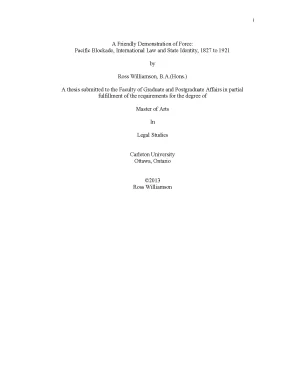
Tải xuống để đọc toàn bội A Friendly Demonstration of Force: Pacific Blockade, International Law and State Identity, 1827 to 1921 by Ross Williamson, B.) A thesis submitted to the Faculty of Graduate and Postgraduate Affairs in partial fulfillment of the requirements for the degree of Master of Arts In Legal Studies Carleton University Ottawa, Ontario ©2013 Ross Williamson ii Abstract This thesis examines the relationship between state identity and pacific blockade, a nineteenth century custom involving the stopping of traffic to a coast without a declaration of war. Drawing on via median constructivism, diplomatic history and international law’s histories, it attempts to explain how pacific blockade emerged despite contradicting contemporary international law, what significance it had for blockading states, and how it could disappear without an explicit rejection. The thesis argues that this practice acquires legitimacy for British decision-makers by performing multiple, conflicting identities in the Ottoman Empire and Latin America. It links pacific blockade to cultural and material hierarchies that legitimized ignoring blockaded states’ interpretations of events.
When the institutional and normative context of the practice changes, the thesis argues that pacific blockade loses its legitimacy to states and international law. Thus it provides an example of an exclusive norm disappearing despite its performance of multiple state identities. iii Acknowledgements I would like to thank Professors Christiane Wilke and Betina Kuzmarov, the members of my thesis committee, for their patience, invaluable assistance and willingness to support this project. iv Table of Contents Page Abstract ii Acknowledgements iii Table of Contents iv Chapter One: Introduction 1 Chapter Two - Created by contradictions: pacific blockade, the Greek revolt and identities in tension 22 Chapter Three - ‘Keeping republics in their place’: pacific blockade in Latin America 51 Chapter Four - The disappearance of pacific blockade 72 Chapter Five - Conclusion: why pacific blockade might be worth remembering 108 Bibliography 125 1 Chapter One – Introduction A friendly warlike measure In January of 1837, thirteen ships from the British Royal Navy ‘amicably’ blockaded the coast of New Granada.
The British ambassador to New Granada, a larger version of modern Colombia, ordered the prevention of all traffic coming to or leaving New Granada as a means of compelling the government to release the British pro-consul, who had been convicted of assaulting a local official. Representatives from both states characterized relations as amicable, but blockade historically fell under belligerent actions in international law. When the blockade started on January 20th and continued for twelve days, stopping four vessels, the government of New Granada compared the situation to war and called upon its citizens to resist it. British officials also suggested that the action might fall outside of peaceful interaction, but neither side ever declared war or acknowledged an opposing declaration of war.
The government of New Granada claimed that the British were violating the law of nations and bringing hostilities into a previously amicable relationship, but twelve days of blockade only brought a declaration of the New Granada government’s intention to provide financial redress for the pro- consul’s mistreatment, with the blockade later seen as amicable or “pacific” in nature.1 1 “Sir John Barrow to The Hon. Fox Strangeways,” no. 27, 27 March 1837, British and Foreign State Papers, 1837-1838, vol.26 (London: Harrison and Sons, 1855) 248 at 252, “Commodore Peyton to Mr. 28, 21 January 1837, British and Foreign State Papers,254 at 254, 256, 258, “Mr.
Turner to Visc. 19, 10 December 1836, British and Foreign State Papers, 190 at 206, 214, “Mr. Turner to Visc.21, 11 December 1837, British and Foreign State Papers, 226 at 231-232, “Mr. Turner to Visc.
22, 20 December 1836, British and Foreign State Papers, 231 at 236-238, “Sir John Barrow to Mr. 30, 27 March 1837, British and Foreign State Papers, 262 at 263, 265. 2 The strange set of circumstances described above provides only one example of a custom used frequently through the nineteenth century, most often against relatively new Latin American states like New Granada. International law scholars would later call this pacific blockade, which is a now obsolete doctrine that receives minimal attention as part of international law’s histories.
The doctrine is less central to the field’s concerns than topics like the construction of sovereignty or the rules of war. Moreover, almost all instances of pacific blockade involved European states blockading those less powerful, a fact that can make pacific blockade seem like mere coercion. However, this ignores the relationship between actions, norms and identities discussed in more recent international relations theory.2 Moreover, representatives of states using blockades without war claimed that such a practice had a basis in customary international law, distinguishing it from simple coercion. Even if these flimsy claims were questionable, it remains problematic to characterize such actions as only coercion wrapped in a legal justification.
Pacific blockade falls outside of the conventional focus of international law’s histories, but it nonetheless plays a part in nineteenth century international law and its relationship with states’ identities. This thesis attempts to remedy the lack of attention to pacific blockade as a part of international law’s histories, diplomatic history, and as a component in the relationship between identities, norms and actions in international relations. By analyzing pacific blockade as a performance of contradictory facets of one state’s identities and a means of pursuing associated interests, the thesis aims to do justice to an otherwise neglected 2 For examples using these concepts, see Diana Panke and Ulrich Petersohn, ‘Why international norms disappear sometimes’ (2011) 18:4 European Journal of International Relations 719 or John F. Clark, ‘A Constructivist Account of the Congo Wars’ (2011) 4:3 African Security 143.
The following introductory chapter explains how pacific blockade rose and declined towards this goal. First, the chapter explains pacific blockade as a practice and a legal doctrine in more depth. Second, it sets out the theory and concepts used by the rest of the thesis to examine pacific blockade. Third, it establishes the significance of this inquiry to the existing literature on the histories of international law, diplomatic history and international relations.
Fourth, the chapter explains the nature of its claims from the perspective of scientific realism. Lastly, this introduction explains how the following chapters will make their claims, connecting the aforementioned theories and concepts to the history of pacific blockade to show the relationship between pacific blockade and the construction of identities. In taking this approach, the thesis attempts to give significance to the origin, use and disappearance of pacific blockade, doing justice to the subject and so contributing to ongoing discussion of international law’s histories, identity and nineteenth century diplomacy. Overview of pacific blockade The lack of scholarly analysis received by pacific blockade may in part relate to the difficulty with which the history of its use is converted into an overarching account.
Although it had relatively clear rules, the doctrine appeared in several unrelated contexts and when it fell into oblivion is difficult to determine. The first example of pacific blockade is typically given as the blockade of Greece by a combined French, British and Russian fleet in 1827, during the Greek War for Independence. Although this intervention came without any reference to pacific blockade, it was later taken as evidence of a custom. A combination of European states used it in Greece again in 1850, 4 1886 and 1897.3 However, the use of pacific blockade was not restricted to the Ottoman Empire or its former territories.
More frequently, Western European states such as Britain and France used pacific blockade against South and Central American states such as the Argentine Confederation, Brazil, Mexico and Nicaragua. The stated grounds for such intervention tended to be the abuse of European subjects, contrasting with the Greek blockades, where the formal grounds for action tended to be the enforcement of an armistice or peace.4 Further contrast among instances of pacific blockade comes through its use in colonial encounters in Asia as well as European diplomacy, seeing use in what became French Indo-China as well as Portugal and the Netherlands.5 Thus pacific blockade as a practice has a rather inconsistent history. The practice’s use does have some common elements insofar as it was almost always used by Western European states against states on the margins or outside of Europe. Part of this thesis addresses the significance of this pattern to the production and reproduction of hierarchies between states in international law.
However, the varied contexts of the practice do make it resistant to generalization. The quiet exit of pacific blockade from practice further compounds the difficulty of discussing its history. While the practice last appeared in the pacific blockade of Venezuela’s coast in 1902 over debt and abuses to European subjects, authors writing 3 Albert E. Hogan, Pacific Blockade (Oxford, UK: Clarendon Press, 1908) 73-76, 108-114, 126-130.
Washburn, “The Legality of Pacific Blockade I” (January 1921) 21:1 Columbia Law Review 55 at 61-63; Washburn refers to the 1814 blockade of Norway by Great Britain but acknowledges that only one other source identifies this as a pacific blockade, with Greece being the incident most frequently identified as the first pacific blockade. 4 Ibid, Hogan, Pacific Blockade at 85-94, 117-120. Also in Albert H. Washburn, “The Legality of Pacific Blockade II” (March 1921) 21:3 Columbia Law Review 227 at 225-234, Albert H.
Washburn, “The Legality of Pacific Blockade III” (May 1921) 21:5 Columbia Law Review 442 at 442-444, 446-450. 5 Ibid, Hogan, Pacific Blockade at 77-83, 122-126, 137-141, Washburn at “The Legality of Pacific Blockade I” at 66-67. 5 about it refer to pacific blockade as a valid part of international law into the 1920s.6 The doctrine faced criticism in the late nineteenth century from an increasingly ambitious international legal profession, and, while it is not recognized in the present, there is no definitive declaration making pacific blockade illegal. The doctrine of desuetude would support pacific blockade’s characterization as no longer an element of international law insofar as desuetude holds that laws not invoked for a considerable period of time lose their validity.7 However, none of the authors examined that discuss pacific blockade connect it with this doctrine, itself excluded from the Vienna Convention on the Law of Treaties in its traditional form.8 As a result, the already inconsistent history of pacific blockade ends with uncertainty over its legal status.
This is not to say that pacific blockade was an altogether unstable concept. In theory, it had clear rules. Blockading states were required to give notice of the blockade and establish its effectiveness over a fixed area. Thus blockades had to be able to stop ingress and egress to particular coasts or ports, rather than only being blockades on paper.
A recognized blockade meant that the vessels of the blockaded state as well as third party ships could be turned back or detained, depending on the circumstances. In principle, that this did not constitute an act of war depended on the lack of effective resistance from the blockaded state.9 Thus, while pacific blockade does not occupy a distinct role in the 6 Ibid, Washburn, “The Legality of Pacific Blockade III” at 453-456; for example, Washburn’s account asserts the validity of pacific blockade as part of international law in 1921 while also acknowledging the criticism directed towards pacific blockade’s legality. 7 Marcelo Kohen, “Desuetude and Obsolescence of Treaties” in Enzo Cannizzaro, ed., The Law of Treaties Beyond the Vienna Convention (Oxford, UK: Oxford University Press, 2011) 350 at 353-354; Michael Glennon, “How International Rules Die” (2005) 93 The Georgetown Law Journal 939 at 942. It is worth noting that Kohen’s discussion of desuetude relates to its exclusion from the Vienna Conventions, but he nonetheless provides an outline of the concept in its traditional form that applied to more than treaties.
8 Ibid, Kohen, “Desuetude and Obsolescence of Treaties” at 351. 9 Supra note 3, Hogan, Pacific Blockade at 32, 70-71.
Nội dung được bảo vệ bản quyền — Tải xuống đầy đủ
Trích dẫn luận án này
Ross Williamson (2013). Williamson afriendlydemonstrationofforcepacificblockade [Luận án tiến sĩ, Carleton University]. LuanAn.net. https://luanan.net/luat-hoc/luat-quoc-te/williamson-afriendlydemonstrationofforcepacificblockade
Câu hỏi thường gặp
Luận án "Williamson afriendlydemonstrationofforcepacificblockade" nghiên cứu về vấn đề gì?
Phân tíchDemonstration of Force của Williamson: Bàn về phong tỏa Thái Bình Dương. Khám phá chiến lược, tác động và ý nghĩa đối với an ninh khu vực.
Luận án "Williamson afriendlydemonstrationofforcepacificblockade" được bảo vệ tại trường nào?
Luận án này được bảo vệ tại Carleton University. Năm bảo vệ: 2013.
Luận án "Williamson afriendlydemonstrationofforcepacificblockade" thuộc chuyên ngành gì?
Luận án "Williamson afriendlydemonstrationofforcepacificblockade" thuộc chuyên ngành Legal Studies. Danh mục: Luật Quốc Tế.
Luận án "Williamson afriendlydemonstrationofforcepacificblockade" có bao nhiêu trang?
Luận án "Williamson afriendlydemonstrationofforcepacificblockade" có 137 trang. Bạn có thể xem trước một phần tài liệu ngay trên trang web trước khi tải về.
Cách tải luận án "Williamson afriendlydemonstrationofforcepacificblockade" về máy như thế nào?
Để tải luận án về máy, bạn nhấn nút "Tải xuống ngay" trên trang này, sau đó hoàn tất thanh toán phí lưu trữ. File sẽ được tải xuống ngay sau khi thanh toán thành công. Hỗ trợ qua Zalo: 0559 297 239.