The ruin of the past deindustrialization
Khám phá tàn tích của quá trình phi công nghiệp hóa trong quá khứ, phân tích những tác động sâu sắc và bài học rút ra cho tương lai.
The University of Western Ontario
Kinesiology
Luan An
Luận án tiến sĩ
Năm xuất bản
Số trang
310
Thời gian đọc
47 phút
Lượt xem
0
Lượt tải
0
Phí lưu trữ
60 Point
Tổng quan nhanh
- Chủ đề:
- Phi công nghiệp hóa: Tác động đến cộng đồng công nhân
- Số trang:
- 310 trang
- Trường:
- The University of Western Ontario
- Chuyên ngành:
- Kinesiology
- Tác giả:
- Neil Stanley
- Năm:
- 2017
Tóm tắt nội dung luận án
I.Phi công nghiệp hóa Tác động đến cộng đồng công nhân
Phi công nghiệp hóa thay đổi sâu sắc các cộng đồng công nhân. Các nhà máy đóng cửa hàng loạt. Hàng ngàn người mất việc làm. Mạng lưới xã hội bị phá vỡ. Phong cảnh quen thuộc trở nên xa lạ. Người dân Midlands, Anh, phải đối mặt với một thế giới mới. Thế giới đó khác xa những gì họ từng biết. Nghiên cứu này khám phá sự mất mát đó. Nó hình thành nên bản sắc, văn hóa và cộng đồng. Từ năm 1945 đến 1990, khu vực Midlands trải qua sự suy thoái công nghiệp nghiêm trọng. Vùng này từng là trái tim sản xuất của nước Anh. Nay nó trở thành Vành đai gỉ sét. Quá trình này biến đổi mọi khía cạnh cuộc sống. Nó để lại những vết sẹo sâu sắc. Các mối quan hệ lao động bị tan rã. Cấu trúc gia đình và cộng đồng suy yếu. Đây là tác động xã hội của phi công nghiệp hóa đối với cuộc sống hàng ngày.
1.1. Sụp đổ sản xuất và thất nghiệp hàng loạt
Các ngành sản xuất cốt lõi sụp đổ. Các nhà máy lớn từng là trụ cột kinh tế đóng cửa vĩnh viễn. Điều này dẫn đến sụp đổ sản xuất trên diện rộng. Hàng chục ngàn công nhân mất việc. Họ rơi vào tình trạng thất nghiệp kéo dài. Sự mất mát này không chỉ là kinh tế. Nó còn là mất mát về địa vị xã hội. Mất mát về mục đích sống. Những kỹ năng lâu đời trở nên vô dụng. Cuộc sống hàng ngày bị đảo lộn. Tỷ lệ thất nghiệp tăng vọt. Nó gây ra áp lực lớn lên các gia đình.
1.2. Biến đổi nhận dạng và mạng lưới xã hội
Công việc là trung tâm của bản sắc công nhân. Mất việc làm gây ra khủng hoảng danh tính. Mạng lưới xã hội chặt chẽ cũng tan rã. Những người cùng làm việc, cùng sinh hoạt hàng ngày giờ đây ly tán. Các quán rượu địa phương, câu lạc bộ xã hội mất đi vai trò. Chúng từng là nơi giao lưu cộng đồng. Sự vắng bóng công việc tạo ra khoảng trống lớn. Nó làm thay đổi cách người dân nhìn nhận bản thân. Nó thay đổi cách họ tương tác với nhau. Cộng đồng cố gắng tìm lại ý nghĩa.
II.Bóng đá Dấu ấn văn hóa thời kỳ suy thoái công nghiệp
Bóng đá giữ vị trí đặc biệt trong cộng đồng công nhân. Nó không chỉ là một môn thể thao. Nó là một phần không thể thiếu của cuộc sống. Trước phi công nghiệp hóa, bóng đá gắn liền với sinh hoạt hàng ngày. Nó phản ánh động lực và giá trị của giai cấp công nhân. Trận đấu cuối tuần là một sự kiện xã hội. Nó mang lại niềm vui và sự đoàn kết. Sau khi các nhà máy đóng cửa, ý nghĩa của bóng đá thay đổi. Nó biến thành một biểu tượng mạnh mẽ. Nó là hình ảnh thu nhỏ của quá khứ. Nó gợi nhớ về một kỷ nguyên đã mất. Bóng đá là sợi dây kết nối với di sản công nghiệp của vùng. Nó là một dấu vết của lịch sử.
2.1. Bóng đá như biểu tượng cho quá khứ công nghiệp
Deindustrialization tạo ra một khoảng trống lớn. Bóng đá lấp đầy một phần khoảng trống đó. Các trận đấu, các đội bóng đại diện cho quá khứ huy hoàng. Những ký ức về chiến thắng. Những buổi chiều tại sân vận động. Chúng hòa quyện với lịch sử cá nhân. Chúng liên quan đến sự mất mát. Bóng đá trở thành một phép ẩn dụ. Nó đại diện cho những gì đã mất đi. Nó gợi nhớ về các thành viên gia đình đã khuất. Nó gợi nhớ về những nơi làm việc. Nó gợi nhớ về cửa hàng và mùi hương quen thuộc. Di sản công nghiệp được lưu giữ qua bóng đá.
2.2. Ý nghĩa văn hóa và sự gắn kết cộng đồng
Bóng đá mang ý nghĩa văn hóa sâu sắc. Nó là chất keo gắn kết các cộng đồng. Ngay cả khi suy thoái công nghiệp hoành hành. Niềm đam mê bóng đá vẫn duy trì. Nó cung cấp một nền tảng chung. Nó cho phép mọi người chia sẻ cảm xúc. Nó giúp họ cùng nhau vượt qua khó khăn. Các câu lạc bộ bóng đá địa phương trở thành điểm tựa tinh thần. Chúng biểu tượng cho bản sắc. Chúng duy trì hy vọng. Chúng chống lại suy thoái đô thị.
III.Cảnh quan hậu công nghiệp Nỗi đau và sự vắng bóng
Sự phi công nghiệp hóa để lại dấu vết rõ ràng. Cảnh quan hậu công nghiệp của Midlands thay đổi sâu sắc. Từng là trung tâm công nghiệp sôi động. Nay nó trở thành vùng đất của sự vắng bóng. Các nhà máy khổng lồ đứng trơ trọi. Chúng từng là biểu tượng của sức mạnh sản xuất. Giờ chúng là những khối đổ nát. Chúng nhắc nhở về một quá khứ đã qua. Phong cảnh trở nên lạ lẫm. Nó không còn là nơi mọi người nhận ra. Nó là một vết thương dai dẳng. Vết thương này được khắc sâu vào đất đai. Nó in sâu vào ký ức tập thể.
3.1. Nhà máy bỏ hoang Dấu vết của một kỷ nguyên
Các nhà máy bỏ hoang là minh chứng rõ ràng nhất. Chúng là di tích của một nền kinh tế đã sụp đổ. Các tòa nhà công nghiệp bị bỏ phế. Thiết bị hoen gỉ. Không gian từng tràn ngập tiếng máy và công nhân. Giờ đây chỉ còn im lặng. Những cấu trúc này đại diện cho sự mất mát. Chúng là biểu tượng của một cộng đồng bị lãng quên. Mỗi nhà máy bỏ hoang đều kể một câu chuyện. Nó nói về công việc, cuộc sống và hy vọng. Chúng trở thành nỗi ám ảnh. Chúng là một phần của suy thoái đô thị.
3.2. Suy thoái đô thị và thách thức tái tạo
Các khu vực công nghiệp cũ trải qua suy thoái đô thị nghiêm trọng. Hạ tầng xuống cấp. Dịch vụ công cộng giảm sút. Các cộng đồng dân cư bị bỏ rơi. Họ đối mặt với nhiều thách thức. Việc tái tạo đô thị trở nên cấp bách. Nhưng cũng vô cùng khó khăn. Cần có nguồn lực lớn. Cần có chiến lược dài hạn. Phải vượt qua những ký ức đau buồn. Phải xây dựng lại từ đống đổ nát. Việc này đòi hỏi sự đổi mới. Nó cần sự hợp tác của nhiều bên.
IV.Tái cơ cấu kinh tế Chuyển đổi Vành đai gỉ sét Anh
Vùng Midlands, Anh, từng là một trung tâm công nghiệp lớn. Nó trở thành một phần của Vành đai gỉ sét châu Âu. Phi công nghiệp hóa buộc phải tái cơ cấu kinh tế. Sự chuyển đổi này là một quá trình đau đớn. Các ngành công nghiệp truyền thống không còn khả thi. Cần phát triển các lĩnh vực kinh tế mới. Việc này tạo ra những thách thức lớn. Nó bao gồm đào tạo lại lực lượng lao động. Nó bao gồm thu hút đầu tư mới. Chính phủ và cộng đồng phải đối mặt. Họ phải tìm cách thích nghi. Họ phải xây dựng lại nền kinh tế địa phương.
4.1. Sự sụp đổ sản xuất và thay đổi mô hình kinh tế
Sụp đổ sản xuất đánh dấu một bước ngoặt. Nền kinh tế chuyển dịch từ công nghiệp nặng. Nó hướng tới dịch vụ và công nghệ. Sự thay đổi này diễn ra nhanh chóng. Nó gây ra những cú sốc lớn. Nhiều công ty sản xuất di dời hoặc đóng cửa. Điều này làm thay đổi cấu trúc thị trường lao động. Nó đòi hỏi một sự thích nghi căn bản. Cộng đồng phải tìm kiếm các cơ hội mới. Họ phải đối mặt với một tương lai không chắc chắn.
4.2. Khó khăn trong việc thích nghi với nền kinh tế mới
Lực lượng lao động cũ gặp khó khăn. Họ thiếu kỹ năng phù hợp với ngành mới. Việc học hỏi cái mới là một thử thách. Người lớn tuổi càng khó khăn hơn. Tái cơ cấu kinh tế không diễn ra suôn sẻ. Nhiều người rơi vào cảnh thất nghiệp dài hạn. Nó gây ra sự phân hóa xã hội. Tỷ lệ nghèo đói tăng lên. Các chính sách hỗ trợ thường không đủ. Chúng không thể giải quyết triệt để vấn đề. Sự thích nghi này cần thời gian. Nó cần sự đầu tư lớn.
V.Di sản công nghiệp Hồi ức và nhận dạng cộng đồng
Di sản công nghiệp của Midlands là một phần không thể thiếu. Nó định hình bản sắc của người dân. Ngay cả khi các nhà máy đã biến mất. Những ký ức vẫn còn sống động. Chúng tồn tại qua lời kể. Chúng tồn tại qua các vật phẩm còn sót lại. Hồi ức về công việc. Hồi ức về cuộc sống cộng đồng. Chúng là nền tảng để hiểu về sự mất mát. Chúng cũng là điểm tựa để xây dựng lại. Quá khứ công nghiệp không hoàn toàn bị lãng quên. Nó sống trong tâm trí của những người từng trải qua.
5.1. Giữ gìn ký ức về thời đại công nghiệp vàng son
Việc giữ gìn ký ức là quan trọng. Các câu chuyện truyền miệng là kênh chính. Chúng kể về cuộc sống trước phi công nghiệp hóa. Chúng mô tả sự thịnh vượng. Chúng mô tả sự gắn kết. Những ký ức này truyền từ thế hệ này sang thế hệ khác. Chúng giúp duy trì một phần bản sắc. Nó chống lại sự xóa nhòa của thời gian. Nó cung cấp một cái nhìn "trước khi" bi kịch suy thoái công nghiệp xảy ra. Nó là một bức tranh sống động về một thời đã qua.
5.2. Cộng đồng công nhân Xây dựng lại bản sắc
Sau phi công nghiệp hóa, cộng đồng công nhân phải xây dựng lại bản sắc. Điều này là một quá trình phức tạp. Nó không chỉ là tìm kiếm công việc mới. Nó còn là tìm kiếm ý nghĩa mới cho cuộc sống. Nó là định hình lại vai trò trong xã hội. Tái tạo đô thị và phát triển kinh tế mới. Chúng cần đi đôi với việc phục hồi tinh thần. Các cộng đồng phải tìm thấy điểm chung mới. Họ phải tạo ra các mạng lưới hỗ trợ mới. Điều này giúp họ thích nghi với thực tại hậu công nghiệp.
VI.Phương pháp lịch sử Hiểu mất mát qua lời kể
Nghiên cứu này sử dụng phương pháp lịch sử xã hội. Nó tập trung vào lời kể trực tiếp. Lịch sử truyền miệng là công cụ chính. Nó giúp nắm bắt cảm nhận cá nhân. Nó giúp hiểu sự mất mát đã định hình cuộc sống hàng ngày như thế nào. Từ năm 1945 đến 1990, tiếng nói của người dân là trung tâm. Họ trực tiếp trải nghiệm phi công nghiệp hóa. Phương pháp này cung cấp cái nhìn sâu sắc. Nó vượt ra ngoài số liệu thống kê. Nó đi sâu vào trải nghiệm con người.
6.1. Lịch sử truyền miệng Nguồn dữ liệu quý giá
Các câu chuyện cá nhân là nguồn dữ liệu vô giá. Chúng mô tả cảm giác bị bỏ rơi. Chúng kể về việc phải vật lộn để thích nghi. Chúng tiết lộ cách cảnh quan hậu công nghiệp tác động lên tâm lý. Mỗi cuộc phỏng vấn là một mảnh ghép. Nó tạo nên bức tranh toàn cảnh về sự thay đổi. Phương pháp này mang lại tính xác thực. Nó thêm chiều sâu cho phân tích. Nó làm nổi bật vai trò của bóng đá. Nó cho thấy bóng đá là nơi lưu giữ ký ức.
6.2. Hiểu tác động xã hội của phi công nghiệp hóa
Phân tích những lời kể giúp hiểu rõ hơn. Nó giúp hiểu về tác động xã hội của phi công nghiệp hóa. Nó không chỉ là mất việc làm. Nó còn là mất mát về bản sắc. Mất mát về cộng đồng. Nghiên cứu tập trung vào bốn mối quan hệ chính. Đó là mối quan hệ với cơ thể, công việc, xã hội và cuộc sống hàng ngày. Việc phân tích này minh họa cách công việc tổ chức và ảnh hưởng đến cuộc sống. Nó cung cấp cái nhìn toàn diện về chấn thương. Nó cho thấy cách các cá nhân đương đầu.
Mục lục chi tiết luận án
Tải xuống file đầy đủ để xem toàn bộ nội dung
Tải đầy đủ (310 trang)Trích đoạn nội dung luận án
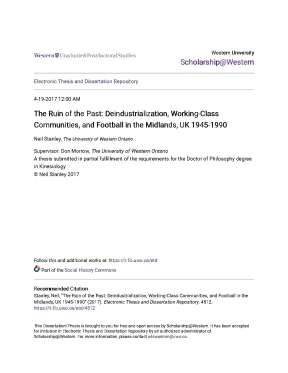
Tải xuống để đọc toàn bộWestern University Scholarship@Western Electronic Thesis and Dissertation Repository 4-19-2017 12:00 AM The Ruin of the Past: Deindustrialization, Working-Class Communities, and Football in the Midlands, UK 1945-1990 Neil Stanley, The University of Western Ontario Supervisor: Don Morrow, The University of Western Ontario A thesis submitted in partial fulfillment of the requirements for the Doctor of Philosophy degree in Kinesiology © Neil Stanley 2017 Follow this and additional works at: https://ir.ca/etd Part of the Social History Commons Recommended Citation Stanley, Neil, "The Ruin of the Past: Deindustrialization, Working-Class Communities, and Football in the Midlands, UK 1945-1990" (2017). Electronic Thesis and Dissertation Repository.ca/etd/4512 This Dissertation/Thesis is brought to you for free and open access by Scholarship@Western. It has been accepted for inclusion in Electronic Thesis and Dissertation Repository by an authorized administrator of Scholarship@Western. For more information, please contact wlswadmin@uwo.
i Abstract and Keywords As a social history of deindustrialization in the Midlands (U.), this study explores how loss informed working-class conceptions of identity, culture, and community. By shutter- ing factories, disrupting social networks, defamiliarizing the landscape, and relegating thousands to the unemployment lines, deindustrialization marooned the Midlands work- ing class in a world they struggled to recognize. Using oral histories to interrogate the ways loss informed everyday life, this study examines how the meanings attached to football transformed the sport into a metonym for the past. The dynamics and values specific to working-class communities are analyzed through the lens of four key working class relationships.
Composing the fabric of reality, by dissecting relationships to the body, employment, sociality, and the everyday, this study illustrates how work organized and influenced life. Acting as a before picture to the trauma of deindustrialization, this study emphasizes football’s ubiquity in the lives of the Midlands’ working class. Dedicat- ing attention to absence, automation, mergers/liquidations, and redundancies, this dis- sertation is also devoted to detailing deindustrialization’s destruction of the working- class community, leaving a landscape defined by absence, memories of football entan- gled with private histories of loss. The departed family members, workplaces, shops, and even smells continued to live on, as deindustrialization transformed football into a trace of the rich Midlands’ industrial heritage.
Keywords: Deindustrialization;The History of Football in the Midlands; English Working Class History; Loss; Oral History; Community; Cultural Meaning of Sport, Wolverhamp- ton; Coventry; Walsall; Birmingham; West Bromwich ii Acknowledgements: I would like to thank my advisor Don Morrow for his unwavering support and belief in me. When I arranged a meeting with Don five years ago to see if he would be interested in supervising my Master’s cognate, it was the start of a relationship with someone who was always engaged and willing to help. I am also grateful to Michael Heine, Kevin Wamsley, Janice Forsyth, Jonathan Vance, and Alan McDougall for serving on my ex- amining committees. In England, I would like to thank all the archivists who aided my research, but in particular Carolyn Ewing of Coventry who helped guide me through the vast reserves of the Herbert Art Gallery’s oral histories.
To my Mom, Dad and Macken- zie, you’ve ceaselessly championed me and encouraged my creativity since I came into this world. Each of you inspire me everyday with your kindness and love of knowledge. To my friends Phil, Corey, Dan, Pat, Mat, Alex, Ruby and Sasha thank you for travelling through life with me. Your love and friendship provided a warm respite from days spent indoors hunched over books and screens.
Lastly, I want to thank my beautiful girlfriend Pilar Magoulas who sacrificed hours of leisure to sit by my side and keep me company. Without you the world becomes unimaginable. iii Dedication This dissertation is dedicated to the memory of Andrew Lomax Strathdee. Table of Contents Abstract and Keywords…………………………………………………………………….i Acknowledgements…………………………………………………………………………ii Dedication…………………………………………………………………………………….iii Introduction……………………………………………………………………………………1 Definitions, Contextualizations, and Frameworks………………………………….12 Chapter 1: Incoming Storm: The Dynamics and Relationships of Working-Class Communities Before Deindustrialization…………………………………………44 Working-Class Relationships to the Body……………………………………………48 Working-Class Relationships to Work……………………………………………….66 Working-Class Intersections with Social Environment…………………………….81 Working-Class Relationships to the Everyday…………………………………….104 Summary………………………………………………………………………………129 Chapter 2: Living With Absence: Landscapes of Loss and Memory…………….132 The Persisting Wound: Landscape after Deindustrialization…………………….133 Contesting Absences: Histories of Loss in the Midlands…………………………145 Summary……………………………………………………………………………….157 Chapter 3: Deindustrialization, automation, and the changing experience of work Inscriptions of Loss: Technology of its discontents……………………………….158 The Meaning of Labour: Automation and Identity…………………………………160 The Queen’s Naked Army Marches on: Empire, Arrogance, and the Economy 171 Summary……………………………………………………………………………….180 Chapter 4: A Loss of Intimacy: The experience of Industrial mergers and liquidations…………………………………………………………………………182 Constellations of Factories: Football and the Intimacy of Industry…………….183 Losing Place: The Defamiliarized community…………………………………….201 Chapter 5: Redundancy as Loss: The End of Mass Industrial Employment….203 The Shape of Redundancy: Differing Responses to workplace change…….228 Chapter 6: Industrial Palimpsest: Football, the Past and the Midlands Working- Class…………………………………………………………………………………231 The Living Lost: Football’s role in preserving the past………………………….233 Loss and its continued memory: Football, time, and change………………….271 Recommendations for Future Research………………………………………….276 Appendix~ Map of the West Midlands…………………………………………………279 Bibliography……………………………………………………………………………….304 1 Introduction Loss and its continued memory shape human life.
A form of disorientation, loss separates individuals from what is familiar and places them in a state of uncertainty. Responses to loss, whether hidden or forthright inform the stories we tell about the world. History, as a concept, is a progression of loss and ruins, a series of lives ma- rooned in an impenetrable, fading past. In his poem “Die Verganglichkeit” Swiss- Ger- man writer Johann Peter Hebel approaches loss and our understanding of its inevitabili- ty through a frank exchange between a father and son as they make their way home by oxcart in the dark of night.
Do you see how the sky is splendid with bright stars? Each star is as it might be a village, and farther up perhaps there is a fine town, you can’t see it from here, and if you live decent you will go to one of those stars and you’ll be happy there, and you’ll find your father there, if it is God’s will, and poor Bessie, your mother. Perhaps you’ll drive up the Milky Way into that hidden town, and if you look down to one side, what’ll you see— Roetteln Castle! The Belchen will be charred and the Blauen, too, like two old towers, and between the two everything will be burnt out, right into the ground. There won’t be any water in the Wiese, everything will be bare and black and deathly quiet, as far as you can see; you’ll see that and say to your mate that’s with you: “Look, that’s where the earth was, and that mountain was called the Blechen. And not far away was Wieslet; I used to live there and harness my oxen, cart wood to Basel and plough, and drain meadows and make splints for torches, and potter about until my death, and I wouldn’t like to go back now.G Sebald, A Place in the Country.
(New York: Random House, 2014), 2 Perched high above the earth and reflecting upon the impossibility of return, the memo- ry of Hebel’s narrator restores his world from a geography of oblivion, long after he has died. Not unlike an historian drawing conclusions from the physical remnants of the past, this passage conveys how the concept of loss leaves indelible, but often invisible marks upon identity, physical geography, memory and the writing of history. Like the blackened wreckage of Hebel’s Basel, the post-World War II communities and cultures of England’s industrial working class exist now, only in ruin and memories of loss. Dis- placed physically by the bulldozers and wrecking balls of urban regeneration and slum clearances, working-class communities were also dispossessed of their basic social fabric by deindustrialization.
Provoked directly by the sterling crisis of 1966 and the sub- sequent implementation of a deflationary budget by the Labour government, the dis- mantling of England’s industrial workforce profoundly fragmented the country’s social and psychological landscapes. Addressing the extent to which deindustrialization chal- lenged working-class identities and self-image Simon J. Charlesworth stated: Deindustrialization has, clearly, had the effect of wrapping many in a powerful sense of entrapment, as low wages, the cheapening of the qualifications they might reasonably aspire to obtain, and the shortening length of time that they hold jobs, have given them a sense of inescapable destiny, of being individuals collectively overwhelmed by historical change.2 Estranged from their own time by the shattering of social continuity, members of dis- placed working-class communities attempted to reconstruct the past by continuing to enact the customs and cultures of their lost worlds. Of these rituals imbued with loss, 2 Simon J.
Charlesworth, A Phenomenology of Working Class Experience, (Cambridge: Cambridge University Press, 2000), 71. 3 attending a football match was one of the most visible ways dissolving working class communities could temporarily restore a sense of the past. Like Hebel’s castle, football teams were ruins of a world existing and adapting to the present. Carrying with them vast histories of loss, they were perhaps one of the few functioning traces of a once vivid world.
Coexisting with the present through memory (or the lack thereof), traditions and archival preservation, loss and its relationship to historical time is perhaps best articu- lated by the French medievalist Philippe Aries in his book Le Temps de L’Histoire. Ex- panding upon the concept that “History” (the total aggregate of past human experience) encompasses both tradition and the practice of history, Aries perceives “History” as “an interplay between two ways of understanding historical time; one as it flows through liv- ing tradition, the other as it punctuates historical reconstruction.”3 For Aries the time of tradition is distinctly existential. It embodies lived experience as it emerges out of the past and confirms our sense of continuity. The time of history is hermeneutical; it decon- structs the meaning of the past by dividing it into distinct eras, enabling us to interpret the differences between the present and the past.4 If we are to approach historical time as an interplay between the past and the present, loss allows us to understand how fragmentation, ruptures in continuity and dispossession imbue tradition, culture and lan- guage with a distinct symbolic property; the embodiment of the past in the present.
While loss has always informed the time of tradition and lived experience, historians 3 Patrick H. Hutton, Philippe Aries and the Politics of French Cultural History (Amherst: University of Massachusetts Press, 2004), 15 4 Ibid 4 such as Peter Fritzsche assert that loss, melancholy and nostalgia have only recently become a defining characteristic of historical consciousness. In his book Stranded in the Present, Fritzsche argues that the French Revolution and its fragmentation of social continuity permanently changed the ways individuals interpreted the past. Fritzsche proposes that the trauma of displacement, mass arrest, execution and occupation trans- formed the past into a source of melancholy.5 Drawing examples from the writings of Chateaubriand, Francois Buzot, Dorothea Schlegel, and the poetry, memoirs and letters of individuals experiencing the aftershock of revolution firsthand, an image of an irre- trievable past emerges.
Exiled from their homelands or cut off from their old ways of life, late 18th century Europeans became “stranded in the past.” While the majority of Fritzsche’s writing emphasizes the melancholic relationship individuals were developing with the past, it would be incorrect to characterize his interpretation as exclusively nega- tive.6 Through the processes of exile and the attempt to create a society unburdened by the customs and laws of the past, Fritzsche argues that Europeans began to develop a contemporary historical consciousness. By actively participating in this redrawing of the social fabric, individuals were coming into closer contact with their contemporaries and were contextualizing their own lives within a larger social narrative. This increased awareness of other people’s lives and the similarities or differences to their own, gave the ‘present” new historical dimensions. Paired with a pronounced longing for a past which they could not return, historical time (as Aries has conceptualized it) became 5 Peter Fritzsche, Stranded in the Present : Modern time and the Melancholy of History (Cambridge, Mass.
; London: Harvard University Press, 2004), 33.
Nội dung được bảo vệ bản quyền — Tải xuống đầy đủ
Trích dẫn luận án này
Neil Stanley (2017). The ruin of the past deindustrialization [Luận án tiến sĩ, The University of Western Ontario]. LuanAn.net. https://luanan.net/kinh-te/the-ruin-of-the-past-deindustrialization
Câu hỏi thường gặp
Luận án "The ruin of the past deindustrialization" nghiên cứu về vấn đề gì?
Khám phá tàn tích của quá trình phi công nghiệp hóa trong quá khứ, phân tích những tác động sâu sắc và bài học rút ra cho tương lai.
Luận án "The ruin of the past deindustrialization" được bảo vệ tại trường nào?
Luận án này được bảo vệ tại The University of Western Ontario. Năm bảo vệ: 2017.
Luận án "The ruin of the past deindustrialization" thuộc chuyên ngành gì?
Luận án "The ruin of the past deindustrialization" thuộc chuyên ngành Kinesiology. Danh mục: Kinh Tế.
Luận án "The ruin of the past deindustrialization" có bao nhiêu trang?
Luận án "The ruin of the past deindustrialization" có 310 trang. Bạn có thể xem trước một phần tài liệu ngay trên trang web trước khi tải về.
Cách tải luận án "The ruin of the past deindustrialization" về máy như thế nào?
Để tải luận án về máy, bạn nhấn nút "Tải xuống ngay" trên trang này, sau đó hoàn tất thanh toán phí lưu trữ. File sẽ được tải xuống ngay sau khi thanh toán thành công. Hỗ trợ qua Zalo: 0559 297 239.