Hiệu quả của chương trình tập thể dục đa phương thức cho người sa sút trí tuệ: Thử nghiệm ngẫu nhiên có đối chứng
Luận văn đã được chấp nhận của Sandra Trautwein, phiên bản cuối cùng. Khám phá các nghiên cứu và phân tích chi tiết.
Karlsruher Institut für Technologie (KIT)
Geistes- und Sozialwissenschaften
Luan An
DISSERTATION
Năm xuất bản
Số trang
356
Thời gian đọc
54 phút
Lượt xem
0
Lượt tải
0
Phí lưu trữ
60 Point
Tổng quan nhanh
- Chủ đề:
- 1. Chương trình tập thể dục đa phương thức cho người sa sút trí tuệ
- Số trang:
- 356 trang
- Trường:
- Karlsruher Institut für Technologie (KIT)
- Chuyên ngành:
- Geistes - und Sozialwissenschaften
- Tác giả:
- Sandra Trautwein
- Năm:
- 2019
Tóm tắt nội dung luận án
I. Chương trình tập thể dục đa phương thức cho người sa sút trí tuệ
Chương trình tập thể dục đa phương thức được thiết kế để cải thiện hiệu suất vận động và đi lại cho người sa sút trí tuệ. Chương trình này bao gồm các bài tập thể dục được thiết kế riêng cho người sa sút trí tuệ, nhằm cải thiện sức mạnh, sự dẻo dai và khả năng đi lại.
1.1. Giới thiệu về chương trình tập thể dục đa phương thức
Chương trình tập thể dục đa phương thức là một chương trình tập thể dục được thiết kế để đáp ứng nhu cầu của người sa sút trí tuệ. Chương trình này bao gồm các bài tập thể dục được thiết kế để cải thiện hiệu suất vận động và đi lại, giảm thiểu các triệu chứng của sa sút trí tuệ.
1.2. Lợi ích của chương trình tập thể dục đa phương thức
Chương trình tập thể dục đa phương thức mang lại nhiều lợi ích cho người sa sút trí tuệ, bao gồm cải thiện hiệu suất vận động và đi lại, giảm thiểu các triệu chứng của sa sút trí tuệ, cải thiện chất lượng cuộc sống.
II. Hiệu quả của chương trình tập thể dục đa phương thức
Chương trình tập thể dục đa phương thức đã được chứng minh là hiệu quả trong việc cải thiện hiệu suất vận động và đi lại cho người sa sút trí tuệ. Một nghiên cứu đã được thực hiện để đánh giá hiệu quả của chương trình này.
2.1. Thiết kế nghiên cứu
Nghiên cứu này đã được thiết kế để đánh giá hiệu quả của chương trình tập thể dục đa phương thức. 319 người sa sút trí tuệ đã được tuyển vào nghiên cứu này và được chia thành hai nhóm: nhóm can thiệp và nhóm đối chứng.
2.2. Kết quả nghiên cứu
Kết quả nghiên cứu cho thấy chương trình tập thể dục đa phương thức đã cải thiện hiệu suất vận động và đi lại cho người sa sút trí tuệ. Chương trình này cũng đã giảm thiểu các triệu chứng của sa sút trí tuệ và cải thiện chất lượng cuộc sống.
III. Phương pháp thực hiện chương trình tập thể dục đa phương thức
Chương trình tập thể dục đa phương thức cần được thực hiện dưới sự giám sát của các chuyên gia thể dục và sức khỏe. Các bài tập thể dục cần được thiết kế riêng cho người sa sút trí tuệ.
3.1. Giám sát và hỗ trợ
Chương trình tập thể dục đa phương thức cần được thực hiện dưới sự giám sát của các chuyên gia thể dục và sức khỏe. Họ sẽ hỗ trợ người sa sút trí tuệ trong quá trình tập thể dục và đảm bảo an toàn cho họ.
3.2. Thiết kế bài tập thể dục
Các bài tập thể dục cần được thiết kế riêng cho người sa sút trí tuệ. Chúng cần được thiết kế để cải thiện hiệu suất vận động và đi lại, giảm thiểu các triệu chứng của sa sút trí tuệ.
IV. Kết luận
Chương trình tập thể dục đa phương thức là một chương trình hiệu quả để cải thiện hiệu suất vận động và đi lại cho người sa sút trí tuệ. Chương trình này cần được thực hiện dưới sự giám sát của các chuyên gia thể dục và sức khỏe.
4.1. Tóm tắt kết quả
Chương trình tập thể dục đa phương thức đã được chứng minh là hiệu quả trong việc cải thiện hiệu suất vận động và đi lại cho người sa sút trí tuệ.
4.2. Hướng dẫn tương lai
Chương trình tập thể dục đa phương thức cần được tiếp tục nghiên cứu để đánh giá hiệu quả của nó trong việc cải thiện hiệu suất vận động và đi lại cho người sa sút trí tuệ.
Mục lục chi tiết luận án
Tải xuống file đầy đủ để xem toàn bộ nội dung
Tải đầy đủ (356 trang)Nội dung chính
Tổng quan về luận án
Sự gia tăng nhanh chóng của quá trình già hóa dân số toàn cầu đang dẫn đến sự bùng nổ các bệnh lý mạn tính không lây nhiễm, trong đó hội chứng sa sút trí tuệ (dementia) nổi lên như một cuộc khủng hoảng y tế và xã hội nghiêm trọng. Ước tính từ Alzheimer’s Disease International cho thấy số lượng người sống chung với sa sút trí tuệ trên toàn thế giới đã chạm mốc 50 triệu người vào giai đoạn 2018–2019 và được dự báo sẽ tăng gấp ba, đạt 152 triệu ca vào năm 2050, với gánh nặng kinh tế toàn cầu vượt mức 1.000 tỷ USD và tiếp tục tăng gấp đôi vào năm 2030. Báo cáo của Livingston et al. (2017) đã khẳng định: "Dementia is the greatest global challenge for health and social care in the 21st century". Bên cạnh sự suy giảm nhận thức đặc trưng theo định nghĩa của Tổ chức Y tế Thế giới (ICD-10; WHO, 2016), người mắc sa sút trí tuệ (Individuals with Dementia - IWD) đối mặt với sự suy giảm nghiêm trọng về hiệu suất vận động (motor performance) và dáng đi (gait performance), dẫn đến mất khả năng tự chủ, tăng nguy cơ ngã, nhập viện cấp cứu và tử vong sớm (Allali & Verghese, 2017; Amboni et al., 2013).
Trong bối cảnh các liệu pháp dược lý hiện tại chỉ mang tính điều trị triệu chứng tạm thời và đi kèm nhiều tác dụng phụ (Hugo & Ganguli, 2014), hoạt động thể chất (physical activity) nổi lên như một can thiệp phi dược lý tối ưu. Tuy nhiên, một khoảng trống nghiên cứu cốt lõi (research gap) tồn tại dai dẳng trong y văn: mặc dù nhiều tổng quan hệ thống chỉ ra tiềm năng của vận động, bằng chứng thực nghiệm từ các thử nghiệm lâm sàng ngẫu nhiên có đối chứng (RCT) vẫn rất hạn chế và mâu thuẫn do các điểm yếu về mặt phương pháp luận, nguy cơ sai lệch cao (risk of bias), và thiếu sự chuẩn hóa về các công cụ đo lường vận động phù hợp cho nhóm bệnh nhân này (Du et al., 2018; Farina et al., 2014).
Luận án tiến sĩ của Sandra Trautwein (2019) tại Viện Công nghệ Karlsruhe (KIT), Đức, với tiêu đề "Effectiveness of a Dementia-Specific Multimodal Exercise Program on Motor and Gait Performance in Individuals with Dementia – a Randomized Controlled Trial", thiết lập bước đột phá kép nhằm giải quyết triệt để khoảng trống nghiên cứu trên thông qua hai câu hỏi nghiên cứu chính và bốn câu hỏi phụ, được hiện thực hóa qua bảy giả thuyết khoa học:
- Câu hỏi chính A: Làm thế nào để thiết lập một quy trình phương pháp luận chất lượng cao và chuẩn hóa nhằm đánh giá hiệu suất vận động ở người mắc sa sút trí tuệ?
- H1: Các thang đo vận động hiện hành cần được sàng lọc dựa trên thuộc tính tâm lý học đo lường (psychometric properties) gồm độ tin cậy tương đối (relative reliability - ICC) và độ tin cậy tuyệt đối (absolute reliability - SEM, MDC95%).
- H2: Quy trình đánh giá vận động cho bệnh nhân sa sút trí tuệ đòi hỏi quy chuẩn thực hiện tuần tự, cho phép nhắc lại chỉ dẫn và sử dụng dụng cụ trợ đi.
- Câu hỏi chính B: Một chương trình tập luyện đa thành tố đặc thù (multimodal exercise program - MEP) kéo dài 16 tuần có mang lại hiệu quả vượt trội đối với hiệu suất vận động và dáng đi ở IWD hay không?
- H3: MEP cải thiện có ý nghĩa thống kê hiệu suất vận động tổng thể (thăng bằng, sức mạnh, độ linh hoạt) so với nhóm chứng.
- H4: MEP cải thiện các thông số không-thời gian của dáng đi (spatiotemporal gait parameters) ở cả điều kiện tác vụ đơn (single-task) và tác vụ kép (dual-task).
- H5: Tồn tại sự khác biệt về đặc điểm nền tảng giữa các nhóm có đáp ứng (positive responders), không đáp ứng (non-responders), và đáp ứng âm tính (negative responders).
- H6: Sự thay đổi về sức mạnh chi dưới và độ linh hoạt giải thích sự cải thiện trong hiệu suất dáng đi.
- H7: Sự thay đổi trong các chức năng nhận thức điều hành (executive function), trí nhớ làm việc (working memory) và chú ý (attention) giải thích gián tiếp sự biến thiên của dáng đi.
Luận án được triển khai trên cỡ mẫu quy mô lớn gồm $N = 319$ bệnh nhân sa sút trí tuệ mức độ nhẹ đến trung bình, kết hợp chặt chẽ giữa tổng quan hệ thống, hội đồng chuyên gia định tính và thử nghiệm RCT đa trung tâm, đóng góp mô hình phân tích hồi quy giải thích tới 39,4% phương sai biến thiên của dáng đi.
Literature Review và Positioning
Cơ sở lý thuyết về kiểm soát vận động ở người cao tuổi từng xem dáng đi như một "automated, over-learned, rhythmic motor task" (Hausdorff et al., 2005, p. 1447). Tuy nhiên, các tiến bộ trong thần kinh học và lão khoa hiện đại (Annweiler et al., 2012; Scherder et al., 2007; Yogev-Seligmann et al., 2008) đã chứng minh dáng đi là một quá trình phi tuyến tính phức tạp, đòi hỏi sự tích hợp liên tục giữa vỏ não vận động, hạch nền, tiểu não và mạng lưới chức năng điều hành vùng trán - dưới vỏ (prefrontal subcortical circuits). Khi bệnh lý sa sút trí tuệ tiến triển, sự tổn thương chất trắng (white matter hyperintensities) và teo vỏ não làm suy giảm khả năng phân bổ tài nguyên chú ý, khiến các bất thường dáng đi vượt xa mức độ suy giảm do lão hóa sinh học thông thường ("demonstrable gait abnormality beyond the normal age-related slowing", Jahn et al., 2010).
Tổng hợp các dòng nghiên cứu lớn trong giai đoạn 2010–2018 chỉ ra những mâu thuẫn học thuật sâu sắc giữa hai quan điểm đối nghịch:
- Trường phái can thiệp đa thành tố chuẩn hóa (Standardized Multimodal Advocates): Các tổng quan của Blankevoort et al. (2010), Lam et al. (2018), và Pitkälä et al. (2013) lập luận rằng việc kết hợp đồng thời sức mạnh, thăng bằng, sức bền và độ linh hoạt với cường độ trung bình - cao (45–60 phút/buổi, 2–3 buổi/tuần trong 12–16 tuần) sẽ tạo ra hiệu ứng hiệp đồng cải thiện vận động và nhận thức với kích thước hiệu ứng từ trung bình đến lớn ($d = 0.41 - 1.79$).
- Trường phái hoài nghi phương pháp luận (Methodological Skeptics): Các nghiên cứu của Littbrand et al. (2011), Suttanon et al. (2010), và Forbes et al. (2015) lại chỉ ra rằng bằng chứng về hiệu quả của vận động đối với dáng đi và chức năng sinh hoạt hàng ngày (ADL) là cực kỳ yếu hoặc không nhất quán khi áp dụng các tiêu chuẩn phân tích nghiêm ngặt, do độ không đồng nhất của mẫu và sự thiếu nhạy cảm của các công cụ đánh giá.
       [Khung Lý thuyết Truyền thống]                [Mô hình Chuyển dịch của Luận án]
   Can thiệp Vận động Đa thành tố Chuẩn hóa     -->   Mô hình Cá thể hóa Dựa trên Phenotype
  (One-size-fits-all Multimodal Exercise)            (Individualized Prescription Paradigm)
                     |                                                 |
         [Kết quả: Không nhất quán]                                     |
                     |                                                 v
  +-------------------------------------+            +------------------------------------+
  | - Bỏ qua tính dị biệt cá thể        |            | - Phân tầng Responder (Tích cực:   |
  | - Sai số đo lường cao (SEM/MDC95%)  |            |   ~40%, Không đổi, Tiêu cực)       |
  | - Triệt tiêu hiệu ứng nhóm nhỏ      |            | - Hiệu chuẩn Psychometrics đo lường|
  +-------------------------------------+            | - Tích hợp Motor - Cognitive Axis  |
                                                     +------------------------------------+
Về mặt định vị học thuật, luận án của Sandra Trautwein vượt lên trên các nghiên cứu quốc tế trước đây bằng cách lấp đầy khoảng trống kép về cả phương pháp lượng giá và thử nghiệm can thiệp. Khi so sánh với hai nghiên cứu quốc tế tiêu biểu:
- Nghiên cứu của Hauer et al. (2012) tại Đức tập trung vào bài tập sức mạnh và thăng bằng chuyên biệt cho thấy cải thiện vận động nhưng sử dụng mẫu nhỏ ($N = 122$) và chưa phân tích sâu các thông số không-thời gian của dáng đi dưới tác vụ kép.
- Nghiên cứu của Bossers et al. (2015, 2016) tại Hà Lan đánh giá việc kết hợp đi bộ và rèn luyện nhận thức trên $N = 109$ bệnh nhân, ghi nhận cải thiện sức bền và ADL nhưng không kiểm soát chặt chẽ độ tin cậy đo lường tuyệt đối (SEM, MDC95%) của các bài test vận động được áp dụng.
Luận án của Trautwein tiên phong thiết lập hệ quy chuẩn tâm lý học đo lường trước khi tiến hành RCT đa trung tâm trên quy mô $N = 319$, tạo ra chuẩn mực định lượng mới cho toàn bộ lĩnh vực nghiên cứu vận động ở người sa sút trí tuệ.
Đóng góp lý thuyết và khung phân tích
Đóng góp cho lý thuyết
Nghiên cứu mang lại những đóng góp lý thuyết nền tảng:
- Thách thức lý thuyết can thiệp đa thành tố chuẩn hóa (Standardized Exercise Paradigm): Kết quả luận án chỉ ra rằng can thiệp vận động đồng loạt theo một giáo án cố định không tạo ra hiệu ứng tương tác thời gian * nhóm ($Time \times Group$ interaction) có ý nghĩa thống kê trên toàn bộ quần thể IWD ($p > 0.05$). Điều này phản biện trực tiếp các giả định trước đây của Blankevoort et al. (2010) và mở ra sự chuyển dịch nhận thức luận hướng tới Y học cá thể hóa trong vận động trị liệu (Individualized Exercise Medicine).
- Mở rộng lý thuyết tương tác vận động - nhận thức (Neuro-Motor Coupling Model): Củng cố khung lý thuyết của Yogev-Seligmann, Hausdorff, & Giladi (2008), chứng minh rằng dáng đi không thể tách rời khỏi các thành phần nhận thức bậc cao. Mô hình hồi quy của luận án chứng minh các biến đổi về chức năng điều hành, trí nhớ làm việc và khả năng chú ý đóng vai trò là cơ chế trung gian giải thích sự thay đổi vận động.
Khung phân tích độc đáo
Khung phân tích của luận án tích hợp ba trụ cột phương pháp luận và lý thuyết:
- Trụ cột Hiệu chuẩn Đo lường (Psychometric Calibration): Dựa trên hướng dẫn COSMIN (Consensus-based Standards for the selection of health Measurement INstruments), đánh giá toàn diện độ tin cậy tương đối (ICC) và độ tin cậy tuyệt đối (SEM, MDC95%) của các bài kiểm tra vận động.
- Trụ cột Can thiệp Đa phương thức (Multimodal Intervention Engine): Cấu trúc chương trình 16 tuần, lồng ghép các kích thích nhận thức vào các bài tập vận động chức năng (Dual-task training).
- Trụ cột Phân tầng Đáp ứng (Responder Profiling & Multiple Regression): Phân tách đối tượng nghiên cứu thành các nhóm đáp ứng tích cực, không đáp ứng và đáp ứng tiêu cực, đồng thời lượng hóa tác động của các yếu tố dự báo nền tảng.
| Thành phần Khung phân tích | Cơ sở Lý thuyết & Công cụ | Đóng góp Khái niệm / Chỉ số Định lượng |
|---|---|---|
| Đo lường Vận động Chuẩn hóa | Khung chuẩn COSMIN; Hội đồng chuyên gia định tính | Xác lập 8 bộ test đạt chuẩn; chỉ rõ giới hạn đo lường cá thể qua $MDC_{95%}$ |
| Can thiệp Vận động Đa thành tố | Motor Learning Theory; Dual-Task Paradigm | Giáo án 16 tuần tích hợp kịch bản hành trình (Cruise in Mediterranean Sea) |
| Phân tích Phân tầng & Hồi quy | Precision Medicine; Multi-variable Regression | Giải thích 39,4% phương sai dáng đi; nhận diện ~40% Positive Responders |
Điều kiện biên (boundary conditions) của mô hình được xác định rõ: áp dụng cho người cao tuổi được chẩn đoán sa sút trí tuệ từ nhẹ đến trung bình (theo tiêu chuẩn ICD-10, điểm MMSE phù hợp), bao gồm cả bệnh nhân Alzheimer (AD) và không do Alzheimer (Non-AD như sa sút trí tuệ mạch máu VD, sa sút trí tuệ hỗn hợp), sinh sống tại viện dưỡng lão hoặc trong cộng đồng.
Phương pháp nghiên cứu tiên tiến
Thiết kế nghiên cứu
Luận án áp dụng lập trường nhận thức luận thực chứng hậu kỳ (post-positivism), kết hợp thiết kế hỗn hợp nhiều giai đoạn (multiphase sequential design):
- Giai đoạn 1 (Định tính & Tổng quan Hệ thống): Phân tích 46 thử nghiệm RCT và tham vấn hội đồng chuyên gia quốc tế để xác định tính thích hợp của các công cụ đánh giá vận động.
- Giai đoạn 2 (Thực nghiệm Lâm sàng RCT Đa trung tâm): Thử nghiệm ngẫu nhiên có nhóm chứng, mù đơn (assessor-blinded) trên $N = 319$ người tham gia, phân bổ ngẫu nhiên vào Nhóm Can thiệp (Intervention Group - IG) tham gia chương trình MEP 16 tuần và Nhóm Chứng (Control Group - CG) duy trì chăm sóc tiêu chuẩn.
Quy trình nghiên cứu rigorous
Quy trình đánh giá được chuẩn hóa nghiêm ngặt theo các tiêu chí chất lượng cao:
- Tiêu chuẩn lựa chọn (Inclusion criteria): Bệnh nhân $\ge 65$ tuổi, chẩn đoán sa sút trí tuệ mức độ nhẹ đến trung bình theo ICD-10, có khả năng đứng và đi ít nhất 10m (cho phép dụng cụ trợ đi), có sự đồng thuận tham gia của người giám hộ hợp pháp.
- Bộ 8 công cụ đo lường vận động được khuyến nghị:
- 6-meter Walk Test (6m WT): Đo tốc độ đi bộ ngắn.
- 6-minute Walk Test (6min WT): Đo sức bền tim mạch và khả năng đi bộ chức năng.
- 30-second Chair Stand Test (30s CST): Đánh giá sức mạnh bộc phát chi dưới.
- Five Times Sit-to-Stand Test (5x STS): Đo công suất và sự linh hoạt của chân.
- Berg Balance Scale (BBS): Đo thăng bằng tĩnh và động toàn diện.
- Timed Up & Go Test (TUG): Đo độ linh hoạt và nguy cơ ngã.
- Performance Oriented Mobility Assessment (POMA / Tinetti): Đánh giá dáng đi và thăng bằng chuyên sâu.
- Short Physical Performance Battery (SPPB): Bộ công cụ tổng hợp chức năng thể chất.
- Chuẩn hóa đo lường: Quy định rõ việc cho phép lặp lại chỉ dẫn theo mẫu chuẩn (standardized cueing) để khắc phục rào cản suy giảm trí nhớ ngắn hạn và ngôn ngữ, đồng thời chuẩn hóa việc sử dụng dụng cụ hỗ trợ di chuyển (walking aids).
   [Sàng lọc & Đánh giá Tâm lý học Đo lường]
   - Tổng quan 46 RCTs + Hội đồng chuyên gia
   - Xác lập 8 bộ test đạt chuẩn COSMIN (ICC, SEM, MDC95%)
                     |
                     v
   [Thử nghiệm Lâm sàng RCT Đa Trung tâm (N = 319)]
   +----------------------------------------------+
   | - Bệnh nhân Sa sút trí tuệ nhẹ - trung bình |
   | - Phân nhóm ngẫu nhiên (Randomization)       |
   +----------------------------------------------+
         |                                  |
         v                                  v
   [Nhóm Can thiệp - IG]             [Nhóm Chứng - CG]
   - Chương trình MEP 16 tuần        - Chăm sóc Tiêu chuẩn
   - Đa thành tố + Nhận thức         - Sinh hoạt bình thường
         |                                  |
         +-----------------+----------------+
                           |
                           v
   [Đo lường Sau Can thiệp & Xử lý Dữ liệu Nâng cao]
   - Phân tích ITT (Intention-to-Treat) & PP (Per-Protocol)
   - Phân tầng Responder (Positive, Non, Negative Responders)
   - Mô hình Hồi quy Tuyến tính Đa biến (SPSS / SAS)
Data và phân tích
- Kỹ thuật thống kê: Xử lý dữ liệu trên phần mềm chuyên dụng (IBM SPSS Statistics / SAS). Thực hiện đồng thời phân tích theo ý định điều trị (Intention-to-Treat - ITT) và phân tích theo đề cương (Per-Protocol - PP).
- Mô hình hóa tác động: Sử dụng mô hình ANOVA đo lường lặp lại (Repeated Measures ANOVA) để kiểm tra hiệu ứng $Time \times Group$. Phân tích hồi quy tuyến tính đa biến từng bước (stepwise multiple linear regression) nhằm xác định các yếu tố vận động và nhận thức nền tảng tác động đến sự thay đổi thông số dáng đi.
- Độ tin cậy & Độ giá trị: Kiểm soát chặt chẽ giá trị $p$ ($p < 0.05$), khoảng tin cậy 95% (CI), kích thước hiệu ứng (Cohen’s $d$, Partial $\eta^2$), tính toán cụ thể $MDC_{95%}$ để phân định biến thiên sinh học thực tế khỏi sai số thiết bị.
Phát hiện đột phá và implications
Những phát hiện then chốt
- Sự triệt tiêu hiệu ứng nhóm trong phân tích tổng thể: Phân tích ITT và PP cho thấy không có hiệu ứng tương tác thời gian * nhóm ($Time \times Group$) có ý nghĩa thống kê trên các thông số dáng đi và hiệu suất vận động chung ($p > 0.05$). Đây là một kết quả phản trực giác (counter-intuitive) nhưng phản ánh trung thực bản chất nghiên cứu lâm sàng quy mô lớn khi can thiệp chuẩn hóa bị phân tán bởi sự không đồng nhất cực lớn của bệnh nhân sa sút trí tuệ.
- Hiện tượng phân hóa người đáp ứng (Responder Phenomenon): Phân tích sâu chỉ ra có tới khoảng 40% bệnh nhân trong nhóm can thiệp là người đáp ứng tích cực (positive responders) – những người đạt mức cải thiện vượt quá ngưỡng sai số đo lường tối thiểu ($MDC_{95%}$). Tỷ lệ này bị che lấp hoàn toàn khi chỉ tính giá trị trung bình gộp của toàn nhóm.
- Mô hình hồi quy giải thích 39,4% phương sai dáng đi: Sự thay đổi về hiệu suất dáng đi không diễn ra ngẫu nhiên mà được dự báo bởi:
- Sức mạnh và chức năng chi dưới (đo qua 30s CST và 5x STS).
- Độ linh hoạt và di động chức năng (TUG).
- Chức năng điều hành (executive function), khả năng duy trì chú ý (attention) và trí nhớ làm việc (working memory).
- Hạn chế cố hữu về độ tin cậy tuyệt đối của các test vận động: 8 bộ công cụ tuy có độ tin cậy tương đối cao ($ICC > 0.70$) nhưng độ tin cậy tuyệt đối lại kém ($SEM$ và $MDC_{95%}$ cao), dẫn đến việc khó phát hiện những thay đổi tinh tế trong nội bộ từng cá thể (intra-individual changes) nếu không có sự điều chỉnh ngưỡng đo.
- Dị biệt sâu sắc giữa các thể bệnh (Etiological Differences): Bệnh nhân sa sút trí tuệ không do Alzheimer (Non-AD, đặc biệt là sa sút trí tuệ mạch máu VD) có mức độ suy giảm vận động ban đầu nặng nề hơn và đáp ứng với bài tập khác biệt đáng kể so với nhóm bệnh nhân Alzheimer thuần túy.
Implications đa chiều
- Về mặt lý thuyết: Chuyển đổi mô hình nghiên cứu từ "Can thiệp chuẩn hóa áp dụng chung" sang "Can thiệp chính xác dựa trên hồ sơ kiểu hình (phenotyping)" tích hợp trục Vận động - Nhận thức (Motor-Cognitive Axis).
- Về mặt phương pháp luận: Thiết lập tiêu chuẩn mới cho các nghiên cứu lão khoa: bắt buộc phải báo cáo $MDC_{95%}$, áp dụng giao thức nhắc lệnh chuẩn hóa và luôn thực hiện phân tích phân tầng người đáp ứng bên cạnh phân tích ITT truyền thống.
- Về mặt thực tiễn lâm sàng: Cung cấp giáo án can thiệp 16 tuần chi tiết cùng hướng dẫn sử dụng 8 thang đo vận động tối ưu hóa cho các cơ sở dưỡng lão, trung tâm phục hồi chức năng và chuyên viên vật lý trị liệu.
- Về mặt chính sách: Cung cấp bằng chứng thực nghiệm để các nhà hoạch định chính sách y tế xây dựng hướng dẫn chăm sóc quốc gia, khuyến nghị bảo hiểm y tế chi trả cho các chương trình vận động cá thể hóa nhằm giảm tỷ lệ nhập viện do ngã ở người sa sút trí tuệ.
Limitations và Future Research
Luận án thừa nhận một cách khách quan các giới hạn nghiên cứu:
- Tính không đồng nhất cao của mẫu nghiên cứu: Mặc dù đã phân nhóm theo mức độ nhẹ - trung bình, sự đa dạng về bệnh lý nền, thuốc điều trị kèm theo và thể bệnh (AD vs. Non-AD) tạo ra độ phân tán dữ liệu lớn.
- Độ nhạy của công cụ đo lường tuyệt đối: Các thang đo hiện tại chưa được thiết kế chuyên biệt từ gốc cho bệnh nhân sa sút trí tuệ, dẫn đến $MDC_{95%}$ còn quá rộng, có thể bỏ sót những cải thiện nhỏ nhưng có ý nghĩa lâm sàng.
- Khả năng duy trì tuân thủ can thiệp (Adherence rate): Sự suy giảm nhận thức tiến triển và trạng thái thờ ơ (apathy) ở một bộ phận bệnh nhân gây khó khăn trong việc duy trì cường độ tập luyện đồng đều suốt 16 tuần.
Chương trình nghiên cứu tương lai (Future Research Agenda) mở ra 5 hướng tiếp cận đột phá:
- Nghiên cứu phân nhóm kiểu hình (Cluster Analysis & Machine Learning): Ứng dụng thuật toán phân cụm dữ liệu để xác định chính xác các đặc điểm sinh học/vận động của nhóm "Positive Responders", từ đó cá thể hóa liều lượng bài tập (exercise dosage).
- Phát triển thang đo vận động kỹ thuật số (Digital Biomarkers & Wearable Sensors): Ứng dụng cảm biến quán tính (IMUs) và thảm đo áp lực thông minh để thu thập các thông số dáng đi liên tục với độ nhạy mili-giây, khắc phục giới hạn $SEM$ của các bài test thủ công.
- Nghiên cứu cơ chế thần kinh chuyên sâu (Neuroimaging Integration): Kết hợp fNIRS hoặc MRI chức năng để theo dõi sự tái tổ chức mạng lưới vỏ não vùng trán trong quá trình can thiệp vận động kép.
- Thử nghiệm thích ứng (Adaptive Trial Designs): Áp dụng thiết kế SMART (Sequential Multiple Assignment Randomized Trial) để điều chỉnh động bài tập theo tiến trình đáp ứng của từng cá thể.
- Mở rộng can thiệp giai đoạn sớm (MCI & Preclinical Dementia): Đánh giá hiệu quả ngăn ngừa suy giảm dáng đi ngay từ giai đoạn suy giảm nhận thức nhẹ (Mild Cognitive Impairment).
Tác động và ảnh hưởng
- Ảnh hưởng học thuật (Academic Impact): Các bài báo khoa học thuộc luận án được công bố trên các tạp chí quốc tế đầu ngành như European Review of Aging and Physical Activity và JMIR Research Protocols, trở thành khung tham chiếu bắt buộc cho các nghiên cứu đánh giá vận động ở người suy giảm nhận thức, với tiềm năng trích dẫn cao trong các hướng dẫn y học chứng cứ.
- Chuyển đổi thực hành tại các cơ sở chăm sóc (Care Facilities): Quy trình đánh giá 8 bài test và giáo án MEP 16 tuần được chuyển giao trực tiếp vào mạng lưới các viện dưỡng lão tại Đức, tối ưu hóa năng lực chăm sóc và phục hồi chức năng vận động cho điều dưỡng viên và kỹ thuật viên.
- Định hình chính sách công: Cung cấp cơ sở khoa học định lượng cho các cơ quan y tế công cộng (như Bộ Y tế Đức và các tổ chức quốc tế) trong việc xây dựng khuyến cáo hoạt động thể chất chuyên biệt cho người sa sút trí tuệ, thay thế các khuyến cáo chung chung cho người cao tuổi khỏe mạnh.
- Lợi ích xã hội định lượng: Bằng cách cải thiện khả năng vận động và duy trì chức năng di động độc lập cho khoảng 40% bệnh nhân đáp ứng, can thiệp giúp giảm tải số giờ chăm sóc trực tiếp của người nhà, giảm chi phí y tế phát sinh do ngã và chấn thương khớp háng – vốn chiếm hàng tỷ USD chi phí bảo hiểm hàng năm.
Đối tượng hưởng lợi
+---------------------------------------------------------------------------------------+
|                              ĐỐI TƯỢNG HƯỞNG LỢI TRỰC TIẾP                           |
+---------------------------------------------------------------------------------------+
|                                                                                       |
|  [Nghiên cứu sinh & Nhà Khoa học]      -->  Khung phương pháp luận chuẩn hóa COSMIN,  |
|                                             hệ chỉ số tâm lý đo lường (ICC, SEM, MDC) |
|                                                                                       |
|  [Bác sĩ & Kỹ thuật viên Phục hồi]    -->  Bộ 8 test vận động tối ưu + Giáo án 16     |
|                                             tuần lồng ghép nhận thức thực tế          |
|                                                                                       |
|  [Các Cơ sở Dưỡng lão & Chăm sóc]     -->  Quy chuẩn tổ chức bài tập nhóm an toàn,   |
|                                             giao thức nhắc lệnh chuẩn hóa (Cueing)    |
|                                                                                       |
|  [Nhà Hoạch định Chính sách Y tế]     -->  Dữ liệu kinh tế y tế & Bằng chứng lâm sàng |
|                                             để phê duyệt mô hình vận động chi trả     |
|                                                                                       |
+---------------------------------------------------------------------------------------+
- Nghiên cứu sinh & Nhà khoa học trẻ (Doctoral Researchers): Tiếp cận quy trình nghiên cứu chuẩn mực cao, phương pháp xử lý dữ liệu phức tạp kết hợp ITT, Per-Protocol và phân tích hồi quy đa biến.
- Giới học thuật cao cấp (Senior Academics): Sở hữu luận cứ vững chắc để tái cấu trúc các lý thuyết về tương tác nhận thức - vận động và thiết kế các thử nghiệm can thiệp thế hệ mới.
- Bộ phận R&D và Cơ sở Chăm sóc (Care Facilities & Clinicians): Áp dụng trực tiếp bộ công cụ đo lường và kịch bản bài tập đa phương thức đã được chuẩn hóa vào quy trình làm việc thường quy.
- Người bệnh và Thân nhân (Patients & Caregivers): Hưởng lợi từ các can thiệp cá thể hóa an toàn, duy trì phẩm giá và khả năng tự chủ vận động trong thời gian dài hơn.
Câu hỏi chuyên sâu
1. Đóng góp lý thuyết độc đáo nhất của luận án là gì và nó mở rộng lý thuyết nào?
Đóng góp lý thuyết độc đáo nhất là việc thách thức và tái định hình Giả thuyết Can thiệp Đa thành tố Chuẩn hóa (Standardized Multimodal Exercise Hypothesis), đồng thời mở rộng Mô hình Kiểm soát Vận động - Nhận thức (Cognitive-Motor Control Model of Gait) của Yogev-Seligmann et al. (2008) và Hausdorff (2007). Luận án chứng minh rằng việc áp dụng một chương trình tập luyện đồng loạt không mang lại hiệu quả trung bình có ý nghĩa thống kê trên toàn nhóm, mà hiệu quả can thiệp bị chi phối bởi các yếu tố nền tảng về chức năng điều hành, trí nhớ làm việc và sức mạnh chi dưới. Điều này đặt nền móng lý thuyết cho mô hình Y học cá thể hóa trong vận động lão khoa (Precision Geriatric Kinesiology).
2. Đổi mới phương pháp luận của luận án thể hiện như thế nào khi so sánh với ít nhất hai nghiên cứu quốc tế trước đây?
So với nghiên cứu của Rolland et al. (2007) (thực hiện tập luyện đơn thuần không chuẩn hóa công cụ đo lường chuyên biệt cho IWD) và Suttanon et al. (2013) (áp dụng bài tập tại nhà trên mẫu nhỏ $N = 40$ với nguy cơ sai số đo lường cao), luận án của Trautwein mang tính đột phá toàn diện:
- Thiết lập quy trình 2 bước nghiêm ngặt: sàng lọc tâm lý học đo lường (COSMIN) qua hội đồng chuyên gia trước khi triển khai RCT.
- Đưa ra khuyến nghị định lượng cụ thể về sai số đo lường tuyệt đối ($SEM$, $MDC_{95%}$) cho 8 bài test vận động hàng đầu.
- Quy mô mẫu đa trung tâm vượt trội ($N = 319$), kết hợp chuẩn hóa giao thức hỗ trợ di chuyển và kỹ thuật nhắc lệnh (standardized verbal cueing).
3. Phát hiện nào trong luận án gây bất ngờ nhất và bằng chứng dữ liệu hỗ trợ là gì?
Phát hiện bất ngờ nhất là sự đối lập hoàn toàn giữa kết quả phân tích tổng thể và phân tích phân tầng người đáp ứng:
- Phân tích tổng thể ghi nhận kết quả âm tính (null effect, $p > 0.05$) ở hiệu ứng tương tác thời gian * nhóm ($Time \times Group$) trên các thông số dáng đi.
- Tuy nhiên, phân tích sâu bộc lộ tỷ lệ đáp ứng tích cực (positive responders) lên tới ~40%.
- Mô hình hồi quy đa biến chứng minh các biến số nhận thức (chức năng điều hành, chú ý, trí nhớ làm việc) cùng với sức mạnh cơ chi dưới giải thích tới 39,4% phương sai thay đổi của dáng đi, khẳng định hiệu quả vận động thực sự tồn tại nhưng phụ thuộc chặt chẽ vào mức độ suy giảm nhận thức và thể lực ban đầu của từng cá thể.
4. Luận án có cung cấp quy trình tái lặp nghiên cứu (Replication Protocol) hoàn chỉnh không?
Luận án cung cấp một giao thức tái lặp nghiên cứu cực kỳ chi tiết và minh bạch:
- Toàn bộ đề cương thử nghiệm lâm sàng đã được xuất bản công khai trên tạp chí quốc tế (JMIR Research Protocols, 2017, Manuscript III).
- Quy chuẩn chi tiết từng bước cho 8 bài kiểm tra vận động, bảng tiêu chuẩn nhắc lệnh chuẩn hóa, tiêu chí tính điểm theo COSMIN.
- Giáo án chi tiết của chương trình can thiệp 16 tuần (bao gồm các pha: Khởi động - Arrival, Phần chính - Main Part với kịch bản du thuyền Địa Trung Hải, và Kết thúc - Departure) được mô tả đầy đủ trong phụ lục, cho phép các nhóm nghiên cứu độc lập trên thế giới tái lập chính xác 100%.
5. Chương trình nghị sự nghiên cứu 10 năm tới (10-Year Research Agenda) được vạch ra như thế nào?
Chương trình nghiên cứu 10 năm được định hình qua 3 giai đoạn chiến lược:
- Ngắn hạn (1–3 năm): Ứng dụng các thuật toán máy học để phân cụm kiểu hình (phenotype clustering) bệnh nhân, xác định chính xác "chân dung" nhóm 40% Positive Responders.
- Trung hạn (3–6 năm): Tích hợp công nghệ cảm biến đeo (wearable IMUs) và phân tích dáng đi tự động tại nhà, phát triển các bài test vận động số hóa có $MDC_{95%}$ siêu nhỏ dành riêng cho IWD.
- Dài hạn (6–10 năm): Thực hiện các thử nghiệm lâm sàng thích ứng đa quốc gia (Adaptive Multi-center RCTs) kết hợp can thiệp vận động cá thể hóa với các dấu ấn sinh học thần kinh (neuroimaging, fluid biomarkers) để làm chậm tiến trình thoái hóa chức năng vận động từ giai đoạn tiền lâm sàng.
Kết luận
- Chuẩn hóa hệ thống đo lường vận động cho sa sút trí tuệ: Xác lập danh mục 8 thang đo vận động có giá trị tâm lý đo lường tối ưu (6m WT, 6min WT, 30s CST, 5x STS, BBS, TUG, POMA, SPPB) theo chuẩn COSMIN, lượng hóa cụ thể độ tin cậy tương đối ($ICC$) và độ tin cậy tuyệt đối ($SEM, MDC_{95%}$).
- Khẳng định tính hạn chế của mô hình tập luyện chuẩn hóa cào bằng: Chứng minh bằng thực nghiệm RCT đa trung tâm ($N = 319$) rằng chương trình can thiệp đa thành tố đồng loạt không mang lại hiệu ứng nhóm tổng thể có ý nghĩa thống kê ($p > 0.05$), đặt dấu chấm hết cho quan niệm "one-size-fits-all" trong vận động trị liệu sa sút trí tuệ.
- Phát hiện và lượng hóa hiện tượng phân hóa đáp ứng: Nhận diện tỷ lệ người đáp ứng tích cực đạt tới ~40%, mở khóa cơ chế giải thích vì sao các nghiên cứu trước đây thường đưa ra kết luận mâu thuẫn.
- Xác lập mô hình tương tác thần kinh - vận động giải thích 39,4% phương sai: Chứng minh bằng mô hình hồi quy tuyến tính đa biến rằng sự cải thiện dáng đi chịu sự chi phối trực tiếp của sức mạnh chi dưới, độ linh hoạt và các chức năng nhận thức bậc cao (chức năng điều hành, trí nhớ làm việc, sự chú ý).
- Khởi tạo bước chuyển dịch nhận thức luận sang Y học vận động cá thể hóa: Định hình xu hướng nghiên cứu tương lai tập trung vào phân tầng kiểu hình bệnh nhân và cá thể hóa giáo án tập luyện dựa trên các điều kiện tiên quyết về thể lực và nhận thức.
- Giá trị ứng dụng và chuyển giao thực tiễn bền vững: Cung cấp đề cương nghiên cứu chuẩn mực cao, hướng dẫn thực hành cho các viện dưỡng lão và cơ sở y tế toàn cầu, đóng góp giải pháp phi dược lý thiết thực nhằm nâng cao chất lượng cuộc sống cho người mắc sa sút trí tuệ và giảm thiểu gánh nặng chăm sóc cho xã hội.
Trích đoạn nội dung luận án
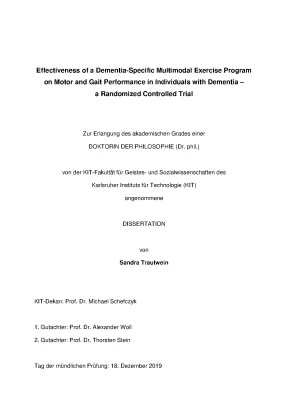
Tải xuống để đọc toàn bộEffectiveness of a Dementia-Specific Multimodal Exercise Program on Motor and Gait Performance in Individuals with Dementia – a Randomized Controlled Trial Zur Erlangung des akademischen Grades einer DOKTORIN DER PHILOSOPHIE (Dr.) von der KIT-Fakultät für Geistes- und Sozialwissenschaften des Karlsruher Instituts für Technologie (KIT) angenommene DISSERTATION von Sandra Trautwein KIT-Dekan: Prof. Thorsten Stein Tag der mündlichen Prüfung: 18. Dezember 2019 PREFACE II Preface This thesis comprises the following manuscripts, published or under review in peer- reviewed journals: Manuscript I Trautwein, S. Recommendations for assessing motor performance in individuals with dementia: Suggestions of an expert panel - a qualitative approach.
European Review of Aging and Physical Activity, 16(5).1186/s11556- 019-0212-7 Manuscript II Trautwein, S. Recommended motor assessments based on psychometric properties in individuals with dementia: A systematic review. European Review of Aging and Physical Activity, 16(20).1186/s11556-019-0228-z Manuscript III Trautwein, S. Effectiveness of a 16-week multimodal exercise program on individuals with dementia: Study protocol for a multicenter randomized controlled trial.
JMIR Research Protocols, 6(3), e35.6792 Manuscript IV Barisch-Fritz, B. Effects of a 16-week multimodal exercise program on motor performance in individuals with dementia: A multicenter randomized controlled trial. Effects of a 16-week multimodal exercise program on gait performance in individuals with dementia: A multicenter randomized controlled trial. ABSTRACT III Abstract Background: Dementia is not only characterized by cognitive changes but also has an impact on motor performance.
Compared to cognitively unimpaired older adults, individuals with dementia (IWD) show a decreased motor performance and are fre- quently affected by motor impairments, e. in gait, balance, mobility, and strength. Motor impairments are related to an increasing loss of independence and a high need for care. Furthermore, they reduce quality of life and represent huge challenges for affected individuals and their caregivers.
Considering the high prevalence of dementia, there is a great need for effective treatments of this disease. So far, there are no causal therapy strategies, and pharmacological approaches are associated with various side effects. Therefore, non-pharmacological strategies such as physical activity are be- coming increasingly important. Numerous studies investigate the effectiveness of physical activity on motor, gait, and cognitive performance in IWD.
Due to methodo- logical limitations, however, evidence is still limited. This thesis focuses on the investi- gation of the effectiveness of physical activity on motor and gait performance in IWD. It pursues the following objectives: 1) to establish a high-quality methodological ap- proach to investigate the effectiveness of physical activity in IWD, and 2) to perform a high-quality randomized controlled trial examining the effects of a dementia-specific multimodal exercise program on motor and gait performance in IWD. Methods: The above-mentioned objectives were carried out on the basis of two pri- mary and four secondary research questions, from which seven hypotheses were de- rived.
In a first step, a high-quality methodological approach was established based on a comprehensive examination of the current state of research and previous studies. It focused on the evaluation of the adequateness of motor assessments previously ap- plied in IWD. In addition, a study design, which fulfills quality criteria derived from the current state of research and considers specific characteristics of IWD, was developed within the framework of a study protocol. In a second step, this high-quality methodo- logical approach was applied in a randomized controlled trial.
For this purpose, 319 individuals with mild to moderate dementia were randomly assigned to an intervention or control group. The intervention group participated in a 16-week multimodal exercise program specifically tailored to IWD. In order to examine the effects of this multimodal exercise program, motor and gait performance of all participants was assessed with a comprehensive assessment battery before and after the intervention. In addition to ABSTRACT IV determining time*group effects on motor and gait performance, responder-non-re- sponder-analyses and multiple linear regression models were used to identify prereq- uisites and impacts of changes in underlying motor and cognitive performance on changes in gait performance.
Results: Based on the limitations of previous studies as identified in recent reviews, various methodological quality criteria were defined. In addition to a general high-qual- ity methodological approach, the use of adequate motor assessments and interven- tions tailored to IWD were determined as key issues. A qualitative examination of motor assessment used in previous studies emphasized the importance of adequate assess- ments for the target group. In addition, the use of a sequential approach, a selection of eight motor assessments, and the allowance of standardized repetitions of instruc- tions as well as use of walking aids were recommended.
Based on a quantitative eval- uation, eight motor assessments, which are characterized by sufficient relative reliabil- ity, assumed sensitivity, and frequent use in previous studies were recommended. Considering insufficient absolute reliability, the adequateness of these motor assess- ments, however, is limited for examining intra-individual changes. Taking into account these findings on adequate motor assessments, a high-quality study design was de- veloped. In addition, a randomized controlled trial examining the effectiveness of a multimodal exercise program showed no statistically significant time* group effects on motor and gait performance in IWD.
In further exploratory analyses, differences in baseline performance of gait, mobility, strength, and severity of cognitive impairments were observed between positive, non-, and negative responders. Moreover, the im- pacts of changes in strength and function of lower limbs, mobility, executive function, attention, and working memory explained up to 39.4 % of the variance of changes in gait performance. Conclusion: This thesis presents an important contribution to improving the method- ological quality of studies investigating the effectiveness of physical activity on motor and gait performance in IWD. It includes a comprehensive examination of adequate motor assessments and suggests an overall high-quality methodological approach, which can be useful for future studies.
Nevertheless, additional investigations are re- quired to further improve methodological approaches in this field of research. For ex- ample, the theoretically established recommendations on motor assessments must be evaluated in appropriate studies and new motor assessments specifically tailored to IWD are needed. In addition to these methodological recommendations and research ABSTRACT V perspectives, this thesis provides important findings for designing and implementing future physical activity interventions that consider the specific characteristics of the target group. The hypothesis that a dementia-specific multimodal exercise program has a positive effect on motor and gait performance in IWD could not be confirmed.
This shows that a standardized physical activity intervention is only suitable to a limited extent for this heterogeneous target group. A proportion of up to 40 % of positive re- sponders as well as the identification of necessary prerequisites and changes in un- derlying motor and cognitive performance allow the assumption that the effectiveness of physical activity is dependent on more complex mechanisms and requires the con- sideration of individual characteristics. Therefore, approaches from individualized med- icine offer promising perspectives. In line with this, it is assumed that the effectiveness of physical activity can be increased if appropriate interventions are tailored to individ- ual prerequisites of participants.
Such approaches must be specified and investigated in future studies. For example, the identification of specific characteristics represents a promising research perspective that allows to better describe IWD and to define dif- ferent clusters of participants with various prerequisites. In addition to the derivation of numerous research perspectives, the results of this thesis also have important appli- cation-oriented implications that emphasize its practical relevance. These include indi- cations on designing and implementing physical activity interventions for IWD, but also the concrete application of recommendations on motor assessments and the multi- modal exercise program in everyday life of care facilities.
In summary, physical activity offers great potential for dealing with dementia in our society. High-quality research such as the manuscripts included in this thesis contribute to exploit this potential and may enable IWD and their caregivers to benefit from the positive effects of physical activity. ZUSAMMENFASSUNG VI Zusammenfassung Hintergrund: Demenzerkrankungen kennzeichnen sich nicht nur durch Veränderun- gen der Kognition, sondern beeinflussen auch die motorische Leistungsfähigkeit. Im Vergleich zu kognitiv gesunden älteren Menschen, zeigen Personen mit Demenz eine reduzierte motorische Leistung und sind häufiger von motorischen Beeinträchtigungen betroffen, z.
im Bereich des Ganges, des Gleichgewichts, der Mobilität oder der Kraft. Motorische Beeinträchtigungen führen u. zu einem zunehmenden Verlust der Selbstständigkeit und einem erhöhten Pflegebedarf. Sie haben einen negativen Ein- fluss auf die Lebensqualität und stellen eine große Herausforderung für Betroffene und ihre Angehörigen dar.
Unter Berücksichtigung der hohen Demenzprävalenz besteht ein großer Bedarf an effektiven Behandlungsmöglichkeiten von Demenzerkrankungen. Bislang gibt es keine ursächlichen Therapiestrategien und medikamentöse Maßnah- men gehen mit verschiedenen Nebenwirkungen einher. Daher gewinnen nichtmedika- mentöse Ansätze wie z. körperliche Aktivität zunehmend an Bedeutung.
Zahlreiche Studien untersuchen den Einfluss körperlicher Aktivität auf die Motorik, den Gang und die Kognition bei Personen mit Demenz. Aufgrund methodischer Limitationen dieser Studien liegt bisher jedoch keine gesicherte Evidenz vor. Im Mittelpunkt dieser Thesis steht die Untersuchung der Effekte körperlicher Aktivität auf die Motorik und den Gang bei Personen mit Demenz. Hierbei werden zwei Ziele verfolgt: 1) die Erarbeitung eines qualitativ hochwertigen methodischen Ansatzes zur Untersuchung der Effektivität kör- perlicher Aktivität bei Personen mit Demenz und 2) die Durchführung einer qualitativ hochwertigen randomisierten kontrollierten Studie, die die Effekte eines demenzspezi- fischen multimodalen Bewegungsprogrammes auf die Motorik und den Gang bei Per- sonen mit Demenz überprüft.
Methoden: Die Bearbeitung der oben genannten Ziele erfolgte anhand von zwei über- geordneten und vier untergeordneten Fragestellungen, aus denen sieben Hypothesen abgeleitet wurden. In einem ersten Schritt wurde aufbauend auf einer umfangreichen Analyse des aktuellen Forschungstandes sowie bisherigen Studien ein qualitativ hoch- wertiges methodisches Vorgehen erarbeitet. Der Schwerpunkt lag hierbei auf der Be- wertung der Eignung bisher verwendeter motorischer Testverfahren für Personen mit Demenz. Darüber hinaus wurde im Rahmen eines Studienprotokolls ein Studiendesign entwickelt, das aus dem Stand der Forschung abgeleitete Qualitätskriterien erfüllt und ZUSAMMENFASSUNG VII die Besonderheiten von Personen mit Demenz berücksichtigt.
Dieses erarbeitete qua- litativ hochwertige methodische Vorgehen wurde in einem zweiten Schritt im Rahmen einer randomisierten kontrollierten Studie eingesetzt. Hierfür wurden 319 Personen mit leichter bis mittelschwerer Demenz randomisiert einer Interventions- oder Kontroll- gruppe zugeteilt. Die Interventionsgruppe absolvierte ein 16-wöchiges multimodales Bewegungsprogramm, das die Besonderheiten der Zielgruppe berücksichtigt. Zur Überprüfung der Effekte dieses Bewegungsprogrammes wurden die motorische und die Gangleistung aller Teilnehmenden vor und nach der Intervention mit einer umfang- reichen Testbatterie überprüft.
Neben der Bestimmung von Zeit*Gruppen Effekten auf die Motorik und den Gang, wurden mithilfe von Responder-Nicht-Responder-Analysen und multiplen linearen Regressionen Voraussetzungen und zugrundeliegende Anpas- sungen identifiziert, die mit den beobachteten Änderungen der Gangleistung zusam- menhängen. Ergebnisse: Anhand von Limitationen bisheriger Studien, die in aktuellen systemati- schen Reviews identifiziert wurden, wurden verschiedene methodische Qualitätskrite- rien definiert. Neben einem allgemeinen qualitativ hochwertigen methodischen Vorge- hen, wurden v. die Verwendung von geeigneten motorischen Testverfahren und an die Zielgruppe angepassten Interventionen als wesentliche Qualitätsmerkmale ermit- telt.
Eine qualitative Überprüfung bisher eingesetzter motorischer Tests unterstreicht die Bedeutung von für die Zielgruppe geeigneten Verfahren. Zudem wurde die Ver- wendung eines sequenziellen Ansatzes, eine Auswahl an acht motorischen Testver- fahren sowie das Zulassen von standardisierten Wiederholungen der Instruktionen und des Einsatzes von gängigen Hilfsmitteln empfohlen. Basierend auf einer quantitativen Bewertung wurden acht motorische Tests empfohlen, die sich durch ausreichende re- lative Reliabilität, angenommene Sensitivität und häufige Verwendung in bisherigen Studien auszeichnen. Allerdings sind diese Testverfahren aufgrund ihrer ungenügen- den absoluten Reliabilität nur begrenzt geeignet um intraindividuelle Veränderungen der motorischen Leistung zu erfassen.
Unter Berücksichtigung dieser Erkenntnisse zu geeigneten motorischen Testverfahren, wurde ein qualitativ hochwertiges Studiende- sign entwickelt. Darüber hinaus zeigte eine randomisierte kontrollierte Studie zur Über- prüfung der Wirksamkeit körperlicher Aktivität keine statistisch signifikanten Zeit*Grup- pen Effekte auf die motorische und die Gangleistung von Personen mit Demenz. In weiteren explorativen Analysen wurden Unterschiede in der Ausgangsleistung des ZUSAMMENFASSUNG VIII Ganges, der Mobilität, der Kraft und dem Grad der kognitiven Beeinträchtigung zwi- schen Positiv-, Nicht- und Negativ-Respondern beobachtet. Zudem erklären Änderun- gen der Kraft und Funktion der unteren Extremitäten, der Mobilität, der exekutiven Funktion, der Aufmerksamkeit und des Arbeitsgedächtnisses 39.4 % der Varianz der Änderung der Gangleistung.
Schlussfolgerungen: Die vorliegende Thesis leistet einen wichtigen Beitrag zur Ver- besserung der methodischen Qualität von Studien zur Überprüfung der Wirksamkeit körperlicher Aktivität auf die motorische und die Gangleistung von Personen mit De- menz.
Nội dung được bảo vệ bản quyền — Tải xuống đầy đủ
Trích dẫn luận án này
Sandra Trautwein, B. Barisch-Fritz (2019). Chương trình tập thể dục đa phương thức cho người sa sút trí tuệ [Luận án tiến sĩ, Karlsruher Institut für Technologie (KIT)]. LuanAn.net. https://luanan.net/giao-duc-hoc/hieu-qua-chuong-trinh-tap-the-duc-da-phuong-thuc-cho-nguoi-sa-sut-tri-tue
Câu hỏi thường gặp
Luận án "Chương trình tập thể dục đa phương thức cho người sa sút trí tuệ" nghiên cứu về vấn đề gì?
Luận văn đã được chấp nhận của Sandra Trautwein, phiên bản cuối cùng. Khám phá các nghiên cứu và phân tích chi tiết.
Luận án "Chương trình tập thể dục đa phương thức cho người sa sút trí tuệ" được bảo vệ tại trường nào?
Luận án này được bảo vệ tại Karlsruher Institut für Technologie (KIT). Năm bảo vệ: 2019.
Luận án "Chương trình tập thể dục đa phương thức cho người sa sút trí tuệ" thuộc chuyên ngành gì?
Luận án "Chương trình tập thể dục đa phương thức cho người sa sút trí tuệ" thuộc chuyên ngành Geistes- und Sozialwissenschaften. Danh mục: Giáo Dục Học.
Luận án "Chương trình tập thể dục đa phương thức cho người sa sút trí tuệ" có bao nhiêu trang?
Luận án "Chương trình tập thể dục đa phương thức cho người sa sút trí tuệ" có 356 trang. Bạn có thể xem trước một phần tài liệu ngay trên trang web trước khi tải về.
Cách tải luận án "Chương trình tập thể dục đa phương thức cho người sa sút trí tuệ" về máy như thế nào?
Để tải luận án về máy, bạn nhấn nút "Tải xuống ngay" trên trang này, sau đó hoàn tất thanh toán phí lưu trữ. File sẽ được tải xuống ngay sau khi thanh toán thành công. Hỗ trợ qua Zalo: 0559 297 239.