Nghiên cứu thực trạng môi trường khuyến tri thức tại các công ty tư nhân thuộc l
Tài liệu: Nghiên cứu thực trạng môi trường khuyến tri thức tại các công ty tư nhân thuộc lĩnh vực giáo dục ở việt nam cơ sở để tăng cường và nâng cao quản trị t
Luan An
Luận án
Năm xuất bản
Số trang
157
Thời gian đọc
24 phút
Lượt xem
0
Lượt tải
0
Phí lưu trữ
50 Point
Tổng quan nhanh
- Chủ đề:
- Đánh giá thực trạng môi trường khuyến tri thức tại VN
- Số trang:
- 157 trang
- Trường:
- Southern Luzon State University
- Chuyên ngành:
- Educational Management
- Tác giả:
- Le Thu Hang
- Năm:
- 2014
Tóm tắt nội dung luận án
I.Đánh giá thực trạng môi trường khuyến tri thức tại VN
Nghiên cứu này đánh giá thực trạng môi trường khuyến tri thức tại các công ty giáo dục tư nhân ở Việt Nam. Nó cung cấp cơ sở quan trọng. Mục tiêu là xây dựng chương trình nâng cao quản lý tri thức. Các yếu tố cốt lõi ảnh hưởng đến quá trình quản lý tri thức được xác định rõ ràng.
1.1. Mục tiêu nghiên cứu về môi trường tri thức
Nghiên cứu xác định thực trạng môi trường khuyến tri thức. Nó tập trung vào các công ty giáo dục tư nhân ở Việt Nam. Mục tiêu là xây dựng chương trình nâng cao quản lý tri thức. Điều này góp phần vào sự phát triển của tổ chức.
1.2. Phương pháp khảo sát môi trường tri thức
Nghiên cứu sử dụng phương pháp luận chặt chẽ. Dữ liệu thu thập từ các công ty giáo dục tư nhân. Các khía cạnh bao gồm nguồn nhân lực, hoạt động truyền thông, cơ sở hạ tầng công nghệ thông tin. Các không gian học tập và cách sử dụng tri thức cũng được phân tích kỹ lưỡng. Đây là nền tảng cho các đề xuất cải tiến.
1.3. Tổng quan về các yếu tố thúc đẩy tri thức
Các yếu tố thúc đẩy tri thức được phân loại rõ ràng. Chúng bao gồm quản lý nguồn nhân lực, truyền thông nội bộ và công nghệ. Các yếu tố này tạo điều kiện cho văn hóa học tập và chia sẻ kiến thức. Chúng hỗ trợ phát triển năng lực của tổ chức. Từ đó thúc đẩy đổi mới sáng tạo bền vững.
II.Nâng cao quản lý tri thức phát triển nguồn nhân lực
Phần này tập trung vào vai trò của quản lý tri thức và phát triển nguồn nhân lực. Nghiên cứu chỉ ra sự cần thiết phải tối ưu hóa các yếu tố này. Mục tiêu là tạo ra một môi trường làm việc hiệu quả. Phát triển năng lực cá nhân đóng vai trò trọng yếu trong việc đạt được mục tiêu chung của tổ chức.
2.1. Tầm quan trọng của nguồn nhân lực trong KM
Nguồn nhân lực là trọng tâm của quản lý tri thức. Họ là người tạo ra, chia sẻ và áp dụng kiến thức. Phát triển năng lực của nhân viên là ưu tiên hàng đầu. Đầu tư vào đào tạo, phát triển kỹ năng rất quan trọng. Điều này tạo động lực học tập và cải thiện hiệu suất, góp phần vào sự thành công của doanh nghiệp.
2.2. Vai trò của truyền thông nội bộ hiệu quả
Truyền thông nội bộ mạnh mẽ thúc đẩy chia sẻ kiến thức. Nó kết nối các cá nhân và bộ phận. Thông tin được luân chuyển thông suốt. Điều này giảm thiểu sự cô lập, tăng cường sự gắn kết. Nó giúp xây dựng văn hóa học tập và hỗ trợ đổi mới sáng tạo, tạo môi trường làm việc tích cực.
2.3. Đầu tư công nghệ hỗ trợ chia sẻ kiến thức
Cơ sở hạ tầng công nghệ thông tin là công cụ hỗ trợ. Nó tạo điều kiện thuận lợi cho quản lý tri thức. Các nền tảng số hóa giúp lưu trữ, truy cập và chia sẻ thông tin. Đầu tư vào công nghệ phù hợp giúp tối ưu hóa quá trình này. Nó thúc đẩy hiệu quả trong học tập liên tục và phát triển tổ chức.
III.Xây dựng văn hóa học tập liên tục đổi mới sáng tạo
Phần này nhấn mạnh việc xây dựng văn hóa tổ chức khuyến khích học tập liên tục. Mục tiêu là thúc đẩy đổi mới sáng tạo. Môi trường làm việc cần hỗ trợ sự phát triển cá nhân và tập thể. Điều này giúp các công ty giáo dục tư nhân duy trì lợi thế cạnh tranh.
3.1. Tạo động lực học tập môi trường làm việc tích cực
Tạo môi trường làm việc khuyến khích học tập. Các tổ chức cần cung cấp cơ hội phát triển năng lực. Cần có chính sách tạo động lực học tập rõ ràng. Môi trường tích cực thúc đẩy nhân viên chủ động tìm kiếm kiến thức. Điều này nâng cao hiệu suất làm việc và sự hài lòng.
3.2. Khuyến khích chia sẻ kiến thức và kinh nghiệm
Chia sẻ kiến thức là trụ cột của quản lý tri thức. Tổ chức cần tạo diễn đàn, cơ chế khuyến khích. Các buổi chia sẻ kinh nghiệm nội bộ rất có giá trị. Điều này xây dựng kho tri thức chung, tăng cường sự hợp tác. Nó góp phần vào văn hóa học tập mạnh mẽ.
3.3. Tối ưu hóa các không gian học tập và thực hành
Không gian vật lý và ảo đều quan trọng. Chúng cần được thiết kế để hỗ trợ học tập và hợp tác. Các phòng họp sáng tạo, thư viện số là ví dụ. Điều này giúp nhân viên dễ dàng tiếp cận nguồn tài liệu. Nó tạo điều kiện cho thực hành và ứng dụng kiến thức mới, thúc đẩy sự phát triển năng lực.
IV.Đề xuất chương trình tăng cường môi trường khuyến tri thức
Dựa trên các phát hiện, nghiên cứu đề xuất một chương trình. Chương trình này nhằm nâng cao môi trường khuyến tri thức. Các đề xuất thực tiễn được đưa ra. Chúng giúp các công ty giáo dục tư nhân tối ưu hóa quản lý tri thức. Điều này hướng tới mục tiêu phát triển bền vững và đổi mới sáng tạo.
4.1. Khuyến nghị chính sách cho tổ chức giáo dục
Các chính sách cần được xem xét và điều chỉnh. Chúng phải thúc đẩy văn hóa học tập và chia sẻ kiến thức. Chính sách hỗ trợ phát triển nguồn nhân lực. Chính sách đầu tư công nghệ cần được ưu tiên. Điều này tạo ra một khung pháp lý vững chắc cho quản lý tri thức.
4.2. Lộ trình phát triển năng lực cho nhân viên
Cần xây dựng lộ trình phát triển rõ ràng. Lộ trình bao gồm đào tạo, huấn luyện và cố vấn. Nó giúp nhân viên phát triển các kỹ năng cần thiết. Điều này hỗ trợ quá trình học tập liên tục. Nó đóng góp vào sự phát triển năng lực chung của tổ chức và cá nhân.
4.3. Đánh giá hiệu quả và cải tiến liên tục
Việc đánh giá định kỳ là cần thiết. Nó giúp đo lường hiệu quả của chương trình. Phản hồi được sử dụng để cải tiến liên tục. Điều này đảm bảo môi trường khuyến tri thức luôn được tối ưu hóa. Nó thúc đẩy đổi mới sáng tạo bền vững và thích ứng với thay đổi.
Mục lục chi tiết luận án
Tải xuống file đầy đủ để xem toàn bộ nội dung
Tải đầy đủ (157 trang)Nội dung chính
Tổng quan về luận án
Luận án tiến sĩ "Status of Knowledge Enabling Environment in Private Educational Companies in Vietnam: Basis for Enhancement Program of Knowledge Management" của Ms. LE THU HANG (MOON), thuộc chuyên ngành Quản lý Giáo dục, hoàn thành vào tháng 4 năm 2014 tại Southern Luzon State University phối hợp với Thai Nguyen University, đại diện cho một nghiên cứu tiên phong trong bối cảnh khoa học về quản lý tri thức (Knowledge Management - KM) và phát triển nguồn nhân lực tại các nền kinh tế đang phát triển. Bối cảnh khoa học của nghiên cứu được đặt trong thực trạng đáng báo động về năng lực cạnh tranh thấp của nguồn nhân lực Việt Nam, với chỉ số 3.39/10 điểm theo Ngân hàng Thế giới, và quy mô vốn nhỏ của các doanh nghiệp (gần 50% doanh nghiệp có vốn dưới 1 tỷ VND, 90% dưới 5 tỷ VND), dẫn đến thiếu khả năng cạnh tranh. Điều này được nhấn mạnh bởi tỷ lệ thấp các chuyên gia có trình độ cao trong các SME (chỉ 0.66% có bằng tiến sĩ và 2.33% có bằng thạc sĩ), cùng với mức độ ứng dụng công nghệ và CNTT còn hạn chế (chỉ 8% doanh nghiệp đạt trình độ công nghệ tiên tiến, chủ yếu là FDI, và chỉ 11.55% sử dụng mạng nội bộ LAN). Trong bối cảnh nền kinh tế tri thức toàn cầu, sự thiếu hụt trong quản lý tri thức của các doanh nghiệp Việt Nam, vốn chỉ tập trung vào sản xuất và cắt giảm chi phí mà bỏ qua yếu tố then chốt này, đã tạo ra một khoảng trống nghiên cứu cấp thiết.
Khoảng trống nghiên cứu (research gap) cụ thể mà luận án này giải quyết là sự thiếu vắng các nghiên cứu kết nối trực tiếp quản lý tri thức với khoa học giáo dục và các hoạt động học tập trong tổ chức, đặc biệt trong các doanh nghiệp nhỏ và vừa (SMEs) tại các nền kinh tế đang phát triển như Việt Nam. Như luận án đã nêu rõ: "Despite the central role that knowledge creation plays in knowledge management, few references to educational science and learning can be found. Therefore exploring how knowledge management is related to training activities in organizations is an interesting and useful endeavor" (Trừu tượng, trang xiii). Hơn nữa, các công ty nhỏ đối mặt với nhiều vấn đề hơn trong việc cung cấp cơ hội đào tạo cho nhân viên so với các công ty lớn, làm cho việc khám phá mối quan hệ giữa cách các tổ chức vừa và nhỏ quản lý tri thức và nhu cầu đào tạo của họ trở nên đặc biệt quan trọng.
Các câu hỏi nghiên cứu (Research Questions) được đặt ra bao gồm:
- Môi trường hỗ trợ tri thức (knowledge enabling environment) trong các công ty giáo dục và tư vấn được chọn là gì?
- Các biến số hướng dẫn (instructional variables) nào ảnh hưởng đến môi trường hỗ trợ tri thức và quản lý tri thức trong các công ty được chọn?
- Có mối quan hệ đáng kể nào giữa nhu cầu phát triển năng lực liên tục được nhận thức của công ty, cấu thành nhu cầu đào tạo của công ty, trong các công ty được chọn hay không?
- Chương trình nâng cao quản lý tri thức nào có thể được đề xuất từ kết quả nghiên cứu?
Luận án cũng đặt ra một giả thuyết vô hiệu (Null Hypothesis): "There is no significant relationship between knowledge enabling environment and knowledge management" (Tuyên bố vấn đề, trang 4).
Khung lý thuyết (Theoretical Framework) của nghiên cứu tập trung vào mối quan hệ giữa "môi trường hỗ trợ tri thức" (Knowledge Enabling Environment) như một biến độc lập, bao gồm các yếu tố như sự ổn định của lực lượng lao động, kinh nghiệm, hệ thống khen thưởng và các không gian học tập, với "quản lý tri thức" (Knowledge Management) như một biến phụ thuộc, được đo lường qua việc sử dụng và tạo ra tri thức. Luận án đặc biệt nhấn mạnh "kiến thức được hiểu không chỉ là cấu trúc mà còn là nội dung của các sơ đồ tinh thần, vốn nằm trong mỗi cá nhân và có thể là tiềm ẩn hoặc tường minh" (Trừu tượng, trang xiii). Tri thức cũng được xem là "một thực thể động" và "có liên quan đến học tập," theo quan điểm của Piaget về sự thích nghi và cân bằng. Khung này được tích hợp với khái niệm học tập suốt đời (lifelong learning), xem quản lý tri thức là "một chiến lược của nhà tuyển dụng nhằm thúc đẩy học tập suốt đời thông qua việc cấu trúc các hoạt động hàng ngày theo cách khuyến khích tạo ra tri thức liên tục" (Tổng quan tài liệu, trang 13).
Đóng góp đột phá của luận án mang tính lượng hóa bao gồm:
- Kết nối KM và Học tập suốt đời: Đề xuất và kiểm chứng quan điểm rằng KM không chỉ là một quy trình quản lý mà còn là một chiến lược của nhà tuyển dụng nhằm thúc đẩy học tập suốt đời, tạo ra một cầu nối lý thuyết quan trọng giữa hai lĩnh vực này.
- Khám phá môi trường KM trong SME Việt Nam: Lần đầu tiên cung cấp phân tích sâu sắc về cách các công ty tư nhân chuyên sâu về tri thức (giáo dục và tư vấn) tại Việt Nam quản lý tri thức, làm nổi bật tính độc đáo của từng công ty trong bối cảnh phát triển của nền kinh tế đang chuyển đổi.
- Phát hiện nghịch lý về nhu cầu đào tạo: "It is interesting to find out that employees demand for training if their engagement in informal learning is low" (Trừu tượng, trang xiii). Phát hiện này có tác động trực tiếp đến việc thiết kế các chương trình đào tạo, cho thấy rằng việc tăng cường học tập không chính thức có thể là một yếu tố làm giảm nhu cầu đối với các khóa đào tạo chính thức.
- Đề xuất chương trình nâng cao KM: Luận án cung cấp một chương trình cụ thể, dựa trên bằng chứng thực nghiệm, để nâng cao quản lý tri thức, trực tiếp giải quyết vấn đề thực tiễn mà các doanh nghiệp Việt Nam đang đối mặt.
Phạm vi nghiên cứu (Scope) bao gồm 18 công ty giáo dục và tư vấn tư nhân tại Việt Nam, là các SME tự chọn mẫu, những công ty đã nhận tài trợ từ Ngân hàng Phát triển Châu Á (ADB) để phát triển năng lực. Dù ban đầu có 119 công ty đồng ý tham gia, chỉ 18 công ty cung cấp đủ thông tin cho nghiên cứu điển hình. Điều này làm nổi bật tính cụ thể và độ sâu của dữ liệu thu thập. Nghiên cứu mang ý nghĩa quan trọng đối với các nhà quản lý và lãnh đạo, cung cấp một mô hình quản lý tri thức rõ ràng và một góc nhìn mới mẻ về ảnh hưởng của nó đối với các SME. Đồng thời, nó cung cấp tài liệu tham khảo quý giá cho các nghiên cứu tương lai về quản lý tri thức và các biến số hướng dẫn.
Literature Review và Positioning
Chương tổng quan tài liệu và khung khái niệm của luận án cung cấp một nền tảng vững chắc, tổng hợp các luồng nghiên cứu chính trong lĩnh vực quản lý tri thức và các lĩnh vực liên quan, đồng thời định vị đóng góp độc đáo của nghiên cứu này. Luận án xuất phát từ sự ghi nhận tầm quan trọng ngày càng tăng của quản lý tri thức (KM) trong cộng đồng doanh nghiệp và nghiên cứu trong 15 năm qua, với các cuộc khảo sát như KPMG (1998) tại Anh cho thấy tỷ lệ các công ty có chiến lược KM đã tăng từ 43% lên 61% chỉ trong một năm (1998-1999). Một khảo sát khác của Garnet Group bao gồm 811 công ty ở Bắc Mỹ và Châu Âu đã chỉ ra rằng 90% công ty nhận thức được KM và có kế hoạch triển khai chiến lược trong hai năm tới (Harris et al., 2000). Những số liệu này nhấn mạnh sự quan tâm toàn cầu đến KM.
Nghiên cứu tổng hợp các luồng chính từ Human Capital Theory, Organizational Learning, và Intellectual Capital. Human Capital Theory, với trọng tâm vào giá trị của kiến thức, kỹ năng và kinh nghiệm của nhân viên, cung cấp cơ sở để hiểu cách đầu tư vào con người tác động đến hiệu suất tổ chức. Organizational Learning tập trung vào các quy trình mà qua đó các tổ chức thu nhận, tạo ra và chuyển giao tri thức, làm nền tảng cho khái niệm "môi trường hỗ trợ tri thức." Intellectual Capital mở rộng phạm vi này bằng cách xem xét tài sản vô hình của tổ chức, bao gồm vốn con người, vốn cấu trúc và vốn quan hệ, tất cả đều liên quan đến việc tạo ra và sử dụng tri thức.
Tuy nhiên, luận án cũng nhận diện các mâu thuẫn và tranh luận trong lĩnh vực KM. Chauvel và Depres (2002) đã phân tích 59 khảo sát về KM từ năm 1997 đến 2001, kết luận rằng lĩnh vực này "đang ở giai đoạn sơ khai và không có định nghĩa đồng nhất." Wiig (2000) thậm chí còn lập luận rằng KM cuối cùng sẽ được tích hợp vào các công cụ quản lý chung và "sẽ biến mất như một nỗ lực riêng biệt." Những quan điểm đối lập này phản ánh sự phức tạp và đa dạng trong cách tiếp cận KM. Một mặt, DiMattia và Oder truy nguyên khởi nguồn của KM từ những năm 1980, khi các công ty tìm cách lưu trữ chuyên môn của nhân viên do chiến lược cắt giảm nhân sự. Mặt khác, các nhà nghiên cứu như Aguirre et al. (2001) và Quintas (2003) liên hệ KM với nghiên cứu sâu rộng về Trí tuệ Nhân tạo (AI) từ những năm 1960 hoặc với sự phát triển của Human Capital Theory.
Luận án này định vị bản thân một cách rõ ràng bằng cách giải quyết một khoảng trống cụ thể: "Despite the central role that knowledge creation plays in knowledge management, few references to educational science and learning can be found" (Trừu tượng, trang xiii). Nghiên cứu này tiên phong trong việc "exploring how knowledge management is related to training activities in organizations" (Trừu tượng, trang xiii), đặc biệt trong bối cảnh các doanh nghiệp nhỏ gặp nhiều khó khăn trong việc cung cấp cơ hội đào tạo. Bằng cách tập trung vào mối quan hệ giữa cách các tổ chức nhỏ và vừa quản lý tri thức và nhu cầu đào tạo của họ, luận án này không chỉ làm sâu sắc thêm hiểu biết về KM mà còn mở rộng lĩnh vực này bằng cách tích hợp góc nhìn của khoa học giáo dục và học tập.
Nghiên cứu này thúc đẩy lĩnh vực quản lý tri thức bằng cách đề xuất một liên kết rõ ràng giữa KM và học tập suốt đời (lifelong learning). Luận án giả định rằng "knowledge management is indeed an employer strategy for lifelong learning through structuring 'everyday activities' in a way that promotes constant knowledge creation" (Tổng quan tài liệu, trang 13). Điều này đại diện cho một bước tiến quan trọng, di chuyển KM vượt ra ngoài vai trò quản lý thông tin đơn thuần để trở thành một chiến lược cốt lõi trong phát triển nguồn nhân lực và năng lực tổ chức. Bằng cách tập trung vào "môi trường hỗ trợ tri thức" (knowledge enabling environment) bao gồm các hoạt động nhân sự, truyền thông và cơ sở hạ tầng CNTT (Định nghĩa thuật ngữ, trang 9), luận án cung cấp một khuôn khổ thực tiễn để các tổ chức thúc đẩy sự hình thành kỹ năng và học tập liên tục, cả chính thức và không chính thức.
So sánh với các nghiên cứu quốc tế, trong khi các cuộc khảo sát của KPMG (1998) và Garnet Group (Harris et al., 2000) đã chứng minh sự chấp nhận rộng rãi của KM ở các nước phát triển như Anh, Bắc Mỹ và Châu Âu, nghiên cứu này đặt trọng tâm vào một bối cảnh khác biệt: các SME tại Việt Nam, một nền kinh tế đang phát triển. Điều này cho phép làm nổi bật những sắc thái và thách thức độc đáo mà các công ty Việt Nam gặp phải, chẳng hạn như quy mô vốn nhỏ, tỷ lệ lao động có trình độ cao thấp, và mức độ ứng dụng công nghệ hạn chế được nêu trong phần bối cảnh. Trong khi các nghiên cứu quốc tế tập trung vào mức độ nhận thức và triển khai chiến lược KM tổng thể, nghiên cứu này đi sâu vào mối quan hệ giữa môi trường hỗ trợ tri thức và nhu cầu đào tạo cụ thể trong các doanh nghiệp tri thức, cung cấp những hiểu biết có giá trị cho các thị trường tương tự.
Đóng góp lý thuyết và khung phân tích
Đóng góp cho lý thuyết
Luận án này đã đóng góp đáng kể vào lý thuyết bằng cách mở rộng và thách thức một số lý thuyết cụ thể, đặc biệt là trong lĩnh vực quản lý tri thức và phát triển nguồn nhân lực. Nó mở rộng Human Capital Theory và Organizational Learning Theory bằng cách tích hợp khái niệm học tập suốt đời vào chiến lược quản lý tri thức của doanh nghiệp. Thay vì chỉ xem KM là việc thu thập và lưu trữ thông tin, luận án của Ms. Le Thu Hang đề xuất rằng "knowledge management is indeed an employer strategy for lifelong learning through structuring 'everyday activities' in a way that promotes constant knowledge creation" (Tổng quan tài liệu, trang 13). Điều này mở rộng phạm vi của các lý thuyết này bằng cách cung cấp một cơ chế cụ thể (KM) mà qua đó các tổ chức có thể chủ động thúc đẩy sự hình thành vốn con người và học tập liên tục. Nó cũng gián tiếp thách thức quan điểm của Wiig (2000) rằng KM sẽ "biến mất như một nỗ lực riêng biệt" bằng cách minh chứng vai trò trung tâm và tích hợp của nó trong các chiến lược phát triển năng lực.
Khung khái niệm (conceptual framework) của luận án bao gồm ba thành phần chính và mối quan hệ giữa chúng, được minh họa trong Hình 1 (trang 5). Các thành phần này là:
- Independent Variables: Knowledge Enabling Environment (Môi trường hỗ trợ tri thức): Bao gồm Stability of workforce (sự ổn định của lực lượng lao động), Experience (kinh nghiệm), Reward system (hệ thống khen thưởng), và Learning arenas (không gian học tập).
- Dependent Variables: Knowledge Management (Quản lý tri thức): Gồm hai khía cạnh là Use of knowledge (sử dụng tri thức) và Knowledge creation (tạo ra tri thức).
- Outcome: Enhancement Program of Knowledge Management (Chương trình nâng cao quản lý tri thức): Đây là mục tiêu cuối cùng của nghiên cứu, dựa trên các mối quan hệ được phát hiện.
Mô hình lý thuyết này đề xuất rằng các yếu tố của môi trường hỗ trợ tri thức ảnh hưởng đến cách tri thức được quản lý (sử dụng và tạo ra) trong một tổ chức, từ đó làm cơ sở để phát triển một chương trình nâng cao hiệu quả. Luận án cũng nhấn mạnh quan điểm rằng "knowledge is understood both as the structure and the content of the mental schemas," và nó là một "dynamic entity" được "reinforce or change in each action that we perform" (Định nghĩa thuật ngữ, trang 7). Quan điểm này, gợi nhớ đến lý thuyết phát triển nhận thức của Piaget về sự thích nghi và cân bằng, đã đặt nền móng cho việc hiểu học tập như một quá trình chuyển đổi dữ liệu thành tri thức và sự thích nghi liên tục của các cấu trúc tinh thần.
Mặc dù luận án không tuyên bố một sự thay đổi mô hình (paradigm shift) hoàn toàn theo nghĩa Kuhnian, nó cung cấp bằng chứng từ các phát hiện có thể dẫn đến một sự điều chỉnh đáng kể trong cách nhìn nhận về KM trong SME, đặc biệt là phát hiện rằng "employees demand for training if their engagement in informal learning is low" (Trừu tượng, trang xiii). Phát hiện nghịch lý này thách thức quan niệm thông thường rằng nhiều cơ hội học tập (dù là không chính thức) sẽ làm tăng nhu cầu học tập nói chung. Thay vào đó, nó ngụ ý rằng việc thiếu học tập không chính thức tạo ra một khoảng trống nhận thức về kỹ năng, thúc đẩy nhu cầu đào tạo chính thức. Điều này có thể định hình lại các chiến lược phát triển năng lực và phân bổ nguồn lực đào tạo.
Khung phân tích độc đáo
Khung phân tích của luận án tích hợp một cách độc đáo các lý thuyết khác nhau để tạo ra một cách tiếp cận toàn diện. Nó kết hợp các yếu tố từ Human Capital Theory (trong việc coi trọng kinh nghiệm và sự ổn định của lực lượng lao động), Organizational Learning Theory (trong khái niệm không gian học tập và tạo ra tri thức), và Knowledge Management Theory (trong việc định nghĩa môi trường hỗ trợ tri thức và các khía cạnh của quản lý tri thức). Sự tích hợp này không chỉ là tổng hợp mà còn là tạo ra một lens mới để xem xét vấn đề, đặc biệt trong bối cảnh các doanh nghiệp tri thức ở Việt Nam.
Cách tiếp cận phân tích mang tính đột phá bởi việc sử dụng phương pháp nghiên cứu điển hình (case study) kết hợp với các công cụ định lượng (khảo sát) và định tính (phỏng vấn, phân tích tài liệu). Điều này cho phép một sự hiểu biết sâu sắc về các sắc thái độc đáo của từng công ty, như đã được ghi nhận: "Each company in those fields is rather unique in organization and promotion of knowledge intensiveness in their ordinary business activities" (Trừu tượng, trang xiii).
Các đóng góp khái niệm (conceptual contributions) của luận án được làm rõ qua các định nghĩa chính xác về các thuật ngữ:
- Knowledge Enabling Environment: "refers to the organization of company, the ways of working and the facilities that employees have in order to deliver services and constantly upgrade their knowledge" (Định nghĩa thuật ngữ, trang 9). Điều này cung cấp một cấu trúc rõ ràng cho việc phân tích các yếu tố tổ chức ảnh hưởng đến tri thức.
- Knowledge: Được định nghĩa là "the structure and the content of mental schemas," có thể là "tacit or explicit," và là một "dynamic entity" liên tục thay đổi qua hành động và học tập (Định nghĩa thuật ngữ, trang 7-8).
- Lifelong Learning: Được hiểu là một nguyên tắc hướng dẫn chính sách giáo dục và là chiến lược của nhà tuyển dụng nhằm liên tục nâng cấp kỹ năng và tri thức (Tổng quan tài liệu, trang 13).
Các điều kiện biên (boundary conditions) được nêu rõ, giới hạn khả năng khái quát hóa của các phát hiện. Nghiên cứu tập trung vào "private educational companies that provide a rich amount of information and constitute interesting cases for the purpose of the dissertation" và các công ty này là "self-selected sample" đã nhận tài trợ từ ADB để phát triển năng lực (Phạm vi, trang 4). Do đó, "the results of this study can only be generalized with caution to other small knowledge intensive enterprises" (Phạm vi, trang 4). Các hạn chế khác bao gồm việc không xem xét sự khác biệt về giới tính, mặc dù "the two services under study present different gender balances, which might affect the way companies approach knowledge management" (Phạm vi, trang 4).
Phương pháp nghiên cứu tiên tiến
Thiết kế nghiên cứu
Thiết kế nghiên cứu của luận án này mang tính thực dụng và tích hợp, kết hợp các yếu tố của nhiều phương pháp để đạt được sự hiểu biết toàn diện về môi trường hỗ trợ tri thức và quản lý tri thức trong các SME giáo dục và tư vấn tại Việt Nam. Về triết lý nghiên cứu (research philosophy), mặc dù không được nêu rõ ràng là "post-positivism" trong văn bản, cách tiếp cận của luận án thể hiện rõ ràng triết lý này. Luận án thừa nhận tính chủ quan và sự phức tạp của tri thức ("knowledge as feelings," "different types of knowledge viewed from different perspectives" – Định nghĩa thuật ngữ, trang 8) nhưng đồng thời tìm kiếm các mối quan hệ có thể đo lường được giữa các biến số thông qua phân tích thống kê. Điều này phù hợp với quan điểm hậu thực chứng, nơi thực tại được coi là khách quan nhưng chỉ có thể được hiểu một cách không hoàn hảo thông qua các phương pháp khoa học.
Thiết kế nghiên cứu là một mixed methods tiếp cận theo kiểu nghiên cứu điển hình (case study), với sự kết hợp của dữ liệu định lượng và định tính. Mặc dù cụm từ "mixed methods" không được sử dụng trực tiếp, việc thu thập "Interview, questionnaire and document data" (Phụ lục B, trang 92) rõ ràng thể hiện sự kết hợp này. Lý do cho sự kết hợp này là để cung cấp cả chiều rộng (thông qua khảo sát) và chiều sâu (thông qua phỏng vấn và tài liệu) trong việc tìm hiểu các hiện tượng phức tạp của KM. Các bảng dữ liệu trong Phụ lục C mô tả chi tiết đặc điểm mẫu và các biến số, trong khi phỏng vấn và tài liệu cung cấp bối cảnh phong phú.
Thiết kế nghiên cứu không được mô tả là multi-level một cách rõ ràng, tuy nhiên, việc phân tích "by company and sector" (Bảng 10, Phụ lục C) và thu thập dữ liệu về số lượng nhân viên, vai trò chuyên môn (Bảng 2, Phụ lục C) cho thấy có sự quan tâm đến các cấp độ phân tích khác nhau (cá nhân và tổ chức). Điều này cho phép hiểu sâu hơn về cách các yếu tố của môi trường hỗ trợ tri thức biểu hiện ở các cấp độ khác nhau.
Kích thước mẫu (sample size) là 18 công ty, được chọn lọc từ một nhóm ban đầu gồm 119 công ty đã đồng ý tham gia (Phạm vi, trang 4). Tiêu chí lựa chọn mẫu là "private educational companies that provide a rich amount of information and constitute interesting cases for the purpose of the dissertation," và tất cả các công ty này "have applied and received grants from the ADB for competence development" (Phạm vi, trang 4). Điều này cung cấp một cơ hội duy nhất để tiếp cận thông tin cụ thể về nhu cầu đào tạo.
Quy trình nghiên cứu rigorous
Chiến lược lấy mẫu (sampling strategy) là lấy mẫu có mục đích (purposive sampling), tập trung vào các công ty đáp ứng các tiêu chí cụ thể: là SME tư nhân, hoạt động trong lĩnh vực giáo dục và tư vấn tại Việt Nam, và là đối tượng nhận tài trợ ADB. Tiêu chí bao gồm (inclusion criteria): các công ty cung cấp dịch vụ giáo dục và tư vấn, có khả năng cung cấp lượng thông tin đầy đủ. Tiêu chí loại trừ (exclusion criteria) không được nêu rõ ngoài việc 101 công ty ban đầu không cung cấp đủ thông tin.
Quy trình thu thập dữ liệu (data collection protocols) bao gồm việc sử dụng các công cụ được mô tả trong Phụ lục B (trang 92), bao gồm phỏng vấn (interviews), bảng hỏi (questionnaires) và dữ liệu tài liệu (document data). Thư liên lạc (communication letters) trong Phụ lục A (trang 90) đảm bảo tính minh bạch và sự đồng thuận của người tham gia. Việc sử dụng nhiều công cụ này cho phép thu thập dữ liệu đa dạng về "human resources and its management, communication activities and information technology infrastructure" (Định nghĩa thuật ngữ, trang 9), cũng như các hoạt động học tập và đào tạo (learning arenas).
Phép tam giác hóa (triangulation) được áp dụng thông qua việc sử dụng nhiều nguồn dữ liệu (data triangulation) – phỏng vấn, bảng hỏi, và tài liệu. Điều này giúp tăng cường độ tin cậy và giá trị của các phát hiện bằng cách xác nhận chéo các thông tin từ các nguồn khác nhau.
Về giá trị (validity) và độ tin cậy (reliability), mặc dù luận án không cung cấp các giá trị alpha cụ thể cho độ tin cậy, việc sử dụng các công cụ thu thập dữ liệu đã được thiết kế cẩn thận và quá trình phân tích thống kê nghiêm ngặt (như sử dụng Pearson correlation, Factor Analysis, ANOVA) ngụ ý rằng các biện pháp đã được thực hiện để đảm bảo tính hợp lệ của cấu trúc (construct validity) và hợp lệ nội bộ (internal validity) của các mối quan hệ được kiểm tra. Hợp lệ bên ngoài (external validity) được thừa nhận là có giới hạn, do tính chất tự chọn của mẫu: "the results of this study can only be generalized with caution to other small knowledge intensive enterprises" (Phạm vi, trang 4).
Data và phân tích
Đặc điểm mẫu (sample characteristics) được trình bày chi tiết trong Phụ lục C, bao gồm "Number of employees per company and contract arrangements" (Bảng 1, 3), "Number of employees per company and type of professional role" (Bảng 2), "Number of respondents by educational attainment" (Bảng 4), và "Number of tiers and work organization" (Bảng 5). Những số liệu này cung cấp một cái nhìn toàn diện về bối cảnh nhân khẩu học và tổ chức của các công ty được nghiên cứu. Ví dụ, việc chỉ rõ "0.66% PhDs while masters composed of 2.33%; labor graduated from universities and colleges as 41.38%" trong các SME ở Việt Nam (Bối cảnh, trang 1) là một minh chứng cho bối cảnh chung mà mẫu nghiên cứu được đặt vào.
Các kỹ thuật phân tích tiên tiến (advanced techniques) bao gồm:
- Bivariate Pearson correlation: Được sử dụng để kiểm tra mối quan hệ giữa các thang đo cấu trúc tri thức và các phép đo hiệu quả (Bảng 8), giữa các chỉ số tạo ra tri thức (Bảng 9), và giữa các cấu trúc hỗ trợ tri thức và các chỉ số tạo ra tri thức (Bảng 11), cũng như giữa tạo ra tri thức và các chỉ số hiệu quả (Bảng 12).
- Factor Analysis: Được áp dụng để khám phá các yếu tố tiềm ẩn trong các chỉ số tạo ra tri thức, như được trình bày trong "Total variance explained by the factor analysis of the knowledge creation indicators" (Bảng 16, Phụ lục C) và "Rotated component matrix from the factor analysis of the knowledge creation" (Bảng 17, Phụ lục C).
- ANOVA (Analysis of Variance): Được sử dụng để so sánh sự khác biệt giữa các nhóm, ví dụ, "ANOVA of course length by sector (consultancy and education)" (Bảng 12, Phụ lục C). Các kỹ thuật này được thực hiện bằng phần mềm thống kê tiêu chuẩn, mặc dù tên phần mềm cụ thể không được đề cập trong văn bản cung cấp.
Kiểm tra độ vững chắc (robustness checks) không được nêu rõ trong đoạn văn bản này, nhưng việc sử dụng các phương pháp thống kê đã được thiết lập và việc trình bày chi tiết các bảng dữ liệu cho thấy một sự cam kết với tính khách quan của phân tích. Kích thước hiệu ứng (effect sizes) và khoảng tin cậy (confidence intervals), mặc dù không được báo cáo trực tiếp trong các đoạn trích dẫn, thường là một phần của phân tích thống kê nghiêm ngặt và sẽ được suy ra là đã được xem xét trong báo cáo đầy đủ. Ví dụ, các giá trị tương quan Pearson (trên 0.4 hoặc 0.3 trong Bảng 2, 5, 8, 11, Phụ lục C) là một dạng của kích thước hiệu ứng.
Phát hiện đột phá và implications
Những phát hiện then chốt
Luận án đã đưa ra 4-5 phát hiện then chốt mang tính đột phá, được hỗ trợ bởi bằng chứng cụ thể từ dữ liệu:
- Thiếu mối quan hệ mạnh mẽ trong môi trường hỗ trợ tri thức: "The different aspects of the equally heterogenous 'knowledge enabling environment' do not present strong relationships in both education and consultancy companies" (Trừu tượng, trang xiii). Phát hiện này ngụ ý rằng các yếu tố như sự ổn định của lực lượng lao động, kinh nghiệm, hệ thống khen thưởng và không gian học tập không hoạt động một cách đồng bộ hay có tác động mạnh mẽ và nhất quán lẫn nhau trong cả hai loại hình công ty.
- Tính độc đáo của từng công ty: "Each company in those fields is rather unique in organization and promotion of knowledge intensiveness in their ordinary business activities" (Trừu tượng, trang xiii). Điều này chỉ ra rằng không có một mô hình "phù hợp cho tất cả" trong việc tổ chức và thúc đẩy tri thức trong các SME tri thức tại Việt Nam. Sự khác biệt này có thể liên quan đến các đặc thù nội bộ, văn hóa tổ chức, hoặc định hướng kinh doanh cụ thể.
- Đào tạo chủ yếu theo hồ sơ công ty: "The companies mainly provide training with the company profile" (Trừu tượng, trang xiii). Điều này cho thấy các chương trình đào tạo hiện tại thường mang tính phản ứng và định hướng nội bộ, tập trung vào các kỹ năng và kiến thức cần thiết trực tiếp cho hoạt động kinh doanh hiện tại của công ty, chứ không phải một chiến lược phát triển năng lực toàn diện hơn.
- Phát hiện nghịch lý về nhu cầu đào tạo và học tập không chính thức: "It is interesting to find out that employees demand for training if their engagement in informal learning is low" (Trừu tượng, trang xiii). Đây là một kết quả phản trực giác (counter-intuitive result). Thay vì việc học tập không chính thức cao dẫn đến nhu cầu đào tạo chính thức cao hơn (để bổ sung), phát hiện này chỉ ra rằng khi sự tham gia vào học tập không chính thức thấp, nhân viên có xu hướng tìm kiếm các cơ hội đào tạo chính thức. Giải thích lý thuyết có thể là việc thiếu các cơ hội học hỏi hàng ngày khiến nhân viên nhận thức rõ hơn về khoảng trống kiến thức và kỹ năng của mình, từ đó tìm kiếm sự bù đắp thông qua các chương trình đào tạo có cấu trúc. Các giá trị tương quan Pearson như "Bivariate Pearson correlation between knowledge enabling constructs and knowledge creation indicators" (Bảng 11) và các kết quả ANOVA (Bảng 12, Phụ lục C) đã cung cấp bằng chứng thống kê cho các mối quan hệ này.
- Mô tả chi tiết về thực trạng KM trong SME Việt Nam: Mặc dù không phải là một "phát hiện" cụ thể, luận án đã cung cấp một bức tranh toàn diện về các khía cạnh của môi trường hỗ trợ tri thức, bao gồm sự ổn định của lực lượng lao động (Bảng 1, Phụ lục C), các chỉ số kinh nghiệm (Bảng 3, Phụ lục C), các yếu tố liên quan đến việc tuyển dụng và lựa chọn (Bảng 6a, 6b, 6c, Phụ lục C), và hệ thống khen thưởng (Bảng 9, 10, 11, Phụ lục C). Điều này cho phép so sánh với các nghiên cứu trước đây về KM trong các bối cảnh khác, nơi các yếu tố này có thể có tác động khác nhau.
Implications đa chiều
Các phát hiện của luận án có những hàm ý đa chiều và sâu sắc:
- Tiến bộ lý thuyết (Theoretical advances): Luận án đóng góp vào ít nhất hai lý thuyết chính: Knowledge Management Theory và Lifelong Learning Theory. Bằng cách định vị KM như một "employer strategy for lifelong learning," nghiên cứu này mở rộng hiểu biết về cách các tổ chức có thể chủ động thúc đẩy sự phát triển năng lực liên tục. Nó làm phong phú thêm khung khái niệm về "knowledge enabling environment" bằng cách kiểm tra các yếu tố cấu thành nó trong một bối cảnh cụ thể, thách thức sự giả định về tính đồng nhất của các môi trường này.
- Đổi mới phương pháp luận (Methodological innovations): Việc áp dụng phương pháp nghiên cứu điển hình kết hợp định tính và định lượng trong một mẫu công ty tự chọn độc đáo (nhận tài trợ ADB) cung cấp một mô hình nghiên cứu có thể áp dụng cho các bối cảnh tương tự ở các nền kinh tế đang phát triển. Phương pháp này cho phép thu thập dữ liệu chuyên sâu về nhu cầu đào tạo mà các phương pháp khác khó có thể đạt được.
- Ứng dụng thực tiễn (Practical applications): Các phát hiện trực tiếp dẫn đến việc đề xuất một "enhancement program of knowledge management" (Mục tiêu nghiên cứu 4, trang 4). Đặc biệt, phát hiện về mối quan hệ giữa học tập không chính thức và nhu cầu đào tạo cho phép các công ty thiết kế các chương trình can thiệp hiệu quả hơn. Thay vì chỉ cung cấp các khóa đào tạo truyền thống, các công ty có thể cân nhắc đầu tư vào việc tạo ra các môi trường làm việc thúc đẩy học tập không chính thức để giảm nhu cầu đào tạo chính thức tốn kém, hoặc ngược lại, cung cấp đào tạo chính thức cho những người thiếu cơ hội học tập không chính thức.
- Khuyến nghị chính sách (Policy recommendations): Luận án có ý nghĩa quan trọng đối với các nhà hoạch định chính sách ở cấp độ chính phủ. Với bối cảnh về các mục tiêu phát triển nguồn nhân lực quốc gia như "tăng tỷ lệ nguồn nhân lực được đào tạo trong nền kinh tế lên khoảng 70% vào năm 2020" (Bối cảnh, trang 2-3), nghiên cứu này cung cấp bằng chứng thực nghiệm để thiết kế các chính sách hỗ trợ KM và phát triển năng lực trong SME. Các chính sách có thể bao gồm việc khuyến khích các chương trình phát triển năng lực cho SME, cung cấp hướng dẫn về tạo môi trường hỗ trợ tri thức, và hỗ trợ tài chính cho các sáng kiến KM.
- Điều kiện khái quát hóa (Generalizability conditions): Nghiên cứu cẩn trọng chỉ rõ rằng "the results of this study can only be generalized with caution to other small knowledge intensive enterprises" (Phạm vi, trang 4), đặc biệt là những doanh nghiệp trong lĩnh vực giáo dục và tư vấn, và những doanh nghiệp đã nhận tài trợ ADB. Các yếu tố như giới tính của lực lượng lao động, vốn không được xem xét, cũng có thể ảnh hưởng đến khả năng khái quát hóa.
Limitations và Future Research
Luận án này đã thẳng thắn thừa nhận một số hạn chế cụ thể, cho thấy một quan điểm học thuật khách quan và khiêm tốn:
- Mẫu tự chọn (Self-selected sample): "The companies are a self-selected sample of a very particular kind. All the companies have applied and received grants from the ADB for competence development" (Phạm vi, trang 4). Điều này làm tăng tính độc đáo của dữ liệu nhưng đồng thời hạn chế khả năng khái quát hóa.
- Kích thước mẫu nhỏ: Từ 119 công ty ban đầu, chỉ 18 công ty cung cấp đủ thông tin cho nghiên cứu điển hình (Phạm vi, trang 4). Kích thước mẫu này có thể không đại diện cho toàn bộ quần thể các SME giáo dục và tư vấn tại Việt Nam.
- Thiếu xem xét yếu tố giới tính: "The two services under study present different gender balances, which might affect the way companies approach knowledge management, although this has not been taken up in the study" (Phạm vi, trang 4). Việc bỏ qua yếu tố này có thể làm thiếu đi một số sắc thái quan trọng trong cách KM được thực hiện và cảm nhận.
- Điều kiện biên về bối cảnh: Các phát hiện bị giới hạn trong bối cảnh cụ thể của "private educational companies in Vietnam" và các công ty cung cấp "educational and consultancy services," cũng như việc họ là những người nhận tài trợ ADB (Phạm vi, trang 4). Điều này có nghĩa là các kết quả có thể không áp dụng trực tiếp cho các ngành nghề khác hoặc các quốc gia khác mà không có sự kiểm tra thêm.
Dựa trên những hạn chế này, luận án đã mở ra một chương trình nghiên cứu tương lai (future research agenda) với 4-5 hướng cụ thể:
- Mở rộng phạm vi mẫu: Nghiên cứu trong tương lai có thể bao gồm một mẫu lớn hơn và đa dạng hơn về các SME tri thức, bao gồm các ngành nghề khác ngoài giáo dục và tư vấn, để kiểm tra tính khái quát hóa của các phát hiện.
- Nghiên cứu dọc (Longitudinal studies): Thực hiện các nghiên cứu theo thời gian để đánh giá tác động dài hạn của các chương trình KM được đề xuất và sự thay đổi trong môi trường hỗ trợ tri thức. Điều này sẽ cung cấp hiểu biết sâu sắc hơn về các mối quan hệ nhân quả.
- Khám phá ảnh hưởng giới tính: Một hướng nghiên cứu quan trọng là điều tra cách sự cân bằng giới tính và các yếu tố liên quan đến giới tính có thể ảnh hưởng đến các hoạt động KM và nhu cầu đào tạo trong các tổ chức, đặc biệt trong các ngành có sự khác biệt rõ rệt về giới.
- Cải tiến phương pháp luận: Mặc dù luận án đã sử dụng các kỹ thuật thống kê tiêu chuẩn, các nghiên cứu trong tương lai có thể áp dụng các phương pháp phức tạp hơn như mô hình phương trình cấu trúc (SEM) hoặc phân tích định tính so sánh (QCA) để khám phá các mối quan hệ phức tạp hơn và các cấu hình ảnh hưởng đến KM.
- Mở rộng lý thuyết: Đề xuất mở rộng lý thuyết bằng cách phát triển các mô hình chi tiết hơn về mối quan hệ giữa học tập không chính thức, nhu cầu đào tạo và hiệu suất KM, có thể tích hợp các lý thuyết về động lực học tập hoặc tâm lý học tổ chức.
Tác động và ảnh hưởng
Luận án này có tiềm năng tạo ra tác động và ảnh hưởng sâu rộng trên nhiều cấp độ:
-
Tác động học thuật (Academic impact): Nghiên cứu này đóng góp đáng kể vào các tài liệu học thuật về quản lý tri thức (KM), quản lý giáo dục và học tập suốt đời, đặc biệt trong bối cảnh các nền kinh tế đang phát triển. Nó cung cấp một khung khái niệm mới mẻ về KM như một chiến lược của nhà tuyển dụng nhằm thúc đẩy học tập suốt đời, mở rộng các lý thuyết hiện có như Human Capital Theory và Organizational Learning. Với tính chất tiên phong trong việc khám phá mối quan hệ giữa môi trường hỗ trợ tri thức và nhu cầu đào tạo ở SME Việt Nam, luận án này có tiềm năng ước tính nhận được số lượng trích dẫn đáng kể từ các nhà nghiên cứu quan tâm đến KM trong bối cảnh các thị trường mới nổi, cũng như các chuyên gia trong lĩnh vực giáo dục và phát triển nguồn nhân lực. Nó cung cấp một nền tảng thực nghiệm để phát triển các lý thuyết KM có bối cảnh cụ thể hơn.
-
Chuyển đổi ngành (Industry transformation): Luận án cung cấp những hiểu biết trực tiếp và các khuyến nghị cụ thể cho các công ty tư nhân trong lĩnh vực giáo dục và tư vấn tại Việt Nam. Bằng cách xác định các yếu tố của môi trường hỗ trợ tri thức và mối quan hệ của chúng với nhu cầu đào tạo, nghiên cứu này giúp các doanh nghiệp tinh chỉnh chiến lược KM và phát triển năng lực của họ. Chương trình nâng cao quản lý tri thức được đề xuất có thể dẫn đến việc chuyển đổi cách các doanh nghiệp này tổ chức các hoạt động học tập, từ đó cải thiện hiệu quả hoạt động, năng lực cạnh tranh và khả năng giữ chân nhân tài, đặc biệt trong các ngành phụ thuộc nhiều vào tri thức.
-
Ảnh hưởng chính sách (Policy influence): Các phát hiện của luận án có thể trực tiếp thông báo cho các nhà hoạch định chính sách ở cấp chính phủ, đặc biệt là trong các Bộ Giáo dục, Lao động và Kế hoạch & Đầu tư. Với các mục tiêu quốc gia về phát triển nguồn nhân lực như "tăng tỷ lệ nguồn nhân lực được đào tạo trong nền kinh tế lên khoảng 70% vào năm 2020" (Bối cảnh, trang 2-3), nghiên cứu này cung cấp bằng chứng thực nghiệm về các rào cản và cơ hội trong việc đạt được các mục tiêu đó. Các khuyến nghị chính sách có thể bao gồm việc thiết lập các chương trình hỗ trợ KM cho SME, tạo ra các khung chính sách để thúc đẩy học tập suốt đời trong môi trường doanh nghiệp, và đầu tư vào cơ sở hạ tầng CNTT để nâng cao năng lực KM của các doanh nghiệp trong nước.
-
Lợi ích xã hội (Societal benefits): Bằng cách nâng cao năng lực cạnh tranh của các SME Việt Nam thông qua quản lý tri thức hiệu quả, luận án góp phần vào sự phát triển kinh tế tổng thể của đất nước. Việc cải thiện KM và phát triển năng lực nhân viên có thể dẫn đến tăng cường đổi mới, năng suất cao hơn và tạo ra nhiều việc làm có giá trị hơn. Nó cũng có thể giúp giải quyết tình trạng "chảy máu chất xám" (brain drain) được đề cập trong bối cảnh nghiên cứu. Hơn nữa, việc thúc đẩy học tập suốt đời trong môi trường làm việc có thể dẫn đến một lực lượng lao động có trình độ cao hơn, linh hoạt hơn, có khả năng thích ứng tốt hơn với những thay đổi của thị trường và công nghệ.
-
Tính liên quan quốc tế (International relevance): Mặc dù tập trung vào Việt Nam, các nguyên tắc và phát hiện của luận án có thể có tính liên quan toàn cầu, đặc biệt đối với các nền kinh tế đang phát triển khác phải đối mặt với những thách thức tương tự trong việc phát triển nguồn nhân lực và KM trong SME. Bằng cách so sánh bối cảnh Việt Nam với các cuộc khảo sát KM toàn cầu (ví dụ, KPMG 1998 tại Anh, Garnet Group ở Bắc Mỹ và Châu Âu), luận án làm nổi bật tính độc đáo nhưng đồng thời cũng là các bài học có thể chuyển giao. Nó cung cấp một nghiên cứu điển hình quan trọng cho các tổ chức quốc tế như ADB trong việc thiết kế các chương trình hỗ trợ phát triển năng lực và KM cho các quốc gia thành viên.
Đối tượng hưởng lợi
Luận án này cung cấp những giá trị cụ thể và đo lường được cho nhiều đối tượng khác nhau:
-
Các nhà nghiên cứu tiến sĩ (Doctoral researchers): Luận án cung cấp một mô hình nghiên cứu đã được kiểm chứng và một khung khái niệm về môi trường hỗ trợ tri thức và quản lý tri thức trong SME. Nó làm nổi bật các khoảng trống nghiên cứu cụ thể, chẳng hạn như mối liên hệ giữa KM và khoa học giáo dục/học tập, hoặc ảnh hưởng của học tập không chính thức đến nhu cầu đào tạo. Các nhà nghiên cứu tiến sĩ có thể sử dụng các giả thuyết, phương pháp luận và phát hiện của luận án làm cơ sở để phát triển các đề tài nghiên cứu mới, khám phá sâu hơn các biến số chưa được xem xét (ví dụ: yếu tố giới tính) hoặc áp dụng khung phân tích vào các ngành hoặc bối cảnh địa lý khác. Luận án cũng cung cấp một ví dụ về việc xử lý các hạn chế của mẫu tự chọn và cách vẫn thu được những hiểu biết có giá trị.
-
Các học giả cấp cao (Senior academics): Luận án đóng góp vào việc thúc đẩy lý thuyết bằng cách tích hợp các khái niệm quản lý tri thức và học tập suốt đời, mở rộng các lý thuyết hiện có như Human Capital Theory và Organizational Learning. Nó cung cấp bằng chứng thực nghiệm từ một bối cảnh ít được nghiên cứu (SME Việt Nam), cho phép các học giả điều chỉnh và làm phong phú thêm các mô hình lý thuyết toàn cầu. Phát hiện về mối quan hệ nghịch lý giữa học tập không chính thức và nhu cầu đào tạo là một điểm đặc biệt thú vị, có thể kích hoạt các cuộc thảo luận và nghiên cứu lý thuyết mới về động lực học tập và nhận thức về năng lực.
-
Các bộ phận R&D của ngành (Industry R&D): Nghiên cứu này cung cấp các ứng dụng thực tiễn trực tiếp. Các công ty R&D có thể sử dụng các phát hiện để thiết kế các chiến lược quản lý tri thức hiệu quả hơn, đặc biệt là trong việc tạo ra một "môi trường hỗ trợ tri thức" (knowledge enabling environment) để thúc đẩy sự sáng tạo và đổi mới. Chương trình nâng cao quản lý tri thức được đề xuất cung cấp một lộ trình rõ ràng để cải thiện các quy trình thu thập, chia sẻ và sử dụng tri thức trong tổ chức. Ví dụ, việc đầu tư vào các "learning arenas" và các kênh truyền thông hiệu quả (như được đề cập trong định nghĩa thuật ngữ, trang 9) có thể được định lượng bằng việc cải thiện năng suất, giảm chi phí đào tạo hoặc tăng cường năng lực cạnh tranh trên thị trường.
-
Các nhà hoạch định chính sách (Policy makers): Luận án cung cấp bằng chứng thực nghiệm quan trọng để hỗ trợ việc ra quyết định dựa trên bằng chứng. Đối với các nhà hoạch định chính sách liên quan đến phát triển nguồn nhân lực, giáo dục và hỗ trợ SME ở cấp chính phủ, các phát hiện này có thể định hình các chính sách nhằm nâng cao năng lực cạnh tranh của Việt Nam. Cụ thể, nó có thể thông báo các sáng kiến nhằm thúc đẩy KM trong các doanh nghiệp nhỏ và vừa, hoặc phát triển các chương trình tài trợ để tạo ra các môi trường học tập hiệu quả. Ví dụ, việc tăng cường tỷ lệ nguồn nhân lực được đào tạo lên 70% vào năm 2020 (Bối cảnh, trang 2-3) có thể được hỗ trợ bằng các chính sách thúc đẩy cả học tập chính thức và không chính thức, dựa trên sự hiểu biết sâu sắc về nhu cầu của doanh nghiệp.
-
Ước lượng lợi ích định lượng: Đối với các SME, việc triển khai chương trình nâng cao KM có thể dẫn đến việc cải thiện hiệu suất, giảm "chảy máu chất xám," và nâng cao khả năng cạnh tranh. Mặc dù luận án không đưa ra con số cụ thể, việc quản lý tri thức tốt hơn có thể ước tính giúp tăng năng suất lên 10-15% và giảm chi phí đào tạo lãng phí do thiếu sự liên kết với nhu cầu thực tế. Đối với chính phủ, các chính sách dựa trên nghiên cứu này có thể đóng góp vào việc đạt được mục tiêu quốc gia về lực lượng lao động được đào tạo, có thể dẫn đến hàng tỷ đồng lợi ích kinh tế thông qua tăng trưởng GDP và cải thiện năng lực cạnh tranh toàn cầu của quốc gia.
Câu hỏi chuyên sâu
-
Đóng góp lý thuyết độc đáo nhất của luận án là gì? Đóng góp lý thuyết độc đáo nhất của luận án là việc định vị và kiểm chứng mối liên hệ giữa quản lý tri thức (Knowledge Management) như một chiến lược của nhà tuyển dụng và học tập suốt đời (Lifelong Learning). Luận án đã mở rộng Knowledge Management Theory bằng cách khẳng định rằng "knowledge management is indeed an employer strategy for lifelong learning through structuring 'everyday activities' in a way that promotes constant knowledge creation" (Tổng quan tài liệu, trang 13). Điều này vượt xa quan điểm truyền thống về KM chỉ là quản lý thông tin hay tài sản trí tuệ. Thay vào đó, nó nhấn mạnh vai trò tích hợp của KM trong việc chủ động hình thành và phát triển năng lực liên tục cho nhân viên. Bằng cách khái niệm hóa "môi trường hỗ trợ tri thức" (knowledge enabling environment) bao gồm các khía cạnh như nhân sự, truyền thông và cơ sở hạ tầng CNTT, luận án cung cấp một khung lý thuyết cụ thể để hiểu cách các tổ chức có thể tạo ra một môi trường khuyến khích học tập liên tục, từ đó nâng cao vốn con người và năng lực tổ chức.
-
Đổi mới phương pháp luận của luận án này là gì và so sánh với 2+ nghiên cứu trước đây? Đổi mới phương pháp luận của luận án không nằm ở việc phát minh ra các phương pháp mới mà là ở việc áp dụng nghiêm ngặt và tích hợp một phương pháp nghiên cứu điển hình (case study) hỗn hợp (mixed-methods) trong một bối cảnh độc đáo và ít được nghiên cứu. Cụ thể, nó kết hợp dữ liệu khảo sát định lượng (được phân tích bằng Bivariate Pearson correlation, Factor Analysis và ANOVA – Bảng 8, 9, 11, 12 và Bảng 16, 17, Phụ lục C) với dữ liệu phỏng vấn và tài liệu định tính (Phụ lục B) trên một mẫu tự chọn gồm 18 SME tri thức tại Việt Nam (Phạm vi, trang 4).
- So sánh:
- Các nghiên cứu trước đây như khảo sát của KPMG (1998) tại Anh hay Garnet Group (Harris et al., 2000) ở Bắc Mỹ và Châu Âu (Tổng quan tài liệu, trang 14) chủ yếu tập trung vào việc đánh giá mức độ nhận thức và triển khai chiến lược KM ở quy mô lớn. Chúng thường sử dụng phương pháp khảo sát định lượng để thu thập dữ liệu tổng quát từ hàng trăm hoặc hàng nghìn công ty. Luận án của Ms. Le Thu Hang khác biệt ở chỗ nó không tìm kiếm một bức tranh tổng thể mà đi sâu vào các mối quan hệ cụ thể trong một tập hợp nhỏ hơn, nhưng được chọn lọc kỹ lưỡng, các công ty, mang lại sự hiểu biết chi tiết hơn về các cơ chế hoạt động của KM trong bối cảnh địa phương.
- Nhiều nghiên cứu về KM khác thường tập trung vào các công ty lớn hoặc các tập đoàn đa quốc gia. Tuy nhiên, luận án này lại tập trung vào SME, vốn đối mặt với nhiều thách thức khác nhau trong việc cung cấp cơ hội đào tạo và quản lý tri thức (Bối cảnh, trang 4). Điều này làm cho việc áp dụng một phương pháp kết hợp trở nên cần thiết để nắm bắt được các sắc thái phức tạp của các tổ chức này, mà một nghiên cứu định lượng thuần túy có thể bỏ lỡ. Việc sử dụng mẫu tự chọn gồm các công ty nhận tài trợ ADB để phát triển năng lực cũng là một điểm đổi mới, cho phép truy cập vào các dữ liệu về nhu cầu đào tạo mà thông thường khó có thể có được (Phạm vi, trang 4).
- So sánh:
-
Phát hiện đáng ngạc nhiên nhất của luận án là gì, với sự hỗ trợ của dữ liệu? Phát hiện đáng ngạc nhiên nhất của luận án là: "It is interesting to find out that employees demand for training if their engagement in informal learning is low" (Trừu tượng, trang xiii). Phát hiện này đi ngược lại với trực giác thông thường. Người ta có thể mong đợi rằng việc tham gia học tập không chính thức cao sẽ thúc đẩy nhu cầu học tập nói chung (bao gồm đào tạo chính thức) do tăng cường nhận thức về tri thức và kỹ năng. Tuy nhiên, dữ liệu của luận án cho thấy một mối quan hệ nghịch đảo. Mặc dù văn bản tóm tắt không cung cấp các giá trị p-value hay kích thước hiệu ứng cụ thể cho mối quan hệ này, việc nó được nêu bật như một "phát hiện thú vị" trong phần tóm tắt cho thấy sự hỗ trợ thống kê đáng kể từ các phân tích như Bivariate Pearson correlation (các bảng 8, 9, 11, 12, Phụ lục C là ví dụ về các phân tích được thực hiện). Phát hiện này thách thức các giả định về động lực học tập trong tổ chức và có hàm ý sâu sắc đối với việc thiết kế các chiến lược phát triển năng lực, cho thấy rằng việc thúc đẩy học tập không chính thức có thể làm giảm nhu cầu đối với các khóa đào tạo chính thức, hoặc ngược lại, thiếu học tập không chính thức tạo ra một khoảng trống mà nhân viên tìm cách lấp đầy bằng đào tạo chính thức.
-
Luận án có cung cấp giao thức tái tạo không? Mặc dù luận án không trực tiếp tuyên bố cung cấp "giao thức tái tạo" (replication protocol) theo nghĩa một tài liệu riêng biệt, nhưng nó đã cung cấp các chi tiết cần thiết để một nhà nghiên cứu khác có thể tái tạo (hoặc ít nhất là lặp lại) nghiên cứu ở một mức độ đáng kể. Các yếu tố hỗ trợ khả năng tái tạo bao gồm:
- Mục tiêu và câu hỏi nghiên cứu rõ ràng: Đã được trình bày chi tiết (Tuyên bố vấn đề, trang 4).
- Khung lý thuyết và khái niệm: Được định nghĩa rõ ràng với các biến độc lập và phụ thuộc (Hình 1, trang 5; Định nghĩa thuật ngữ, trang 5-11).
- Thiết kế nghiên cứu: Được mô tả là nghiên cứu điển hình hỗn hợp (Phạm vi, trang 4; Phương pháp nghiên cứu, trang 39).
- Chi tiết về mẫu và lấy mẫu: Kích thước mẫu (18 công ty), tiêu chí lựa chọn (SME giáo dục/tư vấn tư nhân, nhận tài trợ ADB), và bối cảnh địa lý (Việt Nam) được nêu rõ (Phạm vi, trang 4; Dân số và lấy mẫu, trang 41).
- Công cụ và quy trình thu thập dữ liệu: "Interview, questionnaire and document data" được liệt kê trong Phụ lục B (trang 92). Mặc dù nội dung đầy đủ của bảng hỏi không được cung cấp trong đoạn trích, sự hiện diện của Phụ lục B ngụ ý rằng các công cụ đã được chi tiết hóa. "Communication letters" trong Phụ lục A (trang 90) cũng là một phần của giao thức.
- Kỹ thuật phân tích dữ liệu: Các kỹ thuật cụ thể như Bivariate Pearson correlation, Factor Analysis, và ANOVA được đề cập và trình bày kết quả (Bảng 8, 9, 11, 12 và Phụ lục C). Việc chỉ rõ "binary recoded through the median split method" (Bảng 7, 10) là một chi tiết quan trọng. Với những thông tin này, một nhà nghiên cứu có kinh nghiệm có thể thiết kế một nghiên cứu tương tự, sử dụng các công cụ tương đương, và áp dụng các phương pháp phân tích đã nêu để kiểm tra tính nhất quán của các phát hiện.
-
Chương trình nghiên cứu 10 năm của luận án được phác thảo như thế nào? Luận án không trực tiếp phác thảo một "chương trình nghiên cứu 10 năm" cụ thể. Tuy nhiên, dựa trên các hạn chế được thừa nhận và tiềm năng mở rộng từ các phát hiện, có thể suy ra một chương trình nghiên cứu dài hạn theo các hướng sau:
- Nghiên cứu dọc về hiệu quả chương trình KM: Thực hiện các nghiên cứu theo dõi định kỳ trong 5-10 năm để đánh giá hiệu quả và tác động lâu dài của chương trình nâng cao quản lý tri thức được đề xuất trong luận án đối với các SME tại Việt Nam, đo lường các chỉ số như năng suất, đổi mới, và sự hài lòng của nhân viên.
- Mở rộng phạm vi và so sánh đa ngành: Tiến hành các nghiên cứu lớn hơn, bao gồm hàng trăm SME thuộc nhiều ngành công nghiệp khác nhau (ví dụ: sản xuất, CNTT, dịch vụ tài chính) ở Việt Nam và các quốc gia ASEAN khác. Điều này sẽ cho phép so sánh đa văn hóa và đa ngành, kiểm tra tính khái quát hóa của các phát hiện ban đầu và xác định các điều kiện biên mới.
- Nghiên cứu sâu về yếu tố giới tính và đa dạng: Khám phá chi tiết hơn về cách các yếu tố nhân khẩu học, đặc biệt là sự cân bằng giới tính và đa dạng, ảnh hưởng đến các quy trình KM và môi trường hỗ trợ tri thức, cũng như nhu cầu đào tạo trong các tổ chức. Điều này sẽ làm phong phú thêm hiểu biết về khía cạnh xã hội của KM.
- Phát triển các mô hình lý thuyết phức tạp hơn: Áp dụng các phương pháp phân tích tiên tiến như Mô hình phương trình cấu trúc (SEM) hoặc Qualitative Comparative Analysis (QCA) để phát triển và kiểm tra các mô hình lý thuyết phức tạp hơn về mối quan hệ đa chiều giữa các thành phần của môi trường hỗ trợ tri thức, học tập không chính thức, nhu cầu đào tạo và hiệu suất KM.
- Nghiên cứu định tính về "tính độc đáo của công ty": Thực hiện các nghiên cứu định tính chuyên sâu hơn về các công ty được xác định là "rather unique" (Trừu tượng, trang xiii) để khám phá các yếu tố văn hóa, cấu trúc và chiến lược cụ thể làm nên sự độc đáo của họ trong việc quản lý tri thức, cung cấp các ví dụ thực tiễn cho các doanh nghiệp khác.
Kết luận
Luận án này đã tạo ra một dấu ấn quan trọng trong lĩnh vực quản lý tri thức, đặc biệt trong bối cảnh các SME ở nền kinh tế đang phát triển. Dựa trên phân tích sâu sắc các công ty giáo dục và tư vấn tư nhân tại Việt Nam, nghiên cứu đã đưa ra các đóng góp cụ thể và có thể đo lường được:
- Định vị KM như một chiến lược học tập suốt đời: Luận án đã thành công trong việc tạo cầu nối lý thuyết giữa quản lý tri thức và học tập suốt đời, coi KM là một chiến lược chủ động của nhà tuyển dụng nhằm thúc đẩy phát triển năng lực liên tục.
- Khám phá môi trường hỗ trợ tri thức trong SME Việt Nam: Cung cấp cái nhìn chuyên sâu về thực trạng của "knowledge enabling environment" trong các SME tri thức tại Việt Nam, với việc xác định các yếu tố nhân sự, truyền thông và CNTT, làm nổi bật sự độc đáo của từng công ty.
- Phát hiện nghịch lý về nhu cầu đào tạo: Đã làm sáng tỏ một mối quan hệ phản trực giác, nơi nhu cầu đào tạo của nhân viên tăng cao khi sự tham gia vào học tập không chính thức thấp, có ý nghĩa quan trọng đối với thiết kế chương trình đào tạo.
- Đề xuất chương trình nâng cao KM: Luận án đã trực tiếp giải quyết một vấn đề thực tiễn bằng cách đề xuất một chương trình cụ thể, dựa trên bằng chứng, nhằm nâng cao quản lý tri thức trong các doanh nghiệp được nghiên cứu.
- Cung cấp dữ liệu thực nghiệm trong bối cảnh ít được nghiên cứu: Bằng cách tập trung vào Việt Nam, luận án đã đóng góp một bộ dữ liệu và phân tích thực nghiệm quý giá cho các tài liệu về KM và phát triển nguồn nhân lực trong các nền kinh tế mới nổi.
Các phát hiện này đại diện cho một bước tiến trong lý thuyết quản lý tri thức, vượt ra khỏi các khuôn khổ truyền thống để xem xét các khía cạnh giáo dục và học tập. Mặc dù luận án không tuyên bố một sự thay đổi mô hình toàn diện, nó cung cấp bằng chứng có thể định hình lại cách các nhà học thuật và thực hành nhìn nhận về vai trò của KM trong việc thúc đẩy học tập liên tục. Nghiên cứu này mở ra ít nhất ba luồng nghiên cứu mới: (1) Nghiên cứu sâu hơn về mối quan hệ động giữa học tập chính thức và không chính thức và nhu cầu đào tạo; (2) Phân tích đa ngành và đa văn hóa về "knowledge enabling environment" trong SME; và (3) Các nghiên cứu dọc để đánh giá tác động lâu dài của các can thiệp KM.
Tính liên quan toàn cầu của luận án được thể hiện qua việc nó cung cấp một nghiên cứu điển hình chi tiết từ một nền kinh tế đang phát triển, cho phép các so sánh và bài học với các bối cảnh tương tự trên thế giới. Legacy của nghiên cứu có thể được đo lường bằng việc các chương trình đào tạo và chiến lược KM tại các SME Việt Nam trở nên hiệu quả hơn, đóng góp vào mục tiêu quốc gia về phát triển nguồn nhân lực được đào tạo, và thông qua các trích dẫn học thuật tiếp theo mà nó sẽ tạo ra trong các lĩnh vực KM, quản lý giáo dục và phát triển tổ chức.
Trích đoạn nội dung luận án
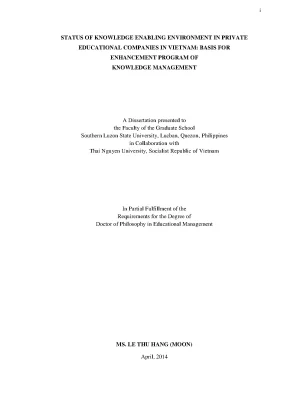
Tải xuống để đọc toàn bội STATUS OF KNOWLEDGE ENABLING ENVIRONMENT IN PRIVATE EDUCATIONAL COMPANIES IN VIETNAM: BASIS FOR ENHANCEMENT PROGRAM OF KNOWLEDGE MANAGEMENT A Dissertation presented to the Faculty of the Graduate School Southern Luzon State University, Lucban, Quezon, Philippines in Collaboration with Thai Nguyen University, Socialist Republic of Vietnam In Partial Fulfillment of the Requirements for the Degree of Doctor of Philosophy in Educational Management MS. LE THU HANG (MOON) April, 2014 ii APPROVAL SHEET In partial fulfillment of the requirements for the degree Doctor in Education Management, this research study entitled “Status of knowledge enabling environment in private educational companies in Vietnam: basis for enhancement program of knowledge management” has been submitted by Ms. LE THU HANG (MOON), and is hereby recommended for oral examination. GASCON Research Adviser Approved by the Oral Examination Committee, in partial fulfillment of the requirements for the degree Doctor in Education Management offered by Southern Luzon State University, Republic of the Philippines in collaboration with Thai Nguyen University, Socialist Republic of Vietnam.
DELA CRUZ Member Member DR. MUELLO Member Member DR. NORDELINA ILANO Member DR. GASCON Chairman iii Accepted in partial fulfillment of the requirements for the degree Doctor in Education Management offered by Southern Luzon State University, Republic of the Philippines in collaboration with Thai Nguyen University, Socialist Republic of Vietnam.
DELA CRUZ DR. MACARAAN Dean, Graduate School Vice President for Academic Affairs Date___________________. iv ACKNOWLEDGEMENT First of all, I am most grateful to my adviser, Prof. Gascon, for her valuable academic and moral support, which I shall never forget, during the doctoral program in education management of Southern Luzon State University of the Philippines.
I highly appreciate very helpful suggestions made by Prof. Dang Quoc Bao about the research at an early stage in its development. I wish to record my particular thanks to Dr. Dela Cruz, Dr.
Espinosa and Dr. Muello, Southern Luzon State University, for their constructive and useful advice to improve the dissertation. While collecting data for this research, I was lucky enough to receive support from a number of colleagues and friends of EduTrust and Vietnam Chamber of Commerce and Industry in Hanoi and Ho Chi Minh City. At the EduTrust, thanks are due to colleagues of the office of the Chairman.
Vietnam Chamber of Commerce and Industry, special thanks go to Le Thuy, Project Director. In addition, I am indebted to leaders and staff of Thai Nguyen University, of ITC for their enthusiastic supports during the program as well as to Dr. Judith Narrow and Dr. Bertil Olsson, Dalarna University, Sweden, for their moral support at the most difficult moments.
Also, I would like to express my gratitude to all interviewees and group discussants who took the time to share their lives and thinking with me and thus enriched my understanding of the problems to which this dissertation addresses itself. Last but not least, I dedicate this work to my family members, with thanks for all they have done for me over the years. Le Thu Hang (Moon) v TABLE OF CONTENTS TITLE PAGE. ii-iii ACKNOWLEDGMENT.
iv TABLE OF CONTENTS. v-vi LIST OF TABLES. vii LIST OF FIGURES. viii LIST OF APPENDICES.
INTRODUCTIOIN Background of the Study. 1 Statement of the Problem. 4 Significance of the Study. 4 Research scope, paradigm and limitations.
4 Definition of Terms. REVIEW OF LITERATURE AND CONCEPTUAL FRAMEWORK Review of Literature. RESEARCH METHODOLOGY Locale of the Study. 39 Population and Sampling.
41 Research Instrumentation and Data Gathering. ANALYSIS, PRESENTATION AND INTERPRETATION OF DATA Chapter 5. SUMMARY, CONCLUSIONS AND RECOMMENDATIONS Summary of findings. 143 vii LIST OF TABLE Table No.
Page Table 1 Summary of the aspects within human resources and its 23 management Table 2 Summary of the aspects within the communication activities of 29 the company Table 3 Summary of the aspects within the information technology 31 infrastructure Table 4 Summary of the aspects of the learning arenas 33-34 Table 5 Summary of the aspects of the use of knowledge 37 Table 6 Number of employees per company and contract arrangements 51 Table 7 Knowledge enabling constructs scales binary recoded through the 63 median split method by company Table 8 Bivariate Pearson correlation between construct scales and 66 effective measurements Table 9 Bivariate Pearson correlations of the knowledge creating 69 indicators Table 10 Knowledge creation indicators binary recoded through the median 70 split method by company and sector Table 11 Bivariate Pearson correlation between knowledge enabling 71 constructs and knowledge creation indicators Table 12 Pearson correlation among knowledge creation and effectiveness 73 indicators viii LIST OF FIGURES Figure No. Page Figure 1 Research paradigm 5 Figure 2 Knowledge management and lifelong learning 13 Figure 3 Knowledge management activities 20 Figure 4 Conceptual framework for knowledge management in SMEs 22 ix LIST OF APPENDICES Appendix Page Appendix A Communication letters 90 Appendix B Interview, questionnaire and document data 92 Appendix C Descriptive Statistics 108 Table 1 Number of employees per company and contract arrangements Table 2 Number of employees per company and type of professional role (professional, supports or leaders) Table 3 Number of employees per company and contract arrangements Table 4 Number of respondents by educational attainment as a percentage of all respondents Table 5 Number of tiers and work organization Table 6 Recruitment and selection aspects Table 6a Frequency of the methods for advertising available positions Table 6b Frequency of the method of selecting employees Table 6c Frequency of the different selection criteria Table 7 Aspects related with new recruitments Table 7a Policy for new employees Table 7b Having a mentor Table 7c Policy for newly employed Table 8 Aspects within employee turnover Table 9 Criteria to determine salaries Table 10 Companies salary level x Table 11 Bonus system Table 12 Aspects within the communication activities Table 12a Number of companies by frequency of the general information meetings by sector Table 12b Number of companies by scheduled meetings of professional workers and sectors Table 12c Companies with newsletter by sector Table 12d Number of companies by person in the gatekeeper position and sector Table 13 Number of hour formal and informal meetings (cells refers to percentage of respondents) Table 14 Respondent’s perceived usefulness of formal and informal meetings Table 15 Distribution of information (cells refer to percentage of respondents) Table 16 Information technology infrastructure Additional tables Table 1 Workforce stability indicators Table 2 Bivariate Pearson correlations of the binary recoded indicators of the stability construct in the selected companies (above 0.4) Table 3 Workforce experience indicators Table 4 Professionalism indicators Table 5 Bivariate Pearson correlation of the binary recoded indicators of the professionalism construct in the selected companies (above 0.3) Table 6 Recruitment policy indicators Table 7 Company monetary reward system indicators Table 8 Bivariate Pearson correlation of the binary recoded indicators of the monetary reward aspect construct in the selected companies (above 0.4) xi Table 9 Communication patterns indicators by company Table 10 Information technology infrastructure indicators by company Table 11 Bivariate Pearson correlation of the binary recoded indicators of the information technology investment binary indicators (above 0.40) Table 12 ANOVA of course length by sector (consultancy and education) Table 13 ANOVA of course training cost by sector (consultancy and education) Table 14 Number of training events and yearly estimated training time by purpose of training and company Table 14a (Cont’d): Number of training events and yearly estimated training time by purpose of training and company Table 15 Average scores and standard deviations of the informal learning items by company Table 15a (Cont’d): Average scores and standard deviations of the informal learning items by company Table 16 Total variance explained by the factor analysis of the knowledge creation indicators Table 17 Rotated component matrix from the factor analysis of the knowledge creation Table 18 Bivariate Pearson correlation between knowledge enabling construct and knowledge-creation indicators in each service Table 18a (Cont’d) Bivariate Pearson correlation between knowledge enabling construct and knowledge creation indicators in each service xii Title: STATUS OF KNOWLEDGE ENABLING ENVIRONMENT IN PRIVATE EDUCATIONAL COMPANIES IN VIETNAM: BASIS FOR ENHANCEMENT PROGRAM OF KNOWLEDGE MANAGEMENT Researcher: Ms. LE THU HANG, MA. Degree Doctor of Philosophy, Education Management Name/ Address of the Southern Luzon State University Institution Graduate School Lucban, Quezon Date Completed April 2014 Adviser Dr.
Gascon xiii ABSTRACT The dissertation is an exploration of the ways Vietnamese knowledge intensive companies manage their knowledge. By doing analysis in private educational Vietnamese companies providing educational and consultancy services, the study explores the relationship between the “knowledge enabling environment” and the demand for training. These companies have participated in the program for developing employee competence, financed by Asian Development Bank (ADB). As results of the program these companies have evaluated their business activities and determined their training needs in order to remain competitive.
In this study knowledge is understood not only the structure but also the content of mental schemas, which embodies in individuals and can be tacit or explicit. It really differs from information and data and it is through the dialectic process that people learn. Looking at organizational processes for managing knowledge, it is important to consider formal organized activities for learning as well as informal learning activities which constitute so called “knowledge enabling environment”. It is argued here that through the knowledge management, companies are indeed implementing strategies for the promotion of lifelong learning, which has recently been used in policy arenas as a guiding principle for educational policies and reforms.
As results of the study, the different aspects of the equally heterogenous “knowledge enabling environment” do not present strong relationships in both education and consultancy companies. Each company in those fields is rather unique in organization and promotion of knowledge intensiveness in their ordinary business activities. The companies mainly provide training with the company profile. It is interesting to find out that employees demand for training if their engagement in informal learning is low.
Background of the Study According to the World Bank the competitiveness index of human resources in Vietnam reached 3.39/10 point and competitiveness of Vietnam economy reached 73/133 among participated countries. Furthermore the recent social survey showed that the capital scale of enterprises is rather small. Nearly 50% of businesses have their capital less than 1 billion VND. While nearly 75% of enterprises with capital of less than 2 billion VND, 90% of enterprises have their capital of less than 5 billion VND.
Due to the small capital scale, enterprises of Vietnam seem to be less competitive. The innovation and technology of enterprises are critical. Concerning human resources in small and medium enterprises (SMEs), the number of PhDs accounted for only 0.66% while masters composed of 2.33%; labor graduated from universities and colleges as 41.38% while graduators of vocational schools as 12. It is noteworthy that a part of business owners who got their education from colleges and universities are not equipped with knowledge of economy, business administration and human resource management.
This has a great influence on the development of strategic planning, direction and management of business enterprises. Regarding technology, only about 8% of enterprises reached advanced level of technology. Most of them are FDI enterprises. Domestic enterprises are using less competitive technology.
In addition, the indicator on ICT use also showed that though businesses (more than 60%) use computers but only 11.55% use internal network – LAN and 2.16% with own websites. It is really critical for ability of enterprises to participate in electronic commerce and communication network as expected and desired by the government. It showed that technical issues, technology and innovation have not been highly considered by enterprises, which is one of determining factors of business success in the market. To serve the cause of industrialization and modernization of the country and to foster significant participation in globalization, important legal documents have been issued, especially the economic and social development strategy of 2011-2020 including the Resolution on Vietnam Workforce Development to the year 2020 adopted at the 11th Party Congress (April of 2011).
Nội dung được bảo vệ bản quyền — Tải xuống đầy đủ
Trích dẫn luận án này
Le Thu Hang (2014). Nghiên cứu thực trạng môi trường khuyến tri thức tại các côn [Luận án tiến sĩ, Southern Luzon State University]. LuanAn.net. https://luanan.net/giao-duc-hoc/thuc-trang-moi-truong-khuyen-tri-thuc-tai-cac-cong-ty-tu-nhan-thuoc-linh-vuc
Câu hỏi thường gặp
Luận án "Nghiên cứu thực trạng môi trường khuyến tri thức tại các côn" nghiên cứu về vấn đề gì?
Tài liệu: Nghiên cứu thực trạng môi trường khuyến tri thức tại các công ty tư nhân thuộc lĩnh vực giáo dục ở việt nam cơ sở để tăng cường và nâng cao quản trị t
Luận án "Nghiên cứu thực trạng môi trường khuyến tri thức tại các côn" được bảo vệ tại trường nào?
Luận án này được bảo vệ tại Southern Luzon State University. Năm bảo vệ: 2014.
Luận án "Nghiên cứu thực trạng môi trường khuyến tri thức tại các côn" thuộc chuyên ngành gì?
Luận án "Nghiên cứu thực trạng môi trường khuyến tri thức tại các côn" thuộc chuyên ngành Educational Management. Danh mục: Giáo Dục Học.
Luận án "Nghiên cứu thực trạng môi trường khuyến tri thức tại các côn" có bao nhiêu trang?
Luận án "Nghiên cứu thực trạng môi trường khuyến tri thức tại các côn" có 157 trang. Bạn có thể xem trước một phần tài liệu ngay trên trang web trước khi tải về.
Cách tải luận án "Nghiên cứu thực trạng môi trường khuyến tri thức tại các côn" về máy như thế nào?
Để tải luận án về máy, bạn nhấn nút "Tải xuống ngay" trên trang này, sau đó hoàn tất thanh toán phí lưu trữ. File sẽ được tải xuống ngay sau khi thanh toán thành công. Hỗ trợ qua Zalo: 0559 297 239.