Nghiên cứu Whey Protein và Cystic Fibrosis: Ảnh hưởng đến viêm nhiễm tại các tế bào biểu mô đường hô hấp
Luận văn phân tích Whey Protein trong Cystic Fibrosis. Nghiên cứu tác dụng dinh dưỡng, lâm sàng cải thiện chức năng hô hấp bệnh nhân.
McGill University
Dietetics and Human Nutrition
Luan An
Luận án tiến sĩ
Năm xuất bản
Số trang
218
Thời gian đọc
33 phút
Lượt xem
0
Lượt tải
0
Phí lưu trữ
50 Point
Tổng quan nhanh
- Chủ đề:
- Whey Protein và Bệnh Xơ Nang: Tổng quan
- Số trang:
- 218 trang
- Trường:
- McGill University
- Chuyên ngành:
- Dietetics and Human Nutrition
- Tác giả:
- Michèle Michel Iskandar
- Năm:
- 2011
Tóm tắt nội dung luận án
I.Whey Protein và Bệnh Xơ Nang Tổng quan
Bệnh xơ nang (CF) là một bệnh di truyền nguy hiểm, đặc trưng bởi tình trạng viêm mãn tính kéo dài và nghiêm trọng. Đường thở của bệnh nhân CF thường xuyên bị tấn công bởi các tế bào bạch cầu trung tính và interleukin (IL)-8, chất hóa hướng động bạch cầu chính. Việc tìm kiếm các liệu pháp kháng viêm mới, an toàn và hiệu quả là trọng tâm điều trị CF. Các nghiên cứu đã chỉ ra whey protein sở hữu nhiều hoạt tính sinh học, bao gồm khả năng chống oxy hóa và kháng viêm. Nghiên cứu này khám phá tác động của whey protein đối với quá trình viêm ở tế bào biểu mô đường hô hấp, đặc biệt là ở những tế bào biểu hiện bộ điều hòa dẫn truyền qua màng xơ nang (CFTR) bị đột biến hoặc loại tự nhiên. Mục tiêu là đánh giá hiệu quả của whey protein, đặc biệt là whey protein isolate (WPI) đã qua xử lý áp suất, trong việc giảm thiểu viêm và cải thiện tình trạng bệnh.
1.1. Xơ nang và viêm mãn tính đường thở
Bệnh xơ nang là một tình trạng di truyền đe dọa tính mạng. Đặc điểm chính là viêm mãn tính, dai dẳng và trầm trọng. Đường thở của bệnh nhân xơ nang cho thấy sự xâm nhập liên tục của bạch cầu trung tính và interleukin (IL)-8. IL-8 là chất hóa hướng động bạch cầu chính. Viêm mãn tính góp phần vào tổn thương phổi tiến triển. Cần có các liệu pháp kháng viêm mới, an toàn và hiệu quả cho bệnh xơ nang.
1.2. Whey protein Giải pháp tiềm năng
Whey protein được biết đến với nhiều hoạt tính sinh học. Các tác dụng bao gồm chống oxy hóa và kháng viêm. Nghiên cứu trước đây gợi ý whey protein hydrolysate (WPH) có thể ức chế phản ứng viêm. Phản ứng viêm này gây ra bởi yếu tố hoại tử khối u (TNF)α trong dòng tế bào biểu mô hô hấp. Việc xử lý whey protein bằng áp suất cao (HP) có thể tăng cường hoạt tính sinh học của chúng.
II.Tiềm năng Chống Oxy hóa của Whey Protein
Stress oxy hóa đóng vai trò quan trọng trong bệnh sinh của xơ nang, góp phần vào tình trạng viêm mãn tính và tổn thương mô. Whey protein, đặc biệt là whey protein isolate (WPI), được công nhận rộng rãi về khả năng chống oxy hóa mạnh mẽ. Các protein này chứa một lượng lớn các axit amin thiết yếu, bao gồm cysteine, một tiền chất quan trọng để tổng hợp glutathione (GSH). GSH là chất chống oxy hóa nội sinh hàng đầu của cơ thể. Bằng cách cung cấp cysteine sinh khả dụng, WPI có thể giúp tăng cường nồng độ GSH, từ đó chống lại các gốc tự do và giảm stress oxy hóa trong đường thở của bệnh nhân xơ nang. Nghiên cứu đã chỉ ra rằng việc xử lý áp suất cao có thể cải thiện hoạt tính chống oxy hóa của WPI, làm tăng hiệu quả bảo vệ tế bào khỏi tổn thương oxy hóa. Điều này làm nổi bật WPI như một chiến lược dinh dưỡng tiềm năng để hỗ trợ khả năng chống oxy hóa của cơ thể.
2.1. Whey protein và stress oxy hóa
Stress oxy hóa là một yếu tố quan trọng trong xơ nang. Nó góp phần vào viêm mãn tính và tổn thương mô. Whey protein có khả năng chống oxy hóa mạnh mẽ. Các nghiên cứu đã kiểm tra tác động của xử lý áp suất cao đối với hoạt tính chống oxy hóa của whey protein isolate (WPI). Kết quả cho thấy xử lý áp suất cao tăng cường hoạt động chống oxy hóa của WPI. Điều này bao gồm khả năng khử sắt (ferric-reducing antioxidant activity) trong dịch nuôi cấy tế bào.
2.2. Vai trò của Glutathione và Cysteine
Whey protein giàu cysteine, một tiền chất quan trọng cho tổng hợp glutathione (GSH). GSH là chất chống oxy hóa nội sinh chính của cơ thể. Bệnh nhân xơ nang thường có mức GSH thấp. Bổ sung whey protein có thể tăng cường nguồn cung cấp cysteine. Từ đó hỗ trợ sản xuất GSH. Điều này giúp chống lại stress oxy hóa và giảm viêm. Cải thiện hoạt tính chống oxy hóa là một lợi ích đáng kể của whey protein.
III.Whey Protein giảm Viêm cải thiện Miễn dịch
Whey protein không chỉ là nguồn dinh dưỡng mà còn thể hiện vai trò quan trọng trong việc điều hòa miễn dịch và giảm viêm. Trong bối cảnh xơ nang, tình trạng viêm mãn tính là nguyên nhân chính gây tổn thương phổi. Nghiên cứu này đã kiểm tra khả năng của whey protein hydrolysate (WPH) trong việc ức chế sản xuất các yếu tố gây viêm. Các tế bào biểu mô đường hô hấp được xử lý với WPH (nguyên bản hoặc đã qua áp suất) và sau đó được kích thích với các tác nhân gây viêm. Cả WPH nguyên bản (nWPH) và WPH đã qua áp suất (pWPH) đều cho thấy khả năng ức chế tiết IL-8 gây ra bởi lipopolysaccharide (LPS), một chất kích thích viêm mạnh. Điều này rất quan trọng vì IL-8 là yếu tố hóa hướng động chính thu hút bạch cầu trung tính đến đường thở, làm trầm trọng thêm tình trạng viêm. pWPH tỏ ra hiệu quả hơn, cần liều lượng thấp hơn để đạt được sự ức chế đáng kể. Cơ chế hoạt động liên quan đến việc giảm liên kết của LPS với các thụ thể bề mặt tế bào, từ đó ngăn chặn kích hoạt con đường viêm.
3.1. Ức chế phản ứng viêm bởi whey protein
Cả hydrolysate whey protein nguyên bản (nWPH) và đã qua áp suất (pWPH) đều ức chế tiết IL-8 do LPS gây ra. pWPH mạnh hơn nWPH, cần liều thấp hơn để ức chế đáng kể. Tuy nhiên, cả hai loại hydrolysate không ức chế tiết IL-8 do TNFα hoặc IL-1β gây ra. Điều này cho thấy tính đặc hiệu của hiệu ứng chống viêm. Việc giảm viêm là mục tiêu chính trong điều trị bệnh xơ nang.
3.2. Cơ chế giảm viêm đường thở
Cơ chế ức chế IL-8 của WPHs không liên quan đến việc thay đổi biểu hiện TLR4 trên màng tế bào. Cũng không có sự gắn trực tiếp và trung hòa LPS. Thay vào đó, cả nWPH và pWPH giảm đáng kể sự gắn kết của LPS với các thụ thể bề mặt tế bào. Điều này dẫn đến ức chế kích hoạt TLR4. Từ đó, ngăn chặn các tín hiệu viêm. Đây là một phát hiện quan trọng về cách whey protein giảm viêm.
IV.Tối ưu hóa Hoạt tính Whey Protein bằng Áp suất
Việc xử lý whey protein bằng áp suất cao (hyperbaric pressure - HP) đã được chứng minh là có khả năng tăng cường đáng kể các hoạt tính sinh học của chúng. Nghiên cứu đã khám phá tác động của phương pháp này đối với khả năng tiêu hóa, hoạt tính chống oxy hóa và kháng viêm của whey protein isolate (WPI). Hydrolysate từ WPI đã qua xử lý áp suất (pWPH) và WPI nguyên bản (nWPH) được tạo ra thông qua các giao thức tiêu hóa in vitro mô phỏng quá trình tiêu hóa của con người. Kết quả cho thấy việc xử lý áp suất trước đó giúp tăng cường khả năng tiêu hóa in vitro của WPI. Điều này đúng bất kể sự khác biệt lớn về điều kiện enzym và cấu hình peptide tạo thành. Điều này ngụ ý rằng quá trình xử lý áp suất tạo ra sự giải phóng tăng cường các peptide hoạt tính sinh học, không phụ thuộc vào môi trường phân giải protein. Việc tối ưu hóa này mở ra triển vọng lớn cho việc sử dụng whey protein hiệu quả hơn trong điều trị hỗ trợ bệnh xơ nang.
4.1. Cải thiện tiêu hóa và hoạt tính sinh học
Xử lý áp suất cao (HP) giúp tăng cường khả năng tiêu hóa in vitro của whey protein isolate (WPI). Quá trình này tạo ra sự giải phóng các peptide hoạt tính sinh học. Hoạt tính chống oxy hóa cũng được cải thiện đáng kể. pWPH cũng cho thấy khả năng ức chế IL-8 mạnh hơn nWPH. Điều này cho thấy sự gia tăng hiệu quả sinh học.
4.2. Khác biệt cấu trúc peptide
Cấu hình peptide thu được từ hydrolysate pWPH có sự khác biệt về định lượng và định tính so với nWPH. Sự thay đổi này có thể là nguyên nhân cho hoạt tính sinh học nâng cao. Áp suất cao làm thay đổi cấu trúc protein. Điều này làm cho chúng dễ bị enzyme phân cắt hơn. Kết quả là tạo ra nhiều peptide có hoạt tính hơn.
V.Nghiên cứu Lâm sàng Whey Protein cho Bệnh Xơ Nang
Để kiểm tra các tác dụng lâm sàng tiềm năng của whey protein isolate (WPI) đã qua xử lý áp suất (pWPI) trong điều kiện in vivo, một nghiên cứu thí điểm nhãn mở kéo dài một tháng đã được tiến hành. Nghiên cứu này bao gồm trẻ em và người lớn mắc bệnh xơ nang (CF) được bổ sung pWPI. Mục tiêu chính là đánh giá tác động của pWPI đối với tình trạng dinh dưỡng của bệnh nhân. Suy dinh dưỡng là một vấn đề phổ biến và nghiêm trọng ở bệnh nhân CF, góp phần làm suy giảm chức năng phổi và chất lượng cuộc sống. Việc tìm kiếm các biện pháp can thiệp dinh dưỡng hiệu quả để cải thiện tăng cân và duy trì khối lượng cơ bắp là rất quan trọng. Kết quả sơ bộ từ nghiên cứu này đã chỉ ra sự cải thiện về tình trạng dinh dưỡng, cho thấy tiềm năng của pWPI như một liệu pháp bổ trợ để hỗ trợ sức khỏe tổng thể của bệnh nhân CF. Mặc dù đây chỉ là một nghiên cứu pilot, nhưng các phát hiện này mở ra hướng đi cho các nghiên cứu lâm sàng quy mô lớn hơn để xác nhận những lợi ích này và khám phá tác động đến chức năng phổi (FEV1).
5.1. Thử nghiệm lâm sàng pilot
Một nghiên cứu thí điểm nhãn mở kéo dài một tháng được thực hiện. Nghiên cứu tập trung vào việc bổ sung whey protein isolate đã qua áp suất (pWPI). Đối tượng là trẻ em và người lớn mắc bệnh xơ nang. Mục tiêu là đánh giá tác dụng in vivo của pWPI. Kết quả ban đầu đã cho thấy tiềm năng.
5.2. Cải thiện tình trạng dinh dưỡng
Bổ sung pWPI cải thiện tình trạng dinh dưỡng. Suy dinh dưỡng là vấn đề phổ biến ở bệnh nhân xơ nang. Cải thiện dinh dưỡng góp phần tăng cân. Điều này có thể gián tiếp hỗ trợ chức năng phổi (FEV1). Mặc dù là nghiên cứu pilot, kết quả gợi ý pWPI là một liệu pháp bổ sung tiềm năng. Cần thêm nghiên cứu để xác nhận những lợi ích này.
Mục lục chi tiết luận án
Tải xuống file đầy đủ để xem toàn bộ nội dung
Tải đầy đủ (218 trang)Trích đoạn nội dung luận án
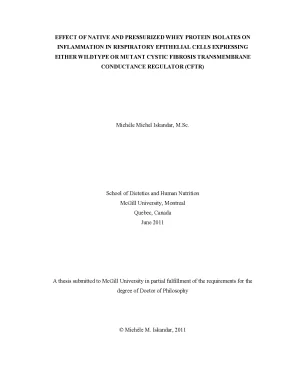
Tải xuống để đọc toàn bộEFFECT OF NATIVE AND PRESSURIZED WHEY PROTEIN ISOLATES ON INFLAMMATION IN RESPIRATORY EPITHELIAL CELLS EXPRESSING EITHER WILDTYPE OR MUTANT CYSTIC FIBROSIS TRANSMEMBRANE CONDUCTANCE REGULATOR (CFTR) Michèle Michel Iskandar, M. School of Dietetics and Human Nutrition McGill University, Montreal Quebec, Canada June 2011 A thesis submitted to McGill University in partial fulfillment of the requirements for the degree of Doctor of Philosophy © Michèle M. Iskandar, 2011 This thesis is dedicated to my grandparents, Juliette, Romaine, Edmond, and particularly Georges, whose foresight made this possible. ii "Science is a wonderful thing if one does not have to earn one’s living at it.” Albert Einstein iii TABLE OF CONTENTS TITLE PAGE.
i TABLE OF CONTENTS. x ADVANCE OF SCHOLARLY KNOWLEDGE. xii CONTRIBUTIONS OF CO-AUTHORS TO MANUSCRIPTS. xv LIST OF TABLES.
xvii LIST OF FIGURES. xviii LIST OF ABBREVIATIONS.1 Rationale and Statement of Purpose.1 Cystic Fibrosis: Epidemiology and Pathophysiology.2 Cystic Fibrosis: Inflammation and Anti-inflammatory Therapy.3 Pathways to IL-8 Secretion.4 Oxidative Stress in CF.5 Therapies for CF.2 Whey Proteins: an Overview.1 Antioxidant Potential of Whey Proteins and Peptides.2 Immunomodulatory and Anti-Inflammatory Potential of Whey Proteins and Peptides.3 Protein Modification by Hyperbaric Pressure Treatment.4 Effect of High Pressure on Whey Proteins. “Effect of Hyperbaric Pressure on the Digestibility and Antioxidant Potential of Whey Protein Isolates”.2 Materials and Methods. “Inhibition of Interleukin-8 Release by Pressurized Whey Protein Hydrolysate in Respiratory Epithelial Cells: Mechanism of Action”.2 Materials and Methods.
“Dietary Supplementation with Pressurized Whey in Patients with Cystic Fibrosis”.2 Subjects and Methods. FINAL CONCLUSION AND SUMMARY. 177 v ABSTRACT Cystic fibrosis (CF) is a fatal inherited disease characterized by chronic, persistent and exaggerated inflammation. The airways of CF patients exhibit a sustained influx of neutrophils and interleukin (IL)-8, the major neutrophil chemoattractant.
Anti- inflammatory therapy is a focus of CF treatment, with a clear need for novel, safe and effective therapies. Whey proteins have been attributed a number of biological activities, including antioxidant and anti-inflammatory effects. Previous research has suggested a suppression of the inflammatory response to tumor necrosis factor (TNF)α by whey protein hydrolysates (WPH) in respiratory epithelial cell lines. Furthermore, it is suggested that hyperbaric pressure (HP) treatment of whey proteins can potentiate their biological activities.
The effect of HP treatment on the digestibility, anti-inflammatory and antioxidant activity of whey protein isolates (WPI) was explored in a series of mechanistic in vitro studies and in a clinical trial. Hydrolysates of pressurized (pWPH) and native (nWPH) whey protein isolates were generated using two differing in vitro digestion protocols that mimic human gastrointestinal digestion. Hyperbaric pressure pre- treatment resulted in enhanced in vitro digestibility and antioxidant activity of WPI regardless of major differences in enzymatic conditions and the resulting peptide profiles, signifying that pressure processing generates an enhanced release of bioactive peptides regardless of the proteolytic environment. The peptide profiles obtained from the hydrolysates of pWPH exhibited quantitative and qualitative differences from those of nWPH.
To explore the possible mechanisms by which WPH may exert their anti- inflammatory effects, wild-type and cystic fibrosis (CF) conductance regulator-deficient cells were treated with either nWPH or pWPH and stimulated with TNFα, interleukin (IL)-1β or lipopolysaccharide (LPS). Both nWPH and pWPH suppressed LPS-induced IL-8 secretion, although pWPH were more potent requiring lower doses to exert significant inhibition. pWPH increased the ferric-reducing antioxidant activity of cell culture supernatant in both cell lines. Neither type of hydrolysate suppressed TNFα- or IL-1β-induced IL-8 secretion.
Since LPS and IL-1β, beyond the activation of their respective receptors, share a common intracellular pathway, further experiments were conducted on signalling events that occur prior to the convergence of the two pathways, vi at the level of Toll-like receptor (TLR)4. There was no effect of either nWPH or pWPH on the cell membrane expression of TLR4. Neither type of WPH exhibited direct binding and neutralization of LPS, but both significantly reduced the binding of LPS to cell surface receptors. It is therefore likely that the WPHs exerted the observed LPS-induced IL-8 suppression by suppressing the binding of LPS to its receptor with the consequent inhibited activation of TLR4.
To explore the possible in vivo clinical effects of pressurized WPI, a one-month, open-label pilot study of supplementation with pressurized WPI in children and adults with CF was conducted. Nutritional status was enhanced in both children and adults. An improvement in lung function was observed in children, and C-reactive protein decreased in the majority of patients with initially high values. Overall, the thesis results provide a novel mechanism by which whey proteins and pressurized whey can exert anti-inflammatory effects and suggest new potential avenues for the use of pressurized whey protein isolate as a nutrition-based anti-inflammatory therapeutic or preventative agent.
vii RESUME La fibrose kystique (FK) est une maladie héréditaire fatale caractérisée par une inflammation chronique et exagérée. Les voies respiratoires des patients atteints de FK présentent un afflux soutenu de neutrophiles et d’interleukine (IL)-8, l’agent chimiotactique majeur des neutrophiles. La thérapie anti-inflammatoire est un focus du traitement de la FK et il existe un besoin évident de nouvelles thérapies sûres et efficaces. Des effets biologiques, incluant des effets antioxydants et anti-inflammatoires ont été attribués aux protéines de lactosérum.
Des recherches antérieures ont suggéré une suppression de la réponse inflammatoire induite par le facteur de nécrose tumorale (TNF)α par des hydrolysats de protéines de lactosérum (WPH). De plus, il a été suggéré que le traitement par pression hyperbare (PH) des isolats de protéines de lactosérum (WPI) peut potentialiser leurs activités biologiques. Les effets d’un traitement PH sur la digestibilité et les activités anti-inflammatoires et antioxydants des WPI ont été explorés dans une série d’études mécanistes in vitro et dans un essai clinique. Des hydrolysats de protéines de lactosérum pressurisées (pWPH) et non pressurisées (nWPH) ont été générés par le moyen de deux différents protocoles de digestion in vitro imitant le processus de digestion gastro-intestinal humain.
Le prétraitement HP a entrainé une augmentation de la digestibilité in vitro et de l’activité antioxydante des WPI, malgré les différences entre les deux protocoles de digestion et entre les profiles de peptides résultant des digestions, signifiant que la pression génère une augmentation des peptides bioactifs générés quel que soit l’environnement protéolytique. Les profiles des peptides des pWPH ont exhibé des différences qualitatives et quantitatives comparés aux nWPH. Pour explorer les mécanismes possibles par lesquels WPH pourraient exercer leurs effets anti- inflammatoires, des lignées cellulaires normales et déficientes du Régulateur de la Conductance Transmembranaire Mucoviscidose (CFTR) ont été traitées avec nWPH ou pWPH et stimulées avec TNFα, IL-1β, ou lipopolysaccharide (LPS). Les nWPH et pWPH ont diminué la sécrétion d’IL-8 induite par LPS, bien que les pWPH aient été plus puissants, requérant de moindres doses pour exercer une inhibition significative.
pWPH a augmenté l’activité antioxydante des surnageants des cultures des deux lignées cellulaires. Aucun type de WPH n’a inhibé la sécrétion d’IL-8 induite par TNFα ou IL- viii 1β. Puisque LPS et IL-1β partagent une voie commune de signalisation suivant l’activation de leurs récepteurs respectifs, des expériences ont été menées sur des événements prenant place en amont de la convergence des deux voies de signalisation, au niveau du récepteur Toll-like receptor (TLR)4. Les nWPH ni les pWPH n’ont eu d’effet sur l’expression du TLR4, mais la liaison entre LPS et les récepteurs de surface a été réduite par les deux traitements.
Aucun WPH n’a exhibé de liaison directe ou de neutralisation du LPS. Il est donc probable que les WPHs aient exercé la suppression d’IL-8 induite par LPS en inhibant la liaison du LPS avec son récepteur et par conséquent l’activation du TLR4. Pour explorer les effets cliniques in vivo des WPI pressurisés, un essai clinique pilote d’une durée d’un mois a été mené, où des enfants et adultes souffrant de FK ont été supplémentés avec des protéines pressurisées. Le statut nutritionnel des enfants et adultes a été amélioré.
Une amélioration des fonctions pulmonaires chez les enfants a été observée et le taux sanguin de protéine C réactive a diminué chez la majorité des patients chez qui les taux étaient élevés au début de l’étude. Globalement, les résultats de cette dissertation fournissent un nouveau mécanisme par lequel les WPI pressurisés peuvent exercer des effets anti-inflammatoires et suggèrent de nouvelles avenues potentielles pour l’usage des WPI pressurisés en tant qu’agent nutritionnel thérapeutique ou préventif. ix ACKNOWLEDGMENTS This work would not have been possible if it were not for many people who have supported me in many ways. My supervisors, Dr.
Larry Lands and Dr. Stan Kubow, have taught me that many things are possible in the pursuit of scientific knowledge with creativity, dedication, perseverance and positive thinking. I thank them both for their patience, their dedication to the work, and for sharing their extensive scientific experience with me. I would like to thank my committee member Dr.
Cameron Skinner, who welcomed me in his lab and generously took time to teach me and discuss the concepts of my thesis with me. I cannot underplay the help and encouragement I have received from Dr. He taught me everything I know about cell culture and was a constant presence throughout my work. He provided for lively scientific debates, took extra time to perform measurements in a timely fashion, and must have answered over a million of my questions over the years.
Thanks to Brian Meehan, who taught me basic skills when I knew so little, and gave me a curiosity to always look for more answers. I am very greatful to Lise Grant, who has always gone above and beyond to orient me within the system when I needed it, and always with a smile. Many thanks to Francine Tardif and Elizabeth Ansell for their professional support. Thanks to all the members of Dr.
Lands’ lab: Nadir Mawji, who reinforced my enjoyment of teaching and who was always eager to learn, and to help by any means he could. Kassey Herscovitch and Maria Camisano for their good nature, encouragement, and for sharing the burden of some experiments. Both Kassey and Maria provided much needed levity throughout stressful times. I thank the members of Dr.
Kubow’s lab: Andre Piccolomini who was always ready to help and his admirable positive attitude especially x under pressure, Kebba Sabally, Atef Nassar and Behnam Azadi for his good nature and for making himself available whenever he could. My friends who have always been positive and understanding: Maritza Laprize for her continued encouragement, Rima Itani, Lynn Khatib and Rima Awar who were present although miles away. Last, but not least I owe a debt of gratitude to my family; my father Michel and my mother Josee, my brother Eddy, for their great, unfailing and unconditional support and encouragement. Although they are hundreds of miles away, they are and have been an important source of comfort throughout every step of this process and of my life.
Without their love and support during difficult times, this work would not have been possible. I am greatful to my partner Alain, for becoming my family, my friend, and a tremendous, constant and loving presence by my side. xi ADVANCE OF SCHOLARLY KNOWLEDGE 1. Claims of Original Research In this thesis, it is demonstrated for the first time that: 1.
Hydrolysates from the in vitro digestion of whey protein isolates act upon wild- type and cystic fibrosis (CF) respiratory epithelial cells to decrease lipopolysaccharide (LPS)-induced interleukin (IL)-8 secretion. The mechanism by which whey protein hydrolysates interfere with LPS-induced IL-8 is through decreasing the binding of LPS to cell surface receptors. Treatment of whey protein isolates with hyperbaric pressure prior to in vitro digestion enhances the LPS-mediated interleukin-8 suppressing effects of the resulting hydrolysates. Treatment of whey protein isolates with hyperbaric pressure prior to in vitro digestion enhances the in vitro antioxidant capacity of the resulting hydrolysates in both aqueous cell-free and cell culture systems.
Short-term supplementation with pressurized whey protein improves BMI in adults, BMI z-score and lung function in children, and decreases serum C-reactive protein levels in patients with initially high values. This thesis presents improvements over previous research: 6.
Nội dung được bảo vệ bản quyền — Tải xuống đầy đủ
Trích dẫn luận án này
Michèle Michel Iskandar (2011). Nghiên cứu Whey Protein và Cystic Fibrosis [Luận án tiến sĩ, McGill University]. LuanAn.net. https://luanan.net/y-te-cong-cong/dinh-duong-cong-dong/nghien-cuu-whey-protein-va-cystic-fibrosis
Câu hỏi thường gặp
Luận án "Nghiên cứu Whey Protein và Cystic Fibrosis" nghiên cứu về vấn đề gì?
Luận văn phân tích Whey Protein trong Cystic Fibrosis. Nghiên cứu tác dụng dinh dưỡng, lâm sàng cải thiện chức năng hô hấp bệnh nhân.
Luận án "Nghiên cứu Whey Protein và Cystic Fibrosis" được bảo vệ tại trường nào?
Luận án này được bảo vệ tại McGill University. Năm bảo vệ: 2011.
Luận án "Nghiên cứu Whey Protein và Cystic Fibrosis" thuộc chuyên ngành gì?
Luận án "Nghiên cứu Whey Protein và Cystic Fibrosis" thuộc chuyên ngành Dietetics and Human Nutrition. Danh mục: Dinh Dưỡng Cộng Đồng.
Luận án "Nghiên cứu Whey Protein và Cystic Fibrosis" có bao nhiêu trang?
Luận án "Nghiên cứu Whey Protein và Cystic Fibrosis" có 218 trang. Bạn có thể xem trước một phần tài liệu ngay trên trang web trước khi tải về.
Cách tải luận án "Nghiên cứu Whey Protein và Cystic Fibrosis" về máy như thế nào?
Để tải luận án về máy, bạn nhấn nút "Tải xuống ngay" trên trang này, sau đó hoàn tất thanh toán phí lưu trữ. File sẽ được tải xuống ngay sau khi thanh toán thành công. Hỗ trợ qua Zalo: 0559 297 239.