Mối quan hệ giữa tích hợp xã hội trong cộng đồng học tập và giữ chân sinh viên năm nhất thiểu số
Tích hợp xã hội và chương trình giữ chân sinh viên năm nhất thiểu số giúp tăng cường sự gắn kết và hỗ trợ tài chính cho sinh viên có hoàn cảnh khó khăn.
Concordia University - Portland
Educational Leadership with a Specialization in Higher Education
Luan An
Luận án tiến sĩ
Năm xuất bản
Số trang
187
Thời gian đọc
29 phút
Lượt xem
0
Lượt tải
0
Phí lưu trữ
50 Point
Tổng quan nhanh
- Chủ đề:
- Tích hợp Xã hội & Duy trì Sinh viên Thiểu số Năm Nhất
- Số trang:
- 187 trang
- Trường:
- Concordia University - Portland
- Chuyên ngành:
- Educational Leadership with a Specialization in Higher Education
- Tác giả:
- Christopher Anthony Phekni
- Năm:
- 2018
Tóm tắt nội dung luận án
I.Tích hợp Xã hội Duy trì Sinh viên Thiểu số Năm Nhất
Tài liệu này khám phá mối quan hệ phức tạp giữa sự hòa nhập xã hội và tỷ lệ giữ chân sinh viên. Trọng tâm đặc biệt được đặt vào sinh viên năm nhất thuộc các nhóm thiểu số. Nghiên cứu đánh giá sự tham gia của sinh viên vào các cộng đồng học tập. Nó phân tích tác động của sự tham gia này đến việc duy trì từ học kỳ đầu tiên sang học kỳ thứ hai của năm học đầu tiên. Việc hiểu sâu sắc các yếu tố này rất quan trọng. Nó giúp cải thiện trải nghiệm học tập và hỗ trợ chuyển tiếp đại học cho sinh viên thiểu số. Tỷ lệ duy trì sinh viên là một thước đo then chốt. Nó phản ánh hiệu quả của các chiến lược hỗ trợ sinh viên.
1.1. Mối quan hệ Hòa nhập Xã hội Giữ chân Sinh viên.
Nghiên cứu này xem xét mối liên hệ giữa hòa nhập xã hội và tỷ lệ duy trì sinh viên. Trọng tâm là sinh viên năm nhất thiểu số. Sự tham gia vào các cộng đồng học tập được đánh giá. Mức độ duy trì từ học kỳ đầu tiên đến học kỳ thứ hai của năm nhất được khảo sát. Việc hiểu các yếu tố này rất quan trọng. Nó giúp cải thiện kinh nghiệm đại học cho sinh viên thiểu số. Tỷ lệ duy trì sinh viên là một chỉ số chính. Nó phản ánh sự thành công của các cơ sở giáo dục.
1.2. Tầm quan trọng Cảm giác Thuộc về Sinh viên.
Cảm giác thuộc về sinh viên là nền tảng cho sự thành công học tập. Sinh viên thiểu số thường đối mặt với những thách thức riêng. Việc tạo ra một môi trường hòa nhập văn hóa sinh viên là thiết yếu. Cộng đồng học tập có thể cung cấp hỗ trợ xã hội cho sinh viên. Sự hỗ trợ này giúp giảm cảm giác bị cô lập. Nó thúc đẩy sự gắn kết và thành công học tập sinh viên năm nhất. Sinh viên cảm thấy được chấp nhận sẽ có nhiều khả năng tiếp tục học tập. Điều này đóng góp vào tỷ lệ duy trì sinh viên tổng thể.
II.Phương pháp Nghiên cứu Duy trì Sinh viên Đại học
Nghiên cứu này sử dụng thiết kế định lượng tương quan. Mục đích là khám phá các mối quan hệ giữa các biến số. Nó không tìm kiếm mối quan hệ nhân quả trực tiếp. Dữ liệu được thu thập thông qua một cuộc khảo sát trực tuyến. Đối tượng là sinh viên năm nhất trong các cộng đồng học tập trên toàn nước Mỹ. Các yếu tố nhân khẩu học và học thuật cũng được xem xét. Việc phân tích dữ liệu được thực hiện bằng phần mềm thống kê chuyên dụng. Phương pháp này cung cấp một cái nhìn tổng thể về các xu hướng. Nó giúp đánh giá các yếu tố ảnh hưởng đến tỷ lệ duy trì sinh viên.
2.1. Thiết kế Nghiên cứu Định lượng Tương quan.
Nghiên cứu áp dụng thiết kế định lượng tương quan. Mục đích là xác định mối quan hệ. Nó không thiết lập quan hệ nhân quả. Phương pháp này phù hợp để khám phá các kết nối. Dữ liệu được thu thập từ một mẫu lớn sinh viên. Phân tích thống kê được sử dụng. Điều này giúp đánh giá mức độ liên kết giữa các biến. Thiết kế này cung cấp cái nhìn sâu sắc về các xu hướng.
2.2. Khảo sát Sinh viên Năm nhất Toàn quốc.
Một cuộc khảo sát trực tuyến đã được thực hiện. Nền tảng Qualtrics được sử dụng. Đối tượng mục tiêu là sinh viên năm nhất trên 18 tuổi. Sinh viên này tham gia các cộng đồng học tập trên khắp Hoa Kỳ. Dữ liệu được thu thập thông qua mạng xã hội. Điều này đảm bảo phạm vi tiếp cận rộng. Nó giúp thu thập đa dạng quan điểm. Thông tin chi tiết về trải nghiệm xã hội được thu thập. Các yếu tố như giới tính, tuổi tác, GPA cũng được xem xét.
III.Kết quả Nghiên cứu Tích hợp Cộng đồng Học tập
Các phát hiện từ nghiên cứu này cho thấy những kết quả đa dạng. Đối với hầu hết các nhóm sinh viên, không có mối tương quan trực tiếp giữa hòa nhập xã hội trong cộng đồng học tập và tỷ lệ duy trì. Tuy nhiên, một ngoại lệ đáng chú ý đã được ghi nhận. Sinh viên người Mỹ gốc Phi thể hiện mô hình duy trì ổn định. Điều này gợi ý rằng các yếu tố duy trì có thể khác nhau giữa các nhóm dân tộc. Các kết quả này thúc đẩy việc xem xét lại các chiến lược hiện có. Nó cần một cách tiếp cận đa dạng, công bằng và hòa nhập (DEI) hơn trong hỗ trợ sinh viên.
3.1. Không liên quan Tích hợp với Duy trì Chung.
Phân tích dữ liệu cho thấy điều bất ngờ. Không có mối tương quan giữa hòa nhập xã hội và duy trì. Kết quả này áp dụng cho nhóm sinh viên gốc Tây Ban Nha. Nó cũng đúng cho các nhóm thiểu số khác và người da trắng. Điều này thách thức một số giả định phổ biến. Các yếu tố khác có thể đóng vai trò lớn hơn. Cần nghiên cứu sâu hơn để hiểu rõ.
3.2. Duy trì ổn định Nhóm Sinh viên Người Mỹ Gốc Phi.
Một phát hiện quan trọng được ghi nhận. Nhóm sinh viên người Mỹ gốc Phi cho thấy sự duy trì ổn định. Điều này diễn ra giữa học kỳ đầu và học kỳ thứ hai. Sự ổn định này khác biệt so với các nhóm khác. Nó gợi ý các yếu tố duy trì độc đáo. Có thể có các cơ chế hỗ trợ riêng. Hoặc các yếu tố văn hóa cụ thể đang hoạt động. Điều này cần được khám phá thêm. Nó có thể cung cấp thông tin cho các chương trình hỗ trợ sinh viên thiểu số.
IV.Tác động Yếu tố Dân số đến Tỷ lệ Duy trì Sinh viên
Nghiên cứu cũng xem xét các yếu tố dân số và học thuật. Kết quả chỉ ra rằng giới tính, tuổi tác không có tác động đáng kể. Các điểm GPA (cấp ba và cuối học kỳ đầu) cũng không liên quan trực tiếp đến tỷ lệ duy trì. Những phát hiện này rất quan trọng. Chúng định hướng lại trọng tâm khỏi các biến số truyền thống. Điều này nhấn mạnh sự cần thiết của việc khám phá các yếu tố phi học thuật khác. Việc hỗ trợ sinh viên năm nhất và chuyển tiếp đại học cần một cách tiếp cận toàn diện hơn. Nó không chỉ tập trung vào thành tích học tập.
4.1. Giới tính Tuổi tác không ảnh hưởng Giữ chân.
Nghiên cứu cũng xem xét các biến số nhân khẩu học. Giới tính của sinh viên không ảnh hưởng đến tỷ lệ duy trì. Tuổi tác của sinh viên cũng không có tác động đáng kể. Những yếu tố này thường được cho là quan trọng. Tuy nhiên, trong nghiên cứu này, chúng không cho thấy mối liên hệ. Điều này tập trung sự chú ý vào các yếu tố khác. Các chương trình hỗ trợ sinh viên cần xem xét điều này.
4.2. Điểm GPA không liên quan Duy trì Học tập.
Điểm trung bình học tập cũng được phân tích. Cả GPA cấp ba và GPA cuối học kỳ đầu không có ảnh hưởng. Chúng không liên quan đến tỷ lệ duy trì sinh viên. Đây là một kết quả đáng chú ý. Nó chỉ ra rằng thành tích học tập trực tiếp không phải là yếu tố duy nhất. Các yếu tố phi học thuật cũng đóng vai trò quan trọng. Thành công học tập sinh viên năm nhất bao gồm nhiều khía cạnh. Chuyển tiếp đại học cần được hỗ trợ đa diện.
V.Chiến lược Tăng cường Hòa nhập Văn hóa Sinh viên
Để cải thiện tỷ lệ duy trì sinh viên, các trường đại học cần xây dựng chiến lược. Chúng phải tập trung vào việc tăng cường hòa nhập văn hóa sinh viên. Tạo ra một môi trường học đường hòa nhập là thiết yếu. Điều này bao gồm việc thúc đẩy cảm giác thuộc về sinh viên. Các chương trình hỗ trợ cộng đồng cần được phát triển. Đặc biệt, chúng phải nhắm đến sinh viên thiểu số. Việc đầu tư vào các sáng kiến Đa dạng, Công bằng và Hòa nhập (DEI) là rất quan trọng. Những chiến lược này giúp tạo ra một khuôn viên trường chào đón. Nó hỗ trợ tất cả sinh viên trong quá trình chuyển tiếp đại học và thành công học tập.
5.1. Xây dựng Môi trường Học tập Hỗ trợ.
Tạo ra một môi trường học đường hòa nhập là điều cần thiết. Các trường đại học cần thúc đẩy cảm giác thuộc về sinh viên. Điều này có thể thông qua các chương trình cố vấn. Hoặc các hoạt động xã hội có cấu trúc. Mục tiêu là giúp sinh viên cảm thấy được kết nối. Điều này đặc biệt quan trọng cho sinh viên thiểu số. Nó giúp họ vượt qua những thách thức chuyển tiếp đại học. Một môi trường hỗ trợ sẽ thúc đẩy sự hòa nhập văn hóa sinh viên.
5.2. Chương trình Hỗ trợ Cộng đồng cho Sinh viên.
Việc phát triển các chương trình hỗ trợ cộng đồng rất quan trọng. Các cộng đồng học tập có thể được củng cố. Cần tập trung vào việc tạo ra không gian an toàn. Sinh viên có thể chia sẻ kinh nghiệm của mình. Điều này bao gồm hỗ trợ xã hội cho sinh viên. Các chương trình Đa dạng, Công bằng và Hòa nhập (DEI) đóng vai trò then chốt. Chúng giúp xây dựng một khuôn viên trường hòa nhập.
VI.Hỗ trợ Thành công Sức khỏe Tinh thần Sinh viên
Sự thành công của sinh viên năm nhất không chỉ giới hạn trong học tập. Nó còn liên quan chặt chẽ đến sức khỏe tinh thần và hỗ trợ xã hội. Các trường đại học phải cung cấp các dịch vụ toàn diện. Điều này bao gồm các chương trình cố vấn mạnh mẽ. Các dịch vụ sức khỏe tinh thần dễ tiếp cận cũng cần thiết. Những hỗ trợ này giúp sinh viên đối phó với căng thẳng. Nó giúp họ phát triển cảm giác thuộc về. Việc đầu tư vào các lĩnh vực này sẽ cải thiện tổng thể sức khỏe tinh thần sinh viên. Nó cũng góp phần vào tỷ lệ duy trì sinh viên lâu dài. Một môi trường hỗ trợ là chìa khóa cho sự phát triển toàn diện.
6.1. Phát triển Chương trình Cố vấn Toàn diện.
Các chương trình cố vấn cung cấp hỗ trợ vô giá. Sinh viên năm nhất, đặc biệt là sinh viên thiểu số, cần hướng dẫn. Cố vấn có thể giúp điều hướng môi trường đại học. Họ cung cấp lời khuyên về thành công học tập sinh viên năm nhất. Cố vấn cũng hỗ trợ phát triển cá nhân. Điều này tăng cường cảm giác thuộc về sinh viên. Nó cũng góp phần vào tỷ lệ duy trì sinh viên dài hạn.
6.2. Nâng cao Dịch vụ Sức khỏe Tinh thần.
Sức khỏe tinh thần sinh viên là một yếu tố quan trọng. Các trường đại học cần đầu tư vào dịch vụ này. Sinh viên năm nhất đối mặt với căng thẳng cao. Sinh viên thiểu số có thể gặp thêm áp lực. Cung cấp tiếp cận dễ dàng đến hỗ trợ sức khỏe tâm thần rất quan trọng. Điều này giúp giảm căng thẳng và lo âu. Nó góp phần vào sự ổn định và duy trì của sinh viên. Môi trường hỗ trợ toàn diện mang lại lợi ích cho mọi người.
Mục lục chi tiết luận án
Tải xuống file đầy đủ để xem toàn bộ nội dung
Tải đầy đủ (187 trang)Trích đoạn nội dung luận án
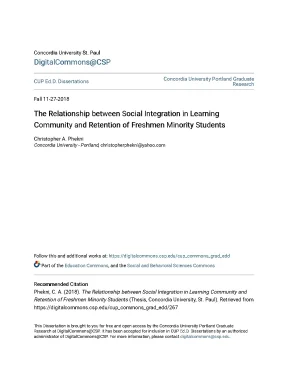
Tải xuống để đọc toàn bộConcordia University St. Paul DigitalCommons@CSP Concordia University Portland Graduate CUP Ed. Dissertations Research Fall 11-27-2018 The Relationship between Social Integration in Learning Community and Retention of Freshmen Minority Students Christopher A. Phekni Concordia University - Portland, christopherphekni@yahoo.com Follow this and additional works at: https://digitalcommons.edu/cup_commons_grad_edd Part of the Education Commons, and the Social and Behavioral Sciences Commons Recommended Citation Phekni, C.
The Relationship between Social Integration in Learning Community and Retention of Freshmen Minority Students (Thesis, Concordia University, St. Retrieved from https://digitalcommons.edu/cup_commons_grad_edd/267 This Dissertation is brought to you for free and open access by the Concordia University Portland Graduate Research at DigitalCommons@CSP. It has been accepted for inclusion in CUP Ed. Dissertations by an authorized administrator of DigitalCommons@CSP.
For more information, please contact digitalcommons@csp. Concordia University - Portland CU Commons Ed. Dissertations Graduate Theses & Dissertations Fall 11-27-2018 The Relationship between Social Integration in Learning Community and Retention of Freshmen Minority Students Christopher A. Phekni Concordia University - Portland Follow this and additional works at: https://commons.edu/edudissertations Part of the Education Commons, and the Social and Behavioral Sciences Commons CU Commons Citation Phekni, Christopher A., "The Relationship between Social Integration in Learning Community and Retention of Freshmen Minority Students" (2018).edu/edudissertations/253 This Open Access Dissertation is brought to you for free and open access by the Graduate Theses & Dissertations at CU Commons.
It has been accepted for inclusion in Ed. Dissertations by an authorized administrator of CU Commons. For more information, please contact libraryadmin@cu- portland. Concordia University–Portland College of Education Doctorate of Education Program WE, THE UNDERSIGNED MEMBERS OF THE DISSERTATION COMMITTEE CERTIFY THAT WE HAVE READ AND APPROVE THE DISSERTATION OF Christopher Anthony Phekni CANDIDATE FOR THE DEGREE OF DOCTOR OF EDUCATION Floralba Arbelo Marrero, Ed.
Faculty Chair Michael Butcher, Ed., Content Specialist Robert Voelkel, Ed., Content Reader The Relationship Between Social Integration in Learning Community and Retention of Freshmen Minority Students Christopher Anthony Phekni Concordia University–Portland College of Education Dissertation submitted to the Faculty of the College of Education in partial fulfillment of the requirements for the degree of Doctor of Education in Educational Leadership With a Specialization in Higher Education Floralba Arbelo Marrero, Ed., Faculty Chair Michael Butcher, Ed., Content Specialist Robert Voelkel, Ed., Content Reader Concordia University–Portland 2018 Abstract This dissertation examined whether student social integration through participation in a learning community is associated with the retention of freshman minority students from the first semester to the second semester of their first year in college. A web-based Qualtrics survey questionnaire was administered through social media to the target population of freshmen aged at least 18 years old in learning communities across the United States. A correlational quantitative research design was utilized to address the research questions. The study examined whether retention between freshmen first and second semester relates to their social experiences in a learning community.
In addition, this study looked to see if these factors which were (a) gender, (b) age, (c) high school GPA or (d) end-of-first-semester GPA, had any effect on the retention of minority freshman students between the first and second semester of college. Data was entered and analyzed using IBM Statistical Package for the Social Science (SPSS) version 25 (2017) software and the Minitab Express (2017) software. Analysis of the data demonstrated that there was no correlation between social integration in a learning community and retention for the Hispanic, Other Minority, and Caucasian group of participants. However, the African American or Black category showed retention as constant between the first and second semester of college.
The variables of (a) gender, (b) age, (c) high school GPA or (d) end-of-first-semester GPA, had no effect on the retention. Keywords: retention, learning community, social integration, minority freshmen students ii Dedication I am dedicating this dissertation to the memory of my mom, Dora Phekni, who believed in me and offered me her nurturing, loving care and guidance. She molded me to be who I am today. iii Acknowledgements I want to express my gratitude to my faculty chair, Dr.
Floralba Arbelo Marrero, for her invaluable guidance. I would like to thank you for the encouragement and allowing me to grow during the research process. I want to thank also my content reader, Dr. Robert Voelkel and my content specialist Dr.
Michael Butcher, for allowing my defense to be a pleasant moment, and for your powerful comments and suggestions. A special thanks to my wife for her patience and understanding throughout this experience. Most of all, I thank you, my Almighty God, for your guidance and the strength you gave me to persevere through all my hurdles. iv Table of Contents Abstract.
iv Table of Contents. v List of Tables. xi List of Figures. xiii Chapter 1: Introduction.
1 Introduction to the Problem. 1 Background, Context, History, and Conceptual Framework for the Problem. 7 Statement of the Problem. 8 Purpose of the Study.
10 Rationale, Relevance, and Significance of the Study. 10 Definition of Terms. 13 Assumption, Delimitations, and Limitations. 14 Chapter 2: Literature Review.
16 Introduction to the Literature Review. 23 Social integration and history of the learning communities. 26 Models of learning communities. 27 Learning communities and freshmen.
32 Retention of African American or Black students. 34 Retention of Hispanic students. 34 Retention of Native American Indian students. 35 Review of Research Literature and Methodological Literature.
36 Quantitative and qualitative methods in the literature review. 37 Issues with quantitative and qualitative methods. 41 Review of Methodological Issues. 42 Internal and external validity.
43 Synthesis of Research Findings. 46 vi Benefits of learning communities. 46 Types of colleges and retention. 50 GPA /ACT score.
50 First-generation students. 51 Critique of Previous Research. 58 Introduction to Chapter 3. 58 Purpose of the Study.
62 Target Population, Sampling Method and Related Procedures. 67 Operationalization of Variables. 70 vii Learning community. 71 Data Analysis Procedures.
71 Limitations and Delimitations of the Research Design. 74 Internal and External Validity. 76 Ethical Issues in the Study. 78 Chapter 4: Data Analysis and Results.
81 Description of the Sample. 84 Summary of the Results. 91 Question 1 Null Hypothesis. 96 viii Question 2 Null Hypothesis.
104 Chapter 5: Discussion and Conclusion. 106 Summary of the Results. 108 Question 1 Null Hypothesis. 109 Question 2 Null Hypothesis.
109 Discussion of the Results. 109 Discussion of the Results in Relation to the Literature. 116 Implication of the Results for Practice, Policy, and Theory. 123 Recommendations for Further Research.
128 Appendix A: CARES (I) Survey. 144 Appendix B: CARES (A) Survey. 146 Appendix C: Form for Database Information. 148 Appendix D: Letter to Volunteers.
149 ix Appendix E: Statement of Original Work. 151 Appendix F: Factor Loading Analysis. 152 x List of Tables Table 1 Participant Demographic:Descriptive Statistics of Sample .85 Table 2 Retention by Social Integration Experience Cross Tabulation .92 Table 3 Fisher’s Exact Test Results .94 Table 4 Coefficients, Standard Error Coefficients and Variance Inflation Factors.97 Table 5 Retention Information .98 Table 6 Model Summary of Deviance R2, Adjusted Deviance R2, and Akaike Information Criterion .99 Table 7 Odds Ratio for the Categorical Variables .99 Table 8 Goodness-of-Fit Tests .100 Table 9 Descriptive Statistics: Gender, Age Group, HS GPA and Freshman GPA .101 Table 10 Binary Logistic Regression: Deviance Table for Retention versus Gender, Age Group, high school GPA and freshman GPA .101 Table 11 Backward Stepwise Regression Analysis for Retention versus Gender, Age Group, high school GPA and freshman GPA .102 Table 12 Descriptive Statistics for the Pretest questions on the CARES-I Survey Questionnaire .153 Table 13 Descriptive Statistics for the Posttest questions on the CARES-A Survey Questionnaire .154 Table 14 Correlation Matrixa for the Pretest questions on the CARES-I Survey Questionnaire .156 Table 15 Correlation Matrixa for the Posttest questions on the CARES-A Survey Questionnaire .157 xi Table 16 KMO and Bartlett's Test for the Pretest questions on the CARES-I Survey Questionnaire.160 Table 17 KMO and Bartlett's Test for the Posttest questions on the CARES-A Survey Questionnaire.160 Table 18 Communalities for the Pretest questions on the CARES-I Survey Questionnaire .161 Table 19 Communalities for the Posttest questions on the CARES-A Survey Questionnaire .162 Table 20 Total Variance Explained for the Pretest questions on the CARES-I Survey Questionnaire.164 Table 21 Total Variance Explained for the Posttest questions on the CARES-A Survey Questionnaire.164 Table 22 Component Matrixa for the Pretest questions on the CARES-I Survey Questionnaire .168 Table 23 Component Matrixa for the Posttest questions on the CARES-A Survey Questionnaire .169 Table 24 Rotated Component Matrixa for the Pretest questions on the CARES-I Survey Questionnaire.169 Table 25 Rotated Component Matrixa for the Posttest questions on the CARES-A Survey Questionnaire.170 xii List of Figures Figure 1 The conceptual framework and flow of operations .8 Figure 2 A conceptual schema for dropout from college .24 Figure 3 The independent variables as presented in this figure are race, gender, age, high school GPA, social integration experience and end of semester GPA and the dependent variable is retention .82 Figure 4 Scree plot for the pretest questions on the CARES-I survey questionnaire .166 Figure 5 Scree plot for the posttest questions on the CARES-A survey questionnaire .167 xiii Chapter 1: Introduction Introduction to the Problem Since 1880, the retention of college students has remained a challenge in the higher education sector (Berger, Ramirez, & Lyons, 2012). Despite programs, support systems, and diverse interventions at colleges, undergraduate student retention continues to be a problem today.
Past research has assessed support program interventions and student characteristics to understand what might allay attrition. Braxton et al. (2014) elaborated on Tinto’s (1975) ideas that some characteristics which college students possess, like “family background, individual attributes and pre-college schooling experiences” affect their retention (p. Voelkel and Chrispeels (2017) stressed that some countries endeavor to improve student learning but many of their methods are ineffective in elevating the accomplishment of their students.
Swail (2014) asserted that more minority students are admitted to colleges, but they are ill-prepared for college coursework due to educational systems that fail to prepare them and the increasingly high cost of tuition; these factors present a barrier to many of them to staying in college long enough to graduate. The National Student Clearinghouse (2017), described the overall rate of retention as the percentage of first-year students that returned to the same college for the next year. In the fall of 2016, there was a 61.1% retention rate of first-year students who entered college in fall 2015. This overall rate of retention of first-year students has a subgroup of Asian students with 72.9% as the highest retention rate, while the subgroup with the lowest retention rate was the African American or Black students at 54.
At 4-year public colleges, the retention rate for freshmen students was 69.7% of freshmen students at private colleges and for 2-year public colleges, it was 49.1% during the same period. 1 Tinto (2012a) asserted that the retention of students is shaped by their sense of belonging in campus social groupings, especially freshmen students that experience many adjustments in “forming new relationships” with peers, staff, and faculty (p. In addition, Arana and Blanchard (2018) mentioned Hispanic students possess ethnic loyalties which could be useful instruments for college administrators to improve the integration of these students. Arbelo- Marrero and Milacci (2016) pointed out that undergraduate Hispanic nontraditional students could persist academically if they related more to their faculty and administrators and developed their capacity to move over hurdles inside their social structures which “affect their academic persistence” (p.
Peña (2017) asserted that learning community such as community college First-Year Experience (FYE) programs helped struggling Latino males to complete their education in community colleges and move on to 4-year university programs to complete their bachelor’s degrees.
Nội dung được bảo vệ bản quyền — Tải xuống đầy đủ
Trích dẫn luận án này
Christopher Anthony Phekni (2018). Tích hợp xã hội và giữ chân sinh viên năm nhất thiểu số [Luận án tiến sĩ, Concordia University - Portland]. LuanAn.net. https://luanan.net/xa-hoi-hoc/the-relationship-between-social-integration-in-learning-community
Câu hỏi thường gặp
Luận án "Tích hợp xã hội và giữ chân sinh viên năm nhất thiểu số" nghiên cứu về vấn đề gì?
Tích hợp xã hội và chương trình giữ chân sinh viên năm nhất thiểu số giúp tăng cường sự gắn kết và hỗ trợ tài chính cho sinh viên có hoàn cảnh khó khăn.
Luận án "Tích hợp xã hội và giữ chân sinh viên năm nhất thiểu số" được bảo vệ tại trường nào?
Luận án này được bảo vệ tại Concordia University - Portland. Năm bảo vệ: 2018.
Luận án "Tích hợp xã hội và giữ chân sinh viên năm nhất thiểu số" thuộc chuyên ngành gì?
Luận án "Tích hợp xã hội và giữ chân sinh viên năm nhất thiểu số" thuộc chuyên ngành Educational Leadership with a Specialization in Higher Education. Danh mục: Xã Hội Học.
Luận án "Tích hợp xã hội và giữ chân sinh viên năm nhất thiểu số" có bao nhiêu trang?
Luận án "Tích hợp xã hội và giữ chân sinh viên năm nhất thiểu số" có 187 trang. Bạn có thể xem trước một phần tài liệu ngay trên trang web trước khi tải về.
Cách tải luận án "Tích hợp xã hội và giữ chân sinh viên năm nhất thiểu số" về máy như thế nào?
Để tải luận án về máy, bạn nhấn nút "Tải xuống ngay" trên trang này, sau đó hoàn tất thanh toán phí lưu trữ. File sẽ được tải xuống ngay sau khi thanh toán thành công. Hỗ trợ qua Zalo: 0559 297 239.