Euclidean dynamical triangulations running couplings and curvatu
Khám phá triangulations động lực học Euclid, các phép ghép nối chạy và cur trong vật lý hấp dẫn lượng tử. Phân tích sâu sắc lý thuyết.
Năm xuất bản
Số trang
95
Thời gian đọc
15 phút
Lượt xem
0
Lượt tải
0
Phí lưu trữ
40 Point
Tổng quan nhanh
- Chủ đề:
- Khám phá Lực hấp dẫn Lượng tử: Phương pháp Lưới Triangulations Động
- Số trang:
- 95 trang
- Trường:
- Syracuse University
- Chuyên ngành:
- Physics
- Tác giả:
- Scott David Bassler
- Năm:
- 2019
Tóm tắt nội dung luận án
I.Khám phá Lực hấp dẫn Lượng tử Phương pháp Lưới Triangulations Động
Tài liệu này khám phá các khía cạnh cơ bản của lực hấp dẫn lượng tử thông qua Euclidean Dynamical Triangulations (EDT). Nó cung cấp một cách tiếp cận mới để hiểu về không gian và thời gian. Công trình này là một phần của nỗ lực lớn hơn nhằm phát triển một lý thuyết trường lượng tử cho lực hấp dẫn. Lưới hấp dẫn là một lĩnh vực nghiên cứu đầy hứa hẹn. Nghiên cứu tập trung vào các vấn đề cơ bản của lý thuyết hấp dẫn. Các kết quả có thể mở ra hướng nghiên cứu mới.
1.1. Bối cảnh Lực hấp dẫn Lượng tử Các Lý thuyết Trường
Lý thuyết trường lượng tử mô tả chính xác nhiều khía cạnh thực tại. Lực hấp dẫn vẫn chưa có mô tả lý thuyết trường lượng tử. Điều này thúc đẩy nghiên cứu các lý thuyết thay thế. Lý thuyết dây là một ví dụ nổi bật. Các kết quả gần đây trong lưới trọng lực lượng tử đang thu hút sự quan tâm mới. Nghiên cứu này đóng góp vào nỗ lực phát triển một lý thuyết lực hấp dẫn lượng tử toàn diện. Nó giải quyết các thách thức cơ bản của vật lý hiện đại.
1.2. Giới thiệu về Triangulations Động Euclidean EDT
Euclidean Dynamical Triangulations (EDT) là một lý thuyết hấp dẫn dạng lưới. Nó cung cấp một cách tiếp cận không nhiễu loạn đối với lực hấp dẫn lượng tử. EDT mô hình hóa không thời gian rời rạc bằng cách sử dụng các phức hợp đơn hình. Nó tạo ra một khuôn khổ tính toán mạnh mẽ. EDT sử dụng phương pháp lưới để nghiên cứu tính chất của không thời gian ở các thang đo nhỏ. Các tiến bộ trong EDT được đánh giá kỹ lưỡng, đặt nền tảng cho các phân tích sâu hơn.
II.Hằng số Ghép chạy trong EDT Hấp dẫn Asymptotic Safety
Luận án đi sâu vào cách các hằng số ghép của Euclidean Dynamical Triangulations biến đổi theo thang đo. Nó đánh giá sự phù hợp của lý thuyết với kịch bản an toàn tiệm cận. Đây là một khía cạnh quan trọng của lý thuyết trường lượng tử. Hành vi của các hằng số ghép quyết định tính nhất quán của lý thuyết. Nghiên cứu này cung cấp bằng chứng thực nghiệm. Nó hỗ trợ các mô hình lý thuyết về lực hấp dẫn lượng tử.
2.1. Phân tích Các hằng số ghép của Lý thuyết
Nghiên cứu kiểm tra hành vi của các hằng số ghép trong Euclidean Dynamical Triangulations. Các hằng số này thay đổi theo thang đo năng lượng. Phân tích này là một phần của khung nhóm tái chuẩn hóa. Hiểu biết về cách các hằng số ghép chạy là quan trọng. Nó tiết lộ tính chất của lý thuyết ở các thang năng lượng khác nhau. Điều này giúp xác định sự tồn tại của các điểm cố định. Nó là cần thiết cho một lý thuyết lực hấp dẫn lượng tử nhất quán.
2.2. Tính nhất quán với Kịch bản An toàn tiệm cận
Kết quả cho thấy sự nhất quán. Các hằng số ghép chạy phù hợp với kịch bản An toàn tiệm cận cho lực hấp dẫn. Kịch bản này đề xuất một điểm cố định phi nhiễu loạn cho lực hấp dẫn lượng tử. Nó cho phép lý thuyết có thể xác định được ở thang UV. Bề mặt tới hạn UV một chiều được phát hiện. Điều này làm cho lý thuyết có khả năng dự đoán tối đa. Nó là một kết quả quan trọng đối với nghiên cứu lực hấp dẫn lượng tử.
III.Chức năng Tương quan Độ cong Hành vi Phổ quát của Không thời gian
Luận án khám phá sâu sắc hàm tương quan độ cong của Euclidean Dynamical Triangulations. Nó tiết lộ hành vi phổ quát trong cấu trúc không thời gian. Điều này cung cấp cái nhìn sâu sắc về bản chất động lực học của không thời gian rời rạc. Các hàm tương quan là công cụ mạnh mẽ. Chúng giúp phân tích cấu trúc của các phức hợp đơn hình. Nghiên cứu này đóng góp vào sự hiểu biết về độ cong không thời gian ở các thang nhỏ.
3.1. Nghiên cứu Hàm tương quan độ cong hai điểm
Nghiên cứu này phân tích các hàm tương quan độ cong hai điểm cho lực hấp dẫn. Các đóng góp không liên kết được loại bỏ cẩn thận. Điều này cho phép quan sát các đặc tính cơ bản của độ cong không thời gian. Dữ liệu này cung cấp cái nhìn sâu sắc về cấu trúc của không thời gian rời rạc. Nó là một thước đo quan trọng trong lưới hấp dẫn. Việc loại bỏ các nhiễu loạn cho phép tập trung vào hành vi cốt lõi.
3.2. Phát hiện Hành vi Phổ quát Suy giảm Luật hàm mũ
Phát hiện hành vi phổ quát trong các bộ tương quan. Chúng bao gồm sự suy giảm theo luật hàm mũ theo khoảng cách. Điều này gợi ý một tính chất cơ bản của không thời gian. Sự suy giảm này có thể cung cấp manh mối về kích thước không gian và các tính chất khác của lực hấp dẫn ở thang nhỏ. Nó là một dấu hiệu của động lực học cơ bản của lực hấp dẫn lượng tử. Các kết quả này hỗ trợ giả thuyết về một vũ trụ hình học.
IV.Ý nghĩa về Lực hấp dẫn Starobinsky Vũ trụ học Quan sát
Các phát hiện có ý nghĩa sâu rộng. Chúng liên quan đến Lực hấp dẫn Starobinsky và tác động đến vũ trụ học quan sát. Công trình này khám phá các mối liên hệ tiềm tàng giữa lực hấp dẫn lượng tử và các mô hình vũ trụ học. Điều này có thể mở ra những con đường mới để kiểm tra các lý thuyết hấp dẫn. Nó cũng có thể giúp giải thích các hiện tượng vũ trụ học hiện tại.
4.1. Hệ số Hạng R^2 trong Hành động Hiệu dụng Năng lượng thấp
Luận án tìm kiếm cách trích xuất hệ số của hạng R^2. Hạng này nằm trong hành động hiệu dụng năng lượng thấp. Đây là một thành phần quan trọng của các mô hình lực hấp dẫn lượng tử. Giá trị của hệ số này có thể có ý nghĩa lớn. Nó ảnh hưởng đến động lực học của không thời gian. Việc xác định hệ số này là bước thiết yếu. Nó giúp liên kết lý thuyết lưới với các mô hình hiệu dụng.
4.2. Sự xuất hiện tự nhiên của Lực hấp dẫn Starobinsky
Hệ số hạng R^2 có thể rất lớn về độ lớn. Điều này ngụ ý Lực hấp dẫn Starobinsky xuất hiện tự nhiên trong lý thuyết. Lý thuyết Lực hấp dẫn Starobinsky là một mở rộng của tương đối rộng. Nó được biết đến với khả năng giải thích lạm phát vũ trụ. Kết quả này có ý nghĩa quan trọng đối với vũ trụ học quan sát. Cần có một phép tính trong lý thuyết hiệu dụng năng lượng thấp để kiểm tra khả năng này. Nó mang lại một liên kết mạnh mẽ.
V.Phương pháp Lưới và Không thời gian Rời rạc trong EDT
Luận án sử dụng nghiêm ngặt phương pháp lưới. Nó xây dựng một mô hình không thời gian rời rạc thông qua Euclidean Dynamical Triangulations. Cách tiếp cận này là nền tảng cho lực hấp dẫn lượng tử không nhiễu loạn. Nó cho phép các phép tính mà các phương pháp nhiễu loạn không thể thực hiện. Việc mô hình hóa không thời gian bằng các phức hợp đơn hình là một đổi mới quan trọng.
5.1. Khung lý thuyết của Phương pháp Lưới cho Hấp dẫn
Phương pháp lưới là một công cụ tính toán mạnh mẽ. Nó đã thành công trong các lý thuyết trường lượng tử khác. Lưới hấp dẫn là một cách tiếp cận để lượng tử hóa hấp dẫn. Nó sử dụng một không thời gian rời rạc. Điều này cho phép tính toán lực hấp dẫn lượng tử không nhiễu loạn. Nó tránh các vấn đề của các phép tính nhiễu loạn thông thường. Khung lý thuyết này cung cấp một nền tảng vững chắc cho các mô phỏng và phân tích.
5.2. Mô hình hóa Không thời gian bằng các Phức hợp Đơn hình
Euclidean Dynamical Triangulations (EDT) sử dụng phức hợp đơn hình. Các phức hợp này hình thành một không thời gian rời rạc. Các điểm và cạnh của lưới xác định cấu trúc cơ bản. Cách tiếp cận này cho phép nghiên cứu các đặc tính động lực học. Nó giúp hiểu các chuyển pha trong hấp dẫn lượng tử. Phương pháp này cung cấp một mô hình mạnh mẽ. Nó cho phép điều tra các hiện tượng phức tạp.
Tải xuống file đầy đủ để xem toàn bộ nội dung
Tải đầy đủ (95 trang)Trích đoạn nội dung luận án
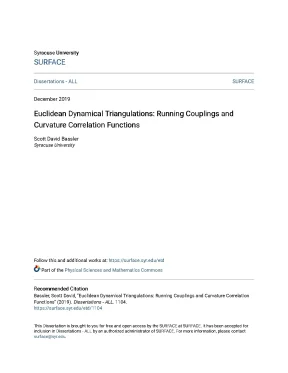
Tải xuống để đọc toàn bộSyracuse University SURFACE Dissertations - ALL SURFACE December 2019 Euclidean Dynamical Triangulations: Running Couplings and Curvature Correlation Functions Scott David Bassler Syracuse University Follow this and additional works at: https://surface.edu/etd Part of the Physical Sciences and Mathematics Commons Recommended Citation Bassler, Scott David, "Euclidean Dynamical Triangulations: Running Couplings and Curvature Correlation Functions" (2019).edu/etd/1104 This Dissertation is brought to you for free and open access by the SURFACE at SURFACE. It has been accepted for inclusion in Dissertations - ALL by an authorized administrator of SURFACE. For more information, please contact surface@syr. Abstract Quantum field theories have been incredibly successful at describing many fundamental aspects of reality with great precision, sometimes relying on the powerful computational tool of lattice methods.
Gravity has so far eluded a quantum field theory description, leading many to consider more exotic theories like String Theory. However, recent results in lattice quantum gravity have brought some renewed interest in the subject. After reviewing the progress made so far in Euclidean Dynamical Triangulations (EDT), a lattice theory of gravity, we examine how the couplings of the theory run with scale, and discover that their runnings are consistent with the asymptotic safety scenario for gravity with a 1-dimensional UV critical surface, making it maximally predictive. We also study two-point curvature correlation functions for gravity, and upon removing the disconnected contributions, we find universal behavior in these correlators, including a power-law drop-off with distance.
We also explore a means of extracting the coefficient of the R2 term in the low energy effective action, and find that this coefficient may be very large in magnitude, though a calculation in the low energy effective theory is still needed to test this possibility. This result implies that Starobinsky Gravity emerges naturally in the theory, which would have important implications for observational cosmology. Euclidean Dynamical Triangulations Running Couplings and Curvature Correlation Functions by Scott Bassler B. Applied Physics, Stockton University, 2013 Dissertation Submitted in partial fulfillment of the requirements for the degree of Doctor of Philosophy in Physics.
Syracuse University December 2019 Copyright c Scott David Bassler 2019 All Rights Reserved Acknowledgments I thank my advisor Jack for helping guide me all these years. In working with him I’ve learned how to code, about lattice techniques, about QCD, about gravity, and all manner of physics I never dreamed would be relevant to the study of gravity. It has been a privilege to work for someone so intelligent and kind. I thank my professors at Syracuse for the numerous challenging but rewarding classes which I was lucky enough to be in.
The long hours on the fourth floor were not in vain! I thank my fellow graduate students for all of their help on handling assignments and life at Syracuse, both in my year and not, both in my department and not. I cannot hope to list them all, but special thanks go out to Greg, Michael, Craig, Shelby, Kyle, Alex, Raghav, Eric, Lindsay, Ohana, and of course Monica. Graduate school for physics is infamous for being a time that people struggle to find happiness. With all of you, it was easy to find.
I thank Walter for helping me foster my love of teaching at Syracuse, first as his teaching assistant, then as an apprentice at teaching conventions, and soon as a peer. I thank my undergraduate advisor Neil for convincing me that physics was a path worth following. I cannot help but wonder where I would be without his wisdom, which he gave when I needed it most. And of course, I thank my family: my mom, my dad, Danny, and Mikey.
For all my life, you have supported me in everything I’ve done, from choir to physics, from Woodbury to Syracuse. I love you all, and couldn’t ask for better parents or brothers. iv Contents 1 Introduction 1 1.1 Quantum Field Theory .2 A Quantum Field Theory of Gravity and Asymptotic Safety .3 Euclidean Dynamical Triangulations. 6 2 The Lattice Formulation 9 2.1 The Discretized Action .5 Evidence for Classical Behavior .1 Global Hausdorff Dimension .2 The de Sitter Solution .6 Towards the Continuum Limit .1 Setting the relative lattice spacing .2 The Spectral Dimension .3 Entropy Scaling of Black Holes.
35 3 Running of the Couplings 36 3.2 Restoring General Coordinate Invariance .3 Dimension of the UV critical surface .1 Unsubtracted Correlation Functions .4 Coefficient of the Power Law Decay. 67 5 Conclusions 74 6 Curriculum Vitae 80 vi List of Figures 1 A schematic view of the phase diagram for EDT as a function in the κ2 − β plane. 14 2 The phase diagram for QCD with Wilson fermions in the β − κ plane. β is the inverse strong coupling constant, 1/αs , and κ is the inverse bare fermion mass.
15 3 This histogram of N0 for the 4k β = 0 ensemble, with a clear double guassian structure. That the two peaks are the same height indicates that the ensemble is correctly tuned to the phase transition. 16 4 A plot of the peak of the volume correlator, cN4 (0), for both the 32k and 16k β = 0 ensembles. The value of κ2 that maximizes the slope is the critical value of κ2.
The red line shows the critical value for the 4k β = 0 ensemble, which should agree with the 16k and 32k ensembles if the correct Hausdorff dimension is chosen. That there is good agreement suggests that the chosen value of 4 is correct. 17 5 The history of the quantity N0 /N4 in Monte Carlo time at β = 0 for three different volumes. From top to bottom, the volumes are 4k, 8k, and 16k.
18 6 The volume distributions, cN4 (x), for three different volumes at β = 0, after rescaling assuming a Hausdorff dimension of 4. 20 7 The volume distributions, n4 (ρ), for three different volumes at β = 0, after rescaling assuming a Hausdorff dimension of 4. 21 8 The rescale n4 (ρ) distribution for several different β values, and therefore several different lattice spacings, as well as the de Sitter solution in black. As the continuum limit is taken, the lattice data gets closer to the de Sitter solution.
22 vii 9 A visualization of the geometries using a network visualization tool. The top left geometry is the coarsest at β = 1.5, the top right is the second coarsest at β = 0. The bottem left is the second finest at β = −0.6, and the bottom right is the finest at β = −0. For the coarser lattice, the baby universe branchings are easily identified as separate from the bulk, but this distinction diminishes for finer lattices.
24 10 The return probability as a function of diffusion time σ for three different volumes at β = 0. This appears to be insensitive to volume. 27 11 The return probability as a function of diffusion time σ for many different β values. 28 12 The return probability Ps as a function of rescaled diffusion time σr for many different β values, where the rescaling is such that the different curves lie on top of one another.
The amount by which σ must be rescaled gives the relative lattice spacing. 29 13 The spectral dimension as a function of distance scale probed in black, as well as the fit suggested by Ambjorn et al. 31 14 The spectral dimension at large distances DS (∞) for many different ensem- bles, and the extrapolation to infinite volume and zero lattice spacing in cyan. Especially fine ensembles are excluded.
33 15 The spectral dimension at large distances DS (∞) for many different ensem- bles, and the extrapolation to infinite volume and zero lattice spacing in cyan. The especially fine ensembles are included, and so a V12 term is included in the fit function. 34 16 The spectral dimension at short distances DS (0) for many different ensembles, and the extrapolation to infinite volume and zero lattice spacing in cyan. The especially fine ensembles are excluded.
37 viii 17 The spectral dimension at short distances DS (0) for many different ensembles, and the extrapolation to infinite volume and zero lattice spacing in cyan. The especially fine ensembles are included, necessitating the inclusion of a V12 term in the fit function. 38 19 GΛ as a function of κ2 for many different values of β. 42 20 GΛsub , Λ̂sub /10, and 10Ĝ plotted together as a function of κ2.
43 21 The correlator as defined in Eq.(30) for the 16k β = 0 ensemble. 48 22 The correlator defined in (31), which should have no measured correlation. 49 23 The modified correlator proposed by de Baker and Smit. 49 24 The connected correlator for the 32k β = 0 ensemble in the triangle approach.
51 25 The connected correlator for the 16k β = 0 ensemble in the triangle approach. 51 26 The connected correlator for the 8k β = 0 ensemble in the triangle approach. 52 27 The connected correlator for the 4k β = 0 ensemble in the triangle approach. 52 28 The connected correlator for the 4k β = 1.5 ensemble in the triangle approach.
53 29 The connected correlator for the 8k β = −0.8 ensemble in the triangle approach. 53 30 The connected correlator for the 32k β = 0 ensemble in the simplex approach. 54 31 The connected correlator for the 16k β = 0 ensemble in the simplex approach. 54 32 The connected correlator for the 8k β = 0 ensemble in the simplex approach.
55 33 The connected correlator for the 4k β = 0 ensemble in the simplex approach. 55 34 The connected correlator for the 4k β = 1.5 ensemble in the simplex approach. 56 35 The connected correlator for the 8k β = −0.8 ensemble in the simplex approach. 56 36 The correlator for the 4k β = 1.5 ensemble with the simplex discretization, zoomed in to highlight the “bump” that is absent for other ensembles.
58 37 The fit in the universal regime to the 32k β = 0 ensemble in the triangle discretization. The fit is done in the range [9,13]. 60 38 The fit in the universal regime to the 16k β = 0 ensemble in the triangle discretization. The fit is done in the range [8,12].
60 ix 39 The fit in the universal regime to the 8k β = 0 ensemble in the triangle discretization. The fit is done in the range [8,18]. 61 40 The fit in the universal regime to the 4k β = 0 ensemble in the triangle discretization. The fit is done in the range [7,11].
61 41 The fit in the universal regime to the 4k β = 1.5 ensemble in the triangle discretization. The fit is done in the range [7,18]. 62 42 The fit in the universal regime to the 8k β = −0.8 ensemble in the triangle discretization. The fit is done in the range [7,12].
62 43 The fit in the universal regime to the 32k β = 0 ensemble in the simplex discretization. The fit is done in the range [22,44]. 63 44 The fit in the universal regime to the 16k β = 0 ensemble in the simplex discretization. The fit is done in the range [20,38].
63 45 The fit in the universal regime to the 8k β = 0 ensemble in the simplex discretization. The fit is done in the range [19,32]. 64 46 The fit in the universal regime to the 4k β = 0 ensemble in the simplex discretization. The fit is done in the range [16,29].
64 47 The fit in the universal regime to the 8k β = −0.8 ensemble in the simplex discretization. The fit is done in the range [43,58]. 65 48 The power of the power law for both the simplex and triangle discretizations.
Nội dung được bảo vệ bản quyền — Tải xuống đầy đủ
Trích dẫn luận án này
Scott David Bassler (2019). Euclidean dynamical triangulations running couplings and cur [Luận án tiến sĩ, Syracuse University]. LuanAn.net. https://luanan.net/vat-ly/euclidean-dynamical-triangulations-running-couplings-and-curvatu
Câu hỏi thường gặp
Luận án "Euclidean dynamical triangulations running couplings and cur" nghiên cứu về vấn đề gì?
Khám phá triangulations động lực học Euclid, các phép ghép nối chạy và cur trong vật lý hấp dẫn lượng tử. Phân tích sâu sắc lý thuyết.
Luận án "Euclidean dynamical triangulations running couplings and cur" được bảo vệ tại trường nào?
Luận án này được bảo vệ tại Syracuse University. Năm bảo vệ: 2019.
Luận án "Euclidean dynamical triangulations running couplings and cur" thuộc chuyên ngành gì?
Luận án "Euclidean dynamical triangulations running couplings and cur" thuộc chuyên ngành Physics. Danh mục: Vật Lý.
Luận án "Euclidean dynamical triangulations running couplings and cur" có bao nhiêu trang?
Luận án "Euclidean dynamical triangulations running couplings and cur" có 95 trang. Bạn có thể xem trước một phần tài liệu ngay trên trang web trước khi tải về.
Cách tải luận án "Euclidean dynamical triangulations running couplings and cur" về máy như thế nào?
Để tải luận án về máy, bạn nhấn nút "Tải xuống ngay" trên trang này, sau đó hoàn tất thanh toán phí lưu trữ. File sẽ được tải xuống ngay sau khi thanh toán thành công. Hỗ trợ qua Zalo: 0559 297 239.