Triết học Đạo đức của William Wollaston - Luận án Tiến sĩ tại CUNY bởi Yael Sofaer
Khám phá triết học đạo đức của William Wollaston qua luận án CUNY. Phân tích sâu sắc các nguyên tắc, lập luận và ảnh hưởng của tư tưởng ông.
City University of New York
Luan An
Luận án tiến sĩ
Năm xuất bản
Số trang
218
Thời gian đọc
33 phút
Lượt xem
0
Lượt tải
0
Phí lưu trữ
50 Point
Tổng quan nhanh
- Chủ đề:
- 1. Phân tích sâu Triết học đạo đức William Wollaston
- Số trang:
- 218 trang
- Trường:
- City University of New York
- Chuyên ngành:
- Triết học
- Tác giả:
- Yael Sofaer
- Năm:
- 2014
Tóm tắt nội dung luận án
I. Phân tích sâu Triết học đạo đức William Wollaston
Luận án CUNY này cung cấp một cái nhìn toàn diện về triết học đạo đức của William Wollaston. Đây là nghiên cứu chuyên sâu đầu tiên về lý thuyết của ông. Wollaston, một nhân vật quan trọng của Triết học Anh thế kỷ 18, đã đưa ra một hệ thống đạo đức độc đáo. Hệ thống này được trình bày trong tác phẩm 'The Religion of Nature Delineated'. Nghiên cứu đặt Wollaston vào bối cảnh Thời kỳ Khai sáng (Anh). Nó làm nổi bật đóng góp của ông vào dự án phát triển lý thuyết đạo đức bằng lý tính thuần túy. Dự án này là nguồn gốc của chủ nghĩa duy thực đạo đức hiện đại. Luận án nhấn mạnh giá trị và sự đổi mới trong tư tưởng của Wollaston. Nó cũng chứng minh sự bỏ qua của giới học thuật đối với ông là không công bằng.
1.1. Luận án CUNY về Triết học đạo đức Wollaston
Luận án này từ CUNY là một nghiên cứu đột phá. Nó tập trung vào Triết học đạo đức Wollaston. Mục tiêu là cung cấp một phân tích kỹ lưỡng chưa từng có. Luận án giải thích lý thuyết đạo đức của William Wollaston một cách chi tiết. Nó khám phá các nguyên tắc nền tảng và ứng dụng của chúng. Đây là một nỗ lực nhằm phục hồi vị trí xứng đáng của Wollaston trong lịch sử triết học.
1.2. Đóng góp của Wollaston trong thời Khai sáng Anh
William Wollaston đã đóng góp đáng kể vào Thời kỳ Khai sáng (Anh). Công trình của ông là một phần của nỗ lực tìm kiếm nền tảng đạo đức qua lý tính. Triết học đạo đức Wollaston định hình sự phát triển của chủ nghĩa duy lý đạo đức. Ông tìm cách xây dựng một hệ thống đạo đức vững chắc. Hệ thống này dựa trên các nguyên tắc phổ quát và khách quan. Đó là một thành tựu quan trọng trong Triết học Anh thế kỷ 18.
1.3. The Religion of Nature Delineated Tác phẩm cốt lõi
'The Religion of Nature Delineated' (1724) là tác phẩm chính của William Wollaston. Cuốn sách này trình bày toàn bộ lý thuyết đạo đức của ông. Nó cung cấp một cái nhìn sâu sắc về tư tưởng Wollaston. Tác phẩm này được xem xét như một đóng góp sáng tạo. Nó đề xuất một phương pháp mới để xác định trạng thái đạo đức của hành động. Tác phẩm này là nền tảng cho việc hiểu Triết học đạo đức Wollaston.
II. Đạo đức học Wollaston Hành động là mệnh đề thật
Một đổi mới trung tâm trong Đạo đức học Wollaston là nguyên lý hành động. Nguyên lý này nói rằng các tác nhân lý tính biểu đạt mệnh đề qua hành động. Các mệnh đề này sở hữu giá trị chân lý. Điều này cho phép xác định trạng thái đạo đức của hành động. Việc này được thực hiện bằng cách đánh giá các giá trị chân lý đó. Nguyên lý này bắc cầu giữa ý tưởng trong tâm trí và thực tế thế giới. Nó định nghĩa hành động có chủ ý là các sự kiện tự nhiên. Các sự kiện này có thể được đánh giá như mọi đối tượng và sự kiện tự nhiên khác. Hành động của các tác nhân đạo đức được đánh giá dựa trên sự nhất quán hoặc không nhất quán với tự nhiên.
2.1. Hành động biểu đạt mệnh đề Lý thuyết trung tâm
Lý thuyết đạo đức của William Wollaston có một nguyên lý đột phá. Đó là ý tưởng hành động biểu đạt mệnh đề. Giống như lời nói, hành động cũng mang theo những tuyên bố. Các tuyên bố này có thể đúng hoặc sai. Việc này tạo ra một cơ sở mới để phân tích đạo đức. Nó cho phép một cách tiếp cận khách quan để đánh giá hành vi. Đây là cốt lõi của Đạo đức học dựa trên sự thật của Wollaston.
2.2. Cầu nối giữa ý nghĩ và thực tại khách quan
Nguyên lý này của Wollaston tạo ra một liên kết quan trọng. Nó nối liền ý tưởng trong tâm trí với các sự kiện thực tế. Hành động trở thành biểu hiện hữu hình của những gì tin tưởng. Nếu một hành động 'nói dối' về thực tế, nó là sai. Nếu nó 'nói thật', nó là đúng. Điều này cho phép áp dụng phương pháp khoa học vào đạo đức. Nó là một hình thức của Chủ nghĩa duy lý đạo đức.
2.3. Đánh giá đạo đức qua giá trị chân lý của hành động
Trong hệ thống của William Wollaston, việc đánh giá đạo đức rất rõ ràng. Nó dựa trên sự thật hay sai lầm của mệnh đề hành động. Sự tương ứng giữa chân lý của hành động và các sự kiện thực nghiệm của thế giới là trọng tâm. Phương pháp này cung cấp một cách cụ thể để đánh giá đạo đức. Nó tuân theo tiêu chuẩn thực nghiệm của chủ nghĩa duy thực đạo đức. Hành động đúng là hành động nói lên sự thật.
III. Lý tính Luật tự nhiên trong đạo đức học Wollaston
Triết học đạo đức Wollaston đặt nền tảng vào lý tính và Luật tự nhiên. Lý tính đóng vai trò thiết yếu trong việc khám phá chân lý. Nó là công cụ để nhận biết các mệnh đề đạo đức. Tiêu chuẩn đạo đức là hành động phù hợp với tự nhiên. Việc này cũng là phương tiện để đạt được hạnh phúc. Hệ thống của Wollaston liên kết chặt chẽ đạo đức với bản chất con người và vũ trụ. Sản xuất hoặc phá hủy hạnh phúc xác định mức độ đúng sai đạo đức của hành động. Đây là một cách tiếp cận Chủ nghĩa duy lý đạo đức mạnh mẽ.
3.1. Lý tính Chuẩn mực phát hiện chân lý đạo đức
Trong triết học của William Wollaston, lý tính là phương tiện chính. Nó dùng để khám phá chân lý. Mục III trong tác phẩm của ông, 'Of Reason, and the Ways of Discovering Truth,' nhấn mạnh điều này. Lý tính cho phép con người nhận ra các mệnh đề và giá trị chân lý của chúng. Việc này là cơ sở cho Chủ nghĩa duy lý đạo đức. Lý tính dẫn dắt đến sự hiểu biết về đạo đức khách quan.
3.2. Sống hài hòa với tự nhiên Nền tảng đạo đức
Nguyên tắc cốt lõi của Đạo đức học Wollaston là hành động phù hợp với tự nhiên. Đây là tiêu chuẩn cơ bản cho mọi hành vi đạo đức. Wollaston tin rằng bản chất con người là tìm kiếm hạnh phúc. Hành động phù hợp với tự nhiên chính là con đường dẫn đến hạnh phúc đó. Điều này kết nối hành vi đạo đức với Luật tự nhiên (Wollaston). Việc này đảm bảo sự hài hòa giữa con người và thế giới.
3.3. Hạnh phúc và tính đúng sai của hành động
William Wollaston khẳng định rằng hạnh phúc là mục tiêu tự nhiên của con người. Việc tạo ra hoặc phá hủy hạnh phúc có mối liên hệ trực tiếp với giá trị đạo đức của hành động. Nếu một hành động phù hợp với tự nhiên và dẫn đến hạnh phúc, nó là đúng. Ngược lại, nếu nó gây ra sự đau khổ và không phù hợp với tự nhiên, nó là sai. Mối liên hệ này cung cấp một khung khổ thực tiễn cho việc đánh giá đạo đức.
IV. The Religion of Nature Nền tảng đạo đức Khai sáng
'The Religion of Nature Delineated' của William Wollaston là một tài liệu quan trọng. Nó trình bày một lý thuyết đạo đức có cấu trúc chặt chẽ. Tác phẩm này phản ánh tinh thần Thời kỳ Khai sáng (Anh). Nó tìm cách đặt nền móng đạo đức vững chắc dựa trên lý tính. Wollaston không chỉ giới thiệu lý thuyết. Ông còn áp dụng nó vào nhiều khía cạnh của đời sống. Các ứng dụng này bao gồm từ tôn giáo đến chính trị và đời sống cá nhân. Tác phẩm này cũng thể hiện rõ nét tư tưởng Thần học tự nhiên của ông.
4.1. Cấu trúc lý thuyết trong The Religion of Nature
'The Religion of Nature Delineated' được chia thành các phần rõ ràng. Mỗi phần khám phá một khía cạnh của lý thuyết đạo đức Wollaston. Từ các khái niệm về hạnh phúc và thiện ác đạo đức. Đến các nghĩa vụ của sinh vật không hoàn hảo và sự thật liên quan đến Chúa. Cấu trúc này giúp người đọc hiểu sâu sắc logic và phạm vi của hệ thống của Wollaston. Nó thể hiện tính toàn diện của tác phẩm.
4.2. Ứng dụng đạo đức vào đời sống xã hội và tôn giáo
William Wollaston không ngừng áp dụng lý thuyết của mình. Ông đưa nó vào các lĩnh vực cụ thể. Phần V đề cập đến các chân lý liên quan đến Chúa. Các phần sau đó bàn về lý thuyết chính trị và các mối quan hệ xã hội. Ông xem xét các chân lý tôn trọng nhân loại nói chung và các xã hội cụ thể. Điều này cho thấy tính thực tiễn của Đạo đức học dựa trên sự thật của ông.
4.3. Luật tự nhiên và Thần học tự nhiên Wollaston
Triết học của William Wollaston tích hợp Luật tự nhiên và Thần học tự nhiên. Ông định nghĩa các chân lý về bản chất con người. Ông xem xét vị trí của con người trong trật tự vũ trụ. Sự tồn tại, sự hoàn hảo và sự quan phòng của Chúa là các chủ đề chính. Điều này nhấn mạnh khía cạnh thần học trong triết lý đạo đức của ông. Nó cung cấp một cái nhìn sâu sắc về niềm tin của ông vào một trật tự tự nhiên dựa trên lý tính.
V. Phê bình và Di sản Triết học Wollaston còn đó
Luận án CUNY này không chỉ giải thích mà còn bảo vệ William Wollaston. Nó phản bác các chỉ trích phổ biến đối với 'The Religion of Nature Delineated'. Những phê bình này thường xuyên bỏ qua cốt lõi lý thuyết của ông. Chúng thường nhắm vào những 'người rơm' dễ tấn công hơn. Mặc dù Wollaston từng rất nổi tiếng, danh tiếng của ông đã suy giảm đáng kể. Tuy nhiên, luận án chứng minh rằng những đóng góp của ông vẫn có ý nghĩa. Triết học đạo đức Wollaston tiếp tục cung cấp những hiểu biết sâu sắc cho triết học đương đại.
5.1. Phản bác các chỉ trích phổ biến về Wollaston
Luận án này giải quyết các lời phê bình sai lệch về William Wollaston. Nhiều nhà phê bình, như Thomas Bott, đã hiểu sai lý thuyết của ông. Họ tạo ra các 'người rơm' để tấn công. Luận án chỉ ra những thiếu sót trong các lập luận này. Nó làm sáng tỏ các điểm bị bỏ qua hoặc xuyên tạc. Việc này giúp khôi phục sự công bằng cho Triết học đạo đức Wollaston.
5.2. Sự thăng trầm danh tiếng của William Wollaston
William Wollaston đã từng là một trong những nhà văn được kính trọng nhất thế kỷ 18. Tuy nhiên, danh tiếng của ông suy giảm nhanh chóng sau khi ông qua đời. Các triết gia như Hume và Bentham đã chỉ trích ông. Điều này dẫn đến việc ông bị bỏ qua trong nhiều thập kỷ. Luận án theo dõi quá trình này. Nó khám phá nguyên nhân đằng sau sự suy giảm này. Nó cũng chỉ ra rằng sự quan tâm trở lại là có cơ sở.
5.3. Di sản Triết học Wollaston Ý nghĩa đương đại
Bất chấp sự suy giảm danh tiếng, Triết học đạo đức Wollaston vẫn mang ý nghĩa. Luận án khẳng định giá trị của nó đối với triết học đương đại. Những ý tưởng của ông về Đạo đức học dựa trên sự thật vẫn có thể truyền cảm hứng. Chúng là một phần quan trọng của Chủ nghĩa duy lý đạo đức. Di sản của William Wollaston cung cấp một lăng kính độc đáo. Nó giúp hiểu rõ hơn về các cuộc tranh luận đạo đức hiện đại. Công trình của ông xứng đáng được xem xét lại một cách nghiêm túc.
Mục lục chi tiết luận án
Tải xuống file đầy đủ để xem toàn bộ nội dung
Tải đầy đủ (218 trang)Trích đoạn nội dung luận án
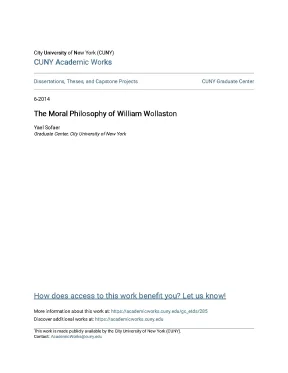
Tải xuống để đọc toàn bộCity University of New York (CUNY) CUNY Academic Works Dissertations, Theses, and Capstone Projects CUNY Graduate Center 6-2014 The Moral Philosophy of William Wollaston Yael Sofaer Graduate Center, City University of New York How does access to this work benefit you? Let us know! More information about this work at: https://academicworks.edu/gc_etds/285 Discover additional works at: https://academicworks.edu This work is made publicly available by the City University of New York (CUNY). Contact: AcademicWorks@cuny.edu THE MORAL PHILOSOPHY OF WILLIAM WOLLASTON by YAEL SOFAER A dissertation submitted to the Graduate Faculty in Philosophy in partial fulfillment of the requirements for the degree of Doctor of Philosophy, The City University of New York 2014 2014 YAEL SOFAER All Rights Reserved ii This manuscript has been read and accepted for the Graduate Faculty in Philosophy in satisfaction of the dissertation requirement for the degree of Doctor of Philosophy. Rosenthal Date Chair of Examining Committee Iakovos Vasiliou Date Executive Officer Stefan Bernard Baumrin John Kleinig Peter Phillips Simpson Supervisory Committee THE CITY UNIVERSITY OF NEW YORK iii Abstract THE MORAL PHILOSOPHY OF WILLIAM WOLLASTON by Yael Sofaer Adviser: Professor Stefan Bernard Baumrin This dissertation provides the first thorough exposition of the moral theory proposed by William Wollaston in his treatise The Religion of Nature Delineated (1724), and demonstrates it to be an innovative contribution to the seventeenth and eighteenth centuries project of developing a moral theory by reason alone (in which lie the origins of contemporary moral realism); with the foundational principle of acting in accordance with nature as the standard of morality. Wollaston s treatise contains an unrecognized innovation: the principle that rational agents express propositions by their actions that, as propositions, have truth values which makes it possible to determine the moral status of such actions by evaluating these truth values.
The principle that actions express propositions to the same extent that verbal statements express propositions bridges the gap between ideas in the mind and the facts of the world (i. It defines the deliberate actions of moral agents as natural events which can thus be evaluated in the same way that all natural objects and events are evaluated. Actions of moral agents can then be evaluated as to whether they are consistent or inconsistent with all other parts of nature. The correspondence between the truthfulness or falsehood of the propositions that moral agents express by their iv deliberate actions, and the empirical facts of the world, provides a focused method of evaluating the moral status of such actions in accordance with the empirical standard of moral realism.
Also, in Wollaston s system, as it is the nature of human beings to seek happiness, and as acting in accordance with nature is the means of attaining happiness, the production or destruction of happiness determines the degree of the moral rightness or wrongness of actions. The dissertation also demonstrates that the prevalent criticisms of The Religion of Nature Delineated which have caused it to be largely disregarded do not engage the theory and are often directed at straw men. The Response to Wollaston’s Theory. The Eighteenth Century: Popularity and Influence.
The Nineteenth Century: Decline and Dismissal. The Twentieth Century: Sporadic Interest. Wollaston’s Moral Theory. The Structure of The Religion of Nature Delineated.
The Reliability of Reason: Section III, “Of Reason, and the Ways of Discovering Truth”. The Standard of Morality: Section II, “Of Happiness”. The Moral Theory of RND: Section I, “Of Moral Good and Evil”. The Extent of Moral Obligation: Section IV, “Of the Obligations of Imperfect Beings with Respect to Their Power of Acting”.
Wollaston’s Application of His Moral Theory. Religion: Section V, “Truths Relating to the Deity. Of His Existence, Perfection, Providence, etc. The Basis of Political Theory: Section VI, “Truths Respecting Mankind in General, Antecedent to All Human Laws”.
Political Theory: Section VII, “Truths Respecting Particular Societies of Men, or Governments”. Domestic Life: Section VIII, “Truths Concerning Families and Relations”. Virtue and the Soul: Section IX, “Truths Belonging to a Private Man, and Respecting (Directly) Only Himself”. The Misleading Observers Straw Man.
Thomas Bott and His Followers. The “All Immorality Is Lying” Straw Man. Joel Feinberg’s Response to Hume. The Description Error.
INTRODUCTION The Rev. William Wollaston (1659-1724) was one of the most famous and highly esteemed writers of his time, and yet in the century following his death, his reputation fell into sharp decline until he became an object of disrespect in the writings of Hume, Price, Bentham, and others. A fair-minded contemporary reader, I think, will find that Wollaston did have something important and original to say, however confused his manner of saying it, so that is one reason for reexamining his major work, The Religion of Nature Delineated (1722)—Joel Feinberg.1 William Wollaston, author of The Religion of Nature Delineated (1724) (hereinafter referred to as RND), was a popular and highly regarded moral philosopher in the eighteenth century, yet in the nineteenth century he fell into disrepute. He was no longer read and his moral theory was ridiculed and dismissed.
This view has persisted to the present. In this dissertation I will provide the first thorough exposition of Wollaston’s moral theory and demonstrate it to be an innovative contribution to the seventeenth and eighteenth centuries’ project of developing a moral theory by reason alone (in which lie the origins of contemporary moral realism); with the foundational principle of acting in accordance with nature as the standard of morality. Also, that it contains a largely unrecognized innovation: the principle that rational agents express propositions by their actions—that, as propositions, have truth values—which makes it possible to determine the moral status of such actions by evaluating these truth values. I will also demonstrate that the prevailing dismissal of this theory is based on arguments which fail to engage it and instead attack straw men.
Wollaston’s moral theory is usually classified as rationalist, but not clearly described. It is 1 Joel Feinberg, “Wollaston and His Critics,” The Journal of the History of Ideas 38, no. 1 most commonly, and incorrectly, described as being somehow similar to Samuel Clarke’s theory of fitness,2 with Wollaston sometimes labeled a disciple of Clarke and subject to descriptions such as this: The moral rationalists claimed, for example, that moral distinctions are based on transcendental principles and immutable relations that oblige all rational creatures and that can only be discerned by the use of reason. An exaggerated view of the power of reason leads the rationalist to suppose that reason can pierce its way into the realm of transcendental values.3 However, Wollaston had no such visions of transcendental normative realms nor does his theory resemble Clarke’s doctrine of intuitively observable fitnesses; rather, he devised a rule for deriving moral judgments from propositions concerning empirical experience.
Wollaston fits into the category Stephen L. Darwall defines as Empirical naturalist internalism: An empirical naturalist tradition, comprising Hobbes, Cumberland, Hutcheson, Hume, and, in most moods, Locke, was driven primarily by the desire to account for normativity in a way consistent with an empiricist epistemology and naturalist metaphysics.4 Central to Wollaston’s theory is his innovative idea that agents express propositions by their actions as well as their words. This provides a means of assigning truth values to actions. Doing so enables judging actions morally on the basis of the foundational principle that the 2 Hume’s description of rationalism as “affirm[ing] that virtue is nothing but a conformity to reason; that there are eternal fitnesses and unfitnesses of things, which are the same to every rational being that considers them,” best describes Clarke’s thesis.
David Hume, A Treatise of Human Nature, ed. David Fate Norton and Mary J. Norton, Introduction by David Fate Norton (Oxford: Oxford University Press, 2000): 294 (3. 3 David Fate Norton, “Hume, human nature, and the foundations of morality” in The Cambridge Companion to Hume, edited by David Fate Norton (Cambridge: Cambridge University Press, 1993): 156.
Darwall, The British Moralists and the Internal ‘Ought’: 1640-1740 (Cambridge: Cambridge University Press, 1995), 14. 2 standard of morality is accordance with nature; this is joined with the epistemic principle that the definition of truth is accordance with nature. This foundational principle of acting in accordance with nature originated in Stoicism and was the prevailing standard of moral theory.5 The idea that actions express propositions provides a systematic method of evaluating whether actions are in accordance with nature. In addition, Wollaston offers a secondary justification for why acting in accordance with nature is right—because it is the method of attaining happiness.
As happiness is the criterion of Epicureanism this makes Wollaston’s theory a fusion of Stoic and Epicurean elements, which adds to its interest. This fusion is accomplished in two steps. In the first, a rule for practicing the Stoic principle of acting according to nature is promulgated (RND Section I). In the second, it is established that seeking happiness is in accordance with human nature (RND Section II).
As human nature is part of nature, this is encompassed within the Stoic principle of acting in accordance with nature. The Epicurean principle is made subordinate to the Stoic principle as Wollaston warns that acting in accordance with nature does not mean acting in accordance with the brutish part of human nature. In the rationalist project, the Stoic principle of following nature was joined with the project of science, leading to the attempt to derive universal moral laws from nature in the same manner that scientists, especially Newton, derived universal physical laws from nature. The rationalist project was proposed by John Locke, who believed morality could be scientifically demonstrated.
I am bold to think, that morality is capable of demonstration, as well as 5 “[Wollaston’s] theory is.the prevailing deist-stoic theory of ‘living according to nature,’ and is in fact what Wollaston intended it to be, an interpretation and partial clarification of that ancient theory. Wollaston holds with the Stoics that actions are wrong because they are ‘contrary to nature. 3 mathematics; since the precise real essence of the things moral words stand for may be perfectly known; and so the congruity or incongruity of the things themselves, be certainly discovered, in which consists perfect knowledge.6 A founding participant in this project was Richard Cumberland. Cumberland was the first man to produce a full-fledged doctrine of natural law in which both the general methods and the specific findings of modern natural science, or natural science as it developed after Galileo, were used to define man's moral duties.7 Thus, Cumberland defines morality as being a subset of the laws of nature: The laws of nature are the only solid foundations of all morality and civil polity.
8 Cumberland’s innovation was to bring logic to bear on moral issues. The principle he developed is that an immoral action expresses a logical contradiction because it expresses two opposing propositions concerning the same category of being, namely human. For, that rational agent most certainly contradicts himself, who prescribes one rule for his own private conduct, and a quite different rule for the conduct of other rational beings, who partake of the very same nature with himself (I. This differs from advocating the golden rule, or the general, widespread idea of fairness.
A person who affirms a proposition concerning conduct for himself, but denies the same proposition concerning someone else (or vice versa), while both are the same category of 6 John Locke, An Essay Concerning Human Understanding (1690), ed. Spelling, italics, capitalization, and punctuation have been modernized. All subsequent Locke quotes in this chapter are from the Essay. 7 Murray Forsyth, “The Place of Richard Cumberland in the History of Natural Law Doctrine,” Journal of the History of Philosophy 20, no.edu/journals/hph/summary/v020/20.
8 Richard Cumberland, A Philosophical Enquiry into the Laws of Nature, translated, notes, and appendix by John Towers (Dublin: Samuel Powell, 1750), http://galenet.com/servlet/ ECCO, document no. CW3322449132, Prolegomena, section 1:ix. Subsequent references to this work are by part number, chapter number, section number, and page number.
Nội dung được bảo vệ bản quyền — Tải xuống đầy đủ
Trích dẫn luận án này
Yael Sofaer (2014). Triết học Đạo đức của William Wollaston: Luận án CUNY [Luận án tiến sĩ, City University of New York]. LuanAn.net. https://luanan.net/triet-hoc/triet-hoc-dao-duc-william-wollaston-luan-an-cunyy
Câu hỏi thường gặp
Luận án "Triết học Đạo đức của William Wollaston: Luận án CUNY" nghiên cứu về vấn đề gì?
Khám phá triết học đạo đức của William Wollaston qua luận án CUNY. Phân tích sâu sắc các nguyên tắc, lập luận và ảnh hưởng của tư tưởng ông.
Luận án "Triết học Đạo đức của William Wollaston: Luận án CUNY" được bảo vệ tại trường nào?
Luận án này được bảo vệ tại City University of New York. Năm bảo vệ: 2014.
Luận án "Triết học Đạo đức của William Wollaston: Luận án CUNY" thuộc chuyên ngành gì?
Luận án "Triết học Đạo đức của William Wollaston: Luận án CUNY" thuộc chuyên ngành Triết học. Danh mục: Triết Học.
Luận án "Triết học Đạo đức của William Wollaston: Luận án CUNY" có bao nhiêu trang?
Luận án "Triết học Đạo đức của William Wollaston: Luận án CUNY" có 218 trang. Bạn có thể xem trước một phần tài liệu ngay trên trang web trước khi tải về.
Cách tải luận án "Triết học Đạo đức của William Wollaston: Luận án CUNY" về máy như thế nào?
Để tải luận án về máy, bạn nhấn nút "Tải xuống ngay" trên trang này, sau đó hoàn tất thanh toán phí lưu trữ. File sẽ được tải xuống ngay sau khi thanh toán thành công. Hỗ trợ qua Zalo: 0559 297 239.