Simulation based analysis and optimization of the united states a
Phân tích và tối ưu hóa dựa trên mô phỏng của Hoa Kỳ. Xây dựng mô hình hiệu quả bằng cách sử dụng phân tích và tối ưu hóa dựa trên mô phỏng.
University of Louisville
Luan An
Luận án tiến sĩ
Năm xuất bản
Số trang
163
Thời gian đọc
25 phút
Lượt xem
1
Lượt tải
0
Phí lưu trữ
50 Point
Tổng quan nhanh
- Chủ đề:
- Simulation US Army Performance Appraisal System Analysis
- Số trang:
- 163 trang
- Trường:
- University of Louisville
- Chuyên ngành:
- Industrial Engineering
- Tác giả:
- Lee A. Evans
- Năm:
- 2018
Tóm tắt nội dung luận án
I.Simulation US Army Performance Appraisal System Analysis
This dissertation offers a comprehensive simulation-based analysis of the United States Army performance appraisal system. It addresses the critical period from 2010 to 2016. During this time, active duty Army personnel decreased significantly. The Department of Defense implemented downsizing measures. Reduced promotion rates were a key instrument. This research focuses on the implications for officer careers. The study utilizes simulation modeling to understand complex system dynamics. It provides deep performance analysis of existing processes. This systematic examination uncovers areas for improvement. The goal is a more effective and fair appraisal system.
1.1. Examining US Army Personnel Downsizing Impact
The US Army experienced over a 17% reduction in active duty personnel. This downsizing directly impacted career progression. Promotion rates were lowered as a strategic tool. The study investigates how these reductions manifested within the appraisal system. It quantifies the effect of personnel reductions on officer retention. Understanding these impacts is crucial for future force management. This research provides a data-driven perspective on downsizing effects.
1.2. Role of Officer Evaluation Reports in Promotions
Promotion boards rely heavily on Officer Evaluation Reports (OERs). OERs serve as the military's performance appraisals. These reports are central to career advancement decisions. The study analyzes their influence on officer selection and retention. It identifies critical factors within OERs affecting promotion outcomes. This analysis highlights the importance of accurate and unbiased evaluations. OERs shape the future leadership of the Army.
II.Optimizing Army Officer Promotion System with Simulation
The research aims at optimizing the Army officer promotion system through advanced simulation modeling. The Defense Officer Personnel Management Act of 1980 mandates termination. Officers not selected for promotion twice are discharged. Promotion rates for Lieutenant Colonel (LTC) hit a two-decade low in 2015-2016. This study seeks solutions for a more equitable system. It employs system optimization techniques to refine promotion processes. The insights gained support strategic human resource planning. This leads to better talent management within the Army. The findings contribute to a robust officer corps.
2.1. Addressing Low Promotion Rates for Lieutenant Colonel
Lieutenant Colonel promotion rates saw unprecedented lows. This impacts morale and officer retention. The dissertation investigates systemic factors contributing to these rates. It proposes data-driven approaches for improvement. Analyzing historical data reveals patterns in promotion bottlenecks. Performance analysis of past promotion cycles guides interventions. The study aims to alleviate future promotion challenges. It ensures qualified officers advance.
2.2. Mitigating Promotion Board Selection Biases
Promotion boards face inherent biases. These affect officer selection outcomes. The simulation approach identifies and quantifies these biases. Strategies for fair evaluation are developed. This ensures merit-based career progression. Understanding bias sources is the first step. Discrete-event simulation models various scenarios. This helps in designing more objective selection mechanisms. Mitigation strategies enhance the integrity of the promotion process.
III.Addressing Biases in Army Performance Evaluation Reports
Biases in performance evaluations are well-documented. Management literature extensively covers this issue. The Army performance evaluation reports (OERs) are not immune. A disconnect often exists between actual performance and management perception. This dissertation highlights these discrepancies. It offers a new perspective on these challenges. The research identifies specific areas where biases manifest. It provides a foundation for developing corrective actions. Effective evaluation is vital for officer development.
3.1. Disconnect Between Actual and Perceived Performance
Employees' true performance levels can differ from supervisors' ratings. This gap affects career trajectories. The study explores the mechanisms behind this disconnect. It emphasizes the need for objective assessment tools. Performance analysis reveals the extent of this divergence. This understanding is critical for accurate talent identification. Closing this gap improves fairness and organizational efficiency.
3.2. Unique Bias in Forced Distribution Appraisal Systems
The Army employs a forced distribution system. This system limits above-average evaluations. This structure introduces a specific bias. It is distinct from commonly documented appraisal biases. The research identifies this unique challenge. Simulation modeling helps in understanding its systemic effects. This bias affects how officers are perceived and promoted. Addressing it ensures a more accurate reflection of performance.
IV.Impact of Forced Distribution on Army Officer Appraisals
The United States Army performance appraisal system utilizes a forced distribution model. This system inherently restricts the number of "above average" evaluations. Raters must adhere to specific quotas. This constraint, combined with human behavior, creates complex dynamics. The dissertation explores how these system dynamics influence officer appraisal outcomes. It uncovers a previously unaddressed bias in literature. This investigation provides crucial insights for system optimization. Understanding these impacts is fundamental for fair career progression. Simulation modeling plays a key role in this analysis.
4.1. Restrictions on Above Average Evaluations
Raters are limited in assigning high marks. This restriction forces difficult choices. It can create an artificial ceiling on perceived performance. The study analyzes the statistical implications of these limitations. It quantifies how these restrictions impact the distribution of scores. This influences overall officer talent recognition. The research examines the consequences for high-performing individuals.
4.2. Human Behavior and System Dynamics Interaction
Human psychology interacts with system rules. This interaction generates unintended consequences. The dissertation models these complex dynamics. It reveals how individual rating decisions aggregate into systemic bias. Simulation modeling is critical for this analysis. It demonstrates the ripple effects of rater decisions. This research shows the intricate interplay within the appraisal process. Understanding this interaction leads to better system design.
V.Dissertation Insights Army Personnel System Optimization
This doctoral dissertation provides significant insights into Army personnel system optimization. It represents a vital contribution from the University of Louisville. The research applies industrial engineering principles to a critical military function. The findings support continuous improvement efforts. The United States Army Human Resources Command benefits from this analytical work. This comprehensive simulation-based analysis offers practical recommendations. It addresses key challenges in talent management. The study promotes a culture of data-driven decision-making.
5.1. University of Louisville Industrial Engineering Research
This work was conducted at the J. Speed School of Engineering. It fulfills requirements for a Doctor of Philosophy degree. The Department of Industrial Engineering provides the academic foundation. This institution champions rigorous, impactful research. The dissertation demonstrates the application of advanced methodologies. It showcases the university's commitment to solving real-world problems. This research contributes to the field of industrial engineering.
5.2. Continuous Improvement for Army Human Resources Command
The research was supported by the Army Human Resources Command. Data was provided to enable in-depth performance analysis. The study fosters a culture of self-critical review. It drives demand for ongoing organizational enhancement. The findings offer actionable strategies for system refinement. This supports the Army's mission of maintaining a strong force. The dissertation is a testament to collaborative research for public service.
Mục lục chi tiết luận án
Tải xuống file đầy đủ để xem toàn bộ nội dung
Tải đầy đủ (163 trang)Trích đoạn nội dung luận án
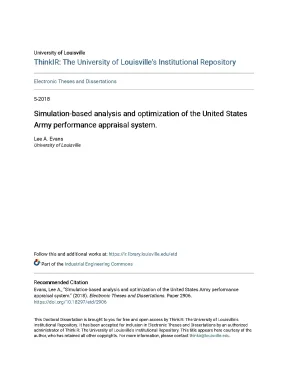
Tải xuống để đọc toàn bộUniversity of Louisville ThinkIR: The University of Louisville's Institutional Repository Electronic Theses and Dissertations 5-2018 Simulation-based analysis and optimization of the United States Army performance appraisal system. Evans University of Louisville Follow this and additional works at: https://ir.edu/etd Part of the Industrial Engineering Commons Recommended Citation Evans, Lee A., "Simulation-based analysis and optimization of the United States Army performance appraisal system. Electronic Theses and Dissertations.18297/etd/2906 This Doctoral Dissertation is brought to you for free and open access by ThinkIR: The University of Louisville's Institutional Repository. It has been accepted for inclusion in Electronic Theses and Dissertations by an authorized administrator of ThinkIR: The University of Louisville's Institutional Repository.
This title appears here courtesy of the author, who has retained all other copyrights. For more information, please contact thinkir@louisville. SIMULATION-BASED ANALYSIS AND OPTIMIZATION OF THE UNITED STATES ARMY PERFORMANCE APPRAISAL SYSTEM Lee A., United States Military Academy, 2000 M., Georgia Institute of Technology, 2009 A Dissertation Submitted to the Faculty of the J. Speed School of Engineering of the University of Louisville in Partial Fulfillment of the Requirements for the Degree of Doctor of Philosophy in Industrial Engineering Department of Industrial Engineering University of Louisville Louisville, Kentucky May 2018 Copyright 2018, Lee A.
Evans All rights reserved SIMULATION-BASED ANALYSIS AND OPTIMIZATION OF THE UNITED STATES ARMY PERFORMANCE APPRAISAL SYSTEM Lee A., United States Military Academy, 2000 M., Georgia Institute of Technology, 2009 Dissertation Approved on April 13, 2018 By the following Dissertation Committee Dr. Bae, Chair Dr. Lihui Bai Dr. Erin Gerber Dr.
Lee Bewley ii ACKNOWLEDGMENTS My sincere gratitude goes to my advisor, Dr. Ki-Hwan Bae, for his mentorship and guidance throughout this process. I would also like to thank my dissertation committee of Dr. Lihui Bai, Dr.
Erin Gerber, and Dr. Lee Bewley for generously sharing their time and ideas. This research would not have been possible without the support from the United States Army Human Resources Command. I would like to thank Mr.
David Martino for his willingness to provide all of the data used to analyze the Army’s performance appraisal system. His intellectual curiosity has forced the Officer Professional Management Directorate to take a critical view of itself, resulting in an organizational culture that demands continuous improve- ment. Martino never lets a subordinate forget that behind every number is a person, a story, and a family; a mantra that has stuck with me throughout this study. Additionally, I would like to thank Mr.
Ike Zeitler, Ms. Teresa Monroe, and MAJ Nick Paul of the Officer Readiness Division for the countless hours spent querying databases in support of this dissertation. I have been extremely fortunate to learn from wonderful public educators; the most influential being my parents, Bill and Linda Evans, who combine for over 50 years experience teaching at the high school level. From flight school to graduate school, their support and encouragement has pushed me to expand my horizons and has made me a better person.
Finally, I would like to thank my wife, Kari, iii and my children, Elin, Brody, and Grant, for their love and continuous support throughout my time at the University of Louisville and during our entire 18-year journey in the Army. iv ABSTRACT SIMULATION-BASED ANALYSIS AND OPTIMIZATION OF THE UNITED STATES ARMY PERFORMANCE APPRAISAL SYSTEM Lee A. Evans April 13, 2018 From 2010 to 2016, the total number of active duty United States Army personnel decreased by over 17%. The Department of Defense uses a variety of instruments to downsize the services, of which the most immediate and impactful is through decreased promotion rates.
The Defense Officer Personnel Management Act of 1980 mandates the termination of officers twice not selected for promotion. As such, the promotion rates to the rank of lieutenant colonel (LTC) for 2015 and 2016 were the lowest over the past two decades. Central to each promotion board is the analysis of officer evaluation reports (OERs), the military version of performance appraisals. The biases associated with evaluating employees are well documented, par- ticularly in management literature.
These biases can often create a disconnect between the actual performance level of an employee and the management’s per- ception of the employee’s performance level. The performance appraisal system in the United States Army is a forced distribution system that restricts the number of above average evaluations raters are allowed to give subordinates. This struc- ture, combined with human behavior and system dynamics, creates an additional bias not currently addressed in literature. v Military personnel systems have long been the subjects for manpower modeling, or workforce planning, due to their size relative to most civilian organizations.
Techniques for manpower modeling include dynamic programming, goal program- ming, Markovian models, and simulation. These techniques assist policy makers with matching the supply of personnel with the available jobs. Rather than analyz- ing the aggregate requirements by occupation and seniority, this study determines the extent to which the current system promotes the best people into the available jobs. While this is often a subjective measurement, the use of discrete event sim- ulations allows us to quantify the effects of the current system and analyze future policy decisions.
In this dissertation, a discrete event simulation framework is considered to replicate the dynamics, structure, and regulatory constraints placed on the offi- cers in the U. Using performance appraisal data provided by the United States Army Human Resources Command, we create a multi-objective response function in order to quantify the human behavior associated with evaluating sub- ordinates. We are able to minimize the squared error of our system output with the multi-objective response function using simulation-optimization techniques. Uti- lizing simulation-optimization techniques for model validation enables estimating unknown input parameters, such as human behavior, based on historical data.
Furthermore, the model allows users to analyze the effects of current constraints on the evaluation system and the effects of proposed personnel policy changes. The effectiveness of the performance appraisal system is based on its ability to vi accurately evaluate the officers’ performance levels. The model output is analyzed by the number of misidentified individuals and the severity of the misidentification. An initial analysis showed that 20.07% of the officers in the system do not receive as many above average evaluations as their performance level warrants.
Additionally, structural changes such as decreasing the average number of a rater’s subordinates from fifteen to five increases the number of misidentified personnel by 59. Ranking and selection methods that include the Kim Nelson (KN) and the Nelson, Swann, Goldsman, Song (NSGS) procedures assists in determining the optimal combination of input parameters such as forced distribution constraints placed on raters, frequency of moves, number of subordinates assigned to each rater, and rater behavior. The simulation will serve as a tool for policy analysis to recommend policies and behavior that maximizes the extent to which the performance appraisal sys- tem accurately identifies the most qualified employees. Consequently, the results demonstrate broad applicability of simulation-optimization in the field of man- power modeling and human resource management.
vii TABLE OF CONTENTS 1 INTRODUCTION 1 1.3 Organization of this Dissertation .1 Military Manpower Modeling and Simulation .2 Performance Appraisal Systems. 49 3 PERSONNEL EVALUATION SIMULATION MODEL 54 3.2 Model Description and Notation .4 Model Verification and Validation .2 Sorting Function Parameter Estimation .1 Preliminary Results and Output Analysis .2 Assessing the Effect of Pool Size .3 Assessing the Effect of Time in Position .6 Response Function Development .2 Parameter Description and Optimization .3 Nelson, Swann, Goldsman, Song (NSGS) Procedure .4 Kim-Nelson (KN) Procedure .5 Applied Simulation Optimization Results .6 Robustness of Responses. 121 6 CONCLUSIONS 124 REFERENCES 127 CURRICULUM VITAE 141 x LIST OF FIGURES 1. Army active duty personnel strength from 1994 to 2016 (Source: Defense Manpower Data Center).
Army active duty lieutenant colonel promotion rate from 1996 to 2016 (Source: U. Army Human Resources Command) .3 Promotion induced attrition pattern prescribed in DOPMA (from Rostker et al.4 Flow chart of the simulated U. Army officer performance appraisal system .5 Excerpt from Department of the Army Form 67-10-2, Field Grade Officer Evaluation Report (Source: Department of the Army Reg- ulation 623-3: Evaluation Reporting System) .6 Promotion rates to the rank of lieutenant colonel by zone of con- sideration (Source: U. Army Human Resources Command) .7 Considered and selected populations to the rank of LTC (Source: U.
Army Human Resources Command) .1 Three sequential functions of performance appraisal systems (from Carroll and Schneier, 1982) .2 Rater motivation to provide accurate or distorted ratings (from Murphy and Cleveland, 1995) .3 Peer-reviewed journal publications on talent management since 1990 (Source: ProQuest) .4 Percent of majors receiving ACOM in first key development (KD) evaluation, fiscal years 2003-2007 (Wardynski et al.5 Seven step process modeling procedure (Hangos and Cameron, 2001) 47 2.6 Basic logic of a simulation-optimization procedure (April et al.7 Simulation-optimization techniques (Carson and Maria, 1997) .8 Fu’s simulation-optimization techniques (Fu, 2001) .1 Distribution of major pool sizes (Source: U. Army Human Re- sources Command) .2 Sample simulation output for 20 entities .3 Distribution of ACOM evaluations by time in grade for U. Army majors in the primary zone of consideration (Source: U. Army Human Resources Command) .4 Distribution of total number of ACOM evaluations for U.
Army majors in PZ zone of consideration (Source: U. Army Human Resources Command) .5 Simulation results for percent of majors receiving top evaluation by years in rank .6 Simulation results for percentages of total top evaluations received by majors .7 Simulation results showing relationship between D, Y , and T for linear sorting function .8 The effect on Y by minimizing weighted multi-objective response function D .9 The effect on T by minimizing weighted multi-objective response function D .10 Box plot showing the distribution of Qi for each number k of ACOM evaluations received .11 Boxplot showing the distribution of Qi for each number k of ACOM evaluations received with varying pool sizes.12 Boxplot showing the distribution of Qi for varying time in position and k number of ACOM evaluations received.13 Percent of officer misidentifications and critical misidentifications when varying the average rating pool size.14 Percent of officer misidentifications and critical misidentifications when varying the average time in position pool size.1 The effect of sorting function Q0ir for an officer with Qi =0.2 A comparison of misidentifications for the current and proposed performance appraisal systems.1 The distribution of top evaluations for the current and proposed performance appraisal systems.2 A comparison of misidentifications for the proposed performance appraisal system with an even and uneven performance distribution. 122 xiv LIST OF TABLES 1.1 LTC promotion rates by number of ACOM evaluations .1 Calculation of expected time in position for optimal p = 0.2 A summary of the minimum Y with sorting function parameters determined by simulation optimization.3 A summary of the minimum T with sorting function parameters determined by simulation-optimization.4 A summary of the minimum D with sorting function parameters determined by simulation optimization.5 The weight of seniority, by year j, in the rater sorting functions.6 Calculations for upper and lower bounds of αj , βj = 1 in Equation (3.7 Calculations for optimized time independent, discrete sorting func- tion parameters αj and βj for use with binary variable Tij and performance percentile Qi .8 A summary of the minimum D with variations of Equation (3.8) sorting function parameters determined by simulation optimization.9 A summary of the percentage of officers receiving k ACOM evalu- ations.10 Classification table of officer misidentification in the current perfor- mance appraisal system.11 The standard deviation and interquartile range of Qi for officers receiving k ACOM evaluations for pool sizes of 15, 10, and 5.12 A summary of the percentage of officers receiving k ACOM evalu- ations for an average pool size of 5.13 The standard deviation and interquartile range of Qi for officers receiving k ACOM evaluations for average time in position (TIP) of 5, 4, 3, 2, and 1 years.14 A summary of misidentified officers deserving k + 1 or k + 2 ACOM evaluations for an average pool size of 15.
Nội dung được bảo vệ bản quyền — Tải xuống đầy đủ
Trích dẫn luận án này
Lee A. Evans (2018). Simulation based analysis and optimization of the united sta [Luận án tiến sĩ, University of Louisville]. LuanAn.net. https://luanan.net/toan-hoc/toan-ung-dung/simulation-based-analysis-and-optimization-of-the-united-states-a
Câu hỏi thường gặp
Luận án "Simulation based analysis and optimization of the united sta" nghiên cứu về vấn đề gì?
Phân tích và tối ưu hóa dựa trên mô phỏng của Hoa Kỳ. Xây dựng mô hình hiệu quả bằng cách sử dụng phân tích và tối ưu hóa dựa trên mô phỏng.
Luận án "Simulation based analysis and optimization of the united sta" được bảo vệ tại trường nào?
Luận án này được bảo vệ tại University of Louisville. Năm bảo vệ: 2018.
Luận án "Simulation based analysis and optimization of the united sta" thuộc chuyên ngành gì?
Luận án "Simulation based analysis and optimization of the united sta" thuộc chuyên ngành Industrial Engineering. Danh mục: Toán Ứng Dụng.
Luận án "Simulation based analysis and optimization of the united sta" có bao nhiêu trang?
Luận án "Simulation based analysis and optimization of the united sta" có 163 trang. Bạn có thể xem trước một phần tài liệu ngay trên trang web trước khi tải về.
Cách tải luận án "Simulation based analysis and optimization of the united sta" về máy như thế nào?
Để tải luận án về máy, bạn nhấn nút "Tải xuống ngay" trên trang này, sau đó hoàn tất thanh toán phí lưu trữ. File sẽ được tải xuống ngay sau khi thanh toán thành công. Hỗ trợ qua Zalo: 0559 297 239.