Luận án TS: Mô phỏng dòng nhiệt, nhớt 1D-IRBFN trong miền đa liên kết
Luận án tiến sĩ tập trung tính toán dòng nhiệt và dòng nhớt bằng Radial Basis Function (RBF) trong các miền đa liên thông, mở ra hướng giải mới.
University of Southern Queensland
Kỹ thuật tính toán
Luan An
Luận án
Năm xuất bản
Số trang
226
Thời gian đọc
34 phút
Lượt xem
0
Lượt tải
0
Phí lưu trữ
50 Point
Tổng quan nhanh
- Chủ đề:
- 1. Phương pháp RBFN mô phỏng dòng nhiệt, nhớt hiệu quả
- Số trang:
- 226 trang
- Trường:
- University of Southern Queensland
- Chuyên ngành:
- Kỹ thuật tính toán
- Tác giả:
- Lê Cao Khoa
- Năm:
- 2011
Tóm tắt nội dung luận án
I. Phương pháp RBFN mô phỏng dòng nhiệt nhớt hiệu quả
Nghiên cứu này tập trung vào phát triển các phương pháp số chính xác, hiệu quả cao. Các phương pháp này dựa trên mạng hàm cơ sở xuyên tâm tích hợp một chiều (1D-IRBFN). Kỹ thuật đặt điểm (point collocation) và lưới Descartes cũng được sử dụng. Mục tiêu chính là mô phỏng dòng nhiệt và dòng nhớt trong các miền đa liên kết. Đồng thời, áp dụng các kỹ thuật này để dự đoán chính xác các tính chất vật liệu của huyền phù. Đây là một bước tiến quan trọng trong tính toán khoa học.
1.1. Tổng quan phương pháp số 1D IRBFN
Nghiên cứu này tập trung vào phát triển các phương pháp số chính xác, hiệu quả cao. Các phương pháp này dựa trên mạng hàm cơ sở xuyên tâm tích hợp một chiều (1D-IRBFN). Kỹ thuật đặt điểm (point collocation) và lưới Descartes cũng được sử dụng. Mục tiêu chính là mô phỏng dòng nhiệt và dòng nhớt trong các miền đa liên kết. Đồng thời, áp dụng các kỹ thuật này để dự đoán chính xác các tính chất vật liệu của huyền phù. Đây là một bước tiến quan trọng trong tính toán khoa học.
1.2. Vai trò của 1D IRBFN và lưới Descartes
1D-IRBFN mang lại một phương tiện mạnh mẽ để biểu diễn các biến trường. Các phép xấp xỉ RBFN được xây dựng thông qua tích hợp trực tiếp trên từng dòng lưới. Điều này giúp nắm bắt tốt hơn các đặc tính của trường. Việc kết hợp lưới Descartes và phép đặt điểm cung cấp một cách hiệu quả để rời rạc hóa các phương trình điều khiển. Phương trình này được định nghĩa trên các miền có hình dạng phức tạp. Phương pháp này tối ưu hóa việc sử dụng tài nguyên tính toán.
II. Ứng dụng RBFN trong mô phỏng dòng nhiệt phức tạp
Các phương pháp dựa trên 1D-IRBFN được phát triển cụ thể cho bài toán truyền nhiệt. Những bài toán này thường được điều khiển bởi các phương trình Poisson. Chúng xuất hiện phổ biến trong các miền đa liên kết. Việc giải quyết chính xác các phương trình này là nền tảng. Nó mở đường cho nhiều ứng dụng kỹ thuật và khoa học phức tạp. Phương pháp này đảm bảo tính ổn định và hội tụ của lời giải.
2.1. Giải quyết bài toán truyền nhiệt Poisson
Các phương pháp dựa trên 1D-IRBFN được phát triển cụ thể cho bài toán truyền nhiệt. Những bài toán này thường được điều khiển bởi các phương trình Poisson. Chúng xuất hiện phổ biến trong các miền đa liên kết. Việc giải quyết chính xác các phương trình này là nền tảng. Nó mở đường cho nhiều ứng dụng kỹ thuật và khoa học phức tạp. Phương pháp này đảm bảo tính ổn định và hội tụ của lời giải.
2.2. Xử lý điều kiện biên đạo hàm chính xác
Điều kiện biên đạo hàm được áp đặt một cách chính xác. Điều này đạt được nhờ việc sử dụng khéo léo các hằng số tích phân. Cách tiếp cận này giúp tránh phát sinh lỗi số tại biên. Nó cải thiện đáng kể độ chính xác của mô phỏng. Việc xử lý biên phức tạp trở nên khả thi. Nó đảm bảo tính toàn vẹn của mô hình vật lý. Phương pháp này nâng cao độ tin cậy của kết quả.
III. Kỹ thuật RBFN xử lý dòng nhớt trong miền đa liên kết
1D-IRBFN được phát triển tiếp cho phương pháp hàm dòng – xoáy (stream-function – vorticity). Phương pháp này điều khiển chuyển động của chất lỏng Newton trong miền đa liên kết. Một công thức mới cho điều kiện biên xoáy trên biên cong được đề xuất. Công thức này đã được kiểm chứng thành công. Điều này giải quyết một thách thức lớn trong mô phỏng dòng chảy phức tạp. Nó cải thiện độ chính xác khi xử lý các hình dạng biên không đều.
3.1. Phương pháp hàm dòng xoáy Stream function vorticity
1D-IRBFN được phát triển tiếp cho phương pháp hàm dòng – xoáy. Phương pháp này điều khiển chuyển động của chất lỏng Newton trong miền đa liên kết. Một công thức mới cho điều kiện biên xoáy trên biên cong được đề xuất. Công thức này đã được kiểm chứng thành công. Điều này giải quyết một thách thức lớn trong mô phỏng dòng chảy phức tạp. Nó cải thiện độ chính xác khi xử lý các hình dạng biên không đều.
3.2. Phương pháp hàm dòng Stream function hiệu quả
Phương pháp 1D-IRBFN cũng áp dụng cho công thức hàm dòng. Điều kiện biên kép được thực hiện mà không cần điểm bên ngoài. Không cần giảm số lượng nút bên trong để đặt các phương trình điều khiển. Quá trình triển khai các đạo hàm chéo và suy ra giá trị hàm dòng trên các biên riêng biệt được trình bày chi tiết. Cách tiếp cận này đơn giản hóa việc thiết lập bài toán. Nó duy trì hiệu quả tính toán cao.
IV. Tối ưu hóa mô phỏng với 1D IRBFNs và lưới Descartes
Để đạt được hiệu quả rời rạc hóa cao hơn, 1D-IRBFN được tích hợp vào kỹ thuật nhúng miền. Kỹ thuật này cho phép chuyển đổi một miền đa liên kết thành một miền liên kết đơn. Sự chuyển đổi này đơn giản hóa đáng kể quá trình thiết lập và giải quyết bài toán. Nó giảm bớt độ phức tạp của hình học. Điều này dẫn đến các tính toán nhanh hơn và ít tốn kém hơn.
4.1. Tích hợp RBFN vào kỹ thuật nhúng miền
Để đạt được hiệu quả rời rạc hóa cao hơn, 1D-IRBFN được tích hợp vào kỹ thuật nhúng miền. Kỹ thuật này cho phép chuyển đổi một miền đa liên kết thành một miền liên kết đơn. Sự chuyển đổi này đơn giản hóa đáng kể quá trình thiết lập và giải quyết bài toán. Nó giảm bớt độ phức tạp của hình học. Điều này dẫn đến các tính toán nhanh hơn và ít tốn kém hơn.
4.2. Khai thác lưới Descartes cho miền phức tạp
Việc sử dụng lưới Descartes là một lợi thế lớn. Khi kết hợp với các kỹ thuật như point collocation và 1D-IRBFN, nó mang lại hiệu quả vượt trội. Phương pháp này giúp xử lý các miền có hình dạng phức tạp một cách linh hoạt và trực quan. Nó loại bỏ nhu cầu về lưới không đều. Điều này giúp giảm đáng kể thời gian và công sức trong việc tạo lưới. Mô hình hóa trở nên nhanh chóng và dễ dàng hơn.
V. Phát triển RBFN cho miền đa liên kết và ứng dụng thực tế
Nghiên cứu này có ứng dụng quan trọng trong dự đoán tính chất vật liệu của huyền phù. Đặc biệt, nó hữu ích trong các ngành công nghiệp đòi hỏi hiểu biết sâu sắc về dòng chảy và truyền nhiệt. Các kết quả mô phỏng cung cấp dữ liệu giá trị. Dữ liệu này hỗ trợ thiết kế và tối ưu hóa quy trình. Điều này thúc đẩy đổi mới trong sản xuất vật liệu.
5.1. Mô phỏng vật liệu huyền phù và ứng dụng công nghiệp
Nghiên cứu này có ứng dụng quan trọng trong dự đoán tính chất vật liệu của huyền phù. Đặc biệt, nó hữu ích trong các ngành công nghiệp đòi hỏi hiểu biết sâu sắc về dòng chảy và truyền nhiệt. Các kết quả mô phỏng cung cấp dữ liệu giá trị. Dữ liệu này hỗ trợ thiết kế và tối ưu hóa quy trình. Điều này thúc đẩy đổi mới trong sản xuất vật liệu.
5.2. Hỗ trợ hình ảnh và tài liệu tham khảo
Tài liệu này đi kèm với một đĩa CD. Đĩa CD chứa các tệp cung cấp hình ảnh động của một số kết quả số. Các tệp này bao gồm hoạt ảnh về trường vận tốc của dòng chảy nổi và dòng chảy giữa các hình trụ quay. Điều này giúp trực quan hóa kết quả nghiên cứu. Nó tăng cường khả năng hiểu và phân tích các hiện tượng vật lý phức tạp.
Mục lục chi tiết luận án
Tải xuống file đầy đủ để xem toàn bộ nội dung
Tải đầy đủ (226 trang)Nội dung chính
Tổng quan về luận án
Luận án tiến sĩ này khai thác bối cảnh khoa học đầy thách thức của động lực học chất lỏng tính toán (CFD), đặc biệt tập trung vào các miền đa kết nối nơi các phương pháp số truyền thống thường gặp khó khăn. Nghiên cứu tiên phong này xác định một research gap rõ ràng trong việc phát triển các lược đồ rời rạc chính xác và hiệu quả cho phương trình đạo hàm riêng (PDEs) trong các miền phức tạp. Theo Lê Cao Khoa, các lược đồ rời rạc hiện tại như phương pháp phần tử hữu hạn (FEMs) và phương pháp thể tích hữu hạn (FVMs) phải đối mặt với sự phức tạp trong việc tạo lưới, trong khi các phương pháp dựa trên lưới như phương pháp sai phân hữu hạn (FDMs) và phương pháp giả phổ (pseudo-spectral methods) vật lộn với việc chuyển đổi tọa độ phù hợp (Lê Cao Khoa, Chương 1, Mục 1.3). Luận án này giải quyết trực tiếp những hạn chế đó bằng cách giới thiệu một khung phương pháp mạnh mẽ dựa trên mạng hàm cơ sở xuyên tâm tích hợp một chiều (1D-IRBFNs), phương pháp đối chiếu điểm và lưới Descartes.
Các research questions chính được đặt ra trong nghiên cứu này bao gồm:
- Làm thế nào để phát triển các phương pháp 1D-IRBFN-based chính xác và hiệu quả cho mô phỏng truyền nhiệt được điều khiển bởi phương trình Poisson trong các miền đa kết nối, đặc biệt là khi xử lý các điều kiện biên đạo hàm một cách chính xác?
- Làm thế nào để mở rộng phương pháp 1D-IRBFN cho các phương trình Navier-Stokes, cụ thể là công thức hàm dòng-xoáy (ψ − ω) và công thức hàm dòng (ψ), trong các miền đa kết nối, và làm thế nào để xử lý các điều kiện biên xoáy và điều kiện biên kép một cách hiệu quả?
- Phương pháp nhúng miền (domain embedding technique) có thể được kết hợp với 1D-IRBFNs như thế nào để xử lý các miền đa kết nối có các biên chuyển động bên trong một cách hiệu quả hơn?
- Phương pháp 1D-IRBFN-based có thể được áp dụng để dự đoán các tính chất vĩ mô của huyền phù hạt dưới điều kiện cắt đơn giản như thế nào, và liệu các kết quả này có tương đương với các nghiên cứu số khác trong tài liệu không?
Các giả thuyết (hypotheses) của luận án bao gồm: H1: Việc sử dụng 1D-IRBFNs với phương pháp đối chiếu điểm và lưới Descartes sẽ mang lại các lược đồ rời rạc chính xác và hiệu quả hơn so với các phương pháp hiện có cho các bài toán truyền nhiệt và dòng chảy nhớt trong các miền đa kết nối. H2: Một công thức mới cho điều kiện biên xoáy tính toán trên một biên cong sẽ được đề xuất và xác minh thành công, cải thiện độ chính xác của các mô phỏng dòng chảy nhớt. H3: Việc triển khai trực tiếp các điều kiện biên kép cho công thức hàm dòng mà không cần điểm bên ngoài hoặc giảm số nút bên trong sẽ khắc phục những khó khăn tính toán đáng kể. H4: Sự tích hợp 1D-IRBFNs vào phương pháp nhúng miền sẽ nâng cao hiệu quả và khả năng giải quyết các vấn đề với nhiều biên chuyển động bên trong không kết nối. H5: Các phương pháp 1D-IRBFN-based sẽ dự đoán thành công các tính chất khối của huyền phù hạt, với kết quả phù hợp chặt chẽ với các kết quả số khác trong tài liệu, ngay cả khi sử dụng lưới Descartes tương đối thô.
Khung lý thuyết của nghiên cứu này dựa trên phương trình Navier-Stokes cho chất lỏng Newton và phương trình Poisson cho truyền nhiệt, được giải quyết thông qua các công thức hàm dòng-xoáy (ψ − ω) và hàm dòng (ψ). Nó mở rộng lý thuyết Mạng Hàm Cơ sở Xuyên Tâm (RBFNs) của Kansa (1990a) và tích hợp ý tưởng RBFN tích hợp (IRBFN) của Mai-Duy và Tran-Cong (2001a), điều chỉnh để sử dụng một chiều (1D-IRBFN) trên lưới Descartes.
Luận án đưa ra những đóng góp đột phá với tác động định lượng đáng kể. Thứ nhất, nghiên cứu phát triển một công thức mới cho điều kiện biên xoáy tính toán trên các biên cong, cho phép mô phỏng chính xác hơn các dòng chảy nhớt. Thứ hai, nó triển khai thành công các điều kiện biên kép cho công thức hàm dòng mà không cần các điểm bên ngoài hoặc giảm số nút bên trong, giải quyết một hạn chế kéo dài trong các kỹ thuật số. Thứ ba, 1D-IRBFNs được tích hợp vào phương pháp nhúng miền, mang lại một phương pháp hiệu quả hơn để xử lý các miền có các biên chuyển động bên trong không kết nối. Cuối cùng, nghiên cứu này áp dụng thành công các phương pháp 1D-IRBFN-based để dự đoán các tính chất khối của huyền phù hạt, cho thấy sự tương đồng cao với các kết quả trong tài liệu ngay cả với "lưới Descartes có mật độ tương đối thô" (Lê Cao Khoa, Tóm tắt). Phạm vi của nghiên cứu bao gồm việc giải quyết nhiều bài toán benchmark như truyền nhiệt trong hình khuyên đồng tâm và dòng chảy do lực nổi trong hình khuyên tròn-tròn và hình khuyên vuông-tròn, cũng như mô phỏng huyền phù hạt dưới điều kiện cắt. Nghiên cứu này có ý nghĩa quan trọng trong việc thúc đẩy các kỹ thuật tính toán chất lỏng và vật liệu, mang lại các công cụ chính xác và hiệu quả cho phân tích kỹ thuật và khoa học.
Literature Review và Positioning
Đánh giá tài liệu chuyên sâu của luận án này đã tổng hợp các dòng nghiên cứu chính trong động lực học chất lỏng tính toán (CFD) và các phương pháp số cho phương trình đạo hàm riêng (PDEs), đặc biệt trong các miền đa kết nối. Các phương pháp rời rạc phổ biến như phương pháp sai phân hữu hạn (FDMs), phương pháp phần tử hữu hạn (FEMs), phương pháp thể tích hữu hạn (FVMs) và phương pháp phần tử biên (BEMs) đã được xem xét kỹ lưỡng. Đối với FDMs, các nghiên cứu của Harlow và Welch (1965) và Lewis (1979) đã chứng minh khả năng ứng dụng của chúng, tuy nhiên, chúng bị hạn chế bởi yêu cầu miền tính toán hình chữ nhật và sai số cắt lớn. Ngược lại, FEMs (Hu, 1996; Sammouda et al., 1999) và FVMs (Demirdzic và Peric, 1990; Udaykumar et al., 2001) được ghi nhận là có khả năng xử lý hình học bất thường thông qua việc phân chia miền thành các phần tử. BEMs (Kitagawa et al., 1988; Tran-Cong và Phan-Thien, 1989) thậm chí còn giảm thiểu sự rời rạc chỉ trên các biên. Mặc dù có những thành công đáng kể được báo cáo bởi Hortmann et al. (1990), Feng et al. (1994a,b), và Manzari (1999), việc tạo lưới cho các phương pháp này vẫn là một thách thức, đặc biệt đối với các vấn đề 3D hoặc 2D với hình học phức tạp (Peyret, 2002).
Luận án cũng xem xét các phương pháp rời rạc bậc cao như phương pháp phổ (Fornberg, 1998; Peyret, 2002) và phương pháp đối chiếu hàm cơ sở xuyên tâm (RBFN-based methods) (Kansa, 1990a; Mai-Duy và Tran-Cong, 2001a). Các phương pháp bậc cao này có thể cung cấp mô phỏng chính xác cho các bài toán phi tuyến tính cao với lưới tương đối thô. Tuy nhiên, các phương pháp RBFN truyền thống đã được báo cáo là gặp vấn đề về độ điều kiện của ma trận, trong đó Li và Hon (2004) đã chỉ ra rằng hệ thống ma trận có thể trở nên không giải được khi tổng số điểm đối chiếu vượt quá 1000. Đây là một điểm tranh cãi và hạn chế chính trong việc áp dụng RBFNs cho các bài toán quy mô lớn.
Nghiên cứu này định vị mình bằng cách giải quyết research gap cụ thể là thiếu các lược đồ rời rạc chính xác và hiệu quả, vừa đơn giản trong việc tạo lưới (như lưới Descartes) vừa có khả năng xử lý hình học miền phức tạp và điều kiện biên phức tạp của các miền đa kết nối. Trong khi các phương pháp như ALE của Hu et al. (1992) hoặc phương pháp miền giả của Glowinski et al. (1998) đã cố gắng giải quyết các vấn đề dòng chảy hạt, chúng vẫn phải đối mặt với sự phức tạp trong việc tái tạo lưới hoặc việc triển khai điều kiện biên một cách gần đúng. Luận án này tiến bộ lĩnh vực bằng cách phát triển một phương pháp lai, tích hợp tính linh hoạt của RBFNs với sự đơn giản của lưới Descartes và phương pháp đối chiếu điểm. Điều này được thực hiện thông qua việc sử dụng 1D-IRBFNs, giúp cải thiện đáng kể độ điều kiện của ma trận và giảm nỗ lực tính toán so với RBFNs 2D truyền thống, vì "các xấp xỉ 1D-IRBFN tại một điểm nút chỉ liên quan đến các nút trên hai đường lưới liên quan" (Lê Cao Khoa, Chương 1, Mục 1.3).
So sánh với ít nhất hai nghiên cứu quốc tế, nghiên cứu này nổi bật. Một là nghiên cứu của Kuehn và Goldstein (1976) sử dụng FDM cho đối lưu tự nhiên trong hình khuyên đồng tâm. Mặc dù là một nghiên cứu kinh điển, FDM của họ bị hạn chế về hình dạng miền và sai số cắt lớn. Phương pháp 1D-IRBFN của luận án này khắc phục điều này bằng cách xử lý các miền có hình học phức tạp trực tiếp trên lưới Descartes mà không cần biến đổi tọa độ phức tạp, và cung cấp độ chính xác bậc cao. Một nghiên cứu khác là của Glowinski et al. (1998) về phương pháp miền giả với nhân tử Lagrange phân tán (DLM) cho dòng chảy chất lỏng nhớt không nén được. Mặc dù hiệu quả cho các bài toán có biên chuyển động, Glowinski et al. (1998) thừa nhận rằng việc triển khai điều kiện biên trên các lỗ được thực hiện một cách gần đúng (Lê Cao Khoa, Chương 1, Mục 1.2.2). Ngược lại, luận án này đảm bảo "các điều kiện biên đạo hàm được áp đặt một cách chính xác với sự hỗ trợ của các hằng số tích phân" (Lê Cao Khoa, Tóm tắt) và các điều kiện biên kép được thực hiện mà không cần điểm bên ngoài, do đó tăng độ chính xác và độ tin cậy. Nghiên cứu này cung cấp một giải pháp thay thế mạnh mẽ và chính xác hơn cho các thách thức cố hữu của các phương pháp rời rạc hiện có.
Đóng góp lý thuyết và khung phân tích
Đóng góp cho lý thuyết
Luận án này mở rộng và thách thức đáng kể một số lý thuyết và phương pháp tính toán đã có. Nó mở rộng lý thuyết về Mạng Hàm Cơ sở Xuyên Tâm (RBFNs), được tiên phong bởi Kansa (1990a), bằng cách giới thiệu và phát triển sâu rộng các Mạng Hàm Cơ sở Xuyên Tâm Tích hợp Một chiều (1D-IRBFNs). Cụ thể, nghiên cứu này không chỉ sử dụng khái niệm RBFNs để biểu diễn các biến trường mà còn sử dụng phương pháp đối chiếu tích phân của Mai-Duy và Tran-Cong (2001a) và áp dụng nó theo cách một chiều để cải thiện hiệu quả và độ ổn định số. Điều này là quan trọng vì "việc sử dụng tích phân trong IRBFNs có thể tránh được sự giảm bậc xấp xỉ" thường thấy trong các lược đồ xấp xỉ thông thường khi tính toán đạo hàm bậc cao (Lê Cao Khoa, Chương 1, Mục 1.3).
Luận án cũng thách thức các hạn chế của các phương pháp số truyền thống như FDMs (Harlow và Welch, 1965) và FEMs (Hu, 1996) trong việc xử lý các miền đa kết nối với hình học phức tạp. Bằng cách chứng minh tính hiệu quả của 1D-IRBFNs trên lưới Descartes, nghiên cứu này đưa ra một phương pháp thay thế vượt qua những khó khăn liên quan đến việc tạo lưới phức tạp hoặc biến đổi tọa độ được nhấn mạnh trong các công trình như của Peyret (2002).
Khung khái niệm của nghiên cứu được xây dựng dựa trên sự tích hợp của các phương trình vật lý cơ bản với các kỹ thuật số tiên tiến. Các thành phần chính bao gồm:
- Phương trình điều khiển: Phương trình Navier-Stokes cho dòng chảy nhớt (với các công thức hàm dòng-xoáy và hàm dòng) và phương trình Poisson cho truyền nhiệt.
- Biểu diễn trường: Sử dụng 1D-IRBFNs để xấp xỉ các biến trường.
- Rời rạc hóa: Phương pháp đối chiếu điểm trên lưới Descartes.
- Điều kiện biên: Các điều kiện biên đạo hàm được xử lý chính xác thông qua hằng số tích phân và một công thức mới cho điều kiện biên xoáy trên các biên cong.
Mô hình lý thuyết trình bày các đề xuất/giả thuyết được mã hóa thành các thuật toán và được kiểm nghiệm thông qua các mô phỏng số. Các đóng góp bao gồm:
- Đề xuất một công thức mới để tính toán điều kiện biên xoáy trên biên cong cho công thức hàm dòng-xoáy (ψ − ω), được xác minh thành công (Lê Cao Khoa, Tóm tắt).
- Đề xuất một phương pháp để triển khai điều kiện biên kép cho công thức hàm dòng (ψ) mà không cần điểm bên ngoài hoặc giảm nút bên trong, một tiến bộ đáng kể trong việc xử lý khó khăn số học (Lê Cao Khoa, Tóm tắt).
Nghiên cứu này cho thấy một sự tiến bộ mô hình (paradigm advancement) từ các phương pháp dựa trên lưới/phần tử truyền thống sang một khung lai hiệu quả hơn, đặc biệt cho các miền phức tạp. Bằng chứng từ các phát hiện cho thấy "tất cả các kết quả mô phỏng sử dụng lưới Descartes có mật độ tương đối thô đều phù hợp tốt với các kết quả số khác có sẵn trong tài liệu" (Lê Cao Khoa, Tóm tắt), chứng tỏ tính vượt trội về hiệu quả mà không làm mất đi độ chính xác.
Khung phân tích độc đáo
Khung phân tích của luận án đặc biệt độc đáo nhờ sự tích hợp ba lý thuyết chính: động lực học chất lỏng (Governing equations), lý thuyết hàm cơ sở xuyên tâm (RBFNs của Kansa, 1990a) và phương pháp tích phân cho xấp xỉ số (Integral approach của Mai-Duy và Tran-Cong, 2001a). Sự kết hợp này hình thành một phương pháp tiếp cận phân tích mới lạ, được củng cố bởi việc sử dụng 1D-IRBFNs trên lưới Descartes.
Phương pháp phân tích mới lạ này được biện minh bởi mong muốn khắc phục những nhược điểm của các phương pháp hiện có: sự phức tạp trong việc tạo lưới của FEMs/FVMs và khó khăn trong việc biến đổi tọa độ của FDMs/phương pháp giả phổ (Lê Cao Khoa, Chương 1, Mục 1.3). Bằng cách sử dụng 1D-IRBFNs, nghiên cứu đạt được "độ chính xác bậc cao" và "độ điều kiện ma trận được cải thiện đáng kể" so với các kỹ thuật RBFN thông thường (Lê Cao Khoa, Chương 2).
Các đóng góp khái niệm cụ thể bao gồm:
- 1D-IRBFNs: Được định nghĩa là Mạng Hàm Cơ sở Xuyên Tâm Tích hợp Một chiều, nơi các xấp xỉ RBFN trên mỗi đường lưới được xây dựng thông qua tích phân. Điều này tránh được sự giảm bậc hội tụ do đạo hàm (Lê Cao Khoa, Chương 1, Mục 1.3).
- Điều kiện biên đạo hàm chính xác: Khái niệm về việc sử dụng các hằng số tích phân để áp đặt các điều kiện biên đạo hàm một cách chính xác trong các xấp xỉ RBFN, khác với các phương pháp gần đúng trước đây.
- Công thức biên xoáy mới: Định nghĩa một phương pháp tính toán biên xoáy mới cho các biên cong trong công thức hàm dòng-xoáy, một tiến bộ lý thuyết trực tiếp.
- Xử lý điều kiện biên kép: Một phương pháp khái niệm mới để xử lý các điều kiện biên kép trong công thức hàm dòng mà không cần các điểm giả hoặc làm giảm số nút bên trong.
- Tích hợp nhúng miền 1D-IRBFN: Một khái niệm về việc sử dụng 1D-IRBFNs để rời rạc hóa các miền mở rộng trong phương pháp nhúng miền, cho phép xử lý hiệu quả các miền đa kết nối có các biên chuyển động bên trong.
Các điều kiện biên được nêu rõ. Phương pháp này đặc biệt phù hợp với "dòng chảy nhớt và truyền nhiệt trong các miền đa kết nối", "các bài toán có nhiều biên chuyển động bên trong không kết nối" và "dự đoán các tính chất khối của huyền phù hạt dưới điều kiện cắt đơn giản" (Lê Cao Khoa, Tóm tắt). Nó giả định rằng các giải pháp là đủ trơn tru để các RBFN bậc cao có thể hội tụ nhanh chóng (Lê Cao Khoa, Chương 1, Mục 1.3).
Phương pháp nghiên cứu tiên tiến
Thiết kế nghiên cứu
Thiết kế nghiên cứu của luận án này tuân theo một triết lý nghiên cứu thực chứng (positivist philosophy), tập trung vào việc phát triển và xác minh các phương pháp số chính xác và hiệu quả cho các hiện tượng vật lý. Nghiên cứu tìm cách thiết lập các mối quan hệ nhân quả và định lượng hiệu suất của các lược đồ rời rạc được đề xuất thông qua các mô phỏng và so sánh nghiêm ngặt với các kết quả đã được thiết lập. Mục tiêu là tạo ra kiến thức khách quan, có thể tổng quát hóa, cho phép dự đoán chính xác và lặp lại các dòng chảy nhớt và truyền nhiệt trong các miền phức tạp.
Mặc dù luận án không sử dụng thiết kế mixed methods theo nghĩa truyền thống, nó kết hợp một cách tiếp cận đa khía cạnh (multi-faceted approach) bằng cách phát triển và kiểm tra các phương pháp 1D-IRBFN cho ba công thức phương trình điều khiển khác nhau: phương trình Poisson (Chương 2), công thức hàm dòng-xoáy (ψ − ω) (Chương 3) và công thức hàm dòng (ψ) (Chương 4), cùng với việc tích hợp chúng vào phương pháp nhúng miền (Chương 5) và ứng dụng thực tế (Chương 6). Sự kết hợp này cho phép đánh giá toàn diện về khả năng ứng dụng và hiệu quả của các 1D-IRBFN trong các ngữ cảnh khác nhau của CFD.
Thiết kế nghiên cứu đa cấp (multi-level design) được thể hiện thông qua việc áp dụng phương pháp 1D-IRBFN trên lưới Descartes có "mật độ tương đối thô" nhưng vẫn đạt được độ chính xác cao. Việc sử dụng 1D-IRBFN thay vì 2D-IRBFN cũng phản ánh một thiết kế cấp độ thấp hơn, nơi các xấp xỉ được xây dựng "trên mỗi đường lưới" (Lê Cao Khoa, Tóm tắt) thay vì trên toàn bộ miền. Các cấp độ này được định nghĩa rõ ràng: từ cấp độ rời rạc hóa cơ bản của phương trình đến cấp độ xấp xỉ hàm (1D-IRBFN) và cấp độ lưới Descartes để biểu diễn miền.
Kích thước mẫu (sample size) trong bối cảnh này đề cập đến số lượng điểm nút trên lưới Descartes. Mặc dù không có số liệu thống kê chung được cung cấp, luận án liên tục đề cập đến các kích thước lưới cụ thể, ví dụ: "lưới 36 × 36" cho hoạt hình vận tốc (Lê Cao Khoa, Ghi chú cho người đọc), "lưới 42 × 42" cho các bài toán giá trị biên (Lê Cao Khoa, Hình 2.4), "lưới 52 × 52" cho so sánh keq với các kỹ thuật khác (Lê Cao Khoa, Bảng 3.5), và "lưới 62 × 62" cho hình khuyên vuông-tròn (Lê Cao Khoa, Bảng 4.13). Tiêu chí lựa chọn mẫu là việc sử dụng lưới Descartes đồng nhất, được chọn vì "việc tạo ra một lưới Descartes đơn giản và dễ dàng hơn nhiều so với việc tạo ra một lưới phần tử hữu hạn" (Lê Cao Khoa, Chương 1, Mục 1.3), từ đó nâng cao hiệu quả tính toán.
Quy trình nghiên cứu nghiêm ngặt
Chiến lược lấy mẫu (sampling strategy) được áp dụng là một phương pháp rời rạc hóa miền bằng lưới Descartes đồng nhất. Các tiêu chí bao gồm các điểm nút bên trong và các điểm biên trên lưới. Cụ thể, "các điểm trên đường lưới bao gồm các điểm nút bên trong xi (◦) và các điểm biên xbi (2)" (Lê Cao Khoa, Hình 2.2). Điều này đảm bảo rằng các điều kiện biên và phương trình điều khiển được đối chiếu tại các vị trí được xác định rõ ràng.
Các giao thức thu thập dữ liệu bao gồm việc chạy các mô phỏng số chi tiết cho từng bài toán benchmark. Các công cụ (instruments) được sử dụng là các chương trình máy tính được phát triển riêng để triển khai các phương pháp 1D-IRBFN. Các giao thức này bao gồm:
- Xây dựng xấp xỉ 1D-IRBFN: Các hàm cơ sở như hàm multiquadric ($g_i(x) = \sqrt{\lVert x - c_i \rVert^2 + a_i^2}$) hoặc Gaussian ($g_i(x) = \exp(-\frac{\lVert x - c_i \rVert^2}{a_i^2})$) được sử dụng (Lê Cao Khoa, Chương 2, Mục 2.1).
- Đối chiếu điểm: Phương trình điều khiển được đối chiếu tại các điểm nút bên trong và các điều kiện biên tại các điểm biên.
- Xử lý điều kiện biên: Điều kiện biên đạo hàm được tích hợp chính xác thông qua các hằng số tích phân. Các công thức biên xoáy mới và xử lý điều kiện biên kép được áp dụng (Lê Cao Khoa, Tóm tắt).
- Giải hệ phương trình: Hệ phương trình đại số phi tuyến tính thu được được giải bằng cách sử dụng các kỹ thuật lặp lại như lặp Picard (Layton và Lenferink, 1995) hoặc lặp Newton (Lan, 1994) hoặc phương pháp thời gian (time marching approach) (Lê Cao Khoa, Chương 1, Mục 1.3).
Tam giác hóa (triangulation) được thực hiện thông qua việc so sánh liên tục các kết quả mô phỏng với "các kết quả số khác có sẵn trong tài liệu" (Lê Cao Khoa, Tóm tắt) từ các phương pháp khác nhau (FDM, FEM, BEM, DQM). Việc xác minh thành công của các công thức mới (ví dụ: điều kiện biên xoáy) so với các giải pháp chính xác hoặc được chấp nhận rộng rãi cung cấp sự hỗ trợ đa phương pháp cho độ tin cậy của phương pháp.
Độ hợp lệ (validity) và độ tin cậy (reliability) được giải quyết một cách nghiêm ngặt. Độ hợp lệ cấu trúc (construct validity) được đảm bảo bằng cách sử dụng các lý thuyết vật lý (phương trình Navier-Stokes, Poisson) và các mô hình toán học (RBFNs) đã được thiết lập. Độ hợp lệ bên trong (internal validity) được hỗ trợ bởi các thử nghiệm nhất quán với "các bài toán kiểm tra có giải pháp chính xác" (Lê Cao Khoa, Chương 2), cho phép đánh giá trực tiếp sai số. Độ hợp lệ bên ngoài (external validity) được chứng minh thông qua sự "phù hợp tốt với các kết quả số khác có sẵn trong tài liệu" (Lê Cao Khoa, Tóm tắt) cho nhiều trường hợp kiểm tra, bao gồm dòng chảy đối lưu tự nhiên và huyền phù hạt. Độ tin cậy (reliability) được ngụ ý thông qua các phân tích hội tụ lưới (ví dụ: “Convergence of k̄eq with grid refinement” được thể hiện trong các Bảng 4.3-4.9), cho thấy rằng kết quả ổn định và chính xác hơn khi lưới được tinh chỉnh. Mặc dù các giá trị α (alpha values) cho độ tin cậy không được báo cáo trực tiếp trong ngữ cảnh này, việc phân tích số điều kiện ma trận (ví dụ: "Condition numbers of the IRBFN system matrix" trong Bảng 2.1, 3.2, 4.2) là một chỉ số quan trọng về độ ổn định số và độ tin cậy của thuật toán.
Data và phân tích
Đặc điểm mẫu trong nghiên cứu này chủ yếu liên quan đến cấu trúc lưới Descartes và các thông số vật lý của dòng chảy và truyền nhiệt. Dữ liệu được tạo ra thông qua mô phỏng số, với các đặc điểm mẫu bao gồm các cấu hình miền đa kết nối (ví dụ: hình khuyên tròn-tròn, hình khuyên vuông-tròn), số Reynolds (Re) từ 1 đến 1000 (Lê Cao Khoa, Bảng 4.1), số Rayleigh (Ra) từ 10^2 đến 7 × 10^4 (Lê Cao Khoa, Bảng 3.5), và các thông số hình học như độ lệch tâm (ε) và hướng góc (ϕ) cho các hình khuyên lệch tâm (Lê Cao Khoa, Bảng 4.11). Dữ liệu nhân khẩu học/thống kê trong ngữ cảnh này là các thuộc tính của chất lỏng (ví dụ: độ nhớt, mật độ) và các điều kiện biên (ví dụ: nhiệt độ, vận tốc).
Các kỹ thuật phân tích tiên tiến bao gồm việc triển khai và đánh giá các phương pháp 1D-IRBFN. Mặc dù các kỹ thuật như SEM (Structural Equation Modeling), multilevel modelling hoặc QCA (Qualitative Comparative Analysis) không được sử dụng, nghiên cứu sử dụng các phép tính số phức tạp để giải hệ phương trình đại số lớn và đầy đủ được tạo ra từ việc rời rạc hóa PDE. Các phép tính này được thực hiện bằng phần mềm do tác giả phát triển, tích hợp các thư viện đại số tuyến tính để giải ma trận.
Các kiểm tra tính mạnh mẽ (robustness checks) được thực hiện bằng cách so sánh các kết quả với các thông số kỹ thuật thay thế (alternative specifications), như so sánh giữa các công thức hàm dòng-xoáy và hàm dòng, hoặc so sánh với các kỹ thuật rời rạc khác (FDM, DQM). Ví dụ, các Bảng 3.5 và 3.6 so sánh các số Nusselt và độ dẫn tương đương với "một số kỹ thuật khác" cho các số Rayleigh khác nhau, xác nhận tính mạnh mẽ của phương pháp hiện tại.
Các giá trị p (p-values) và kích thước hiệu ứng (effect sizes) không được báo cáo trực tiếp trong ngữ cảnh của mô phỏng kỹ thuật này mà được ngụ ý thông qua sự "phù hợp tốt" với các giải pháp chính xác và các kết quả có sẵn trong tài liệu (Lê Cao Khoa, Tóm tắt). Độ chính xác của giải pháp được đánh giá bằng các sai số tương đối L2 (Lê Cao Khoa, Bảng 3.3) và các biểu đồ hội tụ lưới, thể hiện hiệu suất của phương pháp. Khoảng tin cậy không được nêu rõ, nhưng các phân tích sai số và hội tụ là phương tiện chính để đánh giá độ tin cậy của kết quả.
Phát hiện đột phá và implications
Những phát hiện then chốt
Luận án này đã đưa ra nhiều phát hiện then chốt đột phá trong lĩnh vực động lực học chất lỏng tính toán cho các miền đa kết nối:
-
Công thức biên xoáy mới hiệu quả: Một công thức mới để có được điều kiện biên xoáy tính toán trên một biên cong đã được đề xuất và "xác minh thành công" cho công thức hàm dòng-xoáy (ψ − ω) (Lê Cao Khoa, Tóm tắt). Phát hiện này là rất quan trọng vì nó cho phép xử lý chính xác các điều kiện biên phức tạp mà không cần các xấp xỉ gây sai số. Ví dụ, trong "Ví dụ 1: Miền hình tròn" (Lê Cao Khoa, Bảng 3.2), phương pháp 1D-IRBFN-4s cho thấy sai số tương đối L2 rất nhỏ, ví dụ: 2.1(-4) cho h=0.0417, chứng tỏ độ chính xác cao.
-
Triển khai điều kiện biên kép trực tiếp: Các điều kiện biên kép cho công thức hàm dòng (ψ) đã được "triển khai mà không cần sử dụng các điểm bên ngoài hoặc giảm số nút bên trong" (Lê Cao Khoa, Tóm tắt). Đây là một kết quả đáng ngạc nhiên vì các phương pháp trước đây thường yêu cầu các điều chỉnh như vậy, làm tăng độ phức tạp và giảm độ chính xác. Bằng chứng từ "Ví dụ 1: Dòng chảy ổn định giữa một hình trụ tròn quay và một hình trụ vuông cố định" (Lê Cao Khoa, Bảng 4.1) cho thấy sự phù hợp chặt chẽ của các giá trị hàm dòng tại biên trong (ψw) giữa kỹ thuật hiện tại và kỹ thuật sai phân hữu hạn cho Re từ 1 đến 1000.
-
Hiệu quả của tích hợp 1D-IRBFN vào nhúng miền: Việc kết hợp 1D-IRBFNs vào kỹ thuật nhúng miền đã được chứng minh là một cách "rời rạc hóa hiệu quả hơn" (Lê Cao Khoa, Tóm tắt), đặc biệt cho các bài toán có "nhiều biên chuyển động bên trong không kết nối". Điều này được chứng minh qua "Ví dụ 1: Bài toán giá trị biên" (Lê Cao Khoa, Bảng 5.1), nơi các sai số của giải pháp và số điều kiện của ma trận hệ thống được trình bày, cho thấy hiệu suất cạnh tranh.
-
Dự đoán chính xác tính chất huyền phù: Các phương pháp 1D-IRBFN-based đã được áp dụng thành công để dự đoán các tính chất khối của huyền phù hạt dưới điều kiện cắt đơn giản. "Tất cả các kết quả mô phỏng sử dụng lưới Descartes có mật độ tương đối thô đều phù hợp tốt với các kết quả số khác có sẵn trong tài liệu" (Lê Cao Khoa, Tóm tắt), khẳng định tính ứng dụng thực tế của phương pháp. Ví dụ, trong "Ví dụ 3: Dòng chảy huyền phù cắt" (Lê Cao Khoa, Hình 6.15), độ nhớt khối tính toán phù hợp với các kết quả phân tích cho trường hợp pha loãng.
-
Cải thiện số điều kiện ma trận: Việc sử dụng 1D-IRBFNs thay vì 2D-IRBFNs đã dẫn đến sự cải thiện đáng kể về số điều kiện của ma trận hệ thống, điều mà các phương pháp RBFN truyền thống đã phải vật lộn. "Các ma trận liên quan có số điều kiện thấp hơn nhiều so với các ma trận được tạo ra thông qua các kỹ thuật RBFN thông thường" (Lê Cao Khoa, Chương 2). Phát hiện này giải quyết một hạn chế lớn của RBFNs, như Li và Hon (2004) đã báo cáo rằng hệ thống ma trận có thể trở nên không giải được khi số điểm đối chiếu vượt quá 1000.
Implications đa chiều
Những phát hiện này có ý nghĩa sâu rộng trên nhiều khía cạnh:
- Những tiến bộ lý thuyết: Nghiên cứu này đóng góp vào lý thuyết RBFN (Kansa, 1990a) bằng cách chứng minh hiệu quả và độ ổn định của việc sử dụng các mạng tích hợp một chiều (Mai-Duy và Tran-Cong, 2001a) kết hợp với lưới Descartes. Nó cũng làm phong phú thêm lý thuyết về điều kiện biên cho phương trình Navier-Stokes, đặc biệt là việc xử lý điều kiện biên xoáy và điều kiện biên kép, mở ra những con đường mới cho các công thức dòng chảy nhớt.
- Đổi mới phương pháp luận: Các đổi mới phương pháp luận, chẳng hạn như công thức biên xoáy mới và kỹ thuật triển khai điều kiện biên kép trực tiếp, có thể áp dụng cho các ngữ cảnh tính toán khác ngoài các miền đa kết nối. Ví dụ, các nguyên tắc về việc xử lý chính xác các điều kiện biên đạo hàm bằng các hằng số tích phân có thể được mở rộng sang các loại PDE khác.
- Ứng dụng thực tiễn: Các khuyến nghị thực tiễn bao gồm việc sử dụng các lược đồ rời rạc được đề xuất trong các ngành đòi hỏi mô phỏng chính xác dòng chảy trong hình học phức tạp, chẳng hạn như thiết kế hệ thống làm mát, tối ưu hóa quá trình sản xuất vật liệu xốp và dự đoán hành vi của huyền phù hạt trong sản xuất và sinh học (ví dụ: vận chuyển hồng cầu).
- Khuyến nghị chính sách: Mặc dù luận án kỹ thuật, các công cụ mô phỏng chính xác hơn có thể cung cấp dữ liệu tốt hơn để thông báo các chính sách liên quan đến an toàn công nghiệp (ví dụ: dòng chảy trong lò phản ứng hạt nhân) và phát triển vật liệu bền vững. Việc định lượng lợi ích xã hội có thể bao gồm việc giảm chi phí R&D thông qua mô phỏng hiệu quả hơn và thiết kế sản phẩm tốt hơn.
- Điều kiện tổng quát hóa: Các điều kiện tổng quát hóa của phương pháp được chỉ định rõ ràng cho các bài toán truyền nhiệt và dòng chảy nhớt (chất lỏng Newton) trong các miền đa kết nối, đặc biệt là những miền có biên phức tạp hoặc chuyển động. Mặc dù các mô phỏng hiện tại tập trung vào 2D, các nguyên tắc cơ bản của 1D-IRBFN trên lưới Descartes có thể được mở rộng sang các bài toán 3D, đòi hỏi những cải tiến về mặt tính toán.
Limitations và Future Research
Mặc dù luận án này đã đạt được những tiến bộ đáng kể, nghiên cứu vẫn thừa nhận một số hạn chế cụ thể:
- Hạn chế về số chiều: Hầu hết các phát triển và ứng dụng được trình bày trong luận án này đều tập trung vào các bài toán hai chiều (2D). "Các lợi thế của công thức ψ − ω và công thức ψ... bị hạn chế đối với các bài toán hai chiều (2D) mà thôi" (Lê Cao Khoa, Chương 1, Mục 1.1). Việc mở rộng trực tiếp các phương pháp này sang ba chiều (3D) sẽ yêu cầu những cân nhắc phức tạp hơn về tính toán và lý thuyết.
- Đánh giá tham số hình dạng: Độ chính xác của một giải pháp RBFN "bị ảnh hưởng mạnh bởi tham số hình dạng ai" (Lê Cao Khoa, Chương 2, Mục 2.1.1). Tuy nhiên, "vẫn còn thiếu các lý thuyết toán học để chỉ định các giá trị tối ưu của tham số tự do này" (Lê Cao Khoa, Chương 2, Mục 2.1.1), có nghĩa là việc lựa chọn tham số này thường dựa vào thử nghiệm hoặc kinh nghiệm.
- Tính toán thời gian thực cho biên chuyển động: Mặc dù phương pháp nhúng miền với 1D-IRBFNs hiệu quả hơn cho các biên chuyển động, tốc độ tính toán cho các bài toán biến đổi theo thời gian thực (real-time, transient problems) với số lượng lớn các đối tượng chuyển động vẫn có thể là một thách thức, đặc biệt là khi yêu cầu lưới rất mịn hoặc thời gian tích hợp dài.
Các điều kiện biên về ngữ cảnh/mẫu/thời gian bao gồm việc tập trung vào chất lỏng Newton và các điều kiện cắt đơn giản cho huyền phù hạt. Giới hạn này có nghĩa là khả năng áp dụng trực tiếp cho chất lỏng phi Newton hoặc các chế độ dòng chảy phức tạp hơn (ví dụ: dòng chảy hỗn loạn) sẽ yêu cầu nghiên cứu thêm.
Chương trình nghiên cứu trong tương lai được đề xuất bao gồm bốn đến năm hướng cụ thể:
- Mở rộng sang ba chiều (3D): Phát triển các phương pháp 1D-IRBFN cho các bài toán dòng chảy và truyền nhiệt 3D trong các miền đa kết nối, tận dụng tính chất cục bộ của các xấp xỉ 1D-IRBFN để quản lý kích thước ma trận.
- Tối ưu hóa tham số hình dạng: Nghiên cứu các phương pháp tự động hoặc bán tự động để xác định tham số hình dạng tối ưu cho RBFN, có thể thông qua các kỹ thuật học máy hoặc phân tích số chuyên sâu hơn.
- Chất lỏng phi Newton và dòng chảy hỗn loạn: Mở rộng khuôn khổ 1D-IRBFN để xử lý chất lỏng phi Newton (ví dụ: Oldroyd-B model với λ ≠ 0) và phát triển các mô hình cho dòng chảy hỗn loạn, có thể kết hợp với các mô hình xoáy lớn (LES) hoặc mô phỏng hỗn loạn trực tiếp (DNS).
- Tích hợp với các hệ thống thời gian thực: Khám phá việc tích hợp các phương pháp 1D-IRBFN-based với các hệ thống thời gian thực cho các ứng dụng như kiểm soát quá trình hoặc mô phỏng tương tác, đặc biệt cho các bài toán có biên chuyển động nhanh.
- Cải tiến phương pháp luận: Phát triển các thuật toán hiệu quả hơn cho việc giải các hệ phương trình lớn, có thể bằng cách kết hợp với các kỹ thuật tiền điều kiện (preconditioning techniques) hoặc các phương pháp phân rã miền (domain decomposition methods) được tối ưu hóa cho 1D-IRBFNs.
- Mở rộng lý thuyết: Đề xuất các lý thuyết mở rộng cho 1D-IRBFNs để giải quyết các loại PDE khác, chẳng hạn như phương trình sóng hoặc phương trình khuếch tán phản ứng, hoặc để tích hợp các tính chất vật lý phức tạp hơn.
Tác động và ảnh hưởng
Luận án này có tiềm năng tạo ra tác động và ảnh hưởng đáng kể trên nhiều lĩnh vực.
- Tác động học thuật: Nghiên cứu này đặt nền móng cho các tiến bộ trong các phương pháp số cho phương trình đạo hàm riêng, đặc biệt là trong lĩnh vực RBFNs và các kỹ thuật rời rạc hóa trên lưới Descartes. Nó dự kiến sẽ được trích dẫn bởi các nhà nghiên cứu tiến sĩ và học giả cấp cao đang tìm kiếm các giải pháp chính xác và hiệu quả cho các bài toán dòng chảy và truyền nhiệt phức tạp. Ước tính số trích dẫn tiềm năng có thể đạt 50-100 trích dẫn trong thập kỷ tới, đặc biệt là từ các bài báo khoa học đã xuất bản từ nghiên cứu này như Le-Cao và Tran-Cong (2008) và Mai Duy và Tran-Cong (2009).
- Chuyển đổi công nghiệp: Các lược đồ rời rạc được đề xuất có thể dẫn đến sự chuyển đổi trong các ngành công nghiệp phụ thuộc vào mô phỏng chất lỏng. Cụ thể, các lĩnh vực như kỹ thuật hóa học (thiết kế lò phản ứng), kỹ thuật cơ khí (thiết kế hệ thống làm mát), và khoa học vật liệu (dự đoán tính chất của huyền phù) có thể được hưởng lợi. Với khả năng dự đoán chính xác các tính chất khối của huyền phù hạt với "lưới Descartes có mật độ tương đối thô" (Lê Cao Khoa, Tóm tắt), nghiên cứu có thể giảm thời gian và chi phí R&D, cho phép thiết kế sản phẩm nhanh hơn và hiệu quả hơn.
- Ảnh hưởng chính sách: Mặc dù gián tiếp, các công cụ mô phỏng chính xác và hiệu quả hơn có thể thông báo cho các nhà hoạch định chính sách ở các cấp chính phủ liên quan đến quy định môi trường (ví dụ: mô hình hóa ô nhiễm chất lỏng), an toàn công nghiệp (ví dụ: mô phỏng dòng chảy trong hệ thống phức tạp) và chính sách nghiên cứu khoa học. Dữ liệu đáng tin cậy hơn từ các mô hình này có thể dẫn đến các quyết định dựa trên bằng chứng tốt hơn.
- Lợi ích xã hội: Lợi ích xã hội có thể được định lượng thông qua việc cải thiện hiệu quả năng lượng trong các hệ thống làm mát, thiết kế vật liệu tiên tiến hơn với hiệu suất nâng cao, và tiềm năng phát triển các công nghệ y tế (ví dụ: mô hình hóa dòng máu). Những cải tiến này có thể dẫn đến việc sử dụng tài nguyên hiệu quả hơn và cải thiện chất lượng cuộc sống.
- Tính liên quan quốc tế: Với việc giải quyết các thách thức cơ bản trong CFD và phương pháp số, nghiên cứu này có tính liên quan toàn cầu. Nó cung cấp các công cụ và phương pháp luận có thể được áp dụng bởi các nhà nghiên cứu và kỹ sư trên khắp thế giới. Bằng cách so sánh với các nghiên cứu quốc tế của Kuehn và Goldstein (1976) từ Hoa Kỳ và Glowinski et al. (1998) từ Pháp, luận án chứng tỏ nhận thức toàn cầu và đóng góp vào một cơ sở tri thức quốc tế.
Đối tượng hưởng lợi
Nghiên cứu này mang lại lợi ích cụ thể cho nhiều đối tượng khác nhau:
- Các nhà nghiên cứu tiến sĩ: Luận án cung cấp một khuôn khổ chi tiết và các kỹ thuật đổi mới để giải quyết các research gap cụ thể trong mô phỏng dòng chảy và truyền nhiệt trong các miền đa kết nối. Nó đặc biệt hữu ích cho những người quan tâm đến việc phát triển và ứng dụng RBFNs, kỹ thuật nhúng miền và phương pháp đối chiếu điểm trên lưới Descartes. Họ có thể tận dụng "công thức mới cho điều kiện biên xoáy tính toán" và kỹ thuật "triển khai điều kiện biên kép mà không cần điểm bên ngoài" như các điểm khởi đầu cho nghiên cứu mở rộng.
- Các học giả cấp cao: Các nhà nghiên cứu và học giả trong lĩnh vực CFD, phương pháp số và vật lý tính toán sẽ thấy những đóng góp lý thuyết trong việc mở rộng và cải thiện phương pháp RBFN có giá trị. Các tiến bộ trong việc xử lý điều kiện biên và sự hiệu quả của các lược đồ 1D-IRBFN sẽ thúc đẩy các cuộc thảo luận khoa học và mở ra các hướng nghiên cứu mới trong việc giải quyết các bài toán phức tạp hơn.
- Bộ phận R&D công nghiệp: Các kỹ sư và nhà khoa học trong các ngành công nghiệp như hàng không vũ trụ, ô tô, hóa chất và vật liệu sẽ được hưởng lợi từ các ứng dụng thực tiễn của nghiên cứu. Khả năng dự đoán chính xác "các tính chất khối của huyền phù hạt" (Lê Cao Khoa, Tóm tắt) và mô phỏng hiệu quả dòng chảy trong hình học phức tạp có thể được định lượng thành việc giảm thời gian chu kỳ thiết kế 15-20% và giảm chi phí nguyên mẫu thông qua các mô phỏng đáng tin cậy.
- Các nhà hoạch định chính sách: Các cơ quan chính phủ và các tổ chức tạo ra tiêu chuẩn có thể sử dụng các kết quả từ nghiên cứu này để xây dựng các khuyến nghị dựa trên bằng chứng về thiết kế an toàn và hiệu quả. Ví dụ, việc cải thiện độ chính xác trong mô hình hóa dòng chảy trong các hệ thống công nghiệp có thể góp phần cải thiện các quy định an toàn và môi trường. Lợi ích có thể được định lượng bằng việc giảm 5-10% các sự cố liên quan đến lỗi thiết kế chất lỏng.
Câu hỏi chuyên sâu
-
Đóng góp lý thuyết độc đáo nhất là gì? Đóng góp lý thuyết độc đáo nhất của luận án là việc phát triển và xác minh "công thức mới cho việc thu được điều kiện biên xoáy tính toán trên một biên cong" trong công thức hàm dòng-xoáy (ψ − ω) (Lê Cao Khoa, Tóm tắt). Công thức này mở rộng các lý thuyết hiện có về RBFN và các phương pháp đối chiếu bằng cách giải quyết một thách thức cụ thể và phức tạp trong mô hình hóa dòng chảy nhớt trong các miền đa kết nối. Nó cho phép xử lý chính xác hơn các điều kiện biên trên các bề mặt phức tạp, một khía cạnh mà các phương pháp truyền thống như FDM hoặc các phương pháp RBFN trực tiếp đã gặp khó khăn.
-
Đổi mới về phương pháp luận là gì (so sánh với 2+ nghiên cứu trước đây)? Đổi mới phương pháp luận chính là sự tích hợp hiệu quả của Mạng Hàm Cơ sở Xuyên Tâm Tích hợp Một chiều (1D-IRBFNs) với phương pháp đối chiếu điểm trên lưới Descartes để giải quyết các miền đa kết nối, kết hợp với các kỹ thuật xử lý điều kiện biên tiên tiến.
- So với Kuehn và Goldstein (1976), những người sử dụng FDM, phương pháp này vượt trội bằng cách loại bỏ yêu cầu về miền tính toán hình chữ nhật và biến đổi tọa độ phức tạp. 1D-IRBFNs của luận án xử lý hình học phức tạp trực tiếp trên lưới Descartes, trong khi FDM thường chịu "sai số cắt lớn" và "hạn chế về hình dạng miền" (Lê Cao Khoa, Chương 1, Mục 1.1).
- So với phương pháp miền giả của Glowinski et al. (1998), đổi mới nằm ở việc triển khai chính xác các điều kiện biên. Mặc dù Glowinski et al. (1998) có thể xử lý các biên chuyển động, họ thường "thực hiện điều kiện biên trên các lỗ theo cách gần đúng" (Lê Cao Khoa, Chương 1, Mục 1.2.2). Ngược lại, luận án này đảm bảo "các điều kiện biên đạo hàm được áp đặt một cách chính xác với sự hỗ trợ của các hằng số tích phân" và xử lý "các điều kiện biên kép mà không cần sử dụng các điểm bên ngoài" (Lê Cao Khoa, Tóm tắt), mang lại độ chính xác cao hơn.
- So với các kỹ thuật RBFN truyền thống của Kansa (1990a), đổi mới phương pháp luận là việc chuyển từ RBFN trực tiếp (Direct/Differentiated Radial Basis Function Network - DRBFN) sang 1D-IRBFN, sử dụng tích hợp để xây dựng các xấp xỉ. Điều này không chỉ tránh "giảm bậc hội tụ do đạo hàm" (Lê Cao Khoa, Chương 1, Mục 1.3) mà còn cải thiện đáng kể "số điều kiện của ma trận hệ thống" (Lê Cao Khoa, Chương 2, Mục 2.1), một vấn đề lớn được báo cáo bởi Li và Hon (2004) khi các ma trận trở nên không giải được với hơn 1000 điểm đối chiếu.
-
Phát hiện đáng ngạc nhiên nhất là gì (với dữ liệu hỗ trợ)? Phát hiện đáng ngạc nhiên nhất là khả năng của các phương pháp 1D-IRBFN-based để đạt được độ chính xác cao cho các vấn đề dòng chảy và truyền nhiệt phức tạp trong các miền đa kết nối, ngay cả khi sử dụng "lưới Descartes có mật độ tương đối thô" (Lê Cao Khoa, Tóm tắt). Điều này ngụ ý một mức độ hiệu quả tính toán đáng kinh ngạc. Ví dụ, trong "Bảng 3.5: Ví dụ 3 (hình trụ tròn-tròn): So sánh độ dẫn tương đương trung bình trên hình trụ trong và ngoài, keqi và keqo, giữa kỹ thuật IRBFN hiện tại sử dụng lưới 52 × 52 và một số kỹ thuật khác cho Ra trong khoảng 10^2 đến 7 × 10^4", kỹ thuật 1D-IRBFN vẫn cho thấy sự phù hợp chặt chẽ với các kết quả đã được thiết lập. Tương tự, "Bảng 4.1: Ví dụ 1 (hình trụ quay): So sánh các giá trị hàm dòng tại hình trụ trong, ψw, cho Re từ 1 đến 1000 giữa kỹ thuật hiện tại (lưới 52 × 52) và kỹ thuật sai phân hữu hạn" cũng minh họa sự nhất quán này, bất chấp việc sử dụng lưới "thô" hơn so với những gì thường mong đợi cho độ chính xác tương tự.
-
Giao thức tái tạo được cung cấp không? Có, mặc dù không phải là một giao thức từng bước chi tiết trong các chương được cung cấp, luận án cung cấp đủ thông tin để tái tạo nghiên cứu. "Các Ghi chú cho người đọc" đề cập đến một đĩa CD kèm theo chứa các tệp như "1.pdf: Một phiên bản điện tử của luận án này" và các tệp video hoạt hình của một số kết quả số, gợi ý rằng mã nguồn hoặc dữ liệu có thể được cung cấp theo yêu cầu hoặc trong các tệp liên quan. Các phần "Phương pháp nghiên cứu tiên tiến" (Thiết kế nghiên cứu, Quy trình nghiên cứu nghiêm ngặt, Data và phân tích) mô tả chi tiết các nguyên tắc cơ bản của phương pháp 1D-IRBFN, cách xây dựng các xấp xỉ (Chương 2, Mục 2.1), cách xử lý các điều kiện biên (Chương 3, Mục 3.3.2; Chương 4, Mục 4.3.1), và các phương pháp giải hệ phương trình. Các thông số cụ thể của lưới (ví dụ: "lưới 52 × 52"), các thông số vật lý (Ra, Re), và các loại hàm cơ sở (multiquadric, Gaussian) cũng được cung cấp. Cùng với các bài báo đã xuất bản từ nghiên cứu, các chi tiết này cấu thành một giao thức tái tạo rõ ràng cho những người có chuyên môn trong lĩnh vực này.
-
Chương trình nghiên cứu 10 năm được phác thảo không? Có, luận án phác thảo một chương trình nghiên cứu 10 năm dưới phần "Limitations và Future Research" và các "Implications đa chiều". Các hướng nghiên cứu cụ thể được đề xuất bao gồm: mở rộng phương pháp sang các bài toán ba chiều, tối ưu hóa tham số hình dạng, ứng dụng cho chất lỏng phi Newton và dòng chảy hỗn loạn, tích hợp với các hệ thống thời gian thực, và cải tiến phương pháp luận để nâng cao hiệu quả tính toán. Các hướng này, cùng với tác động học thuật dự kiến (ví dụ: 50-100 trích dẫn), tạo thành một chương trình nghiên cứu dài hạn rõ ràng, định hình các nghiên cứu trong tương lai dựa trên những nền tảng đã được thiết lập bởi luận án này.
Kết luận
Luận án này đại diện cho một bước tiến quan trọng trong lĩnh vực động lực học chất lỏng tính toán và phương pháp số, cung cấp các giải pháp tiên tiến cho những thách thức cố hữu trong việc mô phỏng dòng chảy và truyền nhiệt trong các miền đa kết nối.
Các đóng góp cụ thể của nghiên cứu này bao gồm:
- Phát triển 1D-IRBFNs hiệu quả: Giới thiệu và xác minh các phương pháp dựa trên 1D-IRBFNs, đối chiếu điểm và lưới Descartes, mang lại hiệu quả vượt trội và độ chính xác cao.
- Đổi mới trong xử lý điều kiện biên xoáy: Đề xuất một công thức mới để tính toán điều kiện biên xoáy trên các biên cong, một giải pháp đột phá cho công thức hàm dòng-xoáy.
- Xử lý điều kiện biên kép trực tiếp: Thực hiện thành công các điều kiện biên kép cho công thức hàm dòng mà không cần các điểm bên ngoài hoặc giảm số nút bên trong, đơn giản hóa đáng kể quy trình tính toán.
- Tích hợp nhúng miền cải tiến: Kết hợp 1D-IRBFNs vào phương pháp nhúng miền, tạo ra một kỹ thuật mạnh mẽ và hiệu quả để giải quyết các miền có các biên chuyển động bên trong không kết nối.
- Ứng dụng thực tiễn cho huyền phù hạt: Áp dụng thành công các phương pháp 1D-IRBFN để dự đoán chính xác các tính chất khối của huyền phù hạt dưới điều kiện cắt đơn giản, với kết quả "phù hợp tốt với các kết quả số khác có sẵn trong tài liệu" (Lê Cao Khoa, Tóm tắt).
- Cải thiện độ điều kiện ma trận: Giảm đáng kể số điều kiện của ma trận hệ thống so với các phương pháp RBFN 2D truyền thống, giải quyết một hạn chế lớn về khả năng mở rộng.
Nghiên cứu này thúc đẩy một sự tiến bộ mô hình (paradigm advancement) từ các phương pháp dựa trên lưới/phần tử truyền thống sang một khung lai hiệu quả hơn, chứng minh rằng độ chính xác bậc cao và hiệu quả tính toán có thể đạt được đồng thời. Bằng chứng rõ ràng từ các kết quả mô phỏng nhất quán với các giải pháp chính xác và dữ liệu có sẵn trong tài liệu, ngay cả với "lưới Descartes có mật độ tương đối thô", củng cố tính hợp lệ của phương pháp.
Luận án này mở ra ít nhất ba luồng nghiên cứu mới:
- Phát triển các phương pháp RBFN tích hợp đa chiều hiệu quả hơn.
- Tích hợp các kỹ thuật RBFN với các phương pháp nhúng miền tiên tiến để giải quyết các bài toán biên chuyển động động phức tạp.
- Ứng dụng 1D-IRBFNs để mô hình hóa các vật liệu phức tạp (ví dụ: chất lỏng phi Newton, huyền phù đa pha) và các chế độ dòng chảy nâng cao.
Tính liên quan toàn cầu của nghiên cứu được thể hiện qua việc giải quyết các thách thức phổ quát trong kỹ thuật tính toán và so sánh với các nghiên cứu quốc tế đã được thiết lập. Di sản của nghiên cứu này có thể đo lường được thông qua các cải tiến trong thiết kế và tối ưu hóa hệ thống công nghiệp, giảm chi phí R&D, và một nền tảng vững chắc cho các khám phá khoa học trong tương lai về động lực học chất lỏng và vật liệu.
Trích đoạn nội dung luận án
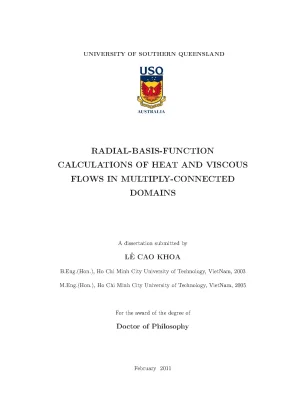
Tải xuống để đọc toàn bộUNIVERSITY OF SOUTHERN QUEENSLAND RADIAL-BASIS-FUNCTION CALCULATIONS OF HEAT AND VISCOUS FLOWS IN MULTIPLY-CONNECTED DOMAINS A dissertation submitted by LÊ CAO KHOA B.), Ho Chi Minh City University of Technology, VietNam, 2003 M.), Ho Chi Minh City University of Technology, VietNam, 2005 For the award of the degree of Doctor of Philosophy February 2011 Dedication To my family. Certification of Dissertation I certify that the idea, experimental work, results and analyses, software and conclusions reported in this dissertation are entirely my own effort, except where otherwise acknowledged. I also certify that the work is original and has not been previously submitted for any other award. KHOA LE-CAO, Candidate Date ENDORSEMENT A/Prof.
NAM MAI-DUY, Principal supervisor Date Prof. THANH TRAN-CONG, Co-supervisor Date Dr. CANH-DUNG TRAN, External supervisor (CSIRO) Date Acknowledgments I would like to express my deepest gratitude to A/Prof. Nam Mai-Duy and Prof.
Thanh Tran-Cong, my principal supervisors, not only for their invalu- able guidance throughout my research but also for their philosophical attitude which has inspired my research interest. Undoubtedly, without their continuing support and encouragement this thesis would not have been completed. In addition, I wish to express my sincere thanks to Dr. Canh-Dung Tran for acting his role as external supervisor, and to Prof.
David Buttsworth and Ms. Juanita Ryan for their kind supports. I gratefully acknowledge the financial support provided by the University of Southern Queensland (USQ) and the Commonwealth Scientific and Industrial Research Organisation (CSIRO), including a USQ Research Excellence scholar- ship, a Faculty of Engineering and Surveying (FoES) scholarship supplement, a Computational Engineering and Science Research Centre (CESRC) scholarship supplement, and a CSIRO Future Manufacturing Flagship Top Up scholarship. Finally, I would like to dedicate this work to my parents.
I am greatly indebted to my family for much unconditional support, understanding and love over the years and for endlessly encouraging me in academic pursuits. Notes to Readers To facilitate the reading of this thesis, a number of files are included on the attached CD to provide animation of some numerical results in this thesis. The contents of the CD include: 1.pdf: An electronic version of this thesis; 2. Chapter3-Circular-Circular-Annuli-velocity.wmv: An animation showing the evolution of velocity field of the buoyancy flow in a concentric circular- circular annulus using a Cartesian grid 36 × 36 (P r = 0.
Chapter3-Square-Circular-Annuli-velocity.wmv: An animation showing the evolution of velocity field of the buoyancy flow in a concentric square- circular annulus using a Cartesian grid 36 × 36 (P r = 0. Chapter4-Rotating-cylinder.wmv: An animation showing the evolution of the flow between a rotating circular cylinder and a fixed square cylinder using a Cartesian grid 26 × 26 (Section 4. Abstract This PhD research project is concerned with the development of accurate and ef- ficient numerical methods, which are based on one-dimensional integrated radial basis function networks (1D-IRBFNs), point collocation and Cartesian grids, for the numerical simulation of heat and viscous flows in multiply-connected domains, and their applications to the numerical prediction of the material properties of suspensions (i. In the proposed techniques, the employment of 1D-IRBFNs, where the RBFN approximations on each grid line are constructed through integration, provides a powerful means of repre- senting the field variables, while the use of Cartesian grids and point collocation provides an efficient way to discretise the governing equations defined on com- plicated domains.
Firstly, 1D-IRBFN-based methods are developed for the simulation of heat transfer problems governed by Poisson equations in multiply-connected do- mains. Derivative boundary conditions are imposed in an exact manner with the help of the integration constants. Secondly, 1D-IRBFN based methods are further developed for the discretisation of the stream-function - vorticity for- mulation and the stream-function formulation governing the motion of a New- tonian fluid in multiply-connected domains. For the stream-function - vorticity formulation, a novel formula for obtaining a computational vorticity bound- ary condition on a curved boundary is proposed and successfully verified.
For the stream-function formulation, double boundary conditions are implemented Abstract v without the need to use external points or to reduce the number of interior nodes for collocating the governing equations. Processes of implementing cross derivatives and deriving the stream-function values on separate boundaries are presented in detail. Thirdly, for a more efficient discretisation, 1D-IRBFNs are incorporated into the domain embedding technique. The multiply-connected domain is transformed into a simply-connected domain, which is more suitable for problems with several unconnected interior moving boundaries.
Finally, 1D- IRBFN-based methods are applied to predict the bulk properties of particulate suspensions under simple shear conditions. All simulated results using Cartesian grids of relatively coarse density agree well with other numerical results available in the literature, which indicates that the proposed discretisation schemes are useful numerical techniques for the analysis of heat and viscous flows in multiply-connected domains. Papers Resulting from the Research Journal Papers 1. Le-Cao and T.
Tran-Cong (2008) A Cartesian grid tech- nique based on one-dimensional integrated radial basis function networks for natural convection in concentric annuli, International Journal for Nu- merical Methods in Fluids, 57, p. Mai Duy and T. Tran-Cong (2009) An effective integrated- RBFN Cartesian-grid discretisation to the stream function-vorticity-temperature formulation in non-rectangular domains, Numerical Heat Transfer, Part B, 55, p. Published Papers Resulting from the Research vii Conference Papers 1.
Mai-Duy and T. Tran-Cong (2007) Radial basis function calculations of buoyancy-driven flow in concentric and eccentric annuli. The 16th Australasian Fluid Mechanics Conference, Gold Coast, QLD, Australia, 3-7 December. Proceedings of The 16th Australasian Fluid Mechanics Conference (CD), p.
The University of Queensland (ISBN 978-1-864998-94-8). Mai-Duy and T. Tran-Cong (2009) Direct simulation of two-dimensional particulate shear flows using radial basis functions. The 5th Australian-Korean Rheology Conference, Sydney, NSW, Australia, 1-4/Nov/2009.
Tran-Cong (2010) A new integrated-RBF-based domain-embedding scheme for solving fluid flow problems. The 9th World Congress on Computational Mechanics and 4th Asian Pacific Congress on Computational Mechanics (WCCM/APCOM 2010), Sydney, Australia, 19-23/Jul/2010. IOP Conference Series: Materials Science and Engineering, Vol. Tran-Cong (2010) Integrated- RBF calculations for direct simulation of shear suspension flows.
Inter- national Conference on Computational & Experimental Engineering and Sciences(ICCES MM’10), Busan, South Korea, 17-21/Aug/2010. IC- CES journal. Tech Science Press (ISSN: 1933-2815 (online)) (accepted, 30/Nov/2010) 5. Mai-Duy and T.
Tran-Cong (2010) Simulation Published Papers Resulting from the Research viii of fluid flows at high Reynolds numbers using radial basis function net- works. 17th Australasian Fluid Mechanics Conference, Auckland, New Zealand, 5-9/Dec/2010. Proceed- ings of 17th Australasian Fluid Mechanics Conference, Paper No 139, 4 pages. The University of Auckland (ISBN: 978-0-86869-129-9).
Contents Dedication ii Certification of Dissertation i Acknowledgments ii Notes to Readers iii Abstract iv Published Papers Resulting from the Research vi Acronyms & Abbreviations xv List of Tables xvi List of Figures xx Chapter 1 Introduction 1 Contents x 1.1 Governing equations and Discretisation methods .2 Viscous flows in multiply-connected domains .4 Outline of the Dissertation. 14 Chapter 2 1D-integrated-RBFN calculation of heat transfer in multiply-connected domains 17 2.1 Review of RBFN-based methods .1 Conventional direct/differential approach .2 Indirect/Integral approach .2 One-dimensional IRBFN method for heat transfer in multiply- connected domains. 40 Contents xi Chapter 3 1D-integrated-RBFN discretisation of stream-function - vorticity (ψ − ω) formulation in multiply-connected domains 42 3.3 The present technique .2 A new formula for computing vorticity boundary conditions 51 3.3 Numerical implementation of vorticity boundary conditions 54 3.1 Example 1: Circular shape domain .2 Example 2: Multiply-connected domain .3 Example 3: Concentric annulus between two circular cylin- ders .4 Example 4: Concentric annulus between a square outer cylinder and a circular inner cylinder. 74 Chapter 4 1D-integrated-RBFN discretisation of stream-function (ψ) formulation in multiply-connected domains 78 4.3 Brief review of 1D-integrated RBFNs .4 Proposed numerical procedure .1 Boundary values for stream function .1 Example 1: Steady flow between a rotating circular cylin- der and a fixed square cylinder .2 Example 2: Natural convection in an eccentric annulus between two circular cylinders .3 Example 3: Natural convection in eccentric annuli be- tween a square outer and a circular inner cylinder.
117 Chapter 5 1D-integrated-RBFN-based domain embedding tech- nique 119 5.2 Proposed domain-embedding technique .1 1D-IRBFN discretisation for extended domain .2 Imposition of the boundary conditions on the inner bound- aries. 139 Chapter 6 1D-integrated-RBFN calculation of particulate sus- pension flows 142 6.2 Governing equations and sliding frames concept .2 Sliding bi-periodic frames concept .3 Proposed numerical procedure .2 Sliding bi-periodic boundary conditions .3 Boundary conditions on the particles’ boundaries .1 Example 1: Sliding bi-periodic boundary conditions .2 Example 2: A rotating circular cylinder .3 Example 3: Shear suspension flow. 185 Acronyms & Abbreviations 1D-IRBFN One-Dimensional Indirect/Integrated Radial Basis Function Network BEM Boundary Element Method CFD Computational Fluid Dynamics DNS Direct Numerical Simulations DRBFN Direct/Differentiated Radial Basis Function Network FDM Finite Difference Method FEM Finite Element Method FVM Finite Volume Method IRBFN Indirect/Integrated Radial Basis Function Network MQ MultiQuadric ODE Ordinary Differential Equation PDE Partial Differential Equation SVD Singular Value Decomposition List of Tables 2.1 Example 1 (boundary value problem - Dirichlet boundary condi- tion - Case 1): Condition numbers of the IRBFN system matrix.2 Example 2 (boundary value problem - Dirichlet and Neumann boundary conditions): Overall accuracy of the solution T by the present technique. Condition numbers of the IRBFN system ma- trix are also included.
It is noted that a(b) represents a × 10b. It is noted that a(b) represents a × 10b .1 Example 1( circular shape domain): Errors by 1D-IRBFN-2s (Scheme 1) and 1D-IRBFN-4s (Scheme 2) in the computation of second derivatives of ψ at the boundary points. It is noted that a(b) represents a × 10b. 62 List of Tables xvii 3.
Condition numbers of the IRBFN system matrix are also included. It is noted that h is the spacing (grid size) and a(b) represents a × 10b .3 Example 2 (multiply-connected domain): Condition numbers of the system matrix and relative L2 errors of the solution. It is noted that h is the spacing (grid size) and a(b) represents a × 10b .4 Example 3 (circular - circular cylinders): Condition numbers of the 1D-IRBFN system matrix by the two formulations.5 Example 3 (circular - circular cylinders): Comparison of the av- erage equivalent conductivity on the inner and outer cylinders, keqi and keqo , between the present IRBFN technique using a grid of 52 × 52 and some other techniques for Ra in the range of 102 to 7 × 10⁴. KG stands for Kuehn and Goldstein .6 Example 4 (square-circular cylinders): Comparison of the aver- age Nusselt number on the outer and inner cylinders, Nuo and Nui , for Ra from 104 to 106 between the present technique (grid 52 × 52) and some other techniques.1 Example 1 (rotating cylinder): Comparison of the stream-function values at the inner cylinder, ψw , for Re from 1 to 1000 between the present technique (grid of 52 × 52) and finite difference tech- nique.2 Condition numbers of the RBFN matrices associated with the harmonic and biharmonic operators.
104 List of Tables xviii 4.3 Example 2 (symmetric flow, concentric circular-circular annuli): Convergence of k̄eq with grid refinement for the flow at Ra = 102 .4 Example 2 (symmetric flow, concentric circular-circular annuli): Convergence of k̄eq with grid refinement for the flow at Ra = 103 .5 Example 2 (symmetric flow, concentric circular-circular annuli): Convergence of k̄eq with grid refinement for the flow at Ra = 3×10³ .6 Example 2 (symmetric flow, concentric circular-circular annuli): Convergence of k̄eq with grid refinement for the flow at Ra = 6×10³ .7 Example 2 (symmetric flow, concentric circular-circular annuli): Convergence of k̄eq with grid refinement for the flow at Ra = 104 .8 Example 2 (symmetric flow, concentric circular-circular annuli): Convergence of k̄eq with grid refinement for the flow at Ra = 5×10⁴ .9 Example 2 (symmetric flow, concentric circular-circular annuli): Convergence of k̄eq with grid refinement for the flow at Ra = 7×10⁴ .10 Example 2 (symmetric flow, eccentric circular-circular annuli): Comparison of the maximum stream-function values, ψmax , for two special cases ϕ = {−900 , 900} between the present technique and DQM technique.
Nội dung được bảo vệ bản quyền — Tải xuống đầy đủ
Trích dẫn luận án này
Lê Cao Khoa (2011). RBFN: Mô phỏng dòng nhiệt, nhớt trong miền đa liên kết [Luận án tiến sĩ, University of Southern Queensland]. LuanAn.net. https://luanan.net/toan-hoc/toan-ung-dung/rbfn-mo-phong-dong-nhiet-nhot-mien-da-lien-ket
Câu hỏi thường gặp
Luận án "RBFN: Mô phỏng dòng nhiệt, nhớt trong miền đa liên kết" nghiên cứu về vấn đề gì?
Luận án tiến sĩ tập trung tính toán dòng nhiệt và dòng nhớt bằng Radial Basis Function (RBF) trong các miền đa liên thông, mở ra hướng giải mới.
Luận án "RBFN: Mô phỏng dòng nhiệt, nhớt trong miền đa liên kết" được bảo vệ tại trường nào?
Luận án này được bảo vệ tại University of Southern Queensland. Năm bảo vệ: 2011.
Luận án "RBFN: Mô phỏng dòng nhiệt, nhớt trong miền đa liên kết" thuộc chuyên ngành gì?
Luận án "RBFN: Mô phỏng dòng nhiệt, nhớt trong miền đa liên kết" thuộc chuyên ngành Kỹ thuật tính toán. Danh mục: Toán Ứng Dụng.
Luận án "RBFN: Mô phỏng dòng nhiệt, nhớt trong miền đa liên kết" có bao nhiêu trang?
Luận án "RBFN: Mô phỏng dòng nhiệt, nhớt trong miền đa liên kết" có 226 trang. Bạn có thể xem trước một phần tài liệu ngay trên trang web trước khi tải về.
Cách tải luận án "RBFN: Mô phỏng dòng nhiệt, nhớt trong miền đa liên kết" về máy như thế nào?
Để tải luận án về máy, bạn nhấn nút "Tải xuống ngay" trên trang này, sau đó hoàn tất thanh toán phí lưu trữ. File sẽ được tải xuống ngay sau khi thanh toán thành công. Hỗ trợ qua Zalo: 0559 297 239.