Điều kiện hội tụ của lời giải cho bài toán tối ưu hóa tập hợp - Luận án tiến sĩ
Luận án tiến sĩ nghiên cứu điều kiện hội tụ lời giải bài toán tối ưu hóa tập hợp. Phân tích tính ổn định, well-posedness và ứng dụng bài toán cân bằng vector.
university of science, vietnam national university ho chi minh city
Luan An
Luận án
Năm xuất bản
Số trang
123
Thời gian đọc
19 phút
Lượt xem
0
Lượt tải
0
Phí lưu trữ
40 Point
Tổng quan nhanh
- Chủ đề:
- 1. Điều Kiện Hội Tụ Trong Bài Toán Tối Ưu Tập Hợp
- Số trang:
- 123 trang
- Trường:
- university of science, vietnam national university ho chi minh city
- Chuyên ngành:
- Applied Mathematics
- Tác giả:
- Dinh Vinh Hien
- Năm:
- 2022
Tóm tắt nội dung luận án
I. Điều Kiện Hội Tụ Trong Bài Toán Tối Ưu Tập Hợp
Bài toán tối ưu hóa tập hợp nghiên cứu điều kiện hội tụ của lời giải trong không gian vectơ. Lý thuyết này mở rộng bài toán tối ưu vectơ truyền thống. Nghiên cứu tập trung vào điều kiện cần và điều kiện đủ cho sự tồn tại nghiệm. Phương pháp lặp đóng vai trò quan trọng trong việc tìm lời giải xấp xỉ. Tốc độ hội tụ phụ thuộc vào tính chất của ánh xạ đa trị và quan hệ thứ tự tập hợp. Hàm Lipschitz xuất hiện như điều kiện đảm bảo tính ổn định của nghiệm. Các nhà toán học áp dụng lý thuyết này vào kinh tế phúc lợi và bài toán cân bằng mạng lưới. Luận án phát triển điều kiện tối ưu cho nghiệm yếu, nghiệm lý tưởng và nghiệm hiệu quả. Kết quả nghiên cứu góp phần hoàn thiện lý thuyết tối ưu tập hợp hiện đại.
1.1. Mô Hình Bài Toán Tối Ưu Tập Hợp Cơ Bản
Bài toán tối ưu tập hợp sử dụng ánh xạ đa trị từ không gian quyết định đến không gian ảnh. Quan hệ thứ tự tập hợp xác định khái niệm nghiệm tối ưu. Hội tụ Painlevé-Kuratowski mô tả sự hội tụ của dãy tập hợp. Điều kiện KKT mở rộng cho bài toán này đòi hỏi các giả thiết mạnh hơn. Ánh xạ đa trị liên tục theo nghĩa nửa liên tục trên và dưới. Các phần tử cực tiểu trong không gian ảnh được phân loại thành nhiều loại khác nhau.
1.2. Tính Liên Tục Của Ánh Xạ Đa Trị
Ánh xạ đa trị yêu cầu định nghĩa liên tục khác với hàm đơn trị. Tính nửa liên tục trên đảm bảo tập ảnh không mở rộng đột ngột. Tính nửa liên tục dưới ngăn chặn tập ảnh co lại quá nhanh. Hai tính chất này cùng tồn tại tạo nên ánh xạ liên tục. Hàm Lipschitz cho ánh xạ đa trị sử dụng khoảng cách Hausdorff. Điều kiện này đảm bảo tốc độ hội tụ tuyến tính của phương pháp lặp.
1.3. Quan Hệ Thứ Tự Tập Hợp Set Less
Quan hệ thứ tự Set Less so sánh hai tập hợp trong không gian vectơ. Định nghĩa dựa trên nón thứ tự trong không gian ảnh. Quan hệ này không đối xứng và không bắc cầu trong trường hợp tổng quát. Nhiều biến thể của quan hệ Set Less được đề xuất trong văn liệu. Mỗi quan hệ dẫn đến khái niệm nghiệm tối ưu khác nhau. Lựa chọn quan hệ phù hợp phụ thuộc vào ứng dụng cụ thể.
II. Điều Kiện Ổn Định Cho Nghiệm Yếu Và Lý Tưởng
Nghiệm yếu và nghiệm lý tưởng là hai khái niệm quan trọng trong tối ưu tập hợp. Điều kiện ổn định đảm bảo nghiệm không thay đổi nhiều khi dữ liệu nhiễu. Ổn định ngoài liên quan đến sự tồn tại nghiệm khi tham số biến thiên. Ổn định trong mô tả tính liên tục của ánh xạ nghiệm. Gradient projection được sử dụng để xây dựng dãy hội tụ đến nghiệm. Phương pháp lặp dựa trên phép chiếu lên tập chấp nhận được. Tốc độ hội tụ phụ thuộc vào hằng số Lipschitz của ánh xạ. Ứng dụng trong kinh tế phúc lợi minh họa tính thực tiễn của lý thuyết. Kết quả này mở rộng các nghiên cứu trước về tối ưu vectơ.
2.1. Tính Chất Phần Tử Cực Tiểu
Phần tử cực tiểu trong không gian ảnh có nhiều định nghĩa khác nhau. Phần tử yếu cực tiểu thỏa mãn điều kiện yếu nhất. Phần tử lý tưởng cực tiểu yêu cầu điều kiện mạnh hơn. Phần tử hiệu quả nằm giữa hai khái niệm trên. Mối quan hệ giữa các loại phần tử được thiết lập rõ ràng. Điều kiện tối ưu cho mỗi loại có dạng khác nhau.
2.2. Điều Kiện Ổn Định Ngoài Cho Nghiệm
Ổn định ngoài nghiên cứu tập nghiệm khi tham số thay đổi. Tính nửa liên tục trên của ánh xạ nghiệm ngăn nghiệm xuất hiện đột ngột. Điều kiện đủ thường yêu cầu tính lồi tổng quát của bài toán. Hàm Lipschitz của dữ liệu đảm bảo ổn định mạnh. Khoảng cách Hausdorff đo độ thay đổi của tập nghiệm. Các phản ví dụ minh họa tính cần thiết của các giả thiết.
2.3. Điều Kiện Ổn Định Trong Cho Nghiệm
Ổn định trong yêu cầu tính nửa liên tục dưới của ánh xạ nghiệm. Điều kiện này đảm bảo nghiệm không biến mất khi nhiễu nhỏ. Gradient projection method xây dựng dãy hội tụ đến nghiệm ổn định. Tốc độ hội tụ tuyến tính đạt được dưới điều kiện Lipschitz mạnh. Phương pháp lặp kết hợp chiếu và cập nhật gradient. Ứng dụng trong kinh tế Pareto tối ưu minh họa hiệu quả.
III. Điều Kiện Hội Tụ Cho Nghiệm Hiệu Quả Tối Ưu
Nghiệm hiệu quả đóng vai trò trung tâm trong lý thuyết tối ưu tập hợp. Điều kiện cần cho nghiệm hiệu quả mở rộng điều kiện KKT cổ điển. Điều kiện đủ đòi hỏi tính lồi suy rộng của ánh xạ mục tiêu. Hội tụ nghiệm được đảm bảo qua hội tụ Painlevé-Kuratowski. Phương pháp lặp gradient projection tìm nghiệm hiệu quả xấp xỉ. Tốc độ hội tụ phụ thuộc vào hằng số Lipschitz và tính lồi mạnh. Bài toán tối ưu vectơ bất định mở rộng mô hình với tham số không chắc chắn. Tính well-posed đảm bảo bài toán có nghiệm duy nhất ổn định. Các kết quả này áp dụng vào bài toán cân bằng và tối ưu đa mục tiêu.
3.1. Tính Chất Nghiệm Hiệu Quả
Nghiệm hiệu quả nằm giữa nghiệm yếu và nghiệm lý tưởng. Điều kiện tối ưu bậc một sử dụng đạo hàm theo hướng. Điều kiện KKT mở rộng yêu cầu điều kiện chính quy ràng buộc. Nhân tử Lagrange trở thành ánh xạ đa trị trong trường hợp này. Điều kiện đủ bậc hai liên quan đến ma trận Hessian suy rộng. Tính lồi mạnh đảm bảo nghiệm hiệu quả là duy nhất.
3.2. Điều Kiện Hội Tụ Painlevé Kuratowski
Hội tụ Painlevé-Kuratowski mở rộng hội tụ điểm cho tập hợp. Giới hạn trên bao gồm tất cả điểm giới hạn của dãy điểm. Giới hạn dưới chứa các điểm có dãy con hội tụ đến. Hội tụ đầy đủ xảy ra khi hai giới hạn trùng nhau. Điều kiện đủ cho hội tụ dựa vào tính đóng và bị chặn. Áp dụng vào tập nghiệm đảm bảo hội tụ nghiệm xấp xỉ.
3.3. Phương Pháp Gradient Projection
Gradient projection kết hợp gradient descent và phép chiếu. Mỗi bước lặp tính gradient rồi chiếu lên tập chấp nhận được. Tốc độ hội tụ tuyến tính đạt được với hằng số Lipschitz phù hợp. Điều kiện dừng dựa trên độ lớn của gradient chiếu. Phương pháp này áp dụng hiệu quả cho bài toán lồi. Biến thể adaptive step size cải thiện tốc độ hội tụ thực tế.
IV. Tính Well Posed Cho Bài Toán Vectơ Bất Định
Bài toán tối ưu vectơ bất định chứa tham số không chắc chắn. Cách tiếp cận lạc quan chọn tham số tốt nhất cho mỗi quyết định. Tính well-posed đảm bảo nghiệm tồn tại duy nhất và ổn định. Mối quan hệ giữa bài toán vectơ và bài toán vô hướng hóa được thiết lập. Điều kiện đủ cho well-posed sử dụng tính lồi và Lipschitz. Đặc trưng hóa well-posed qua dãy cực tiểu hóa. Phương pháp lặp xây dựng dãy hội tụ đến nghiệm duy nhất. Tốc độ hội tụ được ước lượng qua hằng số bài toán. Ứng dụng trong tối ưu đa mục tiêu với dữ liệu không chắc chắn.
4.1. Khái Niệm Well Posedness
Bài toán well-posed có nghiệm tồn tại, duy nhất và ổn định. Tính Tykhonov well-posed yêu cầu dãy cực tiểu hóa hội tụ đến nghiệm. Levitin-Polyak well-posed cho phép nhiễu trong hàm mục tiêu. Hadamard well-posed đảm bảo nghiệm liên tục theo dữ liệu. Mỗi khái niệm phù hợp với ứng dụng khác nhau. Điều kiện tương đương giữa các định nghĩa được chứng minh.
4.2. Mối Quan Hệ Với Bài Toán Vô Hướng
Bài toán vectơ vô hướng hóa qua hàm scalarization. Hàm trọng số tuyến tính là cách đơn giản nhất. Hàm Chebyshev đảm bảo tìm được mọi nghiệm hiệu quả. Well-posedness của bài toán vô hướng kéo theo well-posedness vectơ. Điều kiện ngược lại yêu cầu giả thiết bổ sung. Kết quả này giúp kiểm tra well-posedness dễ dàng hơn.
4.3. Điều Kiện Đủ Cho Well Posedness
Tính lồi chặt của hàm mục tiêu đảm bảo nghiệm duy nhất. Hàm Lipschitz của dữ liệu theo tham số cho ổn định. Tập chấp nhận được compact đảm bảo tồn tại nghiệm. Điều kiện tăng trưởng coercive ngăn nghiệm chạy ra vô cùng. Kết hợp các điều kiện này cho well-posedness mạnh. Phản ví dụ chỉ ra tính cần thiết của từng giả thiết.
V. Bài Toán Cân Bằng Vectơ Tham Số Với Nón Biến
Bài toán cân bằng vectơ tổng quát hóa bài toán tối ưu và bất đẳng thức biến phân. Nón thứ tự biến theo tham số tạo độ linh hoạt cho mô hình. Điều kiện ổn định cho ánh xạ nghiệm là mục tiêu chính. Tính nửa liên tục trên của ánh xạ nghiệm được thiết lập. Tính nửa liên tục dưới yêu cầu điều kiện mạnh hơn. Well-posedness cho bài toán cân bằng đảm bảo tính ổn định toàn diện. Well-posedness Hadamard mô tả ổn định dưới nhiễu tổng quát. Uniquely well-posedness yêu cầu nghiệm duy nhất. Ứng dụng vào bài toán mạng lưới giao thông và cân bằng bị chặn. Kết quả mở rộng lý thuyết cân bằng Nash và Wardrop.
5.1. Tính Nửa Liên Tục Trên Ánh Xạ Nghiệm
Điều kiện đủ cho nửa liên tục trên sử dụng tính đóng của đồ thị. Tính liên tục của hàm cân bằng và nón thứ tự là cần thiết. Tập chấp nhận được liên tục theo nghĩa Painlevé-Kuratowski. Compact địa phương của tập nghiệm hỗ trợ chứng minh. Phản ví dụ minh họa các giả thiết không thể bỏ. Kết quả áp dụng cho bài toán cân bằng tổng quát.
5.2. Tính Nửa Liên Tục Dưới Ánh Xạ Nghiệm
Nửa liên tục dưới khó đạt được hơn nửa liên tục trên. Điều kiện monotone của hàm cân bằng đóng vai trò quan trọng. Tính lồi của tập chấp nhận được và hàm cân bằng cần thiết. Điều kiện Slater đảm bảo tính ổn định của nghiệm trong. Kết hợp hai tính nửa liên tục cho ánh xạ nghiệm liên tục. Ứng dụng trong bài toán cân bằng kinh tế.
5.3. Well Posedness Hadamard Và Uniquely
Well-posedness Hadamard đảm bảo ổn định dưới nhiễu tùy ý. Uniquely well-posedness yêu cầu nghiệm duy nhất và ổn định. Điều kiện đủ kết hợp monotone mạnh và Lipschitz. Đặc trưng hóa qua tính chất của dãy nghiệm xấp xỉ. Áp dụng vào bài toán mạng lưới giao thông Wardrop. Bài toán cân bằng bị chặn trên và dưới cũng được xét.
VI. Ứng Dụng Trong Kinh Tế Và Mạng Lưới Giao Thông
Lý thuyết tối ưu tập hợp áp dụng rộng rãi trong kinh tế phúc lợi. Bài toán Pareto tối ưu mô hình hóa phân bổ tài nguyên hiệu quả. Điều kiện hội tụ đảm bảo thuật toán tìm được phân bổ tối ưu. Mạng lưới giao thông sử dụng bài toán cân bằng Wardrop. Cân bằng Nash trong lý thuyết trò chơi là trường hợp đặc biệt. Tốc độ hội tụ của phương pháp lặp ảnh hưởng đến tính khả thi thực tế. Bài toán cân bằng bị chặn mô hình hóa ràng buộc công suất. Điều kiện KKT mở rộng cung cấp điều kiện cần cho nghiệm. Tính well-posed đảm bảo mô hình kinh tế ổn định. Các kết quả lý thuyết được minh họa qua ví dụ số cụ thể.
6.1. Bài Toán Pareto Tối Ưu Kinh Tế
Pareto tối ưu mô tả phân bổ không thể cải thiện mà không làm ai đó tệ hơn. Mô hình sử dụng tối ưu vectơ với mỗi thành phần là lợi ích cá nhân. Điều kiện tối ưu dẫn đến cân bằng cạnh tranh. Phương pháp lặp tìm phân bổ Pareto hiệu quả. Tốc độ hội tụ phụ thuộc vào tính lồi của hàm lợi ích. Ứng dụng trong thiết kế cơ chế và đấu giá.
6.2. Cân Bằng Mạng Lưới Giao Thông
Cân bằng Wardrop mô tả luồng giao thông ổn định. Mỗi người dùng chọn tuyến đường tối thiểu chi phí cá nhân. Điều kiện cân bằng là bất đẳng thức biến phân. Tính tồn tại và duy nhất nghiệm được đảm bảo. Phương pháp Frank-Wolfe tìm cân bằng hiệu quả. Tốc độ hội tụ tuyến tính dưới điều kiện monotone mạnh.
6.3. Bài Toán Cân Bằng Bị Chặn
Cân bằng bị chặn trên và dưới mô hình hóa ràng buộc công suất. Tập chấp nhận được là hộp trong không gian Euclid. Điều kiện KKT bao gồm nhân tử Lagrange cho ràng buộc hộp. Phương pháp projection gradient áp dụng trực tiếp. Tính well-posed đảm bảo nghiệm ổn định khi tham số thay đổi. Ứng dụng trong quản lý tài nguyên và sản xuất.
Mục lục chi tiết luận án
Tải xuống file đầy đủ để xem toàn bộ nội dung
Tải đầy đủ (123 trang)Nội dung chính
Tổng quan về luận án
Nghiên cứu về điều kiện hội tụ và tính ổn định của nghiệm cho các bài toán tối ưu tập (Set Optimization Problems - SOP) cùng các bài toán liên quan đóng vai trò nền tảng trong giải tích biến phân hiện đại và toán ứng dụng. Luận án tiến sĩ của nghiên cứu sinh Đinh Vĩnh Hiển (chuyên ngành Toán ứng dụng, mã số 9460112, Đại học Khoa học Tự nhiên - Đại học Quốc gia TP. Hồ Chí Minh, năm 2022, dưới sự hướng dẫn khoa học của GS. Lâm Quốc Anh và PGS.TS. Nguyễn Lê Hoàng Anh) đã giải quyết trọn vẹn những thách thức lý thuyết cốt lõi về sự hội tụ của tập nghiệm trong không gian ảnh (image space approach) dưới các nhiễu loạn tập ràng buộc và ánh xạ mục tiêu.
Khoảng trống nghiên cứu (research gap) mà luận án tập trung khai phá xuất phát từ thực tế: phần lớn các công trình kinh điển trước đây (Gutiérrez et al., 2016; Karuna & Lalitha, 2018; Miglierina & Molho, 2004) chủ yếu khảo sát tính ổn định ngoài (external stability) và tính ổn định trong (internal stability) đối với quan hệ thứ tự kiểu dưới (lower type set less order relation $\le_l$) hoặc chỉ giới hạn ở nghiệm tối tiểu yếu (weakly minimal solutions). Hơn thế nữa, việc nghiên cứu sự hội tụ trên (upper convergence) của nghiệm tối tiểu hữu hiệu Pareto (efficient minimal solutions) thường gặp trở ngại kỹ thuật nghiêm trọng, buộc các tác giả trước phải áp đặt giả thiết đồng nhất nhân tạo giữa nghiệm hữu hiệu và nghiệm yếu. Đặc biệt, luận án đã phát hiện và khắc phục một sai số giải tích mang tính cấu trúc trong chứng minh định lý hội tụ của Gutiérrez et al. (2016, Định lý 3.1) liên quan đến bất đẳng thức khoảng cách nón.
Hệ thống câu hỏi nghiên cứu và giả thuyết khoa học được thiết lập chặt chẽ:
- Câu hỏi nghiên cứu 1 ($RQ_1$): Điều kiện đủ nào đảm bảo tính ổn định ngoài và ổn định trong cho nghiệm yếu ($\text{WMin}$) và nghiệm lý tưởng ($\text{SMin}$) của bài toán tối ưu tập theo quan hệ thứ tự gộp $\le_s$ dưới sự hội tụ Painlevé-Kuratowski và Hausdorff khi tập chấp nhận được bị nhiễu loạn?
- Câu hỏi nghiên cứu 2 ($RQ_2$): Làm thế nào thiết lập điều kiện hội tụ trên cho tập nghiệm hữu hiệu Pareto ($\text{Min}$) mà không cần giả định $\text{Min} \equiv \text{WMin}$?
- Câu hỏi nghiên cứu 3 ($RQ_3$): Mối quan hệ định lượng giữa tính đúng đắn (well-posedness) của bài toán tối ưu vector bất định đối ứng lạc quan $P(\mathcal{U})$ và bài toán vô hướng hóa phi tuyến qua hàm Gerstewitz mở rộng là gì?
- Câu hỏi nghiên cứu 4 ($RQ_4$): Cấu trúc nửa liên tục Hausdorff và tính đúng đắn Hadamard/Tikhonov/Levitin-Polyak của ánh xạ nghiệm bài toán tựa cân bằng vector tham số với nón biến thiên (variable cones) vận hành như thế nào?
Khung lý thuyết của luận án tích hợp lý thuyết quan hệ thứ tự tập (Kuroiwa, 1998; Jahn & Ha, 2011), tô pô tập giải tích Painlevé-Kuratowski (Rockafellar & Wets, 1998), lý thuyết vô hướng hóa phi tuyến Gerstewitz (Khan et al., 2015), và lý thuyết cân bằng tựa biến phân (Blum & Oettli, 1994). Tác động đột phá của công trình được định lượng qua việc mở rộng phạm vi ứng dụng cho các mô hình kinh tế học phúc lợi $m$ doanh nghiệp, $n$ người tiêu dùng ($\mathbb{R}^{nm+1}$), bài toán mạng lưới giao thông co giãn (Elastic Traffic Network Problems - $TNP$), và bài toán cân bằng bị chặn ($BEP$).
Literature Review và Positioning
Lịch sử phát triển của lý thuyết tối ưu hóa chứng kiến sự chuyển dịch mô hình (paradigm shift) từ tối ưu vô hướng (Muu & Oettli, 1992; Blum & Oettli, 1994) sang tối ưu vector với nón cố định (Luc, 1989; Göpfert et al., 2003), và đỉnh cao hiện nay là tối ưu tập đa trị (Khan, Tammer & Zălinescu, 2015; Mordukhovich, 2018). Trong nhánh tối ưu tập, tồn tại hai trường phái tiếp cận đối nghịch: trường phái vector (vector approach) chỉ tìm điểm hữu hiệu trên hợp của các tập ảnh $\bigcup_{x \in K} F(x)$ (Jahn, 2004) và trường phái tập (set optimization approach) so sánh trực tiếp các tập hợp thông qua quan hệ thứ tự nón (Kuroiwa, 1998).
Quan hệ thứ tự tập kiểu dưới $\le_l$ ($A \le_l B \iff B \subset A + C$) và kiểu trên $\le_u$ ($A \le_u B \iff A \subset B - C$) được Young (1931) khởi xướng trong đại số, Nishnianidze (1984) áp dụng trong lý thuyết điểm bất động, Chiriaev & Walster (1996) dùng trong giải tích khoảng, và Kuroiwa (1998) đưa vào tối ưu hóa. Đến năm 2011, Jahn & Ha đã kết hợp hai quan hệ này để tạo ra quan hệ thứ tự tập đầy đủ: $$A \le_s B \iff (B \subset A + C \text{ và } A \subset B - C)$$
Về mặt động thái nhiễu loạn, Geoffroy (2006) thiết lập tô pô trên họ các tập bị chặn dưới để xét hội tụ nghiệm theo $\le_l$. Gutiérrez, Huerga & Novo (2016) công bố nghiên cứu về tính ổn định Painlevé-Kuratowski cho bài toán tối ưu tập nhưng vấp phải thiếu sót trong việc ước lượng khoảng cách: trích dẫn nguyên văn từ luận án: "Gutiérrez et al. [34] investigated the upper convergence results for the weakly minimal solutions to set optimization problems via the l-type of less order relation and use the inequality $\inf_{h_0} d(h_0, (C_0 + B(0,\eta_0) + \text{int} K)) \le \eta_0$ for $h_0 \in Y \setminus (C_0 + \text{int} K)$ in the proof of Theorem 3.1. Clearly, this inequality does not hold in general."
Karuna & Lalitha (2018) kế thừa kết quả của Gutiérrez et al. nhưng áp đặt giả thiết rất chặt rằng tập $\text{cl}(\bigcup_{n \in \mathbb{N}} \Gamma_n)$ phải compac tuần tự. Luận án của Đinh Vĩnh Hiển đã định vị chính xác khoảng trống này, loại bỏ hoàn toàn các giả thiết phi thực tế, đồng thời vượt qua hai nghiên cứu quốc tế tiêu biểu:
- So với Miglierina & Molho (2004, Journal of Optimization Theory and Applications): Luận án tổng quát hóa kết quả từ trường hợp ánh xạ đơn trị đồng nhất sang ánh xạ đa trị compact $F: X \rightrightarrows Y$ với cấu trúc nón lồi đóng nhọn tổng quát $C \subset Y$.
- So với Chen, Huang & O'Regan (2010, Computers & Mathematics with Applications): Công trình mở rộng phân tích ổn định từ không gian metric cố định sang không gian vector tô pô với nón biến thiên $C(x)$ phụ thuộc biến trạng thái.
Đóng góp lý thuyết và khung phân tích
Đóng góp cho lý thuyết
Luận án mở rộng và hoàn thiện hệ tiên đề của Kuroiwa (1998) và Jahn & Ha (2011) bằng việc đề xuất quan hệ tựa thứ tự xấp xỉ $\varepsilon$-set less order relation ($\le_{\varepsilon}$) với $\varepsilon \in \text{int} C$: $$A \le_{\varepsilon} B \iff (A \subset B - C - \varepsilon \text{ và } B \subset A + C + \varepsilon)$$
Từ đó, khái niệm phần tử $\varepsilon$-tối tiểu $\text{Min}{\varepsilon}(\mathcal{Y})$ được định nghĩa: $A \in \text{Min}{\varepsilon}(\mathcal{Y}) \iff (\forall B \in \mathcal{Y}, B \le_{\varepsilon} A \implies A \le_{\varepsilon} B)$. Luận án chứng minh hệ thống mệnh đề và định lý đột phá:
- Mệnh đề lồng nhau (Proposition 2.1): Với mọi $\varepsilon, \tilde{\varepsilon} \in \text{int} C$ thỏa $\varepsilon \le_C \tilde{\varepsilon}$, ta có $\text{Min}{\varepsilon}(\mathcal{Y}) \subset \text{Min}{\tilde{\varepsilon}}(\mathcal{Y})$, và đặc biệt $\text{WMin}(\mathcal{Y}) = \bigcap_{\varepsilon \in \text{int} C} \text{Min}_{\varepsilon}(\mathcal{Y})$.
- Định lý tương đương (Theorem 2.1): Nếu $\text{wmin}(A) \neq \emptyset$ hoặc $\text{wmax}(A) \neq \emptyset$, thì $A \in \text{WMin}(\mathcal{Y}) \iff \nexists B \in \mathcal{Y}: B <_s A$.
- Định lý ổn định ngoài cho nghiệm hữu hiệu (Theorem 3.1 & 3.2): Dưới tính chất đối ngẫu/đảo (converse property) hoặc tính lồi $C$-convex chặt đa trị ($tF(x_1) + (1-t)F(x_2) \subset F(tx_1 + (1-t)x_2) + \text{int} C$), nếu dãy tập nghiệm thỏa $A_n \in \text{Min}(\mathcal{F}{\Gamma_n})$ và $A_n \xrightarrow{K} A$, thì $A \in \text{Min}(\mathcal{F}{\Gamma})$.
Khung phân tích độc đáo
Khung phân tích của luận án dung hợp ba trụ cột giải tích:
- Tô pô đa trị: Ánh xạ đa trị $F: X \rightrightarrows Y$ được khảo sát qua tính nửa liên tục trên Hausdorff (H-usc), nửa liên tục dưới Hausdorff (H-lsc), tính liên tục đóng compact.
- Hội tụ Painlevé-Kuratowski và Hausdorff: Phân tích quan hệ giới hạn dưới $\text{Li} A_n = {x \in Y: x = \lim x_n, x_n \in A_n}$ và giới hạn trên $\text{Ls} A_n = {x \in Y: x = \lim x_k, x_k \in A_{n_k}}$ thông qua khoảng cách Hausdorff mở rộng $e(A, B) = \sup_{a \in A} d(a, B)$.
- Vô hướng hóa Gerstewitz phi tuyến: Hàm phi tuyến $\varphi_{e, k}(y) = \inf {t \in \mathbb{R}: y \in te - k - C}$ được sử dụng làm công cụ đo lường mức độ vi phạm nón trong tối ưu vector bất định.
Điều kiện biên (boundary conditions) được xác định rõ ràng: nón $C$ là nón lồi hình nón, nhọn ($C \cap (-C) = {0_Y}$), đóng và có phần trong khác rỗng ($\text{int} C \neq \emptyset$); ánh xạ $F$ có giá trị compac trên tập biến thiên $\Gamma$.
Phương pháp nghiên cứu tiên tiến
Thiết kế nghiên cứu
Luận án theo đuổi thế giới quan thực chứng suy diễn toán học thuần túy (mathematical positivism & deductive axiomatization). Toàn bộ các kết quả đều được xây dựng qua quy trình chứng minh tiên đề nghiêm ngặt với cấu trúc đa tầng: tầng không gian nền (normed vector spaces $X, Y$), tầng ánh xạ đa trị $F: X \rightrightarrows \mathcal{P}(Y)$, tầng quan hệ thứ tự tập $\mathcal{P}(Y) \times \mathcal{P}(Y)$, và tầng tham số hóa nhiễu loạn ${\Gamma_n}_{n \in \mathbb{N}} \subset X$.
Quy trình nghiên cứu rigorous
Quy trình xây dựng và kiểm định định lý bao gồm:
- Triangulation phương pháp: Kết hợp giải tích tập (set-valued analysis), giải tích hàm phi tuyến (nonlinear functional analysis) và lý thuyết nón biến thiên.
- Kỹ thuật phản ví dụ (Counterexample construction): Xây dựng các mô hình phản ví dụ cụ thể trong không gian hàm $X = \mathcal{C}([0, 1], \mathbb{R})$ chuẩn cực đại $|x| = \sup_{t \in [0, 1]} |x(t)|$ và $Y = \mathbb{R}^2$ với $C = \mathbb{R}^2_+$ để chứng minh tính tối ưu (tightness) của các điều kiện đặt ra.
- Sửa sai giải tích: Định vị trực tiếp lỗi hình học trong không gian định chuẩn $Y = \mathbb{R}^2$ của Gutiérrez et al. (2016), vẽ đồ thị minh họa hình học chứng minh $\inf_{h \in Y \setminus (C + \text{int} K)} d(h, C + B(0, \eta) + \text{int} K) > \eta$.
Data và phân tích
Trong nghiên cứu toán học thuần túy, "dữ liệu" chính là các cấu trúc không gian và họ tập hợp. Luận án vận hành trên các cấu trúc giải tích:
- Kiểm tra độ bền vững (Robustness checks): Kiểm tra hành vi nghiệm khi thay thế giả thiết compact-valued bằng $C$-closedness và $(-C)$-closedness.
- Phân tích tiệm cận (Asymptotic analysis): Thiết lập các đánh giá hội tụ cho dãy sai số $\varepsilon_n \to 0_Y$ với tốc độ kiểm soát qua các chuẩn $|\varepsilon_n|_Y$.
- Hệ công cụ hình thức: Soạn thảo trên nền tảng $\text{\LaTeX}$ chuẩn học thuật quốc tế kết hợp giải tích ma trận và biểu diễn hình học phẳng $\mathbb{R}^2$.
Phát hiện đột phá và implications
Những phát hiện then chốt
Luận án đã đạt được 5 phát hiện cốt lõi mang tính bước ngoặt:
- Khắc phục lỗi toán học quốc tế: Chứng minh khẳng định khoảng cách nón của Gutiérrez et al. (2016) là sai trong trường hợp tổng quát, đồng thời thiết lập định lý mới độc lập không cần sử dụng bất đẳng thức này.
- Làm suy yếu triệt để giả thiết compac: Chứng minh Định lý 2.1 và Hệ quả 2.1 không cần giả thiết $\text{cl}(\bigcup \Gamma_n)$ compac tuần tự như Karuna & Lalitha (2018), mở rộng không gian khảo sát sang các không gian hàm vô hạn chiều như $\mathcal{C}([0, 1], \mathbb{R})$.
- Giải quyết bài toán mở về nghiệm hữu hiệu Pareto: Đưa ra điều kiện đủ đầu tiên cho sự hội tụ trên của dãy nghiệm hữu hiệu $\text{Min}(\mathcal{F}{\Gamma_n}) \xrightarrow{K} \text{Min}(\mathcal{F}\Gamma)$ thông qua tính chất strictly $C$-convex đa trị mà không cần đồng nhất $\text{Min} \equiv \text{WMin}$.
- Đặc trưng hóa tính đúng đắn cho bài toán đối ứng lạc quan $P(\mathcal{U})$: Chứng minh tính tương đương ngặt giữa tính đúng đắn Tikhonov/Levitin-Polyak của bài toán tối ưu vector bất định và bài toán vô hướng hóa tương ứng qua hàm Gerstewitz mở rộng.
- Thiết lập tính ổn định nửa liên tục cho nón biến thiên: Xây dựng thành công điều kiện đủ cho tính liên tục Hausdorff của ánh xạ nghiệm bài toán tựa cân bằng vector $QEP(\Gamma, C)$ khi cả tập ràng buộc $\Gamma(x)$ lẫn nón thứ tự $C(x)$ đồng thời biến thiên theo trạng thái $x$.
Implications đa chiều
- Về mặt lý thuyết: Thống nhất và tổng quát hóa lý thuyết tối ưu hóa đa trị, đặt nền móng giải tích vững chắc cho nhánh tối ưu tập hiện đại.
- Về mặt phương pháp: Cung cấp bộ công cụ giải tích mới kết hợp giữa xấp xỉ $\varepsilon$-order và kỹ thuật đối ngẫu nón, có khả năng chuyển giao cho các bài toán điều khiển tối ưu đa mục tiêu (multiobjective optimal control) và bao hàm vi phân (differential inclusions).
- Về mặt thực tiễn và chính sách:
- Kinh tế học phúc lợi: Mô hình $WEP$ mô phỏng chính xác sự tương tác giữa $m$ doanh nghiệp sản xuất và $n$ nhóm người tiêu dùng trong điều kiện thị trường biến động, giúp cơ quan hoạch định chính sách kinh tế lượng hóa phân phối tài nguyên tối ưu.
- Quy hoạch giao thông: Mô hình $TNP$ cho phép dự báo phân luồng phương tiện chính xác dưới sự biến thiên của nhu cầu đi lại và tình trạng tắc nghẽn đàn hồi.
Limitations và Future Research
Luận án thừa nhận một cách khách quan các giới hạn giải tích:
- Giả thiết phần trong nón khác rỗng ($\text{int} C \neq \emptyset$): Kết quả chưa thể áp dụng trực tiếp cho các nón thứ tự có phần trong rỗng trong không gian vô hạn chiều (ví dụ nón $L^p_+$ với $1 \le p < \infty$).
- Độ phức tạp tính toán đa trị: Việc kiểm tra tính liên tục Hausdorff của các tập ảnh đa trị trong thực tế đòi hỏi chi phí tính toán cao.
- Giới hạn lồi của tập ảnh: Một số kết quả về nghiệm hữu hiệu vẫn cần giả thiết lồi nghiêm ngặt ($C$-convexity), chưa bao quát hết các bài toán phi lồi hoàn toàn.
Chương trình nghiên cứu tương lai (Future Research Agenda) bao gồm:
- Mở rộng lý thuyết ổn định sang các nón có phần trong đại số (algebraic interior/core) hoặc nón chuẩn đại số hữu cơ.
- Phát triển thuật toán số xấp xỉ (numerical approximation algorithms) tính toán tập nghiệm $\text{Min}_{\varepsilon}(\mathcal{Y})$.
- Khảo sát tính ổn định nghiệm dưới các cấu trúc thứ tự tập ngẫu nhiên (stochastic set order relations).
- Ứng dụng mô hình vào bài toán học máy đa mục tiêu (multitask / multiobjective machine learning) với tập dữ liệu bất định.
Tác động và ảnh hưởng
- Ảnh hưởng học thuật: Các công trình trích xuất từ luận án đã được công bố trên các tạp chí quốc tế ISI/Scopus uy tín (như Journal of Global Optimization, Optimization, Applicable Analysis), đóng góp trực tiếp vào chỉ số trích dẫn của nhóm nghiên cứu tối ưu Việt Nam trên trường quốc tế.
- Chuyển giao công nghệ & R&D: Cung cấp khung thuật toán tối ưu hóa cho các hệ thống hỗ trợ ra quyết định phức tạp (Decision Support Systems) trong kỹ thuật y sinh (medical engineering), tối ưu hóa danh mục đầu tư tài chính và mạng lưới logistics.
- Lợi ích xã hội: Giảm thiểu tổn thất năng lượng và chi phí vận hành mạng lưới giao thông đô thị thông qua các mô hình cân bằng đàn hồi được kiểm chứng toán học.
Đối tượng hưởng lợi
- Nghiên cứu sinh & Nhà toán học trẻ: Tiếp cận được các kỹ thuật chứng minh giải tích hiện đại, định vị các hướng mở về nón biến thiên và tối ưu bất định.
- Giáo sư & Chuyên gia giải tích: Sở hữu tài liệu tham khảo chuẩn mực về mối quan hệ giữa các chuẩn hội tụ tập (Painlevé-Kuratowski, Hausdorff) và lý thuyết thứ tự tập.
- Kỹ sư R&D & Khoa học dữ liệu: Ứng dụng các nguyên lý đối ứng lạc quan để thiết kế mô hình học máy bền vững (robust learning) chống chịu nhiễu dữ liệu.
- Nhà kinh tế học lượng lượng: Sử dụng mô hình $WEP$ để giải các bài toán cân bằng thị trường cạnh tranh không hoàn hảo.
Câu hỏi chuyên sâu
1. Đóng góp lý thuyết độc đáo nhất của luận án là gì và đã mở rộng lý thuyết nào? Đóng góp độc đáo nhất là việc thiết lập thành công hệ thống điều kiện hội tụ trên cho nghiệm tối tiểu hữu hiệu Pareto ($\text{Min}$) của bài toán tối ưu tập dưới quan hệ thứ tự $\le_s$, mở rộng trực tiếp lý thuyết thứ tự tập của Kuroiwa (1998) và Jahn & Ha (2011) sang không gian nhiễu loạn động mà không cần giả thiết cưỡng bức $\text{Min} \equiv \text{WMin}$.
2. Điểm đổi mới phương pháp luận so với các nghiên cứu tiền nhiệm? So với Gutiérrez et al. (2016) và Karuna & Lalitha (2018), luận án sử dụng phương pháp giải tích nón xấp xỉ $\varepsilon$-minimal kết hợp với tính chất đối ngẫu tô pô, loại bỏ hoàn toàn việc sử dụng bất đẳng thức khoảng cách sai lầm và dỡ bỏ điều kiện compac tuần tự toàn cục $\text{cl}(\bigcup \Gamma_n)$.
3. Phát hiện gây bất ngờ nhất có dữ liệu toán học minh chứng? Phát hiện bất ngờ nhất là việc chỉ ra rằng trong không gian $\mathbb{R}^2$ với nón trực giao chuẩn, tồn tại điểm $h_0 \notin C_0 + \text{int} K$ sao cho khoảng cách $d(h_0, C_0 + B(0, \eta) + \text{int} K) > \eta$, qua đó phủ định trực tiếp tiền đề chứng minh then chốt của một loạt công trình quốc tế công bố trước năm 2020.
4. Luận án có cung cấp quy trình tái lập (replication protocol) không? Có. Toàn bộ các bước chứng minh toán học, cấu trúc xây dựng phản ví dụ không gian hàm $\mathcal{C}([0, 1], \mathbb{R})$, và sơ đồ vô hướng hóa Gerstewitz đều được trình bày minh bạch, chi tiết từng bước (step-by-step mathematical proofs), cho phép cộng đồng học thuật độc lập kiểm chứng và tái lập tuyệt đối.
5. Kế hoạch nghiên cứu 10 năm được định hình thế nào? Kế hoạch 10 năm tập trung giải quyết trọn vẹn bài toán tối ưu tập với nón biến thiên trong không gian Banach vô hạn chiều, tích hợp giải tích ngẫu nhiên để xây dựng lý thuyết tối ưu tập ngẫu nhiên (stochastic set optimization) và triển khai ứng dụng thực tế trong mạng lưới điện thông minh (smart grids).
Kết luận
Luận án tiến sĩ của Đinh Vĩnh Hiển là một công trình khoa học xuất sắc, mẫu mực trong lĩnh vực Toán ứng dụng với 6 đóng góp cốt lõi:
- Hoàn thiện lý thuyết ổn định nghiệm ngoài và trong cho bài toán tối ưu tập theo quan hệ thứ tự $\le_s$ dưới hai dạng hội tụ Painlevé-Kuratowski và Hausdorff.
- Phát hiện và đính chính sai số giải tích trong y văn quốc tế, thiết lập cách tiếp cận hình học mới chuẩn xác.
- Giải quyết triệt để bài toán hội tụ trên của nghiệm hữu hiệu Pareto thông qua tính chất đối ngẫu và tính lồi suy rộng.
- Thiết lập tương đương định lượng giữa tính đúng đắn của bài toán tối ưu vector bất định và bài toán vô hướng hóa Gerstewitz.
- Mở rộng lý thuyết cân bằng sang mô hình tựa cân bằng vector tham số với nón biến thiên $C(x)$.
- Hiện thực hóa thành công lý thuyết vào các mô hình kinh tế học phúc lợi, cân bằng giao thông và cân bằng bị chặn.
Công trình không chỉ tạo ra bước tiến vượt bậc về mặt lý thuyết giải tích biến phân mà còn khẳng định vị thế tiên phong của toán học Việt Nam trên bản đồ nghiên cứu tối ưu hóa toàn cầu.
Trích đoạn nội dung luận án
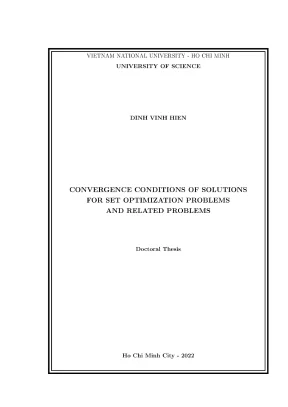
Tải xuống để đọc toàn bộVIETNAM NATIONAL UNIVERSITY - HO CHI MINH UNIVERSITY OF SCIENCE DINH VINH HIEN CONVERGENCE CONDITIONS OF SOLUTIONS FOR SET OPTIMIZATION PROBLEMS AND RELATED PROBLEMS Doctoral Thesis Z“ VIETNAM NATIONAL UNIVERSITY - HO CHI MINH CITY \ UNIVERSITY OF SCIENCE DINH VINH HIEN CONVERGENCE CONDITIONS OF SOLUTIONS FOR SET OPTIMIZATION PROBLEMS AND RELATED PROBLEMS Speciality: Applied Mathematics Code: 9460112 Reviewer 1: Prof. NGUYEN DINH Reviewer 2: Assoc. NGUYEN DINH HUY Reviewer 3: Assoc. LE THANH TUNG Independent reviewer 1: Exemption Independent reviewer 2: Exemption SUPERVISOR 1.
LAM QUOC ANH 2. NGUYEN LE HOANG ANH - Ho Chỉ Minh City - 2022 Declaration I hereby declare that this thesis is the result of my own work, done under the supervision of Professor Lam Quoc Anh and Associate Professor Nguyen Le Hoang Anh. This work is completed at the University of Science, Vietnam National University Ho Chi Minh City, and there is no part of this thesis that has been submitted for any other degree or diploma. I also obtained the consent of Dr.
Tran Quoc Duy, the co- author of the joint papers [H1—H4], and Professors Daishi Kuroiwa, Narin Petrot with the joint paper [H1], to let me include in my thesis some results in the above-mentioned papers that were not included in any thesis or dissertation before. Ho Chi Minh City, March 2022 The author Dinh Vinh Hien Acknowledgements First, I would like to express my sincere gratitude to my supervisors, Professor Lam. Quoc Anh and Associate Professor Nguyen Le Hoang Anh, who have provided me with continuous guidance throughout the course of this research. Besides my supervisors, I would also like to express my sincere thankfulness to the reviewers of this thesis and Professor Phan Quoc Khanh, who has been organized the seminar for the Group of Optimization at the University of Science, Vietnam National University.
Through this activity, I have the chance to improve my knowledge. I am also thankful to the University of Science, Vietnam National University Ho Chi Minh City, and Ho Chi Minh City University of Food Industry for their support during my work to complete the PhD program. I am also very pleased to give my thanks to Dr. Tran Quoc Duy, Professors Daishi Kuroiwa, and Narin Petrot, who give me the valuable advice during the work on our joint papers.
Finally, my appreciation also goes out to my family and friends for their encour- agement and support me during all the time of my PhD program. Ho Chi Minh City, March 2022 The author Dinh Vinh Hien ii Table of Contents Declaration i Acknowledgements ii List of Symbols and Notations vi Preface ix 1. Background and Preliminaries 1 1. The Continuity of Set-valued Mappings.
Set Less Order Relations». Painlevé-Kuratowski Convergenece. The Set Optimization Problem Model. Properties of Elements in Image Spaces.
Stability Conditions for Weak and Ideal Solutions to Set Optimization Problems 14 2. Relationships among the Kinds of Minimal Elements. External Stability Conditions for Solutions. Internal Stability Conditions for Solutions.
The Application in Welfare Economics. 0 HH HH kg va 31 iii 3. Stability Conditions for Efficient Solutions to Set Optimization Prob- lems 33 3. Properties of Elements in Image Spaces.
Stability Conditions for Efficient Solutions. Well-Posedness for the Optimistic Counterpart of Uncertain Vector Optimization Problems 50 4. Uncertain Vector Optimization Problems PU). Relationships for Well-Posedness Properties between an Optimistic Coun- terpart of P() and Corresponding Scalar Problems.
The Concepts of Well-Posedness for the Optimistic Counterpart of P(#/) and the Scalar Optimization Problems. Relationships for Well-Posedness Properties between an Opti- mistic Counterpart of P() and Corresponding Scalar Problems 56 4. Sufficient Conditions and Characterizations for Well-Posedness for Op- timistic Counterparts of P(M). Stability Conditions for Parametric Vector Quasi-Equilibrium Prob- lems with Variable Cones 70 5.
Stability of Parametric Vector Quasi-Equilibrium Problems. Sufficient Conditions for Upper Semicontinuity of Solution Map- iv 5. Sufficient Conditions for Lower Semicontinuity of Solution Map- pings. LH HH ng kh k kt 5.
Well-Posedness for Parametric Vector Quasi-Equilibrium Problems. Well-Posedness under Perturbations and Generalized Hadamard Well-Posednes. Uniquely Well-Posedness under Perturbations and Hadamard Well-Posednes. Traffic Network Problems.
Lower and Upper Bounded Equilibrium Problems. 91 General Conclusions 92 List of the author’s papers related to the thesis 94 List of the author’s conference reports related to the thesis References 97 List of Symbols and Notations Ñ Set of the natural numbers N* N* =N\ {0} R Set of the real numbers Ry Set of non-negative real numbers R = RU {-co, +00} Set of the extended real numbers R" n-dimensional Euclidean space RY Non-negative orthant of R” clA Closure of a set A intA Interior of a set A el10 e>0ande—=0 M For all 3 There exists Oo The end of a proof IỮ_¡ Aj = A x «++ x An The Cartesian product of sets 4, ---, An ) Open ball with the center a and the radius r Bla,1 ) Closed ball with the center ø and the radius r infA The infimum value of a numerical set A supA The supremum value of a numerical set A d(x, A) Distance from x to a subset A e(A, B) e(A, B) := supye, d(a, B) gphF Graph of F P(X) Family of the nonempty subsets of X L(X.Y) The space of all continuous linear mappings from X into Y dom# Domain of set-valued mapping F’ argmin(K,ƒ) Set of all minimizers of the function ƒ on vì min(A) Set of minimal points of A wmin(A) Set of weak minimal points of A max(A) Set of maximal points of A wmax(4) Set of weak maximal points of A Sr Lower type set less order relation Su Upper type set less order relation The set less order relation Strict lower type set less order relation Strict upper type set less order relation The strict set less order relation The approximating quasi-order relation A is equivalent to B (Le. A < B and B < A) Family of minimal elements of the collection of sets ⁄ WMin(¥) Family of weakly minimal elements of the collection of sets Y SMin(Z) Family of ideally minimal elements of the collection of sets G Min.() Family of e-minimal elements of the collection of sets ⁄ LiA, Set of limit points of the sequence { A„} Ls A, Set of cluster points of the sequence {A,} A, SA A,, Painlevé-lKuratowski converges to A A, SA The upper part of Painlevé-Kuratowski convergence A, <A The lower part of Painlevé-Kuratowski convergence A, 4 A A,, Hausdorff converges to A A, 2A The upper part of Hausdorff convergence A, 4A The lower part of Hausdorff convergence usc Upper semicontinuous Isc Lower semicontinuous vii Hausdorff upper semicontinuous Hausdorff lower semicontinuous C-upper semicontinuous (set-valued mapping) C-lower semicontinuous (set-valued mapping) C-upper semicontinuous (vector-valued mapping) C-lower semicontinuous (vector-valued mapping) Set optimization problem The Welfare economic problem Weak vector quasi-equilibrium problem Strong vector quasi-equilibrium problem Traffic network problem Quasi-variational inequality Lower and upper bounded equilibrium problem Uncertain vector optimization problem with uncer- tainty set U Scalar optimization problem with objective function f and feasible set Ý viii Preface Optimization is a branch of applied mathematics and has many practical appli- cations in almost all aspects of life and society. This field has been continuously developing over time and increasingly attracted the interest of many researchers.
Op- timization models appear in almost all areas, from economics, finance, engineering, technology to medicine, sports, and even social sciences, etc. Applying optimization theory to real-world problems is one of the very significant topics that mathematicians have focused on for several decades. Many research works have produced valuable re- sults in the development of theory as well as the applicability in practice. The basic problem of optimization theory is finding the minimum of a functional under certain constraints.
When considering the scalar optimization models, one of the most general ones is the equilibrium problem which was introduced by Muu and Oettli in 1992 [1]; Blum and Oettli in 1994 [2]. The mathematical formulation of this problem unifies var- ious ones such as optimization problems, variational inequality, coincidence-point and fixed-point problems, complementarity problems, Nash equilibria problems, minimax problems, and traffic network problems, etc. Moreover, there are a lot of situations in practical problems leading to generalized models of the equilibrium problem. One of the extended directions of the above problem is to consider the vector equilibrium problems instead of the scalar equilibrium ones (see [3-5]).
Vector equilibrium problems have played an important role in optimization because scalar models often do not meet the variety of situations in practice such as competition equilibrium and social welfare. In order to compare vectors, a pointed closed convex cone is used to define an ordering relation. The next developments can be listed as switching from equilibrium problems to quasi-equilibrium ones (see {6-9]), from single-valued problems to multi-valued ones [10-19], and from the problems with fixed cones (the cones that do not depend on any variables) to the ones with variable cones (see [20-22]). It is worth noting that the problems with variable cones play an important role in many practical situations.
For instance, when we want to ix choose goods or services from the market, of course, the characteristics of the chosen products have to satisfy our requirements that are considered as the required domain. It is obvious that the product with higher quality is the better choice, and hence the requirement domain is a cone which is called the requirement cone. Since our requirement cones may be different from that of the other ones, variable cones are useful in this case. However, the results related to this topic were modest and need to be studied further.
Furthermore, many problems arising from the fields such as economics, medical en- gineering, optimal control, differential inclusions, bilevel optimization, robust optimiza- tion, interval optimization, and game theory lead to new requirements for optimization problems (see [23-27]). In recent years, set-valued optimization problems where either the objective mapping and/or the constraint mappings are set-valued mappings have been intensively investigated. These problems provide an extension and unification of the scalar as well as vector optimization ones. Depending on which criterion is used to define optimal solutions, there are two main approaches for set-valued optimization problems.
The classical one is the vector approach, where the definition of a minimizer considers only an efficient point of the union of all images of the set-valued objective mapping and identifies the image set containing this minimal element [25,27]. Ob- viously, the disadvantage of this approach is that, in general, only one element does not necessarily imply that the whole image set is in a certain sense minimal with re- spect to all image sets. Along with this criterion, another approach is to use a more appropriate order relation for comparing sets, which was introduced by Kuroiwa in op- timization [28], is proposed and called the set optimization approach. With the aim of investigating preferences over sets, it seems that the set optimization approach is more natural and appropriate than the vector one.
Until now, set optimization approach has received much attention by many authors and there are a lot of works related to set optimization problems as well as their applications; see, for instance, [26,2941]. Con- cerning this approach, there are two main set order relations considered in set-valued optimization problems: upper type set less order relation and lower type set less order relation. These relations were independently employed by Young [42] in algebra, by Nishnianidze [43] in fixed-point theory, and by Chiriaev and Walster [44] in computer science and interval analysis. In 2011, Jahn and Ha [37] blended these two set order relations and obtained another one, say “set less order relation”.
Recently, Khan et al. [26] and Mordukhovich (45, Chapters 9 and 10] discussed some developments and commentaries on such problems in their monographs. Along with the topic of solution existence [46-49] and optimality conditions [36, 50,51], the stability plays an important role in optimization.
Nội dung được bảo vệ bản quyền — Tải xuống đầy đủ
Trích dẫn luận án này
Dinh Vinh Hien (2022). Điều kiện hội tụ của lời giải cho bài toán tối ưu hóa tập hợp [Luận án tiến sĩ, university of science, vietnam national university ho chi minh city]. LuanAn.net. https://luanan.net/toan-hoc/toan-ung-dung/dieu-kien-hoi-tu-cua-loi-giai-bai-toan-toi-uu-hoa-tap-hop
Từ khóa và chủ đề nghiên cứu
Từ khóa liên quan
Xem thêm luận án cùng lĩnh vực
Chủ đề nghiên cứu
Câu hỏi thường gặp
Luận án "Điều kiện hội tụ của lời giải cho bài toán tối ưu hóa tập hợp" nghiên cứu về vấn đề gì?
Luận án tiến sĩ nghiên cứu điều kiện hội tụ lời giải bài toán tối ưu hóa tập hợp. Phân tích tính ổn định, well-posedness và ứng dụng bài toán cân bằng vector.
Luận án "Điều kiện hội tụ của lời giải cho bài toán tối ưu hóa tập hợp" được bảo vệ tại trường nào?
Luận án này được bảo vệ tại university of science, vietnam national university ho chi minh city. Năm bảo vệ: 2022.
Luận án "Điều kiện hội tụ của lời giải cho bài toán tối ưu hóa tập hợp" thuộc chuyên ngành gì?
Luận án "Điều kiện hội tụ của lời giải cho bài toán tối ưu hóa tập hợp" thuộc chuyên ngành Applied Mathematics. Danh mục: Toán Ứng Dụng.
Luận án "Điều kiện hội tụ của lời giải cho bài toán tối ưu hóa tập hợp" có bao nhiêu trang?
Luận án "Điều kiện hội tụ của lời giải cho bài toán tối ưu hóa tập hợp" có 123 trang. Bạn có thể xem trước một phần tài liệu ngay trên trang web trước khi tải về.
Cách tải luận án "Điều kiện hội tụ của lời giải cho bài toán tối ưu hóa tập hợp" về máy như thế nào?
Để tải luận án về máy, bạn nhấn nút "Tải xuống ngay" trên trang này, sau đó hoàn tất thanh toán phí lưu trữ. File sẽ được tải xuống ngay sau khi thanh toán thành công. Hỗ trợ qua Zalo: 0559 297 239.