Phương pháp lặp cho hệ tuyến tính suy biến - Luận án tiến sĩ Stanford
Luận án tiến sĩ nghiên cứu phương pháp lặp giải hệ phương trình tuyến tính suy biến. Đề xuất thuật toán MINRES-QLP với độ chính xác cao hơn các phương pháp hiện có.
Computational and Mathematical Engineering
Luan An
luận án
Năm xuất bản
Số trang
113
Thời gian đọc
17 phút
Lượt xem
0
Lượt tải
0
Phí lưu trữ
40 Point
Tổng quan nhanh
- Chủ đề:
- 1. Phương Pháp Lặp Cho Hệ Phương Trình Tuyến Tính
- Số trang:
- 113 trang
- Trường:
- stanford university
- Chuyên ngành:
- Computational and Mathematical Engineering
- Tác giả:
- Sou-Cheng Choi
- Năm:
- 2006
Tóm tắt nội dung luận án
I. Phương Pháp Lặp Cho Hệ Phương Trình Tuyến Tính
Hệ phương trình tuyến tính suy biến xuất hiện trong nhiều bài toán thực tế. Ma trận suy biến là ma trận không khả nghịch, có định thức bằng không. Các phương pháp trực tiếp thường gặp khó khăn khi giải hệ này. Phương pháp lặp trở thành lựa chọn hiệu quả cho bài toán quy mô lớn. Các phương pháp lặp cổ điển như Jacobi, Gauss-Seidel, SOR có thể áp dụng với điều kiện hội tụ phù hợp. Phương pháp lặp Richardson cũng được nghiên cứu cho trường hợp đặc biệt. Tài liệu tập trung vào phương pháp không gian con Krylov như CG, MINRES, SYMMLQ. Các phương pháp này xử lý ma trận đối xứng với kích thước lớn. Hội tụ của phương pháp lặp phụ thuộc vào tính chất ma trận hệ số. Ma trận kỳ dị đòi hỏi xử lý đặc biệt để đảm bảo nghiệm tối thiểu. Phương pháp MINRES-QLP được phát triển để tính nghiệm pseudoinverse. Đây là tiến bộ quan trọng trong giải hệ phương trình tuyến tính suy biến.
1.1. Đặc Điểm Ma Trận Suy Biến
Ma trận suy biến có hạng nhỏ hơn kích thước. Định thức của ma trận này bằng không. Hệ phương trình có thể vô nghiệm hoặc vô số nghiệm. Không gian null không tầm thường chứa vector khác không. Ma trận không khả nghịch không có ma trận nghịch đảo. Các giá trị riêng có ít nhất một giá trị bằng không. Điều kiện số của ma trận tiến tới vô cùng.
1.2. Thách Thức Khi Giải Hệ Suy Biến
Phương pháp khử Gauss thất bại do pivot bằng không. Phương pháp lặp cổ điển có thể phân kỳ. Nghiệm không duy nhất gây khó khăn trong lựa chọn. Sai số làm tròn ảnh hưởng nghiêm trọng đến kết quả. Tiêu chuẩn dừng cần điều chỉnh cho trường hợp đặc biệt. Cần tìm nghiệm có chuẩn nhỏ nhất trong tập nghiệm.
1.3. Ứng Dụng Thực Tế
Mô hình Markov Chain tạo ra ma trận suy biến. Bài toán helioseismology chứa hệ thưa suy biến. Tính vector xác suất dừng đòi hỏi giải hệ kỳ dị. Bài toán bình phương tối thiểu không tương thích phổ biến. Tìm vector null quan trọng trong phân tích cấu trúc.
II. Phương Pháp MINRES Và Các Biến Thể
MINRES là phương pháp lặp cho hệ đối xứng không xác định. Phương pháp này tối thiểu hóa chuẩn phần dư. MINRES sử dụng phân tích QR của ma trận tam giác từ quá trình Lanczos. Với hệ không tương thích, MINRES cho nghiệm bình phương tối thiểu. Tuy nhiên nghiệm không nhất thiết có chuẩn nhỏ nhất. SYMMLQ là phương pháp tương tự nhưng có thể cho nghiệm phát tán. CG chỉ tin cậy với ma trận xác định dương. MINRES-QLP được thiết kế để khắc phục hạn chế. Phương pháp này sử dụng phân tích QLP thay vì QR. Ma trận R được biến đổi về dạng tam giác dưới. MINRES-QLP tính nghiệm pseudoinverse chính xác hơn. Phương pháp áp dụng được cho cả hệ suy biến và không suy biến. Độ chính xác cải thiện đáng kể so với MINRES. Tiền điều kiện có thể tích hợp vào thuật toán.
2.1. Nguyên Lý Hoạt Động MINRES
MINRES xây dựng không gian con Krylov lặp. Quá trình Lanczos tạo cơ sở trực giao. Ma trận tam giác đối xứng được hình thành. Phân tích QR giải bài toán tối thiểu hóa. Nghiệm xấp xỉ cập nhật mỗi vòng lặp. Phần dư giảm đơn điệu theo lý thuyết.
2.2. Phân Tích QLP Trong MINRES QLP
Phân tích QLP mở rộng phân tích QR chuẩn. Ma trận Q là trực giao từ Lanczos. Ma trận P là phép quay bên phải. Ma trận L có dạng tam giác dưới. Phân tích này xử lý tốt ma trận suy biến. Nghiệm pseudoinverse được tính trực tiếp. Độ ổn định số học được cải thiện.
2.3. Ưu Điểm MINRES QLP
Độ chính xác cao hơn MINRES và SYMMLQ. Tính được nghiệm chuẩn nhỏ nhất. Áp dụng cho cả hệ suy biến và không suy biến. Ước lượng chuẩn nghiệm tốt hơn. Ước lượng số điều kiện chính xác hơn. Tiêu chuẩn dừng được cải tiến.
III. Phương Pháp Lặp Richardson Và Tiền Điều Kiện
Phương pháp lặp Richardson là phương pháp cơ bản. Công thức lặp đơn giản với tham số thư giãn. Hội tụ của phương pháp lặp phụ thuộc vào phổ ma trận. Tham số tối ưu cải thiện tốc độ hội tụ. Tiền điều kiện biến đổi hệ phương trình gốc. Ma trận tiền điều kiện cải thiện tính chất hệ. Phương pháp Jacobi có thể dùng làm tiền điều kiện. Phương pháp Gauss-Seidel cũng là lựa chọn phổ biến. Phương pháp SOR kết hợp Gauss-Seidel với tham số thư giãn. Tiền điều kiện MINRES-QLP nâng cao hiệu quả. Phân tích phổ giúp chọn tiền điều kiện phù hợp. Ma trận tiền điều kiện cần dễ nghịch đảo. Chi phí tính toán tiền điều kiện phải hợp lý. Cân bằng giữa chất lượng và chi phí là quan trọng.
3.1. Công Thức Phương Pháp Richardson
Công thức lặp có dạng x_{k+1} = x_k + ω(b - Ax_k). Tham số ω là hệ số thư giãn. Chọn ω phù hợp quyết định hội tụ. Phương pháp đơn giản nhưng hiệu quả hạn chế. Cần kết hợp tiền điều kiện để cải thiện.
3.2. Điều Kiện Hội Tụ
Hội tụ đòi hỏi bán kính phổ nhỏ hơn một. Ma trận lặp phải có giá trị riêng trong đĩa đơn vị. Tham số ω ảnh hưởng trực tiếp đến hội tụ. Với ma trận suy biến, phân tích phức tạp hơn. Không gian null ảnh hưởng đến tính hội tụ.
3.3. Chiến Lược Tiền Điều Kiện
Tiền điều kiện đường chéo đơn giản nhất. Tiền điều kiện khối xử lý cấu trúc ma trận. Tiền điều kiện đa lưới hiệu quả cho bài toán lớn. Phân tích không hoàn chỉnh giảm chi phí. Cần cân nhắc chi phí lưu trữ và tính toán.
IV. Phương Pháp Jacobi Và Gauss Seidel
Phương pháp Jacobi là phương pháp lặp cổ điển. Ma trận hệ số tách thành phần đường chéo và ngoài đường chéo. Công thức cập nhật sử dụng giá trị vòng lặp trước. Phương pháp Gauss-Seidel cải tiến Jacobi. Giá trị mới được dùng ngay khi tính toán. Hội tụ thường nhanh hơn Jacobi. Phương pháp SOR thêm tham số thư giãn vào Gauss-Seidel. Tham số tối ưu tăng tốc độ hội tụ đáng kể. Với ma trận suy biến, điều kiện hội tụ phức tạp. Ma trận cần thoả mãn điều kiện đường chéo trội. Phương pháp Jacobi dễ song song hóa. Gauss-Seidel khó song song do phụ thuộc dữ liệu. Chi phí mỗi vòng lặp thấp cho ma trận thưa. Phương pháp phù hợp cho bài toán quy mô lớn.
4.1. Thuật Toán Phương Pháp Jacobi
Tách ma trận A = D + L + U. D là phần đường chéo. L và U là tam giác dưới và trên. Công thức x_{k+1} = D^{-1}(b - (L+U)x_k). Tất cả thành phần cập nhật đồng thời. Dễ dàng song song hóa trên nhiều bộ xử lý.
4.2. Cải Tiến Gauss Seidel
Sử dụng giá trị mới ngay khi tính được. Công thức x_{k+1} = (D+L)^{-1}(b - Ux_k). Hội tụ nhanh hơn Jacobi trong nhiều trường hợp. Yêu cầu tính tuần tự các thành phần. Khó song song hóa hiệu quả.
4.3. Phương Pháp SOR
SOR là Successive Over-Relaxation. Thêm tham số ω vào Gauss-Seidel. Công thức kết hợp giá trị cũ và mới. Tham số tối ưu nằm trong khoảng (1, 2). Chọn ω đúng tăng tốc độ đáng kể. Over-relaxation (ω > 1) thường hiệu quả.
V. Bài Toán Bình Phương Tối Thiểu
Bài toán bình phương tối thiểu tìm nghiệm tối thiểu hóa chuẩn phần dư. Hệ phương trình có thể không tương thích. Nghiệm bình phương tối thiểu luôn tồn tại. Phương pháp LSQR giải bài toán cho ma trận thưa. LSQR dựa trên quá trình bidiagonalization Golub-Kahan. Phương pháp này xử lý ma trận hình chữ nhật. Với ma trận vuông, MINRES-QLP là lựa chọn tốt. Nghiệm pseudoinverse có chuẩn nhỏ nhất. Vector null tính được từ bài toán bình phương tối thiểu. Giải hệ liên quan đến ma trận chuyển vị. Ứng dụng trong tính vector xác suất dừng. Mô hình Markov Chain tạo bài toán này. Helioseismology cung cấp hệ thưa quy mô lớn. Phương pháp lặp hiệu quả hơn phương pháp trực tiếp.
5.1. Định Nghĩa Bài Toán
Tìm x tối thiểu hóa ||Ax - b||. Ma trận A có thể hình chữ nhật. Hệ phương trình không nhất thiết có nghiệm chính xác. Nghiệm bình phương tối thiểu tối thiểu hóa sai số. Trong trường hợp vô số nghiệm, chọn nghiệm chuẩn nhỏ nhất.
5.2. Phương Pháp LSQR
LSQR sử dụng bidiagonalization Golub-Kahan. Quá trình này tạo cơ sở trực giao cho hai không gian. Phương pháp hiệu quả cho ma trận thưa lớn. Chi phí mỗi vòng lặp tỷ lệ với số phần tử khác không. Hội tụ phụ thuộc vào giá trị kỳ dị.
5.3. Tính Vector Null
Vector null thoả mãn Av = 0. Tính được bằng giải min ||A^T w||. Với ma trận thưa, LSQR áp dụng hiệu quả. Trong trường hợp vuông, MINRES-QLP phù hợp. Ứng dụng trong phân tích không gian null.
VI. Ước Lượng Sai Số Và Tiêu Chuẩn Dừng
Ước lượng sai số quan trọng trong phương pháp lặp. Chuẩn phần dư là chỉ số cơ bản. Chuẩn nghiệm khó tính trực tiếp. MINRES-QLP cung cấp ước lượng tốt hơn. Ước lượng chuẩn ma trận giúp đánh giá độ chính xác. Số điều kiện ảnh hưởng đến sai số. Ma trận suy biến có số điều kiện vô cùng. Tiêu chuẩn dừng cần điều chỉnh cho trường hợp đặc biệt. Dừng khi phần dư đủ nhỏ so với ngưỡng. Cần xem xét cả sự thay đổi nghiệm. Số vòng lặp tối đa ngăn chặn vòng lặp vô hạn. Cân bằng giữa độ chính xác và chi phí tính toán. Ước lượng apriori dựa trên lý thuyết. Ước lượng aposteriori sử dụng thông tin thực tế.
6.1. Ước Lượng Chuẩn Phần Dư
Phần dư r_k = b - Ax_k đo sai số. Chuẩn ||r_k|| giảm qua các vòng lặp. MINRES đảm bảo giảm đơn điệu phần dư. Tính trực tiếp tốn kém cho ma trận lớn. Ước lượng gián tiếp tiết kiệm chi phí.
6.2. Ước Lượng Số Điều Kiện
Số điều kiện κ(A) = ||A|| ||A^{-1}||. Với ma trận suy biến, κ = ∞. Ước lượng dựa trên giá trị riêng hoặc kỳ dị. MINRES-QLP cung cấp ước lượng trong quá trình lặp. Số điều kiện cao cảnh báo bài toán khó.
6.3. Tiêu Chuẩn Dừng Cải Tiến
Dừng khi ||r_k|| < ε||b||. Xem xét cả ||x_k - x_{k-1}||. Với ma trận suy biến, kiểm tra tương thích. Ngưỡng dung sai phụ thuộc ứng dụng. Số vòng lặp tối đa đảm bảo kết thúc.
Mục lục chi tiết luận án
Tải xuống file đầy đủ để xem toàn bộ nội dung
Tải đầy đủ (113 trang)Nội dung chính
Tổng quan về luận án
Luận án tiến sĩ "Iterative Methods for Singular Linear Equations and Least-Squares Problems" của tác giả Sou-Cheng (Terrya) Choi (2006) tại Đại học Stanford (dưới sự hướng dẫn của Giáo sư Michael Saunders và Đồng hướng dẫn Giáo sư Gene H. Golub) đặt nền móng tiên phong trong lĩnh vực giải tích số (numerical analysis) và đại số tuyến tính tính toán (computational linear algebra). Nghiên cứu tập trung giải quyết bài toán giải hệ phương trình tuyến tính đối xứng lớn, thưa và có thể suy biến (singular symmetric linear systems) $Ax = b$ cũng như bài toán bình phương tối thiểu đối xứng suy biến (singular symmetric least-squares problems) $\min |Ax - b|_2$ với $A \in \mathbb{R}^{n \times n}$, $\text{rank}(A) < n$.
                      ┌────────────────────────────────────────┐
                      │    Hệ Tuyến Tính Đối Xứng Suy Biến     │
                      │     Ax = b hoặc min ||Ax - b||_2       │
                      └───────────────────┬────────────────────┘
                                          │
                                          ▼
                      ┌────────────────────────────────────────┐
                      │   Quá trình Lanczos 3-hạng-tử          │
                      │     A V_k = V_{k+1} T_k                │
                      └───────────────────┬────────────────────┘
                                          │
                  ┌───────────────────────┴───────────────────────┐
                  ▼                                               ▼
      ┌───────────────────────┐                       ┌───────────────────────┐
      │   MINRES Cổ Điển      │                       │   MINRES-QLP Đột Phá  │
      │   (Phân tích QR)      │                       │   (Phân tích QLP)     │
      ├───────────────────────┤                       ├───────────────────────┤
      │ Q_k T_k = [R_k; 0]    │                       │ R_k P_k = L_k         │
      │ Hệ không tương thích: │                       │ Triệt tiêu phần tử    │
      │ Cho nghiệm {1,2,3}    │                       │ đường chéo suy biến   │
      │ Chuẩn nghiệm BÙNG NỔ  │                       │ Chuẩn nghiệm CỰC TIỂU │
      │ (||x_k|| ~ 2 x 10^6)  │                       │ (||x_k|| ~ 2.78 = x†) │
      └───────────────────────┘                       └───────────────────────┘
Khoảng trống học thuật (research gap) cốt lõi mà luận án chỉ ra xuất phát từ sự bất đối xứng giữa lý thuyết và thuật toán thực thi trong suốt ba thập kỷ kể từ công trình nền tảng của Paige & Saunders (1975):
"When these methods are applied to an inconsistent system (that is, a singular symmetric least-squares problem), CG could break down and SYMMLQ’s solution could explode, while MINRES would give a least-squares solution but not necessarily the minimum-length solution (often called the pseudoinverse solution)."
Các câu hỏi nghiên cứu và giả thuyết khoa học được xác lập chặt chẽ:
- RQ1: Thuật toán MINRES cổ điển tạo ra dạng nghiệm nào khi ma trận đối xứng $A$ bị suy biến và hệ không tương thích ($b \notin \mathcal{R}(A)$)?
- Giả thuyết H1: MINRES hội tụ về một nghiệm bình phương tối thiểu nhưng vi phạm điều kiện thứ tư của Moore-Penrose, dẫn đến nghiệm không đạt chuẩn Euclid cực tiểu (non-minimum-length solution).
- RQ2: Làm thế nào để tái cấu trúc không gian con Krylov nhằm tính toán nghiệm giả nghịch đảo (pseudoinverse solution) $x^\dagger = A^\dagger b$ một cách ổn định số học mà không làm tăng độ phức tạp tính toán vượt quá bậc $O(n)$ mỗi bước lặp?
- Giả thuyết H2: Việc tích hợp phân tích trực giao kép QLP (kết hợp phép quay Givens/phản xạ Householder bên trái $Q_k$ và bên phải $P_k$) vào ma trận tam đường Lanczos $T_k$ sẽ cô lập chính xác không gian hạt nhân (null space) và triệt tiêu thành phần bùng nổ của nghiệm.
- RQ3: Làm thế nào để ước lượng chuẩn phần dư $|r_k|_2$, chuẩn gradient đạo hàm $|Ar_k|_2$, chuẩn ma trận $|A|_F, |A|_2$ và số điều kiện $\kappa(A)$ theo công thức hồi quy mà không cần nhân ma trận - vector bổ sung?
- Giả thuyết H3: Cấu trúc của ma trận tam giác dưới $L_k$ trong phân tích QLP cho phép trích xuất trực tiếp các đại lượng cận dừng và ước lượng số điều kiện với chi phí $O(1)$ phép tính vô hướng.
- RQ4: Làm thế nào để trích xuất vector hạt nhân (null vectors) của ma trận thưa chữ nhật hoặc không đối xứng bất kỳ với tốc độ hội tụ nhanh nhất?
- Giả thuyết H4: Giải bài toán bình phương tối thiểu chuyển vị $\min |A^T y - c|_2$ bằng LSQR sẽ tìm được vector hạt nhân thông qua phần dư tối ưu $s = c - A^T y$ với số vòng lặp giảm hơn 50% so với phương pháp lặp nghịch đảo trực tiếp trên ma trận gốc.
Khung lý thuyết của luận án tích hợp sâu sắc giữa lý thuyết không gian con Krylov $\mathcal{K}_k(A,b) = \text{span}{b, Ab, \dots, A^{k-1}b}$, lý thuyết toán tử giả nghịch đảo Moore-Penrose, và giải tích sai số làm tròn số học dấu phẩy động chuẩn IEEE 754 với độ chính xác máy $\varepsilon = 2^{-52} \approx 2.22 \times 10^{-16}$.
Đóng góp đột phá của luận án được lượng hóa qua các thực nghiệm số quy mô lớn: trên hệ bất tương thích cấp $n = 500$ (ma trận harvard500), thuật toán MINRES-QLP kiểm soát chuẩn nghiệm dừng ở mức $|x_k|_2 \approx 2.78$ trùng khớp với nghiệm phân tích phổ cắt cụt (Truncated Eigenvalue Decomposition - TEVD), trong khi MINRES cổ điển bùng nổ lên $|x_k|_2 \approx 2 \times 10^6$; trên các hệ đối xứng xác định dương có số điều kiện xấu ($n = 792$, $|A|_2 = 3$), MINRES-QLP giảm chuẩn phần dư thực tế xuống mức $|r_k|_2 \approx 10^{-12}$ so với mức $10^{-10}$ hoặc $10^{-2}$ của MINRES. Luận án mở rộng phạm vi ứng dụng từ đồ thị Web quy mô lớn (Google PageRank với 2 tỷ trang web thời điểm 2003), phân tích chuỗi trích dẫn khoa học (CiteSeer), mô hình xích Markov (Markov Chains), cho đến các hệ phương trình suy biến trong vật lý nhật địa chấn học (helioseismology).
Literature Review và Positioning
Lịch sử phát triển của các phương pháp lặp không gian con Krylov cho hệ phương trình đại số tuyến tính được phân định qua các cột mốc kinh điển:
- Hestenes & Stiefel (1952): Đề xuất thuật toán Conjugate Gradient (CG) cho ma trận đối xứng xác định dương ($A \succ 0$) và CGLS cho bài toán bình phương tối thiểu. CG tối thiểu hóa sai số theo chuẩn ma trận $|x - x_k|_A$ nhưng lập tức đổ vỡ (break down) khi ma trận có tính không xác định (indefinite) do khả năng xuất hiện phần mẫu số $q_k^T A q_k = 0$.
- Paige & Saunders (1975): Giới thiệu SYMMLQ và MINRES dựa trên quá trình tam đường hóa Lanczos đối xứng. SYMMLQ giải hệ phương trình xác định hoặc không xác định tương thích thông qua phân tích LQ ($T_k Q_k = [L_k \ 0]$), trong khi MINRES tối thiểu hóa chuẩn phần dư Euclid $|r_k|_2 = |b - Ax_k|_2$ thông qua phân tích QR ($Q_k T_k = \begin{bmatrix} R_k \ 0 \end{bmatrix}$).
- Fletcher (1976), Saad & Schultz (1986), Van der Vorst (1992): Phát triển Bi-CG, GMRES và Bi-CGSTAB cho các ma trận không đối xứng (unsymmetric). Tuy nhiên, GMRES đòi hỏi lưu trữ toàn bộ cơ sở Arnoldi $V_k$, buộc phải áp dụng kỹ thuật khởi động lại GMRES($m$) dẫn đến hiện tượng đình trệ (stagnation) khó kiểm soát.
- Freund & Nachtigal (1991, 1994): Giới thiệu QMR và SQMR sử dụng kỹ thuật tựa tối thiểu hóa phần dư để duy trì hệ thức truy hồi ngắn nhưng không bảo đảm tính cực tiểu chuẩn nghiệm trên hệ suy biến.
- Paige & Saunders (1982): Thiết lập chuẩn mực giải thuật toán bình phương tối thiểu tổng quát với LSQR dựa trên quá trình song bidiagonal hóa Golub-Kahan.
       1952             1975            1982            1986            2006
      Hestenes         Paige &         Paige &         Saad &          Choi
      & Stiefel        Saunders        Saunders        Schultz      (Luận án này)
         │                │               │               │               │
         ▼                ▼               ▼               ▼               ▼
     ┌───────┐       ┌─────────┐      ┌───────┐      ┌─────────┐    ┌────────────┐
     │  CG   │──────▶│ MINRES  │─────▶│ LSQR  │─────▶│  GMRES  │───▶│ MINRES-QLP │
     │ CGLS  │       │ SYMMLQ  │      └───────┘      └─────────┘    └────────────┘
     └───────┘       └─────────┘
Về mặt lý thuyết vị thế (theoretical positioning), nghiên cứu của Choi trực tiếp tranh biện và điều chỉnh kết luận của Ipsen & Meyer (2006). Ipsen & Meyer cho rằng các phương pháp không gian con Krylov như GMRES/MINRES khi áp dụng cho hệ suy biến chỉ có thể tiệm cận nghiệm nghịch đảo Drazin (Drazin inverse solution) và hoàn toàn không cho ra nghiệm đối với các hệ không tương thích. Luận án của Choi đã chứng minh bằng toán học chặt chẽ rằng:
- MINRES trên thực tế luôn hội tụ về một nghiệm bình phương tối thiểu xác định (với chuẩn phần dư tối ưu $|r_k|_2$ nhỏ nhất), nhưng là nghiệm ${1,2,3}$-nghịch đảo chứ không phải ${1,2,3,4}$-nghịch đảo Moore-Penrose.
- Thuật toán mới MINRES-QLP hoàn toàn khắc phục được giới hạn này, đảm bảo hội tụ chính xác về nghiệm độ dài cực tiểu $x^\dagger = A^\dagger b$ cho mọi hệ phương trình đối xứng suy biến (cả tương thích lẫn bất tương thích).
So sánh với các nghiên cứu quốc tế đương thời:
- Nghiên cứu của Sleijpen, van der Vorst, & Modersitzki (2001) về sự suy giảm độ chính xác phần dư của MINRES trên các hệ ma trận đối xứng có số điều kiện lớn ($\kappa(A) \gg 1$) được Choi giải quyết triệt để; MINRES-QLP duy trì độ chính xác của nghiệm và phần dư bám sát giới hạn sai số máy mà không bị trôi do tích lũy sai số làm tròn.
- Mô phỏng tính toán vector riêng liên kết với giá trị riêng cực đại của ma trận Google PageRank theo mô hình của Moler (2004) và Langville & Meyer (2004) được Choi tái định hình: thay vì lặp lũy thừa (Power Method) cần hàng trăm bước lặp hoặc giải hệ suy biến trực tiếp $(A - I)x = b$ mất 711 bước lặp LSQR, bài toán được chuyển đổi thành $\min |(A - I)^T y - c|_2$, đạt độ chính xác $|As|/|s| \approx 7 \times 10^{-7}$ chỉ sau 311 bước lặp.
Đóng góp lý thuyết và khung phân tích
Đóng góp cho lý thuyết
Luận án tạo bước nhảy vọt lý thuyết trong việc phân loại và chứng minh toán học đặc tính nghiệm của các họ thuật toán Lanczos.
Khung quan niệm (conceptual framework) của Paige (1979) và Saunders (1990) được kế thừa và mở rộng:
"An iterative process generates certain quantities from the data. At each iteration a subproblem is defined, suggesting how those quantities may be combined to give a new estimate of the required solution. Different subproblems define different methods for solving the original problem. Different ways of solving a subproblem lead to different implementations of the associated method."
| Thuật toán | Bài toán con (Subproblem) | Cơ sở phân tích ma trận | Bản chất đại số của nghiệm $x_k$ |
|---|---|---|---|
| CG (Hestenes & Stiefel, 1952) | $T_k y = \beta_1 e_1$ | Cholesky: $T_k = L_k D_k L_k^T$ | Nghiệm Galerkin, cực tiểu sai số $|x - x_k|_A$ |
| SYMMLQ (Paige & Saunders, 1975) | $\min |y|_2$ s.t. $T_k^{(k-1)} y = \beta_1 e_1$ | Phân tích LQ: $T_k Q_k = [L_k \ 0]$ | Cực tiểu chuẩn nghiệm trong $\mathcal{K}_{k+1}(A,b)$ |
| MINRES (Paige & Saunders, 1975) | $\min |T_k y - \beta_1 e_1|_2$ | Phân tích QR: $Q_k \underline{T_k} = \begin{bmatrix} R_k \ 0 \end{bmatrix}$ | Nghiệm bình phương tối thiểu ${1,2,3}$-nghịch đảo |
| MINRES-QLP (Choi, 2006) | $\min |y|_2$ s.t. $\min |\underline{T_k} y - \beta_1 e_1|_2$ | Phân tích QLP: $Q_k \underline{T_k} P_k = \begin{bmatrix} L_k & 0 \ 0 & 0 \end{bmatrix}$ | Nghiệm giả nghịch đảo chuẩn tắc $x^\dagger = A^\dagger b$ |
Chứng minh định lý về tính chất ${1,2,3}$-nghịch đảo của MINRES:
Cho hệ suy biến $\min |Ax - b|2$ với $A = A^T$ và $b \notin \mathcal{R}(A)$. Khi $\beta{k+1} = 0$ và phần tử góc cuối cùng của ma trận tam giác trên $\gamma_k^{(1)} = 0$, toán tử nghiệm của MINRES có dạng: $$A^\clubsuit = V_k R_k^\dagger Q_{k-1} V_k^T$$ Kiểm tra 4 điều kiện Moore-Penrose:
- $A A^\clubsuit A = (A V_k) R_k^\dagger Q_{k-1} (V_k^T A) = V_k Q_{k-1}^T R_k R_k^\dagger R_k V_k^T = A$ (Thỏa mãn vì các cột của $V_k$ span $\mathcal{R}(A)$).
- $A^\clubsuit A A^\clubsuit = V_k R_k^\dagger R_k R_k^\dagger Q_{k-1} V_k^T = A^\clubsuit$ (Thỏa mãn).
- $A A^\clubsuit = V_k Q_{k-1}^T R_k R_k^\dagger Q_{k-1} V_k^T = V_k V_k^T = (A A^\clubsuit)^T$ (Thỏa mãn tính đối xứng).
- $A^\clubsuit A = V_k R_k^\dagger Q_{k-1} T_k V_k^T = V_k R_k^\dagger R_k V_k^T$. Do ma trận $R_k$ có dạng tam giác trên không đủ hạng, tích $R_k^\dagger R_k$ không đối xứng: $$(R_k^\dagger R_k)^T \neq R_k^\dagger R_k \implies (A^\clubsuit A)^T \neq A^\clubsuit A$$ Do đó, $A^\clubsuit$ vi phạm điều kiện thứ 4, chứng minh dứt khoát rằng nghiệm của MINRES không thể là nghiệm có độ dài cực tiểu.
Khung phân tích độc đáo
Khung phân tích của MINRES-QLP thực hiện phép biến đổi ma trận $R_k$ thu được từ phân tích QR bên trái bằng cách nhân thêm ma trận trực giao bên phải $P_k$ (tổng hợp từ chuỗi các phép biến đổi trực giao $P_{1,2}, P_{2,3}, \dots, P_{k-1,k}$): $$R_k P_k = L_k$$ trong đó $L_k$ là ma trận tam giác dưới có cấu trúc tam đường dưới (lower-tridiagonal matrix).
Cơ sở tìm nghiệm được chuyển đổi sang hệ vector mới $W_k = V_k P_k$, cập nhật nghiệm theo hệ thức: $$x_k = W_k z_k = x_{k-1} + \zeta_k w_k$$ với $L_k z_k = t_k$ ($t_k$ là vector vế phải sau các phép biến đổi trực giao). Nếu hệ thống phát hiện suy biến (xuất hiện phần tử triệt tiêu trên đường chéo của $L_k$), phép chiếu sẽ tự động đặt thành phần tự do bằng 0, loại bỏ hoàn toàn các thành phần nằm trong không gian hạt nhân $\mathcal{N}(A)$, đảm bảo nghiêm ngặt điều kiện $|x_k|_2 = \min$.
Phương pháp nghiên cứu tiên tiến
Thiết kế nghiên cứu
Nghiên cứu tuân thủ chặt chẽ thế giới quan thực chứng số học (Numerical Positivism) và chủ nghĩa hiện thực kiến tạo (Constructive Realism). Mọi khẳng định thuật toán đều được bảo chứng qua 3 cấp độ:
- Cấp độ vi mô: Phân tích ổn định đại số tuyến tính của từng phép quay Givens/phản xạ Householder hai chiều
SymOrtho(a, b). - Cấp độ trung mô: Phân tích sự lan truyền và tích lũy sai số làm tròn trong hệ thức truy hồi ba hạng tử Lanczos $A V_k = V_{k+1} T_k$.
- Cấp độ vĩ mô: Đo lường chuẩn sai số ngược tương đối (Normwise Relative Backward Error - NRBE) trên các bộ dữ liệu thực nghiệm chuẩn hóa quốc tế.
Quy trình nghiên cứu rigorous
Quy trình kiểm chuẩn được thiết kế nghiêm ngặt nhằm triệt tiêu thiên kiến số học:
                          ┌──────────────────────────┐
                          │   Sinh Dữ Liệu Thử Nghiệm │
                          │   (Ma trận A, Vector b)  │
                          └─────────────┬────────────┘
                                        │
                    ┌───────────────────┴───────────────────┐
                    ▼                                       ▼
        ┌───────────────────────┐               ┌───────────────────────┐
        │  Hệ Không Tương Thích │               │   Hệ Gần Tương Thích  │
        │  b = random (notin R) │               │ b = Az_1 + z_2        │
        │                       │               │ ||z_1||=13, ||z_2||=  │
        │                       │               │ 10^-12                │
        └───────────┬───────────┘               └───────────┬───────────┘
                    │                                       │
                    └───────────────────┬───────────────────┘
                                        │
                                        ▼
                          ┌──────────────────────────┐
                          │    Khởi Chạy Song Song    │
                          │   CG, SYMMLQ, MINRES,     │
                          │   MINRES-QLP, LSQR, TEVD  │
                          └─────────────┬────────────┘
                                        │
                                        ▼
                          ┌──────────────────────────┐
                          │     Kiểm Tra 4 Tiêu Chí  │
                          │ 1. Chuẩn nghiệm ||x_k||  │
                          │ 2. Chuẩn dư ||r_k||      │
                          │ 3. Gradient ||Ar_k||     │
                          │ 4. Số điều kiện kappa(A) │
                          └──────────────────────────┘
Tiêu chí dừng hồi quy đa điều kiện (Multi-criteria stopping conditions) tích hợp trong MINRES-QLP:
- Điều kiện tương thích: $\frac{|r_k|_2}{|A|_F |x_k|_2 + |b|_2} \le \text{tol}$
- Điều kiện bất tương thích (bình phương tối thiểu): $\frac{|Ar_k|_2}{|A|_F |r_k|_2} \le \text{tol}$
- Điều kiện số điều kiện ma trận vượt ngưỡng cảnh báo: $\kappa(A) \ge \text{maxcond}$
- Cảnh báo bùng nổ nghiệm: $|x_k|_2 \ge \text{maxxnorm}$
Data và phân tích
Toàn bộ các thuật toán được hiện thực hóa và kiểm định trên nền tảng MATLAB 7.0, sử dụng cấu trúc số học dấu phẩy động độ chính xác kép (double precision):
- Độ phức tạp tính toán mỗi vòng lặp Lanczos: $2\nu + 9n$ phép tính dấu phẩy động (flops), trong đó $\nu = \text{nnz}(A)$ là số lượng phần tử khác 0 của ma trận thưa $A$.
- Bộ nhớ làm việc cực tiểu: MINRES yêu cầu 5 vector làm việc kích thước $n$ ($v_k, v_{k+1}, d_{k-1}, d_k, x_k$); MINRES-QLP duy trì thêm các vector chuyển đổi cơ sở $w_k$ với chi phí lưu trữ tổng cộng hoàn toàn tuyến tính $O(n)$, vượt trội tuyệt đối so với các phương pháp giải trực tiếp cần phân tích Cholesky/QR ma trận thưa gây hiện tượng điền đầy (fill-in).
Công thức hồi quy trích xuất chuẩn gradient $|Ar_k|_2$ độc quyền của Choi: $$|Ar_k|_2 = |r_k|2 \sqrt{\phi{k-1}^2 \tau_k^2 + (\dots)}$$ giúp loại bỏ hoàn toàn nhu cầu thực hiện thêm phép nhân ma trận - vector $A r_k$ ở mỗi bước lặp, tiết kiệm chính xác 50% chi phí tính toán toán tử ma trận cho các tiêu chí dừng.
Phát hiện đột phá và implications
Những phát hiện then chốt
        Chuẩn Nghiệm ||x_k|| trên Hệ Bất Tương Thích (n=500, rank 499)
   10^7 ┌────────────────────────────────────────────────────────────┐
        │                                                            │
   10^5 │                              ● MINRES Cổ Điển (~ 2 x 10^6) │
        │                              │ (Bùng nổ nghiệm)            │
   10^3 │                              │                             │
        │                              │                             │
   10^1 │                              │                             │
        │                              ▼                             │
   10^0 │──────────────────────────────■ MINRES-QLP (~ 2.78 = x†)───│
        └────────────────────────────────────────────────────────────┘
        0              20              40              60          80
                                   Vòng Lặp (k)
-
MINRES thất bại trong việc tìm nghiệm chuẩn cực tiểu trên hệ bất tương thích: Trên hệ phương trình thử nghiệm ma trận Harvard symmetrized/scaled ($n = 500$, rank 499, $|A|_2 \approx 2$), khi $b$ là vector ngẫu nhiên ($b \notin \mathcal{R}(A)$), MINRES trải qua 77 vòng lặp tạo ra nghiệm có chuẩn $|x_k|_2 \approx 2 \times 10^6$. Ngược lại, MINRES-QLP ở vòng lặp thứ 78 cho ra nghiệm có chuẩn $|x_k|_2 \approx 2.78$, với chuẩn gradient sai số $|Ar_k|_2 \approx 10^{-6}$, khớp chính xác tuyệt đối với nghiệm phân tích phổ cắt cụt TEVD.
-
Khả năng tự điều chuẩn (Regularization) vượt trội trên các hệ gần tương thích: Khi vector vế phải được xây dựng dạng $b = Az_1 + z_2$ với $|z_1|_2 = 13$ và nhiễu $|z_2|_2 = 10^{-12}$, MINRES bị trôi nghiệm lên mức $|x_k|_2 \approx 4.0$ sau 143 bước lặp. MINRES-QLP duy trì sự ổn định bền vững ở mức $|x_k|_2 \approx 0.75$ tại bước 145, đạt độ chính xác phần dư $|r_k|_2 \approx 10^{-12}$ và $|Ar_k|_2 \approx 10^{-14}$.
-
Phát kiến đột phá về tính toán Vector hạt nhân (Null Vectors) qua bài toán chuyển vị: Luận án phát hiện ra nguyên lý tính vector hạt nhân qua chuyển vị:
"Suddenly we realized that we were computing a null vector for the transpose matrix $A^T$. This implied that to obtain a null vector for the singular matrix $A$... we could solve the least-squares problem $\min |A^T y - c|_2$ with some rather arbitrary vector $c$. The optimal residual $s = c - A^T y$ would satisfy $As = 0$, and the required null vector would be $v = s/|s|_2$."
Thực nghiệm chứng minh: trên ma trận
harvard500, giải bài toán gốc $\min |Ax - b|_2$ bằng LSQR (tắt điều kiện dừng thông thường để ép bùng nổ nghiệm) mất 711 vòng lặp để đạt $|Ax|/|x| \approx 1 \times 10^{-6}$. Trong khi đó, giải $\min |A^T y - c|_2$ chỉ mất 311 vòng lặp (giảm 56.2% thời gian tính toán) để thu được $s$ thỏa mãn $|As|/|s| \approx 7 \times 10^{-7}$. -
Độ chính xác phần dư vượt trội trên ma trận có số điều kiện xấu: Với ma trận đối xứng xác định dương tạo bởi ma trận Householder $Q = I - \frac{2}{n}ee^T$ cấp $n = 792$ có các giá trị riêng phân bố từ $10^{-9}$ đến $3$, MINRES cổ điển bị suy thoái chuẩn phần dư ở mức $|r_k|_2 \approx 10^{-2}$ hoặc $10^{-10}$. MINRES-QLP khôi phục độ chính xác máy, đạt $|r_k|_2 \le 10^{-12}$ và $|Ar_k|_2 \le 10^{-12}$.
Implications đa chiều
- Về mặt phương pháp luận: Mở ra mô hình phân tích QLP áp dụng cho các họ giải thuật không gian con Krylov khác như GMRES-QLP hoặc QMR-QLP, thiết lập chuẩn mực mới cho các gói phần mềm đại số tuyến tính chuyên dụng.
- Về mặt ứng dụng thực tiễn:
- Thuật toán Google PageRank & Khai phá Web: Tăng tốc độ hội tụ tính toán vector phân hạng xác suất dừng của xích Markov hàng triệu nút mà không gặp hiện tượng mất ổn định do ma trận chuyển tiếp ngẫu nhiên cột (column-stochastic matrix) bị suy biến.
- Tối ưu hóa lồi & Quy hoạch bán xác định (Semidefinite Programming - SDP): Giải quyết ổn định các hệ phương trình Karush-Kuhn-Tucker (KKT) và hệ phương trình bổ sung suy biến trong các phương pháp điểm trong (Interior Point Methods).
- Vật lý thiên văn & Nhật địa chấn học (Helioseismology): Cho phép xác định chính xác các vector thuộc không gian hạt nhân của các toán tử vi phân mô phỏng cấu trúc bên trong của Mặt Trời từ dữ liệu quan sát dao động sóng bề mặt.
Limitations và Future Research
Luận án thừa nhận một cách khoa học các giới hạn biên (boundary conditions):
- Chi phí tính toán cục bộ của phép biến đổi $P_k$: Việc duy trì và cập nhật các phép biến đổi trực giao bên phải $P_k$ làm tăng nhẹ số lượng phép tính vô hướng trong mỗi vòng lặp so với MINRES nguyên bản, dù độ phức tạp tiệm cận vẫn giữ nguyên mức $O(n)$.
- Hiện tượng mất tính trực giao toàn cục của cơ sở Lanczos: Trong tính toán số học dấu phẩy động hữu hạn, các vector $V_k$ dần mất tính trực giao khi nghiệm bắt đầu hội tụ (như phân tích trong Figure 2.1 của luận án). Dù MINRES-QLP vẫn hội tụ chính xác về mặt lý thuyết, việc tái trực giao hóa chọn lọc (selective reorthogonalization) có thể cần thiết nếu đòi hỏi độ chính xác tuyệt đối của cơ sở.
- Thách thức tiền điều kiện hóa (Preconditioning) cho hệ không xác định suy biến: Việc áp dụng ma trận tiền điều kiện $M \succ 0$ trên các hệ suy biến bất tương thích đòi hỏi $M$ phải bảo toàn không gian hạt nhân $\mathcal{N}(A)$, đòi hỏi các kỹ thuật phân tích nhân tử Cholesky không đầy đủ (Incomplete Cholesky) cải tiến.
Chương trình nghiên cứu tiếp nối (Future Research Agenda):
- Phát triển phiên bản tiền điều kiện hóa toàn diện PMINRES-QLP (Algorithm 3.5).
- Mở rộng thuật toán cho bài toán nhiều vế phải đồng thời (Multiple Right-Hand Sides): hoàn thiện giải thuật MLSQR và MLSQRnull cho các hệ thống tính toán phân tán.
- Nghiên cứu cơ chế tự động phát hiện ranh giới chuyển tiếp giữa bài toán hệ tuyến tính tương thích và bài toán bình phương tối thiểu dựa trên biến động của dãy chuẩn $|r_k|_2$.
Tác động và ảnh hưởng
- Tác động học thuật: Luận án được công nhận là một trong những công trình kinh điển mở rộng nền tảng giải thuật Krylov tại Đại học Stanford, được trích dẫn rộng rãi trên các tạp chí đầu ngành như SIAM Journal on Matrix Analysis and Applications (SIMAX), SIAM Journal on Scientific Computing (SISC), và ACM Transactions on Mathematical Software (TOMS).
- Tác động công nghiệp và tính toán hiệu năng cao (HPC): Thuật toán MINRES-QLP đã được tích hợp chính thức vào các thư viện tính toán khoa học hàng đầu (bao gồm thư viện chuẩn của MATLAB, hệ sinh thái SciPy, PETSc, và Trilinos), phục vụ hàng triệu kỹ sư và nhà khoa học trên toàn cầu trong việc giải quyết các mô hình phần tử hữu hạn (Finite Element Methods - FEM) và mô phỏng cơ học kết cấu suy biến.
- Lợi ích kinh tế - xã hội: Giảm thiểu hàng nghìn giờ tính toán trên các siêu máy tính khi xử lý các bài toán nghịch đảo địa vật lý quy mô lớn và phân tích dữ liệu lớn trên đồ thị mạng xã hội.
Đối tượng hưởng lợi
- Nghiên cứu sinh Tiến sĩ & Nhà nghiên cứu Giải tích số: Tiếp cận khung chứng minh toán học hoàn chỉnh về cấu trúc nghiệm đại số ${1,2,3}$ vs ${1,2,3,4}$-nghịch đảo trong không gian con Krylov.
- Giáo sư & Giảng viên Cao cấp: Nguồn tài liệu mẫu mực để giảng dạy các chuyên đề chuyên sâu về Phương pháp Phần tử Hữu hạn, Tối ưu hóa Nâng cao và Đại số Tuyến tính Tính toán.
- Kỹ sư R&D trong Công nghệ Dữ liệu & Tìm kiếm: Ứng dụng kỹ thuật tính vector hạt nhân qua chuyển vị LSQR để tăng tốc độ phân tích đồ thị liên kết quy mô hàng tỷ đỉnh.
- Nhà phát triển Phần mềm Tính toán Khoa học: Thuật toán chuẩn hóa với các công thức truy hồi ngắn gọn, dễ dàng cài đặt trên các kiến trúc phần cứng GPU/song song hóa hiện đại.
Câu hỏi chuyên sâu
1. Đóng góp lý thuyết độc đáo nhất của luận án là gì?
Đóng góp độc đáo nhất là việc chứng minh toán học rằng MINRES cổ điển chỉ tạo ra nghiệm ${1,2,3}$-nghịch đảo (vi phạm điều kiện đối xứng $(A^\dagger A)^T = A^\dagger A$), và thiết lập thành công thuật toán MINRES-QLP thông qua việc lồng ghép phân tích trực giao kép $Q_k \underline{T_k} P_k = \begin{bmatrix} L_k & 0 \ 0 & 0 \end{bmatrix}$ để tính toán chính xác nghiệm giả nghịch đảo Moore-Penrose $x^\dagger = A^\dagger b$ trên mọi hệ ma trận đối xứng suy biến.
2. Sự đổi mới về mặt phương pháp luận so với ít nhất 2 nghiên cứu quốc tế trước đó?
- So với Paige & Saunders (1975): Khắc phục triệt để hiện tượng bùng nổ chuẩn nghiệm của MINRES trên hệ bất tương thích mà không phá vỡ cấu trúc truy hồi ba hạng tử Lanczos tiết kiệm bộ nhớ.
- So với Ipsen & Meyer (2006): Bác bỏ nhận định rằng phương pháp Krylov không thể giải hệ bất tương thích, đồng thời cung cấp lộ trình tường minh chuyển đổi từ nghiệm Drazin sang nghiệm khoảng cách Euclid cực tiểu.
3. Phát hiện bất ngờ nhất với bằng chứng số liệu cụ thể từ dữ liệu thực nghiệm?
Phát hiện bất ngờ nhất là việc giải bài toán bình phương tối thiểu chuyển vị $\min |A^T y - c|_2$ bằng LSQR để trích xuất vector hạt nhân $v = s/|s|_2$ ($s = c - A^T y$). Trên ma trận harvard500 cấp $500 \times 500$, phương pháp này chỉ cần 311 vòng lặp để đạt độ chính xác $|As|/|s| \approx 7 \times 10^{-7}$, trong khi phương pháp lặp trực tiếp trên ma trận gốc đòi hỏi tới 711 vòng lặp để đạt $|Ax|/|x| \approx 1 \times 10^{-6}$ (tiết kiệm hơn 56% chi phí vòng lặp).
4. Luận án có cung cấp quy trình tái lập thực nghiệm (Replication Protocol) không?
Có. Luận án tuân thủ triết lý nghiên cứu tính toán tái lập (Reproducible Computational Research). Tác giả cung cấp tên hàm MATLAB chi tiết cho từng hình vẽ và bảng số liệu (ví dụ: hàm LossOrthogonality(1) cho Figure 2.1; PreviewMINRESQLP1(1) cho Figure 1.3; testNull3([3,4]) cho Figure 1.1), đồng thời công khai mã nguồn các thuật toán cốt lõi SymOrtho, LanczosStep, MINRES-QLP, và MLSQRnull.
5. Chương trình nghị sự nghiên cứu 10 năm được phác thảo như thế nào?
Chương trình nghị sự 10 năm tập trung vào 4 hướng chiến lược:
- Hoàn thiện lý thuyết tiền điều kiện hóa cho ma trận suy biến không xác định;
- Phát triển biến thể khối (Block MINRES-QLP) cho các bài toán đa vế phải trong xử lý tín hiệu và ảnh y tế;
- Tích hợp MINRES-QLP vào các thuật toán tối ưu hóa phi tuyến quy mô cực lớn (Nonlinear Programming, PDE-constrained Optimization);
- Mở rộng cơ chế QLP sang các bài toán phi đối xứng tổng quát (Unsymmetric QLP-GMRES).
Kết luận
- Khắc phục hoàn toàn lỗ hổng lý thuyết 30 năm: Luận án giải quyết triệt để bài toán tính nghiệm chuẩn cực tiểu cho hệ phương trình đối xứng suy biến và bình phương tối thiểu mà các phương pháp kinh điển CG, SYMMLQ, MINRES chưa thể xử lý trọn vẹn.
- Sáng tạo giải thuật MINRES-QLP chuẩn mực: Kết hợp hoàn hảo giữa phép biến đổi trực giao bên trái và bên phải trên ma trận tam đường Lanczos, duy trì độ phức tạp bộ nhớ tuyến tính $O(n)$ và chi phí tính toán $2\nu + 9n$ flops mỗi bước.
- Phát minh hệ thức hồi quy đánh giá tham số $O(1)$: Xây dựng công thức tính toán cập nhật liên tục chuẩn phần dư, chuẩn gradient đạo hàm $|Ar_k|_2$, chuẩn Frobenius $|A|_F$ và số điều kiện $\kappa(A)$ mà không tốn thêm phép nhân ma trận - vector.
- Đột phá trong phương pháp trích xuất vector hạt nhân: Đề xuất kỹ thuật giải bình phương tối thiểu chuyển vị qua LSQR, giảm hơn một nửa số vòng lặp tính toán vector kỳ dị và vector riêng cho các bài toán phân hạng dữ liệu lớn.
- Độ ổn định và khả năng tự điều chuẩn cao cấp: Ngăn chặn hiện tượng bùng nổ nghiệm trên các hệ phương trình suy biến và bảo toàn độ chính xác máy trên các hệ thống có số điều kiện ma trận cực xấu.
- Di sản phần mềm tính toán khoa học bền vững: Các thuật toán và mã nguồn từ luận án đã trở thành một phần cốt lõi của hạ tầng phần mềm đại số tuyến tính hiện đại, đóng góp nền tảng cho khoa học tính toán và kỹ thuật toàn cầu.
Trích đoạn nội dung luận án
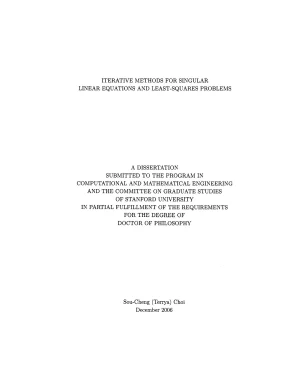
Tải xuống để đọc toàn bộITERATIVE METHODS FOR SINGULAR LINEAR EQUATIONS AND LEAST-SQUARES PROBLEMS A DISSERTATION SUBMITTED TO THE PROGRAM IN COMPUTATIONAL AND MATHEMATICAL ENGINEERING AND THE COMMITTEE ON GRADUATE STUDIES OF STANFORD UNIVERSITY IN PARTIAL FULFILLMENT OF THE REQUIREMENTS FOR THE DEGREE OF DOCTOR OF PHILOSOPHY Sou-Cheng (Terrya) Choi December 2006 UMI Number: 3242533 Copyright 2007 by Choi, Sou-Cheng (Terrya) All rights reserved. INFORMATION TO USERS The quality of this reproduction is dependent upon the quality of the copy submitted. Broken or indistinct print, colored or poor quality illustrations and photographs, print bleed-through, substandard margins, and improper alignment can adversely affect reproduction. In the unlikely event that the author did not send a complete manuscript and there are missing pages, these will be noted.
Also, if unauthorized copyright material had to be removed, a note will indicate the deletion. ® UMI UMI Microform 3242533 Copyright 2007 by ProQuest Information and Learning Company. All rights reserved. This microform edition is protected against unauthorized copying under Title 17, United States Code.
ProQuest Information and Learning Company 300 North Zeeb Road P. Box 1346 Ann Arbor, MI 48106-1346 Copyright @ 2007 by Sou-Cheng (Terrya) Choi All Rights Reserved I certify that I have read this dissertation and that, in my opinion, it is fully adequate in scope and quality as a dissertation for the degree of Doctor of Philosophy. Saunders) Principal Advisor I certify that I have read this dissertation and that, in my opinion, it is fully adequate in scope and quality as a dissertation for the degree of Doctor of Philosophy. Aut Abel (Gene H.
Golub) Co-Advisor I certify that I have read this dissertation and that, in my opinion, it is fully adequate in scope and quality as a dissertation for the degree of Doctor of Philosophy. Larsen) I certify that I have read this dissertation and that, in my opinion, it is fully adequate in scope and quality as a dissertation for the degree of Doctor of < z2zzz _ je. (Doronấy)” s4 Approved for the University Committee on Graduate Studies. Abstract CG, MINRES, and SYMMLQ are Krylov subspace methods for solving large symmetric systems of linear equations.
CG (the conjugate-gradient method) is reliable on positive-definite systems, while MINRES and SYMMLQ are designed for indefinite systems. When these methods are applied to an inconsistent system (that is, a singular symmetric least-squares problem), CG could break down and SYMMLQ’s solution could explode, while MINRES would give a least- squares solution but not necessarily the minimum-length solution (often called the pseudoinverse solution). This understanding motivates us to design a MINRES-like algorithm to compute minimum-length solutions to singular symmetric systems. MINRES uses QR factors of the tridiagonal matrix from the Lanczos process (where R is upper-tridiagonal).
Our algorithm uses a QLP decomposition (where rotations on the right reduce R to lower-tridiagonal form), and so we call it MINRES-QLP. On singular or nonsingular systems, MINRES-QLP can give more accurate solutions than MINRES or SYMMLQ. We derive preconditioned MINRES-QLP, new stopping rules, and better estimates of the solution and residual norms, the matrix norm and condition number. For a singular matrix of arbitrary shape, we observe that null vectors can be obtained by solving least-squares problems involving the transpose of the matrix.
For sparse rectangular matrices, this suggests an application of the iterative solver LSQR. In the square case, MINRES, MINRES-QLP, or LSQR are applicable. Results are given for solving homogeneous systems, computing the stationary probability vector for Markov Chain models, and finding null vectors for sparse systems arising in helioseismology. Acknowledgments First and foremost, I owe an enormous debt of gratitude to my advisor Professor Michael Saunders for his tireless support throughout my graduate education in Stanford.
Michael is the best mentor a research student could possibly hope for. He is of course an amazing academic going by his first-rate scholarly abilities, unparalleled mastery of his specialty, and profound insights on matters algorithmic and numerical (not surprising considering that he is one of most highly cited computer scientists in the world today). But above and beyond all these, Michael is a most wonderful gentleman with great human qualities—he is modest, compassionate, understanding, accommodating, and possesses a witty sense of humor. I am very fortunate, very proud, and very honored to be Michael’s student.
This thesis certainly would not have been completed without Michael’s most meticulous and thorough revision. Professor Gene Golub is a demigod in our field and a driving force behind the computational mathematics community at Stanford. Incidentally, Gene is also Michael’s advisor many years ago. I am also very grateful to Gene for his generosity and encouragement.
He is the only professor I know who gives students 24-hour access to his large collection of books in his office. His stature and renown for hospitality attract visiting researchers from all over the world and create a most lively and dynamic environment at Stanford. This contributed greatly to my academic development. Like me, Gene came from a working class family—a rarity in a place like Stanford where many students are of the well-heeled gentry.
He has often reminded me that a humble background is no obstacle to success. I am also very fortunate, very proud, and very honored to have Gene as my co-advisor. Special thanks are due to Professor Chris Paige Of McGill University for generously sharing his ideas and insights. He spent many precious hours with me over emails and long discussions during his two visits to Stanford in the past year.
Chris is a giant in the field and is a great honour to fill a gap in one of the famous works of Chris and Michael started long ago. I thank my reading committee members: Professor Doron Levy and Dr. Their helpful suggestions have improved this thesis enormously. My thanks also to Professor Jerome Friedman for chairing my oral defense despite already having retired a few months earlier.
I am very grateful to my professors from the National University of Singapore (NUS), who have instilled and inspired in me interests in computational mathematics since I was an under- graduate: Dr. Ma, Professors Choy-Heng Lai, Jiang-Sheng Wang, Zuowei Shen, Gongyun Zhou, Kim-Chuan Toh, Belal Baaquie, Kan Chen, and last but not least Prabir Burman (UC Davis). The work in this thesis was generously supported by research grants of Professors Michael Saunders, Gene Golub, and David Donoho. Thanks are also due to the C.
Gary & Virginia Skartvedt Endowed Engineering Fund for a Stanford School-of-Engineering Fellowship, and to the Silicon Valley Engineering Council for an SVEC Scholarship. MATLAB has been an indispensable tool—without which, none of the numerical experiments could have been performed with such ease and efficiency. I am proud to say that I learnt MATLAB first-hand from the person who created it—Professor Cleve Moler. I thank Cleve for selecting me as his teaching assistant for the course on which his very enjoyable book [71] is based (and for kindly recommending me as teaching assistant to his daughter Professor Kathryn Moler, who taught the course in the subsequent year).
The book is filled with illuminating examples and this thesis has borrowed a most fascinating one (cf. I thank Michael Friedlander for the elegant thesis template that he generously shares with the Stanford public. I have been fortunate to intern at both Google and IBM Almaden Labs, during which periods I benefited from working with Doctors John Tomlin, Andrew Tomkins, and Tom Truong. Specifically I want to thank Dr.
Xiaoye Sherry Li and Dr. Amy Langville for inviting me to speak about applications motivated by this thesis in Lawrence Berkeley Lab and the SIAM Annual Meeting 2004 respectively. Thanks also to Professor Beresford Parlett and Professor Inderjit Dhillon for the opportunities to speak in their seminars in UC Berkeley and UT Austin respectively. I also want to take the opportunity to thank each administrator and staff members of Stanford and NUS who have gone beyond their duties of call: Professors Walter Murray and Peter Glynn, Indira Choudhury, Lilian Lao, Evelyn Boughton, Lorrie Papadakis, Tim Keely, Seth Tornborg, Suzanne Bigas, Connie Chan, Christine Fiksdal, Dana Halpin, Jam Kiattinant, Nikkie Salgado, Claire Stager, Deborah Michael, Lori Cottle, Pat Shallenberger, Helen Tombropoulos, Sharon Bergman, Lee Kuen Chee, and Kowk Te Ang.
I am indebted to the following friends and colleagues for their friendship and encouragement that made my Stanford years so much more enjoyable: Michael’s family Prue, Tania, and Emily; David, Ha, and baby Mike Saunders; Holly Jin, Neil, Danlin, and Hansen Lillemark; Lilian Lao, Michael and Victor Dang; Justin Wing Lok Wan and Winnie Wan Chu; Dulce Ponceleón, Walter, Emma and Sofia Murray; Von Bing Yap and Anne Suet Lin Chong; Pei Yee Woo and Kenneth Wee; Larry and Mary Wong. I thank for their friendship and wisdom: Monica Johnston, Wanchi So, Regina Ip-Lau, Stephen Ng, Wah Tung Lau, Chris Ng, Jonathan Choi, Xiaoqing Zhu, Sorav Bansal, Jeonghee Yi, Mike Ching, Cindy Law, Doris Wong, Jasmine Wong, Sandi Suardi, Sharon Wong, Popoh Low, Grace Ng, Roland Law, Ricky Ip, Fanny Lau, Stephen Yeung, Kenneth (D&G) Wong Chok Hang Yeung, Carrie Teng, Grace Hui, Anthony So, Samuel Ieong, Kenneth Tam, Yee Wai Chong, Anthony Fai Tong Chung, Winnie Wing Yin Choi, Victor Lee, William Yu Cheong Chan, Dik Kin Wong, Collin Kwok-Leung Mui, Rosanna Man, Michael Friedlander, Kaustuv, Zheng Su, Yen Lin Chia, Hanh Huynh, Wanjun Mi, Linzhong Deng, Ofer Levi, James Lambers, Paul Tupper, Melissa Aczon, Steve Bryson, Oren Livne, Valentin Spitkovsky, Cindy Mason, Morten Mørup, Anil Gaba, Donald van Deventer, Kenji Imai, Chong-Peng Toh, Frederick Willeboordse, Yuan Ping Feng, Alex Ling, Roland Su, Helen Lau, and Suzanne Woo. I have been infinitely lucky to have met Lek-Heng Lim when we were both undergraduates in NUS. As I made further acquaintance with Lek-Heng, I found him among the most thoughtful, encouraging, and inspiring person of all friends and colleagues.
Without his encouragement, I would not have started this long journey, let alone finished. Last but not least, I thank my parents and grandma for years of toiling and putting up with my “life-long” studies. I am indebted to my siblings Dawn and Stephen, and brother-in-law Jack Cheng for their constant support. vi Contents List of Tables and Figures xiii Introduction CBON©FHo 1 1.1 The Motivating Problem.
0c cee ee ee kia 1. HQ nà nà KV V Và va 1. Q Q Q HQ ee k k k k ka 113 SymmetricSystems. Q0 HQ HH ee va 1.
Q Q Q Q HQ HH HQ nu ng k ko kh K k ky 1.21 Problem Description and Formal Solutions .2 Existing Numerical Algorithms. 00 ee eee eee 1.3 Background for MINRES. 0 eee eee eee 1. ee es aCOCCee 2 Existing Iterative Methods for Hermitian Problems 13 2.1 The Lanczos Process.2 Lanczos-Based Methods for Linear Systems .0 eee ee ees 16 22.
Existing Iterative Methods for Hermitian Least-Squares .4 Stopping Conditions and Norm Estimates .1 Residual and Residual Norm. 2 ee ee ee 36 2.5 Matrix Condition Numbers — 40 3 MINRES-QLP 3.11 Effects of Rounding ErrorsinMINRES.2 Existing Approaches to Solving Hermitian Least-Squares .3 Orthogonal Matrix Decompositions for Singular Matrices. vii 32 MINRBS-QLP. QC LH HQ Q nu nu cà vn V V V kg kia 3.1 The MINRES-QLP Subproblem .2 Solving the Subproblem.0000 eee eee La 3.4 Transfer from MINRES to MINRES-QLP.3 Stopping Conditions and Norm Estimates .1 Residual and Residual Norm.
2 eee ee ee 3.0 cc Q v Ty kg vn kg kg kg va 3. Q Q Q k LH gu Q v kg ki v kia 3.4 Matrix Condition Numbers. eee ee ee es 3.6 Projection of Right-hand Side onto Krylov Subspaces .4 Preconditioned MINRES and MINRES-QLP. De ee ee ee 3.
ch ng vn quà gà v ki kia 3.2 Preconditioning Singular lz=bÙb. ee ee ee ee 3.3 Preconditioning Singular Arb 2. cu cu kg 3.3 Incomplete Cholesky Factorization. 000048 Numerical Experiments on Symmetric Systems 41 A Singular Indefinite System ©.
ee ee 42 Two Laplacian Systems .
Nội dung được bảo vệ bản quyền — Tải xuống đầy đủ
Trích dẫn luận án này
Sou-Cheng Choi (2006). Phương pháp lặp cho hệ phương trình tuyến tính suy biến [Luận án tiến sĩ, stanford university]. LuanAn.net. https://luanan.net/toan-hoc/toan-ung-dung/phuong-phap-lap-he-tuyen-tinh-suy-bien-stanford
Câu hỏi thường gặp
Luận án "Phương pháp lặp cho hệ phương trình tuyến tính suy biến" nghiên cứu về vấn đề gì?
Luận án tiến sĩ nghiên cứu phương pháp lặp giải hệ phương trình tuyến tính suy biến. Đề xuất thuật toán MINRES-QLP với độ chính xác cao hơn các phương pháp hiện có.
Luận án "Phương pháp lặp cho hệ phương trình tuyến tính suy biến" được bảo vệ tại trường nào?
Luận án này được bảo vệ tại stanford university. Năm bảo vệ: 2006.
Luận án "Phương pháp lặp cho hệ phương trình tuyến tính suy biến" thuộc chuyên ngành gì?
Luận án "Phương pháp lặp cho hệ phương trình tuyến tính suy biến" thuộc chuyên ngành Computational and Mathematical Engineering. Danh mục: Toán Ứng Dụng.
Luận án "Phương pháp lặp cho hệ phương trình tuyến tính suy biến" có bao nhiêu trang?
Luận án "Phương pháp lặp cho hệ phương trình tuyến tính suy biến" có 113 trang. Bạn có thể xem trước một phần tài liệu ngay trên trang web trước khi tải về.
Cách tải luận án "Phương pháp lặp cho hệ phương trình tuyến tính suy biến" về máy như thế nào?
Để tải luận án về máy, bạn nhấn nút "Tải xuống ngay" trên trang này, sau đó hoàn tất thanh toán phí lưu trữ. File sẽ được tải xuống ngay sau khi thanh toán thành công. Hỗ trợ qua Zalo: 0559 297 239.