Nghiên cứu Hành vi Sinh thái Chim Sage-Grouse và Phản ứng với Cải tạo Môi trường sống ở Bắc Utah
Luận án: Greater sage grouse seasonal ecology and responses to habitat man. Xem tóm tắt và tải về tại LuanAn.net
Utah State University
Wildlife Biology
Luan An
Luận án tiến sĩ
Năm xuất bản
Số trang
139
Thời gian đọc
21 phút
Lượt xem
0
Lượt tải
0
Phí lưu trữ
40 Point
Tổng quan nhanh
- Chủ đề:
- 1. Chim Sage-Grouse: Suy thoái môi trường sống và nghiên cứu
- Số trang:
- 139 trang
- Trường:
- Utah State University
- Chuyên ngành:
- Wildlife Biology
- Tác giả:
- Eric T. Thacker
- Năm:
- 2010
Tóm tắt nội dung luận án
I. Chim Sage Grouse Suy thoái môi trường sống và nghiên cứu
Quần thể Chim Sage-Grouse (Centrocercus urophasianus) đang suy giảm đáng báo động. Tình trạng này gây ra lo ngại sâu sắc về sự ổn định lâu dài của loài. Suy thoái môi trường sống và mất đi sinh cảnh được xác định là nguyên nhân chính dẫn đến sự sụt giảm này. Mặc dù nhiều thông tin về hành vi sinh thái của Chim Sage-Grouse đã được biết, vẫn cần thêm dữ liệu về phản ứng của quần thể đối với các biện pháp quản lý cụ thể. Nghiên cứu này được thực hiện để ghi lại các phản ứng của Chim Sage-Grouse đối với những hành động quản lý tại chỗ. Đồng thời, nghiên cứu đánh giá việc sử dụng môi trường sống theo mùa và thời gian của Chim Sage-Grouse. Nghiên cứu cũng so sánh các kỹ thuật được người quản lý tài nguyên và động vật hoang dã sử dụng để đo lường phản ứng thảm thực vật đối với quản lý môi trường sống. Mục tiêu cuối cùng là cung cấp thông tin hữu ích cho các nỗ lực bảo tồn.
1.1. Tình trạng quần thể Chim Sage Grouse
Quần thể Chim Sage-Grouse (Centrocercus urophasianus) trên toàn khu vực đang đối mặt với sự suy giảm nghiêm trọng. Xu hướng này tạo ra những thách thức lớn trong việc bảo tồn loài. Sự giảm sút này đòi hỏi các biện pháp can thiệp khẩn cấp.
1.2. Mối đe dọa từ suy thoái môi trường sống
Suy thoái môi trường sống và mất đi các sinh cảnh quan trọng là yếu tố chính gây ra sự suy giảm số lượng Chim Sage-Grouse. Đặc biệt, môi trường sống cây ngải cứu (sagebrush) đang bị ảnh hưởng nghiêm trọng. Việc bảo vệ và phục hồi các khu vực này trở nên thiết yếu. Các hành vi phá hủy môi trường sống cần được kiểm soát chặt chẽ để đảm bảo sự tồn tại của loài.
1.3. Mục tiêu nghiên cứu về hành vi sinh thái
Nghiên cứu nhằm ghi lại phản ứng của Chim Sage-Grouse đối với các hành động quản lý môi trường sống cụ thể. Đồng thời, nghiên cứu đánh giá việc sử dụng môi trường sống theo mùa và thời gian. Một mục tiêu khác là so sánh tính tương thích của các phương pháp đo lường phản ứng thảm thực vật. Các thông tin này sẽ hỗ trợ việc xây dựng chiến lược bảo tồn hiệu quả cho Chim Sage-Grouse.
II. Phương pháp nghiên cứu hành vi sinh thái Chim Sage Grouse
Để hiểu rõ hành vi sinh thái và phản ứng của Chim Sage-Grouse với các tác động môi trường, nghiên cứu đã triển khai nhiều phương pháp phân tích chuyên sâu. Đặc biệt, phân tích hóa học phân được sử dụng để xác định khẩu phần ăn. Các kỹ thuật đo độ che phủ thảm thực vật cũng được đánh giá. Những phương pháp này cung cấp cái nhìn chi tiết về sự tương tác giữa Chim Sage-Grouse và môi trường sống cây ngải cứu (sagebrush). Nghiên cứu nhằm cung cấp dữ liệu đáng tin cậy cho các quyết định quản lý bảo tồn.
2.1. Phân tích khẩu phần ăn mùa đông Sage Grouse
Nghiên cứu đã sử dụng phương pháp sắc ký khí để phân tích viên phân của Chim Sage-Grouse vào mùa đông. Phương pháp này cho phép xác định chính xác các loài cây ngải cứu trong khẩu phần ăn. Kết quả cho thấy tập tính kiếm ăn Sage-Grouse bao gồm các loài cây đặc trưng. Phân tích viên phân là một công cụ hiệu quả để nghiên cứu chế độ ăn của Centrocercus urophasianus.
2.2. Xác định loài cây ngải cứu trong chế độ ăn
Phân tích đã xác nhận cây ngải cứu đen (Artemisia nova) là thành phần quan trọng trong khẩu phần ăn mùa đông của Chim Sage-Grouse tại các quần thể ở phía tây Hạt Box Elder và Dãy Parker Mountain. Phát hiện này nhấn mạnh tầm quan trọng của môi trường sống cây ngải cứu (sagebrush) đối với tập tính kiếm ăn Sage-Grouse. Việc hiểu rõ chế độ ăn giúp ích cho các chiến lược bảo tồn Centrocercus urophasianus.
2.3. So sánh kỹ thuật đo độ che phủ
Nghiên cứu cũng đánh giá tính tương thích của phương pháp chặn điểm đường (line-point intercept) và phương pháp che phủ tán Daubenmire để ước tính độ che phủ tán. Kết quả cho thấy hai phương pháp này không tương thích. Điều này có ý nghĩa quan trọng đối với các nhà quản lý khi lựa chọn phương pháp đo lường thảm thực vật trong môi trường sống cây ngải cứu (sagebrush).
III. Phản ứng của Chim Sage Grouse với cải tạo môi trường sống
Các biện pháp cải tạo môi trường sống cây ngải cứu (sagebrush) có thể ảnh hưởng đến hành vi sinh thái của Chim Sage-Grouse, đặc biệt là tập tính sinh sản Sage-Grouse và sự sống sót của đàn con. Nghiên cứu này tập trung vào việc đánh giá phản ứng của các đàn con Chim Sage-Grouse đối với các khu vực bị đốt cháy có kiểm soát. Việc này cung cấp cái nhìn sâu sắc về cách các hoạt động quản lý ảnh hưởng đến lựa chọn môi trường sống của Centrocercus urophasianus. Các kết quả nghiên cứu góp phần vào việc phát triển các chiến lược quản lý hiệu quả hơn.
3.1. Ảnh hưởng của đốt cháy có kiểm soát lên đàn con
Đàn con Chim Sage-Grouse đã chọn các khu vực bị đốt cháy có kiểm soát nhỏ (khoảng 25 ha), không đồng đều. Các khu vực này nằm trong quần xã cây ngải cứu lớn núi (A. tridentata vaseyana) ở độ cao lớn, phía đông bắc Utah. Sự lựa chọn này cho thấy đàn con tìm kiếm các điều kiện môi trường sống cụ thể sau khi có sự thay đổi. Điều này ảnh hưởng trực tiếp đến tập tính sinh sản Sage-Grouse và sự phát triển của chim non.
3.2. Lựa chọn môi trường sống cây ngải cứu của đàn con
Phản ứng của đàn con Centrocercus urophasianus với các khu vực bị đốt cháy cho thấy sự ưu tiên đối với môi trường sống cây ngải cứu (sagebrush) đã được cải tạo theo cách cụ thể. Các khu vực này có thể cung cấp nguồn thức ăn và nơi trú ẩn phù hợp hơn. Việc hiểu rõ các yếu tố này là rất quan trọng để quản lý sinh cảnh hiệu quả và hỗ trợ tập tính làm tổ Sage-Grouse cũng như sự sống còn của đàn con.
IV. Hành vi sinh thái Sage Grouse Sử dụng môi trường sống theo ngày
Hành vi sinh thái của Chim Sage-Grouse bao gồm các kiểu sử dụng môi trường sống khác nhau giữa ban ngày và ban đêm. Nghiên cứu đã kiểm tra đặc điểm thảm thực vật và côn trùng tại các địa điểm mà đàn con Chim Sage-Grouse sử dụng trong khoảng thời gian 24 giờ. Phân tích này cung cấp thông tin chi tiết về các yêu cầu môi trường sống của Centrocercus urophasianus trong các giai đoạn khác nhau trong ngày. Việc hiểu rõ sự thay đổi này giúp đưa ra các quyết định quản lý môi trường sống phù hợp hơn.
4.1. Đặc điểm vị trí sử dụng ban ngày của đàn con
Việc sử dụng địa điểm của đàn con Chim Sage-Grouse ở phía tây bắc Utah không khác biệt đáng kể trong giờ ban ngày. Điều này cho thấy các đàn con có thể di chuyển và kiếm ăn rộng rãi hơn trong các khu vực môi trường sống cây ngải cứu (sagebrush) vào ban ngày. Tập tính kiếm ăn Sage-Grouse vào ban ngày có thể linh hoạt hơn.
4.2. Đặc điểm vị trí trú ngụ ban đêm của đàn con
Ngược lại, các địa điểm trú ngụ ban đêm của Chim Sage-Grouse được đặc trưng bởi các cây bụi thấp hơn và nhiều đất trống hơn so với các địa điểm sử dụng vào giữa trưa. Những đặc điểm này có thể cung cấp sự che phủ và an toàn cần thiết cho đàn con vào ban đêm. Đây là một khía cạnh quan trọng của tập tính làm tổ Sage-Grouse và hành vi sinh thái tổng thể của loài.
V. Kết luận và ý nghĩa bảo tồn Centrocercus urophasianus
Nghiên cứu này đã cung cấp những hiểu biết quan trọng về hành vi sinh thái của Chim Sage-Grouse và phản ứng của chúng với các hoạt động cải tạo môi trường sống. Các phát hiện cho thấy tầm quan trọng của môi trường sống cây ngải cứu (sagebrush) và cách thức quản lý nó có thể ảnh hưởng trực tiếp đến sự sống còn của Centrocercus urophasianus. Việc áp dụng các kết quả này vào thực tiễn sẽ nâng cao hiệu quả của các chương trình bảo tồn. Cần tiếp tục nghiên cứu để hiểu rõ hơn về di cư Sage-Grouse và các yếu tố phức tạp khác ảnh hưởng đến loài.
5.1. Phát hiện chính từ nghiên cứu về hành vi sinh thái
Các phát hiện quan trọng bao gồm khả năng xác định khẩu phần ăn mùa đông qua phân, sự không tương thích của các phương pháp đo độ che phủ, và phản ứng tích cực của đàn con đối với các khu vực đốt cháy có kiểm soát nhỏ. Ngoài ra, sự khác biệt trong việc sử dụng môi trường sống giữa ban ngày và ban đêm cũng được làm rõ. Những điều này cung cấp nền tảng vững chắc cho quản lý Centrocercus urophasianus.
5.2. Hướng dẫn quản lý môi trường sống cây ngải cứu
Dựa trên kết quả, việc quản lý môi trường sống cây ngải cứu (sagebrush) cần xem xét các khu vực đốt cháy nhỏ, không đồng đều để hỗ trợ đàn con. Cần lựa chọn phương pháp đo lường thảm thực vật phù hợp. Việc hiểu rõ tập tính kiếm ăn Sage-Grouse, tập tính sinh sản Sage-Grouse và tập tính làm tổ Sage-Grouse là chìa khóa để thiết kế các chương trình bảo tồn hiệu quả nhằm chống lại suy thoái môi trường sống và bảo vệ Chim Sage-Grouse.
Mục lục chi tiết luận án
Tải xuống file đầy đủ để xem toàn bộ nội dung
Tải đầy đủ (139 trang)Trích đoạn nội dung luận án
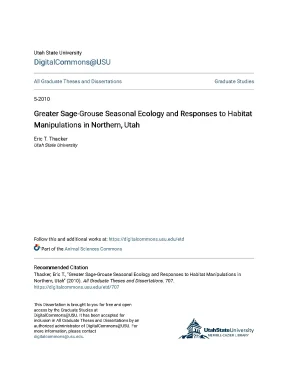
Tải xuống để đọc toàn bộUtah State University DigitalCommons@USU All Graduate Theses and Dissertations Graduate Studies 5-2010 Greater Sage-Grouse Seasonal Ecology and Responses to Habitat Manipulations in Northern, Utah Eric T. Thacker Utah State University Follow this and additional works at: https://digitalcommons.edu/etd Part of the Animal Sciences Commons Recommended Citation Thacker, Eric T., "Greater Sage-Grouse Seasonal Ecology and Responses to Habitat Manipulations in Northern, Utah" (2010). All Graduate Theses and Dissertations.edu/etd/707 This Dissertation is brought to you for free and open access by the Graduate Studies at DigitalCommons@USU. It has been accepted for inclusion in All Graduate Theses and Dissertations by an authorized administrator of DigitalCommons@USU.
For more information, please contact digitalcommons@usu. GREATER SAGE-GROUSE SEASONAL ECOLOGY AND RESPONSES TO HABITAT MANIPULATIONS IN NORTHERN, UTAH by Eric T. Thacker A dissertation submitted in partial fulfillment of the requirements for the degree of DOCTOR OF PHILOSOPHY in Wildlife Biology Approved: ________________________ ______________________________ Terry A. Connelly Major Professor Committee Member ________________________ ______________________________ Mark W.
Ryel Committee Member Committee Member _______________________ ______________________________ R. Douglas Ramsey Bryon R. Burnham Committee Member Dean of Graduate Studies UTAH STATE UNIVERSITY Logan, Utah 2010 ii Copyright © Eric T. Thacker 2010 All Rights Reserved iii ABSTRACT Greater Sage-Grouse Seasonal Ecology and Responses to Habitat Manipulations in Northern, Utah by Eric T.
Thacker, Doctor of Philosophy Utah State University, 2010 Major Professor: Dr. Messmer Department: Wildland Resources Declining greater sage-grouse populations (Centrocercus urophasianus; hereafter sage-grouse) have led to increased concern regarding the long-term stability of the species. Previous research has identified factors contributing to the observed population declines. Habitat degradation and loss have been implicated as major factors in population declines.
Although much is known about sage-grouse biology, more information is needed about population responses to specific management actions. This research was conducted to document sage-grouse responses to site-specific management actions. Additionally, I evaluated sage-grouse temporal and seasonal habitat-use and the comparability of techniques used by range and wildlife managers to measure vegetation responses of habitat management. Specifically, I evaluated 1) whether chemical analysis (gas chromatography) of sage-grouse fecal pellets could identify sagebrush species in sage-grouse winter diets, 2) the comparability of the line-point intercept and Daubenmire canopy cover methods for estimating canopy cover, 3) the response of sage-grouse broods to prescribed burns in a high elevation sagebrush community in northeastern iv Utah, and 4) the vegetation and insect characteristics of sites used by sage-grouse broods during a 24-hour period.
I was able to determine wintering sage-grouse diets using gas chromatography by analyzing fecal pellets. This research also confirmed that black sagebrush (Artemisia nova) was an important component of sage-grouse winter diets in western Box Elder County and Parker Mountain populations. The line-point intercept and Daubenmire methods for estimating canopy cover are not comparable. Sage-grouse broods selected small (~ 25 ha) patchy prescribed burns in high elevation mountain big sagebrush (A.
tridentata vaseyana) communities in northeastern Utah. Sage-grouse brood-site use in northwestern Utah did not differ during the diurnal hours, but nocturnal roost sites were characterized by shorter statured shrubs and more bare ground when compared to midday sites. (138 pages) v ACKNOWLEDGMENTS The title page of a dissertation fails to acknowledge that the resulting document is not because of one individual's solo effort; it is a concerted effort of many dedicated individuals. I must first acknowledge Dr.
Terry Messmer, who has provided me with the funding, mentoring, and guidance to complete this research. Messmer has allowed me to explore research interests that were not part of my original project. This has allowed me to explore topics that I would not have otherwise been exposed to. Messmer is passionate about research having direct impacts to the local communities; this has left a lasting impression upon me.
I would also like to acknowledge Dr. Messmer's ability to assemble a great staff and lab. Specifically I would like to thank Todd Black, for countless nights of trapping, enthusiasm for the research, and technical support. Additionally I would like to also thank David Dahlgren and Michael Guttery, who are good friends and colleagues, who have helped trap and allowed me to bounce ideas off them from time to time.
I would also like to thank the rest of Dr. Messmer's lab for the help they provided on my behalf. I also must recognize my committee, Dr. Ron Ryel, Dr.
Douglas Ramsey, Dr. Mark Brunson, and Dr. John "Jack" Connelly, for the time they spent reviewing drafts, their knowledge, and their professional guidance. This has definitely enriched my graduate experience.
I must extend special thanks to "Jack" Connelly for helping me integrate into the sage-grouse world. I would like to recognize the Box Elder Adaptive Resource Management local working group for providing grass roots support for sage-grouse conservation in Box Elder County. Troy Forrest (Box Elder Soil Conservation District) has provided much vi insight and technical help to see the Grouse Creek Livestock Association project through. I would also like to thank the Grouse Creek Livestock Association for allowing open access to their land holdings to conduct my research.
Specifically I would like to thank Blaine and Jay Tanner of Della Ranches. They provided places to store equipment, helped me gain access to private land, and helped us out of a few tight spots. I must also thank the Grouse Creek community who welcomed me, my technicians, and most importantly my family into the community for the past four summers. Grouse Creek is a long ways from a tire shop and Gordon Tanner fixed numerous flats “free of charge.” Why because that is what he has done for everyone for the last 10 years, thanks Gordon.
I would like recognize the Utah Division of Wildlife Resources for all the help and support they provided to me. I would specifically like to thank Dean Mitchell, Dave Olsen, Brian Maxfield, and Kory Inglet for their help. I would also like to thank the Ashley National Forest for offering me the chance to work on Anthro Mountain. Robert Christensen and Allen Huber were great to work with and provided data that required adding additional work to their busy schedules.
I would also like to acknowledge Dr. Dale Gardner of the USDA - ARS Poisonous Plant Research Lab, for performing the chemical analysis of sage-grouse fecal material. Gardner is an exceptional natural product chemist who participated in this project simply because he is passionate about grouse. I would like to express my many thanks to my technicians who have worked long difficult hours in the field (Chris Wesolek, Lee Nelson, Bobby Boswell, Jeff Dacey, Justin Windsor, Clint Wirick, and Stuart Luttich).
I have been very fortunate to have technicians who were very passionate about the work, were enjoyable to work with, and vii were great workers. I would like to especially thank Chris Wesolek for his exceptional dedication in performing some of the more mundane tasks of sorting insects, data entry, and prepping fecal pellets for chemical analysis. Last of all I would like to tell my family how incredibly grateful I am to them. They have sacrificed much in order to support my professional goals.
Messmer made it possible for me to take my family with me to Grouse Creek, Utah each field season. It takes a strong and dedicated woman to tolerate the rigors of a spouse in graduate school, but it takes someone extra special to willingly move her home to Grouse Creek each summer to be with her husband. Not only was she willing to move her home to Grouse Creek each summer, but she was also a lot of help on the project. She cooked meals and cookies for technicians, recorded and entered vegetation data, and even trapped a few grouse.
I am sure she is the only soccer mom that has jumped off the back of a moving ATV at midnight with a long-handled dip net in her hand! Her friendship and support exemplifies the true meaning of love. Additionally, there are 4 little girls (Emma, Allie, Kassie, and Lillie) who mean the world to me. They think things like dissertations, proposals, research, radio-collared grouse, bird dogs, and sagebrush are a normal part of daily life. I hope they remember time spent in Grouse Creek as fondly as I do.
It has been a great experience to share the wonders of sage-grouse and sagebrush country with my daughters. I must also mention the unfailing support of my parents and my brothers. I would especially like to thank my father, who spent countless hours with me in the great outdoors instilling in me an appreciation for the natural wonders of the world around us. The time spent in the field as a young boy has had a significant impact on my current professional pursuits.
Additionally my mother has provided me the viii encouragement that only a mother who “sees what could be” instead of “what is.” Thanks to all of my family members who have spent time in the field with me over the last 4 years. Thacker ix CONTENTS Page ABSTRACT. v LIST OF TABLES. xii LIST OF FIGURES.
INTRODUCTION AND LITERATURE REVIEW. 1 SAGE-GROUSE REPRODUCTIVE ECOLOGY. 4 Pre-laying Habitat. 5 SAGE-GROUSE WINTER ECOLOGY.
USING GAS CHROMOTOGRAPHY TO DETERMINE GREATER SAGE-GROUSE WINTER DIETS IN TWO UTAH POPULATIONS. COMPARABILITY OFDAUBENMIRE AND LINE-POINT INTERCEPT METHODS FOR GREATER SAGE-GROUSE HABITAT PARAMETERS. GREATER SAGE-GROUSE RESPONSE TO PRECRIBED FIRE IN HIGH ELEVATION SAGEBRUSH COMMUNITIES IN NORTHEASTERN, UTAH. TEMPORAL HABITAT-USE BY GREATER SAGE-GROUSE BROODS IN NORTHWESTERN UTAH.
CASE STUDY: LESSONS LEARNED FROM A COST- SHARE PROJECT INTENDED TO BENEFIT GREATER SAGE-GROUSE IN UTAH. GROUSE CREEK GRAZING ASSOSIATION CONSERVATION PLAN. 118 xii LIST OF TABLES Table Page 2-1. Greater sage-grouse (Centrocercus urophasianus) diet consumption by sagebrush (Artemisia spp.) community type in West Box Elder and Parker Mountain, Utah, 2007-2998.
ARNO = black sagebrush (A. nova), ATRTW = Wyoming sagebrush (A. tridentata wyomingensis), MIX = mixed sagebrush. Burn history from 1991 - 2008 on Anthro Mountain, Utah.
These numbers reflect the actual size of the burns and include non-sagebrush (Artemisia spp. Area of burns and proportion of study area treated by prescribed fire on Anthro Mountain, Utah. These values are calculated from a 30 m resolution raster and excluded non-sagebrush (Artemisia spp. Percent of greater sage-grouse (Centrocercus urophasianus) brood using prescribed burns, on Anthro Mountain, Utah, 2003-2009.
List of forbs found in Grouse Creek, Utah that are important to sage-grouse (Centrocercus urophasianus) chicks. ) This list is adapted from Klebenow and Gray 1968, Martin et al. Results from a complete randomized design testing for significance (α = .05) by time periods for sage-grouse (Centrocercus urophasianus) brood locations in Grouse Creek, Utah in 2007-2008. Means and SE for structure and forage measured at sage-grouse (Centrocercus urophasianus) brood locations in Grouse Creek, Utah, 2007-2008.
Greater sage- grouse broods were located during 4 time periods. Time periods were as follows: AM (sunrise - 0900 hrs), NOON (1200-1600 hrs), PM (1800 - sunset), and ROOST (2100 - 0300 hrs). TSC = total shrub cover, PGC = perennial grass cover, TFC = total forb cover, BGC = bare ground cover, TSH = total shrub height, THH = total herbaceous height, GFC = grouse forb cover, GIV = grouse insect volume. Seed mixture developed by the Utah Division of Wildlife Resources specifically for reseeding treatments for plots in, Grouse Creek Conservation Area, West Box Elder County, Utah 2006.
113 xiii LIST OF FIGURES Figures Page 2-1. Comparison of gas chromatograms of terpene profiles from black sagebrush (Artemisia nova) and Wyoming sagebrush (A. tridentata wyomingensis) from West Box Elder County, Utah in 2008. This shows the crude terpene profile for both species of sagebrush to illustrate differences in profiles between the two species.
Relative abundance is the relative abundance of each compound (chromatogram peak) and retention (x-axis) time is the amount of time it takes each compound (peak) to travel through the column. Gas chromatograms for terpene profiles from black sagebrush (Artemisia nova) and Wyoming sagebrush (A. wyomingensis) plants and fecal pellets collected in West Box Elder County, Utah 2008.
Nội dung được bảo vệ bản quyền — Tải xuống đầy đủ
Trích dẫn luận án này
Eric T. Thacker (2010). Hành vi sinh thái chim Sage-Grouse và phản ứng với cải tạo môi trường sống [Luận án tiến sĩ, Utah State University]. LuanAn.net. https://luanan.net/sinh-hoc/hanh-vi-sinh-thai-chim-sage-grouse-phan-ung-cai-tao-moi-truong-song
Câu hỏi thường gặp
Luận án "Hành vi sinh thái chim Sage-Grouse và phản ứng với cải tạo môi trường sống" nghiên cứu về vấn đề gì?
Luận án: Greater sage grouse seasonal ecology and responses to habitat man. Xem tóm tắt và tải về tại LuanAn.net
Luận án "Hành vi sinh thái chim Sage-Grouse và phản ứng với cải tạo môi trường sống" được bảo vệ tại trường nào?
Luận án này được bảo vệ tại Utah State University. Năm bảo vệ: 2010.
Luận án "Hành vi sinh thái chim Sage-Grouse và phản ứng với cải tạo môi trường sống" thuộc chuyên ngành gì?
Luận án "Hành vi sinh thái chim Sage-Grouse và phản ứng với cải tạo môi trường sống" thuộc chuyên ngành Wildlife Biology. Danh mục: Sinh Học.
Luận án "Hành vi sinh thái chim Sage-Grouse và phản ứng với cải tạo môi trường sống" có bao nhiêu trang?
Luận án "Hành vi sinh thái chim Sage-Grouse và phản ứng với cải tạo môi trường sống" có 139 trang. Bạn có thể xem trước một phần tài liệu ngay trên trang web trước khi tải về.
Cách tải luận án "Hành vi sinh thái chim Sage-Grouse và phản ứng với cải tạo môi trường sống" về máy như thế nào?
Để tải luận án về máy, bạn nhấn nút "Tải xuống ngay" trên trang này, sau đó hoàn tất thanh toán phí lưu trữ. File sẽ được tải xuống ngay sau khi thanh toán thành công. Hỗ trợ qua Zalo: 0559 297 239.