Britzke dissertation 2003 use of bat detectors
Luận văn Britzke 2003 sử dụng máy dò dơi để nghiên cứu sinh thái học và hành vi của loài dơi. Khám phá công nghệ phát hiện dơi.
Tennessee Technological University
Environmental Sciences
Luan An
luận án
Năm xuất bản
Số trang
73
Thời gian đọc
11 phút
Lượt xem
0
Lượt tải
0
Phí lưu trữ
40 Point
Tổng quan nhanh
- Chủ đề:
- Tối ưu hóa Sử dụng Bat Detectors trong Nghiên cứu Dơi
- Số trang:
- 73 trang
- Trường:
- Tennessee Technological University
- Chuyên ngành:
- Environmental Sciences
- Tác giả:
- Eric R. Britzke
- Năm:
- 2003
Tóm tắt nội dung luận án
I.Tối ưu hóa Sử dụng Bat Detectors trong Nghiên cứu Dơi
Nghiên cứu này tập trung vào việc tối ưu hóa cách sử dụng máy dò siêu âm (ultrasonic detectors) cho các nghiên cứu sinh thái dơi ở miền Đông Hoa Kỳ. Dơi tại khu vực này sử dụng cơ chế định vị bằng tiếng vang (bat echolocation) để săn mồi và điều hướng. Sự tiến bộ của công nghệ đã nâng cao đáng kể việc ứng dụng các thiết bị này trong các nghiên cứu thực địa. Mặc dù các máy dò dơi (bat detectors) được sử dụng rộng rãi, vẫn còn nhiều câu hỏi cơ bản về phương pháp sử dụng và các giới hạn của công nghệ này chưa được giải đáp. Mục tiêu chính là cung cấp hướng dẫn rõ ràng hơn về việc triển khai hiệu quả các kỹ thuật giám sát âm thanh (acoustic monitoring) để thu thập dữ liệu đáng tin cậy. Nghiên cứu giải quyết những khoảng trống này, nhằm cải thiện độ chính xác và tính ứng dụng của dữ liệu thu được. Các phát hiện giúp định hình các phương pháp thực địa (field methods) hiệu quả hơn cho các khảo sát dơi (bat surveys).
1.1. Tầm quan trọng của Ultrasonic Detectors trong Nghiên cứu
Máy dò siêu âm (ultrasonic detectors) đóng vai trò thiết yếu trong việc nghiên cứu hành vi và sinh thái dơi. Chúng cho phép các nhà khoa học thu thập dữ liệu về tiếng gọi định vị của dơi, vốn không thể nghe được bằng tai người. Công nghệ này là nền tảng cho nhiều nghiên cứu về sinh thái học dơi, từ việc xác định sự hiện diện của loài đến đánh giá mức độ hoạt động. Việc sử dụng chúng đã mở ra cánh cửa mới để hiểu rõ hơn về các loài dơi, đặc tính bay, và môi trường sống của chúng. Tuy nhiên, việc áp dụng cần được thực hiện cẩn trọng, xem xét các yếu tố ảnh hưởng đến chất lượng dữ liệu.
1.2. Những Hạn chế Hiện có của Công nghệ Phát hiện Dơi
Mặc dù các máy dò dơi (bat detectors) mang lại nhiều lợi ích, nhưng chúng cũng có những hạn chế cố hữu. Một số vấn đề liên quan đến độ chính xác của việc xác định loài dơi (bat species identification) dựa trên tiếng gọi. Ngoài ra, các yếu tố môi trường và thiết bị có thể ảnh hưởng đến chất lượng và tính đầy đủ của dữ liệu thu được. Nghiên cứu này đặt ra các câu hỏi cơ bản về việc liệu dữ liệu thu được có phản ánh chính xác hoạt động của dơi (bat activity) hay không, đặc biệt là trong các môi trường khác nhau. Việc hiểu rõ những hạn chế này là cần thiết để tránh diễn giải sai kết quả.
II.Định Danh Loài Dơi bằng Công nghệ Ultrasonic Detectors
Luận án đã điều tra khả năng định danh loài dơi (bat species identification) thông qua phân tích âm thanh bằng cách sử dụng máy dò dơi Anabat II. Phương pháp này dựa trên việc phân tích các đặc điểm của tiếng gọi định vị của dơi (bat echolocation). Một tổng cộng 12 loài dơi ở miền Đông Hoa Kỳ đã được đưa vào nghiên cứu. Phân tích chức năng phân biệt (discriminant function analysis) được áp dụng để xây dựng mô hình phân loại. Kết quả cho thấy mức độ chính xác khác nhau giữa các loài. Các phát hiện này cung cấp cái nhìn sâu sắc về độ tin cậy của việc sử dụng các máy dò siêu âm (ultrasonic detectors) cho mục đích định danh loài trong các khảo sát dơi (bat surveys). Việc cải thiện các kỹ thuật này là rất quan trọng cho các nghiên cứu về đa dạng sinh học và bảo tồn dơi.
2.1. Phương pháp Định Danh Dựa trên Âm thanh
Nghiên cứu sử dụng máy dò Anabat II để thu thập tiếng gọi định vị của dơi. Các tiếng gọi này sau đó được phân tích để xác định các đặc điểm âm học độc đáo của từng loài. Phân tích chức năng phân biệt là một kỹ thuật thống kê mạnh mẽ được sử dụng để phân loại các cá thể vào các nhóm đã biết. Phương pháp này cố gắng tìm ra sự kết hợp tuyến tính của các biến số có thể phân biệt tốt nhất các loài dơi dựa trên các thông số của tiếng gọi. Quá trình này là nền tảng của bioacoustics, cho phép nhận dạng từ xa các loài dơi mà không cần bắt giữ chúng. Điều này là đặc biệt hữu ích cho các loài quý hiếm hoặc khó tiếp cận.
2.2. Độ chính xác của Định Danh Loài Dơi
Đánh giá chéo đã cho ra tỷ lệ chính xác dao động từ 56,5% đối với Myotis grisescens. Tuy nhiên, 10 trong số 12 loài được nghiên cứu có tỷ lệ chính xác cao hơn 70%. Những kết quả này chỉ ra rằng, mặc dù hiệu quả không đồng đều giữa tất cả các loài, nhưng phương pháp này vẫn rất có giá trị. Các yếu tố như sự chồng chéo trong đặc điểm tiếng gọi giữa các loài hoặc chất lượng của bản ghi có thể ảnh hưởng đến độ chính xác. Việc hiểu rõ những khác biệt này là quan trọng để diễn giải đúng dữ liệu và phát triển các công cụ phân loại tốt hơn trong tương lai, nâng cao chất lượng của dữ liệu phân tích tiếng gọi dơi (data analysis bat calls).
III.Đánh giá Hoạt động Dơi và Yếu tố Môi trường Tác động
Nghiên cứu đã điều tra tác động của mức độ ánh sáng xung quanh lên hoạt động của dơi (bat activity). Điều này được thực hiện thông qua các bản ghi thụ động, kết hợp với các máy đo cường độ ánh sáng tại ba trạm cố định ở Kentucky. Mục đích là để hiểu các yếu tố môi trường ảnh hưởng đến mô hình bay và săn mồi của dơi. Các yếu tố như nhiệt độ và thời gian sau khi mặt trời lặn được xác định là có ý nghĩa đáng kể trong việc giải thích sự biến đổi của hoạt động dơi. Tuy nhiên, mức độ ánh sáng xung quanh không phải là một yếu tố giải thích có ý nghĩa. Kết quả này thách thức một số giả định phổ biến về ảnh hưởng của ánh sáng đối với dơi và có ý nghĩa quan trọng đối với các khảo sát dơi (bat surveys) và chiến lược bảo tồn.
3.1. Phân tích Tác động Ánh sáng và Nhiệt độ
Để đánh giá tác động của ánh sáng, các bản ghi âm thanh được thực hiện song song với việc đo cường độ ánh sáng. Dữ liệu này được phân tích để tìm mối liên hệ giữa các yếu tố môi trường và hoạt động của dơi. Các nhà nghiên cứu phát hiện ra rằng nhiệt độ và thời gian sau khi mặt trời lặn là những yếu tố quan trọng, có khả năng giải thích sự thay đổi trong hoạt động dơi. Điều này nhấn mạnh vai trò của các điều kiện khí hậu và chu kỳ ngày đêm trong việc điều chỉnh hành vi của dơi. Việc hiểu rõ những mối quan hệ này là cần thiết để dự đoán chính xác hơn các mô hình hoạt động của dơi và lên kế hoạch cho các nghiên cứu bioacoustics.
3.2. Mức độ Ánh sáng và Hoạt động Dơi
Thật bất ngờ, mức độ ánh sáng xung quanh không được chứng minh là một yếu tố quan trọng trong việc giải thích sự biến động của hoạt động dơi. Điều này có thể cho thấy rằng dơi có khả năng thích nghi với các điều kiện ánh sáng khác nhau hoặc rằng các yếu tố khác có ảnh hưởng mạnh mẽ hơn. Phát hiện này có ý nghĩa quan trọng đối với các phương pháp thực địa (field methods) và thiết kế khảo sát. Các nhà khoa học có thể cần tập trung vào các biến số môi trường khác khi cố gắng dự đoán hoạt động của dơi, thay vì chỉ dựa vào ánh sáng, khi thực hiện acoustic monitoring.
IV.Phân tích Không gian Hoạt động Dơi qua Acoustic Monitoring
Các nghiên cứu về sử dụng môi trường sống của dơi (bat habitat use studies) thường giả định rằng hoạt động của dơi (bat activity) là đồng đều trong suốt các môi trường sống được khảo sát. Luận án đã kiểm tra sự biến đổi không gian của hoạt động dơi trong hai khu vực khác nhau: một rừng trưởng thành và một khu vực khai thác gỗ. Một lưới gồm 6 trạm được sử dụng để thu thập dữ liệu về hoạt động dơi. Kết quả cho thấy sự biến đổi không gian trong hoạt động dơi giữa các trạm cao gấp đôi ở rừng trưởng thành so với khu vực khai thác gỗ. Điều này gợi ý rằng cần có số lượng máy dò siêu âm (ultrasonic detectors) khác nhau để lấy mẫu hoạt động dơi một cách đầy đủ trong các môi trường sống đa dạng này. Phát hiện này rất quan trọng đối với việc thiết kế các khảo sát dơi (bat surveys) chính xác.
4.1. Sự thay đổi Hoạt động Dơi theo Không gian
Nghiên cứu sử dụng một lưới các trạm thu âm để đánh giá sự phân bố không gian của hoạt động dơi. Thay vì giả định một sự phân bố đồng đều, phương pháp này cho phép nhận diện các khu vực có hoạt động cao hoặc thấp. Sự biến đổi không gian là một yếu tố quan trọng cần được xem xét trong các nghiên cứu sinh thái, vì nó ảnh hưởng trực tiếp đến việc lấy mẫu và diễn giải dữ liệu. Hiểu được các mô hình phân bố này giúp tối ưu hóa việc đặt máy dò trong các khảo sát acoustic monitoring, đảm bảo thu được một bức tranh toàn diện về việc sử dụng môi trường sống của dơi.
4.2. Số lượng Detectors cần thiết cho các Môi trường sống
Sự biến đổi hoạt động dơi cao hơn trong rừng trưởng thành cho thấy rằng các môi trường sống khác nhau yêu cầu số lượng máy dò siêu âm (ultrasonic detectors) khác nhau để lấy mẫu hiệu quả. Rừng trưởng thành, với cấu trúc phức tạp hơn, có thể tạo ra nhiều 'điểm nóng' hoặc 'điểm lạnh' về hoạt động dơi, đòi hỏi nhiều thiết bị hơn để bao quát. Ngược lại, khu vực khai thác gỗ có thể có hoạt động dơi phân bố đồng đều hơn, cần ít máy dò hơn. Phát hiện này có ý nghĩa thực tiễn quan trọng cho các phương pháp thực địa (field methods) và phân tích dữ liệu tiếng gọi dơi (data analysis bat calls), giúp tối ưu hóa nguồn lực và tăng cường độ tin cậy của dữ liệu thu được trong các bat surveys.
V.Cải thiện Phân tích Dữ liệu Cuộc gọi Dơi và Chất lượng Dữ liệu
Không phải tất cả các tiếng gọi định vị bằng tiếng vang (bat echolocation) được ghi lại đều có thể được xác định loài. Để giải quyết vấn đề này, một bộ lọc khách quan đã được xây dựng để đánh giá xem chuỗi tiếng gọi có thể định danh được hay không. Sau đó, tác động của loại môi trường sống lên tỷ lệ các chuỗi tiếng gọi còn sót lại sau bộ lọc được xác định. Các môi trường sống có cấu trúc phức tạp hơn (ví dụ: rừng trưởng thành) có tỷ lệ chuỗi tiếng gọi có thể định danh thấp hơn. Điều này chỉ ra rằng chất lượng dữ liệu và khả năng định danh loài có thể thay đổi đáng kể tùy thuộc vào môi trường sống. Việc hiểu rõ điều này là cần thiết để cải thiện các phương pháp phân tích dữ liệu tiếng gọi dơi (data analysis bat calls) và nâng cao độ tin cậy của việc xác định loài dơi (bat species identification) trong acoustic monitoring.
5.1. Xây dựng Bộ lọc Khách quan cho Chuỗi Tiếng gọi
Một thách thức lớn trong bioacoustics là việc xử lý các bản ghi tiếng gọi dơi không rõ ràng hoặc không đầy đủ. Để giải quyết vấn đề này, nghiên cứu đã phát triển một bộ lọc khách quan. Bộ lọc này được thiết kế để đánh giá chất lượng và tính đầy đủ của các chuỗi tiếng gọi, từ đó xác định liệu chúng có đủ điều kiện để định danh loài hay không. Việc sử dụng bộ lọc giúp loại bỏ dữ liệu nhiễu hoặc không phù hợp, chỉ giữ lại những bản ghi có giá trị phân tích cao. Điều này cải thiện đáng kể độ tin cậy của các kết quả định danh và hiệu quả của các phương pháp thực địa (field methods) trong bat surveys.
5.2. Ảnh hưởng của Môi trường sống đến Khả năng Định Danh
Nghiên cứu đã xác định rằng loại môi trường sống có ảnh hưởng đáng kể đến tỷ lệ các chuỗi tiếng gọi có thể định danh sau khi áp dụng bộ lọc. Các môi trường sống có cấu trúc phức tạp, như rừng trưởng thành, có tỷ lệ tiếng gọi có thể định danh thấp hơn. Điều này có thể là do sự phản xạ âm thanh từ cây cối dày đặc hoặc do dơi hoạt động theo cách khác trong những môi trường này, ảnh hưởng đến chất lượng bản ghi. Phát hiện này nhấn mạnh tầm quan trọng của việc xem xét đặc điểm môi trường sống khi thiết kế các khảo sát dơi (bat surveys) và khi thực hiện phân tích dữ liệu tiếng gọi dơi (data analysis bat calls) bằng các máy dò siêu âm (ultrasonic detectors).
Mục lục chi tiết luận án
Tải xuống file đầy đủ để xem toàn bộ nội dung
Tải đầy đủ (73 trang)Trích đoạn nội dung luận án
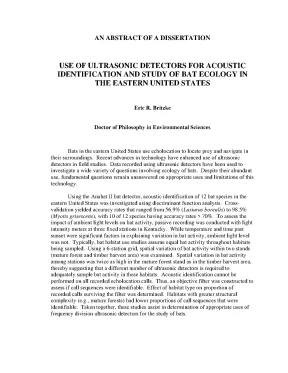
Tải xuống để đọc toàn bộAN ABSTRACT OF A DISSERTATION USE OF ULTRASONIC DETECTORS FOR ACOUSTIC IDENTIFICATION AND STUDY OF BAT ECOLOGY IN THE EASTERN UNITED STATES Eric R. Britzke Doctor of Philosophy in Environmental Sciences Bats in the eastern United States use echolocation to locate prey and navigate in their surroundings. Recent advances in technology have enhanced use of ultrasonic detectors in field studies. Data recorded using ultrasonic detectors have been used to investigate a wide variety of questions involving ecology of bats.
Despite their abundant use, fundamental questions remain unanswered on appropriate uses and limitations of this technology. Using the Anabat II bat detector, acoustic identification of 12 bat species in the eastern United States was investigated using discriminant function analysis. Cross- validation yielded accuracy rates that ranged from 56.5% (Myotis grisescens), with 10 of 12 species having accuracy rates > 70%. To assess the impact of ambient light levels on bat activity, passive recording was conducted with light intensity meters at three fixed stations in Kentucky.
While temperature and time past sunset were significant factors in explaining variation in bat activity, ambient light level was not. Typically, bat habitat use studies assume equal bat activity throughout habitats being sampled. Using a 6-station grid, spatial variation of bat activity within two stands (mature forest and timber harvest area) was examined. Spatial variation in bat activity among stations was twice as high in the mature forest stand as in the timber harvest area, thereby suggesting that a different number of ultrasonic detectors is required to adequately sample bat activity in these habitats.
Acoustic identification cannot be performed on all recorded echolocation calls. Thus, an objective filter was constructed to assess if call sequences were identifiable. Effect of habitat type on proportion of recorded calls surviving the filter was determined. Habitats with greater structural complexity (e., mature forests) had lower proportions of call sequences that were identifiable.
Taken together, these studies assist in determination of appropriate uses of frequency division ultrasonic detectors for the study of bats. USE OF ULTRASONIC DETECTORS FOR ACOUSTIC IDENTIFICATION AND STUDY OF BAT ECOLOGY IN THE EASTERN UNITED STATES ___________________ A Dissertation Presented to the Faculty of the Graduate School Tennessee Technological University By Eric R. Britzke ___________________ In Partial Fulfillment of the Requirements for the Degree DOCTOR OF PHILOSPHY Environmental Sciences ___________________ May 2003 CERTIFICATE OF APPROVAL OF DISSERTATION USE OF ULTRASONIC DETECTORS FOR ACOUSTIC IDENTIFICATION AND STUDY OF BAT ECOLOGY IN THE EASTERN UNITED STATES By Eric R. Britzke Graduate Advisory Committee: ________________________________ _________ Chairperson Date ________________________________ __________ Member Date ________________________________ __________ Member Date ________________________________ ___________ Member Date _______________________________ ____________ Member Date Approved for the Faculty: ___________________________ Associate Vice President for Research and Graduate Studies _______________________ ii Date ACKNOWLEDGEMENTS I thank members of my committee, Dr.
Roberts, and Dr. Wells, for assistance provided throughout this lengthy process from study design to completion of this manuscript. I also thank all additional people that assisted in editing associated manuscripts. Financial support for this project was provided by the Arkansas Game and Fish Commission, Bat Conservation International, Great Smoky Mountains National Park, Mammoth Cave National Park, National Forests in North Carolina, Ozark-St.
Francis National Forest, Southern Research Station of the U. Forest Service, Tennessee Wildlife Resources Agency, and the U. Fish and Wildlife Service. Additionally, the Center for the Management, Utilization, and Protection of Water Resources and Department of Biology at Tennessee Technological University provided funding and support for this project.
This project would not have been possible without the assistance of numerous people throughout the eastern United States. While I cannot name all of these volunteers, some people deserve special attention: Tom Biebighauser, Robert Currie, Alan Hicks, Susan Loeb, and John MacGregor. Chris Corben provided extensive assistance for his technical advice on the use of Analook software throughout this study. Finally, special thanks to Tammy Jones, Michael Schirmacher, and Andrew Scott; they managed to persevere despite difficult situations I thrust upon them.
iii TABLE OF CONTENTS Page LIST OF TABLES…………………………………………………………………… vi LIST OF FIGURES…………………………………………………………………. vii INTRODUCTION…………………………………………………………………… 1 Echolocation Properties…………………………………………………. 5 Uses of Ultrasonic Detectors……………………………………………. A Quantitative Method for Acoustic Identification of Bats in the Eastern United States……………………………………………………… 9 Introduction……………………………………………………………… 10 Methods………………………………………………………………….
Effect of Ambient Light Levels on Bat Activity. Spatial Variation in Bat Activity in Two Forest Stands. 36 iv Page PART 4. Effect of Habitat Type on Potential Identification of 42 Bat Echolocation Calls.
46 LITERATURE CITED……………………………………………………………… 52 v LIST OF TABLES Table Page 1.1 Number of recording locations and sample sizes of each bat species represented in the call library used to construct the DFA classification model……………………………………………………….2 Accuracy rates (%) of 12 species of bats for 3 iterations and average of the cross-validation procedure using DFA based on 10 echolocation call parameters.3 Average classification rates (%) from cross-validation testing of the DFA. N = number of test sequences for each bat species. Species codes represent the first two letters of the genus and the specific epithet. Actual species identifications are listed across the top, while predicted species identifications are along the side.
Unknown species identifications resulted from 2 species being identified by an equal number of calls within the sequence……………… 21 vi LIST OF FIGURES Figure Page 1.1 Locations from which bat echolocation calls were recorded with the Anabat II bat detector system…………………………………… 22 2.1 Mean number of echolocation files (±SE) recorded at 3 stations during 3 different moon phases. Number of files of bat activity did not differ among moon phases……….2 Relationships between rank of number of bat call sequences recorded and rank light intensity for 15-minute periods pooled for 12 nights of recording at each site…………………………………….1 Frequency distributions of coefficients of variation in bat activity among 6 stations in mature forest and shelterwood habitat stands……………………………………………………………… 39 3.2 Frequency distributions of similarities in bat activity among 6 stations sampled in mature forest and shelterwood stands……………….3 Relationships between distance between stations and similarities among those stations in the number of files recorded in mature forest and shelterwood stands…………………………………………….1 Relationship between number of bat call sequences that survived cleaning of filter 1 and number of bat call sequences surviving the cleaning of filter 2……………………………………………………….2 Proportion of bat call sequences surviving cleaning of filter 1 by habitat (F = 32. Habitats with the same letters are not statistically different in pairwise comparisons………………………. 51 vii INTRODUCTION Worldwide, many bat species have experienced severe population declines (Fujita and Tuttle 1991; Pierson 1998; Racey 1998; Richards and Hall 1998).
In the eastern United States, two monotypic species and two subspecies of another species are listed as federally endangered by the U. Fish and Wildlife Service (Harvey et al. Listing bats as threatened or endangered has prompted extensive research into ecology of bats (Racey and Entwistle 2003). Until the late 1990’s, most research focused on the use of capture and/or observational techniques.
However, relatively little is known about habitat use of many bats. Recently, ability to study bats has been improved by advances in technology (e., ultrasonic detectors and radio-telemetry). Initial ultrasonic detectors were expensive, susceptible to damage, and logistically difficult to use (Griffin 1958), but early efforts indicated that some species could be acoustically identified (Fenton and Bell 1981; Simmons et al. Recent advances in technology have resulted in widespread use of detectors for study of bat ecology (Betts 1998); however, several aspects of their use need refinement.
1 2 Echolocation Properties A single emission of sound is referred to as a call, and a series of calls is a call sequence (Fenton 1999). The sound produced with the lowest frequency is designated as the fundamental harmonic. As a by-product of sound production, other harmonics are produced at whole number multiples of the frequency of lower harmonics. For example, if sound is produced at 20 kHz, harmonics will also be produced at 40 kHz, 60 kHz, etc.
Further, as frequencies increase, harmonics are produced at increasingly lower amplitudes (energy). Because high frequency sound attenuates faster and is produced at lower amplitudes, higher harmonics travel shorter distances from the source than lower harmonics. Echolocation calls of bats consist of three phases: search, approach, and terminal (Griffin et al. Search phase calls are produced to locate prey, approach phase calls are produced to identify exact locations of prey, and terminal phase calls are produced just prior to capture.
Search phase calls are useful in the study of bat echolocation because they constitute a majority (ca. 90%) of calls produced by bats, exhibit consistency in structure throughout the call sequence, and may possess species-specific characteristics (Betts 1998; Fenton and Bell 1981; O’Farrell et al. Ultrasonic Detectors Orientation capabilities of bats were first studied by Italian scientist, Lazzaro Spallazani in the 1790’s (Griffin 1958). Spallazani observed that bats flew equally well 3 without vision, but he was unable to determine the method they used to orient to their surroundings.
However, he demonstrated that bats deprived of both sight and hearing could not successfully orient to their surroundings. Although ultrasound was suspected, high frequency sounds produced by bats were not detected until the late 1930’s (Griffin 1958). Before analysis of echolocation calls can be conducted, incoming signals must be converted to frequencies that are within the range of human hearing. Based on differences in methods to convert this incoming sound, three classes of ultrasonic detectors have been developed: heterodyne, frequency division, and time expansion.
Heterodyne detectors are narrowband instruments; i., they only detect ~ 10 kHz frequency range at any one time. A frequency is manually selected, and the ultrasonic detector converts all sounds within 5 kHz of the selected frequency into audible clicks. Heterodyne detectors can only be operated through active recording (researcher present), do not permit more advanced analysis of detected signals, and fail to detect bats outside the narrow band of frequencies being sampled (Fenton 1988). Consequently, heterodyne detectors are useful for a narrow range of study designs.
For example, heterodyne detectors can be tuned to a frequency of a target species to determine presence or activity of this species. Despite the limitations of this detector type, they are frequently used to study bat activity (Ahlen and Baagoe 1999; Crampton and Barclay 1998; Grindal and Brigham 1999; Limpens and Kapteyn 1991; Walsh and Harris 1996). Frequency division detectors are broadband (10-200 kHz) instruments that divide incoming frequencies by preset values. The Anabat II bat detector system (Titley 4 Electronics; www.au) is a widely used instrument of this type (Betts 1998).
Frequency division detectors can be used under active or passive (researcher absent) modes. Echolocation calls are recorded to tape recorders (Hayes and Hounihan 1994) or directly to laptop computers (O’Farrell 1998). Time expansion systems are also broadband ultrasonic detectors in which incoming signals are stored in a digital buffer. When the buffer is filled or when specified by the user, signals are downloaded at 1/10 of their normal speed to a tape recorder.
For example, incoming sounds that are 1.7 seconds in length will require 17 seconds to download, a period in which additional echolocation calls cannot be detected. Frequency division and time expansion systems retain different information from incoming sounds. The Anabat system only uses the harmonic with the most energy for recording (i., usually the fundamental harmonic), and information on harmonic structure and amplitude is lost. Time expansion systems retain complete incoming signals, providing for more thorough analysis.
This increased information retention comes at a large cost with file sizes being much larger for the time expansion system (> 1 MB each) than for the Anabat system (1-15 KB) each). Thus, time expansion systems require more powerful computers to record and analyze echolocation calls. The Anabat system measures lower maximum and higher minimum frequency values than time expansion systems (Fenton et al. However, these 1-2 kHz differences are less than variation from other sources (Brigham et al.
1989; Murray et al. 2001; Thomas et al. Additionally, simultaneous sampling indicated that Anabat systems detect fewer echolocation calls than time expansion detectors (i., microphones 5 on time expansion systems were more sensitive)(Fenton 2000; Fenton et al.
Nội dung được bảo vệ bản quyền — Tải xuống đầy đủ
Trích dẫn luận án này
Eric R. Britzke (2003). Britzke dissertation 2003 use of bat detectors [Luận án tiến sĩ, Tennessee Technological University]. LuanAn.net. https://luanan.net/sinh-hoc/britzke-dissertation-2003-use-of-bat-detectors
Câu hỏi thường gặp
Luận án "Britzke dissertation 2003 use of bat detectors" nghiên cứu về vấn đề gì?
Luận văn Britzke 2003 sử dụng máy dò dơi để nghiên cứu sinh thái học và hành vi của loài dơi. Khám phá công nghệ phát hiện dơi.
Luận án "Britzke dissertation 2003 use of bat detectors" được bảo vệ tại trường nào?
Luận án này được bảo vệ tại Tennessee Technological University. Năm bảo vệ: 2003.
Luận án "Britzke dissertation 2003 use of bat detectors" thuộc chuyên ngành gì?
Luận án "Britzke dissertation 2003 use of bat detectors" thuộc chuyên ngành Environmental Sciences. Danh mục: Sinh Học.
Luận án "Britzke dissertation 2003 use of bat detectors" có bao nhiêu trang?
Luận án "Britzke dissertation 2003 use of bat detectors" có 73 trang. Bạn có thể xem trước một phần tài liệu ngay trên trang web trước khi tải về.
Cách tải luận án "Britzke dissertation 2003 use of bat detectors" về máy như thế nào?
Để tải luận án về máy, bạn nhấn nút "Tải xuống ngay" trên trang này, sau đó hoàn tất thanh toán phí lưu trữ. File sẽ được tải xuống ngay sau khi thanh toán thành công. Hỗ trợ qua Zalo: 0559 297 239.