The construction and impact of power in cross sector partnerships
Khám phá cách xây dựng, tác động quyền lực trong hợp tác liên ngành. Phân tích động lực, chiến lược hiệu quả.
Luan An
Luận án tiến sĩ
Năm xuất bản
Số trang
213
Thời gian đọc
32 phút
Lượt xem
0
Lượt tải
0
Phí lưu trữ
50 Point
Tổng quan nhanh
- Chủ đề:
- Exploring Power Dynamics in Cross-Sector Partnerships
- Số trang:
- 213 trang
- Trường:
- Antioch University
- Chuyên ngành:
- Leadership and Change
- Tác giả:
- Kimberly Allyn Walker
- Năm:
- 2020
Tóm tắt nội dung luận án
I.Exploring Power Dynamics in Cross Sector Partnerships
Cross-sector partnerships bring together diverse entities. These include public agencies, private corporations, and civil society organizations. Understanding power dynamics within these collaborations is crucial. Inter-organizational power shapes how partners interact. It dictates resource allocation and strategic direction. Partnerships often form to address complex societal issues. Solutions require collective action. However, the diverse nature of partners introduces inherent challenges. Different sectors operate under varying mandates and resource bases. This creates a fertile ground for power imbalances. This document examines how power is constructed. It analyzes its far-reaching impact. Public-private partnerships exemplify this complexity. Government bodies bring regulatory authority. Corporations contribute financial capital and market expertise. Civil society organizations offer grassroots knowledge and community trust. Each brings unique strengths. Each also carries specific vulnerabilities. The study explores these intricate relationships. It sheds light on the lived experiences of individuals within these collaborations. A deeper understanding of power structures leads to more effective partnerships. It fosters equitable outcomes. Ignoring power dynamics can lead to project failure. It can also exacerbate existing inequalities. Thus, recognizing and addressing these dynamics becomes paramount for successful cross-sector engagement. This research provides insights into navigating these complex terrains.
1.1. Defining Power in Collaborative Contexts
Power manifests in multiple forms. It is not solely about authority. It includes influence, control over resources, and decision-making capacity. In collaborative contexts, power is often fluid. It can shift based on context, issue, and partner needs. Defining power requires a nuanced approach. It considers both explicit and implicit forms. Explicit power relates to formal roles and mandates. Implicit power involves reputation, expertise, and networks. This study explores how participants perceive and enact power. It examines their understanding of its presence and effects. A shared understanding of power definitions helps partners communicate effectively. It establishes a foundation for balanced engagement.
1.2. Types of Inter Organizational Power
Inter-organizational power varies significantly. It encompasses coercive power, reward power, legitimate power, referent power, and expert power. Coercive power involves the ability to punish or withhold resources. Reward power offers incentives for compliance. Legitimate power derives from formal positions or mandates. Referent power stems from admiration or respect. Expert power comes from specialized knowledge or skills. In public-private partnerships, each type of power can be present. For instance, government agencies often hold legitimate power. Corporations may wield reward power through funding. Civil society organizations might possess referent power. Recognizing these types helps in analyzing power dynamics. It assists in anticipating potential conflicts or synergies. The interplay of these power types defines collaboration dynamics.
1.3. Relevance for Public Private Partnerships
Public-private partnerships are a key focus. These collaborations are designed to leverage resources across sectors. They aim to achieve common goals. The success of these partnerships heavily relies on managing power dynamics. Governments seek efficient service delivery. Private entities pursue profitability and market reach. Civil society organizations advocate for community needs. Their differing objectives can create tension. Power influences how these objectives are prioritized. It affects resource distribution and project governance. Understanding power's relevance allows for proactive management. It ensures partnerships deliver intended public value. The study offers critical insights for practitioners. It enhances the design and implementation of future collaborations.
II.Understanding Power Imbalances in Cross Sector Work
Cross-sector partnerships frequently encounter power imbalances. These disparities arise from varied sources. Differences in funding, human capital, or institutional legitimacy contribute to them. When one partner possesses significantly more resources, resource dependency emerges for others. This dependence can grant disproportionate stakeholder influence to the dominant party. Such imbalances can skew decision-making processes. They may marginalize the voices of less powerful partners. The research investigates how these imbalances are perceived. It explores their practical implications on collaborative ventures. Acknowledging power disparities is the first step toward mitigation. Failing to address them can lead to distrust. It can also result in inequitable distribution of benefits. Effective partnerships strive for a balance. They seek to empower all participants. This promotes shared ownership and commitment. The study highlights the subtle ways power disparities manifest. It offers a framework for analysis. This understanding is vital for fostering more equitable collaboration models.
2.1. Manifestations of Unequal Resource Dependency
Unequal resource dependency is a primary source of power imbalances. One partner might control critical funding. Another might possess essential expertise. A third could have access to vital networks. These dependencies manifest in various ways. For example, a non-profit organization might rely heavily on corporate funding. This can influence its programmatic decisions. A smaller civil society organization might depend on a government agency for data. This shapes its advocacy efforts. The study explores these tangible and intangible resource dependencies. It analyzes how they confer power. Understanding these manifestations helps partners negotiate more effectively. It identifies areas requiring strategic rebalancing of contributions.
2.2. Identifying Sources of Partnership Disparity
Sources of partnership disparity are multi-faceted. They extend beyond just financial capital. They include differences in institutional size, political clout, and public recognition. A large corporation typically holds more public recognition than a small community group. A government body has inherent legitimate authority. These factors contribute to power imbalances. Historical context also plays a role. Past interactions or societal hierarchies can reinforce disparities. The study identifies these diverse sources. It examines how they are perceived by partnership participants. Recognition of these sources is critical. It allows for targeted interventions. These interventions aim to level the playing field. This ensures all voices are heard in decision-making processes.
2.3. Effects on Stakeholder Influence
Power imbalances directly affect stakeholder influence. Partners with greater power often exert more control over agendas. They can dominate discussions and dictate outcomes. Less powerful stakeholders may find their perspectives minimized. Their contributions might be undervalued. This can lead to feelings of disenfranchisement. It can reduce commitment to the partnership's goals. The study explores how individuals experience these effects. It reveals the challenges faced by those with less influence. Understanding these effects is essential for designing inclusive governance structures. It promotes mechanisms that genuinely incorporate diverse perspectives. This ultimately strengthens the partnership's legitimacy and effectiveness.
III.Impact of Power on Cross Sector Partnership Outcomes
The impact of power extends significantly to partnership outcomes. Power dynamics directly influence a collaboration's success or failure. They shape the achievement of shared objectives. Effective decision-making processes are central to positive outcomes. Power determines who participates in these processes. It dictates whose priorities are reflected in strategic plans. When power imbalances are unaddressed, outcomes can be distorted. Projects may fail to meet community needs. Resources might be misallocated. This research investigates the tangible and intangible effects of power on collaborative results. It analyzes how power configurations enable or hinder collective action. Positive outcomes stem from balanced power relationships. These relationships foster trust and mutual respect. Conversely, negative outcomes often link to dominant partners. They can override the interests of others. The study provides insights into how to mitigate adverse impacts. It highlights strategies for achieving more equitable and sustainable partnership results. Corporate social responsibility initiatives are particularly sensitive to these power impacts.
3.1. Power s Role in Decision Making Processes
Power holds a central role in decision-making processes. It determines access to information. It influences agenda setting and final choices. Partners with more power can unilaterally make decisions. They may bypass consensus-building. This can lead to resentment among other stakeholders. It undermines the collaborative spirit. The study examines how power is exercised in specific decision points. It analyzes its influence on the legitimacy and acceptance of outcomes. Understanding this role is critical. It informs the design of fair and transparent decision-making frameworks. This fosters greater buy-in from all partners. It ensures stakeholder influence is adequately represented.
3.2. Influence on Partnership Effectiveness
The impact of power on partnership effectiveness is profound. Balanced power relationships tend to enhance effectiveness. They promote shared ownership and commitment. Partners feel valued. They are more likely to contribute fully. Conversely, significant power imbalances can reduce effectiveness. They lead to conflicts, distrust, and disengagement. Projects may falter or fail outright. The research explores these links empirically. It identifies how power configurations correlate with measures of partnership success. Insights gained are valuable. They guide efforts to optimize collaborative performance. This ensures resources are used efficiently. It maximizes the positive impact of joint ventures.
3.3. Implications for Corporate Social Responsibility
Corporate social responsibility (CSR) initiatives often involve cross-sector partnerships. Corporations collaborate with non-profits or government entities. These partnerships aim to address social or environmental issues. The power dynamics in these ventures are critical. Corporations typically hold significant financial power. This can influence the direction of CSR programs. It may prioritize corporate interests over community needs. The study explores these implications. It examines how power shapes the authenticity and impact of CSR efforts. Understanding this relationship helps ensure CSR initiatives are genuinely beneficial. It promotes equitable distribution of benefits. This upholds the ethical foundations of CSR.
IV.Navigating Resource Dependency in Collaborative Settings
Resource dependency is a fundamental aspect of cross-sector partnerships. Organizations often enter collaborations to access resources they lack internally. These resources can be financial, human, informational, or reputational. The degree of dependence influences power dynamics. A partner with unique or scarce resources gains leverage. Managing this dependency effectively is crucial for partnership sustainability. Unmanaged dependency can lead to power imbalances. It can create vulnerabilities for less resource-rich partners. This research explores strategies for navigating these complexities. It identifies mechanisms to mitigate risks associated with high dependency. Successful navigation requires clear communication. It demands transparent agreements. It also necessitates a focus on mutual benefit. The goal is to transform dependency into interdependency. This fosters a more balanced and resilient partnership. The study provides actionable insights for practitioners.
4.1. Assessing Resource Contributions and Needs
A thorough assessment of resource contributions is essential. Partners bring diverse assets to the table. These include funding, staff expertise, political connections, and community access. Identifying what each partner brings clarifies potential resource dependency. It highlights areas of strength and weakness for the collective. Understanding mutual needs helps frame the partnership. It moves beyond a one-way reliance. This assessment must be ongoing. Needs and contributions can evolve over time. This proactive approach helps anticipate shifts in power dynamics. It enables timely adjustments to partnership structures. Clear assessment forms the basis for equitable resource sharing.
4.2. Mitigating Risks from Power Imbalances
High resource dependency often fuels power imbalances. Mitigation strategies are necessary. These include diversifying funding sources for dependent partners. They involve building the capacity of less powerful organizations. Establishing clear contractual agreements can also reduce risks. These agreements define roles, responsibilities, and resource flows. They protect against unilateral decision-making. The study explores various mitigation tactics. It assesses their effectiveness in real-world partnership contexts. Practical tools for risk management are presented. These help foster more secure and balanced collaborative relationships. Reducing risk strengthens the overall governance structures.
4.3. Developing Robust Governance Structures
Governance structures play a critical role in managing resource dependency. They establish rules and processes for interaction. Robust governance ensures transparency and accountability. It provides mechanisms for conflict resolution. These structures should clearly define decision-making processes. They should articulate how resources are allocated and managed. Effective governance frameworks can buffer against power imbalances. They distribute influence more equitably. This fosters trust among partners. The research investigates successful governance models. It highlights features that promote fairness and resilience. Strong governance is foundational for long-term partnership viability. It secures against the adverse effects of resource disparities.
V.Effective Governance for Cross Sector Power Structures
Effective governance structures are critical for managing power dynamics in cross-sector partnerships. These structures provide the framework for interaction, decision-making, and accountability. Poor governance can exacerbate power imbalances, leading to inefficiencies and conflict. Conversely, robust governance fosters equitable participation and shared ownership. It ensures all partners' stakeholder influence is considered. The study examines how different governance models impact partnership success. It identifies best practices for designing structures that promote fairness. These structures must be adaptable. They need to respond to evolving partnership needs. Transparency in processes is paramount. Clear communication channels are also vital. Such governance builds trust. It strengthens the collective capacity of the partnership. It is essential for realizing the full potential of cross-sector collaboration. Practitioners can leverage these insights to build more resilient and impactful partnerships. This ensures decision-making processes are inclusive.
5.1. Designing Equitable Governance Frameworks
Equitable governance frameworks are foundational. They ensure fair representation and balanced authority. These frameworks involve clearly defined roles and responsibilities. They include agreed-upon protocols for communication and dispute resolution. Mechanisms for shared leadership can be incorporated. This prevents domination by any single partner. The study explores design principles for such frameworks. It highlights the importance of participatory processes in their creation. Engaging all partners in the design phase increases buy-in. It ensures the framework addresses specific power dynamics of the collaboration. An equitable framework promotes sustainable inter-organizational power structures.
5.2. Fostering Balanced Decision Making Processes
Balanced decision-making processes are vital for partnership health. These processes require more than just voting. They involve active listening, consensus-building, and respectful negotiation. Governance structures should outline how decisions are made. They should specify criteria for significant choices. Implementing strategies like joint committees or rotating leadership can foster balance. These approaches distribute stakeholder influence more broadly. The research analyzes successful approaches to balanced decision-making. It provides guidance on avoiding pitfalls. Ensuring all voices contribute to key decisions strengthens partnership outcomes. It reduces the likelihood of power imbalances dictating policy.
5.3. Promoting Inclusive Stakeholder Influence
Promoting inclusive stakeholder influence is a hallmark of effective governance. This means actively soliciting input from all partners. It involves valuing diverse perspectives. It also includes creating safe spaces for disagreement and discussion. Governance structures should include formal and informal channels for influence. Workshops, feedback sessions, and regular check-ins are examples. Special attention must be paid to marginalized partners. Their voices might otherwise be overlooked. The study explores methods for enhancing inclusivity. It demonstrates how such practices lead to more robust and legitimate partnership solutions. True inclusivity ensures that the impact of power is constructive, not divisive.
Mục lục chi tiết luận án
Tải xuống file đầy đủ để xem toàn bộ nội dung
Tải đầy đủ (213 trang)Trích đoạn nội dung luận án
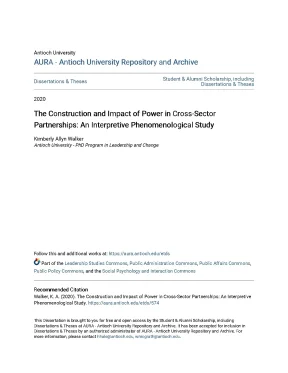
Tải xuống để đọc toàn bộAntioch University AURA - Antioch University Repository and Archive Student & Alumni Scholarship, including Dissertations & Theses Dissertations & Theses 2020 The Construction and Impact of Power in Cross-Sector Partnerships: An Interpretive Phenomenological Study Kimberly Allyn Walker Antioch University - PhD Program in Leadership and Change Follow this and additional works at: https://aura.edu/etds Part of the Leadership Studies Commons, Public Administration Commons, Public Affairs Commons, Public Policy Commons, and the Social Psychology and Interaction Commons Recommended Citation Walker, K. The Construction and Impact of Power in Cross-Sector Partnerships: An Interpretive Phenomenological Study.edu/etds/574 This Dissertation is brought to you for free and open access by the Student & Alumni Scholarship, including Dissertations & Theses at AURA - Antioch University Repository and Archive. It has been accepted for inclusion in Dissertations & Theses by an authorized administrator of AURA - Antioch University Repository and Archive. For more information, please contact hhale@antioch.edu, wmcgrath@antioch.
The Construction and Impact of Power in Cross-Sector Partnerships: An Interpretive Phenomenological Study Kimberly Allyn Walker ORCID Scholar ID #0000-0003-1070-3765 A Dissertation Submitted to the PhD in Leadership and Change Program of Antioch University in partial fulfillment for the degree of Doctor of Philosophy May 2020 This dissertation has been approved in partial fulfillment of the requirements for the degree of PhD in Leadership and Change, Graduate School of Leadership and Change, Antioch University. Dissertation Committee • Lize (A.) Booysen, DBL, Committee Chair • Donna Ladkin, PhD, Committee Member • Kirk Emerson, PhD, Committee Member Copyright 2020 Kimberly Allyn Walker All rights reserved Acknowledgments Completing this dissertation is the proudest moment of my life, and one in which I am acutely aware how much support was needed to get me here. I begin this dissertation with lots of gratitude. To C16⎯Thanks for your friendship.
What an incredible group to be a part of: our experiences together challenged and empowered me. Thank you for all the personal growth that you supported. Special recognition to Ashley Blackburn, Mike Bills, and Lauren Bullock, who have been my closest companions during this process. Mike, thanks for being a research buddy as well! To my interviewees⎯Thank you for sharing your stories with someone who was a total stranger.
I learned so much from you, have profound respect for the difficult and amazing work that you do, and really could not have done this without you! To Lize⎯Thank you for being an advisor, and then a dissertation chair, who had to be part coach, part mentor, and part guide to me at every stage of my PhD journey. Your steady support throughout the program was exactly the support I needed to reach my goals. My dissertation could not have been in better hands. I’ve never seen someone provide high-level and detailed feedback so quickly with such ease.
I stand in awe of your scholarship and am incredibly grateful for all you've done for me. To Donna⎯Thank you for the massive amount of knowledge you've imparted throughout this process. I’ve really enjoyed our time working together. I've grown tremendously as a phenomenologist and an academic because of you, and truly discovered a new way of seeing and understanding the world.
Every interaction with you during this process made me a sharper thinker. i To Kirk⎯Thank you for your collaborative governance program, which hopefully will continue to generate folks invested in cross-sector problems to solve the world, as well as bringing your expert eye to my research. I've been honored to have your thought partnership and hope to follow in your footsteps as an impressive scholar-practitioner. To Corrie⎯Thanks for being my constant cheerleader throughout this journey.
I was so lucky to have you first as a professor and then as a mentor and friend. I know I’m not alone in having benefited from your wisdom and care. To Norm⎯Thanks for unknowingly helping lead me toward this path and for teaching me how to have an impact on an enormous social issue. I use what I learned working with you every day and am grateful for your friendship.
To my grandmothers Tommie Lean Walker and Jean Patton, two of the strongest women I know⎯I hope I’ve made you proud. To the friends and coworkers who kept me going through this process, encouraged me, and checked in: thank you for your unwavering support and your friendship before, during, and (hopefully) after my PhD! To Jones⎯Thanks for being my couch or floor buddy for many a writing session. You're a good boy. To my parents, Judy and Harry (the other Drs.
Walker) ⎯I owe all of this to you. Thank you for encouraging my education and modeling what hard work and service mean. I spend every day of my life benefiting from how I was raised. I wouldn't be here without your unconditional love and support, and I am fully aware of that.
And finally, to Markus, who had to endure and sacrifice more than anyone during this process: while doing this PhD is one of the best decisions I've ever made, marrying you is still ii the very best one. As a good friend once told me, not everyone could handle being married to me. Congrats on pulling it off! And thank you for your patience and your support. Here's to post-grad life.
iii Abstract In the United States, cross-sector partnerships, a form of collaboration, are becoming increasingly common in practice (Gray & Purdy, 2018). However, questions remain regarding the effectiveness of these partnerships and if the many challenges of using them can be overcome. In particular, the intersection of cross-sector partnerships and power, which can deeply impact these partnerships, needs more attention. This study used interpretive phenomenology to understand, from the participant perspective, (a) the experience and construction of power, (b) the impact of power on participants, and (c) how power dynamics in these initiatives compare to dynamics in organizations.
Seventeen participants from four homelessness-focused Collective Impact (CI) initiatives, a popular cross-sector partnership model, were interviewed about their experiences. In addition, I reviewed key documents about each initiative. Data was interpreted using a variety of theoretical lenses, including critical theory, as well as my own work experience in this area, and carefully analyzed through iterative re-engagement, reflexivity, and thematic analysis. The findings revealed that power presented in six different ways: resources, structures and processes, identity, resistance, formal leadership, and framing and communication.
When examining the differences between collaborations, differences in these six areas, as well as the identity and ways of operating of the partner who began the partnership, seemed to influence the experience of power. Financial resources were a dominant form of power and provided some partners with disproportionate influence. Dominant partners were also able to stack power across these six areas. The impacts of power dynamics were largely negative.
Other significant findings included that some partners did not experience power at all. Critical theory and positive framing may explain this outcome. I call for an expanded CI model with a sixth condition related to power. As part of this sixth condition, I iv suggest communities make structural changes, such as, to honor discursive power more effectively, putting consumers in positions of power and rotating facilitation responsibilities.
This dissertation is available in open access at AURA: Antioch University Repository and Archive, http://aura.edu/ and Ohiolink ETD Center, https://etd.edu/ Keywords: leadership, power, power dynamics, cross-sector, collaboration, Collective Impact, absence of power, homelessness, interpretive phenomenology, IPA, interorganizational, critical theory, discursive power, resource power, identity, race, resistance, framing v Table of Contents Acknowledgments. iv Table of Contents. vi List of Tables. xi List of Figures.
xii Chapter I: Introduction. 1 Purpose of the Study. 2 Definitions of Key Terms. 4 Interorganizational or Multi-Stakeholder Partnership.
4 Cross-Sector Partnership. 5 Study Significance to Practice and the Cross-Sector Field. 5 Significance for Theory. 6 Cross-Sector Leadership.
9 Overview of Research Design. 10 Scope and Limitations of the Study. 14 Outline of the Remaining Chapters. 15 Chapter II: Literature Review.
17 Cross-Sector Partnership Origins and Motivations. 19 Partner Motivations and Initiating Factors. 19 vi Characteristics of Cross-Sector Leadership. 22 Comparison to Other Leadership Theories.
24 Leadership Roles in Cross-Sector Partnerships. 25 Leader Responsibilities and Skills. 26 Leadership Structures and Governance. 27 Challenges of Cross-Sector Partnerships.
28 Power and Trust. 28 Lack of Control or Familiar Power Sources. 29 Difficulty Defining and Measuring Success. 29 Lack of Alignment in Purpose, Commitment, or Goals.
30 Investment of Time. 30 New Roles, Skills, and Relationships. 31 Benefits of Cross-Sector Partnerships. 31 Micro-(individual) Level Benefits.
31 Meso-(organizational) Level Benefits. 32 Macro-(community) Level Benefits. 33 Factors That Influence Success. 33 Gaps in the Literature.
37 Mutually Reinforcing Activities. 37 Shared Measurement Systems. 38 Other Key Processes. 38 Leadership in CI.
39 Measures of Success and Outcomes. 39 Challenges and Criticisms of CI. 41 vii Collaborative Efforts to End Homelessness in the United States. 42 Power and Cross-Sector Partnerships.
44 Definitions of Power. 45 Leadership and Power. 46 Sources and Presentations of Power in Cross-Sector Partnerships. 48 Critical Theory and Related Frameworks.
55 Steven Lukes and Critical Theory. 58 Experiences of Power. 59 Synthesis of Power Literature. 60 Gaps in the Literature.
62 Chapter III: Research Method. 64 Research Philosophy and Approach. 66 Research Approach Justification. 71 Overview of Semi-structured Interviews.
73 Analysis and Presentation. 73 Research Design Limitations. 80 viii Chapter IV: Findings. 85 Presentation of the Findings.
88 Discussion of the Three Case Studies. 90 Constructions and Experiences of Power in Community A. 94 Perceived Impact of Power Dynamics in Community A. 97 Comparison to Power in Home Organizations in Community A.
97 Summary of Community A. 98 Constructions and Experiences of Power in Community B. 102 Perceived Impact of Power Dynamics in Community B. 105 Comparison to Power in Home Organizations in Community B.
105 Summary of Community B. 106 Constructions and Experiences of Power in Community C. 110 Perceived Impact of Power Dynamics in Community C .110 Comparison to Power in Home Organizations in Community C .110 Summary of Community C. 111 Conclusion and Integration of the Community Narratives.
111 Themes from Interviews Across all Three Cases. 114 ix Integration of Findings of Case Studies and Individual Interviews. 130 Chapter Summary and Conclusion. 133 Reflection on Differences Between Communities.
134 Review of All Themes. 135 Experiences and Constructions of Power. 137 Summary of Research Question 1. 146 Perceived Impact of Power.
147 Comparison to Home Organization. 148 Collective Impact and Critical Theory. 149 Significance of This Study. 151 Implications for Leadership and Collaborative Theory.
153 Findings That Align with the Literature. 153 Findings That Did Not Align with the Literature. 154 Recommendations for Action. 161 Lack of Definition of Power.
161 Lack of Diversity in Interview Sample. 161 Sensitivity of the Topic. 163 Limited Responses to Some Questions. 163 Areas for Future Study.
164 Closing Reflections on Researcher Experience. 168 Appendix A: Interview Guide. 190 Appendix B: IRB Informed Consent Form. 193 Appendix C: Email to Participants.
197 x List of Tables Table 4.1 Age Range of Participants .2 Partner Type across Interviewees .3 Sector Type of Interviewees .4 Alignment on Coding.5 Demographics of Each Community .6 Unique Themes and Subthemes Highlighted in the Three Cases .7 Themes and Subthemes Highlighted in All Three Cases .1 Themes and Subthemes in How Power and Power Asymmetries are Experienced, Constructed, and Understood (Research Question 1) .2 Interpreting the Findings Through Critical Theory. 150 xi List of Figures Figure 1. Data Analysis Process. Collective Impact Model.
Expanded Collective Impact Model.
Nội dung được bảo vệ bản quyền — Tải xuống đầy đủ
Trích dẫn luận án này
Kimberly Allyn Walker (2020). The construction and impact of power in cross sector partner [Luận án tiến sĩ, Antioch University]. LuanAn.net. https://luanan.net/quan-tri-kinh-doanh/the-construction-and-impact-of-power-in-cross-sector-partnerships
Câu hỏi thường gặp
Luận án "The construction and impact of power in cross sector partner" nghiên cứu về vấn đề gì?
Khám phá cách xây dựng, tác động quyền lực trong hợp tác liên ngành. Phân tích động lực, chiến lược hiệu quả.
Luận án "The construction and impact of power in cross sector partner" được bảo vệ tại trường nào?
Luận án này được bảo vệ tại Antioch University. Năm bảo vệ: 2020.
Luận án "The construction and impact of power in cross sector partner" thuộc chuyên ngành gì?
Luận án "The construction and impact of power in cross sector partner" thuộc chuyên ngành Leadership and Change. Danh mục: Quản Trị Kinh Doanh.
Luận án "The construction and impact of power in cross sector partner" có bao nhiêu trang?
Luận án "The construction and impact of power in cross sector partner" có 213 trang. Bạn có thể xem trước một phần tài liệu ngay trên trang web trước khi tải về.
Cách tải luận án "The construction and impact of power in cross sector partner" về máy như thế nào?
Để tải luận án về máy, bạn nhấn nút "Tải xuống ngay" trên trang này, sau đó hoàn tất thanh toán phí lưu trữ. File sẽ được tải xuống ngay sau khi thanh toán thành công. Hỗ trợ qua Zalo: 0559 297 239.