Palpable pedagogy expressive arts leadership and change in soc
Lãnh đạo nghệ thuật biểu đạt, sư phạm hữu hình và thay đổi trong giáo dục. Khám phá tiềm năng thúc đẩy chuyển đổi.
Leadership & Change
Luan An
Luận án tiến sĩ
Năm xuất bản
Số trang
255
Thời gian đọc
39 phút
Lượt xem
1
Lượt tải
0
Phí lưu trữ
50 Point
Tổng quan nhanh
- Chủ đề:
- Expressive Arts Pedagogy for Social Justice Education
- Số trang:
- 255 trang
- Trường:
- Antioch University
- Chuyên ngành:
- Leadership & Change
- Tác giả:
- Lucy Elizabeth Barbera
- Năm:
- 2009
Tóm tắt nội dung luận án
I.Expressive Arts Pedagogy for Social Justice Education
This study examines the crucial role of expressive arts within social justice teacher education. Arts-based pedagogy offers unique avenues for exploring complex societal issues. Traditional teacher education often overlooks the power of creative methods. This research highlights the effectiveness of integrating arts into the curriculum. It focuses on how educators can better prepare future teachers. The goal is to equip them with tools to address inequity effectively. The expressive arts provide a palpable pathway for deep understanding and engagement. This approach fosters educational innovation by making learning personally resonant.
1.1. Defining Arts Based Approaches in Education
Defining arts-based approaches involves understanding their experiential nature. Expressive arts education utilizes various forms: visual arts, drama, music, movement, and creative writing. These methods move beyond conventional lecturing. They engage participants holistically. This pedagogical shift encourages active participation and reflection. The approach emphasizes process over product. It fosters an environment of openness and discovery for future educators.
1.2. Addressing Inequity through Creative Practice
Addressing inequity through creative practice is a core tenet. Expressive arts allow individuals to confront difficult topics safely. They facilitate the exploration of social injustices. Participants can express perspectives and experiences that resist verbalization. This process cultivates empathy and critical thinking. It empowers future teachers to challenge systemic biases. Arts integration serves as a powerful tool for social justice advocacy.
1.3. Bridging Theory and Experience in Teacher Training
Bridging theory and experience in teacher training is essential. Social justice concepts often remain abstract in traditional settings. Arts-based pedagogy makes these concepts concrete and tangible. Experiential learning transforms theoretical knowledge into lived understanding. Future educators learn to apply principles of equity directly. This prepares them for real-world classroom challenges. It ensures a deeper connection to the material.
II.Cultivating Leadership Through Arts Based Learning
Arts-based learning serves as a catalyst for developing robust leadership qualities. The expressive arts environment nurtures abilities crucial for effective leadership. It encourages improvisation, collaboration, and critical self-reflection. These practices are fundamental for navigating complex educational landscapes. The pedagogy promotes a deeper understanding of self and others. This foundational insight supports the emergence of creative leadership. It moves beyond hierarchical models, embracing distributed leadership. This approach supports educational innovation.
2.1. Developing Transformational Leadership Skills
Developing transformational leadership skills is a key outcome. Participants learn to inspire and motivate others through authentic expression. They develop the capacity to envision new possibilities. This form of leadership fosters growth and empowerment within communities. It emphasizes empathy, integrity, and a commitment to shared values. Experiential learning contexts provide fertile ground for these skills to flourish. Future leaders emerge with a holistic understanding of their impact.
2.2. Empowering Educators as Agents of Change
Empowering educators as agents of change is central. Arts-based pedagogy equips teachers with innovative strategies. They become proactive in shaping inclusive classroom cultures. Educators gain confidence to challenge norms and advocate for marginalized voices. This empowerment extends beyond the classroom. It influences broader school communities and policy discussions. Creative leadership inspires continuous improvement and systemic change.
2.3. Fostering Imagination for Innovative Solutions
Fostering imagination for innovative solutions is vital for leadership. The expressive arts unlock creative potential. Participants learn to approach problems with fresh perspectives. They develop the agility to adapt to unforeseen challenges. This imaginative capacity is crucial for effective change management. Leaders who think creatively can inspire novel approaches to old problems. They drive progress in educational settings and beyond.
III.Driving Social Change via Expressive Arts Integration
Expressive arts integration acts as a powerful engine for social change. Arts-based pedagogy provides unique platforms for examining societal structures. It fosters critical awareness of injustices and inequalities. The process involves active participation and personal reflection. This engagement cultivates a deeper commitment to social transformation. Change management principles are embedded within this artistic exploration. It demonstrates how creative methods can drive significant societal shifts. Embodied learning makes these shifts deeply personal and impactful for participants.
3.1. Facilitating Dialogue and Understanding Through Art
Facilitating dialogue and understanding through art is a key mechanism. Art forms transcend language barriers and cultural divides. They create shared experiences that bridge differences. Participants can explore sensitive topics non-verbally. This opens pathways for empathetic communication. It fosters mutual respect and understanding among diverse groups. Arts integration promotes constructive dialogue necessary for collective action and social cohesion.
3.2. Empowering Voices for Social Transformation
Empowering voices for social transformation is a direct result. Expressive arts provide a platform for marginalized communities. Individuals can articulate experiences often silenced in conventional settings. This empowerment builds confidence and agency. It enables participants to advocate for their rights and needs. Arts-based pedagogy amplifies calls for justice. It contributes to a more equitable and inclusive society through active participation.
3.3. Implementing Arts Based Strategies for Community Impact
Implementing arts-based strategies for community impact extends the reach. Teachers trained in expressive arts can apply these methods in various settings. They can design community-based art projects addressing local issues. These initiatives foster collective engagement and problem-solving. They demonstrate the practical application of experiential learning. Arts integration becomes a tool for sustainable social development. Transformational leadership guides these efforts for lasting change.
IV.Transformational Learning in Teacher Education
Transformational learning represents a cornerstone of this teacher education approach. The expressive arts pedagogy cultivates profound shifts in participants' understanding. It moves beyond rote memorization to authentic engagement. Educators undergo a personal and professional metamorphosis. This process impacts their teaching philosophies and classroom practices. Experiential learning environments facilitate this deep internal change. It prepares teachers not just to teach, but to inspire. The result is a more dynamic and responsive educational system, driven by educational innovation.
4.1. Fostering Deep Reflection and Self Awareness
Fostering deep reflection and self-awareness is paramount. Expressive arts activities encourage introspection. Participants explore their identities, biases, and values. This self-examination is critical for social justice educators. It leads to a more nuanced understanding of complex social issues. Embodied learning ensures these insights are deeply felt. The reflection process fuels continuous personal and professional growth for educators.
4.2. Shifting Pedagogical Paradigms for Educators
Shifting pedagogical paradigms for educators is a key outcome. Teachers move away from traditional, didactic methods. They embrace student-centered, participatory approaches. Arts-based pedagogy models innovative instructional strategies. It encourages a flexible and responsive teaching style. This paradigm shift empowers educators to create inclusive learning spaces. It promotes a more holistic and human-centered education for all students.
4.3. Sustaining Educational Innovation in Practice
Sustaining educational innovation in practice is a long-term goal. Teachers integrate expressive arts into their daily curriculum. They adapt these methods to diverse student needs and contexts. This commitment to innovation fosters dynamic classrooms. It keeps learning relevant and engaging for students. Change management principles guide the implementation of new practices. The result is a vibrant, evolving educational landscape within schools.
V.Understanding Palpable Pedagogy An Ethnographic View
This ethnographic study, titled 'Palpable Pedagogy,' delves into the classroom culture. It explores an arts-based teacher education course. The research employs an ethnographic/auto-ethnographic approach. This qualitative method offers deep insights into human experience. It investigates the felt meaning generated by expressive arts education. The study spans three consecutive years of course instruction. It provides a unique lens on pedagogical innovation. The aim is to reveal the power of arts in teacher development. The findings offer valuable perspectives on experiential learning and its impact.
5.1. Examining Classroom Culture Through Arts Lenses
Examining classroom culture through arts lenses reveals dynamic interactions. The study meticulously documents participant engagement. It observes how expressive arts facilitate communication. It analyzes the evolving group dynamics. The arts provide unique data points for cultural analysis. This perspective uncovers subtle layers of learning. It highlights the impact of an arts-based environment. This approach supports a comprehensive understanding of educational settings.
5.2. Qualitative Inquiry Felt Meaning and Transformation
Qualitative inquiry emphasizes felt meaning and transformation. The research captures the subjective experiences of participants. It explores how expressive arts evoke emotional and intellectual shifts. The study seeks to understand these profound changes. It identifies factors contributing to transformative learning. This deep inquiry uncovers the essence of palpable pedagogy. It validates the power of non-traditional educational methods and their effectiveness.
5.3. Implications for Future Arts Based Teacher Training
Implications for future arts-based teacher training are significant. The study provides concrete evidence for arts integration. It outlines effective strategies for using expressive arts in social justice education. The findings inform curriculum development. They advocate for broader adoption of arts-based pedagogy. This research contributes to educational innovation. It supports the preparation of more empathetic and effective teachers ready for social change.
Mục lục chi tiết luận án
Tải xuống file đầy đủ để xem toàn bộ nội dung
Tải đầy đủ (255 trang)Trích đoạn nội dung luận án
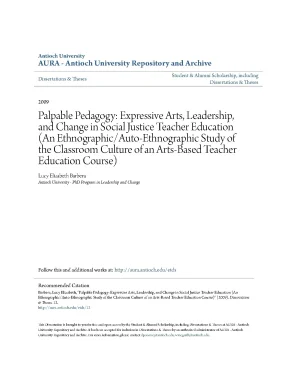
Tải xuống để đọc toàn bộAntioch University AURA - Antioch University Repository and Archive Student & Alumni Scholarship, including Dissertations & Theses Dissertations & Theses 2009 Palpable Pedagogy: Expressive Arts, Leadership, and Change in Social Justice Teacher Education (An Ethnographic/Auto-Ethnographic Study of the Classroom Culture of an Arts-Based Teacher Education Course) Lucy Elizabeth Barbera Antioch University - PhD Program in Leadership and Change Follow this and additional works at: http://aura.edu/etds Recommended Citation Barbera, Lucy Elizabeth, "Palpable Pedagogy: Expressive Arts, Leadership, and Change in Social Justice Teacher Education (An Ethnographic/Auto-Ethnographic Study of the Classroom Culture of an Arts-Based Teacher Education Course)" (2009).edu/etds/12 This Dissertation is brought to you for free and open access by the Student & Alumni Scholarship, including Dissertations & Theses at AURA - Antioch University Repository and Archive. It has been accepted for inclusion in Dissertations & Theses by an authorized administrator of AURA - Antioch University Repository and Archive. For more information, please contact dpenrose@antioch.edu, wmcgrath@antioch. PALPABLE PEDAGOGY: EXPRESSIVE ARTS, LEADERSHIP, AND CHANGE IN SOCIAL JUSTICE TEACHER EDUCATION (AN ETHNOGRAPHIC/AUTO-ETHNOGRAPHIC STUDY OF THE CLASSROOM CULTURE OF AN ARTS-BASED TEACHER EDUCATION COURSE) LUCY ELIZABETH BARBERA A DISSERTATION Submitted to the Ph.
in Leadership & Change Program of Antioch University in partial fulfillment of the requirements for the degree of Doctor of Philosophy January, 2009 This is to certify that the dissertation entitled: PALPABLE PEDAGOGY: EXPRESSIVE ARTS, LEADERSHIP, AND CHANGE IN SOCIAL JUSTICE TEACHER EDUCATION (AN ETHNOGRAPHIC/AUTO- ETHNOGRAPHIC STUDY OF THE CLASSROOM CULTURE OF AN ARTS-BASED TEACHER EDUCATION COURSE) prepared by Lucy Elizabeth Barbera is approved in partial fulfillment of the requirements for the degree of Doctor of Philosophy in Leadership & Change. Approved by: ________________________________________________________________ Chair date Carolyn Kenny, Ph. ________________________________________________________________ Committee Member date Laurien Alexandre, Ph. ________________________________________________________________ Committee Member date Laura Shapiro, Ph.
________________________________________________________________ External Reader date Maxine Greene, Ph.D Copyright 2009 Lucy Barbera All rights reserved I would like to dedicate this dissertation to the memory of Thomas Anthony Barbera Sr., brother-of-my-heart, July 12, 1948—February 13, 2008; to my sisters Joyce, Margaret, Laura, and Faith; to my brothers Barney and Jack; and to my parents Giacoma and Baldassare, and thank them for their unwavering love and support. Acknowledgements I would like to thank Carolyn Kenny, my dissertation chair and educator extraordinaire, who, through her guidance, support, and trust in me, provided a model of how beauty, truth, and justice make transformational learning possible. I would like to thank Laura Shapiro, who broke through hard ground with her original arts-based research, making it possible for me to walk in her footsteps for my own inquiry. I would like to thank Laurien Alexandre for her vision of leadership education and the benefits that vision has manifested in my life and learning.
I would like to thank Maxine Greene for the inspiration she has given me and so many others in education to apply the power of the imagination toward social justice. I would like to thank Rebecca Hosmer, my copy editor, and Matthew Swerdloff, my technologist, for their constant support and dedication to my dissertation’s publication, without which it would not have been possible. Finally, I want to thank my students for their courage and authentic expressions. I have learned so much from them.
i Abstract Palpable Pedagogy: Expressive Arts, Leadership, and Change in Social Justice Teacher Education is an arts-informed ethnographic study of the pedagogy and culture engendered when the expressive arts are employed in social justice teacher education. Palpable Pedagogy is a qualitative study that examines the power of the expressive arts to identify, explore, and address issues of inequity in the context of a social justice teacher education course that I taught over three consecutive years. The literature in the field outlines the essential components for effective social justice teacher education (identity, reflection, and dialogue) and neatly explores them. However, with the exception of Art teacher education, where national learning standards require that cultural diversity be explored through the arts, little has been written about the utilization and power of the arts as a pedagogical tool in general teacher education for social justice.
My objective in Palpable Pedagogy is to reveal the layers of felt meaning, transformational learning, and release of the imagination (Greene, 1995) for leadership and change that my students experienced in my social justice teacher education course, “Expressive Arts, Leadership, and Change.” The arts themselves provide a splendid methodological match for research of this kind. McNiff (1998) proposes that there is no better way to study the effects of the arts than through the arts themselves. Using an aesthetic approach in my ethnographic study, I employ participant observation, field notes, photography, videography, interviews, and student art process, and product as my data, creating a text/context of the phenomenologically understood life worlds of my students. A bricolage results, with the inclusion of my justice educator/artist self-study, situating me both emicly and eticly in the life world of my students and classroom.
Readers will aesthetically experience data presented in the forms of student and researcher poetry, performance, painting, mask making, sculpture, and narrative, as a way of understanding and ii knowing. This study reveals the inherent potential of the expressive arts as a pedagogical tool to reclaim art as a necessary human behavior/ birthright (Dissanayake, 1992) to make meaning, galvanize learning, catalyze leadership, and inspire action—thus, creating a unique and palpable pedagogy for social justice teacher education. This dissertation contains embedded images in jpg format. It also includes nine associated video files in avi format and two associated audio files in mp3 format.
The electronic version of this dissertation is available in the open-access OhioLink ETD Center, www. iii TABLE OF CONTENTS Acknowledgements i! Abstract ii! Table of Contents iv! List of Figures vi! List of AV Files xii! Chapter I: Introduction 1! The Study 5! The Epistemology of Aesthetics 6! Teacher Education, Leadership, and the Arts 8! Social Imagination and Palpable Pedagogy 10! Identity, Dialogue, and Reflection in Social Justice Education 15! Identity 15! Dialogue 17! Student Action Plan Presentation: Taking the “Diss” Out of Disability 17! Reflection 20! The Crisis of Representation—Art as a Form of Knowledge 23! Art as Process 23! Summary 24! Chapter II: Literature Review 26! The Roots of Art, Beauty, Justice, and Humanity 27! Aesthetic Education 31! Critical Theory and Humanistic Education 35! Multicultural Art Teacher Education 39! Arts-based Teacher Education and the Arts and Social Justice in Adult Education 41! Aesthetic Leadership 46! Chapter III: Research Methodology 50! Philosophy and Theory of the Arts as Inquiry Tool 50! Ethnographic/Autoethnographic Methods 55! Research Process and Participant Selection 57! Ethical Considerations 59! Summary 61! Chapter IV: Findings and Results of Study 64! Introduction 64! “The Arts” Defined 67! The Themes 68! A Few Words About Beauty 71! Identity: Autobiography—Past, Present, and Future 71! Reflection 82! Reflection Through Journal Writing 84! Mask-making as Reflection Tool 89! Emotion and Action 94! iv Fear of the Arts 96! Dialogue 106! Community 113! Compassion, Connection, Unity 117! Mandala-making and Community 122! Summary 129! Chapter V: Autoethnography 131! Dream 131! Autobiography: Unfolding Into the Present, Emboldened Into the Future 134! Autoethnographic Journal: July—December 2007 140! The Roots of Art—We Are All Connected In This Way 144! Finding Home: A Map to Finding My True Voice 146! Self-Study Research and Social Justice Education 167! Closing—Retrospective Show 168! Next Steps 170! Autoethnograpic Journal: Epilogue, July 2008-April 2009 171! Chapter VI: Discussion of Conclusions 181! Art as Mystery 181! Palpable Pedagogy 186! Interconnecting Themes Revisited 188! Antagonists to the Arts 190! Chapter VII: Implications for Leadership and Change 196! Brief Recapitulation of the Study 196! Literature Review Revisited 196! Relevance of the Study to Leadership and Change 197! Aesthetic Leadership and the Art of Leadership 198! Leadership Development of Teachers: Reflective Teacher Leaders 201! Suggestions for Future Explorations and Research 203! Challenges of the Study and Findings 205! Closing 206! Appendices 208! Appendix A 209! Appendix B 221! Appendix C 223! Appendix D 226! Appendix E 227! References 229! v List of Figures Figure 1.1 My Great Grandmother, Eugina Martinelli.2 Lucy Barbera (center) listens as her student tells about her life.3 Lucy Barbera “Teaching Who She Is.4 The dimensions of the epistemology of aesthetics.5 Front and back of student mask: Oppression and liberation.6 Model of palpable pedagogy.7 Polarities: Inclusion—Exclusion.9 Student sharing her educational autobiography.10 Extension of autobiography: Singing "Somewhere Over the Rainbow.11 Students explore and dialogue about ability and disability.12 Body trace and self-exploration on disability.13 Lucy Barbera (left) joins student dialogue group, 2007.14 Student uses movement to demonstrate personal ability.16 Student reflects on her Touchstone.17 Journal reflection on Touchstone.1 The data streams.2 What each of the following dissertation chapters will address.1 Student with Self-portrait Mask, 2006.3 Identified sub-themes.4 Interconnected themes and subthemes.5 Patton’s table under construction, with close-up, 2007.6 Lindsey’s journal: “I Am From” poem, 2007.7 Ellie’s mask of identity, 2007.8 Student points to compassion as a key element of her self-portrait, 2006.9 Lindsey’s journal entry on “The Letter,” 2007.10 Lindsey’s reflective journal cover, 2007.11 Inside Lindsey’s reflective journal, 2007.12 Lindsey’s reflection of G.13 Inside Lindsey’s journal—contexts for social justice work (Shapiro, 2004).14 Lindsey’s journal entries—personal and critical reflection side-by-side, 2007.15 Student dramatization “The Faces of Discrimination,” 2006.16 Student-generated composite list of polarities (flip chart notes, 2006-2008).17 Student reflection through mask-making.18 Student mask—being heard and being silenced, 2007.19 Face of oppression and rainbow of color, 2007.20 Mask—inclusion and exclusion, 2007.21 Student uses her feet to scribble her emotions, 2007.22 Students at the Dorsky Museum, July 2007.23 Student lends a work of art—“Her” Life, Samuel Dorsky Museum, 2006.24 Dramatization—students embodying fear of judgment and shame, 2008.25 Dramatization—students embodying resolution, hope, and vision, 2008.26 Students in dialogue groups, 2007.27 Students dialogue with Lucy Barbera, Dorsky Museum of Art, 2007.28 Students dialogue in dyads, 2006.29 Students use art as a springboard for dialogue, 2007.30 Students in dialogue, 2007.31 Students set up the retrospective show, 2007.32 Deep listening and dialogue, 2007.33 Deep noticing, retrospective show, 2007.34 Lindsey’s journal response to handouts Young (1990), Rogers (1993).35 Student drawing a mandala, 2007.37 Lindsey’s journal—mandala (Togut, 2004).38 Student creating her Piece of the World, 2007.39 Students assembling World Mandala, 2007.40 The World Mandala, 2007.41 Students pass the flame, 2007.42 Students bring their lights to the world, 2007.43 The candlelit World Mandala, 2007.44 The culture of an arts-based social justice teacher education course, 2006-2008.4 Mom, Laura, and Me; Dad and half of our Tribe.7 Bury Me Standing (Fonseca, 1995).8 Angelina, an aristocrat, eloped with the Gypsy’s son, Luigi.10 My Touchstone speaks.11 Landscape of the Soul.12 Self-portrait painted on 7-14-07.13 Close-up of necklace.14 7825 4th Avenue, spring 1955 with my mother.15 7825 4th Avenue, summer 1956 (me in white dress, my father and siblings).16 House on Calamar Lane, Woodstock.17 Open meadows across the Mill Stream.18 House on Wittenberg Road.19 Pine Hill cottage on Birch Creek Road.20 Rosendale house on Mountain Road.21 Landscape around cabin.22 Cabin we lived in after I split up with Alexander’s father.23 Magical, mystical stone croppings in the woods behind the cabin.24 Leopard carved into front door.25 Second converted chicken coop.26 Hearts Content Road place with footbridge.27 Falls behind Hearts Content Road place and house.28 Along the river behind Hearts Content Road place.29 Porch, meadow, and Alexander and I at Crispell Road home.30 Ohayo Mountain Road house.31 Alexander’s first major painting, 1994.32 School house in Rhinebeck.33 Apartment and studio a mile north of the school house.34 House at 7 Charles Street.36 Studio at 22 Stuyvesant Street.37 Rifton house on Hardenburgh Road.38 Stream behind Rifton house.39 House at 3 Charles Street, Rhinecliff.40 House in Woodstock and Sawkill River, 2007.42 Alexander and I at 676 Zena Road, 2006.44 Students and I set up Retrospective Show, 2007.45 Students viewing exhibit of my work at the Retrospective Show, 2007.46 Buddha of No Fear.47 Homage to Tom, collage 2008.48 My niece, Jackie Joy and I releasing Tom's ashes.49 Close-ups of Homage to Tom, collage, 2008.50 Homage collage, close-ups, 2008.51 Close-ups, Homage collage, 2008.52 Touchstone for Tom, hawk feather and fox tooth, 2008.53 Tom in turban, Chico, California, 2008.54 The healing power of love, Tommy, Jr.2 Students sharing Touchstones, 2008.
Nội dung được bảo vệ bản quyền — Tải xuống đầy đủ
Trích dẫn luận án này
Lucy Elizabeth Barbera (2009). Palpable pedagogy expressive arts leadership and change in s [Luận án tiến sĩ, Antioch University]. LuanAn.net. https://luanan.net/giao-duc-hoc/palpable-pedagogy-expressive-arts-leadership-and-change-in-soc
Câu hỏi thường gặp
Luận án "Palpable pedagogy expressive arts leadership and change in s" nghiên cứu về vấn đề gì?
Lãnh đạo nghệ thuật biểu đạt, sư phạm hữu hình và thay đổi trong giáo dục. Khám phá tiềm năng thúc đẩy chuyển đổi.
Luận án "Palpable pedagogy expressive arts leadership and change in s" được bảo vệ tại trường nào?
Luận án này được bảo vệ tại Antioch University. Năm bảo vệ: 2009.
Luận án "Palpable pedagogy expressive arts leadership and change in s" thuộc chuyên ngành gì?
Luận án "Palpable pedagogy expressive arts leadership and change in s" thuộc chuyên ngành Leadership & Change. Danh mục: Giáo Dục Học.
Luận án "Palpable pedagogy expressive arts leadership and change in s" có bao nhiêu trang?
Luận án "Palpable pedagogy expressive arts leadership and change in s" có 255 trang. Bạn có thể xem trước một phần tài liệu ngay trên trang web trước khi tải về.
Cách tải luận án "Palpable pedagogy expressive arts leadership and change in s" về máy như thế nào?
Để tải luận án về máy, bạn nhấn nút "Tải xuống ngay" trên trang này, sau đó hoàn tất thanh toán phí lưu trữ. File sẽ được tải xuống ngay sau khi thanh toán thành công. Hỗ trợ qua Zalo: 0559 297 239.