A method to my quietness a grounded theory study of living and l
Nghiên cứu lý thuyết nền khám phá phương pháp tạo dựng sự tĩnh lặng, một hành trình khám phá cuộc sống đầy ý nghĩa và vững chắc.
Luan An
Luận án tiến sĩ
Năm xuất bản
Số trang
223
Thời gian đọc
34 phút
Lượt xem
0
Lượt tải
0
Phí lưu trữ
50 Point
Tổng quan nhanh
- Chủ đề:
- Exploring Introversion: A Grounded Theory Study
- Số trang:
- 223 trang
- Trường:
- Antioch University
- Chuyên ngành:
- Leadership and Change
- Tác giả:
- Leatrice Oram
- Năm:
- 2016
Tóm tắt nội dung luận án
I.Exploring Introversion A Grounded Theory Study
This dissertation thoroughly investigates the multifaceted nature of introversion. It rigorously employs a grounded theory methodology. The comprehensive study deeply explores the lived experiences of individuals. Specific focus is placed on the intricate dynamics of living and leading as an introvert. The meticulous research provides profound insights. It systematically uncovers core concepts related to quietness. A nuanced understanding of introverted traits represents a primary goal. This robust qualitative research offers a unique and invaluable perspective. It meticulously builds theory directly from empirical data. The study significantly contributes to the broader field of leadership studies. It also enriches the understanding of personality and social contexts. The research approach is systematic and transparent. It clearly reveals emergent patterns and complex relationships. This work stands as a foundational text. It effectively addresses a significant gap in current understanding. The chosen method ensures academic rigor and validity. Data collection is exceptionally thorough and detailed. Subsequent analysis consistently generates new theoretical frameworks. The study strongly emphasizes the subjective experience of introverts. It brings new and illuminating light to the concept of quiet leadership.
1.1. Research Methodology Grounded Theory Principles
Grounded theory meticulously guides this extensive investigation. This method is designed to build theory directly from collected data. No preconceived notions or hypotheses drive the research process. Instead, insights emerge organically. Data collection and analytical processes occur in a highly iterative and simultaneous fashion. Constant comparison is identified as a key analytical technique. Collected data is systematically coded, categorized, and refined. The pursuit of theoretical saturation is paramount. This ensures exceptionally comprehensive coverage of the phenomenon. The overall approach is fluid and iterative. It readily allows for the emergence of novel themes and patterns. This methodology provides an exceptionally robust framework. It effectively captures complex social phenomena. The study strictly adheres to rigorous qualitative research standards. It ultimately offers a fresh and insightful lens on the intricate world of introversion.
1.2. The Essence of Introversion Defining Quietness
Introversion stands as the central conceptual pillar of this study. It fundamentally involves a pronounced preference for quiet, less stimulating environments. Quietness, in this context, transcends mere silence. It profoundly signifies an internal orientation of energy. Energy stores are primarily recharged through periods of solitude. Conversely, excessive external stimuli can rapidly drain introverted individuals. This comprehensive study deeply explores the intricate nuances of this fundamental trait. It moves significantly beyond simplistic or stereotypical definitions. Quietude, therefore, emerges as a profound source of inherent strength. It serves as a potent method for deep cognitive processing. A thorough understanding of this essence is absolutely critical. It fundamentally informs how introverts perceive and navigate the world. The study extensively sheds light on this rich internal landscape.
1.3. Qualitative Research Data Collection Approach
The research rigorously employs qualitative methodologies. In-depth, semi-structured interviews were systematically conducted. Participants willingly shared their profound personal narratives. Rich stories detailing their experiences of living and leading as introverts were meticulously gathered. This immersive approach allowed for the collection of exceptionally rich and nuanced data. Individual experiences were explored with significant detail and sensitivity. Subtle nuances of introversion consistently emerged throughout the interviews. The primary focus remained steadfastly on participants' lived realities. This comprehensive method provided essential contextual understanding. It effectively captured the richness and complexity of human experience. The robust qualitative data forms the indisputable basis for theory generation. It significantly validates the subjective world of introverted individuals. This research provides a powerful and much-needed voice to introverts.
II.Understanding Quietness in Introverted Leadership Roles
This research deeply delves into the specific dynamics of introverted leadership. It fundamentally challenges conventional, often extroversion-biased, notions of leadership effectiveness. Quietness is frequently misunderstood or undervalued within leadership paradigms. This study prominently highlights the unique and substantial strengths introverts inherently bring to leadership positions. Introverted leaders consistently display profound thoughtfulness and careful consideration. They are typically reflective, deliberate decision-makers. Their leadership approach distinctly differs from their more extroverted counterparts. This grounded theory study meticulously identifies specific, core introverted leadership attributes. It comprehensively examines precisely how quietude profoundly impacts leadership effectiveness and outcomes. The significant findings contribute meaningfully to a more inclusive and diverse view of leadership potential. Understanding these intricate dynamics proactively promotes the development of diverse and effective leadership teams. Organizations demonstrably benefit from embracing varied leadership styles. This transformative work actively redefines conventional leadership potential. It unequivocally demonstrates that quiet leaders can indeed drive significant and lasting organizational change. The study ultimately provides practical and actionable insights for contemporary leadership development programs.
2.1. Leadership Styles Strengths of Introverted Leaders
Introverted leaders possess a distinct and powerful set of strengths. They consistently prove to be exceptionally skilled listeners, absorbing information deeply. Profound, analytical thinking characterizes their considered approach to challenges. Strategic planning is an inherent and common trait among them. These leaders excel at empowering their team members, fostering autonomy. Introverts often encourage and thrive on independent, focused work. They consistently prefer depth and thoroughness over superficial breadth in tasks. Their quiet, composed presence often exerts a calming influence on teams. This leads to the establishment of stable and predictable work environments. Decision-making processes are typically deliberate, thoughtful, and well-researched. These leaders frequently inspire strong loyalty and commitment from their followers. Their authenticity and genuine nature are highly valued by colleagues. They meticulously build strong, meaningful, and enduring professional relationships. This study extensively details these invaluable and often overlooked leadership attributes.
2.2. Navigating Challenges Introverts in Dynamic Environments
Introverts inherently face specific and often unique challenges. High-stimulation environments, with constant noise or activity, can be intensely draining for them. Continuous, prolonged social interaction is frequently taxing on their energy reserves. Public speaking engagements can be particularly daunting and anxiety-inducing. The study extensively explores effective strategies for proactively managing these challenges. It directly addresses the crucial aspect of energy management for introverts. Adaptability within diverse settings becomes a critical skill for success. Introverts learn to thrive and contribute significantly despite inherent challenges. They develop sophisticated coping mechanisms to preserve their energy. Structured and predictable environments often provide immense support. They actively seek and prioritize periods of quietude for restoration. These specific strategies ensure their sustained effectiveness and contribution. The research offers profound insights into successfully navigating these demanding external requirements.
2.3. Impact of Quietude Enhancing Decision Making
Quietude profoundly impacts the quality and effectiveness of decision-making processes. Introverts process incoming information with remarkable depth and precision. They meticulously consider multiple perspectives and potential outcomes. Hasty or impulsive decisions are consistently avoided. Deep reflection and thoughtful contemplation are key components of their approach. This methodical process invariably leads to well-thought-out and robust outcomes. The quality of their decisions often surpasses decisions made under pressure or haste. Their internal processing capabilities allow for exceptionally complex problem-solving. A sense of inner peace significantly contributes to clarity of thought. The study definitively demonstrates this vital link between quietude and superior decision-making. It actively highlights the immense value of quiet, reflective practice. This ultimately enhances overall leadership effectiveness and organizational performance.
III.Practical Strategies for Living with Introversion
Living authentically as an introvert presents unique and empowering opportunities for personal growth. This study offers a wealth of practical strategies. It meticulously helps individuals fully embrace and leverage their intrinsic introverted nature. Developing a distinct "method to one's quietness" is identified as a foundational principle. This crucial process invariably involves deep self-reflection and comprehensive self-understanding. The strategies are specifically designed to optimize personal energy management. They proactively promote enhanced well-being and sustained personal growth. The rigorous research provides clear, actionable advice. It robustly helps introverts not just survive, but actively thrive in diverse personal and professional settings. The overarching aim is to strategically leverage inherent introverted strengths. It consciously minimizes any potential drawbacks or challenges. The study wholeheartedly supports profound personal transformation. It actively encourages authentic self-acceptance and appreciation.
3.1. Enhancing Well being Daily Practices for Introverts
Specific daily practices are essential for supporting introverted well-being. These practices include scheduling dedicated alone time for recharging. Intentional periods of quiet contemplation are consistently beneficial. Actively engaging in mindfulness practices significantly helps in grounding oneself. Deep self-reflection consistently proves to be a powerful developmental tool. These carefully chosen activities effectively recharge internal energy reserves. They proactively prevent emotional and cognitive burnout. Prioritizing deliberate quietude profoundly improves overall mental and emotional health. Setting clear, firm boundaries is identified as an absolutely essential practice. The study meticulously outlines effective routines that work for introverts. It actively promotes a sustainable and fulfilling lifestyle for individuals with introverted tendencies.
3.2. Managing Energy Sustaining Quietness and Focus
Effective energy management is absolutely vital for introverted individuals. Extensive social interactions demonstrably deplete their internal energy stores. Conversely, solitude consistently replenishes these vital reserves. Strategic planning for social events proves to be immensely helpful. Taking intentional breaks throughout the day helps maintain sustained focus. Creating a quiet, undisturbed workspace significantly supports productivity and concentration. Understanding one's unique personal energy rhythms is unequivocally crucial. This awareness significantly helps sustain natural quietness. It also supports periods of deep, uninterrupted focus. The research provides comprehensive insights into these critical energy management practices.
3.3. Personal Growth Embracing Introverted Strengths
True personal growth for introverts involves fully embracing their inherent strengths. These valuable attributes include deep thought, profound empathy, and keen observation skills. Strong analytical capabilities are frequently identified as common traits. Introverts often offer unique and insightful perspectives on situations. Recognizing and actively cultivating these specific strengths robustly builds confidence. It significantly fosters deep personal transformation. The study strongly encourages genuine self-acceptance. It powerfully highlights the inherent strength found in quietness. Introversion is consciously reframed as an undeniable asset, not a deficit.
IV.Cultivating Inner Peace through Quiet Self Reflection
A profound sense of inner peace is demonstrably achievable through dedicated, quiet self-reflection. This comprehensive research explores various distinct pathways to this state. It emphatically emphasizes the paramount importance of internal, contemplative practices. Quietude, therefore, becomes a powerful gateway to deeper personal understanding. The study thoughtfully connects the experience of introversion with various spiritual practices. It clearly highlights the essential role of mindfulness in this journey. Diverse contemplative practices are meticulously examined and discussed. These specific methods consistently foster heightened self-awareness. They reliably lead to an enduring sense of calm and serenity. This crucial section provides a practical, actionable guide. It helps individuals systematically develop and nurture their rich inner world. The cultivation of lasting inner peace is presented as a continuous and rewarding journey. It profoundly supports overall personal well-being.
4.1. Mindfulness Techniques Achieving Inner Harmony
Mindfulness techniques are absolutely instrumental in cultivating inner peace. They bring heightened awareness to the present moment, which is a powerful practice. This immediate presence significantly reduces stress levels and mental clutter. It profoundly enhances cognitive focus and clarity of thought. Practices like meditation are pivotal; they consistently help calm the racing mind. Structured breathwork specifically supports the achievement of a deep inner harmony. These essential techniques are widely accessible to all individuals. They can be readily integrated into any daily life routine. Consistent mindfulness fosters a profound sense of quietude. It simultaneously deepens the capacity for self-reflection. The grounded theory study extensively demonstrates their proven efficacy for holistic well-being.
4.2. Contemplative Practices Deepening Self Awareness
Contemplative practices consistently deepen self-awareness and personal insight. Dedicated journaling provides an invaluable outlet for thoughts and emotions. Solitary walks in nature frequently promote profound reflection and clarity. Spending extended time in natural environments proves immensely restorative for introverts. These diverse activities strongly encourage deep introspection. They actively facilitate a powerful connection with one's authentic inner self. Intense, deep processing of experiences occurs during these quiet times. This systematic process reliably leads to profound personal insights. The study thoroughly examines how introverts naturally engage in these enriching practices. This provides a clear roadmap for personal growth and understanding.
4.3. Spiritual Practices Connecting with Quietude
Various spiritual practices offer a direct and powerful path to quietude. These practices can encompass prayer, meditation, or quiet, personal rituals. They provide a profound sense of meaning and purpose in life. They consistently foster a deep and abiding inner peace. Connecting with a higher purpose or intrinsic values is often an integral component. These practices actively nourish the soul and spirit. They reinforce an internal locus of control and resilience. The study thoroughly explores how introverts effectively leverage these practices for their holistic well-being. This connection strengthens their inner resolve.
V.The Power of Quietude Pathways to Personal Transformation
Quietude, often underestimated, holds immense and transformative power. It consistently drives significant personal transformation in individuals. This grounded theory study meticulously demonstrates how introverts effectively harness this profound power. The journey towards transformation inherently involves deep self-acceptance and continuous personal growth. Redefining introversion, moving beyond societal stereotypes, is identified as a crucial and empowering step. It shifts the perception from a perceived weakness to a recognized, valuable strength. The rigorous research vividly illustrates clear pathways to profound and lasting change. This comprehensive transformation impacts all facets of an individual's life. It robustly enhances self-confidence, effectiveness, and overall fulfillment. Ultimately, it leads to a state of sustained, lasting well-being. The study powerfully inspires others to fully embrace their quiet, inner nature. It unequivocally showcases the immense potential for flourishing.
5.1. Personal Development Embracing Quiet Strength
Personal development for introverts explicitly focuses on cultivating quiet strength. It fundamentally involves recognizing and valuing unique personal abilities. These valuable abilities include deep thought, profound empathy, and sharp observation skills. Actively cultivating these specific strengths consistently empowers individuals. It inevitably leads to greater self-efficacy and internal resilience. Embracing one's inherent quietness is not about attempting to change one's core nature. It is profoundly about optimizing and leveraging one's natural state of being. The study provides a clear and actionable framework for this essential growth. This approach ensures sustainable and authentic self-improvement.
5.2. Identity Formation Redefining Introversion
Positive identity formation is absolutely central to the process of transformation. Introversion, historically, is often widely misunderstood or misrepresented. Society frequently tends to favor overtly extroverted traits and behaviors. This groundbreaking study fundamentally redefines introversion. It powerfully presents it as an undeniably valuable personal asset. Individuals are guided to move beyond limiting stereotypes. They actively construct a more positive and affirming self-identity. This critical reframe strongly fosters genuine self-acceptance. It profoundly empowers introverts to thrive authentically. The rigorous research clearly highlights this essential and transformative shift in perception.
5.3. Lasting Well being Sustained Personal Transformation
Sustained personal transformation invariably leads to lasting, holistic well-being. This encompasses emotional, mental, and even physical health benefits. Regular engagement in quietude practices consistently contributes to this profound state. Embracing one's introversion naturally reduces internal conflict and self-doubt. It actively promotes a more authentic, integrated, and fulfilling life. The study compellingly suggests numerous long-term advantages. These benefits contribute significantly to a richer, more meaningful existence. It effectively outlines a practical blueprint for continuous personal growth and contentment. This transformation fosters deep satisfaction.
Mục lục chi tiết luận án
Tải xuống file đầy đủ để xem toàn bộ nội dung
Tải đầy đủ (223 trang)Trích đoạn nội dung luận án
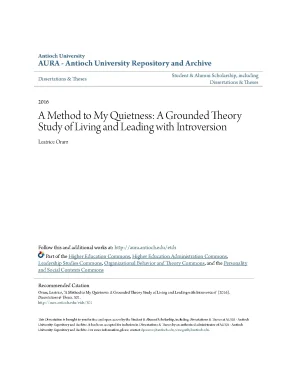
Tải xuống để đọc toàn bộAntioch University AURA - Antioch University Repository and Archive Student & Alumni Scholarship, including Dissertations & Theses Dissertations & Theses 2016 A Method to My Quietness: A Grounded Theory Study of Living and Leading with Introversion Leatrice Oram Follow this and additional works at: http://aura.edu/etds Part of the Higher Education Commons, Higher Education Administration Commons, Leadership Studies Commons, Organizational Behavior and Theory Commons, and the Personality and Social Contexts Commons Recommended Citation Oram, Leatrice, "A Method to My Quietness: A Grounded Theory Study of Living and Leading with Introversion" (2016).edu/etds/301 This Dissertation is brought to you for free and open access by the Student & Alumni Scholarship, including Dissertations & Theses at AURA - Antioch University Repository and Archive. It has been accepted for inclusion in Dissertations & Theses by an authorized administrator of AURA - Antioch University Repository and Archive. For more information, please contact dpenrose@antioch.edu, wmcgrath@antioch. A METHOD TO MY QUIETNESS: A GROUNDED THEORY STUDY OF LIVING AND LEADING WITH INTROVERSION LEATRICE ORAM A DISSERTATION Submitted to the Ph.
in Leadership and Change Program of Antioch University in partial fulfillment of the requirements for the degree of Doctor of Philosophy July 2016 This is to certify that the Dissertation entitled: A METHOD TO MY QUIETNESS: A GROUNDED THEORY STUDY OF LIVING AND LEADING WITH INTROVERTSION prepared by Leatrice Oram is approved in partial fulfillment of the requirements for the degree of Doctor of Philosophy in Leadership and Change. Approved by: Elizabeth Holloway, Ph., Chair date Laura Morgan Roberts, Ph., Committee Member date Harriet Schwartz, Ph., Committee Member date Sandie Turner, Ph., External Reader date Copyright 2016 Leatrice Oram All rights reserved Acknowledgments The last three years would have proved impossible if I had not had the support of many dear friends, family, and colleagues. For all the times I had to be away, whether in Yellow Springs or just in my study upstairs, I am gratefully indebted. Thanks are due to Susan Cain, author of Quiet: The Power of Introverts in a World That Can’t Stop Talking (2012) for inspiring me and for liking my dweeby, fangirl posts on her Facebook page.
You will be one of the first recipients of this dissertation, like it or not. Thanks go out to my colleagues at Antioch University New England for allowing me a flexible schedule to get my work done and for the financial underwriting of my degree program. Thank you to C13—my doctoral squad—for embracing my introverted self and for opening my eyes time and time again; from you and with you, I will keep learning. To my oenophile intervention team of Dani Chesson and Maria Dezenberg especially, you are truth-tellers and crack-ups, muses and graces.
To my Seattle crew: William, Kara, Benjamin, and Julia Laverde, thank you for opening your home to me, for all that sushi, and for making me a movie star. To my coding team, Dr. Timothy Eklin and Dr. Aviva Cohen, thank you for your time and expertise.
And to my research partner, Dr. Roxanne Swogger, you softie, you big-brained, laughing warrior. Saturdays at 9:30 will never be the same. We did it! To the participants in this study: I am in awe of the ease and exactitude with which you told me your stories and showed me your realities of being introverts and leaders.
Without you, this would not be, period. A special thanks to P22, whose verbal acuity provided the title of this work. i My gratitude goes out to the faculty and staff of the Antioch University PhD in Leadership and Change. You have fostered a unique program of the most marvelous, evolving design.
You model what it means to be responsive, relational, and reflexive leaders and scholars. For those who support our students’ research—Deb Baldwin, Cathy Boswell, Vanessa Helgerson, and Emily DeMaria virtually and Abby Jones on my campus—you make our small program very powerful. To Margaret Morgan and Leslee Creighton, thank you for all you know and for your light touch. Laurien Alexandre, extravert extraordinaire, you saw where I was going long before I did.
(By the way, it’s still all about the dog.) To my committee: Dr. Laura Morgan Roberts, for introducing me to positive identity and positive organizational scholarship; Dr. Harriet Schwartz who helped me discover discovering; and Dr. Sandie Turner for her thoughtful, close reading, thank you all.
And finally to Dr. Elizabeth Holloway, you were combobulated when I was discombobulated, funny and disarming when I was in a tizzy, and certain when I was unsure. You were utterly practical, incisive, and direct. On every call, in every note, on every Google Hangout, you grokked my ideas and you grokked me.
In other words, you were my perfect dissertation chair and I admire you deeply. To my particular village—Wendy, Kelly, Kate, Cis, BeeP, Geeba, GeeBee, DIR, Audie, Uncles Sarah and Gene, the Divine Miss M, Mel, El Miguel Grande, Impy, Grammy, Nick, Deb, Dad, and Mike—your encouragement from near, far, here, there, and everywhere mattered so very, very much. And finally, to Andrew and Louisa, my own true loves, my steadfast, ardent hearts. this is for you, first and last.
I love you and our lives together. Let’s go play. ii Dedication To Andrew Thomas Oram and Louisa Theodora Oram, for your enduring love and patience. To my mom, Sabina Thorne Johnson, who would have a PhD herself if she hadn’t had her hands full.
I wish you were here with me still. You would have pulled this quotation from your mighty storehouse of memory: “Indeed what is there that does not appear marvellous, when it comes to our knowledge the first time? How many things, too, are looked upon as quite impossible, until they have actually been effected?” (Pliny the Elder, trans. 1855) iii Abstract Leadership scholar-practitioners must create a more sustainable, diverse, and equitable future, fostering emergence and development of resilient, competent leaders, including those who may have been previously overlooked. Leadership studies, particularly those situated in early trait and behavior paradigms, have long privileged extraverted leaders as ideal.
The scholarly conversation is limited on introverted leaders; moreover, most of that literature depicts introversion as either a pathological construct associated with shyness and social anxiety, or includes introversion only by omission, as a state of deficit-of-extraversion. This study instead began with positive inquiry, framing introversion as a positive individual difference, and explored the lived experiences of introverted leaders. This research coalesced perspectives from positive psychology, positive identity at work, and positive organizational scholarship to inquire into introversion as a positive leadership construct. In this constructivist grounded theory study, leaders who identified as introverts and who reported introversion typology on the Myers Briggs Type Indicator (MBTI®) were asked to reflect on their experiences of introversion, leadership identity development, and professional and personal pursuits.
From the amassed data emerged three theoretical propositions. First, enacting leadership has significant costs for an introverted leader’s energy and identity. Second, an introverted leader must adopt a conscious learning orientation to leadership development, including experimentation with possible leader identities. Third, effective introverted leadership is dependent on understanding the powerful intersectionality of introversion, relationship, and identity.
This dissertation is available in open access at AURA, http://aura.edu/ and OhioLink ETD Center, https://etd.edu/etd iv Table of Contents Abstract. iv Table of Contents .v List of Tables. vii List of Figures. viii Chapter I: Introduction .1 Statement of Purpose .3 Situating the Research and the Researcher .4 Introversion: The Construct .9 Significance to Theory and Practice.15 Overview of the Dissertation.15 Chapter II: Review of the Literature .17 Examining the Construct of Introversion-Extraversion .18 Introversion-Extraversion in Leadership Studies .20 Introversion-Extraversion in Wider Cultural and Global Perspectives .25 Reframing Introversion as a Positive Leadership Construct .32 Positive Organizational Scholarship .34 Strengths-Based Approaches .35 Identity Literature as the Foundation to Positive Identity at Work .36 Introversion and Positive Identity .44 Chapter III: Methodology .46 Tracing the Path That Led to Choosing Constructivist Grounded Theory .47 Need for Qualitative Research in Management and Leadership Studies .48 Origins of a Methodological Revolution: The Discovery of Grounded Theory .51 Methods in a Constructivist Grounded Theory Study .78 Chapter IV: Findings.81 Where It All Happens: Contexts for the Core and Primary Dimensions .83 Core Dimension: Reflecting and Reflexing .86 Primary Dimension: Observing and Listening .95 Primary Dimension: Stretching .100 Primary Dimension: Engaging .103 Primary Dimension: Depleting .121 Primary Dimension: Retreating .128 Chapter V: Discussion and Implications.129 What We Discovered Together: Co-Construction of Understanding and Meaning .130 Models of Living and Leading With Introversion .135 Living With Introversion: The Gibbous Moon .138 Leading With Introversion: Imagining A Leadership Round Table .139 Living and Leading With Introversion .144 Theoretical Proposition One .145 Theoretical Proposition Two .149 Theoretical Proposition Three .154 Implications for Practice .157 Limitations of the Study .161 Recommendations for Future Research .191 vi List of Tables Table 4.1 Core Dimension: Reflecting and Reflexing .2 Primary Dimension: Observing and Listening .3 Primary Dimension: Stretching .4 Primary Dimension: Engaging.5 Primary Dimension: Depleting .6 Primary Dimension: Retreating .124 vii List of Figures Figure 4.1 With Self (Internal), In Passage (Transitional), and With Others (External) Contexts .2 Relative Connections Between Contexts, Core, and Primary Dimensions .1 Participants’ Lived Experiences of Introversion .2 Social Processes Involved in Living and Leading With Introversion .142 viii 1 Chapter I: Introduction A bird’s eye view of the study of leadership reveals long-standing, vacillating answers to the question, “What makes a great leader?” Early leadership theorists (e., Gibb, 1947; Stogdill, 1948) originated what is now called the trait paradigm, characterized by the belief that there were leaders and non-leaders, and that what made someone (usually a man) effective was inborn.
Studies bloomed, attesting to ideal demographics, skills, abilities, and personality traits (e., Bono & Judge, 2004; Judge & Bono, 2000; Moss, Ritossa, & Ngu, 2006). In these views, attributes like intelligence, conscientiousness, and extraversion were paramount, all issuing from the individual. Even as later theorists explored leadership with more complex, relational frameworks versus focusing on a single leadership entity, researchers still sought to identify some transcendent quality (e., Bono, Hooper, & Yoon, 2012; Brown & Reilly, 2009; Hautala, 2006, 2008; Kalshoven, Den Hartog, & DeHoogh, 2011; Rubin, Munz, & Bommer, 2005). I find myself drawn to more practical ideas; I have long been interested in how individuals integrate who they are and what they do.
I locate this interest specifically in how individuals develop leadership identity, their experiences of leadership emergence, and how they continue to develop as leaders, either in congruence or conflict with their understanding of their own personal identities. Increasingly, I have come to believe that my innate introversion plays a significant part in the choices I have made and in how I make meaning of pivotal experiences on my own leadership path. I have found little scholarship that sheds positive light on introversion and leadership, while there is ample research on extraversion as exemplary and predictive of leadership effectiveness. Moreover, there are countless studies and scales where introversion in leadership and management settings is seen at best as a lack of extraversion (Cattell & Schuerger, 2003; Costa & McCrae, 1992) and at worst as a social and functional 2 pathology (e., Bauer, Erdogan, Liden, & Wayne, 2006; Lee & Ashton, 2004, 2015; Mumford et al., 2000; Ryckman, Thornton, Gold, & Collier, 2011).
By coalescing perspectives from psychology, leadership theory, and identity literature, then framing them through the fields of positive organizational scholarship and positive identity at work, I approach introversion as a leadership construct from a positive versus deficit stance. I interviewed leaders who identified as introverts and were typed as such on the Myers Briggs Type Indicator (MBTI®) and asked them to reflect on their perceptions of their introversion and their work lives. The stories that resulted helped illustrate a fuller range of participants’ lived experiences as introverted leaders.
Nội dung được bảo vệ bản quyền — Tải xuống đầy đủ
Trích dẫn luận án này
Leatrice Oram (2016). A method to my quietness a grounded theory study of living a [Luận án tiến sĩ, Antioch University]. LuanAn.net. https://luanan.net/tam-ly-hoc/a-method-to-my-quietness-a-grounded-theory-study-of-living-and-l
Câu hỏi thường gặp
Luận án "A method to my quietness a grounded theory study of living a" nghiên cứu về vấn đề gì?
Nghiên cứu lý thuyết nền khám phá phương pháp tạo dựng sự tĩnh lặng, một hành trình khám phá cuộc sống đầy ý nghĩa và vững chắc.
Luận án "A method to my quietness a grounded theory study of living a" được bảo vệ tại trường nào?
Luận án này được bảo vệ tại Antioch University. Năm bảo vệ: 2016.
Luận án "A method to my quietness a grounded theory study of living a" thuộc chuyên ngành gì?
Luận án "A method to my quietness a grounded theory study of living a" thuộc chuyên ngành Leadership and Change. Danh mục: Tâm Lý Học.
Luận án "A method to my quietness a grounded theory study of living a" có bao nhiêu trang?
Luận án "A method to my quietness a grounded theory study of living a" có 223 trang. Bạn có thể xem trước một phần tài liệu ngay trên trang web trước khi tải về.
Cách tải luận án "A method to my quietness a grounded theory study of living a" về máy như thế nào?
Để tải luận án về máy, bạn nhấn nút "Tải xuống ngay" trên trang này, sau đó hoàn tất thanh toán phí lưu trữ. File sẽ được tải xuống ngay sau khi thanh toán thành công. Hỗ trợ qua Zalo: 0559 297 239.