A theory of curriculum development in the professions an integra
Lý thuyết phát triển chương trình đào tạo nghề: Phân tích lý thuyết phát triển CT trong giáo dục chuyên nghiệp, đề xuất phương pháp cải tiến.
Luan An
Luận án tiến sĩ
Năm xuất bản
Số trang
415
Thời gian đọc
1 giờ 3 phút
Lượt xem
0
Lượt tải
0
Phí lưu trữ
60 Point
Tổng quan nhanh
- Chủ đề:
- 1. Integrating Theories for Professional Curriculum Development
- Số trang:
- 415 trang
- Trường:
- Antioch University
- Chuyên ngành:
- Leadership and Change
- Tác giả:
- Shelley Ann Chapman
- Năm:
- 2007
Tóm tắt nội dung luận án
I. Integrating Theories for Professional Curriculum Development
This foundational work proposes a new framework for curriculum design principles in professional education. It integrates two powerful theories. Jack Mezirow’s Transformative Learning Theory addresses adult learning and perspective shifts. Joseph Schwab’s Deliberative Curriculum Theory focuses on practical, context-dependent curriculum inquiry. The resulting 'transformative-deliberative' approach offers a holistic model. It aims to develop curricula that not only impart knowledge but also foster deep, critical transformations. This framework redefines instructional design for professions, moving beyond traditional methods. It seeks to create more relevant and impactful learning experiences for future professionals. This integration provides a robust theoretical base for modern professional education models, emphasizing both individual growth and collective wisdom.
1.1. Foundations of Transformative Learning Theory
Mezirow’s Transformative Learning Theory is central to this integration. It posits that adults learn through critical reflection on their experiences. This reflection often leads to a 'perspective transformation'. Learners challenge long-held assumptions and beliefs. This process results in more inclusive, differentiating, and permeable meaning perspectives. The theory underpins effective adult learning theory (Andragogy). It emphasizes the learner's active role in constructing knowledge. Its application in professional curricula ensures deeper engagement. It promotes enduring personal and professional development.
1.2. Principles of Schwab s Deliberative Curriculum
Schwab’s Deliberative Curriculum Theory provides the practical lens. It advocates for a deliberative, rather than theoretical, approach to curriculum design principles. Curriculum development is seen as a practical art. It involves informed judgment and negotiation among stakeholders. Decisions are made in specific contexts, not derived from universal principles. This approach emphasizes an ongoing dialogue. It considers competing values and diverse perspectives. It ensures curricula are relevant, responsive, and robust for professional contexts. This is crucial for designing effective professional development frameworks.
1.3. Synergy in Curriculum Design for Professions
The integration of Mezirow and Schwab creates a powerful synergy. Transformative learning provides the 'why' – fostering critical reflection and personal change. Deliberative inquiry provides the 'how' – a practical, collaborative method for designing curricula. This combined approach builds professional education models focused on deep learning. It supports the development of curricula that challenge assumptions. It also ensures programs are practically sound and contextually appropriate. This synergy redefines instructional design for professions, promoting transformative outcomes.
II. Transformative Deliberative Curriculum Approach
The proposed 'transformative-deliberative' curriculum approach is a novel framework. It aims to integrate profound personal change with practical, collective decision-making. This approach moves beyond traditional content delivery. It targets transformation in curriculum processes, classroom experiences, and professional work itself. It is designed to foster critical thinking and adaptability. This model ensures professional development frameworks are dynamic. It produces professionals ready for complex challenges. The approach builds competency-based learning initiatives from a deeper theoretical foundation. It promotes active, engaged learning rather than passive reception. This framework creates robust educational programs.
2.1. Defining the New Curriculum Framework
This framework synthesizes critical reflection and practical deliberation. It views curriculum as a dynamic, evolving entity. The focus is on processes that lead to meaningful learning. It prioritizes creating environments where learners can question their perspectives. This includes considering alternative viewpoints. The framework supports curriculum design principles that are both theoretically rich and pragmatically grounded. It aims for systemic transformation across all levels of professional education. This ensures relevance and impact in changing professional landscapes.
2.2. Fostering Critical Reflection and Professional Growth
A core tenet of this approach is fostering critical reflection. Learners are encouraged to examine their assumptions. They analyze their frames of reference. This process is vital for adult learning theory (Andragogy). It drives personal and professional growth. The curriculum facilitates experiences that provoke disorienting dilemmas. These challenges lead to new understandings and changed perspectives. This deep engagement directly supports professional development frameworks. It builds adaptable and reflective practitioners. This prepares them for evolving professional roles.
2.3. Guiding Curriculum Processes and Experiences
The transformative-deliberative approach guides every stage of curriculum development. From initial conceptualization to classroom implementation, it informs decisions. It emphasizes a collaborative process among educators and stakeholders. This ensures curricula are relevant and effective. It designs learning experiences that promote active inquiry. Learners are pushed to engage with real-world problems. This focus on practical application enhances instructional design for professions. It ensures learning directly translates into improved professional practice. This makes curricula highly impactful.
III. Enhancing Professional Education Models and Outcomes
This integrated theory significantly enhances professional education models. It offers a pathway to more effective and transformative learning outcomes. The approach moves beyond mere skill acquisition. It emphasizes developing a professional's capacity for critical judgment and ethical practice. It directly impacts how institutions design and evaluate their programs. The framework provides a strong foundation for competency-based learning. It ensures that competencies are developed through deep, meaningful engagement. This results in graduates prepared for the complexities of their professions. It creates a new standard for excellence in professional training and development.
3.1. Revolutionizing Professional Education Models
The transformative-deliberative approach introduces a paradigm shift. It moves professional education models from information transfer to meaning-making. This revolutionizes how programs are structured. It encourages experiential learning, case studies, and critical dialogue. These methods foster deeper understanding and application. The focus is on developing adaptive experts, not just technicians. This ensures graduates possess the intellectual flexibility needed for dynamic professional environments. It prepares them for lifelong learning and continuous improvement.
3.2. Assessing Learning Outcomes for Professional Practice
This theory provides new insights into learning outcomes assessment. Evaluation focuses on evidence of perspective transformation and deliberative capacity. It moves beyond traditional tests of factual recall. Assessment methods include reflective journals, project-based evaluations, and peer feedback. These evaluate critical thinking, problem-solving, and ethical reasoning. The goal is to measure the impact on actual professional practice. This ensures that curricula produce truly competent and reflective professionals. It validates the effectiveness of the transformative approach.
3.3. Addressing Accreditation Standards and Interprofessionalism
The transformative-deliberative approach supports stringent accreditation standards. It does so by producing highly competent and ethically aware professionals. Its emphasis on collaboration and diverse perspectives also fosters interprofessional education. Learners develop skills to work effectively across different professional boundaries. This prepares them for team-based care and complex societal challenges. The framework demonstrates a commitment to excellence and innovation. It ensures programs meet and exceed regulatory requirements. It graduates professionals ready for modern healthcare and other fields.
IV. Applying Deliberative Inquiry in Curriculum Processes
The deliberative aspect of this theory is crucial for practical application. It ensures curriculum design principles are not abstract but contextually relevant. This involves an ongoing process of inquiry and negotiation. Stakeholders collaborate to define learning goals and content. It moves away from top-down curriculum mandates. Instead, it promotes shared ownership and collective wisdom. This fosters a sense of commitment and relevance among all participants. The deliberative process is fundamental for creating responsive and effective instructional design for professions. It ensures curricula evolve with the needs of the professional landscape.
4.1. Practical Application of Deliberative Design Principles
Deliberative design principles are applied throughout curriculum development. This involves rigorous discussion, debate, and problem-solving. Educators and practitioners work together. They analyze specific educational needs and goals. They consider various perspectives and potential impacts. This ensures the curriculum is tailored to the unique demands of a profession. This practical approach is a cornerstone for robust curriculum design principles. It results in programs that are both theoretically sound and highly practical. It leads to improved learning outcomes.
4.2. Stakeholder Engagement in Curriculum Development
Active engagement of diverse stakeholders is paramount. This includes faculty, students, employers, and professional bodies. Their input ensures the curriculum addresses real-world challenges. It also reflects current professional standards. This collaborative approach enhances the legitimacy and effectiveness of the curriculum. It promotes a shared understanding of educational goals. This broad participation strengthens professional development frameworks. It creates programs that are broadly supported and highly relevant to the professional community.
4.3. Iterative Design for Responsive Professional Programs
Curriculum development is viewed as an iterative process. It is not a one-time event. Continuous reflection and feedback cycles are integrated. This allows for ongoing refinement and adaptation. Programs remain responsive to changing professional needs and societal demands. This iterative approach is vital for maintaining currency and relevance. It ensures that professional education models are dynamic. They can evolve effectively over time. This continuous improvement mechanism strengthens the long-term impact of the curriculum.
V. Impact on Professional Practice and Workplace Learning
The transformative-deliberative approach extends its influence beyond academic settings. It directly impacts workplace-integrated learning and professional practice. Curricula designed with this theory equip professionals with adaptable mindsets. They develop capacities for critical inquiry and ethical decision-making. This fosters genuine transformation in how professionals approach their work. It prepares them for complex, ill-structured problems inherent in many professions. The theory supports the development of competency-based learning that is truly actionable. It bridges the gap between theory and practice effectively. This ensures lasting impact on professional careers.
5.1. Transforming Classroom Experiences for Future Practice
Classroom experiences under this framework are designed to be immersive. They simulate real-world professional challenges. Learners engage in case studies, simulations, and ethical dilemmas. This prepares them for the complexities of future practice. The emphasis is on developing practical judgment and critical reflection. This ensures skills acquired are transferable. It creates a robust foundation for workplace-integrated learning. The classroom becomes a laboratory for professional growth. It cultivates the necessary skills for real-world application.
5.2. Fostering Transformation in Professional Work Settings
Professionals trained through this approach bring a transformative lens to their work. They are adept at questioning established norms and seeking innovative solutions. This leads to continuous improvement in professional settings. It drives organizational change and development. The approach cultivates professional development frameworks that support lifelong learning. It encourages practitioners to become agents of change. They actively shape their professions. This impact goes beyond individual competence, influencing entire fields.
5.3. Advancing Competency Based Learning in Professions
The theory significantly advances competency-based learning. It moves beyond a checklist approach to competencies. Instead, it focuses on developing the underlying capacities for effective professional action. Learners cultivate critical thinking, ethical reasoning, and problem-solving skills. These are core competencies for all professions. The transformative aspect ensures these competencies are deeply integrated. They are applied with wisdom and judgment. This results in truly competent professionals ready to excel.
Mục lục chi tiết luận án
Tải xuống file đầy đủ để xem toàn bộ nội dung
Tải đầy đủ (415 trang)Trích đoạn nội dung luận án
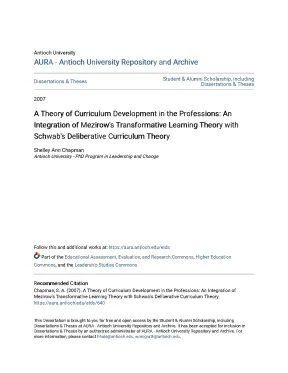
Tải xuống để đọc toàn bộAntioch University AURA - Antioch University Repository and Archive Student & Alumni Scholarship, including Dissertations & Theses Dissertations & Theses 2007 A Theory of Curriculum Development in the Professions: An Integration of Mezirow's Transformative Learning Theory with Schwab's Deliberative Curriculum Theory Shelley Ann Chapman Antioch University - PhD Program in Leadership and Change Follow this and additional works at: https://aura.edu/etds Part of the Educational Assessment, Evaluation, and Research Commons, Higher Education Commons, and the Leadership Studies Commons Recommended Citation Chapman, S. A Theory of Curriculum Development in the Professions: An Integration of Mezirow's Transformative Learning Theory with Schwab's Deliberative Curriculum Theory.edu/etds/640 This Dissertation is brought to you for free and open access by the Student & Alumni Scholarship, including Dissertations & Theses at AURA - Antioch University Repository and Archive. It has been accepted for inclusion in Dissertations & Theses by an authorized administrator of AURA - Antioch University Repository and Archive. For more information, please contact hhale@antioch.edu, wmcgrath@antioch.
Transformative-Deliberative Curriculum Theory i Running head: TRANSFORMATIVE-DELIBERATIVE CURRICULUM THEORY A Theory of Curriculum Development in the Professions: An Integration of Mezirow’s Transformative Learning Theory with Schwab’s Deliberative Curriculum Theory A transformative-deliberative curriculum approach can lead to curricula that target transformation in curriculum processes, classroom experiences, and professional work. Shelley Ann Chapman Antioch University A DISSERTATION Submitted to the Ph. in Leadership & Change Program of Antioch University in partial fulfillment of the requirements for the degree of Doctor of Philosophy January, 2007 Transformative-Deliberative Curriculum Theory ii Signature Page This is to certify that the dissertation entitled: A THEORY OF CURRICULUM DEVELOPMENT IN THE PROFESSIONS: AN INTEGRATION OF MEZIROW’S TRANSFORMATIVE LEARNING THEORY WITH SCHWAB’S DELIBERATIVE CURRICULUM THEORY: A TRANSFORMATIVE-DELIBERATIVE CURRICULUM APPROACH CAN LEAD TO CURRICULA THAT TARGET TRANSFORMATION IN CURRICULUM PROCESSES, CLASSROOM EXPERIENCES, AND PROFESSIONAL WORK. Prepared by Shelley Ann Chapman is approved in partial fulfillment of the requirements for the degree of Doctor of Philosophy in Leadership & Change.
Approved on January 21, 2007 by: Jon F. Wergin, Chair Laurien Alexandre, Committee Member Edward W. Taylor, Committee Member Ilene B. Harris, External Reader Transformative-Deliberative Curriculum Theory iii Acknowledgments To God be the glory.
Great things He has done. Fanny Crosby Be transformed by the renewing of your mind. Romans 12:2b I want to acknowledge the incredible expertise, insight, and generosity of my dissertation committee. Ilene Harris was a former student of Joseph Schwab, is an expert on deliberative curriculum inquiry, and is a nationally recognized leader in medical education.
Ilene helped me to understand Schwab’s work on a deep level. Edward Taylor is an expert on Jack Mezirow’s transformative learning theory, a leader in the field of adult education, and a passionate advocate for critical analysis and reflection. Ed challenged me to think in ways I had never thought before about power in the deliberative process. Laurien Alexandre, one of the architects of Antioch University’s truly innovative PhD in Leadership and Change program, is an expert on graduate professional education and critical theory.
Laurien provided a strong sense of emotional support while at the same time preparing me for a lifetime of rigorous, academic critique. Jon Wergin is a nationally acclaimed expert on higher education in general and graduate professional education in particular. He has researched and written extensively on leading and changing processes and systems in academe. I once heard him give a keynote speech at a national conference and secretly wished he could be my advisor.
Little did I know how blessed I would be when eleven months later he and I both met at Antioch, where he became my advisor, committee chair, and good friend. He led me each step of the way, giving pertinent direction, intriguing suggestions, and moral support. Jon even convinced me finally that I am not an imposter. Though I could not possibly name all the important people who should be acknowledged, I will mention a few others here.
Gloria John believed in me when no one else did, mentored me, Transformative-Deliberative Curriculum Theory iv taught me how to write, and directed me to Antioch. Amy Yerkes Schmaljohn, former Associate Dean of Academic Affairs at Johns Hopkins University, required me to pursue a doctoral degree, and provided me with a support structure that allowed me to work and study. Sara Hill, Doug Hough, and Lindsay Thompson, all of Johns Hopkins University, gave helpful feedback on the Curriculum Caucus Guide. Jennifer Smith’s incredible support, always given with a sweet spirit, will never be forgotten.
True friends prayed for me and encouraged me through my three-and-a-half-year journey—Adrienne, Anistine, B., Cathy, Claudia, Cora, Debbie, Faye, Gretel, Jeanne, Julie, Karen K, Karen L., Karin, Marti, Nancy, Sally, Sandy, Susan, and many others. I could not have completed this program without their support. I pray God’s blessing upon them. I want to acknowledge my 85-year-old mother, who was forced to leave school while in the tenth grade, but who instilled within me the drive to take advantage of the educational opportunities she never had.
Finally, I acknowledge my children, who were my personal cheerleaders and therapists. Though a high schooler, Lynn’s rock-like faith and patience with my work and study schedule made this dissertation possible. Besides Ann’s helpful critique on the new theory, her uplifting, positive spirit, and laughter always put a smile on my face. Tolu’s long and deep conversations about the graduate professional education he had experienced impacted this study.
It is to my wonderful children that I dedicate this dissertation. Transformative-Deliberative Curriculum Theory v Abstract A hundred years ago, the problem with professional education was that it lacked a sound scientific foundation and opportunities for clinical practice. Throughout the past three decades, discussions on graduate professional education have focused on how to improve the theory/practice continuum, either through new formats or strategies, or by emphasizing one over the other. However, with the new century, new problems have emerged within the professional education arena.
This dissertation has focused on two main problems in graduate professional education in the early 21st century: students are focusing too much on technical expertise and not enough on becoming transformed into authentic professionals who serve the public good; and educators are using technical expertise to plan for technical learning without intentionally planning for their students to transform into genuine professionals, or those who profess their expert knowledge for the public good. Both problems stem from deeply held assumptions that the rational, cause/effect linear approach is the best way to plan curriculum and the best way for students to learn. This dissertation demonstrates that both assumptions are flawed. This study proposes in a new theory, one which integrates the learning theory of Jack Mezirow with the deliberative curriculum theory of Joseph Schwab to break the technical/rational grip on curriculum work and professional education.
Graduate professional education needs to be transformative, and in order for that to happen, curriculum planning must be done in a deliberative fashion. The new transformative-deliberative approach to curriculum planning can be implemented by using the Curriculum Caucus Guide, a heuristic developed to help educators use this new approach to curriculum work and to begin to effect needed change. The electronic version of the dissertation is accessible at the Ohiolink ETD center http://www. Transformative-Deliberative Curriculum Theory vi A Theory of Curriculum Development in the Professions: An Integration of Mezirow’s Transformative Learning Theory with Schwab’s Deliberative Curriculum Theory Table of Contents Chapter 1: Introduction 1 Context Of Graduate Professional Education 2 Transformative Learning Theory And Deliberative Curriculum Theory 5 Transformative Learning Theory 6 Deliberative Curriculum Theory 9 The Study 13 Chapter Two: Literature Review 15 Chapter Three: Methodology 17 Chapter Four: The New Theoretical Model 20 Chapter Five: Implications 22 Chapter 2: Literature Review 23 Transformative Learning Theory 23 Brief History of Adult Learning 23 Transformative-Deliberative Curriculum Theory vii The Development of Mezirow’s Transformative Learning Theory 34 Research on Mezirow’s Theory 65 Deliberative Curriculum Theory 111 Definition of Curriculum 112 Brief History of Curriculum Theory 114 The Development of Schwab’s Deliberative Curriculum Theory 125 Research on Schwab’s Theory 142 The Relationship between Schwab’s Work and Program Planning 147 Graduate Professional Education 158 Definitions of Profession, Professional 158 Professional Education and Calls for Reform 164 Suggestions for Reform 168 Coda 184 Chapter 3: Methodology—Developing a Theory of Integration 186 The Importance of Theories 186 Transformative-Deliberative Curriculum Theory viii Historical and Philosophical Roots of Theoretical Paradigms 189 Theory Building 204 Framework for Theory Integration 225 Application of Framework to this Study 227 Assessing a New Theory 242 Positioning 244 Chapter 4: Integrating the Theories of Mezirow and Schwab 246 Phase 1: Establish the Theory-Builder’s Beliefs and Values 248 Phase 2: Choose a Theoretical Paradigm 249 Phase 3: Identify the Need 251 Phase 4: Choose the Type of Model to be Developed 252 Phase 5: Research the Theories 253 Phase 6: Reinvigorate the Theories 282 Phase 7: Reflect upon the Empirical Research 298 Phase 8: Reflect on Personal Experience 300 Transformative-Deliberative Curriculum Theory ix Phase 9: Develop a Metaphor and Heuristic 324 Phase 10: Assess the Theory and Heuristic 351 Chapter 5: Implications of the New Theory 357 Major Accomplishments 361 Problems Likely to be Encountered 363 Other Domains for the Heuristic 372 Evaluation of the New Theory 375 References 377 Appendix—Copyright Permissions 400 Transformative-Deliberative Curriculum Theory 1 A Theory of Curriculum Development in the Professions: An Integration of Mezirow’s Transformative Learning Theory with Schwab’s Deliberative Curriculum Theory “There has never been a time when the quality of professional education was more important, or more subject to question, than the present” (Sullivan, p.
Chapter 1: Introduction Professional education is in a critical period. The historical connotation of the term professional with a commitment to the public good has been gravely influenced by the notion of technical professionalism or careerism. Students in graduate professional schools often learn specialized knowledge and technical skills without a deep and transforming experience that leads them to understand what it means to “profess” their values, beliefs, passions, and concerns for the public good. Being professional also means being able to listen carefully and to be able to question their stereotypes and assumptions about their work (Sullivan, 2005, p.
Pedagogy and curriculum design processes have come from the paradigm of technical rationality, caught in a hopelessly unending pendulum swing between theory and practice. The focus of change has often been to introduce new teaching strategies or delivery formats, which usually emphasize one need over the other—knowledge or skills, rigor or relevance, science or application. Trying to find the right balance has hindered educators from seeing a deeper need to plan for learning that includes knowledge and skills, but takes students to a higher level, that of transformation into professionalism. Reforms have been suggested continually throughout the past three decades.
However, Sullivan said as recently as last year “Professional renewal has to begin in professional education, or it will have no lasting future. Also during the past three Transformative-Deliberative Curriculum Theory 2 decades two theories have emerged, that if brought together, can help educators effect the type of change necessary for graduate professional education. The purpose of this study is to integrate transformative learning theory with deliberative curriculum theory in order to propose a heuristic that can contribute to the reform of graduate professional education. CONTEXT OF GRADUATE PROFESSIONAL EDUCATION Almost a hundred years ago, one of the most significant events in the history of graduate professional education took place.
Flexner (1910) conducted an exhaustive study of medical schools in the U. and Canada that served as a wake-up call for many of them. The findings were not without merit. Many medical schools, so-called, had arisen throughout the two nations by the 1870s, but often with few resources other than professors, and the teaching was for the most part didactic.
For some of the schools, the curriculum often lasted only nine months, and no applicant who could pay his fees or sign his name was turned away. While a good number of the schools had loose university affiliations, many did not.
Nội dung được bảo vệ bản quyền — Tải xuống đầy đủ
Trích dẫn luận án này
Shelley Ann Chapman (2007). A theory of curriculum development in the professions an int [Luận án tiến sĩ, Antioch University]. LuanAn.net. https://luanan.net/giao-duc-hoc/a-theory-of-curriculum-development-in-the-professions-an-integra
Câu hỏi thường gặp
Luận án "A theory of curriculum development in the professions an int" nghiên cứu về vấn đề gì?
Lý thuyết phát triển chương trình đào tạo nghề: Phân tích lý thuyết phát triển CT trong giáo dục chuyên nghiệp, đề xuất phương pháp cải tiến.
Luận án "A theory of curriculum development in the professions an int" được bảo vệ tại trường nào?
Luận án này được bảo vệ tại Antioch University. Năm bảo vệ: 2007.
Luận án "A theory of curriculum development in the professions an int" thuộc chuyên ngành gì?
Luận án "A theory of curriculum development in the professions an int" thuộc chuyên ngành Leadership and Change. Danh mục: Giáo Dục Học.
Luận án "A theory of curriculum development in the professions an int" có bao nhiêu trang?
Luận án "A theory of curriculum development in the professions an int" có 415 trang. Bạn có thể xem trước một phần tài liệu ngay trên trang web trước khi tải về.
Cách tải luận án "A theory of curriculum development in the professions an int" về máy như thế nào?
Để tải luận án về máy, bạn nhấn nút "Tải xuống ngay" trên trang này, sau đó hoàn tất thanh toán phí lưu trữ. File sẽ được tải xuống ngay sau khi thanh toán thành công. Hỗ trợ qua Zalo: 0559 297 239.