Kyei pakwa dissertation wex final approval
Luận văn Kyei Pakwa, phê duyệt cuối cùng. Tổng hợp nghiên cứu, kết quả và đề xuất quan trọng cho sự phát triển tiếp theo.
Năm xuất bản
Số trang
206
Thời gian đọc
31 phút
Lượt xem
0
Lượt tải
0
Phí lưu trữ
50 Point
Tổng quan nhanh
- Chủ đề:
- Ph.D. Dissertation on African Leadership Restoration
- Số trang:
- 206 trang
- Trường:
- Antioch University
- Chuyên ngành:
- Leadership & Change
- Tác giả:
- Daniel Kyei-Poakwa
- Năm:
- 2021
Tóm tắt nội dung luận án
I.D
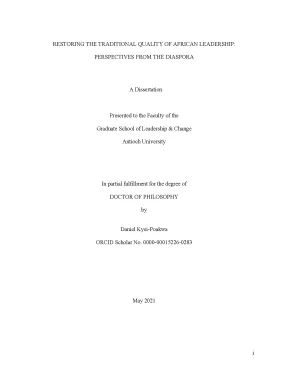
This Ph.D. dissertation addresses a critical issue: restoring the traditional quality of African leadership. The work explores perspectives from the Diaspora. It represents the successful graduate studies completion for a Doctor of Philosophy degree. The document, titled "RESTORING THE TRADITIONAL QUALITY OF AFRICAN LEADERSHIP: PERSPECTIVES FROM THE DIASPORA," fulfills doctoral degree requirements at Antioch University. This academic research project offers valuable insights into complex leadership challenges across Africa. It seeks to redefine effective governance through a unique lens. The dissertation submission signifies a significant milestone in academic research.
1.1. Dissertation s Core Purpose and Scope
The core purpose is to analyze flaws in contemporary African leadership. It proposes solutions. The scope includes insights from Africans living in the Diaspora. Their experiences offer unique viewpoints on leadership challenges and potential improvements. This detailed study aims to inform policy and practice.
1.2. Author and Academic Credentials
The dissertation was presented by Daniel Kyei-Poakwa. It was submitted to the Faculty of the Graduate School of Leadership & Change, Antioch University. The author’s ORCID Scholar No. is 0000-0001-5226-0283. This reflects rigorous academic pursuit and scholarly identification for the academic research project approval.
II.Exploring African Leadership Challenges Solutions
Contemporary African leadership faces significant challenges. This doctoral thesis acknowledges a widely held view of deep flaws. It positions Diasporic Africans as key stakeholders. Their understanding of leadership challenges and desirable characteristics can influence change. The research aims to explore these problems and identify viable solutions. This involved rigorous data collection and analysis. The findings offer a pathway for future improvement initiatives.
2.1. Unpacking Contemporary Leadership Flaws
The research identified specific leadership flaws. Top responses included incompetence and corruption. Exclusion of qualified individuals due to sexism, tribalism, and nepotism was also highlighted. These issues undermine effective governance. They hinder progress across the continent. Addressing these challenges is paramount for sustainable development.
2.2. Research Methodology Focus Group Approach
Four focus groups were convened. Participants were Diasporic Africans residing in Rhode Island, United States. A researcher facilitated each group meeting. Discussions focused on needed changes in African leadership. Questions explored desirable characteristics in political leadership. They also examined how the Diaspora can support improvement. Transcripts were analyzed for recurring ideas and themes.
III.Diaspora s Role in African Leadership Improvement
The Diaspora plays a crucial role in African leadership improvement. This academic research project confirms their significant potential. Perspectives from Africans living abroad offer fresh insights. These external viewpoints often identify blind spots. They also suggest innovative solutions for domestic issues. The research specifically explored how this group can contribute to positive change. Their engagement is vital for holistic progress.
3.1. Perspectives from Diasporic African Communities
Diasporic Africans offer unique perspectives. Their experiences blend traditional values with global understanding. This dual lens provides a comprehensive view of leadership issues. The research synthesized their viewpoints on restoring sound leadership. Such insights are invaluable for reform efforts in home countries.
3.2. Desired Leadership Qualities and Diaspora Support
Focus groups emphasized several desirable leadership characteristics. Honesty was a leading response. Personal qualities of leaders were deemed important. Achieving visionary leadership received strong support. Enacting democratic values was also a key theme. The Diaspora identified diverse ways to offer help. These range from skill transfer to advocacy. This reinforces the potential for significant external support.
IV.Ubuntu Philosophy Basis for Leadership Renewal
Ubuntu philosophy forms a foundational basis for leadership renewal. This doctoral thesis highlights its re-emergence. Ubuntu is a tradition-based perspective. It has gained prominence across Africa in recent decades. The research integrated Ubuntu into focus group discussions. Its principles guided conversations on leadership change. This demonstrates the enduring relevance of indigenous knowledge systems.
4.1. The Enduring Relevance of Ubuntu
All group discussions began with Ubuntu. Its philosophy and relevance were considered. Ubuntu emphasizes interconnectedness and community. These principles provide a strong moral compass for leaders. The concept "I am because we are" encapsulates its essence. Reviving practices based on Ubuntu promises ethical leadership.
4.2. Integrating Traditional Wisdom for Change
Discussions explored how leadership renewal relates to Ubuntu. This integration of traditional wisdom offers a unique approach. It counters prevailing Western-centric leadership models. Adopting Ubuntu principles can foster integrity. It can also promote inclusivity and accountability. This ancient philosophy provides a framework for modern reforms.
V.Doctoral Thesis Final Review Approval Process
The doctoral thesis final review marks the culmination of extensive academic work. This dissertation submission underwent a rigorous thesis approval process. The academic committee approval ensures adherence to high scholarly standards. The document meets all university guidelines for dissertations. This final approval signifies its readiness for public dissemination. It represents a significant achievement in academic research.
5.1. Committee Approval and University Standards
The dissertation by Daniel Kyei-Poakwa received approval. Committee members signed below the acceptance. They recommended acceptance by the faculty of the Graduate School of Leadership and Change, Antioch University. This fulfills the doctoral degree requirements. The academic committee ensures the quality and integrity of the work.
5.2. Open Access for Academic Research Project
This academic research project approval facilitates wider access. The dissertation is available in open access. It can be found at AURA: Antioch University Repository and Archive (http://aura.edu/) and OhioLINK ETD Center (https://etd.edu/etd). This ensures broad visibility for the research. It promotes knowledge sharing in the academic community. The final manuscript submission is now public.
Mục lục chi tiết luận án
Tải xuống file đầy đủ để xem toàn bộ nội dung
Tải đầy đủ (206 trang)Trích đoạn nội dung luận án
Tải xuống để đọc toàn bộRESTORING THE TRADITIONAL QUALITY OF AFRICAN LEADERSHIP: PERSPECTIVES FROM THE DIASPORA A Dissertation Presented to the Faculty of the Graduate School of Leadership & Change Antioch University In partial fulfillment for the degree of DOCTOR OF PHILOSOPHY by Daniel Kyei-Poakwa ORCID Scholar No. 0000-00015226-0283 May 2021 i RESTORING THE TRADITIONAL QUALITY OF AFRICAN LEADERSHIP: PERSPECTIVES FROM THE DIASPORA This dissertation by Daniel Kyei-Poakwa has been approved by the committee members signed below who recommend that it be accepted by the faculty of the Graduate School of Leadership and Change, Antioch University in partial fulfillment of the requirements for the degree of DOCTOR OF PHILOSOPHY Dissertation Committee: Lize Booysen, DBL, Chairperson Laura Morgan Roberts, PhD Richard Lobban, PhD ii Copyright © 2020 by Daniel Kyei-Poakwa All Rights Reserved iii ABSTRACT RESTORING THE TRADITIONAL QUALITY OF AFRICAN LEADERSHIP: PERSPECTIVES FROM THE DIASPORA Daniel Kyei-Poakwa Graduate School of Leadership & Change Antioch University Yellow Springs, Ohio There is a widely held and mainly fair view that Africa’s contemporary leadership is deeply flawed. Reform is needed and this dissertation takes the position that the challenges to and desirable characteristics of leadership are understood and can be influenced by Africans living in the Diaspora. To explore the challenges and possible solutions, four focus groups were convened drawing on Diasporic Africans living in Rhode Island in the United States.
Each group meeting was facilitated by the researcher and discussed several questions about the most needed changes in leadership in Africa today. These concerned the most desirable characteristics in political leadership in Africa and how Diasporic African leaders can support leadership improvement in Africa. All group discussions began with consideration of the philosophy and relevance of Ubuntu a tradition-based perspective that has re-emerged through Africa in the last 30 years. Groups discussed how leadership renewal and improvement related to reviving practices based on Ubuntu.
Transcripts from these sessions were analyzed for the number of mentions of particular ideas. Results were condensed into clusters of related ideas and themes for purposes of discussion. The top responses to the first question about challenges were about incompetence; corruption; and the exclusion of good leaders and officials because of sexism, tribalism, and nepotism. The leading responses to the second question on desirable leadership characteristics emphasized honesty, personal qualities of leaders, achieving visionary leadership, and enacting democratic values.
In response to the third question of involving the Diaspora, a diverse range of ways in which help would be given were enumerated. This work concludes with a synthesis of the perspectives of Diasporic Africans on how to restore sound leadership in home countries. iv This dissertation is available in open access at AURA: Antioch University Repository and Archive, http://aura.edu/ and OhioLINK ETD Center, https://etd.edu/etd Keywords: Ubuntu, Leadership, Focus Groups, Diaspora, Corruption v Dedication I dedicate this work to legacy of my deceased dad, my children, and my grandchildren and those who will follow, as well as the community of learners of African Political Leadership reforms. I am because we are.
vi Acknowledgements First, I am thankful to God for His strength, wisdom, and mercies to pursue and successfully complete this doctoral program. His grace indeed has been sufficient for me. Many people have had a hand in the completion of this work, and I can say with humility and gratitude that this was indeed a joint effort, a true epitome of “I am because we are.” Notwithstanding, I take full responsibility for the scholarship presented here. I acknowledge the legacy of my deceased dad, the late Albert Kyei-Poakwa, who believed in education as a catalyst to progress in life and therefore made great sacrifices to give his children the best opportunities for education.
His efforts have been an impetus of my inspiration on my academic journey. Not forgetting the prayers and support of my 85-year-old living mother, Lady Betty Kyei-Poakwa, that her children will succeed in all their endeavors. I especially thank my wife and children, particularly my first-born, Albert, who provided the technological support for my doctoral work. I am committed to helping him reach the pinnacle of his career.
Special thanks go to my dissertation chair, Dr. Lize Booysen for her sound guidance and tutelage throughout this project. I am very grateful to Dr. Laura Morgan Roberts—member of my committee, first as my advisor and first chair, for her invaluable input before taking up her appointment at the University of Virginia.
I am also thankful to Dr. Richard Lobban for his priceless contribution to my work as my mentor for the ILA and as part of my committee. I wish to thank the entire faculty and staff of the Antioch Leadership and Change Program for the great role they all played in my doctoral accomplishments. I am grateful to my cohort group C12 for accepting me as a part of the learning community.
I met several wonderful people from whom I acquired information quintessential to vii my academic endeavors. Thanks to Antioch for bringing such a wonderful group my way. I have also benefitted from the kindness of members of other cohort groups. I owe a debt of gratitude to my research team consisting of Alicine Francois, Tayina Jolicoeur, and Dr.
Anita Defoe for the great support afforded me when I needed it most. Furthermore, I am grateful to the 35 participants in my four focus groups for the investment of their time, talents, and ingenious creativity demonstrated during the focus group discussions. You shall always remain anonymous—except in my grateful recollection. Finally, I am thankful to my competent and creative editor Dr.
Norman Dale, an angel sent from heaven to hold my hands to the finish line. May God richly bless you all. viii Table of Contents Abstract. vii Table of Contents.
ix List of Tables. xii List of Figures. xiii Chapter I: Introduction. 1 Background of Study.
1 Statement of the Problem. 4 Recent Positive Changes in African Leadership. 6 Exploring the Diaspora’s Perspectives on African Leadership. 12 The Purpose and Significance of the Study.
12 Methodology for the Study. 14 Limitations of the Study. 16 Outline of Dissertation Chapters. 17 Chapter II : Literature Review.
19 Overview of This Chapter. 20 Africa as the Dark Continent. 22 African Leaders as Malevolent and Corrupt. 27 (Re)Turning to Ubuntu?.
29 The African Diaspora and Its Role. 34 Chapter III: Research Methodology. 39 Choice of Focus Group Discussion as Data Gathering Approach. 39 What are Focus Groups and How Did the Method Originate?.
42 ix Advantages of Focus Groups. 43 Limitations of Focus Groups. 45 When to Use Focus Group in Research. 46 The Focus Group Research Process.
48 Selection and Composition of the Focus Groups. 51 Invitations and Commitments to the Participants. 53 Venues for Sessions. 54 Approach of the Facilitator/Moderator.
54 Topics/Questions for the Session. 55 Format of Each Session. 56 Record of Meetings. 57 Approach to Analysis.
58 Chapter IV: Reporting on the Research Findings. 61 Map of the Findings Chapter. 61 Overview of Focus Groups—Participation, Location, Composition and Process. 62 Process of the Focus Groups.
67 Focus Group Results. 68 Focus Group 1 Meeting Results. 69 Focus Group 2 Meeting Results. 85 Focus Group 3 Meeting Results.
96 Focus Group 4 Meeting Results. 108 Comparing and Consolidating the Results of the Focus Group Discussions. 121 Comparing Group Responses on Research Question 1 (Political Leadership Challenges in Africa). 122 Comparing Group Responses on Research Question 2 (Characteristics Desirable for Leadership Reform).
124 Comparing Group Responses on Research Question 3 (How Diaspora Can Help). 129 Discussion of Findings Research Questions (Topics) Considered in the Focus Groups. 130 Research Question 1: What Are the Most Needed Changes in Leadership in Africa Today?. 130 Research Question 2: Regarding What are the Most Desirable Characteristics in Political Leadership in Africa?.
143 Research Question 3 How Can the Diaspora Support Improved Leadership in Africa?. 153 The Role of Ubuntu Reforming Contemporary Leadership in Africa. 160 General Implications and Recommendations From This Study for Theory, Research, and Practice of Leadership. 163 Contribution and Relation to Scholarship.
163 Contribution of This Study to Practice and Resulting Recommendations for Action. 164 Limitations of This Study. 167 Future Research Directions. 190 Appendix: Recruitment Letter for Focus Group Participants.
191 xi List of Tables Table 2. Ubuntu Equivalent Concepts Across Africa. Biographical Details of the Focus Group Participants. Focus Group Participants Responses to Three Questions.
Connecting Research Questions to Focus Group Topics. Frequency of Mention of Responses to Question 1 re Challenges with Today’s Leaders. Aggregated Themes for Research Question 1 Responses. Frequency of Mention of Responses to Research Question 2 re Most Desired Changes in Leadership.
Aggregated Themes for Research Question 2 Responses. Frequency of Mention of Responses to Question 3 re How Diaspora Can Help Reform Leadership in Africa. Aggregated Themes for Research Question 3 Responses. 155 xii List of Figures Figure 2.
Topics and Flow of Literature Review. Cartoon Depicting Leopold II and Other Imperial Powers at 1884–1885 Berlin Conference. Map of Countries of Origin of Focus Group Participants. Flow of Steps in Deriving and Presenting Results of Each Focus Group Discussion 69 Figure 4.
Challenges of Political Leadership in Africa: Frequency of Mention in Focus Group 1. Characteristics Desirable for Leadership Reform: Frequency of Mention in Focus Group 1. Ways for Diaspora to Help Build Leadership Capacity in Country of Origin: Frequency of Mention in Focus Group 1. Summary of Most Mentioned Issues for All Topics, Focus Group 1.
Challenges of Political Leadership in Africa: Frequency of Mention in Focus Group 2. Characteristics Desirable for Leadership Reform: Frequency of Mention in Focus Group 2. Ways for Diaspora to Help Build Leadership Capacity in Country of Origin: Frequency of Mention in Focus Group 2. Summary of Most Mentioned Issues for All Research Questions, Focus Group 2.
Challenges of Political Leadership in Africa: Frequency of Mention in Focus Group 3. Characteristics Desirable for Leadership Reform: Frequency of Mention in Focus Group 3. Ways for Diaspora to Help Build Leadership Capacity in Country of Origin: Frequency of Mention in Focus Group 3. Summary of Most Mentioned Issues for All Research Questions, Focus Group 3 107 Figure 4.
Challenges of Political Leadership in Africa: Frequency of Issues Mentioned in Focus Group 4. Characteristics Desirable for Leadership Reform: Frequency of Mention in Focus Group 4. Ways to Help Build Leadership Capacity in Country of Origin: Frequency of Mention in Focus Group 4. Summary of Most Mentioned Issues for All Research Questions, Focus Group 4 .Summary of Most Mentioned Issues in the Four Focus Groups for Research Question 1—Political Leadership Challenges in Africa.
Summary of Most Mentioned Issues in the Four Focus Groups for Research Question 2—Characteristics Desirable for Leadership Reform. Summary of Most Mentioned Issues in the Four Focus Groups for Research Question 3—How Diaspora Can Help. Clusters of Themes for Focus Group Question 1. Clusters of Themes for Focus Group Question 2.
Clusters of Themes for Focus Group Question 3. 154 xiv 1 Chapter I: Introduction Background of Study Effective leadership is a prerequisite for the socioeconomic and political development of modern societies. However, the African continent is generally seen as suffering from a leadership vacuum, or worse, leadership whose “corruption sands the wheels of development in the African continent” (Owoye & Bissessar, 2014, p. Salawu et al.
(2012) postulated that excellent leadership is rare in Africa, and poor leadership is thought to be the source of most problems plaguing African societies. An extensive body of literature associates Africa’s underdevelopment for more than 50 years after independence with poor political leadership (Afegbua & Adejuwon, 2012; Heleta, 2007; Mbah, 2013; Mills, 2010).
Nội dung được bảo vệ bản quyền — Tải xuống đầy đủ
Trích dẫn luận án này
Daniel Kyei-Poakwa (2021). Kyei pakwa dissertation wex final approval [Luận án tiến sĩ, Antioch University]. LuanAn.net. https://luanan.net/ly-luan-va-lich-su-giao-duc/kyei-pakwa-dissertation-wex-final-approval
Câu hỏi thường gặp
Luận án "Kyei pakwa dissertation wex final approval" nghiên cứu về vấn đề gì?
Luận văn Kyei Pakwa, phê duyệt cuối cùng. Tổng hợp nghiên cứu, kết quả và đề xuất quan trọng cho sự phát triển tiếp theo.
Luận án "Kyei pakwa dissertation wex final approval" được bảo vệ tại trường nào?
Luận án này được bảo vệ tại Antioch University. Năm bảo vệ: 2021.
Luận án "Kyei pakwa dissertation wex final approval" thuộc chuyên ngành gì?
Luận án "Kyei pakwa dissertation wex final approval" thuộc chuyên ngành Leadership & Change. Danh mục: Lý Luận và Lịch Sử Giáo Dục.
Luận án "Kyei pakwa dissertation wex final approval" có bao nhiêu trang?
Luận án "Kyei pakwa dissertation wex final approval" có 206 trang. Bạn có thể xem trước một phần tài liệu ngay trên trang web trước khi tải về.
Cách tải luận án "Kyei pakwa dissertation wex final approval" về máy như thế nào?
Để tải luận án về máy, bạn nhấn nút "Tải xuống ngay" trên trang này, sau đó hoàn tất thanh toán phí lưu trữ. File sẽ được tải xuống ngay sau khi thanh toán thành công. Hỗ trợ qua Zalo: 0559 297 239.