Luận án nghiên cứu tài nguyên con người và thị trường lao động cho sinh viên đại học tại Colombia
Khám phá tài nguyên nhân lực & thị trường lao động Colombia. Phân tích xu hướng, thách thức & cơ hội phát triển nguồn nhân lực toàn diện.
Agricultural, Environmental and Development Economics
Luan An
Dissertation (Luận án Tiến sĩ)
Năm xuất bản
Số trang
91
Thời gian đọc
14 phút
Lượt xem
1
Lượt tải
0
Phí lưu trữ
40 Point
Tổng quan nhanh
- Chủ đề:
- Nghiên cứu Nguồn Nhân Lực Colombia: Tổng quan chuyên sâu
- Số trang:
- 91 trang
- Trường:
- The Ohio State University
- Chuyên ngành:
- Agricultural, Environmental and Development Economics
- Tác giả:
- Norma Gomez
- Năm:
- 2015
Tóm tắt nội dung luận án
I.Nghiên cứu Nguồn Nhân Lực Colombia Tổng quan chuyên sâu
Nghiên cứu này phân tích mối quan hệ giữa tích lũy nguồn nhân lực, lợi nhuận từ giáo dục và di cư của sinh viên tốt nghiệp đại học tại Colombia. Nó sử dụng dữ liệu mới về điểm thi tốt nghiệp trung học phổ thông và đại học. Thông tin kết quả thị trường lao động và địa điểm được kết hợp. Nhiều mô hình được áp dụng. Mục tiêu là tìm hiểu lượng vốn con người tích lũy trong quá trình học đại học. Nghiên cứu cũng xem xét cách vốn này được thưởng trên thị trường lao động. Ngoài ra, phân tích cách các ưu đãi này dẫn đến việc phân bổ lại nguồn nhân lực trên khắp các vùng của Colombia, thông qua việc phân tích các quyết định di cư. Nghiên cứu cung cấp cái nhìn sâu sắc về thị trường lao động Colombia. Các phát hiện có thể hỗ trợ Chính sách lao động Colombia và Phát triển nguồn nhân lực Colombia. Nó là một đóng góp quan trọng cho việc hiểu động lực Việc làm tại Colombia.
1.1. Mục tiêu Nghiên cứu Thị trường Lao động Colombia
Nghiên cứu chính tập trung vào ba khía cạnh. Một là tích lũy vốn con người trong quá trình học đại học. Khía cạnh thứ hai là lợi nhuận tài chính thu được từ giáo dục đại học. Khía cạnh thứ ba là quyết định di cư của sinh viên tốt nghiệp. Mục tiêu chung là làm sáng tỏ động lực của thị trường lao động Colombia. Các phân tích được thực hiện cho sinh viên tốt nghiệp đại học. Nghiên cứu sử dụng dữ liệu chi tiết về kết quả học tập và nghề nghiệp. Điều này giúp đánh giá toàn diện về Nguồn nhân lực Colombia. Các kết quả có ý nghĩa lớn cho các nhà hoạch định chính sách. Nó có thể giúp cải thiện điều kiện Việc làm tại Colombia và giảm Thất nghiệp Colombia.
1.2. Dữ liệu độc đáo về Kỹ năng Lao động Colombia
Nghiên cứu tận dụng các bộ dữ liệu mới có sẵn. Các bộ dữ liệu này bao gồm điểm kiểm tra tiêu chuẩn hóa. Các bài kiểm tra này được thực hiện vào cuối cấp ba và cuối đại học. Điều này cho phép theo dõi sự phát triển Kỹ năng lao động Colombia của sinh viên. Thông tin về kết quả thị trường lao động cũng được sử dụng. Dữ liệu về địa điểm làm việc và sinh sống cũng được bao gồm. Sự kết hợp dữ liệu độc đáo này giúp đánh giá chính xác hơn. Nó cho phép phân tích sâu sắc về giá trị gia tăng của giáo dục. Điều này cũng hỗ trợ nghiên cứu về quyết định di cư. Nghiên cứu trở nên mạnh mẽ hơn với nguồn dữ liệu đa dạng.
II.Đánh giá Giá trị Gia tăng Giáo dục Đại học Colombia
Chương một của nghiên cứu tập trung vào giá trị gia tăng của giáo dục đại học. Nó sử dụng điểm thi quốc gia độc đáo tại Colombia. Cùng một sinh viên tham gia các bài kiểm tra tiêu chuẩn hóa. Các bài kiểm tra được thực hiện vào cuối cấp ba và cuối đại học. Những điểm số này được dùng để ước tính giá trị gia tăng của giáo dục đại học theo từng trường. Sau đó, dữ liệu được tổng hợp theo khu vực. Mười khu vực được định nghĩa trong cả nước. Các trường đại học được xếp hạng dựa trên giá trị gia tăng. Bảng xếp hạng được trình bày theo khu vực. Các phát hiện có ý nghĩa quan trọng cho việc hiểu Giáo dục và việc làm Colombia. Nó cho thấy sự khác biệt về chất lượng đào tạo.
2.1. Phương pháp đo lường Giáo dục và Việc làm Colombia
Mô hình "Average Residual" được sử dụng. Phương pháp này giúp ước tính giá trị gia tăng của mỗi trường đại học. Nó đánh giá mức độ các trường cải thiện Kỹ năng lao động Colombia của sinh viên. Sau đó, kết quả được tổng hợp theo 10 khu vực. Việc này cho phép so sánh hiệu suất giữa các khu vực. Phương pháp này cung cấp cái nhìn định lượng. Nó đánh giá hiệu quả giáo dục đại học. Điều này quan trọng cho các chính sách cải thiện chất lượng giáo dục. Nó cũng liên quan đến việc định hướng Phát triển nguồn nhân lực Colombia.
2.2. Kết quả so sánh Giá trị Đại học Công lập và Tư thục
Nghiên cứu phát hiện các trường đại học công lập vượt trội. Chúng tạo ra giá trị gia tăng cao hơn so với các trường tư thục. Điều này đúng với 5 khu vực hàng đầu. Các trường đại học ở các thành phố chính cũng vượt trội. Chúng có hiệu suất tốt hơn so với các trường ở các thành phố cấp hai. Sự chênh lệch khu vực này rất đáng chú ý. Nó có ý nghĩa quan trọng cho quá trình phát triển. Các thành phố nhỏ hơn có thể hưởng lợi từ việc tạo ra giá trị cao hơn. Điều này giúp sinh viên tốt nghiệp có thể ở lại khu vực. Họ có thể đổi mới và thu hút vốn vật chất cũng như vốn con người.
III.Lợi nhuận từ Giáo dục Đại học Tiền lương Colombia
Chương hai ước tính lợi nhuận từ giáo dục đại học ở Colombia. Dữ liệu về tiền lương của sinh viên tốt nghiệp đại học được sử dụng. Thông tin về điểm kiểm tra tiêu chuẩn hóa và trường đại học tốt nghiệp cũng được bao gồm. Một mô hình phương trình Mincer được sử dụng để ước tính lợi nhuận của giáo dục. Cấu trúc phân cấp của lợi nhuận này được xem xét. Một mô hình đa cấp được áp dụng cho phân tích này. Nghiên cứu thu được các ước tính lợi nhuận không đồng nhất. Điều này cho thấy sự quan trọng của việc xem xét sự đa dạng này. Kết quả có ý nghĩa lớn đối với Thị trường lao động Colombia và Tiền lương và thu nhập Colombia.
3.1. Ước tính Tiền lương và Thu nhập Colombia
Các ước tính lợi nhuận giáo dục đại học tại Colombia cho thấy sự khác biệt đáng kể. Sinh viên tốt nghiệp từ các trường đại học xếp hạng hàng đầu nhận được mức tăng lương khoảng 12%. Ngược lại, sinh viên tốt nghiệp từ các trường xếp hạng thấp nhất phải chịu mức phạt lương gần 10%. Mức phạt này cao hơn khoảng cách lương ước tính trung bình là 8%. Điều này nhấn mạnh vai trò của chất lượng giáo dục. Nó ảnh hưởng trực tiếp đến Tiền lương và thu nhập Colombia.
3.2. Sự đa dạng trong Lợi ích Giáo dục Đại học Colombia
Sự đa dạng trong lợi nhuận là rất quan trọng. Mức độ quan trọng của sự không đồng nhất này được so sánh. Nó tương đương với vấn đề giới tính trong khoảng cách tiền lương. Tuy nhiên, nó nhận được ít sự chú ý hơn trong các tài liệu nghiên cứu. Việc xem xét sự đa dạng này là cần thiết. Nó giúp hiểu rõ hơn về Thị trường lao động Colombia. Các nhà hoạch định chính sách cần chú ý đến vấn đề này. Nó ảnh hưởng đến công bằng và hiệu quả Việc làm tại Colombia. Nó cũng có thể định hình Chính sách lao động Colombia trong tương lai.
IV.Di cư Nguồn Nhân Lực Colombia Phân tích quyết định
Chương ba sử dụng dữ liệu từ nhiều bộ ngành ở Colombia. Mục tiêu là theo dõi sinh viên tốt nghiệp đại học. Hành trình của họ được theo dõi từ khi còn học cấp ba, khi vào đại học và khi tham gia thị trường lao động. Nghiên cứu tập trung vào sự khác biệt. Đó là sự khác biệt giữa xác suất di cư của người di cư lặp lại và người di cư quay lại. Một sự kết hợp của cả hai nhóm cũng được xem xét. Các mô hình hồi quy logistic riêng biệt được ước tính. Chúng được áp dụng cho người di cư lặp lại, người di cư quay lại và cả hai nhóm kết hợp. Các kết quả cho thấy có sự khác biệt đáng kể giữa các nhóm. Điều này có ý nghĩa quan trọng cho việc hiểu Dân số lao động Colombia và di chuyển của họ.
4.1. Theo dõi Dân số Lao động Colombia di cư nội bộ
Nghiên cứu này độc đáo trong việc theo dõi dọc sinh viên. Họ được theo dõi từ giai đoạn trung học đến đại học. Sau đó, họ được theo dõi vào Thị trường lao động Colombia. Việc này cung cấp một cái nhìn toàn diện. Nó về các yếu tố ảnh hưởng đến di cư nội bộ. Dữ liệu từ nhiều nguồn khác nhau được tích hợp. Điều này tạo ra một bộ dữ liệu phong phú. Nó cho phép phân tích chi tiết các quyết định di chuyển. Nghiên cứu làm sáng tỏ các mô hình di cư. Nó cung cấp thông tin giá trị về Dân số lao động Colombia.
4.2. Khác biệt giữa người di cư lặp lại và di cư quay lại
Các kết quả cho thấy sự khác biệt đáng kể. Sự khác biệt này tồn tại giữa người di cư lặp lại và người di cư quay lại. Việc tính đến điểm đến của người lao động dẫn đến các kết luận khác nhau. Điều này cho thấy các nghiên cứu trước đây về di cư nội bộ ở Colombia có thể bị sai lệch. Hơn nữa, việc có thêm một "làn sóng" di cư – từ trung học đến đại học – bổ sung thông tin có giá trị. Nó hỗ trợ phân tích di cư. Điều này rất quan trọng để phát triển Chính sách lao động Colombia hiệu quả.
Tải xuống file đầy đủ để xem toàn bộ nội dung
Tải đầy đủ (91 trang)Trích đoạn nội dung luận án
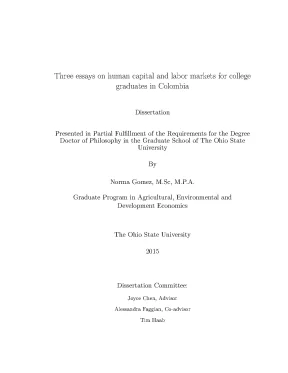
Tải xuống để đọc toàn bộThree essays on human capital and labor markets for college graduates in Colombia Dissertation Presented in Partial Fulfillment of the Requirements for the Degree Doctor of Philosophy in the Graduate School of The Ohio State University By Norma Gomez, M. Graduate Program in Agricultural, Environmental and Development Economics The Ohio State University 2015 Dissertation Committee: Joyce Chen, Advisor Alessandra Faggian, Co-advisor Tim Haab c Copyright by Norma Gomez 2015 Abstract This research analyzes the relationship among human capital accumulation, return to education, and migration, for university graduates in Colombia. Taking advantage of newly available data on the graduate tests scores administered at the end of high school and at the end of college, information on labor market outcomes, and location; I use different models to study how much human capital is accumulated during college, how this capital is rewarded in the labor market, and how these incentives lead to reallocation of human capital across regions in Colombia by analyzing migration decisions. The first chapter is based on the uniqueness of the national tests scores in Colombia where the same students take standardized test both at the end of high school and at the end of college.
I use these scores to estimate the value added of college education by university and then aggregate it by region using an Average Residual model. I define 10 regions in the country and rank universities according to value added, presenting rankings by region. I find that public universities outperform private ones in terms of value added, for the regions on the top 5. These results suggest that public universities generate higher value added compared to private universities, also that universities in the regions where the main cities are located outperform universities in second-tier cities.
This regional disparity is relevant, since the development process ii in these smaller cities might benefit from generating higher value for their graduates, which could stay in the region, innovate, and attract physical and human capital. The second chapter estimates returns to college education in Colombia. Using data for wages of college graduates, as well as information on standardized test scores, and university where they graduated from, I estimate a Mincer equation type model to obtain the return of education, and I look at the hierarchical structure of this return by using a multilevel model. I obtain heterogeneous estimates of returns for college education in Colombia, and prove that accounting for this heterogeneity matters.
I find that the wage premium for graduating from top-ranked universities is around 12%, while the penalty for graduating from bottom-ranked universities is close to 10%, higher than the estimated wage gap (8%). The magnitude of the coefficients suggests that the importance of that heterogeneity is comparable to the gender issue in wage gap, although it has received significantly less attention in the literature. The third chapter uses data from different ministries in Colombia to follow college graduates since they are in high school, when they go to college and once they join the labor market. I focus on the differences between the probability of migration of repeat and return migrants, and a combination of both groups.
I estimate separate logistic regression models for the repeat migrants, the return migrants, and both groups combined, and I present results that suggest that there are significant differences between the repeat and return migrants, therefore, taking into account the destination of the worker leads to different conclusions. This suggests that previous studies on internal migration in Colombia might be biased. Furthermore, having an additional iii wave of migration -from high school to college- adds valuable information to the migration analysis. iv Acknowledgments During the last four years I have received support and encouragement from a great number of individuals.
Alessandra Faggian has been a mentor, and excellent advisor, and over the years has become a dear friend. Her guidance has made this a fulfilling journey. Joyce Chen provided her support not only as advisor, but as instructor. I have learned a great deal from her classes, and from watching her teach.
I would like to thank Dr. Tim Haab for his support over the past two years as an idea became a completed manuscript. In addition, thanks to Jenny Gnagey, who patiently went over previous drafts of this manuscript and provided valuable comments. I also acknowledge the support from the Colombian Institute for the Evaluation of Higher Education ICFES, which provided funding for one of these chapters, but also considerable technical support.
I would like to express my deepest gratitude to my fellow classmates and friends, from whom I learned so much, but also, who have made being away from my country, my family, and my husband, much more bearable. Finally, thanks to my mom and family who cared for me at every step, despite the distance. Thanks to Norman, my loving husband who stood by me in the darkest hours, and to my baby, Gabriela, who was my best companion while finishing this dissertation. Economics, Universidad Nacional de Colombia 2011.
Master in Public Administration M., Columbia University Awarded a Scholarship from Bank of Japan/World Bank Graduate Scholarship Program 2014. in Agricultural, Environmental and Development Economics, The Ohio State University Publications Books Economı́a Matemática en Matlab (2008) (Mathematical Economics in Matlab). With Norman Maldonado, Eduardo Sánchez and Lida Quintero. ISBN 978-958-719-110-3 Book Chapter Strategic Asset Allocation: Balancing Short Term Liquidity Needs and Real Capital Preservation for Central Banks.
With Javier Bonza and Reinaldo Pabón. Edited by: Arjan B. Berkelaar, Joachim Coche and Ken Nyholm, in: Central Bank Reserves and Sovereign Wealth Management. ISBN-13 978-0230580893 Fields of Study Major Field: Agricultural, Environmental and Development Economics Specialization: Labor Economics, Economics of Education, Regional Economics vi Contents Page Abstract.
vi List of Tables. ix List of Figures .6 Analysis of an extended dataset. 79 viii List of Tables Table Page 1.1 Descriptive Statistics for Application 2011-2 .2 Universities by Geographical Location .3 Universities by Type .4 Average Residuals all universities .5 Average Residuals: Public universities .6 Average Residuals: Private universities .1 Fields of Study .2 Estimates of multilevel model .3 Estimates for returns of college education .1 Definition of Variables .2 Migration type of Colombian graduates .3 Migration type by gender .4 Descriptive Statistics of the individual and university .5 Descriptive Statistics of the location .6 Results from the logistic regression .7 Results from the logistic regression - Controls .8 AME from the logistic regression. 70 x List of Figures Figure Page 1.1 Regions defined for the analysis .2 Value added: All universities .3 Value added in 2008: All universities .4 Value added in 2009-1: All universities .5 Value added in 2009-2: All universities .6 Value added in 2011-1: All universities .7 Value added in 2011-2: All universities .1 Cumulative distribution of βj (individuals) .2 Cumulative distribution of βj (universities) .1 Location of universities in the sample .2 Number of graduates per 1,000 inhabitants, per departamento .3 Graduates per 1,000 inhabitants, by departamento in 2011 .4 Number of graduates in the sample by location.
65 xi Chapter 1: Value Added in College Education: A Regional Approach 1.1 Introduction The development of indexes to measure the quality of higher education institu- tions (HEI from now on) is essential to improve a national education system and ultimately a national economy. Standardized student tests have been widely used as a tool to assess education quality. However, in most countries these tests are usually administered only before the students enter college and not later on. Colombia is an exception in this respect, and as far as I am aware, it is the only country in the world that requires students to take two standardized national tests: one, SABER 11, at the end of high school, and another one, SABER PRO, at the end of their tertiary education.
The Instituto Colombiano para la Evaluación de la Educación Superior (ICFES) collects data on students’ performance in both exams. Taking advantage of this peculiarity of the Colombian education system, in this chapter I use an Average Residual model to measure university and region value added based on the SABER 11 and SABER PRO tests scores. I also look at how, and if, a university location affects its value added. 1 There might be differences in value added in different regions or in different ge- ographical contexts (e.
The geographical variation in the HEIs value added offers new insight into the regional differences in educational outcomes in Colombia and sheds some light on why these differences exist. Although there is large heterogeneity in educational outcomes among the different regions in Colombia, this issue still remains rather under-explored. I produce a regional value added ranking which could be used to design education policy, but could also be linked in the future to other relevant variables, such as regional innovation or growth. Test scores represent a useful measure of the human capital individuals accumulate during college, and they are a practical method to assess the contribution of different universities in the economy of a country.
The performance measure developed in Colombia is unique in the world and has been implemented only recently, which means that the information collected from these tests can be a tool to design policies to increase the quality of HEI and to enhance the matching between local labor supply and demand, since SABER PRO could be used as a signal of student quality for employers in the country. The chapter is organized as follows.2 introduces the theoretical frame- work.3 describes the data, while section 1.4 presents the methodology used. The results are discussed in section 1.5 and the analysis of an extended dataset are presented in section 1.2 Theoretical framework Government spending in education is central to increasing the economic perfor- mance of a country. While the costs of education are clear and tangible even in the 2 short run (in terms of direct costs, but also opportunity costs as foregone income from labor), the returns to education are more difficult to quantify because they often take a longer time to become visible and because of the positive externalities, at the indi- vidual and local level, associated with more years of education, such as reduction in crime.
There is also an increasing interest in designing clear mechanisms to assess the return to the investment in education measured as performance of schools and HEI. Among the models to measure school quality and economic returns to education, the production function or input-output approach has been widely used. The model assumes that the student receives multiple inputs from her home and school which produce cognitive achievement (Todd and Wolpin 2003). Value Added Models (VAM) are a set of statistical models based on the production function approach, they use test score data to measure student achievement, and estimate the effect of school or teachers on student performance (McCaffrey et al.
It starts from the production function approach where the value that college education adds to students depends also on the skills they have previously acquired, in particular VAM assume that a lagged test score provides information for historical inputs that the student previously received, innate endowment or other unobservables (Todd and Wolpin 2003). The interest on the input-output approach to generate policy results in schools in the United States was initially motivated by the Equality and Educational Op- portunity (the “Coleman Report”) in 1996, where school effects were examined in a large sample of students from the US Department of Education. The findings of the report challenged the effect of teachers and schools on performance and highlighted 3 the correlation between family inputs and achievement (Rivkin, Hanushek, and Kain 2005, p. VAM have proven to be useful for providing an answer to whether the perfor- mance of a teacher affects cognitive achievement of a student or a class; since VAM incorporate student inputs that teachers and schools cannot influence, they control for these unobserved factors and offer a more precise measure of the impact of teachers or schools on student achievement.
Nội dung được bảo vệ bản quyền — Tải xuống đầy đủ
Trích dẫn luận án này
Norma Gomez (2015). Nghiên cứu tài nguyên con người và thị trường lao động tại Colombia [Luận án tiến sĩ, The Ohio State University]. LuanAn.net. https://luanan.net/quan-tri-kinh-doanh/nghien-cuu-tai-nguyen-con-nguoi-thi-truong-lao-dong-tai-colombia
Câu hỏi thường gặp
Luận án "Nghiên cứu tài nguyên con người và thị trường lao động tại Colombia" nghiên cứu về vấn đề gì?
Khám phá tài nguyên nhân lực & thị trường lao động Colombia. Phân tích xu hướng, thách thức & cơ hội phát triển nguồn nhân lực toàn diện.
Luận án "Nghiên cứu tài nguyên con người và thị trường lao động tại Colombia" được bảo vệ tại trường nào?
Luận án này được bảo vệ tại The Ohio State University. Năm bảo vệ: 2015.
Luận án "Nghiên cứu tài nguyên con người và thị trường lao động tại Colombia" thuộc chuyên ngành gì?
Luận án "Nghiên cứu tài nguyên con người và thị trường lao động tại Colombia" thuộc chuyên ngành Agricultural, Environmental and Development Economics. Danh mục: Quản Trị Kinh Doanh.
Luận án "Nghiên cứu tài nguyên con người và thị trường lao động tại Colombia" có bao nhiêu trang?
Luận án "Nghiên cứu tài nguyên con người và thị trường lao động tại Colombia" có 91 trang. Bạn có thể xem trước một phần tài liệu ngay trên trang web trước khi tải về.
Cách tải luận án "Nghiên cứu tài nguyên con người và thị trường lao động tại Colombia" về máy như thế nào?
Để tải luận án về máy, bạn nhấn nút "Tải xuống ngay" trên trang này, sau đó hoàn tất thanh toán phí lưu trữ. File sẽ được tải xuống ngay sau khi thanh toán thành công. Hỗ trợ qua Zalo: 0559 297 239.