The ability contract full dissertation
"Phân tích và cải tiến hiệu suất của các mô hình machine learning trong xử lý ngôn ngữ tự nhiên thông qua các phương pháp mới và ứng dụng thực tế."
Women’s, Gender and Sexuality Studies
Luan An
Luận án tiến sĩ
Năm xuất bản
Số trang
296
Thời gian đọc
45 phút
Lượt xem
0
Lượt tải
0
Phí lưu trữ
50 Point
Tổng quan nhanh
- Chủ đề:
- 1. Ability Contract Theory: Women, HIV, and Social Norms
- Số trang:
- 296 trang
- Trường:
- The Ohio State University
- Chuyên ngành:
- Women’s, Gender and Sexuality Studies
- Tác giả:
- Allyson Lesley Day
- Năm:
- 2014
Tóm tắt nội dung luận án
I. Ability Contract Theory Women HIV and Social Norms
This dissertation introduces the "ability contract" framework. It explores how women living with HIV navigate societal expectations. The theory posits ability is a triad of labor, utility, and predictability. This framework is crucial for understanding the liberal citizen-subject. Work by John Locke, Carol Pateman, Charles Mills, and Shannon Winnubst informs this theory. The ability contract defines expected roles. Individuals are often assessed for their perceived capability. These assessments can implicitly influence views on legal capacity. A person's perceived ability to contribute shapes their social standing. This theoretical lens applies to understanding complex identities. It considers how chronic conditions challenge societal norms.
1.1. Defining the Ability Contract Framework for Citizens
The ability contract is a core concept. It describes how society values labor, utility, and predictability. These values define a "normal" citizen. For women living with HIV, these expectations create significant pressures. They must constantly negotiate their perceived value and function. Societal norms often assume a baseline contractual capacity for adults. This capacity is linked to steady labor and predictable output. The dissertation examines how these assumptions impact individuals with episodic illnesses. It highlights how an individual's perceived reliability affects their social and economic integration. This theoretical foundation helps to unpack the subtle forms of exclusion experienced by marginalized groups.
1.2. Theorizing Lived Experiences with Invisible Episodic Illness
The project applies the ability contract to women with HIV. It draws from experiences with what the author terms "invisible episodic illness." This category includes conditions like lupus, early stage MS, and chronic depression. These illnesses challenge conventional notions of consistent mental capacity. They involve fluctuating symptoms. Such conditions make stable labor and predictable utility difficult. The study investigates the daily negotiations involved. Women manage family, work, and the medical system. Their experiences reveal a constant tension. They balance perceived ability with actual health challenges. This negotiation subtly touches upon societal expectations regarding legal capacity. The legal system often assumes consistent cognitive function. Episodic conditions challenge this assumption, creating unique dilemmas for individuals.
II. Disability Identity Future Labor Key Research Findings
Research reveals critical insights into identity and work. Women with HIV resist identifying as disabled. This occurs despite many accessing disability resources. Their identity links strongly to future work potential. The prediction of becoming a wage-earner is central. This outlook shapes their dis/identification with disability status. The study found this connection paramount. It poses questions about labor and disability. Intersections of gender, race, class, and medical citizenship are explored. These findings highlight a tension. People perceive their ability differently from formal classifications. This can influence views on incapacity to contract in various social settings. Resistance to a disability label is a coping mechanism. It protects self-perception in a society that often devalues those with limited work capacity.
2.1. Resistance to Disability Identification Explored in Depth
Participants consistently rejected a disability identification. This was true even when utilizing disability support services. The resistance stems from societal stigma associated with disability. Identifying as disabled can mean a loss of perceived legal capacity in some contexts. It can impact social acceptance and future opportunities. The study highlights this paradox. Individuals access needed resources. Yet, they avoid the label. This phenomenon illustrates the power of social constructs around ability. It shows how the stigma of incapacity to contract or participate fully in society can be profound. The women sought to maintain an identity of competence and future potential. This resistance is a form of self-preservation against negative stereotypes.
2.2. The Primacy of Future Labor Predictions in Identity
Identity formation closely tied to future labor. Participants connected their self-worth to predicted wage-earning ability. This future-oriented perspective overshadowed current employment status. It became a primary driver for their dis/identification with disability. Society often equates productivity with legal capacity. The ability to earn wages signifies independence. This strong link raises questions. How do fluctuating health conditions affect long-term planning? How does this future focus influence present decisions? For example, it might affect willingness to seek legal recognition of incapacity to contract for specific tasks. The study uncovers this powerful psychological driver. It demonstrates the profound impact of labor expectations on individual identity and societal belonging.
III. Negotiating Capacity Ideological Affective Material Factors
Negotiations for women with HIV involve multiple dimensions. These dimensions are ideological, affective, and material. Ideological factors shape perceptions of ability. Affective factors involve emotional management. Material factors relate to practical realities. The dissertation examines these layers. It shows how women navigate a complex social landscape. This navigation often impacts their perceived legal capacity. Understanding these layers offers a holistic view. It reveals how ability is not a static state. Instead, it is continuously constructed and contested. Such continuous negotiation influences access to resources. It also affects interactions with institutions. These interactions may involve implicit assessments of contractual capacity or vulnerability.
3.1. Ideological Underpinnings Shaping Ability Perceptions
Ideology plays a crucial role in defining ability. Societal beliefs about productivity and independence are powerful. These beliefs dictate who is considered 'able' or 'disabled.' They influence how individuals with chronic illness are perceived. Such ideological frameworks can subtly affect judgments of mental capacity. They can also impact assessments of contractual capacity. People internalize these norms. They may feel pressure to conform to an 'abled' ideal. This pressure can lead to self-censorship. It can also cause reluctance to seek accommodations. The study argues against these rigid ideological constructs. It promotes a more fluid understanding of ability. This understanding acknowledges diverse forms of contribution and value beyond strict labor definitions.
3.2. Affective Dimensions of Living with Episodic Conditions
The affective aspects are significant. Women living with HIV manage complex emotions. These include fear, hope, resilience, and frustration. These emotional negotiations are central to their experience. They impact how individuals present themselves. They also affect how others perceive their mental capacity. Chronic pain or fatigue can affect concentration. This impacts emotional regulation. While not strictly mental illness and contract law issues, these states can create vulnerabilities. These vulnerabilities might be exploited, leading to situations of undue influence. Understanding these affective states is crucial. It helps to contextualize decision-making. It highlights the importance of emotional support systems.
3.3. Material Negotiations with Healthcare and Employment Systems
Material negotiations are practical and systemic. Women interact with the medical industrial complex. They also navigate family responsibilities and labor markets. These interactions often involve bureaucratic processes. They require proving eligibility for benefits. They necessitate advocating for accommodations. These material realities challenge traditional notions of legal capacity. They expose individuals to potential duress or subtle coercion. The systems are not always designed for fluctuating health needs. They often demand consistent performance. This pressure can create situations where an individual's incapacity to contract or to fully participate is overlooked. The study reveals the daily grind of managing these material constraints.
IV. Beyond Narrative Fetishization Medical Industrial Critique
The dissertation critically examines narrative medicine. It challenges the "fetishization of narrative" within the medical industrial complex. While narratives are valuable, their use can be problematic. They can simplify complex experiences. They might focus on individual stories without systemic critique. The research analyzes life narratives of women with HIV. This includes both group participants' stories and published accounts. It also scrutinizes the reading group's reception to these narratives. This multi-layered analysis uncovers limitations. It highlights where narrative use falls short. It emphasizes a need for systemic change. The critique argues against a superficial engagement with patient stories. It seeks deeper, structural understanding of ability and mental capacity within healthcare systems.
4.1. Analyzing Diverse Life Narratives of Women with HIV
The study analyzes personal narratives. These include stories from reading group participants. It also reviews published memoirs by women with invisible episodic illnesses. These narratives offer rich insights. They detail the daily struggles and triumphs. They reveal how individuals manage their health, work, and social lives. The stories illuminate challenges to consistent mental capacity. For instance, fatigue or brain fog affects cognitive function. These lived accounts provide critical data. They show how abstract concepts like the "ability contract" manifest. The analysis goes beyond simple retelling. It interprets these narratives within a broader theoretical framework. This ensures a deeper sociological understanding. It avoids merely consuming personal tragedy.
4.2. Critiquing the Medical Industrial Complex s Narrative Use
The dissertation issues a strong critique. It targets the medical industrial complex's use of narrative. Often, patient stories are co-opted or simplified. They serve institutional agendas. This can lead to a "fetishization of narrative." It reduces complex experiences to marketable stories. This process often overlooks systemic failures. It also fails to address issues of legal capacity or incapacity to contract within healthcare settings. The critique advocates for caution. It urges a move beyond superficial empathy. Instead, it calls for genuine structural change. This involves recognizing the full humanity and agency of patients. It means respecting their contractual capacity and autonomy, even amidst illness. The research pushes for a more ethical engagement with personal narratives.
V. Lived Experience Informing Legal Contractual Capacity
The study's findings directly inform discussions on legal capacity. Experiences of women with HIV challenge static legal definitions. Concepts like legal capacity and contractual capacity often assume consistent states of mind. However, episodic illnesses introduce fluctuations. This dissertation offers a nuanced perspective. It highlights the gap between lived reality and legal frameworks. It suggests that contemporary contract law needs reconsideration. This applies particularly when assessing an individual's ability to make decisions. The work provides a foundation for advocacy. It supports a legal approach that acknowledges dynamic human abilities. It moves beyond simplistic binary classifications of 'able' or 'disabled.' This research promotes a more equitable system. It better reflects the complex nature of human health and agency.
5.1. Rethinking Mental Contractual Capacity Through Illness
Chronic, episodic illness compels a reevaluation of mental capacity. Legal systems typically assume a stable cognitive state for valid contracts. This dissertation demonstrates how fluctuating health challenges this assumption. Conditions like HIV can impact cognitive function intermittently. This affects an individual's contractual capacity at different times. It raises questions about informed consent. It also questions the ability to understand complex legal agreements. The research highlights the need for flexible legal interpretations. It argues against rigid assessments of incapacity to contract. Instead, it advocates for an understanding that accounts for a spectrum of cognitive states. This perspective is crucial for ensuring justice and protecting vulnerable populations. It aligns legal frameworks with human variability.
5.2. Implications for Voidable Contracts Vulnerability
The study's insights have direct implications for contract law. The negotiations faced by women with HIV expose vulnerabilities. These vulnerabilities can lead to situations where contracts might be voidable contracts. Factors like social pressure, economic precarity, or fluctuating health states can mimic undue influence or duress. While not always legally actionable, these dynamics are significant. They demonstrate how external pressures impact genuine assent. The research suggests that a broader understanding of vulnerability is needed. This includes recognizing how systemic issues, not just overt coercion, can compromise legal capacity. This understanding can inform policies. It can better protect individuals who navigate complex health and social challenges. It enhances fairness in contractual agreements. This perspective is vital for a more compassionate legal system.
Tải xuống file đầy đủ để xem toàn bộ nội dung
Tải đầy đủ (296 trang)Trích đoạn nội dung luận án
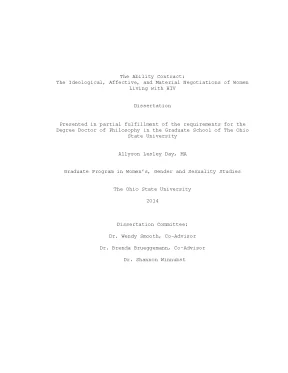
Tải xuống để đọc toàn bộThe Ability Contract: The Ideological, Affective, and Material Negotiations of Women Living with HIV Dissertation Presented in partial fulfillment of the requirements for the Degree Doctor of Philosophy in the Graduate School of The Ohio State University Allyson Lesley Day, MA Graduate Program in Women’s, Gender and Sexuality Studies The Ohio State University 2014 Dissertation Committee: Dr. Wendy Smooth, Co-Advisor Dr. Brenda Brueggemann, Co-Advisor Dr. Shannon Winnubst Copyright by Allyson Lesley Day 2014 Abstract This dissertation project theorizes the ability contract as a means for understanding the experience of women living with HIV in the United States.
I understand the ability contract as the triad of labor-utility-predictability that is central to the construction of the liberal citizen-subject, extending the work of John Locke, Carol Pateman, Charles Mills and Shannon Winnubst. The theory of this project is rooted in my original field research; during the 2012-2013 academic year, I spent six months facilitating a reading group for women living with HIV. Together, we read popular memoirs written by women with what I have termed invisible episodic illness, such as lupus, early stage m., chronic depression and HIV. Participants in the reading group used these books as a catalyst for discussing their daily negotiations of labor, family and the medical industrial complex in relation to disability identity.
I also conducted one-on-one preliminary and follow-up interviews. What I found was that my research participants all resisted a disability identification, despite many of them accessing disability resources. They also all closely connected their identity not to their current employment conditions, but to their prediction of how they will ii be able to work in the future. This prediction of becoming a wage-earner was the primary reason for their dis/identification with disability.
What explains this close connection of disability with future labor? And what is the relationship between labor and disability at the intersection of gender, race, class, and (medical) citizenship? In order to address these questions, I developed a three-tier reading group research method; in my dissertation, I analyze life narratives of women living with HIV, both the narratives of the women in my group and published narratives; I also analyze the reading group reception to those life narratives; finally, I re-read social contract theory alongside American multiracial feminisms, disability theory, autobiographical theory, and affect theory to understand the Ability Contract as affective, material and ideological; this interpretation leads me to an analysis of narrative medicine, where I argue against the fetishization of narrative within the medical industrial complex. iii For Catherine iv Acknowledgments My gratitude to my Dream Team; in particular, Brenda Brueggemann, who has been with this project since its inception in my first Disability Studies course and whose enthusiasm for this project and for the field of Disability Studies has inspired not just this work but an entirely transformative way of looking at the world; Wendy Smooth, whose insistence on tangible social justice work and critical intersectionality has left me questioning my questions, providing deep guidance that will no doubt sustain a future career worth of deep holes; and finally, Shannon Winnubst, who took a risk on a wayward graduate student and asked the tough questions of evidence and scope. Thank you! Special thanks to the Elizabeth D. Gee Grant Committee and Arts and Humanities Graduate Grant Committee for financially supporting this project.
I also want to thank those who have been informal mentors and intellectually generous throughout my career at Ohio State, including: Cricket Keating, Kimberly Springer, Guisela Latorre, Jenny Suchland, Judy Wu, Kimberly Springer, Linda Bernhard, Lynn Itagaki, Mytheli Sreenivas, and Rebecca Wanzo. Thanks to my colleagues and peers, including Amanda Rossie, Andrea Guilino, Brena Yu-Chen Tai, Dawn Miles, Deema Kaedbey, Haley Swenson, Judy Rodriguez, Julia Istomina, Justin Acome, Lindsay Bernhagen, Lois v Kwa, Meredith Lee and Stacia Kock. Thanks, too, for a killer WGSS administrative team: Andy Cavins, Lexie Beer, Lynaya Elliot, and Tess Pugsley. Thanks to the Society for Disability Studies community, especially those colleagues and mentors who have taken the time to sit with this project: Aimi Hamraie, Allison Kafer, Kate Caldwell, and Sami Schalk.
I look forward to many more projects! Beyond thanks to the community that saw this project in its earliest phases at Simmons College: Prof Beck Thompson, Prof Jyoti Puri and Prof. And to my radical, pitcher- sharing feminist collective when we were all first reading Foucault together as MA students: Brenda Sanya, Candace Cheatham, Elizabeth Lehr, Gwen Warman, Jess Guerrero, Meiver De La Cruz, and Shana Russell. And finally, for Catherine Harrington, who shared the pitchers, the poverty, and the celebrations. This project is as much yours.
vi Vita 2005……………………………………………………BFA Creative Writing/BA Political Science The University of Maine at Farmington 2009……………………………………………………MA Gender and Cultural Studies Simmons College, Boston, MA PUBLICATIONS “Emobodied Triumph and Political Mobilization: Reading Marvelyn Brown’s The Naked Truth: Young, Beautiful and (HIV) Positive” in a/b: Journal of Autobiography, 28. Emily Hipchen and Ricia Chansky, Chapel Hill, NC. “Toward a Feminist Reading of the Disability Memoir: The Critical Necessity for Intertextuality in Marya Hornbacher’s Wasted and Madness” in Disability Studies Quarterly,31:2. Brenda Brueggeman and Scot Danforth.
FIELDS OF STUDY Major Field: Women’s, Gender and Sexuality Studies vii TABLE OF CONTENTS Abstract……………………………………………………………………………………………………………………………………………ii Dedication…………………………………………………………………………………………………………………………………………iv Acknowledgements…………………………………………………………………………………………………………………………v Vita…………………………………………………………………………………………………………………………………………………………vii Introduction: Illuminating Parameters and Politicizing Feminist Disability Methodology……………………………………………………………………………………………………………1 Chapter 1: Consciousness and Differential Identification: Introducing the Ability Contract…………………………………………………………………………………16 Chapter 2: The Ability Contract as Ideological: The Circulation of Autobiography and Subjectivity……………………………………52 Chapter 3: The Ability Contract as Affective: Women, Reproductive Labor and Early HIV Narrative……………………………………93 Chapter 4: The Ability Contract as Material: Women’s Negotiations of Labor, HIV and Disability Identity…………149 Chapter 5: Negotiating the Labor of Writing…………………………………………185 Chapter 6: Narrative Medicine, The Ability Contract, and the Fetishization of Narrative within the Medical Industrial Complex………………………………………………………………………………………………………………………………….……………222 Conclusions: Neoliberalism, the Hermeneutics of HIV, and The Future of the Ability Contract…………………………………………………………………………258 References…………………………………………………………………………………………………………………………………………267 Appendix A: Initial Open-Ended Interview Script and Demographic Questionnaire…………………………………………………………………………………………………………………………………281 Appendix B: Booklist…………………………………………………………………………………………….………………284 Appendix C: Reading Group Questions and Follow-Up Interview……………………………………………………………………………………………………………………………………………286 viii Introduction: Illuminating Parameters and Politicizing Feminist Disability Methodology The Beginning It is possible that this project really began when I was a 19-year old poet, taking my first creative nonfiction class and becoming enraptured by life writing. While I did complete my BFA in creative writing, I was never totally sold on understanding nonfiction (or any literature) from a strictly formalist context- my women’s studies and political science classes gave me more tools for interrogating how literature can be mobilized for social justice. In many ways, this project began when I first read Audre Lorde’s The Cancer Journals, an origin story that I share with many feminist projects about illness and disability. As a white working class lesbian hospitalized for bulimia nervosa, I was consistently being given scripts for my illness (I was nieve and taking media’s misogyny too far, I hated myself and needed men to love me, my mother was too controlling, I was just an out of control addict) that did not seem to fit my reality.
My hospitalization came after a few emergency room visits that indicated cardiac abnormalities and severe internal bleeding of 1 my esophagus and stomach. At the time of my first admission, the director of the program told me that my esophageal bleeding was encroaching on my aorta artery and that another purge could kill me. Every eating disorder book that I had been devouring was leaving me hungry for reasons that I did not quite understand. All I knew was that the eating disorder narrative that I had learned to perform in order to access treatment could not be reconciled with my actual, lived experience.
My experience with bulimia as a white, working class lesbian was not understood within the eating disorder treatment framework. The narrative I was given was a narrative of privilege that I, simply, do not have nor understand. It was Lorde who first spoke to me about this schism between actual lived disease experience and the narrative we are taught by medical professionals and the hegemonic white, middle and upper class society as a whole. Lorde taught me about the importance of life narrative in disability.
Ultimately, my mental illness (which as taken various DSM diagnosis over the years) caused several long-term physical impairments, a connection that brought me to the young field of Feminist Disability Studies. During my MA work, following my own exploration of life writing with my BFA portfolio, I began an excavation of Lorde’s The Cancer Journals, finding theories of the collective body 2 established by other black feminist writers thinking about Cancer, writers like Toni Cade Bambara. In tracing a geneology of these ideas, I discovered, through the writing and advocacy of Essex Hemphill and Cheryl Clarke, a connection between understandings of cancer and HIV. The combination of queer theory and black feminist thought provided me with the deep theoretical tools for excavating these connections but it also left me hungry to reach beyond the page, to understand the experience of women who do not have the material and intellectual privilege to publish their work.
When I began my PhD Program, I began to knit connections between mental illness and chronic illness like HIV or lupus, seeing them as sharing a messy corner of feminist disability studies, one with permeable boundaries and incongruous edges that I have come to label invisible episodic conditions. I had grand ideas about painting this corner with broad strokes, writing a comparative and exhaustive project about all invisible episodic conditions and yet, I kept coming back to HIV. The literature on women and HIV was growing the works of Michelle Berger and Patti Lather being particularly influential, but no one was discussing women and HIV within disability studies or the feminist health movement. I began volunteering at the local AIDS Service Organization, while I read broadly and taught women’s health courses.
My students, quarter after quarter, continued to 3 surprise me with their interest in women and HIV and my own collection of teachable source material only reinforced that gaps in feminist scholarship. It began to seem as if my project as choosing me. Working with people living with HIV has also given me the opportunity to work with people that I have always understood as a part of my chosen family, the mentors that took me in when my father, a conservative evangelical minister, refused to support me after I came out. HIV is not my illness and yet, HIV is very much mine.
HIV has co-constructed a radical queer community that gave me my tools for recovery and, quite literally, saved my life. The Methodology Once I decided to focus my work on women living with HIV, I kept asking about identity and how women with HIV identify—is HIV a part of their identity, the way it was claimed by some queer activists in the 1980’s and 1990’s? Is disability a part of these women’s identities? Is there space for coalition-building between women with HIV and women with other recognized disabilities? Do they share experiences? Does how one identifies affect what services one accesses? Does a woman living with HIV need to understand herself as part of a disability community in order to access disability resources? Because I am asking directly about identity in my project, I realized very early on (and this is 4 actually what was so exciting to me) that I would need to really develop a research model that could address questions of identity that are not just one-time, yes or no questions. I knew, from the outset, that identity is a lot more complicated than that.
Nội dung được bảo vệ bản quyền — Tải xuống đầy đủ
Trích dẫn luận án này
Allyson Lesley Day (2014). The ability contract full dissertation [Luận án tiến sĩ, The Ohio State University]. LuanAn.net. https://luanan.net/ly-luan-va-lich-su-giao-duc/triet-hoc-giao-duc/the-ability-contract-full-dissertation
Câu hỏi thường gặp
Luận án "The ability contract full dissertation" nghiên cứu về vấn đề gì?
"Phân tích và cải tiến hiệu suất của các mô hình machine learning trong xử lý ngôn ngữ tự nhiên thông qua các phương pháp mới và ứng dụng thực tế."
Luận án "The ability contract full dissertation" được bảo vệ tại trường nào?
Luận án này được bảo vệ tại The Ohio State University. Năm bảo vệ: 2014.
Luận án "The ability contract full dissertation" thuộc chuyên ngành gì?
Luận án "The ability contract full dissertation" thuộc chuyên ngành Women’s, Gender and Sexuality Studies. Danh mục: Triết Học Giáo Dục.
Luận án "The ability contract full dissertation" có bao nhiêu trang?
Luận án "The ability contract full dissertation" có 296 trang. Bạn có thể xem trước một phần tài liệu ngay trên trang web trước khi tải về.
Cách tải luận án "The ability contract full dissertation" về máy như thế nào?
Để tải luận án về máy, bạn nhấn nút "Tải xuống ngay" trên trang này, sau đó hoàn tất thanh toán phí lưu trữ. File sẽ được tải xuống ngay sau khi thanh toán thành công. Hỗ trợ qua Zalo: 0559 297 239.