Soltz wendy unheard voices and unseen fights
Khám phá "Unheard Voices and Unseen Fights" của Soltz Wendy. Tiếng nói thầm lặng, cuộc chiến không thấy. Hé lộ những câu chuyện chưa từng được kể.
Năm xuất bản
Số trang
297
Thời gian đọc
45 phút
Lượt xem
0
Lượt tải
0
Phí lưu trữ
50 Point
Tổng quan nhanh
- Chủ đề:
- Wendy Soltz Unveils Hidden Struggles for Social Justice
- Số trang:
- 297 trang
- Trường:
- The Ohio State University
- Chuyên ngành:
- History
- Tác giả:
- Wendy Fergusson Soltz
- Năm:
- 2016
Tóm tắt nội dung luận án
I.Wendy Soltz Unveils Hidden Struggles for Social Justice
The dissertation by Wendy Fergusson Soltz redefines understanding of Jewish involvement in Southern civil rights. Traditional narratives often simplify Jewish engagement, suggesting an alliance with African Americans based on common oppression. These tropes also claim Southern Jews remained silent on civil rights issues, fearing antisemitic repercussions. Soltz's extensive archival research systematically challenges these long-held beliefs. The work reveals a far more intricate landscape of Jewish activity. Southern Jews actively promoted higher education for African Americans, demonstrating a profound commitment to social justice. This advocacy, however, manifested differently than commonly perceived. The study meticulously uncovers these hidden struggles and the nuanced ways Southern Jews participated. It highlights the importance of re-examining historical records. This re-evaluation provides a deeper, more accurate depiction of a pivotal era. The research by Wendy Soltz offers invaluable insights into marginalized voices and their contributions to societal change.
1.1. Debunking Myths Jewish Engagement in Civil Rights
Common historical accounts often misrepresent Jewish involvement in the civil rights movement. Myths persist about a unified alliance between Jews and African Americans. Other narratives suggest Southern Jews avoided activism due to fear of antisemitism. This dissertation provides critical counter-evidence. Scholarly work is built upon rigorous archival research. The findings overturn these simplistic portrayals. Jewish individuals in the South were not passive observers. Their actions demonstrated a clear, albeit complex, commitment to civil rights. This commitment focused particularly on educational advancement for African Americans.
1.2. Southern Jews Unorganized Advocacy for African Americans
Southern Jews engaged in civil rights advocacy in distinct ways. Their efforts often lacked formal organization. This differed significantly from their Northern coreligionists. College campuses became unique arenas for their involvement. These institutions provided opportunities to support African Americans pursuing higher education. The approach was often individualistic and nuanced. This unorganized nature made their contributions less visible. Yet, their actions were persistent and impactful. The research sheds light on these previously unseen fights for equity.
1.3. Archival Insights Rethinking Historical Narratives
Extensive archival research forms the bedrock of this dissertation. The study draws on a rich collection of historical documents. This primary source material allows for a detailed re-examination of events. New perspectives emerge regarding the roles of Southern Jews. The findings encourage a critical re-evaluation of established historical narratives. They underscore the importance of nuanced interpretation. This methodological rigor ensures a robust and accurate historical account. The work by Wendy Soltz provides an essential framework for future scholarship.
II.Marginalized Voices Jews in Southern Civil Rights
The dissertation illuminates the complex position of Jews involved in Southern civil rights. Their efforts focused on higher education for African Americans. This work occurred within a profoundly segregated society. College campuses, surprisingly, offered a unique liberal atmosphere. This progressive environment stood in stark contrast to the surrounding landscape. The South was riddled with antisemitic, antiforeigner, and anti-Communist sentiments. Jews participating in this struggle faced a dual challenge. They grappled with their own identity, both as Americans and as perceived outsiders. Their position as neither fully white nor Black added another layer of complexity. These marginalized voices navigated a precarious existence. Their commitment to social justice propelled them forward. The study emphasizes the systemic inequality they confronted. This deeply impacted the visibility and immediate success of their contributions. The research provides a crucial lens for understanding hidden struggles against prejudice.
2.1. College Campuses Sites of Liberalism Amidst Bigotry
Southern college campuses served as critical hubs for civil rights activity. They fostered a more liberal environment compared to the broader society. This atmosphere allowed for discussions and actions promoting racial equality. Yet, these campuses were not isolated from prejudice. They existed within a region saturated with antisemitism. Antiforeigner and anti-Communist sentiments were also prevalent. This juxtaposition created a unique and challenging context. It forced Jewish advocates to operate strategically. The campuses represented both opportunity and peril.
2.2. Identity Conflict Jews as Insiders and Outsiders
Jews involved in civil rights in the South confronted significant identity questions. They questioned their belonging as both nonwhite and nonblack individuals. Their American identity was simultaneously affirmed and challenged. Society often viewed them as both insiders and foreigners. This constant negotiation created immense personal and communal strain. It complicated their ability to form alliances. Their unique position highlights the multifaceted nature of marginalized voices. This struggle for identity was central to their experience.
2.3. Systemic Inequality Obstacles to Immediate Success
The deeply entrenched systemic inequality in the South presented immense barriers. Jewish contributions to civil rights were not immediately or obviously successful. The constant negotiation of identity and societal prejudice hindered progress. This environment demanded persistence and resilience. The lack of organized effort also contributed to slower inroads. The dissertation acknowledges these profound obstacles. It demonstrates the enduring nature of hidden struggles against deeply rooted systems. The long-term impact, however, proved significant despite initial setbacks.
III.Systemic Inequality Southern Campuses Jewish Identity
The dissertation profoundly explores the intersection of systemic inequality, Southern college campuses, and Jewish identity. It delves into the specific challenges faced by Jewish individuals advocating for African American higher education. The South of 1910–1964 was a landscape defined by pervasive segregation and deep-seated prejudices. Jewish activists found themselves navigating a complex social terrain. The liberal atmosphere of some college campuses offered a glimmer of hope. However, this was consistently overshadowed by broader societal biases. Antisemitism was a constant threat, alongside widespread antiforeigner and anti-Communist sentiments. These external pressures directly impacted Jewish engagement. They forced individuals to question their very place within American society. The research highlights how these systemic forces shaped the effectiveness and visibility of their work. It provides a detailed account of their hidden struggles. The study underscores the profound impact of societal structures on individual agency.
3.1. Navigating Prejudice Antisemitism and Antiforeigner Sentiments
Jewish advocates operated within a hostile environment. Antisemitic attitudes were prevalent throughout the South. These prejudices were compounded by general antiforeigner sentiments. The region also experienced strong anti-Communist hysteria. Such a climate made public activism precarious. Jewish individuals faced potential backlash for their involvement. This constant threat of reprisal demanded careful navigation. It often compelled them to adopt less overt forms of advocacy. Their resilience in the face of such widespread prejudice is a key theme.
3.2. Complexities of Identity Nonwhite Nonblack and American
The identity of Southern Jews during this period was profoundly complex. They occupied a unique social category, distinct from both white and Black populations. This positioning led to questions of belonging. Were they truly American, or perpetual outsiders? This internal and external negotiation of identity was relentless. It impacted their strategic choices in activism. The struggle to define their place within a segregated society adds nuance. It reveals the multifaceted nature of marginalized voices in historical contexts.
3.3. Hidden Struggles The Challenge of Making Inroads
Jewish contributions to civil rights in the South were often indirect. Their efforts to make significant inroads were hindered by systemic inequality. The constant need to negotiate their identity and navigate prejudice slowed progress. Success was neither immediate nor always apparent. This dissertation uncovers these hidden struggles. It demonstrates the persistent effort required for change. The long-term impact of their work often overshadowed short-term visible gains. This emphasizes the endurance of those committed to social justice.
IV.Advocacy Resilience Unseen Jewish Contributions Examined
This dissertation by Wendy Soltz meticulously examines the advocacy and resilience of Southern Jews. It brings to light their previously unseen contributions to civil rights. The focus remains on their efforts to advance higher education for African Americans. These actions were neither formally organized nor immediately successful. Yet, they represented a profound commitment to social justice. Jewish individuals navigated intense societal pressures, including pervasive antisemitism. Their distinct approach differentiated them from Jewish activists in the North. The study showcases their fortitude in the face of systemic inequality. It redefines the historical understanding of Jewish involvement in the South. This research provides a powerful narrative of determination and enduring impact. The dedication to supporting marginalized voices highlights a critical chapter in American history.
4.1. Promoting Higher Education A Quiet Form of Social Justice
Jewish individuals in the South championed higher education for African Americans. This advocacy was a crucial form of social justice. Education was seen as a path to empowerment and equality. Their efforts often took quiet, less confrontational forms. This strategic choice allowed them to operate within hostile environments. It was a subtle yet powerful challenge to segregation. The commitment to educational access underscores their long-term vision. This approach required immense resilience and foresight.
4.2. Unorganized Efforts Different Approaches in the South
The nature of Jewish involvement in the South was largely unorganized. This contrasted with more structured efforts elsewhere. Southern Jews acted through individual initiatives and local networks. They utilized college campuses as sites for this activism. This decentralized approach made their contributions harder to track. It also made them less susceptible to coordinated opposition. The dissertation highlights the effectiveness of these disparate actions. It demonstrates alternative models of advocacy against systemic inequality.
4.3. Future Impact The Long Term Significance of Early Actions
The immediate success of Jewish contributions was often limited. Constant negotiation and systemic barriers hindered rapid progress. However, the long-term significance of their early actions is undeniable. Their quiet, persistent advocacy laid groundwork for future change. It fostered an environment conducive to educational advancement. This resilience paved the way for greater opportunities. The dissertation emphasizes the lasting legacy of these unseen fights. It underscores how initial struggles can lead to eventual empowerment for marginalized voices.
V.Personal Narratives Challenging Myths Empowering Histories
Wendy Soltz's dissertation "Unheard Voices and Unseen Fights" enriches historical understanding through personal narratives. It effectively challenges long-standing myths about Jewish participation in Southern civil rights. The research empowers a more accurate and nuanced understanding of this period. By meticulously examining archival materials, Soltz brings to light previously overlooked stories. These personal narratives reveal the courage and complexity of individuals. They highlight the intricate dynamics of identity, advocacy, and social change. The work moves beyond simplistic portrayals. It offers a deeper appreciation for the contributions of marginalized voices. This scholarly endeavor provides a vital resource for anyone interested in social justice history. It underscores the power of historical research to reshape collective memory and foster empowerment.
5.1. Soltz s Research Dedication to Uncovering Truth
Wendy Soltz dedicated significant effort to this historical investigation. Her commitment to uncovering truth is evident throughout the dissertation. The research involved extensive travel and meticulous archival work. It required navigating complex historical records. This dedication ensured a comprehensive and accurate account. The scholarly rigor employed provides a strong foundation. It establishes the work as a definitive resource on the subject.
5.2. Scholarly Foundation Building on Previous Work
The dissertation builds upon existing scholarly literature. It synthesizes past research while introducing new perspectives. Soltz acknowledges the contributions of other historians. The work critically engages with previous interpretations. This approach strengthens the overall argument. It situates the new findings within a broader academic context. This scholarly foundation ensures robust and impactful conclusions. It contributes significantly to the field of modern Jewish history.
5.3. Empowering Understanding A Legacy of Academic Rigor
“Unheard Voices and Unseen Fights” fosters a more complete historical understanding. It empowers readers with nuanced insights into complex social dynamics. The work challenges traditional narratives, promoting critical thought. It highlights the importance of recognizing all marginalized voices. The dissertation's academic rigor sets a high standard. It leaves a lasting legacy for future studies. This research ultimately contributes to a richer, more inclusive historical record.
Tải xuống file đầy đủ để xem toàn bộ nội dung
Tải đầy đủ (297 trang)Trích đoạn nội dung luận án
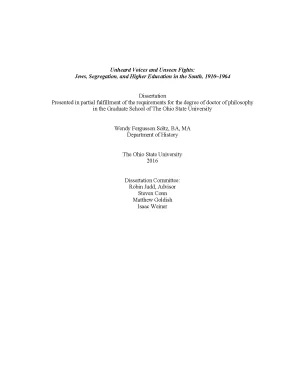
Tải xuống để đọc toàn bộUnheard Voices and Unseen Fights: Jews, Segregation, and Higher Education in the South, 1910–1964 Dissertation Presented in partial fulfillment of the requirements for the degree of doctor of philosophy in the Graduate School of The Ohio State University Wendy Fergusson Soltz, BA, MA Department of History The Ohio State University 2016 Dissertation Committee: Robin Judd, Advisor Steven Conn Matthew Goldish Isaac Weiner Copyright by Wendy Fergusson Soltz 2016 Abstract Jewish involvement in civil rights for African Americans has often been shrouded in myth. Typical tropes declare that Jews built an alliance with African Americans based on a sense of common oppression but that Southern Jews stayed quiet concerning civil rights issues fearing antisemitic repercussion. This dissertation uses archival research and builds on past scholarly work to overturn these tropes and reveal the complex situation of Jews in the South who promoted higher education for African Americans. Jews interested in civil rights between 1910 and 1965 did not formally build an alliance with African Americans, and those who lived in the South were not quiet; however, they operated in different and unorganized ways compared to their coreligionists in the North.
Southern college campuses provided a unique site for Jews to take part in the struggle for enabling African Americans to pursue higher education. By its very nature, the college campus fostered a liberal atmosphere but was surrounded by a landscape riddled with antisemitic, antiforeigner, and anti-Communist sentiments. Jews who chose to take part in this struggle in the South simultaneously questioned their own identity as both nonwhite and nonblack and also American (insider) and foreigner (outsider). This constant negotiation hindered their ability to make inroads, thus Jewish contributions in the South were neither obviously nor immediately successful.
ii Dedication To my grandparents (of blessed memory) who emphasized, and my parents who continually reemphasize, the importance of higher education. iii Acknowledgments Throughout my graduate work, I repeatedly declared that I had the best advisor at Ohio State University and I sincerely meant it. Thank you Robin for your wisdom, patience, guidance, and friendship. Thank you for believing in me more than I believed in myself and putting up with overwhelming amounts of passive voice and unnecessary (but, I still argued, interesting) archival material of which I just could not let go.
Thank you to Matt Goldish and Isaac Weiner at OSU and Steve Conn now at Miami University for serving on my committee and offering advice on the dissertation that follows. I want to thank Mark Bauman, Patrick Potyondy, and Leslie Soltz for reading and providing feedback on this dissertation and to my copy editor, Michael Levine. The 2014 American Jewish Historical Society Biennial Conference participants were also crucial in providing feedback. I am indebted to many archivists for their mental catalogs and guidance during the research phase: Gary Zola, Kevin Proffitt, and Dana Herman at the American Jewish Archives; Jeremy Katz and Mickey Harvey at the Breman Archives in Atlanta; John Bence and Kathleen Shoemaker at Emory University Archives; Kayin Shabazz at Atlanta University Archives; Matt Turi at University of North Carolina Archives; Amy McDonald at Duke University Archives; Kevin Ray and Thomas Land of University of Alabama Archives; and Aisha Johnson at Fisk University Archives.
To my friends: thank iv you Corinne Warrener Catalano for your continued hospitality in Atlanta and Daniel Parmer for your assistance with quantitative analysis. To my interviewees: thank you Fred Leffert, Larry Pike, and Joel Shurkin for speaking with me about your experiences at Emory. It took incredible resources to travel and conduct my research, but first I must express my gratitude to the Melton Center for Jewish Studies at OSU for continued assistance and support of my work. Other funding assistance for this project came from the OSU Department of History, the College of Arts and Sciences at OSU, the OSU Alumni Grant, the Office of Diversity and Inclusion Grant at OSU, the American Academy for Jewish Research grant, and the American Jewish Archives Marcus Center Fellowship.
To my daughter, Eleora Margalit: thank you for conveying to me the urgency to complete this dissertation and to my sisters, Katy, Liz, and Sheryl: thank you for watching her so I could write. Finally, thank you to Micah, my ever-present calm voice of reason and simultaneously my loudest cheerleader.BA, Anthropology, minor in Spanish, Indiana University 2001–2002 .Summer 2003 Graduate Student in Hebrew Program, The Hebrew University of Jerusalem, Israel 2004 .MA, Anthropology and Museum Studies, The George Washington University 2007 .MA, Near Eastern and Judaic Studies and Women and Gender Studies, Brandeis University Fields of Study Major Field: History Primary Field: Modern Jewish History Secondary Fields: Modern US History and Public History vi Table of Contents Abstract .1 Chapter One: “I Regret To Inform You…” Jewish Job Applicants to Fisk University and Atlanta University, 1910-1954 .22 Chapter Two: Just Miles Away but Worlds Apart: Jewish Participation in Integration Programs at Black Mountain College and Highlander Folk School, 1933–1964 .73 Chapter Three: Imagining Jewish Activists and Activism at the University of North Carolina and the University of Alabama, 1945–1964 .125 Chapter Four: Town and Gown: The Complicated Triangle of Desegregation, the Private University, and Jewish-owned Stores and Businesses, 1945–1964 .252 Appendix A: Discussion on Terms .266 vii Introduction “And Jews were involved in that? In the South?” This was the response I received from an historian over coffee one morning when I described my dissertation research. I was accustomed to this response—people typically expressed surprise when I explained that I was writing about Jews who both lived in the South and advocated for higher education for African Americans beginning in 1910. Some individuals were surprised that Jews even lived in the South; others were baffled by their early involvement in civil rights work; and a few shared their knowledge of Julius Rosenwald, the Chicago philanthropist who built thousands of elementary schools for African Americans.
Finally, a number remembered the Freedom Riders from the North: the Jewish activists who travelled south temporarily to combat segregated public transportation in the 1960s. For these individuals and others I spoke to, the history of Jewish involvement in desegregating higher education in the South, by Jews who actually lived in the South, was an unfamiliar topic. There is an important reason why: their actions were largely unknown and many were unsuccessful. This dissertation examines the ways in which Jews were involved in higher education for African Americans in the South from 1910 to 1964.
It traces their engagement at the individual level and uses eight case studies to reveal active and vocal Jews living, studying, and working on campuses in the South. My research confronts three oft-repeated scholarly assumptions about Southern Jews and civil rights activism: 1 first, the idea that Jews and African Americans built a formal alliance; second, the notion that Jewish involvement in civil rights activism was confined to the period from the late 1940s to the early 1960s; and third, the idea that Southern Jews remained silent on civil rights issues because they feared violent antisemitic repercussions. This project complicates these commonly accepted tropes and reveals their inaccuracies. Significance The notion that Jews and African Americans were natural allies, an assertion that appeared as early as 1977, has been a mainstay in scholarship on this topic.
American Jewish historian Hasia Diner argues that Jews and African Americans found solidarity in oppression, and that by combating discrimination against African Americans, Jews believed they were also fighting discrimination against all groups, including themselves. According to Diner, the early involvement of prominent Jews, such as Joel and Arthur Spingarn and Rabbi Stephen S. Wise, in the National Association for the Advancement of Colored People (NAACP) shows that the “Jewish factor” in civil rights work was not accidental or random.1 Most scholars agree that before World War II, Jewish involvement in civil rights issues increased, and that this involvement had its golden age in the 1940s and 1950s with work done by American Jewish organizations such as the American Jewish Committee, the Anti-Defamation League of B’nai B’rith, and the American Jewish Congress; scholars also generally agree that, in the late 1960s and early 1970s, 1 Hasia R. Diner, In the Almost Promised Land: American Jews and Blacks, 1915–1935 (Westport, CT: Greenwood Press, 1977), 149.
2 Jewish involvement in civil rights work declined due to antisemitism within the Black Power movement.2 Other scholars, however, argue that Jews did not always find a common bond in oppression with African Americans and that Jews have often incorrectly imagined the needs of African Americans. Ultimately, these scholars argue, the two groups had different experiences and thus different needs.3 While Jews faced problems of acceptance and discrimination in the United States, African Americans encountered different obstacles because they came to this country as slaves.4 These scholars argue that it is pointless to continue trying to label the complicated relationship between African Americans and Jews: “focusing only on [animosity between African Americans and Jews] tends toward reducing the two groups’ relation to a simplistic binary…. Viewing 2 Murray Friedman, What Went Wrong?: The Creation and Collapse of the Black-Jewish Alliance (New York: Free Press, 1995), 15; For a top-down approach, see Stuart Svonkin, Jews Against Prejudice: American Jews and the Fight for Civil Liberties (New York: Columbia University Press, 1997); See also this dissertation’s conclusion. 3 Seth Forman, Blacks in the Jewish Mind: A Crisis of Liberalism (New York: New York University Press, 1998), and Cheryl Greenberg, Troubling the Waters: Black-Jewish Relations in the American Century (Princeton, NJ: Princeton University Press, 2006).
See also Cheryl Greenberg, “Negotiating Coalition: Black and Jewish Civil Rights Agencies in the Twentieth Century,” in Struggles in the Promised Land: Toward a History of Black-Jewish Relations in the United States, ed. Jack Salzman and Cornel West (Oxford: Oxford University Press, 1997), 153–76. In addition, several edited volumes published in the 1990s also grappled with the notion of a formalized alliance: Jack Salzman, Adina Back, and Gretchen Sullivan Sorin, eds., Bridges and Boundaries: African Americans and American Jews (New York: George Braziller, 1992); V. Kletnick, and Genna Rae McNeil, eds., African Americans and Jews in the Twentieth Century: Studies in Convergence and Conflict (Columbia: University of Missouri Press, 1998); and Maurianne Adams and John H., Strangers and Neighbors: Relations Between Blacks & Jews in the United States (Amherst: University of Massachusetts Press, 1999).
Litwack, Trouble In Mind: Black Southerners in the Age of Jim Crow (New York: Knopf, 1998). 3 the two groups only as enemies or comrades limits the ramifications of their relations.”5 Finally, labeling groups of people over large spans of time is inherently problematic: “to speak of ‘The Jews,’ just as to speak of ‘The Blacks,’ always distorts, and almost always offends.”6 In this project I never assume a formalized Black-Jewish alliance at any time during the twentieth century, although in a few circumstances (scattered about in all four chapters), individual Jews did empathize with the African American situation specifically because of their Jewishness. The story I tell includes these idiosyncratic Jews; it does not focus on Jewish agencies or institutions, for I show how, at the grassroots level, individual Jews grappled with their own place in American society in terms of race, ethnicity, and class outside the realm of Judaism and formal Jewish institutions. Using higher education as a window to examine this negotiation from the ground up exposes the falsehoods of the belief that Jewish involvement in civil rights was limited to its golden age from the late 1940s to the early 1960s.
In 2005, Jacquelyn Dowd Hall, who coined the term the long civil rights movement, argued that the Civil Rights Movement consisted of a series of local struggles rather than a wide, sweeping national campaign, and she consequently dated the movement’s origins to the 1920s and 1930s.7 Adopting a “long civil rights” perspective, this dissertation’s exploration of Jewish engagement in civil rights activism begins as early as 1910. McGraw, Two Covenants: Representations of Southern Jewishness (Baton Rouge: Louisiana State University Press, 2005), 146.
Nội dung được bảo vệ bản quyền — Tải xuống đầy đủ
Trích dẫn luận án này
Wendy Fergusson Soltz (2016). Soltz wendy unheard voices and unseen fights [Luận án tiến sĩ, The Ohio State University]. LuanAn.net. https://luanan.net/van-hoc/soltz-wendy-unheard-voices-and-unseen-fights
Câu hỏi thường gặp
Luận án "Soltz wendy unheard voices and unseen fights" nghiên cứu về vấn đề gì?
Khám phá "Unheard Voices and Unseen Fights" của Soltz Wendy. Tiếng nói thầm lặng, cuộc chiến không thấy. Hé lộ những câu chuyện chưa từng được kể.
Luận án "Soltz wendy unheard voices and unseen fights" được bảo vệ tại trường nào?
Luận án này được bảo vệ tại The Ohio State University. Năm bảo vệ: 2016.
Luận án "Soltz wendy unheard voices and unseen fights" thuộc chuyên ngành gì?
Luận án "Soltz wendy unheard voices and unseen fights" thuộc chuyên ngành History. Danh mục: Văn Học.
Luận án "Soltz wendy unheard voices and unseen fights" có bao nhiêu trang?
Luận án "Soltz wendy unheard voices and unseen fights" có 297 trang. Bạn có thể xem trước một phần tài liệu ngay trên trang web trước khi tải về.
Cách tải luận án "Soltz wendy unheard voices and unseen fights" về máy như thế nào?
Để tải luận án về máy, bạn nhấn nút "Tải xuống ngay" trên trang này, sau đó hoàn tất thanh toán phí lưu trữ. File sẽ được tải xuống ngay sau khi thanh toán thành công. Hỗ trợ qua Zalo: 0559 297 239.