Sexual Commodification and Negotiation among Louisiana's Quadroons, 1805-1860 - Dissertation by Noël Mellick Voltz
Luận án phân tích sự thương mại hóa tình dục của Quadroons Louisiana 1805-1860, hé lộ bối cảnh xã hội, kinh tế và chủng tộc phức tạp.
Năm xuất bản
Số trang
284
Thời gian đọc
43 phút
Lượt xem
0
Lượt tải
0
Phí lưu trữ
50 Point
Tổng quan nhanh
- Chủ đề:
- Louisiana Quadroons: Sexual Commodification (1805-1860)
- Số trang:
- 284 trang
- Trường:
- The Ohio State University
- Chuyên ngành:
- History
- Tác giả:
- Noël Mellick Voltz
- Năm:
- 2014
Tóm tắt nội dung luận án
I.Louisiana Quadroons Sexual Commodification 1805 1860
This document examines sexual commodification among Louisiana's quadroons from 1805 to 1860. It focuses on how free women of color, specifically those of mixed-race identity, navigated their precarious position in the antebellum South. The research investigates the system of plaçage, a form of concubinage, and its implications for these individuals. It highlights the economic and social factors influencing their lives within a rigid racial hierarchy. Understanding the specific quadroon status is essential to grasp the complex dynamics of this historical period.
1.1. Defining Quadroon Status in Antebellum Louisiana
Quadroons were free women of color in antebellum Louisiana. Their identity was rooted in mixed-race heritage, often possessing lighter skin. This status placed them in a unique, often precarious, position within the rigid racial hierarchy of the antebellum South. Understanding quadroon status is crucial to comprehending their experiences. These individuals were distinct from enslaved populations and held specific legal and social distinctions.
1.2. Plaçage A System of Concubinage
Plaçage was a recognized system of concubinage in Louisiana. White men formed long-term sexual liaisons with free women of color, specifically quadroons. This arrangement often involved financial sponsorship and other forms of material support. Plaçage formalized relationships that blurred lines between consensual unions and sexual exploitation. It became a significant part of the economic and social fabric for many mixed-race individuals.
1.3. Economic Social Factors for Mixed Race Women
For free people of color, particularly quadroons, plaçage offered potential economic and social advancement. It provided a pathway for women to secure resources for themselves and their families. This often came at the cost of sexual commodification. Navigating these relationships required strategic decision-making within the constraints of racial and gender inequality in Louisiana history. It shaped their opportunities.
II.Quadroon Balls Concubinage Sexual Exploitation
The infamous Quadroon Balls in New Orleans played a central role in the system of plaçage and sexual commodification. These events facilitated interracial liaisons between white men and light-skinned free quadroon women. The balls were a formal institution where financial sponsorship was exchanged for connubial placement. They illustrate the deeply ingrained sexual exploitation within the antebellum South's racial hierarchy.
2.1. Origins and Function of Quadroon Balls
Quadroon Balls emerged in New Orleans around 1805. A newspaper advertisement formally defined this institution. These events were limited to white men and light-skinned free quadroon women. They served as interracial rendezvous points. The balls provided entertainment and opportunities for forming sexual liaisons. They were central to the system of plaçage.
2.2. Financial Sponsorship and Interracial Liaisons
At Quadroon Balls, financial "sponsorship" was exchanged for connubial placement. Wealthy white men sought free women of color for long-term relationships. Money and other payments facilitated these arrangements. This system institutionalized a form of sexual exploitation. It offered women a degree of security within a racially stratified society, but underscored their commodified status.
2.3. Public Perception and Societal Norms
Public perception of Quadroon Balls varied. They were infamous, yet openly practiced. These events reflected the complex racial hierarchy of antebellum Louisiana. They highlighted societal norms that permitted the sexual exploitation of free women of color. The balls embodied the intersection of race, gender, and class, shaping the experiences of mixed-race individuals.
III.Sexual Agency Free Women of Color in Antebellum LA
Despite facing subjugation, free women of color in antebellum Louisiana exerted significant sexual agency. They utilized sex across the color line as a tool for negotiation, challenging a purely victimized narrative. This strategic deployment of their sexuality allowed them to pursue social and economic advancement within the constraints of their environment. The document examines this agency through various sites of contestation, including the body, ballroom, courtroom, and sanctuary.
3.1. Negotiating Across the Color Line
Free women of color in antebellum Louisiana demonstrated significant sexual agency. They used sex across the color line as a tool of negotiation. This strategy allowed them to maneuver within a restrictive society. Their actions challenged simplistic notions of victimhood. It showcased their capacity for strategic decision-making under duress. This negotiation was critical for survival and advancement.
3.2. Strategic Use of Sexuality for Advancement
These women leveraged their sexuality to make strategic claims to freedom. This advanced them socially and economically. They navigated literal and figurative spaces to improve their circumstances. This approach allowed them to gain a foothold in a society that often subjugated them. It reveals a complex understanding of power dynamics.
3.3. Sites of Contestation Body Ballroom Court Sanctuary
Sexual agency manifested in various sites of contestation. These included the body, the ballroom, the courtroom, and the sanctuary. Utilizing contemporary records like journals, newspapers, and court cases, this agency is examined. These distinct environments provided different avenues for free women of color to exert influence. It highlights the multifaceted nature of their resistance.
IV.Racial Hierarchy Mixed Race Identity in Louisiana
The study delves into the complex racial hierarchy of antebellum Louisiana and its impact on mixed-race identity. Free people of color, particularly quadroons and those with mulatto identity, occupied a unique and often precarious position. Their experiences highlight the intersections of race, gender, and class. This work challenges prevailing historical narratives by showing how these individuals navigated their social standing and resisted hegemonic myths.
4.1. Precarious Position in Antebellum Society
Free people of color occupied a precarious position in antebellum Louisiana. Their race, gender, and class often led to subjugation. Yet, this very positioning also afforded them unique spaces for social and economic maneuver. Their mixed-race identity complicated their standing within the strict racial hierarchy. Their lives illustrate the complexities of Louisiana history.
4.2. Navigating Race Gender and Class
Navigating the intersection of race, gender, and class was a daily challenge. Quadroons were not simply victims; they were active agents. They sought ways to improve their lives and protect their families. This navigation involved strategic choices regarding relationships, economic activities, and legal battles. Their resilience is a testament to their agency.
4.3. Challenging Hegemonic Myths of Identity
The experiences of free women of color challenge hegemonic myths. These myths often simplified racial and gender roles. Their lives reveal the complexities of mulatto identity and racial classification. This research pushes against overly simplistic dichotomous images. It provides a more accurate portrayal of mixed-race individuals in the antebellum South.
V.Challenging Narratives Black Female Agency in Antebellum LA
This research critically examines existing scholarship on black female agency in the antebellum era. It moves beyond simplistic dichotomies, such as the hypersexualized jezebel or the entirely victimized free woman of color. The study offers a more nuanced understanding of agency and trauma, acknowledging the complexities of their lived experiences. By reinterpreting historical narratives, it provides a richer, more accurate portrayal of free people of color in Louisiana history.
5.1. Moving Beyond Simplistic Dichotomies
Existing scholarship often presents simplistic dichotomies. These include the hypersexualized "jezebel" or the totally victimized "respectable" free woman of color. This research moves beyond these limited portrayals. It seeks a more nuanced understanding of black female agency. It avoids pigeonholing these women into predetermined roles.
5.2. Nuanced Understanding of Agency and Trauma
The study engages questions of sexual agency and trauma. It acknowledges the vulnerabilities while highlighting strategic actions. Free women of color were not simply passive recipients of their circumstances. They actively negotiated, adapted, and resisted. This approach illuminates their complex inner lives and external struggles. It enriches the discussion on sexual exploitation.
5.3. Reinterpreting Historical Narratives
This work reinterprets historical narratives. It builds upon and pushes beyond previous historiographic discussions. It challenges the fetishizing and fantasizing gaze of white men. The research ultimately illuminates a more nuanced understanding of black female agency in the antebellum era. It contributes significantly to Louisiana history scholarship.
Mục lục chi tiết luận án
Tải xuống file đầy đủ để xem toàn bộ nội dung
Tải đầy đủ (284 trang)Trích đoạn nội dung luận án
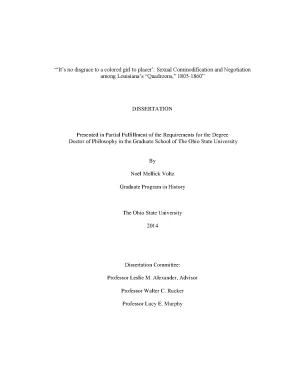
Tải xuống để đọc toàn bộ“‘It’s no disgrace to a colored girl to placer’: Sexual Commodification and Negotiation among Louisiana’s “Quadroons,” 1805-1860” DISSERTATION Presented in Partial Fulfillment of the Requirements for the Degree Doctor of Philosophy in the Graduate School of The Ohio State University By Noël Mellick Voltz Graduate Program in History The Ohio State University 2014 Dissertation Committee: Professor Leslie M. Alexander, Advisor Professor Walter C. Rucker Professor Lucy E. Murphy Copyright by Noël Mellick Voltz 2014 Abstract In 1805, a New Orleans newspaper advertisement formally defined a new social institution, the infamous Quadroon Ball, in which prostitution and plaçage – a system of concubinage – converged.
These balls, limited to white men and light-skinned, free “Quadroon” women, became an interracial rendezvous that provided evening entertainment and the possibility of forming sexual liaisons in exchange for financial “sponsorship.” At these balls, money and other forms of payment were exchanged for the connubial placement of free women of color with wealthy white men. My dissertation entitled, ‘It’s no disgrace to a colored girl to placer’: Sexual Commodification and Negotiation Among Louisiana’s “Quadroons,” 1805-1860” seeks to understand how free women of color used sex across the colorline as a tool of negotiation in various spaces, like the Quadroon Ballroom, in antebellum Louisiana. More specifically, utilizing contemporary travelers’ journals, newspapers, poems, songs, letters, notarial and ecclesiastical records, court cases and other legal documents, my dissertation examines the sexual agency exerted by Louisiana’s free women of color in four sites of contestation – the body, the ballroom, the courtroom and the sanctuary. Free women of color occupied a precarious position in antebellum Louisiana, often subjugated because of their race, gender and class; yet, this very positioning also afforded them a space in which to maneuver socially and economically.
I contend that in these literal and figurative spaces, these women drew upon their sexuality to make ii strategic claims to their freedom advancing themselves socially and economically. This work pushes the boundaries of current scholarship engaging questions of sexual agency and trauma, race and identity, hegemonic myth and cultural reappropriation. In so doing, I build upon and push beyond historiographic discussions of the fetishizing and fanticizing gaze of white men and the overly simplistic dichotomous images of the hypersexualized jezebel and the totally victimized yet “respectable” free woman of color. Ultimately, this research illuminates a more nuanced understanding of black female agency in the antebellum era.
iii To Marie. iv Acknowledgments This project has been over a decade in the making and has truly been a labor of love and, at times, sorrow. No work of this magnitude can ever be completed without the support, guidance, knowledge, care, and patience of so many people to whom I am truly grateful. Although an acknowledgement can never fully capture the extent of my gratitude, I would like to take a moment and recognize some of the many individuals who have helped make this project a reality.
First and foremost, my largest debt of gratitude is owed to my advisors and friends, Dr. Leslie Alexander and Dr. I have been so blessed to have such talented, knowledgeable, supportive, and dedicated mentors. You both have inspired and guided me since I was a sophomore in undergraduate and have consistently and selflessly been committed to my success both academically and personally.
It has truly been an honor and a privilege to work with you. I hope that I can one day walk in your footsteps and be the kind of mentor and advisor for my students that you have modeled for me. From the bottom of my heart, thank you! In addition to Dr. Alexander and Dr.
Rucker, I also specifically want to thank Dr. Lucy Murphy, Dr. Hasan Jeffries, and Dr. Each of you has gone above and beyond in supporting me.
I have learned so much from each of you and I am so thankful that I have had the opportunity to work with you all. Murphy – It has been a pleasure to get to know you and to work with you these last few years. Thank you for serving on my committees, for being so warm, supportive, and insightful, and for guiding me and challenging me in my study of people “in-between.” I have learned so much from you. Thank you! Dr.
Jeffries – I want to thank you for being an amazing professor, for originally sparking my interest in attaining a Ph., and for encouraging me to pursue undergraduate research in the first place. Greg – You have truly stood by my side and have supported me through both the highs and lows of my graduate school career. Thank you for listening, for helping me find my voice, and for pushing me when I felt like giving up. Graduate school has been one of the most exciting, and yet trying times, in my life.
I could not have completed this degree without the love and support of all of my friends. To all of my friends in graduate school and outside –You have enriched my life and given me the strength to complete this endeavor. Particular thanks are due to: Whitney Boyd, Ashley Jones, Leon and Jenny McCullough, Jessica Wallace, and John Howard. You all have been so wonderful and have always been there to commiserate with me, to make me smile, and to get me out of the house when writing was making me stir crazy.
I also owe special thanks to Ray Parr. You have been so encouraging through this research and writing process. From listening to me “nerd out” about my sources, to our day-long FaceTime writing sessions, your support never ceases to amaze me. Thank you for being you! Finally, I could not have written this dissertation without the love and support of my girls - Audrey, Shirley, Roxi, and Emily - and my extended Lane Bryant vi Family – Bridget, Jenni, Christi, Amy, Miss.
Charlotte, and Miss. Arlene – I love you, ladies! You are my friends, my encouragers, and have truly become my second family. Your friendship, kindness, and care, has meant more to me than words can express or than you can ever know. I can’t wait to see you all at our next Girls Night Out! This dissertation could never be produced without the assistance, knowledge and resources that I found in the archives in Louisiana.
I am so grateful for the warm and welcoming reception I have experienced at every archive I visited and I want to thank all the staff and archivists who have assisted me as I have journey into the past. In particular, thanks to: the Special Collections Department at the University of New Orleans - Earl K. Long Library, The William Research Center at the Historic New Orleans Collection, the Special Collections Department at Louisiana State University’s Howard-Tilton Memorial Library, The Cammie G. Henry Research Center at Northwestern State University of Louisiana, the Office of Archives at the Archdiocese of New Orleans, the Louisiana Division City Archives and Special Collections at the New Orleans Public Library, the Amistad Research Center at Tulane University, the New Orleans Notarial Archives, and last but not least, the Sisters of Mt.
Additionally, I want to say a special thanks to Dr. Virginia Meacham Gould, Dr. Monique Guillory and the member of the St. Augustine Catholic Church.
I have truly appreciated our conversations about the free people of color in antebellum Louisiana. Thank you for giving me your time and sharing your knowledge. I am also very grateful for the funding I have received from Ohio State University to support this project. Specifically, I would like to thank the College of Arts and vii Sciences, and particularly Dr.
John Roberts, former dean of the College of the Arts and Humanities, the History Department, Henry H. Simms Award, and the Retrieving the American Past Research Award. Finally, I would like to say thank you to my family – and particularly to my mother Margo and to my sister Christine. None of this would have been written or possible without your guidance, support, and love.
This dissertation is dedicated to Marie. It has been amazing to see how much you have grown. I can’t wait to see what your future holds. I love you! viii Vita 2003.Rehoboth Christian School 2008., Ohio State University 2010.
History, Ohio State University 2008 to present .Graduate Teaching Associate and Fellow, Department of History, The Ohio State University Publications “As she sits down to write…: Using Primary Sources to Understand the Past” in Rethinking Emilie Frances Davis: Lesson Plans for Teaching Her 1863-1865 Civil War Pocket Diaries, ed. Karsonya Wise Whitehead and Conra Gist, 91-108. Baltimore: Apprentice House, 2014. Fields of Study Major Field: History ix Table of Contents Abstract.
ix List of Tables. xi List of Figures. 1 Chapter 1: “Mapping the Margins”:. 25 Chapter 2: The Body.
63 Chapter 3: The Ballroom. 98 Chapter 4: The Courtroom. 146 Chapter 5: The Sanctuary. 235 Appendix A: Population Data.
237 Appendix B: Relevant Images. 241 x List of Tables Table 1: “Population of Louisiana”. 223 Table 2: “Population of New Orleans by Sex”. 223 xi List of Figures Figure 1: Creole in a Red Headdress.
224 Figure 2: Portrait of Betsy. 225 Figure 3: Two Quadroon Ball Advertisements. 226 Figure 4: Sketch of a Quadroon Ball by John H. 226 xii Introduction In 1859, a mixed-race, free woman of color and hairdresser named Eliza Potter published her travel narrative, A Hairdresser’s Experience in High Life, an account of her voyages throughout the South in the 1840s and 1850s.
During the course of her extensive travels both nationally and internationally, Potter spent considerable time visiting and working in New Orleans, Louisiana. As a hairdresser and a free woman of color, Potter was able to enter into the inner circle of the New Orleans elite and also gained particular knowledge about the unique and infamous lives of Louisiana’s free women of color. Throughout her narrative, Potter, like many of her contemporaries, described the prevalence of interracial sex between women of color and white men in Louisiana. In one such instance, she wrote: The colored lady who kept the house…was very beautiful and very wealthy; she owned a great deal of property and many slaves, and kept two houses more like some of the elegant mansions of the nobility, than anything else.
She inherited this property by her husband and master, he emancipated her…he made all over to her – property, money and shares – a short time after, he died, leaving her in possession of all of his wealth. Several gentlemen were going to see her at one time [after his death]; one of these gentlemen, was a Mr. They made proposals to her, not exactly of matrimony, but by them considered in the same holy light as lawful marriage; she flattered Mr. B--- for some time, making him believe she would take him for her lawful “placeyer,” but when the evening came on that he looked for the fulfillment of her promise, she deceived him and took another…Such occurrences as these are frequent.
I could neither find paper nor time to tell you half of such things as come under my notice.1 1 Eliza Potter, A Hairdresser’s Experience in High Life (1859; reprint, New York: Oxford University Press, 1991), 160-161. 1 Potter’s recollection of this nameless “colored lady” of New Orleans, serves as a unique window into the world of antebellum Louisiana’s notorious free women of color and particularly into their sexual choices and agency. Antebellum Louisiana was home to one of the largest and most wealthy populations of free people of color in the 19th century and, of this population, it was the free women of color, who captured the intrigues, imaginations and pens of travelers, like Potter, who ventured to the Crescent City.
Nội dung được bảo vệ bản quyền — Tải xuống đầy đủ
Trích dẫn luận án này
Noël Mellick Voltz (2014). Sexual Commodification among Louisiana's Quadroons, 1805-1860 [Luận án tiến sĩ, The Ohio State University]. LuanAn.net. https://luanan.net/lich-su/sexual-commodification-and-negotiation-among-louisianas-quadroons-1805-1860
Câu hỏi thường gặp
Luận án "Sexual Commodification among Louisiana's Quadroons, 1805-1860" nghiên cứu về vấn đề gì?
Luận án phân tích sự thương mại hóa tình dục của Quadroons Louisiana 1805-1860, hé lộ bối cảnh xã hội, kinh tế và chủng tộc phức tạp.
Luận án "Sexual Commodification among Louisiana's Quadroons, 1805-1860" được bảo vệ tại trường nào?
Luận án này được bảo vệ tại The Ohio State University. Năm bảo vệ: 2014.
Luận án "Sexual Commodification among Louisiana's Quadroons, 1805-1860" thuộc chuyên ngành gì?
Luận án "Sexual Commodification among Louisiana's Quadroons, 1805-1860" thuộc chuyên ngành History. Danh mục: Lịch Sử.
Luận án "Sexual Commodification among Louisiana's Quadroons, 1805-1860" có bao nhiêu trang?
Luận án "Sexual Commodification among Louisiana's Quadroons, 1805-1860" có 284 trang. Bạn có thể xem trước một phần tài liệu ngay trên trang web trước khi tải về.
Cách tải luận án "Sexual Commodification among Louisiana's Quadroons, 1805-1860" về máy như thế nào?
Để tải luận án về máy, bạn nhấn nút "Tải xuống ngay" trên trang này, sau đó hoàn tất thanh toán phí lưu trữ. File sẽ được tải xuống ngay sau khi thanh toán thành công. Hỗ trợ qua Zalo: 0559 297 239.