Sử dụng công nghệ trong giáo dục K-12: Sự liên quan giữa lãnh đạo công nghệ và sử dụng công nghệ
Khám phá cách công nghệ cách mạng hóa giáo dục K-12, tăng cường học tập, đổi mới phương pháp giảng dạy và chuẩn bị cho tương lai.
Educational Studies
Luan An
Luận án tiến sĩ
Năm xuất bản
Số trang
217
Thời gian đọc
33 phút
Lượt xem
0
Lượt tải
0
Phí lưu trữ
50 Point
Tổng quan nhanh
- Chủ đề:
- Tối ưu Công nghệ trong Giáo dục K-12: Xu hướng
- Số trang:
- 217 trang
- Trường:
- The Ohio State University
- Chuyên ngành:
- Educational Studies
- Tác giả:
- Shiang-Yu Lin
- Năm:
- 2016
Tóm tắt nội dung luận án
I.Tối ưu Công nghệ trong Giáo dục K 12 Xu hướng
Tài liệu này khám phá mối quan hệ giữa vai trò lãnh đạo công nghệ và việc sử dụng công nghệ trong các trường học K-12. Có một niềm tin chung rằng công nghệ có thể cải thiện cơ hội học tập cho tất cả học sinh. Chính phủ khuyến khích sử dụng công nghệ giáo dục thông qua tài trợ hạ tầng công nghệ. Họ cũng thúc đẩy phát triển các ứng dụng công nghệ giáo dục. Tuy nhiên, tình trạng sử dụng công nghệ trong các trường K-12 vẫn còn mơ hồ. Nghiên cứu này làm sáng tỏ cách thức lãnh đạo ảnh hưởng đến việc tích hợp các công cụ số. Các công cụ này bao gồm hệ thống quản lý học tập (LMS) và thiết bị di động trong giáo dục. Công nghệ giáo dục hiện nay còn bao gồm các xu hướng mới như thực tế ảo (VR) trong lớp học, thực tế tăng cường (AR) trong giáo dục, và trí tuệ nhân tạo (AI) trong giáo dục. Những công nghệ này mở ra nhiều tiềm năng mới cho môi trường học tập.
1.1. Tiềm năng cải thiện cơ hội học tập
Công nghệ giáo dục hứa hẹn nâng cao cơ hội học tập cho tất cả học sinh. Các nguồn lực từ chính phủ khuyến khích phát triển hạ tầng công nghệ. Chúng cũng thúc đẩy ứng dụng công nghệ giáo dục đa dạng. Mục tiêu là tạo ra môi trường học tập hiệu quả. Việc này hỗ trợ cá nhân hóa học tập. Công nghệ giúp học sinh tiếp cận kiến thức theo nhiều cách khác nhau.
1.2. Thực trạng chuyển đổi số giáo dục K 12
Tình hình sử dụng công nghệ tại các trường K-12 còn mơ hồ. Cần làm sáng tỏ mức độ hiệu quả thực tế của chuyển đổi số giáo dục. Nghiên cứu này cung cấp cái nhìn sâu sắc về hiện trạng. Nó cũng chỉ ra các yếu tố ảnh hưởng đến việc tích hợp công nghệ. Đây là bước quan trọng để tối ưu hóa việc sử dụng công nghệ.
II.Lãnh đạo Công nghệ Giáo dục Nền tảng Thành công
Lãnh đạo công nghệ là một khái niệm mới nổi trong nghiên cứu giáo dục. Nó được mô tả là một đặc điểm của trường học. Đặc điểm này liên quan đến lập kế hoạch, mua sắm. Nó cũng bao gồm một loạt các hoạt động quản lý và lãnh đạo phân tán. Những hoạt động này dẫn đến việc sử dụng công nghệ một cách có ý nghĩa và hiệu quả trong trường học. Mặc dù có nghiên cứu xác định mối quan hệ tích cực giữa lãnh đạo trường học và kết quả học sinh, rất ít nghiên cứu tập trung vào mối liên hệ giữa lãnh đạo công nghệ và việc sử dụng công nghệ của giáo viên và học sinh. Việc này bao gồm cả phương pháp dạy học tích hợp công nghệ.
2.1. Định nghĩa và vai trò lãnh đạo công nghệ
Lãnh đạo công nghệ giáo dục đóng vai trò thiết yếu. Vai trò này bao gồm việc định hình chiến lược công nghệ. Nó cũng bao gồm việc hỗ trợ triển khai các giải pháp số. Các nhà lãnh đạo giúp đảm bảo rằng công nghệ được sử dụng hiệu quả. Mục tiêu là cải thiện quá trình dạy và học. Việc này đặc biệt quan trọng trong bối cảnh chuyển đổi số giáo dục.
2.2. Tác động đến việc sử dụng công nghệ giáo dục
Nghiên cứu giả thuyết mối quan hệ tích cực giữa lãnh đạo công nghệ và sử dụng công nghệ. Lãnh đạo hiệu quả là vai trò cần thiết. Nó giúp ứng dụng công nghệ K-12 một cách hiệu quả. Điều này ảnh hưởng trực tiếp đến cách giáo viên triển khai phương pháp dạy học tích hợp công nghệ. Nó cũng tác động đến việc học sinh tương tác với các công cụ kỹ thuật số.
III.Phương pháp Nghiên cứu Đánh giá Sử dụng Công nghệ
Nghiên cứu này được tiến hành để kiểm tra tình trạng hiện tại của việc sử dụng công nghệ và lãnh đạo công nghệ trong các trường K-12. Nó cũng xem xét mối quan hệ giữa lãnh đạo công nghệ và việc giáo viên sử dụng công nghệ cho hướng dẫn toán học. Dữ liệu từ cuộc khảo sát phản hồi nhanh năm 2009 về "Sử dụng công nghệ giáo dục của giáo viên trong các trường công lập Hoa Kỳ" (FRSS95, 2009) đã được phân tích. Thống kê mô tả và phân tích nhân tố được thực hiện để đặc trưng hóa việc sử dụng công nghệ K-12 và lãnh đạo công nghệ.
3.1. Nguồn dữ liệu và mẫu khảo sát K 12
Nghiên cứu sử dụng dữ liệu từ khảo sát FRSS95 năm 2009. Đây là một cuộc khảo sát cấp quốc gia của Hoa Kỳ. Mẫu bao gồm 3.159 giáo viên từ 1.563 trường công lập. Mẫu được chia thành giáo viên tiểu học và trung học. Sự phân chia này giúp khám phá câu hỏi nghiên cứu về công nghệ giáo dục K-12.
3.2. Đo lường chỉ số sử dụng công nghệ giáo dục
Trong tập dữ liệu FRSS95, việc sử dụng công nghệ được đặc trưng hóa. Nó bao gồm việc giáo viên sử dụng công nghệ chung cho chuẩn bị lớp học. Gồm cả hướng dẫn và công việc hành chính. Gồm cả việc giáo viên sử dụng công nghệ để giao tiếp với phụ huynh hoặc học sinh. Gồm cả quản lý dữ liệu học sinh (có thể qua hệ thống quản lý học tập - LMS). Gồm cả việc học sinh sử dụng thiết bị di động trong giáo dục trong giờ học.
3.3. Các yếu tố lãnh đạo công nghệ được xem xét
Nhận thức của giáo viên về lãnh đạo công nghệ được đặc trưng hóa. Nó bao gồm nhân sự công nghệ toàn thời gian trong các quận. Gồm cả chất lượng phát triển chuyên môn về công nghệ giáo dục. Gồm cả quyền truy cập công bằng vào các công cụ và tài nguyên kỹ thuật số. Những yếu tố này là chỉ số quan trọng của lãnh đạo công nghệ.
IV.Mối Quan hệ Lãnh đạo Công nghệ và Ứng dụng Thực tế
Các phân tích MANCOVA và phân tích hồi quy tiếp theo đã được sử dụng. Mục đích là để kiểm tra xem có mối quan hệ giữa lãnh đạo công nghệ và việc sử dụng công nghệ hay không. Đồng thời xác định thuộc tính nào của lãnh đạo công nghệ liên quan đáng kể đến việc sử dụng công nghệ. Phân tích được thực hiện riêng cho mẫu tiểu học và trung học. Kết quả xác nhận giả thuyết về mối quan hệ tích cực.
4.1. Kết quả chung về mối liên hệ tích cực
Nghiên cứu xác nhận một mối quan hệ tích cực giữa lãnh đạo công nghệ và việc sử dụng công nghệ. Điều này đặc biệt đúng trong các trường tiểu học. Lãnh đạo mạnh mẽ thường đi đôi với mức độ sử dụng công nghệ cao hơn. Việc này cho thấy tầm quan trọng của lãnh đạo trong chuyển đổi số giáo dục.
4.2. Khác biệt giữa trường tiểu học và trung học
Mặc dù có mối quan hệ tích cực chung, các yếu tố cụ thể có thể khác nhau. Sự khác biệt tồn tại trong phân phối nhiệm vụ giảng dạy chính. Do đó, mẫu tiểu học và trung học được phân tích riêng. Điều này giúp khám phá chi tiết hơn về mối quan hệ giữa lãnh đạo công nghệ và sử dụng công nghệ giáo dục K-12 ở từng cấp học.
V.Yếu tố Quyết định Phát triển và Tiếp cận Công nghệ
Kết quả nghiên cứu chỉ ra rằng chất lượng phát triển chuyên môn và quyền truy cập công bằng có mối quan hệ tích cực đáng kể với tất cả các chỉ số sử dụng công nghệ. Điều này nhấn mạnh tầm quan trọng của việc đầu tư vào đào tạo giáo viên. Nó cũng cho thấy cần đảm bảo mọi học sinh và giáo viên đều có cơ hội sử dụng công nghệ. Việc này rất quan trọng để tối đa hóa lợi ích của công nghệ trong giáo dục.
5.1. Chất lượng phát triển chuyên môn giáo viên
Chất lượng phát triển chuyên môn (PD quality) có mối quan hệ tích cực đáng kể. Nó ảnh hưởng đến tất cả bốn chỉ số sử dụng công nghệ. Điều này đúng với cả mẫu tiểu học và trung học. Đào tạo tốt giúp giáo viên tự tin hơn. Nó hỗ trợ họ tích hợp công nghệ hiệu quả vào phương pháp dạy học tích hợp công nghệ. Điều này cải thiện trải nghiệm học trực tuyến K-12.
5.2. Đảm bảo tiếp cận công bằng thiết bị di động
Quyền truy cập công bằng vào các công cụ và tài nguyên kỹ thuật số (range of access) cũng rất quan trọng. Yếu tố này có mối quan hệ tích cực đáng kể. Nó ảnh hưởng đến tất cả các chỉ số sử dụng công nghệ. Việc này đảm bảo mọi học sinh có thể hưởng lợi từ công nghệ. Điều này hỗ trợ mô hình học trực tuyến K-12 và cá nhân hóa học tập. Nó cũng giúp sử dụng hiệu quả hệ thống quản lý học tập (LMS).
Mục lục chi tiết luận án
Tải xuống file đầy đủ để xem toàn bộ nội dung
Tải đầy đủ (217 trang)Trích đoạn nội dung luận án
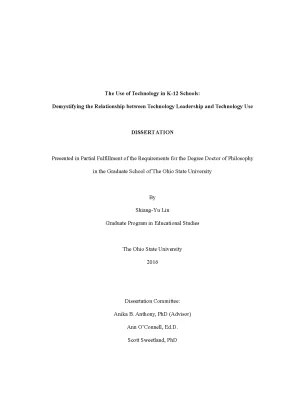
Tải xuống để đọc toàn bộThe Use of Technology in K-12 Schools: Demystifying the Relationship between Technology Leadership and Technology Use DISSERTATION Presented in Partial Fulfillment of the Requirements for the Degree Doctor of Philosophy in the Graduate School of The Ohio State University By Shiang-Yu Lin Graduate Program in Educational Studies The Ohio State University 2016 Dissertation Committee: Anika B. Anthony, PhD (Advisor) Ann O’Connell, Ed. Scott Sweetland, PhD Copyrighted by Shiang-Yu Lin 2016 Abstract There is a common belief that technology can help improve learning opportunities for all students (DeBell & Chapman, 2006; U. Department of Education, 2010).
government encourages the use of educational technology in K-12 schools through funding technological infrastructure and the development of educational technology applications, the state of technology use in K-12 schools remains vague. Technology leadership, an emerging concept in educational scholarship, has been described as a school characteristic associated with planning, purchasing, and a host of distributed management and leadership practices that lead to meaningful and effective utilization of technology in schools (S. Dexter, 2008; Hew & Brush, 2007). Although there is research establishing a positive relationship between school leadership and student outcomes (Hallinger & Heck, 1996; Robinson, Lloyd, & Rowe, 2008; Waters, Marzano, & Mcnulty, 2003), few studies have examine links between technology leadership and technology use by teachers and students.
This study was conducted to examine the current state of technology use and technology leadership in K-12 schools. It also examined the relationship between technology leadership and teachers’ technology use for mathematics instruction. Following Anderson and Dexter's (2005) claim that technology leadership functions as a necessary role in the effective use of K-12 school technology use, I hypothesized a ii positive relationship between technology leadership and technology use for teaching and learning. This dissertation begins with a review of relevant research and policy literature on ways in which school-level technology leadership and technology policies influence technology integration.
Next, it describes how data from the 2009 fast-response survey titled "Teachers' Use of Educational Technology in U. Public Schools" (FRSS95, 2009) has been analyzed. Descriptive statistics and factor analyses were conducted to characterize K-12 technology use and technology leadership. Next, MANCOVA and a follow-up regression analysis were utilized to examine whether a relationship between technology leadership and technology use existed, and to determine which attributes of technology leadership were significantly associated with technology use.
The target population for this study was U. public elementary and secondary teachers who were identified to participate in the 2009 fast-response survey titled "Teachers' Use of Educational Technology in U. The FRSS nationwide teacher survey sampled 3,159 public school teachers from 1563 public schools (NCES, 2010). The sample consisted of 1784 public elementary teachers, 1286 public secondary teachers, and 89 teachers in public combined schools.
Due to a large difference existing in the distribution of main teaching assignment between the participants in elementary schools and those in secondary schools, the elementary sample and the secondary sample were extracted from the total sample to explore the research questions regarding teachers’ and students’ educational technology use, teachers' perceptions of technology leadership, and the relationship between technology leadership and educational technology use in K-12 schools. iii In the FRSS95 dataset, technology use was characterized by teachers' general technology use for classroom preparation, instruction, and administrative tasks (general use), teachers’ administrative technology use for communicating with parents or students (Admin_comm), teachers’ administrative technology use for viewing or managing student data (Admin_data), and students' technology use during instructional time (student use). Teachers' perceptions of technology leadership were characterized by full- time technology personnel within districts (tech personnel), the quality of professional development for educational technology (PD quality) and equitable access to digital tools and resources (range of access). With these four indicators of technology use and three indicators of technology leadership, analyses examined the relationship between technology use and technology leadership in elementary schools and secondary schools.
As expected, PD quality and range of access had statistically significant positive relationships with all four technology use indicators in both samples. Furthermore, technology personnel was a statistically significant predictor across all types of technology use in the elementary sample, but not a significant one across Admin_comm, Admin_data, or student use in the secondary sample. The study findings also showed that the inclusion of technology leadership in the models resulted in a significant increase in the amount of variance explained above and beyond that accounted for by school enrollment size, community type, poverty, minority student population, main teaching assignment and years of teaching experience. In short, regardless of the type of technology use or teachers’ instructional grade level, technology leadership matters.
The amount of variance explained for general technology use was the greatest among the four technology use variables in elementary schools, as well as in iv secondary schools. The amount of variance explained for Admin_comm use was the least among the four technology use variables in elementary schools, as well as in secondary schools. With the exception of student use, the technology leadership indicators in elementary schools explained a greater amount of variance of technology use than that in secondary schools. Even with the limited number of indicators used in this analysis to measure technology leadership and technology use, the study findings confirmed and demonstrated the influence of teacher's perceptions of technology leadership on several meaningful technology-related uses by teachers and students.
Although the indicators of technology leadership in this study differed from those conceptual dimensions of technology leadership in Anderson and Dexter's study, both of these studies showed a strong positive relationship between technology leadership and technology use. This implies that technology leadership still serves a necessary role in the effective utilization of educational technology even if technology leadership is not depicted as principals’ behaviors. Moreover, the findings imply the importance of the quality of technology- related professional activities and the equitable access to educational technology. The study suggest future researchers and policy makers should regard technology leadership as a powerful organizational function that positively impacts teachers’ and students’ technology use.
v Dedicated to my husband, Ting-Hsiang Hung, my parents, Jing-Huei Lin and Hui-Chun Yang. vi Acknowledgments It is unbelievable to have such a PhD journey full of joy, challenges and happiness. It is the most valuable and unforgettable part in my life. I am really grateful to have so many people around to give me support.
All of you made my life so meaningful. First and foremost, I would like to thank my advisor, Dr. Anthony, for having me as her advisee. I have her valuable guidance on a variety of research aspects, including theory, methodology and presentation.
She gave me not only substantial guidance, but spiritual support as well, especially during times when I felt frustrated. Her attitude not only towards research, life and people has deeply inspired me. I really appreciate having been given the opportunity to work with her. Allen and Dr.
Sweetland for serving on my dissertation and candidacy committee. I appreciate the insights regarding methodology and quantitative research from Dr. O’Connell and those influential discussions during my dissertation committee meetings. Allen for her guidance in politics and educational leadership as well as her helpful suggestion in K-12 technology policies.
Sweetland for his valuable suggestion regarding student achievement and financial factors in my research. Warnick for his encouragement on polishing my final project in his class for potential publication. His encouragement led to my heightened confidence and decision to pursue this PhD. I would also like to thank Dr.
Lomax for sharing the knowledge on multivariate experimental design and structural vii equation modeling. Hoy for his inspiration in organizational and administrative theory in education. I am grateful that he introduced Dr. Anthony to be my advisor.
I also feel blessed because of all the assistance I received from my friends. Hui Jiang, who was my TA in the multivariate experimental design, helped me gain comprehensive understanding in quantitative research design, which became the major research method in my dissertation. Ian Wei, Dr. Jason Wu and Dr.(to-be) Wei-Ting Yen, who were my mentors at OSU, provided me with sage guidance and excellent suggestions in both coursework and research.
VanHorn, my favorite classmates, gave me substantial support in my candidacy exam. I also thank Deb, the director of office of student service, for her reliable assistance on dealing with and meeting the various requirements at school. In addition, I had a wonderful time working with folks in the Dennis Learning Center. We shared both professional knowledge and life experiences with one another.
Hansley, my supervisor and friend, shared knowledge of work and life in school and beyond. I appreciate the opportunity she gave me to work in the DLC. Leona, a doctor-to- be and also my friend, was my motivational partner for completing the journey of this PhD. Sung Jun Won, my officemate, discussed statistics questions and shared many funny stories with me.
I appreciate all the sweet wishes and gifts I received for my and my husband’s new-born baby from the DLC team, Leah, Marissa, Jessica, Cathleen, Jane, Lauren and Dr. I greatly appreciate the fact that I have a lot of good Taiwanese friends here in Columbus, our second home. We have shared many precious moments together, no viii matter if the times were good or bad, happy or sorrowful. From hot pot parties in the winter to Chinese New Year celebrations, from barbecues in the summer to a new, exciting football season, so many of my best memories were created here with these friends.
They will never, never be forgotten. They are my second family. Last but not the least; I would like to thank my family. I thank my parents for raising and supporting me all my life.
I could never pursue my dream without their endless love. I would also like to thank Howell Yang and Wisely Yang, my cousins and friends, for proofreading several of my papers, including this dissertation. I am grateful to have these two patient and diligent proofreaders. Ting-Hsiang, my beloved husband, he is my soul mate and life’s inspiration.
How lucky I have been to meet him, fall in love with him, marry him and have our adorable daughter, Olivia, with him here in Columbus. Without him, I would have never had such an amazing and unbelievable journey. Of course, this splendid path I walk continues onward. We are writing our story, with all the blessings and love I could ask for from this world.
ix Vita June 1996 .Taipei First Girls High School, Taipei City, Taiwan 2000. Foreign Languages and Literature, National Cheng Kung University, Tainan City, Taiwan 2000 to 2001 .Intern Instructor and International & Aboriginal Students Afterschool Counseling Instructor, National Tainan Junior College of Nursing, Tainan City, Taiwan 2001 to 2005 .Homeroom Teacher and Administrator, Nan-Shan Private High School, New Taipei City, Taiwan 2005 to 2010 .Homeroom Teacher of Talented Mathematics and Science Class and A- Division English Instructor, New Taipei Municipal Ji-Sui Junior High School, New Taipei City, Taiwan x 2011 to 2012 .Staff Assistant, OSU Buckeye Village, The Ohio State University 2012. Educational Policy and Leadership, The Ohio State University 2013 to 2014 .Graduate Teaching Fellow, Walter E. Dennis Learning Center, The Ohio State University 2012 to 2015 .Graduate Teaching Associate, Department of Educational Studies, The Ohio State University 2015 to present.
Candidate, Educational Administration, The Ohio State University Fields of Study Major Field: Educational Studies xi Table of Contents Abstract. x Fields of Study. xi Table of Contents. xii List of Tables.
xvii List of Figures. xx Chapter 1: Introduction. 3 K-12 Technology Policy at the Federal Level. 4 K-12 Technology Policy at the State Level.
11 Purpose of the Study. 12 Significance of the Study. 13 xii Research Questions. 15 Chapter 2: Review of Literature.
16 Why is Technology Leadership Important?. 17 The Roles of Technology Leaders in K-12 Education. 20 Principals / District-Level Administrators. 22 Technology Coaches / Technology Specialist / School Administrators.
33 Critique of the Literature .
Nội dung được bảo vệ bản quyền — Tải xuống đầy đủ
Trích dẫn luận án này
Shiang-Yu Lin (2016). Sử dụng công nghệ trong giáo dục K-12 [Luận án tiến sĩ, The Ohio State University]. LuanAn.net. https://luanan.net/quan-ly-giao-duc/su-dung-cong-nghe-trong-giao-duc-k-12
Câu hỏi thường gặp
Luận án "Sử dụng công nghệ trong giáo dục K-12" nghiên cứu về vấn đề gì?
Khám phá cách công nghệ cách mạng hóa giáo dục K-12, tăng cường học tập, đổi mới phương pháp giảng dạy và chuẩn bị cho tương lai.
Luận án "Sử dụng công nghệ trong giáo dục K-12" được bảo vệ tại trường nào?
Luận án này được bảo vệ tại The Ohio State University. Năm bảo vệ: 2016.
Luận án "Sử dụng công nghệ trong giáo dục K-12" thuộc chuyên ngành gì?
Luận án "Sử dụng công nghệ trong giáo dục K-12" thuộc chuyên ngành Educational Studies. Danh mục: Quản Lý Giáo Dục.
Luận án "Sử dụng công nghệ trong giáo dục K-12" có bao nhiêu trang?
Luận án "Sử dụng công nghệ trong giáo dục K-12" có 217 trang. Bạn có thể xem trước một phần tài liệu ngay trên trang web trước khi tải về.
Cách tải luận án "Sử dụng công nghệ trong giáo dục K-12" về máy như thế nào?
Để tải luận án về máy, bạn nhấn nút "Tải xuống ngay" trên trang này, sau đó hoàn tất thanh toán phí lưu trữ. File sẽ được tải xuống ngay sau khi thanh toán thành công. Hỗ trợ qua Zalo: 0559 297 239.