Quan điểm của Lãnh đạo: Quyền lực của Hiệu trưởng tại các Hệ thống Charter Nông thôn Georgia
Khám phá quyền lực và tầm ảnh hưởng của hiệu trưởng trường charter ở vùng nông thôn Georgia. Hiểu rõ vai trò, thách thức và cơ hội.
Educational Policy Studies
Luan An
luận án
Năm xuất bản
Số trang
113
Thời gian đọc
17 phút
Lượt xem
1
Lượt tải
0
Phí lưu trữ
40 Point
Tổng quan nhanh
- Chủ đề:
- Hiệu trưởng Trường Charter Nông thôn Georgia: Quyền lực
- Số trang:
- 113 trang
- Trường:
- Georgia State University
- Chuyên ngành:
- Educational Policy Studies
- Tác giả:
- Brock Robert Holley
- Năm:
- 2021
Tóm tắt nội dung luận án
I.Hiệu trưởng Trường Charter Nông thôn Georgia Quyền lực
Luận văn này khám phá quyền lực của hiệu trưởng trường charter nông thôn Georgia. Nghiên cứu tập trung vào quan điểm lãnh đạo. Hiệu trưởng là nhân tố then chốt trong quá trình ra quyết định. Họ vận hành các trường thuộc hệ thống charter. Hệ thống này khác biệt so với trường truyền thống. Georgia có mô hình charter system duy nhất. Mô hình này trao quyền tự chủ cho toàn bộ các khu học chánh. Đây là lĩnh vực ít được nghiên cứu. Đặc biệt là ở các khu vực nông thôn của Georgia. Nông thôn được định nghĩa là các quận có dân số dưới 50.000 người.
1.1. Khái niệm Quyền lực của Hiệu trưởng Trường Charter.
Quyền lực của hiệu trưởng trường charter liên quan đến khả năng ảnh hưởng. Nó bao gồm khả năng đưa ra quyết định tại trường học. Luận văn này xem xét mức độ trao quyền. Các hiệu trưởng nhận thức về quyền lực của họ. Quyền tự chủ trường charter là trọng tâm. Hiệu trưởng cần có quyền kiểm soát. Họ cần kiểm soát các hoạt động hàng ngày. Điều này giúp đáp ứng nhu cầu cụ thể của học sinh. Đặc biệt ở các trường charter nông thôn Georgia.
1.2. Thấu hiểu Quan điểm Lãnh đạo Trường học Nông thôn.
Quan điểm lãnh đạo trường học nông thôn rất quan trọng. Môi trường nông thôn có những đặc thù riêng. Nguồn lực có thể hạn chế. Cộng đồng thường gắn bó chặt chẽ. Lãnh đạo giáo dục nông thôn cần thích nghi. Họ phải hiểu rõ bối cảnh địa phương. Hiệu trưởng có thể thúc đẩy sự phát triển. Họ tạo ra các chính sách phù hợp. Mục tiêu là nâng cao chất lượng giáo dục. Nghiên cứu này cung cấp cái nhìn sâu sắc.
II.Quyền Tự chủ Trường Charter tại Georgia Mô hình độc đáo
Georgia đi tiên phong trong mô hình quản trị trường charter độc đáo. Mô hình này áp dụng cho toàn bộ các khu học chánh. Nó không chỉ giới hạn ở các trường riêng lẻ. Cách tiếp cận này mang lại sự trao quyền và linh hoạt. Đặc biệt là ở cấp độ trường học. Các quận charter system hoạt động tương tự trường charter truyền thống. Tuy nhiên, tất cả các trường công lập đều nằm trong hợp đồng charter. Điều này tạo ra một hệ thống quản lý trường học riêng biệt. Luận văn nghiên cứu tác động của mô hình này. Nó tập trung vào hiệu trưởng trường charter.
2.1. Đặc điểm Hệ thống Trường Charter của Georgia.
Hệ thống trường charter của Georgia bắt đầu vào năm 2007. Nó cho phép các quận đăng ký thành một "charter system". Mục tiêu là tăng cường quyền tự chủ cấp trường. Hệ thống mang lại sự linh hoạt trong chương trình giảng dạy. Nó cũng cho phép đổi mới trong hoạt động. Các trường có thể thí điểm những phương pháp mới. Điều này nhằm nâng cao hiệu quả giáo dục. Chính sách giáo dục Georgia thúc đẩy sự đổi mới này.
2.2. Sự linh hoạt trong Quản lý trường học charter.
Sự linh hoạt là lợi ích chính của mô hình. Các hiệu trưởng có nhiều quyền quyết định hơn. Họ có thể quản lý ngân sách hiệu quả hơn. Họ cũng có thể điều chỉnh nhân sự. Điều này giúp ứng phó nhanh chóng với nhu cầu địa phương. Quản lý trường học trong mô hình này đòi hỏi sự chủ động. Hiệu trưởng phải là những lãnh đạo giáo dục năng động. Họ tận dụng quyền tự chủ để tạo ra môi trường học tập tốt nhất.
III.Lãnh đạo Giáo dục Nông thôn Thách thức và Cơ hội
Lãnh đạo giáo dục nông thôn đối mặt nhiều thách thức. Các khu vực này thường có nguồn lực hạn chế. Số lượng học sinh ít hơn. Khoảng cách địa lý gây khó khăn. Việc tuyển dụng giáo viên nông thôn cũng là một vấn đề. Các trường charter nông thôn Georgia có thể tìm kiếm giải pháp. Quyền tự chủ cho phép họ thích nghi tốt hơn. Hiệu trưởng có cơ hội định hình trường học. Họ tạo ra các chương trình phù hợp. Điều này nhằm phục vụ tốt nhất cộng đồng của họ.
3.1. Các Thách thức giáo dục nông thôn nổi bật.
Thách thức giáo dục nông thôn bao gồm thiếu thốn tài chính. Cơ hội phát triển chuyên môn cho giáo viên ít hơn. Công nghệ và cơ sở vật chất có thể lạc hậu. Học sinh cũng gặp khó khăn trong tiếp cận giáo dục chất lượng cao. Các trường nông thôn thường nhỏ hơn. Điều này ảnh hưởng đến quy mô lớp học và đa dạng hóa chương trình. Lãnh đạo phải tìm cách vượt qua những hạn chế này.
3.2. Vai trò của lãnh đạo trong Cải thiện chất lượng giáo dục.
Lãnh đạo giáo dục nông thôn có vai trò quan trọng. Họ là người định hướng chiến lược. Họ thúc đẩy đổi mới. Hiệu trưởng tạo ra một môi trường hỗ trợ. Họ thu hút và giữ chân giáo viên giỏi. Quyền tự chủ trường charter giúp họ linh hoạt hơn. Họ có thể thiết kế các giải pháp đặc thù. Mục tiêu cuối cùng là cải thiện chất lượng giáo dục. Họ đáp ứng nhu cầu học tập của từng học sinh.
IV.Quản lý Trường học Charter Tầm nhìn và Ra quyết định
Quản lý trường học charter đòi hỏi tầm nhìn rõ ràng. Hiệu trưởng cần xác định mục tiêu giáo dục. Họ phải xây dựng chiến lược thực hiện. Quyền tự chủ cấp trường trao cho họ quyền lực này. Luận văn khảo sát cách hiệu trưởng sử dụng quyền. Họ đưa ra các quyết định hàng ngày. Các quyết định này ảnh hưởng trực tiếp đến trường học. Ví dụ bao gồm quản lý ngân sách, tuyển dụng nhân sự. Nó cũng bao gồm phát triển chương trình giảng dạy. Đây là trách nhiệm lớn lao của người lãnh đạo.
4.1. Tầm quan trọng của Việc ra quyết định tại địa phương.
Việc ra quyết định tại địa phương là cốt lõi. Nó cho phép trường học phản ứng nhanh chóng. Trường có thể đáp ứng nhu cầu cụ thể của học sinh. Ví dụ, chương trình học có thể được điều chỉnh. Các hoạt động ngoại khóa có thể được thêm vào. Điều này giúp tối ưu hóa kết quả học tập. Quyền tự chủ trường charter là công cụ mạnh mẽ. Nó thúc đẩy sự đổi mới từ bên trong.
4.2. Khía cạnh thực tiễn trong Quản lý trường học.
Quản lý trường học trong mô hình charter system bao gồm nhiều khía cạnh. Nó đòi hỏi kỹ năng lãnh đạo mạnh mẽ. Hiệu trưởng phải quản lý tài chính. Họ cần xây dựng mối quan hệ cộng đồng. Họ cũng phải giám sát hiệu suất giáo viên. Lãnh đạo giáo dục nông thôn đối mặt với nguồn lực hạn chế. Họ cần sáng tạo để đạt được mục tiêu. Hiệu trưởng là những người giải quyết vấn đề.
V.Tác động của Chính sách Giáo dục Georgia lên Trường Charter
Chính sách giáo dục Georgia đóng vai trò định hình. Nó tạo ra khuôn khổ cho các trường charter system. Chính sách này khuyến khích sự đổi mới. Nó hỗ trợ quyền tự chủ của trường. Mục tiêu là nâng cao chất lượng giáo dục công lập. Tuy nhiên, ít nghiên cứu về tác động thực tế. Đặc biệt là đối với quyền lực của hiệu trưởng. Luận văn này góp phần lấp đầy khoảng trống đó. Nó cung cấp cái nhìn sâu sắc từ các lãnh đạo trường học. Họ hoạt động trong môi trường nông thôn.
5.1. Chính sách giáo dục Georgia và hệ thống charter.
Chính sách giáo dục Georgia tạo điều kiện thuận lợi. Nó cho phép các quận chuyển đổi thành charter system. Mục đích là để các trường được linh hoạt hơn. Chính sách này cung cấp một cơ chế tài trợ riêng biệt. Nó cũng đặt ra các yêu cầu về trách nhiệm giải trình. Các hiệu trưởng phải điều hướng trong khuôn khổ này. Họ sử dụng sự linh hoạt để phục vụ học sinh. Mô hình quản trị trường charter mang lại lợi ích.
5.2. Hỗ trợ và Tài trợ trường charter.
Tài trợ trường charter là một yếu tố quan trọng. Các trường charter system nhận được tài trợ công. Tuy nhiên, họ có thể sử dụng linh hoạt hơn. Quyền tự chủ tài chính cho phép đầu tư vào các lĩnh vực ưu tiên. Ví dụ, tuyển dụng giáo viên nông thôn có kinh nghiệm. Hoặc phát triển chương trình đặc biệt. Điều này giúp họ cạnh tranh hơn. Nó cũng giúp họ đáp ứng nhu cầu của cộng đồng nông thôn.
Tải xuống file đầy đủ để xem toàn bộ nội dung
Tải đầy đủ (113 trang)Trích đoạn nội dung luận án
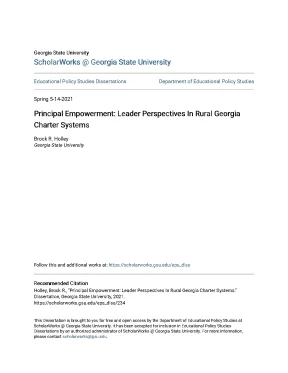
Tải xuống để đọc toàn bộGeorgia State University ScholarWorks @ Georgia State University Educational Policy Studies Dissertations Department of Educational Policy Studies Spring 5-14-2021 Principal Empowerment: Leader Perspectives In Rural Georgia Charter Systems Brock R. Holley Georgia State University Follow this and additional works at: https://scholarworks.edu/eps_diss Recommended Citation Holley, Brock R., "Principal Empowerment: Leader Perspectives In Rural Georgia Charter Systems." Dissertation, Georgia State University, 2021.edu/eps_diss/234 This Dissertation is brought to you for free and open access by the Department of Educational Policy Studies at ScholarWorks @ Georgia State University. It has been accepted for inclusion in Educational Policy Studies Dissertations by an authorized administrator of ScholarWorks @ Georgia State University. For more information, please contact scholarworks@gsu.
ACCEPTANCE This dissertation, PRINCIPAL EMPOWERMENT: LEADER PERSPECTIVES IN RURAL GEORGIA CHARTER SYSTEMS, by BROCK R. HOLLEY, was prepared under the direction of the candidate’s Dissertation Advisory Committee. It is accepted by the committee members in partial fulfillment of the requirements for the degree, Doctor of Education, in the College of Education & Human Development, Georgia State University. The Dissertation Advisory Committee and the student’s Department Chairperson, as representatives of the faculty, certify that this dissertation has met all standards of excellence and scholarship as determined by the faculty.
_________________________ James Kahrs, Ed. Committee Chair _________________________ _________________________ Kristina Brezicha, Ph. Robert Hendrick, Ph. Committee Member Committee Member _________________________ Date _________________________ Jennifer Esposito, Ph.
Chairperson, Department of Educational Policy Studies _________________________ Paul A. Dean College of Education & Human Development AUTHOR’S STATEMENT By presenting this dissertation as a partial fulfillment of the requirements for the advanced degree from Georgia State University, I agree that the library of Georgia State University shall make it available for inspection and circulation in accordance with its regulations governing materials of this type. I agree that permission to quote, to copy from, or to publish this dissertation may be granted by the professor under whose direction it was written, by the College of Education’s Director of Graduate Studies, or by me. Such quoting, copying, or publishing must be solely for scholarly purposes and will not involve potential financial gain.
It is understood that any copying from or publication of this dissertation which involves potential financial gain will not be allowed without my written permission. Holley NOTICE TO BORROWERS All dissertations deposited in the Georgia State University library must be used in accordance with the stipulations prescribed by the author in the preceding statement. The author of this dissertation is: Brock Robert Holley 120 Valley Circle Calhoun, Georgia 30701 The director of this dissertation is: Dr. James Kahrs Department of Educational Policy Studies College of Education Georgia State University Atlanta, Georgia 30303 CURRICULUM VITAE Brock R.
Holley ADDRESS: 120 Valley Circle Calhoun, Georgia 30701 EDUCATION: Ed. 2021 Georgia State University Educational Policy Studies Ed. 2017 University of West Georgia Educational Leadership Masters Degree 2014 Georgia College Special Education Bachelors Degree 2013 Georgia College Special Education PROFESSIONAL EXPERIENCE: 2018-present Assistant Principal Calhoun City Schools 2013-2018 Teacher Calhoun City Schools PRESENTATIONS AND PUBLICATIONS: Doane-Beeler, M. Georgia Association of Positive Behavior Support Conference, Atlanta, Georgia.
PRINICPAL EMPOWERMENT: LEADER PERSPECTIVES IN RURAL GEORGIA CHARTER SYSTEMS by BROCK R. HOLLEY Under the Direction of Dr. James Kahrs ABSTRACT This dissertation examines the perspectives of principals leading rural Georgia schools within districts following charter system governance and addresses the overarching research question, “How do rural Georgia charter system principals perceive their level of empowerment in local school decision making?” Georgia charter system governance is available for any public school district in the state and offers empowerment and flexibility at the school house level. Charter system governance operates similarly to traditional charter schools but includes all public schools in the system charter contract.
Little research is available on the process of local leader empowerment in rural Georgia charter systems because Georgia is the only state to offer charter governance to districts and charter systems are relatively new having been created in 2007. Rural school systems are defined by the county the district is located in, having less than 50,000 people according to the 2010 census. This multiple case study utilized semi-structured interviews of seven principals in rural Georgia charter systems to understand the level of local empowerment and autonomy perceived by these leaders. Additionally, an internal and external document review took place to achieve triangulation during the data collection process.
Internal documents included the local system charter contract and the governance team documents from the local district. The external documents included the rules, regulations, and by-laws of charter system governance from the Georgia Department of Education and the Charter System Foundation. Thematic analysis was used to identify themes collected through principal interviews and document reviews. Results indicate that principals in rural Georgia charter systems perceive empowerment in decision-making at the local school level.
Five major themes emerged during the data analysis portion of the study: charter system governance, system-level support, the principalship, rural impact, and the local community. The results of this dissertation can help guide state, district, and school-level leaders, especially in rural settings, by understanding the perspectives of principals regarding empowerment and autonomy to make decisions in the best interest of the local school and community. INDEX WORDS: Georgia charter systems, principal leadership, empowerment, distributed leadership, rural schools, multiple case study PRINCIPAL EMPOWERMENT: LEADER PERSPECTIVES IN RURAL GEORGIA CHARTER SYSTEMS by BROCK R. HOLLEY A Dissertation Presented in Partial Fulfillment of Requirements for the Degree of Doctor of Education in Educational Leadership in Educational Policy Studies in the College of Education Georgia State University Atlanta, Georgia 2021 Copyright by Brock R.
Holley 2021 i DEDICATION This dissertation is dedicated to my family. To my wife, Jennifer, and our daughter, Julia, for their love, support, and patience. Jennifer, your encouragement and selfless attitude motivated me during the entire doctoral program. You sacrificed a significant portion of your time to accommodate my work and research.
You are the best wife I could ever ask for and I thank God for your love and support every day. To my mother, Susan, and my father, Don, for the positive example they collectively set for Trent, Jake, and I. Resiliency, hard-work, and commitment are just some of the values you taught that helped me through this program. ii ACKNOWLEDGMENTS I would like to acknowledge the following people: The seven rural Georgia principals who allowed me to share their stories about their school and community.
They were unbelievably helpful and dedicated to their students, teachers, and schools. Georgia is blessed with some unbelievable school leaders in every corner of this great state. James Kahrs, my committee chair, whose leadership and advice during the dissertation process was invaluable. We spoke about school and life just as much as we did about my dissertation.
I am extremely grateful for your wisdom and encouragement. Kristina Brezicha and Dr. Robert Hendrick, my committee members, who gave intentional support and feedback throughout the dissertation process. Sheryl Cowart Moss, who guided our cohort and many others through the doctoral journey at Georgia State University.
Peter Coombe, who served as my mentor, principal, and friend from the time I began working at Calhoun City Schools and has always pushed me to continue growing as a leader. Cohort VII, I learned so much from hearing your perspectives and experiences. Our times of in- person classes were cut short due to COVID-19, but I look forward to staying in touch and watching you all grow professionally and personally. Jennifer, Julia, Susan, Don, Trent, and Jake, thank you and I love you.
iii TABLE OF CONTENTS LIST OF TABLES……………………………………………………………………………. iv 1 PRINCIPAL EMPOWERMENT: LEADER PERSPECTIVES IN RURAL GEORGIA CHARTER SYSTEMS………………………………………………. 30 2 PRINCIPAL EMPOWERMENT: LEADER PERSPECTIVES IN RURAL GEORGIA CHARTER SYSTEMS…………………………………………………. 99 iv LIST OF TABLES Table 1.
Study School Districts, Participants, Geographic Location, and Population Range…. 50 1 CHAPTER 1 PRINCIPAL EMPOWERMENT: LEADER PERSPECTIVES IN RURAL GEORGIA CHARTER SYSTEMS As with many of the industries in today’s world, education and the roles of different actors in education continue to evolve and adapt. As operations and systems begin to change, we realize what works the best and learn from past mistakes to improve students’ future outcomes. All disciplines experience the need for reflection and feedback pertaining to growth and development for endeavors to come.
The field of education is notorious for facing rapid change and adjustments to policies and procedures. The responsibility of promptly comprehending change is necessary for educational leaders at all levels. At the school level, the principal is the overarching leader and is accountable for all aspects of school operations. Numerous research articles show that effective school leadership is a strong predictor of student success and second only to direct classroom instruction (Louis, Leithwood, Wahlstrom, & Anderson, 2010; Coelli & Green, 2012; Ni, Yan, & Pounder, 2018).
Included in the ever-changing educational landscape is the increasingly diverse population of students schools are serving. While immediate and extended families largely contribute to child development and achievement, many students recognized positive relationships with teachers, counselors, and administrators as an essential factor in school success (Williams & Bryan, 2013). Due to the significant impact teachers and leaders have on students (Louis et al., 2010; Coelli & Green, 2012; Williams & Bryan, 2013; Ni et al., 2018; Pendola & Fuller, 2018), the need exists for leaders to be aware of local community issues and needs (Cruzerio & Boone, 2009; Schuman, 2010). Principals and school leaders hold a distinct understanding of local community needs and the instructional and pedagogical skills needed to advance student learning 2 (Hays, 2013; Parylo & Zepeda, 2014; Dou, Devos, & Valcke, 2017).
As a result, there is a need to understand the perception of empowerment between the central office and local principals, who are tasked to make decisions in their students and the local community’s best interest. Background of the Problem A shifting educational landscape requires an exceptional skill set for modern-day principals. Gone are the days of principals sitting in their office and merely managing school operations. In addition to the standard management requirements, principals are now trusted to drive instruction and provide distinctive student needs solutions.
These diverse school necessities emphasize the local school leader’s empowerment to make decisions in the student population and the local community’s best interest. Local school decision-making for principals includes, but is not limited to, school finance and budgeting, human resource allocation, and instructional development and supports. The gap between central office decision-making and school-level decision-making presents a problem that can inhibit efficient progress. Whitty and Power (2000) detailed the idea of school districts moving toward decentralization and away from the notion that all schools in a district have the same needs.
Additionally, charter schooling has grown in popularity since first established in the early 1990s (Hunt, 2010). The State of Georgia offers a unique charter option to schools and communities. Much like an individual school can adopt a charter for increased flexibility, school systems in Georgia have the opportunity for applying to become a charter school system, which grants flexibility to all schools governed by those districts (Georgia Charter Systems Act, 2007). Georgia public school districts have the option of following one of three governance models: status quo system, strategic waiver system, or charter system.
Georgia status quo school systems must follow all State Board of Education and Title 20 laws, rules, and regulations. Status 3 quo systems cannot request waivers from any of these requirements except for a few rare circumstances. Title 20 is the Georgia code section outlining public education’s legal responsibilities (Ga. Status quo systems account for the smallest portion of Georgia’s public school systems, with only two districts operating under status quo governance.
The second governance option available to Georgia’s school districts is the strategic waiver governance option, otherwise known as Investing in Excellence in Education or IE2 systems. Strategic waiver systems can waive some of the State Board of Education and Title 20 regulations.
Nội dung được bảo vệ bản quyền — Tải xuống đầy đủ
Trích dẫn luận án này
Brock Robert Holley (2021). Quyền lực của Hiệu trưởng Trường Charter ở Nông thôn Georgia [Luận án tiến sĩ, Georgia State University]. LuanAn.net. https://luanan.net/quan-ly-giao-duc/quyen-luc-hieu-truong-truong-charter-nong-thon-georgia
Câu hỏi thường gặp
Luận án "Quyền lực của Hiệu trưởng Trường Charter ở Nông thôn Georgia" nghiên cứu về vấn đề gì?
Khám phá quyền lực và tầm ảnh hưởng của hiệu trưởng trường charter ở vùng nông thôn Georgia. Hiểu rõ vai trò, thách thức và cơ hội.
Luận án "Quyền lực của Hiệu trưởng Trường Charter ở Nông thôn Georgia" được bảo vệ tại trường nào?
Luận án này được bảo vệ tại Georgia State University. Năm bảo vệ: 2021.
Luận án "Quyền lực của Hiệu trưởng Trường Charter ở Nông thôn Georgia" thuộc chuyên ngành gì?
Luận án "Quyền lực của Hiệu trưởng Trường Charter ở Nông thôn Georgia" thuộc chuyên ngành Educational Policy Studies. Danh mục: Quản Lý Giáo Dục.
Luận án "Quyền lực của Hiệu trưởng Trường Charter ở Nông thôn Georgia" có bao nhiêu trang?
Luận án "Quyền lực của Hiệu trưởng Trường Charter ở Nông thôn Georgia" có 113 trang. Bạn có thể xem trước một phần tài liệu ngay trên trang web trước khi tải về.
Cách tải luận án "Quyền lực của Hiệu trưởng Trường Charter ở Nông thôn Georgia" về máy như thế nào?
Để tải luận án về máy, bạn nhấn nút "Tải xuống ngay" trên trang này, sau đó hoàn tất thanh toán phí lưu trữ. File sẽ được tải xuống ngay sau khi thanh toán thành công. Hỗ trợ qua Zalo: 0559 297 239.