Phân tích Lịch sử/Phả hệ về Tài liệu của Hội đồng Giáo viên Toán học Quốc gia
Luận án: An archaeological genealogical historical analysis of the nationa. Xem tóm tắt và tải về tại LuanAn.net
Teaching and Learning with a concentration in Mathematics Education
Luan An
Luận án tiến sĩ
Năm xuất bản
Số trang
269
Thời gian đọc
41 phút
Lượt xem
0
Lượt tải
0
Phí lưu trữ
50 Point
Tổng quan nhanh
- Chủ đề:
- Nghiên cứu Lịch sử Tài liệu Chuẩn Toán học
- Số trang:
- 269 trang
- Trường:
- Georgia State University
- Chuyên ngành:
- Teaching and Learning with a concentration in Mathematics Education
- Tác giả:
- Erika Catherine Bullock
- Năm:
- 2013
Tóm tắt nội dung luận án
I.Nghiên cứu Lịch sử Tài liệu Chuẩn Toán học
Luận văn này tiến hành phân tích lịch sử sâu rộng. Nó tập trung vào các tài liệu chuẩn của Hội đồng Quốc gia Giáo viên Toán (NCTM). Nghiên cứu áp dụng phương pháp khảo cổ học và phả hệ học. Nó khám phá sự phát triển của các khái niệm toán học trong giáo dục. Việc này cung cấp cái nhìn mới về lịch sử toán học trong chương trình giảng dạy. Luận văn không chỉ kể lại một biên niên sử toán học đơn thuần. Nó đi sâu vào các lý do và động lực đằng sau những thay đổi. Điều này giúp hiểu rõ hơn nguồn gốc các khái niệm toán học được trình bày. Nghiên cứu xem xét cách các chuẩn định hình quan điểm về môn toán. Nó phân tích cách các chuẩn ảnh hưởng đến việc truyền bá kiến thức toán học. Mục tiêu là tiết lộ những tầng ý nghĩa ẩn giấu. Nó muốn làm rõ những giả định tiềm ẩn trong tài liệu. Nghiên cứu này góp phần vào phương pháp nghiên cứu lịch sử toán học ứng dụng. Nó đặc biệt quan tâm đến lĩnh vực giáo dục.
1.1. Mục tiêu Phân tích Lịch sử Giáo dục
Nghiên cứu này có mục tiêu chính. Nó muốn mổ xẻ các tài liệu chuẩn giáo dục toán học. Việc này nhằm hiểu cấu trúc ngầm của chúng. Nó tìm kiếm các lực lượng lịch sử, xã hội, chính trị. Các lực lượng này đã định hình nên chuẩn. Phân tích này vượt ra ngoài bề mặt tài liệu. Nó đào sâu vào các cuộc tranh luận. Nó khám phá các quyết định đã dẫn đến sự thay đổi.
1.2. Đối tượng Nghiên cứu Chuẩn NCTM
Đối tượng chính là các tài liệu chuẩn do NCTM ban hành. Các tài liệu này đã có ảnh hưởng của các tác phẩm toán học rất lớn. Chúng ảnh hưởng đến nền giáo dục toán học Hoa Kỳ. Việc phân tích bao gồm các phiên bản khác nhau của chuẩn. Nó theo dõi sự tiến hóa của chúng. Nó xem xét cách các yêu cầu toán học thay đổi. Nó cũng khảo sát cách các phương pháp sư phạm được khuyến nghị biến đổi.
II.Phương pháp Phân tích Biên Niên Sử Toán học
Luận văn áp dụng một phương pháp nghiên cứu lịch sử toán học độc đáo. Nó kết hợp hai cách tiếp cận: khảo cổ học và phả hệ học của Foucault. Phương pháp khảo cổ học tập trung vào "những gì đã được nói". Nó phân tích các hệ thống diễn ngôn trong tài liệu chuẩn. Nó đào sâu để tìm ra các quy tắc ngầm. Các quy tắc này chi phối việc tạo ra kiến thức toán học. Nó tìm kiếm sự thay đổi của chúng theo thời gian. Phương pháp phả hệ học truy tìm nguồn gốc các khái niệm toán học. Nó xem xét sự phát triển của các chuẩn. Nó khám phá các mối quan hệ quyền lực, các cuộc đấu tranh. Nó chỉ ra cách các ý tưởng toán học giành được ưu thế. Đây không chỉ là việc tạo ra một biên niên sử toán học đơn giản. Đây là sự hiểu biết về sự hình thành của tri thức. Nó là việc nhận ra các mối liên hệ lịch sử phức tạp. Phương pháp này giúp làm sáng tỏ những điều bị bỏ qua. Nó làm rõ những sự kiện bị lãng quên trong quá trình hình thành các tài liệu.
2.1. Khảo Cổ Học trong Tài liệu Toán
Khảo cổ học ở đây không phải khai quật vật thể. Nó là việc đào sâu vào các lớp văn bản. Nó khám phá những tiền giả định sâu xa nhất. Nó tìm kiếm cách các từ ngữ, cấu trúc biểu đạt hình thành. Nó xem xét các khái niệm toán học trong chuẩn. Nó phân tích các điều kiện cho phép "nói" về toán học. Nó xem xét cách giáo dục toán học được định nghĩa.
2.2. Phả Hệ Học về Khái Niệm Toán Học
Phả hệ học truy tìm dòng dõi. Nó theo dõi sự tiến hóa của các ý tưởng. Nó khám phá những điểm rẽ quan trọng trong lịch sử toán học giáo dục. Nó xem xét các lực lượng xã hội và chính trị. Các lực lượng này định hình sự chấp nhận. Chúng định hình sự bác bỏ các phương pháp giảng dạy cụ thể. Nó không chỉ là dòng thời gian. Nó là câu chuyện về quyền lực. Nó là câu chuyện về sự kiểm soát kiến thức.
III.Sự Phát Triển Kiến Thức Toán Học qua Chuẩn
Các tài liệu chuẩn NCTM không tĩnh. Chúng đại diện cho sự phát triển của lý thuyết toán học trong giáo dục. Chúng phản ánh những thay đổi trong nhận thức xã hội. Các chuẩn định hình những gì được coi là quan trọng. Chúng định nghĩa cách toán học nên được dạy. Nghiên cứu này theo dõi biên niên sử toán học của các chuẩn. Nó chỉ ra các giai đoạn chuyển đổi chính. Mỗi giai đoạn đều có những điểm nhấn riêng. Có những khái niệm được ưu tiên. Có những phương pháp được khuyến khích. Điều này trực tiếp ảnh hưởng đến truyền bá kiến thức toán học. Nó tác động đến cách thế hệ học sinh tiếp cận môn học. Luận văn phân tích mối quan hệ. Nó xem xét mối quan hệ giữa các xu hướng toán học. Nó cũng xem xét các xu hướng giáo dục rộng hơn. Nó làm rõ cách chúng hội tụ trong các tài liệu chuẩn.
3.1. Biên Niên Sử của Chuẩn Giáo dục
Nghiên cứu lập một biên niên sử toán học chi tiết. Nó tập trung vào các tài liệu chuẩn. Nó xác định các thời kỳ quan trọng. Nó chỉ ra khi nào các khái niệm toán học mới xuất hiện. Nó cũng chỉ ra khi nào các khái niệm cũ được định hình lại. Ví dụ bao gồm sự nhấn mạnh về giải quyết vấn đề. Hay sự tăng cường về tư duy tính toán. Nó khám phá các yếu tố nội bộ và bên ngoài. Các yếu tố này đã thúc đẩy sự thay đổi.
3.2. Ảnh Hưởng của Chuẩn tới Giảng Dạy
Các tài liệu chuẩn có ảnh hưởng của các tác phẩm toán học rất lớn. Chúng tác động trực tiếp đến thực tiễn giảng dạy. Chúng định hướng nội dung khóa học. Chúng cũng ảnh hưởng đến việc đánh giá học sinh. Phân tích chỉ ra cách các giáo viên phải điều chỉnh. Họ phải điều chỉnh phương pháp của mình. Họ phải đáp ứng các yêu cầu mới. Điều này thay đổi cách thức truyền bá kiến thức toán học trong lớp học. Nó cũng tác động đến nhận thức của học sinh về môn toán.
IV.Ảnh Hưởng của Tài liệu Chuẩn Toán Học
Các tài liệu chuẩn NCTM tạo ra ảnh hưởng của các tác phẩm toán học sâu rộng. Ảnh hưởng này không chỉ giới hạn trong giáo dục. Nó lan rộng sang các lĩnh vực liên quan. Chúng định hướng việc phát triển sách giáo khoa. Chúng tác động đến các kỳ thi đánh giá năng lực. Điều này định hình lại toàn bộ hệ thống. Nó quyết định cách kiến thức toán học được coi trọng. Nó ảnh hưởng đến cách kiến thức được kiểm tra. Nghiên cứu này phân tích những hậu quả. Nó xem xét các tác động dự kiến và không dự kiến. Nó cho thấy các chuẩn đã định hình tư duy. Nó định hình tư duy của các nhà giáo dục toán học. Nó cũng ảnh hưởng đến các nhà hoạch định chính sách. Luận văn góp phần vào việc hiểu biết. Nó làm rõ hơn về vai trò của các tài liệu chính sách. Nó làm rõ vai trò của chúng trong lịch sử toán học giáo dục.
4.1. Định Hướng Chương trình Toán Học
Các chuẩn NCTM đóng vai trò trung tâm. Chúng định hình chương trình giảng dạy toán học ở cấp quốc gia. Chúng cung cấp một khuôn khổ. Nó cho những gì học sinh nên biết và có thể làm. Việc này có ảnh hưởng của các tác phẩm toán học rất lớn. Nó đến sự đồng nhất và chất lượng giáo dục. Phân tích này khám phá cách các chuẩn đã thay đổi. Chúng thay đổi những ưu tiên về nội dung toán học. Chúng cũng thay đổi các kỹ năng cần thiết.
4.2. Tác Động tới Thực Tiễn Sư Phạm
Các chuẩn không chỉ là lý thuyết. Chúng có tác động thực tế đến giáo viên. Chúng ảnh hưởng đến việc đào tạo giáo viên. Chúng tác động đến phương pháp giảng dạy. Nghiên cứu chỉ ra cách các yêu cầu chuẩn. Chúng khuyến khích hoặc ngăn cản một số phương pháp. Ví dụ, nhấn mạnh vào học tập hợp tác. Hay tập trung vào giải quyết vấn đề thực tế. Việc này thay đổi cách truyền bá kiến thức toán học trong lớp học.
V.Nguồn Gốc và Định Hướng Toán Học Hiện Đại
Luận văn khám phá sâu hơn. Nó đi vào nguồn gốc các khái niệm toán học trong chuẩn. Nó không chỉ là sự liệt kê nội dung. Nó là việc tìm kiếm triết lý ẩn sâu. Các chuẩn phản ánh các tranh luận lịch sử. Chúng phản ánh các xu hướng triết học về bản chất toán học. Nghiên cứu này phơi bày cách các quan điểm. Nó phơi bày cách các quan điểm về logic, trực giác, ứng dụng. Nó đã định hình sự phát triển của lý thuyết toán học trong giáo dục. Việc này cung cấp cái nhìn về tương lai. Nó chỉ ra định hướng của toán học hiện đại. Đặc biệt trong bối cảnh học đường. Nó làm rõ mối quan hệ giữa các nhánh toán học. Nó thể hiện chúng trong các tài liệu hướng dẫn.
5.1. Triết Lý Đằng Sau Khái Niệm Toán
Mỗi khái niệm toán học có nguồn gốc các khái niệm toán học sâu sắc. Chúng có lịch sử riêng. Các chuẩn không chỉ đơn giản là trình bày chúng. Chúng diễn giải và định hình lại chúng. Phân tích chỉ ra các luồng tư tưởng. Các luồng tư tưởng này đã ảnh hưởng đến việc lựa chọn. Chúng ảnh hưởng đến cách trình bày các khái niệm. Việc này bao gồm cả ảnh hưởng của các nhà toán học vĩ đại.
5.2. Liên Kết Giữa Các Nhánh Toán Học
Nghiên cứu cũng xem xét. Nó xem xét cách các chuẩn tạo ra mối quan hệ giữa các nhánh toán học. Chúng tạo ra sự kết nối liên ngành. Các chuẩn khuyến khích tích hợp đại số, hình học, thống kê. Điều này thay đổi cách học sinh nhìn nhận. Nó thay đổi cách học sinh nhìn nhận sự thống nhất của toán học. Nó cũng tác động đến sự phát triển của lý thuyết toán học theo hướng ứng dụng.
Mục lục chi tiết luận án
Tải xuống file đầy đủ để xem toàn bộ nội dung
Tải đầy đủ (269 trang)Trích đoạn nội dung luận án
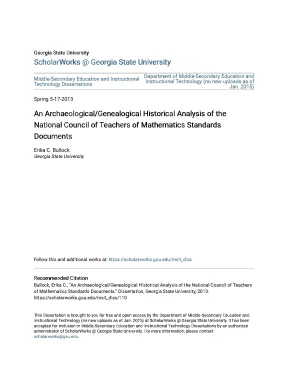
Tải xuống để đọc toàn bộGeorgia State University ScholarWorks @ Georgia State University Middle-Secondary Education and Instructional Department of Middle-Secondary Education and Instructional Technology (no new uploads as of Technology Dissertations Jan. 2015) Spring 5-17-2013 An Archaeological/Genealogical Historical Analysis of the National Council of Teachers of Mathematics Standards Documents Erika C. Bullock Georgia State University Follow this and additional works at: https://scholarworks.edu/msit_diss Recommended Citation Bullock, Erika C., "An Archaeological/Genealogical Historical Analysis of the National Council of Teachers of Mathematics Standards Documents." Dissertation, Georgia State University, 2013.edu/msit_diss/110 This Dissertation is brought to you for free and open access by the Department of Middle-Secondary Education and Instructional Technology (no new uploads as of Jan. 2015) at ScholarWorks @ Georgia State University.
It has been accepted for inclusion in Middle-Secondary Education and Instructional Technology Dissertations by an authorized administrator of ScholarWorks @ Georgia State University. For more information, please contact scholarworks@gsu. ACCEPTANCE This dissertation, AN ARCHAEOLOGICAL/GENEALOGICAL HISTORICAL ANALYSIS OF THE NATIONAL COUNCIL OF TEACHERS OF MATHEMATICS STANDARDS DOCUMENTS, by ERIKA CATHERINE BULLOCK, was prepared under the direction of the candidate’s Dissertation Advisory Committee. It is accepted by the committee members in partial fulfillment of the requirements for the degree, Doctor of Philosophy, in the College of Education, Georgia State University.
The Dissertation Advisory Committee and the student’s Department Chairperson, as representatives of the faculty, certify that this dissertation has met all standards of excellence and scholarship as determined by the faculty. The Dean of the College of Education concurs. _________________________________ _________________________________ David Stinson, Ph. Stephanie Behm-Cross, Ph.
Committee Chair Committee Member _________________________________ _________________________________ Elizabeth DeFreitas, Ph. Janice Fournillier, Ph. Committee Member Committee Member _________________________________ _________________________________ Philo Hutcheson, Ph. Pier Junor Clarke, Ph.
Committee Member Committee Member _________________________________ Date _________________________________ Dana L. Chairperson, Department of Middle-Secondary Education and Instructional Technology _________________________________ Paul Alberto, Ph. Interim Dean College of Education AUTHOR’S STATEMENT By presenting this dissertation as a partial fulfillment of the requirements for the advanced degree from Georgia State University, I agree that the library of Georgia State University shall make it available for inspection and circulation in accordance with its regulations governing materials of this type. I agree that permission to quote, to copy from, or to publish this dissertation may be granted by the professor under whose direction it was written, by the College of Education’s Director of Graduate Studies, or by me.
Such quoting, copying, or publishing must be solely for scholarly purposes and will not involve potential financial gain. It is understood that any copying from or publication of this dissertation which involved potential financial gain will not be allowed without my written permission. _____________________________________________ Erika Catherine Bullock NOTICE TO BORROWERS All dissertations deposited in the Georgia State University library must be used in accordance with the stipulations prescribed by the author in the preceding statement. The author of this dissertation is Erika Catherine Bullock 5526 Somervale Court Douglasville, GA 30134 The director of this dissertation is Dr.
Stinson Department of Middle-Secondary Education and Instructional Technology College of Education Georgia State University Atlanta, GA 30303 CURRICULUM VITAE Erika Catherine Bullock ADDRESS: 5526 Somervale Court Douglasville, GA 30134 EDUCATION: Ph. 2013 Georgia State University Teaching and Learning with a concentration in Mathematics Education M. 2008 Georgia State University Mathematics Education B. 2002 Spelman College Computer Information Science PROFESSIONAL EXPERIENCE: 2009–present Graduate Research Assistant Georgia State University, GA 2008–2010 Mathematics Teacher McEachern High School, Cobb County School System, GA 2005–2008 Mathematics Teacher Cedar Grove High School, DeKalb County School System, GA 2004–2005 Server Operations Specialist Insight Global/Turner Broadcasting Systems, GA 2003–2004 Technical Support Specialist State Farm Insurance Company, GA PUBLICATIONS Bullock, E.
Conducting “good” equity research in mathematics education: A question of methodology [Special issue]. Journal of Mathematics Education at Teachers College, 3(2), 30–36. Transitioning into contemporary theory: Critical postmodern theory in mathematics education research.), Proceedings of the 34th annual meeting of the North American Chapter of the International Group for the Psychology of Mathematics Education (pp. Kalamazoo, MI: Western Michigan University.
On the brilliance of Black children in mathematics education: A response to a clarion call [Special issue]. Journal of Urban Mathematics Education, 5(1), 1–7. Critical postmodern theory in mathematics education research: A praxis of uncertainty [Special issue]. Educational Studies in Mathematics, 80(1), 41–55.
Foucault’s genealogy and presentism: Examining the intersections of theory and postmodern historiography, paper presented at the International Congress of Qualitative Inquiry, Urbana-Champaign, IL. Critical postmodern methodology in mathematics education research: Opening previously unseen vistas for data collection, analysis, and representation, paper presented at the International Congress of Qualitative Inquiry, Urbana-Champaign, IL. “TIP”-ing through mathematics teacher education: A triadic approach to teacher preparation, paper presented at the annual meeting of the American Educational Research Association, Vancouver, British Columbia, Canada. A praxis of uncertainty in mathematics education research, paper presented at the annual meeting of the American Educational Research Association, Vancouver, British Columbia, Canada.
Relationship building from the front line: Supporting pre-service mathematics teachers in urban professional development schools, paper presented at the Professional Development Schools National Conference, Las Vegas, NV. The public stories of mathematics educators, session facilitated at the annual meeting of the Georgia Council of Teachers of Mathematics, Eatonton, GA. Critical postmodern theory in mathematics education research: A praxis of uncertainty, paper presented at the Mathematics Education and Contemporary Theory Conference, Manchester, United Kingdom. HONORS AND AWARDS (selected) Southern Regional Education Board Doctoral Scholars Program Dissertation Award; $20,000; submitted February 2012; awarded July 2012 Georgia State University College of Education Dean’s Doctoral Dissertation Award; $1,000; submitted March 2012; awarded April 2012 Georgia State University College of Education Department of Middle-Secondary Education and Instructional Technology Beverly J.
Armento Doctoral Award; $1,000; submitted March 2012; awarded April 2012 PROFESSIONAL SOCIETIES AND ORGANIZATIONS (selected) 2009–present American Educational Research Association 2009–present Sisters of the Academy 2007–present Georgia Council of Teachers of Mathematics 2005–present National Council of Teachers of Mathematics ABSTRACT AN ARCHAEOLOGICAL/GENEALOGICAL HISTORICAL ANALYSIS OF THE NATIONAL COUNCIL OF TEACHERS OF MATHEMATICS STANDARDS DOCUMENTS by Erika Catherine Bullock Since the mid-20th century in the United States, there have been several reform movements within mathematics education; each movement has been subject to its own unique socio-cultural and -political forces. The National Council of Teachers of Mathematics’ (NCTM) Standards documents—Curriculum and Evaluation Standards for School Mathematics (1989), Professional Standards for Teaching Mathematics (1991), Assessment Standards for School Mathematics (1995), and Principles and Standards for School Mathematics (2000)—not only represent the most recent of these reform movements but also the most enduring. Collectively, these documents have formed a discourse (cf. Foucault, 1969/1972)—Standards-based mathematics education—that has guided mathematics education through the 1990s and beyond.
This study uses Foucaultian archaeological and genealogical methods (cf. Foucault, 1969/1972, 1975/1995) to explore Standards-based mathematics education as a “discursive formation” (Foucault, 1969/1972) and the complex power relations (cf. Foucault, 1976/1990) that made it possible for the formation to become The discourse of school mathematics, making others impossible. Data for the exploration includes the Standards documents, earlier histories of the NCTM Standards moment, scholarly and policy literature surrounding the NCTM documents, and oral history interviews with several of the writers of the NCTM documents.
The study presents a historical narrative of mathematics education in the 20th century that both contextualizes Standards-based mathematics education and problematizes NCTM’s efforts; a key focus is the strategy that NCTM deployed to maintain the viability of Standards-based mathematics education as a discourse. Foucault’s (1984) “author function” is used to address the ways that the writers, externalities, and NCTM as an organization “authored” the Standards documents. The study concludes arguing that perpetuating the discursive formation of Standards-based mathematics education is neither good nor bad but only dangerous; therefore, it requires mathematics educators to maintain a sense of pessimistic activism related to present and future reform efforts (cf. AN ARCHAEOLOGICAL/GENEALOGICAL HISTORICAL ANALYSIS OF THE NATIONAL COUNCIL OF TEACHERS OF MATHEMATICS STANDARDS DOCUMENTS by Erika Catherine Bullock A Dissertation Presented in Partial Fulfillment of Requirements for the Degree of Doctor of Philosophy in Teaching and Learning in the Department of Middle-Secondary Education and Instructional Technology in the College of Education Georgia State University Atlanta, GA 2013 Copyright by Erika Catherine Bullock 2013 ACKNOWLEDGMENTS To my Lord and Savior Jesus Christ: Thank you for causing all things to work together for good.
You have shown your faithfulness at every turn. I am grateful for the love, peace, grace, mercy, and wisdom that you have given me so freely. To my grandparents, James and Jacquelyn Trimm: My only wish is that you could have been here to witness this moment. Thank you for being fine examples of educators.
I dedicate this and all of my work to you; I hope that I will walk worthy of the legacy that you left for me. To my parents, Walter and Valerie Bullock: Thank you for your perpetual love and support. No matter how rough the road and how crazy my decisions may have seemed, you have trusted and encouraged me. I am forever grateful.
To my family and friends: I have been blessed with an incredible family and dear friends. Thank you for every call, card, meal, thought, prayer, and venting session. My life is much richer because of you. Gwen Benson: Thank you for supporting me and for providing the space for such a tremendous experience.
Having you as a cheerleader is a true blessing. To the Southern Regional Education Board: Thank you for the Doctoral Dissertation Award that allowed me the freedom to write and think. To Jay, Jackie, Christopher, Nathan, Maisie, Tene, Demetricia, Adrienne, Crystal, Chike, Garfield, Anthony, Brandon, Sarah, Teri, and everyone who read drafts, talked through ideas, or listened to my (in)coherent ramblings: Engaging with each of you has helped me to conceptualize who I am as a scholar. Thank you for lending your strengths to me and for allowing me to serve you with mine.
To my major professor, Dr. David Stinson: Thank you for planting the PhD seed in my mind and for nurturing it over these years. You have taught me so much. Thank you for always believing in me (sometimes more than I believed in myself) and for allowing me the space to become my own scholar.
To my dissertation committee: I appreciate the commitment that each of you made to my work and me. Each of you has made an indelible imprint on me both as a person and as a researcher. Thank you for treating my work with great care and for helping me to present a product of which I can be proud. I have learned much from each of you.
To every scholar (young and seasoned) that I have met along the way in person and in print: Your have helped me to find myself and lose myself over and over. Thank you for releasing a piece of yourself into the world for me to pick up, play with, turn over, throw away, and pick up again. Finally, to the narrators in this study: Thank you for sharing your stories, experiences, and thoughts with me. It was an honor to work with you.
ii TABLE OF CONTENTS Page Abbreviations .1 Why Historical Inquiry? .4 Mathematics Education as a Historical Product .7 Previous Historical Work .9 Summary and Conclusion .26 Summary and Conclusion .44 Reading to Get to Writing .61 Additional Analytical Strategies .66 Data Reporting and Representation .67 Summary and Conclusion .68 4 SETTING UP THE STANDARDS .70 The Challenge of Public Education: Progressive vs.71 Mathematics Education Emerges: Mathematicians vs.75 Reconsidering the Sputnik Effect .82 Back to Basics .83 Paving the Road to Standards .84 Summary and Conclusion .95 5 THE STANDARDS DOCUMENTS .97 Curriculum and Evaluation Standards for School Mathematics (CESSM) .101 Professional Standards for Teaching Mathematics (PSTM) .121 Assessment Standards for School Mathematics (ASSM) .134 Principles and Standards for School Mathematics (PSSM) .137 Summary and Conclusion .163 The Author Function .163 The Writers as Authors .166 iii The Externalities as Authors .170 The 26th Participant: NCTM as Author.176 Summary and Conclusion .197 7 RECAPITULATION AND CONCLUSION.199 What Remains Unsaid.204 AFTERWORD: A LETTER TO THE NARRATORS .
Nội dung được bảo vệ bản quyền — Tải xuống đầy đủ
Trích dẫn luận án này
Erika Catherine Bullock (2013). Phân tích Lịch sử/Phả hệ về Tài liệu Toán học [Luận án tiến sĩ, Georgia State University]. LuanAn.net. https://luanan.net/lich-su/phan-tich-lich-su-phale-tai-lieu-giao-vien-toan-hoc
Câu hỏi thường gặp
Luận án "Phân tích Lịch sử/Phả hệ về Tài liệu Toán học" nghiên cứu về vấn đề gì?
Luận án: An archaeological genealogical historical analysis of the nationa. Xem tóm tắt và tải về tại LuanAn.net
Luận án "Phân tích Lịch sử/Phả hệ về Tài liệu Toán học" được bảo vệ tại trường nào?
Luận án này được bảo vệ tại Georgia State University. Năm bảo vệ: 2013.
Luận án "Phân tích Lịch sử/Phả hệ về Tài liệu Toán học" thuộc chuyên ngành gì?
Luận án "Phân tích Lịch sử/Phả hệ về Tài liệu Toán học" thuộc chuyên ngành Teaching and Learning with a concentration in Mathematics Education. Danh mục: Lịch Sử.
Luận án "Phân tích Lịch sử/Phả hệ về Tài liệu Toán học" có bao nhiêu trang?
Luận án "Phân tích Lịch sử/Phả hệ về Tài liệu Toán học" có 269 trang. Bạn có thể xem trước một phần tài liệu ngay trên trang web trước khi tải về.
Cách tải luận án "Phân tích Lịch sử/Phả hệ về Tài liệu Toán học" về máy như thế nào?
Để tải luận án về máy, bạn nhấn nút "Tải xuống ngay" trên trang này, sau đó hoàn tất thanh toán phí lưu trữ. File sẽ được tải xuống ngay sau khi thanh toán thành công. Hỗ trợ qua Zalo: 0559 297 239.