Luận án: Luật Cần sa Y tế, Bảo hiểm Y tế và Sử dụng Chăm sóc Sức khỏe - Nghiên cứu của Pelin Ozluk tại Đại học Georgia
Luận án về Luật Cần sa Y tế, Bảo hiểm và Chăm sóc Sức khỏe: Phân tích chuyên sâu các vấn đề pháp lý, tài chính và y tế liên quan.
Năm xuất bản
Số trang
135
Thời gian đọc
21 phút
Lượt xem
0
Lượt tải
0
Phí lưu trữ
40 Point
Tổng quan nhanh
- Chủ đề:
- 1. Tác động Luật Cần sa Y tế đến Thuốc Kê đơn & Opioid
- Số trang:
- 135 trang
- Trường:
- Georgia State University
- Chuyên ngành:
- Economics
- Tác giả:
- Pelin Özlük
- Năm:
- 2018
Tóm tắt nội dung luận án
I. Tác động Luật Cần sa Y tế đến Thuốc Kê đơn Opioid
Luận án khám phá ảnh hưởng của Luật cần sa y tế (MMLs) đến việc sử dụng thuốc kê đơn. Nghiên cứu đặc biệt chú trọng opioid. Hơn một nửa dân số Hoa Kỳ sống ở các bang có MMLs. Nhiều bệnh nhân sử dụng cần sa y tế để kiểm soát cơn đau. Họ thường ưu tiên cần sa hơn opioid. Bằng chứng về việc thay đổi sử dụng thuốc kê đơn do cần sa y tế còn hạn chế. Nghiên cứu sử dụng dữ liệu Khảo sát Chi tiêu Y tế (MEPS) từ năm 1996 đến 2014. Phân tích ước tính tác động của MMLs. Phát hiện cho thấy MMLs làm giảm đáng kể chi tiêu opioid kê đơn. Điều này góp phần giảm gánh nặng y tế.
1.1. Giảm chi phí opioid cho người trẻ
MMLs dẫn đến giảm 2,47 đô la chi tiêu opioid kê đơn mỗi người. Giảm chi phí này được ghi nhận ở người trưởng thành trẻ (18-39 tuổi) mỗi năm. Phần lớn sự giảm này đến từ việc sử dụng cường độ cao. Các bang cho phép trồng cần sa tại nhà có mức giảm lớn hơn. Việc hợp pháp hóa cần sa y tế mang lại lợi ích tài chính. Nó giảm gánh nặng chi phí y tế cho hệ thống chăm sóc sức khỏe.
1.2. Hợp pháp hóa cần sa và hiệu ứng lâu dài
Hiệu ứng giảm chi phí opioid kéo dài theo thời gian. Tác động này trở nên mạnh mẽ hơn sau nhiều năm thực hiện MMLs. MMLs cũng làm giảm số lượng viên opioid được sử dụng. Không có tác động đáng kể nào đối với việc sử dụng opioid ở người lớn tuổi. Điều này chỉ ra sự khác biệt về độ tuổi trong hiệu quả của Luật cần sa y tế.
1.3. Quy định về cần sa y tế và loại thuốc thay thế
Nghiên cứu điều tra tác động của MMLs lên các loại thuốc kê đơn khác. Cần sa có thể là một lựa chọn thay thế tiềm năng. Việc cho phép các nhà thuốc bán cần sa y tế thường liên quan đến sự sụt giảm sử dụng các thuốc khác. Tuy nhiên, hiệu quả này phụ thuộc vào loại MML, biên độ sử dụng và tuổi tác. Quy định về cần sa y tế định hình mô hình sử dụng thuốc.
II. Chính sách Bảo hiểm Y tế Tiếp cận Chi phí Chăm sóc
Chương hai nghiên cứu cách bảo hiểm phổ quát ảnh hưởng đến việc sử dụng dịch vụ chăm sóc sức khỏe. Bằng chứng được rút ra từ cải cách y tế Massachusetts năm 2006. Luật này cải tổ thị trường bảo hiểm. Nó yêu cầu tất cả cư dân phải có bảo hiểm y tế. Đồng thời, nó cung cấp trợ cấp cho người có thu nhập thấp mua bảo hiểm. Dữ liệu từ MEPS giai đoạn 2000-2015 được sử dụng. Nghiên cứu cung cấp bằng chứng về sự gia tăng đáng kể trong việc sử dụng dịch vụ.
2.1. Cải cách bảo hiểm y tế tại Massachusetts
Cải cách Massachusetts tăng số lượt khám bệnh viện. Nó cũng tăng số lượt khám với nhà cung cấp dịch vụ y tế tại phòng khám một cách đáng kể. Các kết quả này mạnh mẽ với các nhóm đối chứng khác nhau. Các giả định về hình thức chức năng khác nhau cũng được kiểm chứng. Chính sách bảo hiểm y tế tác động trực tiếp đến hành vi tìm kiếm chăm sóc sức khỏe.
2.2. Tăng cường tiếp cận chăm sóc sức khỏe
Ảnh hưởng của cải cách tăng dần theo thời gian. Mức tăng tối đa đạt được sau năm 2010. Cải cách cũng làm tăng chi tiêu chăm sóc sức khỏe. Khả năng sử dụng dịch vụ chăm sóc sức khỏe cũng tăng đáng kể. Điều này cho thấy tiếp cận chăm sóc sức khỏe được cải thiện dưới các chính sách bảo hiểm phổ quát.
2.3. Tác động kinh tế của bảo hiểm phổ quát
Nghiên cứu sử dụng cải cách làm công cụ đo lường bảo hiểm y tế. Ước tính tác động lớn của bảo hiểm đối với việc sử dụng dịch vụ. Điều này nhấn mạnh tác động kinh tế của chính sách bảo hiểm phổ quát lên hệ thống chăm sóc sức khỏe. Chi phí và lợi ích của bảo hiểm toàn dân là đáng kể đối với quốc gia.
III. Đạo luật Chăm sóc Giá cả phải chăng ACA và Y tế
Chương thứ ba kiểm tra tác động của Đạo luật Chăm sóc Giá cả phải chăng (ACA). ACA nhằm mục tiêu đạt được bảo hiểm y tế gần như phổ quát tại Hoa Kỳ. Mục tiêu này thông qua sự kết hợp của các quy định. Các quy định bao gồm các lệnh, trợ cấp, sàn giao dịch và mở rộng Medicaid. Dữ liệu từ MEPS được sử dụng để điều tra tác động của ACA. Nghiên cứu tập trung vào việc sử dụng và chi tiêu chăm sóc sức khỏe của người lớn không phải người già.
3.1. Mở rộng bảo hiểm tư nhân và Medicaid
Một chiến lược khác biệt trong khác biệt trong khác biệt được sử dụng. Chiến lược này xác định riêng các tác động của việc mở rộng bảo hiểm tư nhân và Medicaid của ACA. Nó tận dụng sự khác biệt trong quyết định mở rộng Medicaid của các bang. Tình trạng bảo hiểm trước ACA của các cá nhân cũng được xem xét. Hệ thống chăm sóc sức khỏe đã trải qua một sự thay đổi cấu trúc lớn.
3.2. Đánh giá mức độ sử dụng dịch vụ y tế
Các tác động của việc mở rộng bảo hiểm của ACA tập trung. Chúng đặc biệt rõ rệt ở những người thiếu bảo hiểm trước khi luật có hiệu lực. Những cá nhân như vậy có nhiều khả năng bị ảnh hưởng ở các bang tham gia. Mức độ sử dụng dịch vụ y tế được đánh giá kỹ lưỡng, cho thấy sự cải thiện rõ rệt về tiếp cận chăm sóc sức khỏe.
3.3. Chính sách ACA và thay đổi chi tiêu y tế
Chính sách ACA tạo ra sự thay đổi lớn. Nó ảnh hưởng đến cả việc sử dụng và chi tiêu y tế. Việc hiểu rõ những thay đổi này rất quan trọng. Nó giúp định hình các chính sách y tế tương lai. Phân tích này cung cấp cái nhìn sâu sắc. Nó về cách luật pháp ảnh hưởng đến chăm sóc sức khỏe toàn quốc và tác động kinh tế của nó.
IV. Tương lai Cần sa Y tế Bảo hiểm và Chăm sóc Sức khỏe
Luận án tổng hợp các phát hiện quan trọng. Nghiên cứu này khám phá sự giao thoa giữa Luật cần sa y tế, chính sách bảo hiểm y tế, và việc sử dụng dịch vụ y tế. Nhấn mạnh việc MMLs làm giảm sự phụ thuộc vào opioid. Nó cũng nêu bật vai trò của bảo hiểm phổ quát trong việc cải thiện tiếp cận chăm sóc sức khỏe. Các chính sách như ACA có tác động lớn. Chúng định hình hệ thống chăm sóc sức khỏe tại Hoa Kỳ và các quyền bệnh nhân cần sa.
4.1. Quy định về cần sa y tế và tiềm năng tương lai
Quy định về cần sa y tế đang tiếp tục phát triển. Các chính sách có thể mang lại lợi ích đáng kể. Chúng giảm chi phí y tế và cải thiện kết quả sức khỏe. Việc xem xét cẩn thận các quy định là cần thiết. Điều này đảm bảo tính an toàn và hiệu quả của cần sa y tế. Các chính sách cần cân nhắc để tối ưu hóa lợi ích.
4.2. Quyền bệnh nhân cần sa và phạm vi bảo hiểm
Việc công nhận quyền bệnh nhân cần sa là một vấn đề quan trọng. Cần có các cuộc thảo luận về phạm vi bảo hiểm cần sa. Hiện tại, nhiều chính sách bảo hiểm chưa chi trả. Bệnh nhân thường phải tự trả chi phí. Các chính sách tương lai có thể thay đổi điều này. Việc mở rộng phạm vi bảo hiểm cần sa sẽ cải thiện tiếp cận.
4.3. Hoàn trả chi phí cần sa và chính sách bảo hiểm
Vấn đề hoàn trả chi phí cần sa vẫn còn bỏ ngỏ. Các nhà hoạch định chính sách cần xem xét. Việc đưa cần sa y tế vào gói bảo hiểm cơ bản. Điều này giúp giảm gánh nặng tài chính cho bệnh nhân. Nó cũng mở rộng tiếp cận chăm sóc sức khỏe hiệu quả hơn. Các chính sách bảo hiểm cần thích nghi với xu hướng hợp pháp hóa cần sa.
Mục lục chi tiết luận án
Tải xuống file đầy đủ để xem toàn bộ nội dung
Tải đầy đủ (135 trang)Trích đoạn nội dung luận án
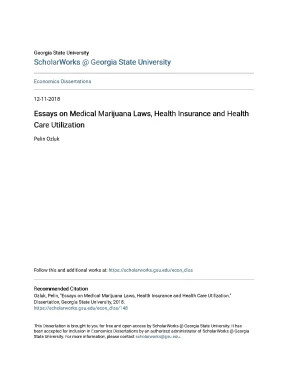
Tải xuống để đọc toàn bộGeorgia State University ScholarWorks @ Georgia State University Economics Dissertations 12-11-2018 Essays on Medical Marijuana Laws, Health Insurance and Health Care Utilization Pelin Ozluk Follow this and additional works at: https://scholarworks.edu/econ_diss Recommended Citation Ozluk, Pelin, "Essays on Medical Marijuana Laws, Health Insurance and Health Care Utilization." Dissertation, Georgia State University, 2018.edu/econ_diss/148 This Dissertation is brought to you for free and open access by ScholarWorks @ Georgia State University. It has been accepted for inclusion in Economics Dissertations by an authorized administrator of ScholarWorks @ Georgia State University. For more information, please contact scholarworks@gsu. ABSTRACT ESSAYS ON MEDICAL MARIJUANA LAWS, HEALTH INSURANCE AND HEALTH CARE UTILIZATION BY PELIN ÖZLÜK AUGUST 2018 Committee Chair: Charles Courtemanche Major Department: Economics National Health Expenditures Accounts estimates that U.S health care spending grew 4.3 percent from the previous year to reach $3.3 trillion, or $10,338 per person in 2016.
The overall share of gross domestic product (GDP) related to health care spending was 17.9 percent in 2016, up from 17. Moreover, increased use of opioid prescriptions led to excessive use and abuse of these drugs, resulting in nationwide “opioid epidemic”. This dissertation examines how different policy interventions contributed to the rise in health care utilization and prescribed opioids in U. The first chapter examines how medical marijuana laws changed utilization of prescription drugs with a special emphasis on prescribed opioids.
More than half of the US population lives in a state that has adopted medical marijuana laws (MMLs). Studies show that most medical marijuana patients use marijuana for managing their pain with the overwhelming majority of them preferring it to opioids. Despite ongoing pro-marijuana policies and the growing trend of public acceptance, the evidence on how people change their prescription use due to the availability of marijuana as an alternative treatment is limited. Using the variations across state MMLs between 1996 and 2014 of Medical Expenditure Panel Survey (MEPS) this paper estimates the effects of MMLs on prescription drug utilization, with a focus on opioids.
I find that MMLs lead to a $2.47 decrease in per person prescribed opioid spending among young adults (ages 18-39) over a year. Most of this decrease results from the intensive margin of use and MML states that allow home cultivation experience even larger decreases. Furthermore, the decreasing effects are persistent over time and they get stronger following the years of implementation. MMLs also decrease the number of opioid pill use among young adults.
I do not find any discernible impact on older populations' opioid utilization. I then investigate the effects on other prescriptions for which marijuana can be a potential substitute and find the allowance of dispensaries is generally associated with decreases, although the effects depend on the type of MML, the margin of use and age. The second chapter examines how universal insurance coverage affects health care utiliza- tion drawing evidence from the health reform of Massachusetts in 2006. This law reformed insurance markets, mandated that all residents in the state would be required to take up health insurance, and provided subsidies for lower-income individuals to purchase it.
Using data from MEPS between 2000 and 2015, I provide evidence that the Massachusetts health care reform increased counts of hospital and office-based medical provider visits significantly. The results were robust to using alternative control groups and different functional form as- sumptions. I find the reform's effects grew over time, reaching its maximum after 2010. The reform also increased health care expenditures and probability of health care service use significantly.
Finally, I use the reform to instrument for health insurance and estimate large impacts of insurance on health care utilization. The third chapter examines the impact of the Affordable Care Act on health care uti- lization. The Affordable Care Act (ACA) aimed to achieve nearly universal health insurance coverage in the United States through a combination of regulations, mandates, subsidies, exchanges, and Medicaid expansions. We use data from the Medical Expenditure Panel Survey (MEPS) to investigate the impacts of the ACA on the health care utilization and ex- penditures of non-elderly adults.
A difference-in-difference-in-differences strategy separately identifies the effects of the ACA's expansions of private and Medicaid coverage by leveraging variation in states' Medicaid expansion decisions and individuals' pre-ACA insurance status. Intuitively, impacts of the ACA's insurance expansions should be concentrated among those who lacked insurance prior to the law, and such individuals are more likely to be affected in states that participated in the Medicaid expansion. Similar methods have been used to study the ACA's effects on outcomes such as health insurance coverage, access to care, risky health behaviors, and self-assessed health. However, they have not been previously used to investigate impacts on health care spending.
Theoretically, the net effect on spending is ambiguous. On one hand, insurance lowers the effective price of care, which should increase utilization across-the-board. On the other hand, insurance improves access to primary and preventive care, which could potentially reduce use of expensive emergency services. The results suggest that the ACA increased health care utilization in some dimensions – in- cluding counts of inpatient hospital visits, medical-provider office visits and total counts of prescription fills, inpatient, outpatient, medical-provider office and ER visits combined on its first year.
However, these increases in health care utilization in counts were not observed in ACA's second year. We also found that the ACA increased coverage and led to significant gains in both expansion and non-expansion states consistent with what has been found by prior studies. This significant gain in insurance was not limited to ACA's first year but it carried to second year. ESSAYS ON MEDICAL MARIJUANA LAWS, HEALTH INSURANCE AND HEALTH CARE UTILIZATION BY PELIN ÖZLÜK A Dissertation Submitted in Partial Fulfillment of the Requirements for the Degree of Doctor of Philosophy in the Andrew Young School of Policy Studies of Georgia State University GEORGIA STATE UNIVERSITY 2018 Copyright by Pelin Özlük 2018 ACCEPTANCE This dissertation was prepared under the direction of Pelin Özlük’s Dissertation Committee.
It has been approved and accepted by all members of that committee, and it has been accepted in partial fulfillment of the requirements for the degree of Doctor of Philosophy in Economics in the Andrew Young School of Policy Studies of Georgia State University. Dissertation Chair: Charles Courtemanche Committee: James Marton Shiferaw Gurmu Jason Hockenberry Electronic Version Approved: Sally Wallace, Dean Andrew Young School of Policy Studies Georgia State University August, 2018 DEDICATION This dissertation is dedicated to my grandmother, Ayşe Dinç. iv ACKNOWLEDGMENTS I would like to express my deepest appreciation to my advisor, Chuck Courtemanche for guiding and supporting me over the years. Without his guidance this dissertation would not have been possible.
He has set an excellent example of a mentor, and role model for me. I would also express my gratitude to my dissertation committee members Jim Marton, Shif Gurmu and Jason Hockenberry for all of their guidance through this process; their discussion, ideas, and feedback have been invaluable. I would also like to thank Tom Mroz for always being available to discuss and guide my research, and Garth Heutel for his support. I am extremely grateful to my mom, Vicdan Dinç for her endless love, support and protection.
I would not have been who I am without her by my side. I am deeply grateful to my sister, Ekin Özlük for being my best friend and my guide in life. I am incredibly lucky to have her as my sister. I would also extend my deepest gratitude to my brother in law Jason Neymeyer who has been an excellent role model and my support system for me over the years.
I also owe many thanks to my father Kenan Özlük for always being on my side. I would like to extend my thanks to my best friends in life, Lale Seçginli and Aylin Kertik for their endless love and friendship. I am very grateful to have met you earlier in life so I could grow with you. I am deeply thankful to all the other great friends I have made in the program.
They have been incredibly supportive and made my experience at Georgia State fun. I want to specifically thank Rhita Simorangkir for her genuine friendship. Last but not least, I would like to express my gratitude to Kuzu, Koko, Buck and Teddy for filling my life with love and fun. v Table of Contents ACKNOWLEDGMENTS v List of Figures viii List of Tables ix Chapter 1 :The Effects of Medical Marijuana Laws on Utilization of Pre- scribed Opioids and Other Prescription Drugs 1 1.1 Medical uses of marijuana and substitutability with opioids .2 Effects of MMLs and contribution of this study .1 Data characteristics and two-part model .2 Effects on total number of opioid pills .3 Effects on the utilization of other prescription drugs.
27 Chapter 2 :The Impact of Universal Coverage on Health Care Utilization: Evidence from Massachusetts 29 2.2 Tests Related to Inference. 46 Chapter 3 :The Impact of the Affordable Care Act on Health Care Utiliza- tion 48 3.1 Effects of Health Insurance on Health Care Utilization .2 Effects of the 2014 Affordable Care Act .5 Sensitivity and Other Checks. 65 Appendix 103 References 112 VITA 121 vii List of Figures 1.1 Distribution of opioid expenditures - Ages 18+ .2 Results from event study analyses on opioid expenditures .1 Changes in Health Care Service Use Counts 2000 to 2015 .2 Changes in Health Care Service Use Spending 2000 to 2015. 69 viii List of Tables 1.1 Medical marijuana laws and provisions by state, 1996-2014 .2 Summary statistics for outcome variables .3 Summary statistics for control variables .4 Ages 18-39 - Average marginal effects on opioid spending .5 Ages 40-64 - Average marginal effects on opioid spending .6 Ages 65+ - Average marginal effects on opioid spending .7 Effects of different policy combinations on opioid expenditures .8 Average marginal effects on opioid pills .9 Other medicines Ages 18-39 .10 Other medicines Ages 40-64 .11 Other medicines Ages 65+ .12 Placebo Test Ages 18-39 .13 Placebo Test Ages 40-64 .14 Placebo Test Ages 65+ .1 Means of control variables .2 Means of outcome variables .3 Effects of the reform on health care utilization of counts: Average marginal effects from negative binomial .4 Effects of the reform on health care utilization of counts: Average marginal effects from hurdle model .5 Effects of the reform on health care utilization on spending: Average marginal effects from two-part model .6 Effects of the reform on health care utilization on the extensive margin: Av- erage marginal effects from probit .7 Effects of the reform on health care utilization on the intensive margin: Av- erage marginal effects from GLM .8 Match on pretreatment levels: Average marginal effects from negative binomial 86 2.9 Match on pretreatment trends: Average marginal effects from negative binomial 87 2.10 Match on pretreatment coverage: Average marginal effects from negative bi- nomial .11 New England states: Average marginal effects from negative binomial .12 Synthetic control group: Average marginal effects from negative binomial .13 Event study: Average marginal effects from negative binomial .1 Summary statistics for outcome variables for all the samples .2 Summary statistics for control variables .3 Effects of ACA on probability of having insurance coverage: LPM results .4 Effects of ACA on health care utilization of counts between 2013-2014: Aver- age marginal effects from negative binomial .5 Effects of ACA on health care utilization of counts between 2014-2015: Aver- age marginal effects from negative binomial .6 Effects of ACA on health care Utilization of Counts Between 2013-2014: Av- erage marginal effects from poisson .7 Effects of ACA on health care utilization of counts between 2014-2015: Aver- age marginal effects from poisson .8 Effect of ACA on health care expenditures 2013-2014: Average marginal ef- fects from two-part model (First part: Probit, Second part: GLM with a log link and gamma family) .9 Effect of ACA on probability of health care utilization 2013-2014: Average marginal effects from probit model .
Nội dung được bảo vệ bản quyền — Tải xuống đầy đủ
Trích dẫn luận án này
Pelin Özlük (2018). Luận án về Luật Cần sa Y tế, Bảo hiểm và Chăm sóc Sức khỏe [Luận án tiến sĩ, Georgia State University]. LuanAn.net. https://luanan.net/luat-hoc/luan-an-ve-luat-can-sa-y-te-bao-hiem-va-cham-soc-suc-khoe
Câu hỏi thường gặp
Luận án "Luận án về Luật Cần sa Y tế, Bảo hiểm và Chăm sóc Sức khỏe" nghiên cứu về vấn đề gì?
Luận án về Luật Cần sa Y tế, Bảo hiểm và Chăm sóc Sức khỏe: Phân tích chuyên sâu các vấn đề pháp lý, tài chính và y tế liên quan.
Luận án "Luận án về Luật Cần sa Y tế, Bảo hiểm và Chăm sóc Sức khỏe" được bảo vệ tại trường nào?
Luận án này được bảo vệ tại Georgia State University. Năm bảo vệ: 2018.
Luận án "Luận án về Luật Cần sa Y tế, Bảo hiểm và Chăm sóc Sức khỏe" thuộc chuyên ngành gì?
Luận án "Luận án về Luật Cần sa Y tế, Bảo hiểm và Chăm sóc Sức khỏe" thuộc chuyên ngành Economics. Danh mục: Luật Học.
Luận án "Luận án về Luật Cần sa Y tế, Bảo hiểm và Chăm sóc Sức khỏe" có bao nhiêu trang?
Luận án "Luận án về Luật Cần sa Y tế, Bảo hiểm và Chăm sóc Sức khỏe" có 135 trang. Bạn có thể xem trước một phần tài liệu ngay trên trang web trước khi tải về.
Cách tải luận án "Luận án về Luật Cần sa Y tế, Bảo hiểm và Chăm sóc Sức khỏe" về máy như thế nào?
Để tải luận án về máy, bạn nhấn nút "Tải xuống ngay" trên trang này, sau đó hoàn tất thanh toán phí lưu trữ. File sẽ được tải xuống ngay sau khi thanh toán thành công. Hỗ trợ qua Zalo: 0559 297 239.