Memoir of a bear clan womans educational journey
Hành trình học vấn của một phụ nữ tộc Gấu. Khám phá những bài học về văn hóa, sự trưởng thành và khám phá bản thân.
University of New Mexico
Language, Literacy, and Sociocultural Studies
Luan An
Luận án
Năm xuất bản
Số trang
230
Thời gian đọc
35 phút
Lượt xem
0
Lượt tải
0
Phí lưu trữ
50 Point
Tổng quan nhanh
- Chủ đề:
- Indigenous Educational Journey: Cultural Identity
- Số trang:
- 230 trang
- Trường:
- University of New Mexico
- Chuyên ngành:
- Language, Literacy, and Sociocultural Studies
- Tác giả:
- Angelina Frances Medina
- Năm:
- 2016
Tóm tắt nội dung luận án
I.Indigenous Educational Journey Cultural Identity
Angelina Frances Medina's memoir explores a profound cultural identity journey. Early life involved a deep immersion in Pueblo traditions. The Keres language was the primary mode of communication within family and community. This traditional upbringing formed a strong foundation. It shaped initial understandings of the world. Such experiences are crucial for Indigenous women's memoirs, offering unique insights into tribal heritage. The narrative highlights the strength derived from these early cultural connections. This upbringing contrasts sharply with later educational environments. The memoir details a significant cross-cultural learning experience. An encounter with White culture introduced English and a different world. Comic books and a Hershey bar symbolized this initial bridge. This marked a departure from the exclusively Pueblo existence. Navigating two distinct cultural landscapes became a central theme. The narrative reflects on adapting to new languages and customs. This transition deeply impacted a burgeoning cultural identity journey. It forced introspection on belonging and difference. American schooling presented significant academic challenges Indigenous students often face. Negative interactions with racist teachers severely damaged self-esteem. Confidence dwindled, fostering a strong aversion to formal education. The author describes dreading and hating school at all levels. This section highlights the detrimental effects of insensitive educational practices. It forms a critical part of the Native American education narrative. The struggle for self-worth within a hostile system is powerfully conveyed.
1.1. Traditional Pueblo Upbringing
Angelina Frances Medina's early life centered on deep Pueblo traditions. The Keres language was spoken exclusively within her family and community. This traditional upbringing established a strong foundation of cultural identity. It provided an authentic perspective on Indigenous ways of knowing. These initial experiences are vital to understanding the author's journey. Such foundational elements are common in Indigenous women's memoirs, reflecting a connection to ancestral heritage. This period shaped the author's worldview significantly.
1.2. Navigating Cross Cultural Worlds
A significant cross-cultural learning experience unfolded. The author encountered White people, introducing the English language and another world. Comic books and a Hershey bar symbolized this initial cultural bridge. This marked a shift from an exclusively Pueblo existence. Navigating these two distinct cultural landscapes became central. The narrative explores adapting to new languages and customs. This transition deeply impacted the ongoing cultural identity journey, fostering introspection and understanding cultural differences.
1.3. Early Schooling Challenges
American schooling brought significant academic challenges Indigenous students frequently experience. Negative encounters with racist teachers severely eroded self-esteem and confidence. This fostered a profound dislike for American schooling at all levels. The memoir describes dread and hatred associated with these early educational years. This section powerfully illustrates the detrimental effects of insensitive educational practices. It is a critical part of the Native American education narrative, highlighting systemic obstacles.
II.Pueblo Pedagogy s Impact Student Success
Accidentally becoming a teacher marked a profound turning point. The author implemented the Pueblo way of interacting with students. This approach drew directly from Indigenous knowledge systems. It offered a stark contrast to conventional American schooling methods. Students shared similar life experiences, fostering a deep connection. This innovative method cultivated positive classroom dynamics. It represented a deliberate shift in Native American education practices. The focus moved towards culturally relevant instruction. Implementing Pueblo epistemology and pedagogy yielded remarkable results. Student negative behavior transformed into positive engagement. A strong sense of responsibility for studies emerged within the classroom. The learning environment became supportive and genuinely empowering. This transformation demonstrates the inherent power of culturally appropriate education. It effectively addresses previous academic challenges Indigenous learners faced. The new methods cultivated a nurturing space for growth. This is a testament to resilience and education working effectively together. Students surprised themselves by catching up and advancing academically. They achieved higher levels of achievement, often beyond their expectations. This success stemmed from understanding and applying traditional Pueblo ways. The integration of cultural perspectives proved vital for their learning. This highlights the effectiveness of Indigenous knowledge systems in practical application. It underscores the potential for academic excellence when culture is respected. The memoir provides compelling evidence of this transformative educational approach. It offers a powerful model for future Native American education initiatives, emphasizing cultural integration.
2.1. Adopting Indigenous Teaching Methods
A pivotal moment occurred when the author became a teacher. Traditional Pueblo ways of interacting with students were freely implemented. This approach leveraged Indigenous knowledge systems, providing a stark alternative to mainstream methods. Students, many sharing similar life experiences, responded positively. This culturally informed pedagogy began to transform the classroom. It showcased a dedication to culturally relevant Native American education, moving beyond conventional paradigms.
2.2. Transforming Classroom Environments
The application of Pueblo epistemology and pedagogy created significant change. Students' previously negative behaviors shifted to positive engagement. A sense of responsibility for their studies emerged. The classroom environment became supportive and empowering, fostering genuine learning. This transformation demonstrates the efficacy of culturally sensitive education. It actively addresses and overcomes academic challenges Indigenous students often encounter. The methods built resilience and promoted a conducive learning atmosphere.
2.3. Student Achievement through Culture
Students achieved remarkable academic success, surprising themselves by advancing rapidly. This achievement was directly linked to the implementation of Pueblo cultural approaches. The integration of traditional perspectives proved instrumental in their learning journey. This section highlights the power of Indigenous knowledge systems in fostering academic excellence. It underscores the importance of cultural respect within Native American education. The memoir provides compelling evidence of this culturally-driven student achievement.
III.Overcoming Academic Challenges A Bear Clan Narrative
The dissertation functions as a powerful Indigenous women's memoir. It directly confronts profound schooling adversity experienced by the author. Negative interactions with racist teachers are explicitly detailed. These incidents significantly damaged self-esteem and overall confidence. The narrative bravely recounts feelings of dread and hatred towards American schooling systems. This portrayal illuminates common academic challenges Indigenous students have historically faced. It provides a raw, honest account of systemic failures within education. The memoir serves as a powerful historical record, documenting personal struggle. Despite profound negative experiences, a journey of healing and restoration unfolded. The transition to teaching, though accidental, marked a significant personal shift. It was within this role that self-confidence began to rebuild. The act of empowering students, in turn, empowered the teacher herself. This forms a core part of the personal growth narrative, showcasing resilience and education. The ability to overcome past traumas and thrive is central to the story. It underscores the capacity for remarkable personal restoration. The author's academic path culminated in a Ph.D. from the University of New Mexico. This achievement stands as a profound testament to immense perseverance and dedication. Earlier degrees in Elementary Education, Humanities, and Educational Administration preceded this milestone. The dissertation itself represents a major academic and personal triumph. It fulfills the rigorous requirements in Language, Literacy, and Sociocultural Studies. This impressive trajectory showcases unwavering commitment to lifelong learning. It defies the early academic challenges Indigenous students often encounter. This is a remarkable story of sustained educational triumph against adversity.
3.1. Confronting Schooling Adversity
This Indigenous women's memoir directly addresses past educational adversity. Details include negative experiences with racist teachers. These interactions severely impacted the author's self-esteem and confidence. The narrative recounts feelings of dread and hatred for American schooling. This portrayal highlights significant academic challenges Indigenous students faced. It offers an honest account of systemic shortcomings and personal struggle within educational institutions.
3.2. Restoring Self Confidence
Despite profound negative schooling experiences, a journey of healing emerged. The transition into teaching, albeit accidental, proved pivotal. In this new role, self-confidence began to rebuild. Empowering students had a reciprocal effect, empowering the teacher. This forms a central part of the personal growth narrative. It illustrates a powerful example of resilience and education, demonstrating the capacity to overcome past traumas and achieve personal restoration through meaningful work.
3.3. Educational Milestones Achieved
The author's academic journey culminated in a Ph.D. from the University of New Mexico. This significant achievement stands as a testament to immense perseverance. Earlier degrees included Elementary Education, Humanities, and Educational Administration. The dissertation itself fulfilled requirements in Language, Literacy, and Sociocultural Studies. This impressive trajectory showcases unwavering dedication to higher learning. It directly counters the early academic challenges Indigenous students often face, marking a profound educational triumph.
IV.First Nations Spirituality Guiding Education
The memoir implicitly highlights the profound role of First Nations spirituality and traditional wisdom. Pueblo cultural interactions formed the core of the author's teaching philosophy. The 'Pueblo way' emphasizes community, respect, and holistic learning approaches. These principles are deeply rooted in ancient tribal values and worldviews. They offer an alternative, enriching framework to dominant Western educational models. The narrative showcases the practical, effective application of this Indigenous wisdom. It demonstrates its efficacy across diverse educational settings. This represents a significant contribution to Indigenous knowledge systems, providing a vital perspective. Effective pedagogy within the classroom stemmed from authentic, culturally grounded interactions. The teacher connected with students on a deeply shared experience level. This fostered trust, mutual understanding, and a sense of belonging. Such interactions are foundational to Tribal traditions learning. They create an environment where students feel seen, valued, and respected. This approach contrasts sharply with impersonal, mainstream educational methods. It underscores the transformative power of cultural relevance in education. The memoir provides compelling evidence of this successful, culturally responsive teaching. The 'Bear Clan Woman' identity permeates the entire narrative. This specific tribal affiliation suggests a deeper connection to ancestral lineage and inherent responsibilities. This identity likely influences the author's values, perspectives, and unique teaching approaches. It is an integral and shaping part of the author's cultural identity journey. This rich heritage profoundly informs the dedication to community well-being and education. It subtly guides the author's personal path and pedagogical methodologies. The memoir reflects the enduring and profound impact of this powerful ancestral legacy.
4.1. Incorporating Tribal Wisdom
The memoir subtly emphasizes the guiding role of First Nations spirituality and wisdom. Pueblo cultural interactions formed the basis of the author's teaching philosophy. Principles of community and holistic learning, inherent in tribal traditions, are highlighted. These values provide an alternative framework to Western education. The narrative demonstrates the practical application of this Indigenous wisdom. It showcases its effectiveness, contributing significantly to Indigenous knowledge systems.
4.2. Cultural Interactions in Pedagogy
Effective teaching emerged from genuine cultural interactions. The author connected with students through shared experiences, fostering trust and understanding. These interactions are fundamental to Tribal traditions learning. They create a classroom environment where students feel valued. This culturally relevant approach contrasts with mainstream methods, proving more impactful. The memoir provides clear evidence of this successful, relationship-based pedagogy, enhancing student engagement and learning outcomes.
4.3. Bear Clan Identity s Influence
The 'Bear Clan Woman' identity is central to the narrative. This tribal affiliation suggests a deep connection to ancestral lineage and cultural responsibilities. This identity likely shapes the author's values, perspectives, and teaching methods. It is a crucial element of the cultural identity journey described. This heritage profoundly informs the dedication to community and education, guiding the author's path. The memoir reflects the enduring impact of this powerful legacy.
V.Resilience and Education A Native American Memoir
The entire work stands as a powerful testament to resilience and education. Despite significant early negative experiences, a relentless pursuit of learning continued. The journey through multiple advanced degrees demonstrates unwavering commitment. Obstacles and prejudices encountered did not deter the author's progress. This perseverance is a distinguishing hallmark of many Indigenous women's memoirs. It showcases the immense strength required to navigate biased educational systems. The narrative truly embodies a spirit of enduring through profound adversity. Angelina Frances Medina's story is a profound personal growth narrative. It traces an evolution from early childhood innocence to academic leadership. The transformation from a student scarred by racism to an empowering educator is truly remarkable. This profound internal shift speaks to deep personal strength and courage. It offers significant inspiration to those facing similar systemic struggles. The memoir beautifully illustrates a journey of continuous self-discovery. It emphasizes the ongoing process of learning and evolving, even in challenging environments. The memoir contributes significantly to the field of Native American education. It offers a powerful model of resilience for future generations of students and educators. The successful integration of Pueblo pedagogy leaves a lasting, positive legacy. It challenges and re-evaluates conventional educational approaches. The narrative encourages a critical re-evaluation of teaching methods and philosophies. This work inspires others facing academic challenges Indigenous to persevere. It champions the transformative power of cultural authenticity in achieving enduring educational success and fostering community well-being.
5.1. Perseverance in Academic Pursuits
The memoir exemplifies profound resilience and education. Despite early negative experiences, a relentless pursuit of knowledge persisted. The journey through multiple advanced degrees underscores unwavering commitment. Obstacles and systemic prejudices did not hinder progress. This perseverance characterizes many Indigenous women's memoirs. It highlights the strength required to navigate challenging educational systems. The narrative embodies a powerful spirit of enduring adversity.
5.2. Personal Growth Narrative Unveiled
Angelina Frances Medina's story is a compelling personal growth narrative. It charts an evolution from childhood to academic leadership. The transformation from a student scarred by racism to an empowering educator is profound. This journey speaks to deep internal strength and courage. It offers inspiration to individuals facing similar struggles. The memoir beautifully illustrates continuous self-discovery and the power of ongoing learning and adaptation.
5.3. Legacy of Educational Resilience
The memoir makes a significant contribution to Native American education. It provides a powerful model of resilience for future generations. The successful integration of Pueblo pedagogy creates a lasting legacy. It challenges conventional educational approaches and philosophies. The narrative encourages a re-evaluation of teaching methods. This work inspires others facing academic challenges Indigenous to persevere. It champions cultural authenticity in achieving educational success.
VI.Indigenous Knowledge Systems Transformative Teaching
The memoir meticulously details the practical application of Pueblo epistemology. This system of knowledge emphasizes relationality, observation, and experiential learning. It stands in direct contrast to Western, individualistic paradigms of education. The author's classroom became a living example of these principles in action. This practical demonstration clearly highlights the efficacy of traditional Indigenous ways. It provides a tangible model for integrating Indigenous knowledge systems into modern educational frameworks. The approach fostered a deeper, more meaningful, and culturally relevant learning process for students. Pueblo pedagogy proved to be an exceptionally powerful tool for positive change. It effectively transformed both student behavior and academic outcomes within the classroom. The methods employed were gentle, consistently culturally affirming, and highly effective in practice. This represents a significant and valuable contribution to Native American education. It champions an approach that profoundly respects and actively leverages students' cultural backgrounds. The narrative strongly suggests that true learning flourishes in culturally responsive environments. This pedagogy offers a compelling blueprint for future educational reform initiatives. The memoir fundamentally redefines what constitutes educational success. It moves beyond narrow, standardized metrics to encompass holistic student development. Students not only achieved impressive academic results but also grew significantly in personal responsibility. This comprehensive success stemmed directly from methods rooted in Tribal traditions learning. It challenges the prevailing, often limited, notions of educational achievement. The work powerfully advocates for an education that nurtures identity, fosters community bonds, and promotes well-being. The positive impact on student lives was truly profound and enduring.
6.1. Pueblo Epistemology in Practice
The memoir meticulously describes the application of Pueblo epistemology. This knowledge system values relationality, observation, and experiential learning. It contrasts sharply with Western individualistic paradigms. The author's classroom exemplified these principles in action. This practical demonstration highlights the efficacy of traditional ways. It provides a tangible model for integrating Indigenous knowledge systems into modern education. The approach fostered deeper, more meaningful learning.
6.2. Pedagogy for Positive Change
Pueblo pedagogy emerged as a powerful catalyst for positive change. It transformed student behavior and academic outcomes significantly. The methods, gentle and culturally affirming, proved highly effective. This represents a substantial contribution to Native American education. It advocates for an approach that respects and leverages cultural backgrounds. The narrative suggests that true learning thrives in culturally responsive environments. This pedagogy offers a blueprint for educational reform and success.
6.3. Redefining Educational Success
The memoir redefines educational success beyond standardized metrics. It encompasses holistic student development, including academic achievement and personal responsibility. This success stemmed from methods rooted in Tribal traditions learning. It challenges conventional notions of achievement in education. The work advocates for an education that nurtures identity and community. It provides a compelling argument for culturally grounded teaching, demonstrating profound impact on student lives.
Tải xuống file đầy đủ để xem toàn bộ nội dung
Tải đầy đủ (230 trang)Trích đoạn nội dung luận án
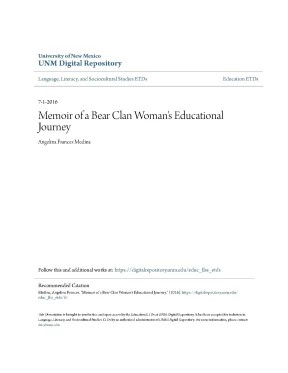
Tải xuống để đọc toàn bộUniversity of New Mexico UNM Digital Repository Language, Literacy, and Sociocultural Studies ETDs Education ETDs 7-1-2016 Memoir of a Bear Clan Woman's Educational Journey Angelina Frances Medina Follow this and additional works at: https://digitalrepository.edu/educ_llss_etds Recommended Citation Medina, Angelina Frances. "Memoir of a Bear Clan Woman's Educational Journey.edu/ educ_llss_etds/61 This Dissertation is brought to you for free and open access by the Education ETDs at UNM Digital Repository. It has been accepted for inclusion in Language, Literacy, and Sociocultural Studies ETDs by an authorized administrator of UNM Digital Repository. For more information, please contact disc@unm.
Angelina Frances Medina Candidate Language, Literacy, and Sociocultural Studies Department This dissertation is approved, and it is acceptable in quality and form for publication: Approved by the Dissertation Committee: Dr. Lucretia Pence, Chairperson Dr. Carlos Lopez-Leiva Dr. Donald Zancanella MEMOIR OF A BEAR CLAN WOMAN’S EDUCATIONAL JOURNEY By Angelina Frances Medina B., Elementary Education, Fort Lewis College, 1974 B., Humanities, Fort Lewis College, 1974 M., Educational Administration, University of New Mexico, 1978 DISSERTATION Submitted in Partial Fulfillment of the Requirements for the Degree of Doctor of Philosophy Language, Literacy, and Sociocultural Studies The University of New Mexico Albuquerque, New Mexico July, 2016 Dedication Joe Medina of Zia Pueblo, the best dad ever, this is for you! Calsue Murray, my wonderful and most patient husband, your loving heart carried me; this is for you, as well! iii Acknowledgements First and foremost acknowledgements are made to the students who taught me to listen, hear, and do or this memoir might not have become a reality.
Loving thanks to my husband, Calsue Murray, for your patience, endless encouragement and support, day and night! Special thanks to my wonderful dissertation chairperson, Dr. Lucretia Penny Pence, for your endless encouragement, support, and for providing a different and valuable perspective when I least expected but who also provided the guidance and direction needed for me to successfully complete my dissertation. I must also give my heartfelt thanks to the rest of my dream team, Dr. Carlos Lopez-Leiva, and Dr.
Don Zancanrella for your wonderful support, beautiful praises for my memoir, and for passing me with Distinction! Loving thanks also to friends and colleagues Dr. LaNysha Adams-Foss, Laurie Ihm, Erin Hulse, and Anni Lemming for your endless support through thick and thin. iv MEMOIR OF A BEAR CLAN WOMAN’S EDUCATIONAL JOURNEY By ANGELINA FRANCES MEDINA B., Elementary Education, Fort Lewis College, 1974 B., Humanities, Fort Lewis College, 1974 M., Educational Administration, University of New Mexico, 1978 Ph., Language, Literacy, and Sociocultural Studies, University of New Mexico, 2016 ABSTRACT This study utilizes memoir, a qualitative research method, to tell how a Pueblo teacher’s Pueblo cultural interactions with her students led to positive classroom behavior and achievement. It describes three diverse and separate sets my life experiences, in thematic chapters, that took place.
I describe my Pueblo traditional upbringing and interactions with family and community wherein I spoke only the Keres language. Then, I describe my first encounter with White people who introduced me to the foreign language of English and another world, through comic books and a Hershey bar. I was introduced into American schooling where negative experiences with racist teachers shredded my esteem and self confidence enough to dread and hate American schooling at all levels. Later, when I accidentally became a teacher, I freely implemented the Pueblo way of interacting with and teaching my students whose life experiences were very much similar to mine! In implementing Pueblo epistemology and pedagogy, my students’ negative behavior became positive.
They accepted responsibility to improve their studies and surprised themselves by catching up and advancing into higher levels of achievement. v Table of Contents Chapter 1: Memoir. 3 Chapter 3: Sick of School. 5 Chapter 4: Shra-me.
13 Conflicting, Confusing, Misguiding Messages. 14 Consequences of Colonial America Not Being Shra-me. 15 Top of the World. 17 Wanna-be Scientist.
19 Examples of the Bureau of Indian Affairs not Being Shra-me. 20 Be Proud, Third Graders, for Being Shra-me. 38 Chapter 5: New Horizons and Realizations. 52 Native American Language Teacher’s Institute at UNM.
54 Isleta – My First Lessons. 55 Chapter 6: Amazing Discoveries. 69 Hershey Bars and Little Lulu. 69 On My Own in San Francisco and College.
83 “Don’t Cry, Lie!”. 84 vi No More Broken English!. 88 Fort Lewis College – Who Me?. 90 Chapter 7: Exploring, Discovery, Practicing and Learning.
94 Consequences of Favoritism. 94 Student Teaching Internship. 95 Chapter 8: Students and Teacher Learning Together. 98 Fantastic Fifth Graders.
99 To Share or Not to Share – That was the Question. 100 Students’ Voice and Choice. 110 Planning for the Future. 116 Learning Big Words.
120 Throw Out the Spelling Book!. 121 Fifth Graders Meet Third Grader’s Challenge. 124 Overcoming Writing Challenges. 127 Curiosity Earns an Excursion Trip.
137 Chapter 9: Why, How Come, Because…. 142 vii I Can’t Be One. 145 Third Time Around – Revolving Door. 146 No Piano Lessons for You!.
148 You Were Supposed to Punish Him!. 149 Chapter 10: Recognition – Skill Sets Appreciated!. 158 Miss Indian Expo - Key to College. 159 In the Shadow of My Dreams.
161 Chapter 11: Birth, Identity and Roots. 165 Traditional Pueblo Upbringing. 173 Daily Life in Our Ancient Dwelling. 174 Weedima and Chuyai.
176 My Brother, My Teacher. 177 Tsiya aka Zia. 180 My Many Names. 186 Chapter 12: In Beauty It Begins.
188 Pueblo Life Core Curriculum. 190 Exploring the Natural World. 193 Dedication and Diligence. 194 The Field Trips Became a Reality.
196 Researching – A New Experience. 200 Chapter 13: In Beauty We Were. 206 Please Donate Computers. 208 Chapter 14: Sacred Space.
220 ix Chapter 1: Memoir Memoir is a self-narrative, a qualitative research method, that depends on memory, poems, personal essays, or journals to tell one’s story (Chang, 2007). The first thing that a writer needs to consider is the point and purpose for writing the memoir initially (Kirby & Latta, 2007). In this memoir the writer needs to focus on the question “so what happened to me” that relates to the research question for this particular memoir, “How does a Pueblo teacher’s cultural background guide her interaction with her students?” This helps the writer “to know the message and the point that they want to develop and emphasize in their memoir pieces (Kirby & Latta, 2007)” that readers may relate to their own lives. Will someone identify with the memoirist’s story enough to find meaning in their own lives? How will that story change their lives? What is it that the writer wants their reader to understand as a result of reading the memoir? Memoir, written by individuals who want to tell a story, using data from their memory cannot conform to a dissertation format because there is no one way of collecting data.
According to Victor Villanueva, “Memory simply cannot be adequately portrayed in the conventional discourse of the academy. I am grateful for the acknowledgment of perceptions that academic discourse provides, for the resources the conventions of citation make available, for the ideocentric discourse that displays inductive or deductive lines of reasoning, a way to trace a writer’s logical connections. Academic discourse is cognitively powerful! But the cognitive alone is insufficient. It can be strong for logos.
It can be strong for ethos. But it is very weak in pathos. Academic discourse tries, after all, to reach the Aristotelian ideal of being completely logocentric, though it cannot be freed of the ethical appeal to authority (Villanueva, 1993).” 1 Research studies have been conducted by collecting self-narratives from authors which were then published in a book called Stories of Experience and Narrative Inquiry (Clandinin & Connelly, 2000). This book contains personal narratives of various memoir genres written by teachers of their personal stories.
These stories were used in the authors’ studies of educational experience. There is no one way of using memoir as methodology. Poetic inquiry (Pelias, 2013) that reveals the memorist’s emotions felt from experiences of curiosity, critical thinking, sadness, depression, or elation and enlightenment is another strong way of expressing or telling a story. Poetry is a way of expressing one’s thoughts on the injustices that occur in one’s life time and then using poetry as a way of slinging those stings away as it has been done in this memoir to make a point.
Memoirs are selective in that “memoirists focus on the most significant experiences in their lives” on those “hours and minutes that are keen in their lives –the time when the memoirist felt or was most alive, when experiences penetrate to the quick (Phifer, 2000). These can then be organized into thematic chapters to tell a story. 2 Chapter 2: Introduction Racism toward Native American people continues as lawmakers in Washington, D. verbalize we should have equality in all ways.
Unfortunately, their idea of equality is inequality for Native people and Native Students. So much of what is supposed to be fair to Native people is in conflict with the American mainstream way of life. This is also true in the Public schools as it is in Bureau of Indian Education funded schools. Institutional racism results from ignorance that is threaded in covert and overt racism.
For decades, institutional racism has been the conscious and unconscious exclusion from the curriculum of American Indian history, culture, languages, literacy, and instructional practices relevant to students’ lives. As I have described my student behavior in American schools, students who have been mistreated similarly exhibit reactive-passive behavior, like I did. Some teachers may claim that Pueblo students have delayed adolescence because such students, in their estimation, become resistant but this resistance may actually be an expression of hopelessness and powerlessness. I grew up in Public schools where racist attempts were made to mold me and shape me into a brown-skinned Indian Caucasian thinking American.
I have resisted being controlled, by teachers and public school administrators, as have my ancestors and those who came after me. The resistance by Native students is what many Caucasian teachers complain about. We, Native students, are resilient. Our resistance and resiliency and reasons behind them are still misunderstood.
My writing about our Pueblo way of teaching and learning will hopefully bring insightful enlightenments as to how a Pueblo teacher’s Pueblo cultural interaction with her students lead to positive classroom behavior and achievement that pre- service teachers and seasoned teachers can attempt to model with their diverse students. 3 I want Indian students to be acknowledged for the life experiences they bring to school that make enormous contributions not only to their classmates but to their teachers as well. I want teachers to understand that learning a foreign language when one’s own language is not written or based on Latin is an insurmountable challenge. English, with all its rules and complexities, has little in common with an oral language based on a Pueblo way of life.
English is complicated. It’s frustrating and stressful. Honest communication is important to the practice of respect, acknowledgements, and sincere compliments in a safe and harmonious classroom environment. Most Pueblo and other Native American children enter schools with lived experiences that have formed much of their identity and knowledge about family and community duties and responsibilities.
This includes their knowledge about school rules and classroom self discipline. It is common for Pueblo children to have voice in making family decisions at an early age. It is also very common for them to have choices in duties in the home and community. I would strongly encourage this type of interaction with students.
Nội dung được bảo vệ bản quyền — Tải xuống đầy đủ
Trích dẫn luận án này
Angelina Frances Medina (2016). Memoir of a bear clan womans educational journey [Luận án tiến sĩ, University of New Mexico]. LuanAn.net. https://luanan.net/nghien-cuu-van-hoa/dan-toc-hoc/memoir-of-a-bear-clan-womans-educational-journey
Câu hỏi thường gặp
Luận án "Memoir of a bear clan womans educational journey" nghiên cứu về vấn đề gì?
Hành trình học vấn của một phụ nữ tộc Gấu. Khám phá những bài học về văn hóa, sự trưởng thành và khám phá bản thân.
Luận án "Memoir of a bear clan womans educational journey" được bảo vệ tại trường nào?
Luận án này được bảo vệ tại University of New Mexico. Năm bảo vệ: 2016.
Luận án "Memoir of a bear clan womans educational journey" thuộc chuyên ngành gì?
Luận án "Memoir of a bear clan womans educational journey" thuộc chuyên ngành Language, Literacy, and Sociocultural Studies. Danh mục: Dân Tộc Học.
Luận án "Memoir of a bear clan womans educational journey" có bao nhiêu trang?
Luận án "Memoir of a bear clan womans educational journey" có 230 trang. Bạn có thể xem trước một phần tài liệu ngay trên trang web trước khi tải về.
Cách tải luận án "Memoir of a bear clan womans educational journey" về máy như thế nào?
Để tải luận án về máy, bạn nhấn nút "Tải xuống ngay" trên trang này, sau đó hoàn tất thanh toán phí lưu trữ. File sẽ được tải xuống ngay sau khi thanh toán thành công. Hỗ trợ qua Zalo: 0559 297 239.