Luận văn: Địa chất & Địa hóa Vùng núi lửa Uvas và Cao nguyên Rubio, New Mexico
Khám phá địa chất & địa hóa độc đáo của Vùng núi lửa Uvas, New Mexico. Phân tích chuyên sâu về hoạt động magma và thành phần khoáng sản.
Missouri State University
Geospatial Sciences in Geography, Geology, and Planning
Luan An
Luận văn thạc sĩ
Năm xuất bản
Số trang
113
Thời gian đọc
17 phút
Lượt xem
1
Lượt tải
0
Phí lưu trữ
40 Point
Tổng quan nhanh
- Chủ đề:
- Địa chất Vùng núi lửa Uvas: Cấu trúc & Hình thái
- Số trang:
- 113 trang
- Trường:
- Missouri State University
- Chuyên ngành:
- Geospatial Sciences in Geography, Geology, and Planning
- Tác giả:
- Max Logan Hoffman
- Năm:
- 2017
Tóm tắt nội dung luận án
I.Địa chất Vùng núi lửa Uvas Cấu trúc Hình thái
Vùng nam-trung New Mexico nổi bật với các sự kiện kiến tạo Kainozoi. Các sự kiện này tạo ra một hệ thống nguồn magma phức tạp. Điều này dẫn đến hoạt động núi lửa đa dạng và sự tiến hóa magma trong khu vực. Nghiên cứu tập trung vào vùng núi lửa Uvas (UVF) và Đá Rubio Peak. Các dữ liệu cấu trúc và phân bố không gian được thu thập. Việc này giúp hiểu rõ sự hình thành và phát triển của các nguồn magma liên quan. Các đá núi lửa được lựa chọn dựa trên tầm quan trọng của chúng. Chúng giúp xác định thời điểm tương đối của các sự kiện chuyển tiếp magma và kiến tạo.
1.1. Các sự kiện kiến tạo Kainozoi ở New Mexico
New Mexico trải qua nhiều sự kiện kiến tạo Kainozoi. Các sự kiện này tạo ra hệ thống nguồn magma phức tạp. Hoạt động núi lửa đa dạng phản ánh quá trình này. Khu vực nghiên cứu là trọng điểm của các biến đổi địa chất quan trọng. Các cơ chế kiến tạo định hình cảnh quan núi lửa hiện tại.
1.2. Di chuyển magma tại Núi lửa Uvas
Di chuyển magma phụ thuộc vào các vết nứt kéo giãn. Các vết nứt này có xu hướng Tây Bắc/Đông Nam. Chúng dần trở thành các khe dẫn magma. Dữ liệu không gian hỗ trợ hiểu biết về đường di chuyển của magma. Cấu trúc địa chất kiểm soát sự phun trào.
1.3. Sự hình thành đê núi lửa
Sự hình thành đê núi lửa được giải thích bằng cơ chế kéo căng. Các đoạn đê đứt đoạn cắt ngang ứng suất giãn nở. Điều này định hình cấu trúc vùng núi lửa Uvas. Quá trình này tạo ra các kênh dẫn magma lên bề mặt. Hiểu biết này quan trọng cho địa chất New Mexico.
II.Địa hóa Núi lửa Uvas Nguồn gốc Magma Quá trình
Nghiên cứu sử dụng dữ liệu địa hóa và thạch học để phân tích nguồn magma. Phân tích này so sánh vùng núi lửa Uvas và Đá Rubio Peak. Mục tiêu là làm rõ mối quan hệ và sự khác biệt giữa các nguồn magma. Các kết quả từ tỷ lệ đồng vị oxy và phóng xạ được sử dụng. Chúng cung cấp cái nhìn sâu sắc về quá trình nhiễm bẩn và nguồn gốc mantle. Điều này làm nổi bật sự phức tạp của địa hóa núi lửa trong khu vực.
2.1. Nghiên cứu địa hóa các đá núi lửa
Dữ liệu địa hóa được thu thập từ vùng núi lửa Uvas. Dữ liệu này giúp hiểu sự phát triển nguồn magma. Các nghiên cứu tập trung vào thành phần hóa học của đá. Phân tích thành phần nguyên tố vết và đồng vị cung cấp thông tin chi tiết. Chúng xác định nguồn gốc và quá trình tiến hóa của magma.
2.2. Nguồn magma bị biến đổi ở Uvas
Các đá núi lửa Uvas bị nhiễm bẩn nặng. Giá trị đồng vị oxy δ18O cao và thấp được quan sát. Điều này cho thấy sự tương tác mạnh mẽ với vỏ Trái Đất. Quá trình nhiễm bẩn làm thay đổi thành phần hóa học ban đầu của magma. Đây là đặc điểm nổi bật của địa hóa núi lửa Uvas.
2.3. Quá trình tiến hóa magma
Các sự kiện núi lửa và kiến tạo Kainozoi định hình quá trình tiến hóa magma. Sự đa dạng hóa magma diễn ra trong khu vực. Điều này tạo ra nhiều loại đá núi lửa khác nhau. Nghiên cứu làm sáng tỏ các cơ chế kiểm soát sự tiến hóa này. Phân tích địa hóa là chìa khóa để hiểu quá trình.
III.Hoạt động núi lửa Kainozoi Bối cảnh New Mexico
Khu vực nam-trung New Mexico được biết đến với hoạt động núi lửa Kainozoi. Các sự kiện này tạo ra một hệ thống phức tạp các nguồn magma và cấu trúc kiến tạo. Việc nghiên cứu các đá núi lửa từ vùng Uvas và Rubio Peak là cần thiết. Chúng giúp làm sáng tỏ sự tăng trưởng và phát triển của các nguồn mantle liên quan. Phân tích này đặt trong bối cảnh rộng lớn hơn của địa chất New Mexico và các sự kiện kiến tạo khu vực.
3.1. Sự hình thành các trường núi lửa Kainozoi
Vùng nam-trung New Mexico đặc trưng bởi hoạt động núi lửa Kainozoi. Các trường núi lửa lớn hình thành tại đây. Chúng bao gồm vùng núi lửa Uvas và Mogollon-Datil. Sự hình thành này liên quan đến các lực kiến tạo khu vực. Các trường núi lửa này là bằng chứng cho hoạt động địa chất mạnh mẽ.
3.2. Vai trò của Rio Grande Rift
Rio Grande Rift đóng vai trò quan trọng trong kiến tạo khu vực. Các hoạt động kéo giãn kiến tạo tạo điều kiện cho magma trồi lên. Khu vực này trải qua quá trình giãn nở mạnh mẽ. Sự nứt vỡ của vỏ Trái Đất tạo ra các kênh dẫn dung nham. Điều này góp phần vào hoạt động núi lửa Kainozoi.
3.3. Thời điểm chuyển tiếp kiến tạo và magma
Các đá núi lửa được chọn dựa trên tầm quan trọng của chúng. Chúng cung cấp thông tin về thời điểm chuyển tiếp kiến tạo. Các sự kiện magma và kiến tạo liên quan chặt chẽ. Việc xác định thời gian này là trọng tâm của nghiên cứu địa chất. Nó giúp hiểu lịch sử phát triển của khu vực.
IV.Phân tích Đá núi lửa Uvas và Rubio Peak
Nghiên cứu thực hiện phân tích địa hóa và thạch học trên các đá núi lửa. Các mẫu từ vùng núi lửa Uvas và Đá Rubio Peak được so sánh. Mục tiêu là khám phá mối quan hệ và sự khác biệt về nguồn magma. Các kết quả từ tỷ lệ đồng vị oxy và phóng xạ được sử dụng để đánh giá. Phân tích này làm rõ sự tiến hóa của magma trong các trường núi lửa khác nhau ở New Mexico.
4.1. So sánh nguồn magma Uvas và Rubio Peak
Mối quan hệ và sự khác biệt về nguồn magma được phân tích. Dữ liệu địa hóa và thạch học cung cấp thông tin chi tiết. Nguồn gốc của các loại đá được xác định. So sánh này là chìa khóa để hiểu sự tiến hóa magma khu vực. Nó làm nổi bật sự đa dạng của các quá trình hình thành đá.
4.2. Đặc điểm địa hóa của Rubio Peak
Đá Rubio Peak phản ánh một nguồn mantle đồng nhất. Nguồn này tương đối khác biệt so với mảng mantle khác. Tỷ lệ đồng vị phóng xạ và oxy cung cấp bằng chứng. Sự đồng nhất này khác với sự nhiễm bẩn của đá núi lửa Uvas. Điều này cho thấy các nguồn magma khác nhau.
4.3. Quan trọng trong nghiên cứu địa chất
Việc so sánh giúp hiểu rõ hơn về sự phát triển magma. Nghiên cứu này cung cấp cái nhìn về quá trình hình thành vỏ Trái Đất. Nó làm sáng tỏ các sự kiện kiến tạo khu vực. Các kết quả có giá trị cho địa chất New Mexico. Chúng đóng góp vào hiểu biết về các hệ thống núi lửa.
V.Đặc điểm Đá núi lửa Bazan Andesit Rhyolit
Vùng núi lửa Uvas và các trường liên quan ở New Mexico chứa nhiều loại đá núi lửa. Sự đa dạng này phản ánh các quá trình magma phức tạp. Các loại đá chính thường bao gồm dung nham bazan, andesit và rhyolit. Mỗi loại đá mang dấu vết địa hóa riêng. Chúng cung cấp thông tin quan trọng về nguồn gốc và quá trình tiến hóa magma. Hiểu biết về các loại đá này là cần thiết để giải mã lịch sử núi lửa của khu vực.
5.1. Thành phần đa dạng của đá núi lửa
Vùng núi lửa Uvas chứa nhiều loại đá núi lửa. Sự đa dạng này phản ánh quá trình tiến hóa magma phức tạp. Các loại đá bao gồm bazan, andesit và rhyolit. Mỗi loại có thành phần hóa học và khoáng vật đặc trưng. Chúng hình thành từ các giai đoạn magma khác nhau.
5.2. Dung nham bazan và Andesit bazan
Dung nham bazan là loại đá phổ biến trong vùng. Andesit bazan cũng xuất hiện đáng kể. Thành phần hóa học của chúng cung cấp thông tin về nguồn magma sâu. Các đá này thường là sản phẩm của magma nguyên thủy. Chúng là chỉ báo quan trọng của hoạt động núi lửa ban đầu.
5.3. Sự hiện diện của Andesit và Rhyolit
Đá Andesit và Rhyolit cũng được tìm thấy. Sự hiện diện của chúng cho thấy quá trình phân dị magma. Điều này chỉ ra sự tiến hóa từ magma nguyên thủy. Các loại đá này thường liên quan đến các vụ phun trào bùng nổ hơn. Chúng đại diện cho giai đoạn tiến hóa muộn hơn của magma.
Mục lục chi tiết luận án
Tải xuống file đầy đủ để xem toàn bộ nội dung
Tải đầy đủ (113 trang)Trích đoạn nội dung luận án
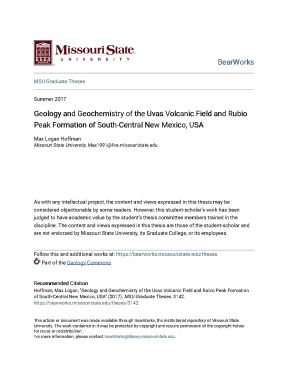
Tải xuống để đọc toàn bộBearWorks MSU Graduate Theses Summer 2017 Geology and Geochemistry of the Uvas Volcanic Field and Rubio Peak Formation of South-Central New Mexico, USA Max Logan Hoffman Missouri State University, Max1991@live.edu As with any intellectual project, the content and views expressed in this thesis may be considered objectionable by some readers. However, this student-scholar’s work has been judged to have academic value by the student’s thesis committee members trained in the discipline. The content and views expressed in this thesis are those of the student-scholar and are not endorsed by Missouri State University, its Graduate College, or its employees. Follow this and additional works at: https://bearworks.edu/theses Part of the Geology Commons Recommended Citation Hoffman, Max Logan, "Geology and Geochemistry of the Uvas Volcanic Field and Rubio Peak Formation of South-Central New Mexico, USA" (2017).
MSU Graduate Theses.edu/theses/3142 This article or document was made available through BearWorks, the institutional repository of Missouri State University. The work contained in it may be protected by copyright and require permission of the copyright holder for reuse or redistribution. For more information, please contact BearWorks@library. GEOLOGY AND GEOCHEMISTRY OF THE UVAS VOLCANIC FIELD AND RUBIO PEAK FORMATION OF SOUTH-CENTRAL NEW MEXICO, USA A Masters Thesis Presented to The Graduate College of Missouri State University TEMPLATE In Partial Fulfillment Of the Requirements for the Degree Masters of Science, Geospatial Sciences in Geography, Geology, and Planning By Max Logan Hoffman August 2017 Copyright 2017 by Max Logan Hoffman ii GEOLOGY AND GEOCHEMISTRY OF THE UVAS VOLCANIC FIELD AND RUBIO PEAK FORMATION OF SOUTH-CENTRAL NEW MEXICO, USA Geology, Geography, and Planning Missouri State University, August 2017 Master of Science Max Logan Hoffman ABSTRACT South-central New Mexico is characterized by many Cenozoic volcanic and tectonic events that produced a complex system of magma sources.
These mechanisms are responsible for the diverse volcanic activity and magmatic evolution in New Mexico. To understand the growth and development of the mantle sources associated with these events, geochemical, petrographic, structural and spatial distribution data were collected from the Uvas volcanic field (UVF) and the Rubio Peak Formation of the Mogollon-Datil volcanic field (MDVF). Volcanic rocks from these volcanic fields were chosen based on their importance to relative timing of magmatic and tectonic transitioning events. The structural and spatial data from the UVF infer that magma migration relied on tensional fractures trending NW/SE, to progressively become magma-feed fractures.
The emplacement of these dikes are explained by the mechanism of stretching, allowing discontinuous echelon dike segments to cross-cut adjacent to the extensional stress. The relationships and differences of UVF and MDVF magma sources are explained by the combination of geochemical and petrologic data. Results from oxygen isotope and radiogenic ratios suggest the UVF volcanic rocks are heavily contaminated by high and low δ18O values, while Rubio Peak rocks reflect a homogenous mantle source relative to the differential mantle array. KEYWORDS: basaltic andesites, geochemistry, magma-feed fractures, New Mexico, spatial analyst, Uvas Volcanic Field This abstract is approved as to form and content _______________________________ Gary S.
Michelfelder Chairperson, Advisory Committee Missouri State University iii GEOLOGY AND GEOCEHMISTRY OF THE UVAS VOLCANIC FIELD AND RUBIO PEAK FORMATION OF SOUTH-CENTRAL NEW MEXICO, USA By Max Logan Hoffman A Masters Thesis Submitted to the Graduate College Of Missouri State University In Partial Fulfillment of the Requirements For the Degree of Master of Science, Masters of Science, Geospatial Sciences in Geography, Geology, and Planning August 2017 Approved: _______________________________________ Gary S. Michelfelder, PhD _______________________________________ Kevin L. Mickus, PhD _______________________________________ Xin Miao, PhD _______________________________________ Julie Masterson, PhD: Dean, Graduate College In the interest of academic freedom and the principle of free speech, approval of this thesis indicates the format is acceptable and meets the academic criteria for the discipline as determined by the faculty that constitute the thesis committee. The content and views expressed in this thesis are those of the student- scholar and are not endorsed by Missouri State University, its Graduate College, or its employees.
iv ACKNOWLEDGEMENTS I would like to thank the people involved in this research project for their help and their support. First, I would like to thank my committee members Dr. Gary Michelfelder (Chairperson), Dr. Kevin Mickus, and Dr.
Xin Miao for their leadership and support in developing and completion of this project. A much deserved thanks to Emily Salings, Shannon Rentz, Grant Spoering, Amber Akers, and Brandie Oehring, whom helped with in the field and laboratory. Special thanks is much appreciated from Dr. Peter Larson of Washington State University and Dr.
Frank Ramos of New Mexico State University their professional analytical and laboratory assistance. I would like to thank the Graduate College of Missouri State University for their funding assistance to help cover the cost of travel, field work, laboratory test, and attend professional conferences. I would also like to thank the Department of Geography, Geology, and Planning and the College of Natural and Applied Sciences for providing the analytical software and tools necessary to produce the results of this research. A final thanks goes out to all of my family and friends who provided the encouragement to help me through this journey.
v TABLE OF CONTENTS Chapter 1 - Introduction .10 Rubio Peak Formation .11 Uvas Basalt-Basaltic Andesites .16 Oxygen Isotope Geochemistry.16 Geospatial Structural and Volcanic Analysis .19 Chapter 4 – Structural and Surface Analysis of the Sierra de las Uvas Volcanic Field, New Mexico .42 Chapter 5 – Oxygen Isotope Geochemistry of Volcanic Rocks in South Central New Mexico: Insight on Crustal Contamination and Magmatic Evolution .94 Structural and Surface Analysis of the Sierra de las Uvas Volcanic Field, New Mexico .94 vi TABLE OF CONTENTS (CONTINUED) Oxygen Isotope Analysis of Volcanic Rocks in South-Central New Mexico .99 vii LIST OF TABLES Table 5. Radiogenic variations from whole rock samples in Uvas, Rubio Peak and Cooney Canyon tuff samples.84 viii LIST OF FIGURES Figure 1.1 Digital elevated model of New Mexico.1 Simplified geologic map of the MDVF and the UVF area in south-central New Mexico .1 Thematic geology map of study area.2 Remote sensed image of study area with labeled volcanic centers .3 Remote-sensed Landsat image (false color RGB) of Sierra de las Uvas Volcanic Field.4 Histograms and scatter plots of bandwidths of the Uvas lavas, sedimentary and ash units of the Sierra de las Uvas Volcanic Field.5 Volcanic-structural map of Sierra de las Uvas Volcanic Field.6 Drainage network in the Sierra de las Uvas Volcanic Field with mapped interpreted mass lava flows and suggested location of volcanic centers .7 Cross-section A-A’ of the Sierra de las Uvas Volcanic Field .8 Landsat image of the Escondidio Ranch cinder cone (A and B) and cone near the Little White Gap volcanic center .9 Scatter plots of structural parameters (height, weight, volume, and ellipticity) are compared to find distribution relationships between volcanic cones and centers in the Sierra de las Uvas Volcanic Field .10 Landsat image (false color) of the Sierra de las Uva Volcanic Field (UVF) with interpreted σ1 and σ3 stress orientations.1 Digital Elevation Model (DEM) of New Mexico.2 Simplified geology map of study area in southern New Mexico.3 Schematic cross section illustrating a model of evolving magma sources during different tectonic regimes in southern New Mexico…………………………….4: Illustrates the variations of phenocryst and textures in the Uvas basalt to basaltic andesites and the Rubio Peak andesites .88 ix LIST OF FIGURES (CONTINUED) Figure 5.5 Radiogenic isotope compositions (87Sr/86Sr, 144Nd/143Nd, 206Pb/204Pb, 207 Pb/204Pb, 208Pb/204Pb) compared of the Sierra de las Uvas basalts, Rubio Peak andesites and Coon Canyon tuff in south-central New Mexico.6 Tectono-stratigraphic column of south-central New Mexico. Modified from McMillan et al. Tectonic and magmatic events are compared to 87Sr/86Sr and εNd to reflect changes in the shifting tectonic regime .7 Radiogenic isotope compositions compared to oxygen isotope values of the Sierra de las Uvas basalts, Rubio Peak andesites and the Cooney Canyon tuffs in south- central New Mexico .8 Oxygen isotope values from sampled volcanic rocks from the Sierra de las Uvas Volcanic Field (UVF) and Rubio Peak, Kneeling Nun tuff and Cooney Canyon tuffs from the Mogollon-Datil Volcanic Field (MDVF).9 Oxygen isotope values of mineral separates in the Sierra de las Uvas (UVF) and Mogollon-Datil (MDVF) volcanic rocks vs whole-rock SiO2 wt %.93 x CHAPTER 1 - INTRODUCTION The wide distribution of volcanism, shifting tectonics, and evolving magma sources in New Mexico has made it a popular region of interest for understanding complex changes and development of both heterogeneous and homogenous igneous systems (Johnson et al., 1990; Mack, 2004; Ramos and Reid, 2005; Annen et al., 2006; Best et al.
Previous studies (Dungan et al., 1986; Perry et al., 1987; Duncker et al., 1991; McMillan et al., 2000) have described the geologic record in southern New Mexico and have determined implications of three mantle sources associated with these igneous systems: lithosphere, asthenosphere, and ocean-island basalts (OIB). Though previous research has distinguished these mantle sources to local volcanic fields, there is uncertainty understanding the evolving magmatic processes and implications of crustal contamination without constraining the assimilating factors. The objective of this project is to characterize the petrogenesis and magmatic evolution of the Sierra de las Uvas volcanic field (UVF) and the Rubio Peak formation of the Mogollon-Datil volcanic field (MDVF) in southern New Mexico (Fig. The following chapters examine geochemical, petrographic, structural, and geomorphologic data associated with the UVF and the Rubio Peak formation of the MDVF to examine the magmatic implications involved with these extrusive records of magmatism during two time periods of tectonic transition: (1) continental arc magmatism and (2) early Rio Grande rifting.
The specific goals of this project address three questions: (1) What are the primary sources of magma associated with the Uvas basaltic andesites and the intermediate composition rocks of the Rubio Peak Formation? (2) What are the processes 1 involved in the differentiation of these magmas? (3) What does the magmatic plumbing system look like and is there a structural control on the magma reservoir feeding the Uvas Volcanic Field cinder cones? This study examines the deep magma genesis of the Rubio Peak formation and Uvas lavas in addition to understand the magmatic implications of a shallow crustal environment on controlling magma compositions during changes in the tectonic regime. The question of understanding the shallow magmatic plumbing system can help understand the deep magmatic reservoir. The relationships between shallow and deep magmatic reservoir growth and development is vital to understanding the tectonic implications that cause the immense calc-alkaline volcanism in south-central New Mexico (45-24 Ma; McMillan et al. Manuscript 1 The first manuscript titled “Structural and surface analysis of the Sierra de las Uvas volcanic field, New Mexico: Implications for magma migration” has recently been submitted to the Bulletin of Volcanology and awaits comments from the reviewers.
This manuscript presents a study using publicly available geospatial and remote sensing data and geometric classifications to provide insight on the magma migration pathways in the UVF. The manuscript seeks to determine if structural controls and geomorphic analyses suggest a relationship to the known tectonic and volcanic history in the area. The goal of this manuscript was to look at a poorly studied volcanic field and determine the evolution of this volcanic field. This manuscript uses geospatial and remote sensing analyses to identify known and unknown volcanic centers and structures of the 2 UVF and determine controlling structural trends.
The analytical procedure includes using sets of spatial analyst and data management tools to provide statistical and surface results on the UVF and its structures. These were comprised of creating geologic maps, identifying known and suggested volcanic centers, creating drainage networks and rose diagrams of faults and dikes, cone analyses, and relating information to suggested magmatic implications. These methods correlate to similar research (Adlyaman et al., 1998; Corazzato and Tibaldi, 2006; Grosse et al., 2012; Bolós et al., 2014; Muirhead et al., 2016) in which determined the relationships between volcanic structures and patterns. In this study, I propose three research questions: (1) Through remote sensing and geospatial analyses, can volcanic centers and distribution be characterized?
Nội dung được bảo vệ bản quyền — Tải xuống đầy đủ
Trích dẫn luận án này
Max Logan Hoffman (2017). Địa chất & Địa hóa Vùng núi lửa Uvas, New Mexico [Luận án tiến sĩ, Missouri State University]. LuanAn.net. https://luanan.net/khoa-hoc-trai-dat-moi-truong/dia-chat-dia-hoa-vung-nui-lua-uvas-cao-nguyen-rubio-new-mexico
Câu hỏi thường gặp
Luận án "Địa chất & Địa hóa Vùng núi lửa Uvas, New Mexico" nghiên cứu về vấn đề gì?
Khám phá địa chất & địa hóa độc đáo của Vùng núi lửa Uvas, New Mexico. Phân tích chuyên sâu về hoạt động magma và thành phần khoáng sản.
Luận án "Địa chất & Địa hóa Vùng núi lửa Uvas, New Mexico" được bảo vệ tại trường nào?
Luận án này được bảo vệ tại Missouri State University. Năm bảo vệ: 2017.
Luận án "Địa chất & Địa hóa Vùng núi lửa Uvas, New Mexico" thuộc chuyên ngành gì?
Luận án "Địa chất & Địa hóa Vùng núi lửa Uvas, New Mexico" thuộc chuyên ngành Geospatial Sciences in Geography, Geology, and Planning. Danh mục: Khoa Học Trái Đất & Môi Trường.
Luận án "Địa chất & Địa hóa Vùng núi lửa Uvas, New Mexico" có bao nhiêu trang?
Luận án "Địa chất & Địa hóa Vùng núi lửa Uvas, New Mexico" có 113 trang. Bạn có thể xem trước một phần tài liệu ngay trên trang web trước khi tải về.
Cách tải luận án "Địa chất & Địa hóa Vùng núi lửa Uvas, New Mexico" về máy như thế nào?
Để tải luận án về máy, bạn nhấn nút "Tải xuống ngay" trên trang này, sau đó hoàn tất thanh toán phí lưu trữ. File sẽ được tải xuống ngay sau khi thanh toán thành công. Hỗ trợ qua Zalo: 0559 297 239.