Wjstegemoller dissertation uiuc 2009
Luận văn tiến sĩ Wjstegemoller tại UIUC năm 2009, tập trung nghiên cứu về lĩnh vực. Đóng góp quan trọng
Secondary and Continuing Education
Luan An
Luận án tiến sĩ
Năm xuất bản
Số trang
398
Thời gian đọc
1 giờ
Lượt xem
0
Lượt tải
0
Phí lưu trữ
60 Point
Tổng quan nhanh
- Chủ đề:
- Wjstegemoller Thesis: Latino Student Biliteracy at UIUC
- Số trang:
- 398 trang
- Trường:
- university of illinois at urbana-champaign
- Chuyên ngành:
- Secondary and Continuing Education
- Tác giả:
- William Jason Stegemoller
- Năm:
- 2009
Tóm tắt nội dung luận án
I.Wjstegemoller Thesis Latino Student Biliteracy at UIUC
William Jason Stegemoller's 2009 doctoral thesis explores critical aspects of biliteracy. The Wjstegemoller thesis focuses on Latino immigrant students at a university. This University of Illinois Urbana-Champaign dissertation provides a qualitative examination. It investigates writing and writing experiences. Six bilingual (Spanish-English) immigrant university students form the participant group. Immigrant students represent a growing segment of university populations. Their unique characteristics and needs often receive insufficient attention. This research offers valuable insights into their academic journeys.
1.1. Focus of Wjstegemoller Research Paper
The Wjstegemoller research paper centers on bilingual immigrant university students. It examines their engagement with writing across various contexts. The study highlights the complex interplay between language, identity, and academic expectations. It addresses how language policies, explicit and implicit, impact these students. The UIUC doctoral thesis 2009 illuminates challenges and adaptations. It contributes to understanding a vital demographic within higher education.
1.2. Theoretical Foundations UIUC Doctoral Thesis 2009
This academic publication UIUC draws on established theoretical models. Hornberger's continua of biliteracy model (1989; 2000) provides a framework. It helps understand participants' writing experiences. The concept of language as dialogic (Bakhtin, 1986) also informs the analysis. This theoretical lens offers a nuanced perspective. It moves beyond simplistic views of language acquisition. The framework allows for deeper exploration of linguistic practices and identities.
II.Methodological Design Wjstegemoller Research Approach
The Wjstegemoller research approach employs a rigorous qualitative methodology. A constructivist paradigm guides the entire study. This framework prioritizes understanding multiple realities. The design combines narrative inquiry with aspects of grounded theory. This blended approach allows for rich, detailed data collection and analysis. It ensures comprehensive exploration of participant experiences. The Illinois research output is built on strong methodological principles.
2.1. Paradigm Framework Academic Publications UIUC
A constructivist paradigm (Mertens, 1998) underpins this graduate thesis 2009. It acknowledges the subjective nature of human experience. Narrative inquiry (Clandinin & Connelly, 2000) forms a core component. This method captures individual stories and experiences. Aspects of grounded theory (Strauss & Corbin, 1998) inform data analysis. This iterative process allows themes to emerge directly from the data. The robust framework strengthens the study's validity.
2.2. Data Collection in Graduate Thesis 2009
Extensive data collection supported the Wjstegemoller PhD work. Forty hours of interviews were conducted. These included 18 literacy history interviews. Twelve text-based interviews also provided rich data. Over 100 pages of student writing were collected. This writing spanned high school, university courses, and creative pieces. Supplementary documents, like syllabi and assignment sheets, added context. This comprehensive dataset enabled deep analysis.
2.3. Data Analysis Ivanic s Framework in Illinois Research Output
Data analysis centered on Ivanic’s framework (1998). It focused on participants' 'autobiographical selves.' This involved examining literacy histories in detail. Writing experiences within the university context were scrutinized. Participants’ understandings of themselves also formed a key analytical area. This approach provided a holistic view of each student’s journey. The analysis meticulously uncovered patterns and meanings.
III.Key Findings Latino Students Literacy Histories Agency
The Wjstegemoller thesis reveals crucial insights into Latino students' literacy development. A constellation of factors shaped their experiences. Educational environments, both subtractive and additive, played significant roles. The study highlights how students navigate institutional expectations. It also examines their acts of agency within academic contexts. These findings offer a deeper understanding of bilingual students’ journeys. The 2009 scholarly articles UIUC contribute valuable knowledge here.
3.1. Factors Shaping Literacy Histories in Wjstegemoller PhD Work
Several factors profoundly influenced participants' language and literacy experiences. Subtractive educational environments sometimes hindered first language use. Additive environments supported bilingual development. Age of arrival to the United States was a key variable. Education received in the home language also showed impact. The quality of high school experiences varied. Socioeconomic status also contributed. These elements collectively informed their literacy trajectories.
3.2. Mediated Agency in University Writing 2009 Scholarly Articles UIUC
The concept of mediated agency (Wertsch, Tulviste & Hagstrom, 1993) was central. It conceptualized participants' actions. They sometimes 'went against the grain' of university norms. Other times, they accommodated the university context in their writing. This dynamic interplay showcases their adaptive strategies. The University of Illinois Urbana-Champaign dissertation provides examples of these choices. Students actively shaped their writing identities within institutional constraints.
3.3. University Contexts Identity Expression in UIUC Doctoral Thesis
The university context presented both challenges and opportunities. Certain environments were particularly inviting for students. Latina/Latino Studies courses provided such spaces. An African-American Studies course also fostered openness for some. In these inviting contexts, participants experimented more. They expressed cultural identities. They also used Spanish in their writing more freely. This demonstrates the power of inclusive academic spaces.
IV.Student Writing Stances Development Wjstegemoller Insight
The Wjstegemoller insight details how students connected to writing. It explores the stances they developed. These stances emerged from their unique literacy histories. The study also traces their ongoing development as writers within the university. This segment of the Wjstegemoller research paper showcases students' resilience and evolving identities. It offers a nuanced view of academic writing progression. The Illinois research output demonstrates dynamic learning.
4.1. Connections to Writing University of Illinois Library Catalog
Participants connected to writing in multifaceted ways. They connected politically, referencing the Latino community and activism. They connected safely, avoiding certain identity aspects and choosing neutral topics. They also connected personally, drawing on personal experiences and stories. These diverse connections illustrate the personal significance of writing. The UIUC doctoral thesis 2009 highlights these varied engagements.
4.2. Stances Toward Writing Wjstegemoller Research Paper Highlights
Participants developed distinct stances toward writing. These stances grew directly from their literacy histories. Some sought healing through their writing. Others took significant risks in their expression. Many actively worked to overcome obstacles in their writing journeys. These stances reflect profound personal and academic growth. The graduate thesis 2009 details these transformative processes.
4.3. Writing Development at University Graduate Thesis 2009
Student writing continued to develop in the university setting. Participants asserted their identities in writing more boldly. They took risks to express previously withheld aspects of their identities. They actively negotiated how to relate their identities to the university context. This ongoing development indicates a dynamic process. It challenges assumptions of static writer identities. The Wjstegemoller PhD work illustrates this evolution.
V.Implications for Biliteracy Support Wjstegemoller Thesis
The Wjstegemoller thesis offers significant implications for educational practices. It emphasizes understanding the intricate experiences of immigrant students. It also highlights the complexities of bilingualism in academic settings. These implications guide improved support strategies. They inform policies promoting inclusive learning environments. This academic publication UIUC provides actionable recommendations. It underscores the importance of tailored support systems.
5.1. Understanding Immigrant Experiences Bilingualism UIUC 2009
A primary implication involves recognizing the complexity of immigrant students’ experiences. Nuances of bilingualism must be deeply understood. Maintaining the first language is crucial from a young age. This maintenance may have lasting positive effects into college. Educational institutions must acknowledge these factors. The University of Illinois Urbana-Champaign dissertation stresses this foundational understanding.
5.2. Valuing Home Language Safe Spaces Academic Publications UIUC
Home literacy instruction in the first language plays a vital role. It can mitigate negative effects of subtractive school environments. Students' home languages serve as valuable resources. They can draw on these resources for academic writing in English. Explicitly safe spaces are crucial for students. These spaces help explore issues of racism and linguistic chauvinism. They foster writing development. This graduate thesis 2009 advocates for such supportive structures.
5.3. Social Networks University Support Illinois Research Output
The study suggests learning more about students’ use of social networks. These networks are often rich sources of support. Universities should actively build these networks into formal support services. This integration can enhance student success. Relying solely on writing centers may overlook existing support systems. The Wjstegemoller PhD work recommends a holistic approach to student aid. This promotes more effective and culturally responsive assistance.
Tải xuống file đầy đủ để xem toàn bộ nội dung
Tải đầy đủ (398 trang)Trích đoạn nội dung luận án
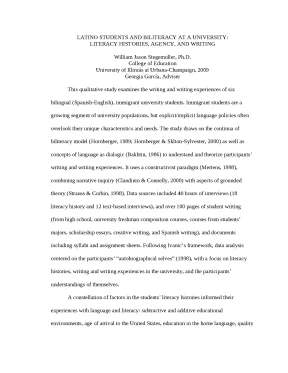
Tải xuống để đọc toàn bộLATINO STUDENTS AND BILITERACY AT A UNIVERSITY: LITERACY HISTORIES, AGENCY, AND WRITING William Jason Stegemoller, Ph. College of Education University of Illinois at Urbana-Champaign, 2009 Georgia García, Adviser This qualitative study examines the writing and writing experiences of six bilingual (Spanish-English), immigrant university students. Immigrant students are a growing segment of university populations, but explicit/implicit language policies often overlook their unique characteristics and needs. The study draws on the continua of biliteracy model (Hornberger, 1989; Hornberger & Sklton-Sylvester, 2000) as well as concepts of language as dialogic (Bakhtin, 1986) to understand and theorize participants’ writing and writing experiences.
It uses a constructivist paradigm (Mertens, 1998), combining narrative inquiry (Clandinin & Connelly, 2000) with aspects of grounded theory (Strauss & Corbin, 1998). Data sources included 40 hours of interviews (18 literacy history and 12 text-based interviews), and over 100 pages of student writing (from high school, university freshman composition courses, courses from students’ majors, scholarship essays, creative writing, and Spanish writing), and documents including syllabi and assignment sheets. Following Ivanic’s framework, data analysis centered on the participants’ “autobiographical selves” (1998), with a focus on literacy histories, writing and writing experiences in the university, and the participants’ understandings of themselves. A constellation of factors in the students’ literacy histories informed their experiences with language and literacy: subtractive and additive educational environments, age of arrival to the United States, education in the home language, quality of high school experiences, and socioeconomic status.
The concept of mediated agency (Wertsch, Tulviste & Hagstrom, 1993) was used to conceptualize participants’ acts of “going against the grain” or accommodating the university context in their writing. The university context was often seen as challenging for some of the participants, but some contexts, Latina/Latino Studies courses and an African-American Studies course, were particularly inviting for three of the six participants. In such inviting contexts, the participants experimented more with expressing their cultural identities, or with using Spanish in their writing. The majority of the participants drew on rich social support networks as they engaged in academic writing, and chose not to utilize the university writing center.
The participants connected to writing politically (by referencing the Latino community and activism), safely (by avoiding sharing certain aspects of their identities, choosing neutral topics, and topics that met perceived expectations), and personally (by referencing personal experiences and stories). The participants developed stances toward writing that grew out of their literacy histories by: (a) seeking healing, (b) taking risks, and (c) overcoming obstacles. The participants showed ways in which their experiences developing as writers continued in the university. The participants’ writing developed in that they: (a) asserted identities in writing, (b) took risks to express previously withheld aspects of their identities, and (c) negotiated how to relate their identities to the university context.
Major implications of the study focus on the importance of understanding the complexity of immigrant students’ experiences and the nuances of bilingualism. Maintenance of the first language is important from a young age and may have lasting effects into college. Home literacy instruction in the first language may play a role in downplaying the negative effects of a subtractive environment at school. Furthermore, students’ home languages can be a resource that they draw on in the university as they develop their academic writing in English.
Immigrant students who have experienced racism and linguistic chauvinism can benefit from explicitly safe spaces to explore these issues and it may help them develop as writers. It is important to learn more about students’ use of social networks and build them into university support services. © 2009 William Jason Stegemoller LATINO STUDENTS AND BILITERACY AT A UNIVERSITY: LITERACY HISTORIES, AGENCY, AND WRITING BY WILLIAM JASON STEGEMOLLER B., Indiana University at Bloomington, 1993 M., University of Illinois at Urbana-Champaign, 1999 DISSERTATION Submitted in partial fulfillment of the requirements for the degree of Doctor of Philosophy in Secondary and Continuing Education in the Graduate College of the University of Illinois at Urbana-Champaign, 2009 Urbana, Illinois Doctoral Committee: Professor Georgia E. García, Chair Professor Thomas A.
Schwandt Professor Frederick G. Davidson Associate Professor Paul A. Prior ABSTRACT This qualitative study examines the writing and writing experiences of six bilingual (Spanish-English), immigrant university students. Immigrant students are a growing segment of university populations, but explicit/implicit language policies often overlook their unique characteristics and needs.
The study draws on the continua of biliteracy model (Hornberger, 1989; Hornberger & Sklton-Sylvester, 2000) as well as concepts of language as dialogic (Bakhtin, 1986) to understand and theorize students’ writing and writing experiences. It uses a constructivist paradigm (Mertens, 1998), combining narrative inquiry (Clandinin & Connelly, 2000) with aspects of grounded theory (Strauss & Corbin, 1998). Data sources included 40 hours of interviews (18 literacy history and 12 text-based interviews), more than 100 pages of student writing (from high school, university freshman composition courses, courses from participants’ majors, scholarship essays, creative writing, and Spanish writing), and documents including syllabi and assignment sheets. Following Ivanic’s framework, data analysis centered on the participants’ “autobiographical selves” (1998), with a focus on literacy histories, writing and writing experiences in the university, and the participants’ understandings of themselves.
A constellation of factors in the participants’ literacy histories informed their experiences with language and literacy: subtractive and additive educational environments, age of arrival to the United States, education in the home language, quality of high school experiences, and socioeconomic status. The concept of mediated agency (Wertsch, Tulviste & Hagstrom, 1993) was used to conceptualize participants’ acts of “going against the grain” or accommodating the university context in their writing. The ii university context was often seen as challenging for some of the participants, but some contexts, Latina/Latino Studies courses and an African-American Studies course, were particularly inviting for three of the six participants. In such inviting contexts, the participants experimented more with expressing their cultural identities, or with using Spanish in their writing.
The majority of the participants drew on rich social support networks as they engaged in academic writing, and chose not to utilize the university writing center. The participants connected to writing politically (by referencing the Latino community and activism), safely (by avoiding sharing certain aspects of their identities, choosing neutral topics, and topics that met perceived expectations), and personally (by referencing personal experiences and stories). The participants developed stances toward writing that grew out of their literacy histories by: (a) seeking healing, (b) taking risks, and (c) overcoming obstacles. The participants showed ways in which their experiences developing as writers continued in the university.
The participants’ writing developed in that they: (a) asserted identities in writing, (b) took risks to express previously withheld aspects of their identities, and (c) negotiated how to relate their identities to the university context. Major implications of the study focus on the importance of understanding the complexity of immigrant students’ experiences and the nuances of bilingualism. Maintenance of the first language is important from a young age and may have lasting effects into college. Home literacy instruction in the first language may play a role in downplaying the iii negative effects of a subtractive environment at school.
Furthermore, students’ home languages can be a resource that they draw on in the university as they develop their academic writing in English. Immigrant students who have experienced racism and linguistic chauvinism can benefit from explicitly safe spaces to explore these issues and it may help them develop as writers. It is important to learn more about students’ use of social networks and build them into university support services. iv ACKNOWLEDGMENTS As I wrote this dissertation about bilingual, immigrant students developing as writers in the university, my aim was to explore their literacy histories and how they interrelate with their writing and writing experiences in the university context.
As I engaged in that process, I occasionally discerned parallels between the participants’ experiences and my own. Once such parallel was the importance of support networks. Like the students in my study, I benefited from the support of many people, and this study would not have been possible without them. Many thanks to my academic adviser and dissertation chair, Dr.
I am grateful for the time and energy that Dr. García invested in mentoring me, and in helping me shape my research. I deeply appreciate her guidance and support that always pushed me toward the highest standards in research. I also express my gratitude to my doctoral committee: Dr.
Prior, and Dr. I appreciate the unique perspectives that each of the members of my committee provided, and the important ways that each of them challenged me and encouraged me. I would also like to thank the students who participated in my study: Cristina, Diana, Diego, Jenny, Maria, and Nicolas. I was changed by the experience of knowing and working with each of my participants.
I was moved by the trust and honesty that characterized my participants’ interactions with me. I would also like to express my gratitude to the university offices and individuals I worked with at those offices who assisted me in recruiting participants for my study. v I also want to acknowledge the people I worked with in writing groups as I wrote this dissertation: Marcia Buell, Lara Handsfield, Holly Middleton, Young-Kyung Min, as well as Yu-Ming Cheng, and Debra Erickson. Everyone in these writing groups provided invaluable personal and professional support and inspiration.
I would also like to express my gratitude to fellow doctoral students with whom I shared many struggles and triumphs on our paths: Joyce Bezdizeck, Jolyn Blank, Gregory Cheatham, Helena Hall, Angela López-Velásquez, Teresa Mendez-Bray, Raúl Mora Velez, Claudia Petty. And also thanks to my family and many friends who always provided support, love, and encouragement throughout this long process. vi TABLE OF CONTENTS LIST OF TABLES.ix CHAPTER 1 PURPOSE AND SIGNIFICANCE OF THE STUDY.1 CHAPTER 2 THEORETICAL FRAMEWORK AND REVIEW OF LITERATURE. 26 Summary of Literature Review.
94 Organization of Findings.110 Pre-university Experiences With Language, Literacy, and Education. 115 University Writing Experiences: Struggle, Boundaries, Blurred Boundaries.142 Academic Writing at the University: Identity and Transformation.177 Summary of Findings.219 CHAPTER 5 SUMMARY, DISCUSSION, AND IMPLICATIONS. 228 Discussion of the Findings. 281 Limitations of the Study.
293 APPENDIX A CRISTINA’S WRITING.306 APPENDIX B DIANA’S WRITING.318 vii APPENDIX C DIEGO’S WRITING. 321 APPENDIX D JENNY’S WRITING.331 APPENDIX E MARIA’S WRITING.334 APPENDIX F NICOLAS’S WRITING.340 APPENDIX G QUESTIONNAIRE FOR STUDENT PARTICIPANTS.344 APPENDIX H STUDENT INTERVIEWS.351 viii LIST OF TABLES Table Page 1 Undergraduate Enrollment by Racial/Ethnic Category at the University and Percentage of State Population by Racial/Ethnic Category. 80 2 Percentage of University Undergraduates and State Populations That Is Foreign-Born in 2005. 87 4 Writing Discussed During Text-Based Interviews.
93 6 Coding Examples: Immigration Stories.101 7 Coding Examples: Pre-University Stories.102 8 Coding Examples: University Writing Stories.103 9 Example of Themes in Text-Based Interviews.105 10 Self-reported Spanish Abilities. 116 11 Self-reported English Abilities.116 12 High School Contexts.130 13 Transfer and Second Language Issues in Two of Cristina’s Course Papers.159 ix CHAPTER 1 PURPOSE AND SIGNIFICANCE OF THE STUDY The majority of research on English language learners (ELLs) and bilingual students in post-secondary contexts has focused on international students who usually have fairly limited exposure to life in the U., are generally well educated, and are relatively financially secure (Harklau, Losey, & Sigeal, 1999). For the most part, these students return to their home countries after they complete their studies in the U. However, according to Harklau, Losey, and Siegal (1999), large numbers of students in various stages of acquiring English are graduating from U.
high schools and continuing their education in U. colleges and universities. These students are immigrants, refugees, and children of immigrants who often have diverse educational histories. Harklau and Siegal (2009) note that it is extremely difficult to estimate the number of students who speak languages other than English in U.
higher education because colleges and universities do not routinely collect this type of information. A study by Caps, Fix, Murray, Ost, Passel, and Herwantoro (2005) estimated that 19% of secondary school students are immigrants or U.-born children of immigrants.
Nội dung được bảo vệ bản quyền — Tải xuống đầy đủ
Trích dẫn luận án này
William Jason Stegemoller (2009). Wjstegemoller dissertation uiuc 2009 [Luận án tiến sĩ, University of Illinois at Urbana-Champaign]. LuanAn.net. https://luanan.net/giao-duc-hoc/wjstegemoller-dissertation-uiuc-2009
Câu hỏi thường gặp
Luận án "Wjstegemoller dissertation uiuc 2009" nghiên cứu về vấn đề gì?
Luận văn tiến sĩ Wjstegemoller tại UIUC năm 2009, tập trung nghiên cứu về lĩnh vực. Đóng góp quan trọng
Luận án "Wjstegemoller dissertation uiuc 2009" được bảo vệ tại trường nào?
Luận án này được bảo vệ tại University of Illinois at Urbana-Champaign. Năm bảo vệ: 2009.
Luận án "Wjstegemoller dissertation uiuc 2009" thuộc chuyên ngành gì?
Luận án "Wjstegemoller dissertation uiuc 2009" thuộc chuyên ngành Secondary and Continuing Education. Danh mục: Giáo Dục Học.
Luận án "Wjstegemoller dissertation uiuc 2009" có bao nhiêu trang?
Luận án "Wjstegemoller dissertation uiuc 2009" có 398 trang. Bạn có thể xem trước một phần tài liệu ngay trên trang web trước khi tải về.
Cách tải luận án "Wjstegemoller dissertation uiuc 2009" về máy như thế nào?
Để tải luận án về máy, bạn nhấn nút "Tải xuống ngay" trên trang này, sau đó hoàn tất thanh toán phí lưu trữ. File sẽ được tải xuống ngay sau khi thanh toán thành công. Hỗ trợ qua Zalo: 0559 297 239.