To establish the degree of interest for new technical instruction
Nghiên cứu đánh giá mức độ quan tâm của công nghệ mới trong thiết kế và phát triển thiết bị kỹ thuật.
Western Michigan University
Luan An
Luận án
Năm xuất bản
Số trang
134
Thời gian đọc
21 phút
Lượt xem
0
Lượt tải
0
Phí lưu trữ
40 Point
Tổng quan nhanh
- Chủ đề:
- Đánh giá mức độ quan tâm đào tạo kỹ thuật mới
- Số trang:
- 134 trang
- Trường:
- Western Michigan University
- Chuyên ngành:
- Educational Leadership
- Tác giả:
- Ahmed Said Sulayman Derbas
- Năm:
- 1985
Tóm tắt nội dung luận án
I.Đánh giá mức độ quan tâm đào tạo kỹ thuật mới
Các trường cao đẳng cơ sở tại Saudi Arabia thiếu chương trình kỹ thuật. Điều này tạo ra khoảng trống lớn trong việc đào tạo nhân lực. Đào tạo kỹ thuật mới là cần thiết. Nhu cầu nhân sự kỹ thuật và quản lý trung cấp rất cao. Mục đích nghiên cứu là đánh giá mức độ quan tâm đến các chương trình này tại Taif Junior College. Việc này nhằm đáp ứng nhu cầu phát triển của đất nước. Nghiên cứu tạo cơ sở cho việc phát triển giáo dục công nghệ. Nó giúp định hình các khóa học chuyên ngành phù hợp.
1.1. Bối cảnh cần đào tạo kỹ thuật
Hiện tại, các trường cao đẳng cơ sở không có chương trình kỹ thuật. Điều này hạn chế khả năng cung cấp nhân lực được đào tạo. Saudi Arabia thiếu các kỹ thuật viên và quản lý trung cấp. Nhu cầu đào tạo kỹ thuật mới là cấp thiết. Sự thiếu hụt này ảnh hưởng đến nhiều lĩnh vực công nghiệp.
1.2. Mục tiêu nghiên cứu chính
Mục tiêu chính là xác định mức độ quan tâm của sinh viên. Quan tâm đến việc triển khai các chương trình đào tạo kỹ thuật mới. Đối tượng khảo sát là Taif Junior College. Nghiên cứu giải quyết nhu cầu học tập kỹ thuật. Nó tìm cách cung cấp các khóa học chuyên ngành phù hợp.
1.3. Tầm quan trọng đề tài
Đề tài này rất quan trọng cho việc phát triển giáo dục công nghệ. Kết quả sẽ định hướng chính sách đào tạo. Nó cung cấp cơ sở vững chắc cho việc xây dựng chương trình. Việc này hỗ trợ phát triển kỹ năng cho sinh viên. Nghiên cứu thị trường giáo dục là nền tảng.
II.Nghiên cứu nhu cầu học tập kỹ thuật tại Taif
Nghiên cứu tập trung vào sinh viên hiện tại của Taif Junior College. Một mẫu đại diện được chọn để thu thập dữ liệu. Dữ liệu này bao gồm thông tin nhân khẩu học và các giá trị giáo dục. Mục tiêu là hiểu rõ nhu cầu học tập kỹ thuật. Từ đó, xác định các chương trình đào tạo kỹ thuật mới tiềm năng. Phân tích nhu cầu đào tạo này cung cấp cái nhìn sâu sắc. Nó là cơ sở cho các quyết định giáo dục.
2.1. Đối tượng khảo sát chính
Đối tượng nghiên cứu là toàn bộ sinh viên. Sinh viên đang theo học tại Taif Junior College. Thời gian khảo sát là năm học 1984-85. Đây là quần thể đại diện cho nhu cầu học tập kỹ thuật. Thông tin từ nhóm này mang lại giá trị thực tiễn cao.
2.2. Phương pháp lấy mẫu
Mẫu gồm 255 sinh viên được lựa chọn. Phương pháp lấy mẫu ngẫu nhiên đơn giản được áp dụng. Điều này đảm bảo tính đại diện của mẫu. Mẫu cung cấp cái nhìn khách quan về cộng đồng sinh viên. Kết quả từ mẫu có thể khái quát hóa cho toàn bộ.
2.3. Dữ liệu thu thập
Dữ liệu được thu thập bằng bảng câu hỏi hai phần. Phần đầu tiên thu thập thông tin nhân khẩu học. Phần thứ hai tập trung vào các giá trị giáo dục được lựa chọn. Đây là cơ sở cho việc phân tích nhu cầu đào tạo. Việc này giúp hiểu rõ hơn về sinh viên.
III.Phương pháp phân tích nhu cầu đào tạo nghề
Một bảng câu hỏi chuyên biệt được phát triển cho nghiên cứu này. Quy trình phân phối và thu thập dữ liệu được thực hiện cẩn thận. Tỷ lệ phản hồi cao cho thấy sự hợp tác. Dữ liệu sau đó được lập bảng và phân tích bằng tần số và tỷ lệ phần trăm. Phương pháp này giúp đánh giá mức độ quan tâm một cách định lượng. Nó cung cấp thông tin mô tả chi tiết về nhu cầu đào tạo nghề.
3.1. Thiết kế bảng câu hỏi
Bảng câu hỏi được chính nhà nghiên cứu phát triển. Nó có cấu trúc rõ ràng với hai phần chính. Phần nhân khẩu học xác định hồ sơ đối tượng. Phần giá trị giáo dục đánh giá cụ thể sự quan tâm. Thiết kế này giúp thu thập dữ liệu hiệu quả và có hệ thống.
3.2. Quy trình phân phối thu thập
Bảng câu hỏi được phân phối cho tổng số 300 đối tượng. 255 bảng câu hỏi đã được hoàn thành và gửi lại. Tỷ lệ phản hồi đạt 85%. Quy trình thu thập dữ liệu được thực hiện cẩn thận. Việc này đảm bảo tính toàn vẹn và đáng tin cậy của số liệu.
3.3. Kỹ thuật phân tích dữ liệu
Dữ liệu được lập bảng và phân tích bằng các phương pháp thống kê. Tần số và tỷ lệ phần trăm được sử dụng. Thông tin mô tả được báo cáo rõ ràng. Kỹ thuật này hỗ trợ đánh giá mức độ quan tâm. Nó cung cấp cái nhìn định lượng về nhu cầu đào tạo nghề.
IV.Kết quả khảo sát sự tiếp nhận khóa học kỹ thuật
Kết quả nghiên cứu cho thấy sự quan tâm đáng kể. Phần lớn các mục trong khảo sát có phản hồi tích cực. Điều này chứng tỏ nhu cầu đào tạo kỹ thuật mới là có thật. Sinh viên sẵn lòng tiếp nhận các khóa học chuyên ngành. Các phát hiện này minh chứng cho triển vọng tốt. Taif Junior College có thể phát triển các chương trình giáo dục công nghệ. Sự tiếp nhận khóa học là yếu tố then chốt cho thành công.
4.1. Mức độ quan tâm tổng thể
Kết quả cho thấy sự quan tâm rõ rệt. 9 trong số 13 mục (69.2%) có phản hồi tích cực. Những phản hồi này ủng hộ việc phát triển các chương trình đào tạo kỹ thuật mới. Điều này xác nhận nhu cầu học tập kỹ thuật hiện hữu. Mức độ quan tâm rất đáng ghi nhận.
4.2. Minh chứng nhu cầu đào tạo
Các phát hiện chứng minh nhu cầu đào tạo là có thật. Sinh viên bày tỏ mong muốn được học các khóa học kỹ thuật. Đây là tín hiệu tích cực cho giáo dục công nghệ. Nhu cầu này cần được đáp ứng kịp thời. Nó sẽ giúp phát triển kỹ năng cần thiết cho lực lượng lao động.
4.3. Đánh giá triển vọng chương trình
Có đủ cơ sở để kết luận về triển vọng. Việc phát triển các chương trình đào tạo kỹ thuật mới là khả thi. Triển vọng cho các khóa học chuyên ngành rất tích cực. Taif Junior College có thể mở rộng các chương trình của mình. Sự tiếp nhận khóa học là yếu tố thành công.
V.Khuyến nghị phát triển giáo dục công nghệ
Nghiên cứu đề xuất cần có thêm nghiên cứu chuyên sâu. Cần xác định chính xác loại hình chương trình kỹ thuật phù hợp. Các khóa học chuyên ngành phải đáp ứng nhu cầu của Kế hoạch 5 năm lần thứ tư. Định hướng này giúp phát triển kỹ năng cho lực lượng lao động quốc gia. Giáo dục công nghệ là chìa khóa cho sự phát triển bền vững. Phân tích nhu cầu đào tạo liên tục cải thiện hiệu quả chương trình.
5.1. Nhu cầu nghiên cứu chuyên sâu
Nghiên cứu sâu hơn được khuyến nghị. Cần xác định loại chương trình kỹ thuật cụ thể. Các chương trình này phải phù hợp với nhu cầu phát triển của Saudi Arabia. Điều này đặc biệt quan trọng trong Kế hoạch 5 năm lần thứ tư (1985-1990). Nghiên cứu thị trường giáo dục liên tục là cần thiết.
5.2. Định hướng khóa học chuyên ngành
Các khóa học chuyên ngành cần được thiết kế cẩn thận. Chúng phải phù hợp với nhu cầu của ngành công nghiệp. Định hướng này giúp phát triển kỹ năng chuyên biệt. Nó đảm bảo sinh viên sẵn sàng cho thị trường lao động. Đào tạo nghề phải có mục tiêu và kết quả rõ ràng.
5.3. Tầm nhìn phát triển kỹ năng
Mục lục chi tiết luận án
Tải xuống file đầy đủ để xem toàn bộ nội dung
Tải đầy đủ (134 trang)Trích đoạn nội dung luận án
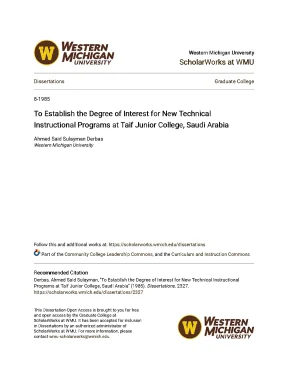
Tải xuống để đọc toàn bộKHOAN Western Michigan University UNIVERSITY ScholarWorks at WMU Dissertations Graduate College 8-1985 To Establish the Degree of Interest for New Technical Instructional Programs at Taif Junior College, Saudi Arabia Ahmed Said Sulayman Derbas Western Michigan University Follow this and additional works at: https://scholarworks.edu/dissertations G Part of the Community College Leadership Commons, and the Curriculum and Instruction Commons Recommended Citation Derbas, Ahmed Said Sulayman, "To Establish the Degree of Interest for New Technical Instructional Programs at Taif Junior College, Saudi Arabia" (1985).edu/dissertations/2327 This Dissertation-Open Access is brought to you for free and open access by the Graduate College at ScholarWorks at WMU. It has been accepted for inclusion Wi in Dissertations by an authorized administrator of ESTERN ScholarWorks at WMU. For more information, please MICHIGAN contact wmu-scholarworks@wmich. UNIVERSITY TO ESTABLISH THE DEGREE OF INTEREST FOR NEW TECHNICAL INSTRUCTIONAL PROGRAMS AT TAIF JUNIOR COLLEGE, SAUDI ARABIA by Ahmed Said Sulayman Derbas A Dissertation Submitted to the Faculty of The Graduate College in partial fulfillment of the requirements for the Degree of Doctor of Education Department of Educational Leadership Western Michigan University Kalamazoo, Michigan August 1985 Reproduced with permission of the copyright owner.
Further reproduction prohibited without permission. TO ESTABLISH THE DEGREE OF INTEREST FOR NEW ‘TECHNICAL INSTRUCTIONAL PROGRAMS AT TAIF JUNIOR COLLEGE, SAUDI ARABIA Ahmed Said Sulayman Derbas, Ed. Western Michigan University, 1985 At the present time, junior colleges do not have technical programs that would provide trained Saudis to assume responsibility in technical and middle management fields. The purpose of this study was to establish the degree of interest for new technical instruc tional programs at Taif Junior College to meet those needs.
The population of this study consisted of all students attending the college for the academic school year 1984-85. A sample of 255 was selected by using a simple random method. Data were collected utilizing a two-section questionnaire which has been developed by the researcher. The first section focused on demographic information while the second section dealt with selected values of education.
The questionnaire was distributed to 300 subjects, of which 255 questionnaires were completed and returned to the researcher. Data were tabulated and analyzed using frequencies and percentages and reported as descriptive information. Since 9 of the 13 items (69.2%) had responses in the desired direction, it was concluded that there is an interest for developing new technical instructional programs at Taif Junior College. Further research in this area is recommended in order to know what types of technical programs would accommodate the Reproduced with permission of the copyright owner.
Further reproduction prohibited without permission. neede of development in Saudi Arabia throughout the Fourth Five-Year Plan, 1985-1990. Reproduced with permission of the copyright owner. Further reproduction prohibited without permission.
INFORMATION TO USERS This reproduction was made from a copy of a document sent to us for microfilming, While the most advanced technology has been used to photograph and reproduce this document, the quality of the reproduction is heavily dependent upon the quality of the material submitted. The following explanation of techniques is provided to help clarify markings or notations which may appear on this reproduction. The sign or “target” for pages apparently lacking from the document photographed is “Missing Page(s)”. If it was possible to obtain the missing page(s) or section, they are spliced into the film along with adjacent pages.
This may have necessitated cutting through an image and duplicating adjacent pages to assure complete continuity. When an image on the film is obliterated with a round black mark, it is an indication of either blurred copy because of movement during exposure, duplicate copy, or copyrighted materials that should not have been filmed. For blurred pages, a good image of the page can be found in the adjacent frame. If copyrighted materials were deleted, a target note will appear listing the pages in the adjacent frame.
When a map, drawing or chart, etc., is part of the material being photographed, a definite method of “sectioning” the material has been followed. It is customary to begin filming at the upper left hand comer of a large sheet and to continue from left to right in equal sections with small overlaps. If necessary, sectioning is continued again—beginning below the first row and continuing on until complete. For illustrations that cannot be satisfactorily reproduced by xerographic means, photographic prints can be purchased at additional cost and inserted into your xerographic copy.
These prints are available upon request from the Dissertations Customer Services Department. Some pages in any document may have indistinct print. In all cases the best available copy has been filmed. Universi Microfilms International 300/N.
Zeeb Road ‘Ann Atbor, MI 48106 Reproduced with permission of the copyright owner. Further reproduction prohibited without permission. Reproduced with permission of the copyright owner. Further reproduction prohibited without permission.
8826122 Derbas, Ahmed Said Sulayman TO ESTABLISH THE DEGREE OF INTEREST FOR NEW TECHNICAL INSTRUCTIONAL PROGRAMS AT TAIF JUNIOR COLLEGE, SAUD! ARABIA Western Michigan University ED. 1985 University Microfilms International oon. zee» oad, ann Arbor, Mi48108 Copyright 1985 by Derbas, Ahmed Said Sulayman All Rights Reserved Reproduced with permission of the copyright owner. Further reproduction prohibited without permission.
Reproduced with permission of the copyright owner. Further reproduction prohibited without permission. PLEASE NOTE: In all cases this material has been filmed in the best possible way from the available copy. Problems encountered with this document have been identified here with a check mark.
Glossy photographs or pages 2, Colored illustrations, paper or print 3. Photographs with dark background 4. Illustrations are poor copy 5. Pages with black marks, not original copy, 6.
Print shows through as there is text on both sides of page. Indistinet, broken or small print on several pages_v/ 8. Print exceeds margin requirements__ 9. Tightly bound copy with print lost in spine 10.
Computer printout pages with indistinct print 11. Page(s) ___ lacking when material received, and not available from school or author. Page(s) seem to be missing in numbering only as text follows, 18. Two pages numbered.
14, Curling and wrinkled pages 18. Dissertation contains pages with print at a slant, filmed as received 16. Other University Microfilms International Reproduced with permission of the copyright owner. Further reproduction prohibited without permission.
Reproduced with permission of the copyright owner. Further reproduction prohibited without permission. Copyright by Ahmed Said Sulayman Derbas 1985) Reproduced with permission of the copyright owner. Further reproduction prohibited without permission.
DEDICATION To the dearest person in my whole life. To my mother, F. A1 Osaimt I proudly dedicate this work. May God bless us all.
-Ahmed= August 7, 1985 Kalamazoo, Michigan Reproduced with permission of the copyright owner. Further reproduction prohibited without permission. ACKNOWLEDGMENTS This dissertation would not have been completed without the continuous support and assistance of many individuals, some to whom I wish to express my appreciation and sincere gratitude. To the chairman of my doctoral committee, Dr.
Warfield, for his guidance and assistance throughout my course of study, and to the members of the committee, Dr. Schlack, and Dr. Robert Brashear, for their coopera~ tion, guidance, and assistance. To my family, my brothers for their encouragement and support to pursue my doctoral study, and most important a special gratitude to my younger brother, Bander Derbas, for his understanding and sacri- fice which has helped make this project a success.
Ahmed Said Sulayman Derbas it Reproduced with permission of the copyright owner. Further reproduction prohibited without permission. TABLE OF CONTENTS ACKNOWLEDGMENTS 6 6 eee eee te ee ee ee ee LIST OF TABLES 6 e+ eee eee eee eee tee ee ee ee ME LIST OF FIGURES 6 6 ee eee ee ee ee ee ee ee VEE CHAPTER INTRODUCTION 6 se ee eee ee ee eee eee 1 -=. 4 Purpose of the Study.
ss eee ee eee ee ene 5 Significance of the Study Summary of Chapter Le. + eee ee eee ee eee 9 II. REVIEW OF SELECTED LITERATURE. +e eee eee ee 10 Introduction ss ee eee eee eee eee eee 18 Educational Development.
++ +++ eee ee eee UL Manpower in Saudi Arabia, 1980-1985 .- 13 Human Resource Development » +++ ++ eee eee 20 Education and Training. ee eee eee ee ee 4 Major Goals ss see eee ee ee eee ee ee 2B Historical Model Other Countries Have Copied 3L Historical Developnent. 33 Manpower Problems in Less-Developed Countries. 3⁄4 Shortage of Skilled Labor in LDCs.- 34 Manpower Goals, Policies, and Programs.
nh Policies see eee eee eee eee ee eee 36 dải Reproduced with permission of the copyright owner. Further reproduction prohibited without permission. Table of Contents~-Continued CHAPTER, Programs se ee eee eee ee ee ee eee TO Junior Colleges in Some Developing Nations: Their Roles in Meeting Manpower Needs «+ +e ss + 39 Junior Colleges in Saudi Arabia - s+ +++ ees 42 Objectives of Saudi Arabia's Future Technical Junior Colleges see eee tee ee eee eee 45 Summary «6 eee ee ee ee ee ee eee ee 46 III. THE METHOD «ee ete ee ee ee ee ee ee 50 Introduction «6 ee ee ee ee ee ee ee ee 50 Population and Sample » +++ +e eee eee eee 50 Instrumentation ‹ ‹ + + + + + „ ¬ ee ee 50 Pilot Test s+ see ee ee ee ee ee eee ee 51 Data Collection ++ eee eee eee eee eee 52 Data Analysis Procedure 52 ‘IV.
THE FINDINGS «see eet eee eee ee we eee 54 Demographic Data. s+ sete ee eee eee eee Sh Respondent's Age +s + eee te ee ee ee ee 5h Sumary ss ee ee ee eee ee eee Questionnaire Findings «ss ee eee eee eens 57 Tabulation «se eee ee ee ee eee ee Khó 57 Visual Presentation.v và vs cv 6Ú Analysis of the Result. + sees eee ees 60 Summary «ee eee ee ee ee ee eee 70 V. SUMMARY, CONCLUSION, AND RECOMMENDATIONS .- +++ ~ 72 iv Reproduced with permission of the copyright owner.
Further reproduction prohibited without permission. Table of Contents~-Continued Summary 6 ee eee ee eee 22 Conclusion and Recommendations. + +++ +e eee 72 Conclusion «+ +e ee ee ee ee ee ee ee 73 Recommendations «+ + ++ +e eee eee een 73 APPENDICES As Questionnaire «6 ee ee eee ee ee ee ee 76 B. Summary Statistics and Locations of Junior Colleges in Saudi Arabia.
eee ee ee eee ee ee ee 80 Œ. Formula and Table for Determining Sample Size. 83 A Summary of the Saudi Arabia Five-Year Plans. 86 The Progress of Education in Saudi Arabia.
+ ee eee eee ee eee eee 102 BIBLIOGRAPHY 6 6 eee ee eet ee te ee ee ee ee ee THỦ Reproduced with permission of the copyright owner. Further reproduction prohibited without permission. LIST OF TABLES 1. Saudi Arabia: Employment by Nationality in 1980 Pu lrCCHiolp rẽ.
3 Estimated Manpower Distribution in Selected Occupational Groups in 1980 - 1. es ee eee eee ee 3 3. Employment by Economic Sector and Nationality, 1975. Employment of Migrants in Selected Years.
Projected School Enrollnents, 1979-80 to 1984-85. Number of Students Enrolled in 1984-85 and Expected Enrollment in 1989-90 «6. eee eee eee eee eee 29 7. Expenditure on Human Resources Over the Fourth Five-Year Development Plan in Millions.
31 Age of Respondents. ‹ ee eee eee eee ee eee 5S 9. Means, Standard Deviations, Sample Sizes and Frequencies, and Percentages of Responses. Sample Size, Frequencies, and Percentages of Responses: Favoring, Opposing, and Undecided Towards the Subject Hi ee i ne ee eS) vi Reproduced with permission of the copyright owner.
Further reproduction prohibited without permission. LIST OF FIGURES 1. Bar Chart Illustrating the Number of Respondents in Favor, Opposed, and Undecided in Having Technical Instructional Program at the Taif Junior College. Bar Chart Illustrating the Number of Respondents in Favor, Opposed, and Undecided in Havingthe Technical Instructional Program at Taif Junior College.
Nội dung được bảo vệ bản quyền — Tải xuống đầy đủ
Trích dẫn luận án này
Ahmed Said Sulayman Derbas (1985). To establish the degree of interest for new technical instru [Luận án tiến sĩ, Western Michigan University]. LuanAn.net. https://luanan.net/giao-duc-hoc/to-establish-the-degree-of-interest-for-new-technical-instruction
Câu hỏi thường gặp
Luận án "To establish the degree of interest for new technical instru" nghiên cứu về vấn đề gì?
Nghiên cứu đánh giá mức độ quan tâm của công nghệ mới trong thiết kế và phát triển thiết bị kỹ thuật.
Luận án "To establish the degree of interest for new technical instru" được bảo vệ tại trường nào?
Luận án này được bảo vệ tại Western Michigan University. Năm bảo vệ: 1985.
Luận án "To establish the degree of interest for new technical instru" thuộc chuyên ngành gì?
Luận án "To establish the degree of interest for new technical instru" thuộc chuyên ngành Educational Leadership. Danh mục: Giáo Dục Học.
Luận án "To establish the degree of interest for new technical instru" có bao nhiêu trang?
Luận án "To establish the degree of interest for new technical instru" có 134 trang. Bạn có thể xem trước một phần tài liệu ngay trên trang web trước khi tải về.
Cách tải luận án "To establish the degree of interest for new technical instru" về máy như thế nào?
Để tải luận án về máy, bạn nhấn nút "Tải xuống ngay" trên trang này, sau đó hoàn tất thanh toán phí lưu trữ. File sẽ được tải xuống ngay sau khi thanh toán thành công. Hỗ trợ qua Zalo: 0559 297 239.