The transition experience of waldorf elementary graduates attendi
Trải nghiệm chuyển đổi của cựu học sinh tiểu học Waldorf sang các trường mới.
University of St. Thomas
Leadership, Policy, and Administration / Education
Luan An
Luận án tiến sĩ
Năm xuất bản
Số trang
325
Thời gian đọc
49 phút
Lượt xem
0
Lượt tải
0
Phí lưu trữ
60 Point
Tổng quan nhanh
- Chủ đề:
- 1. Transition Experience
- Số trang:
- 325 trang
- Trường:
- University of St. Thomas
- Chuyên ngành:
- Leadership, Policy, and Administration / Education
- Tác giả:
- Peter Lawton
- Năm:
- 2016
Tóm tắt nội dung luận án
I. Transition Experience
Nghiên cứu về trải nghiệm chuyển tiếp của sinh viên Waldorf khi vào trường trung học không thuộc hệ thống Waldorf. Sử dụng phương pháp nghiên cứu chất lượng và hiện象 học, nghiên cứu này xem xét cách 13 sinh viên Waldorf trải nghiệm thách thức học tập và xã hội khi chuyển sang trường trung học không thuộc hệ thống Waldorf.
1.1. Giới Thiệu
Nghiên cứu này nhằm mục đích hiểu rõ hơn về trải nghiệm chuyển tiếp của sinh viên Waldorf khi vào trường trung học không thuộc hệ thống Waldorf.
1.2. Phương Pháp Nghiên Cứu
Nghiên cứu này sử dụng phương pháp nghiên cứu chất lượng và hiện tượng học để thu thập và phân tích dữ liệu.
II. Academic Challenges
Sinh viên Waldorf gặp phải thách thức học tập khi chuyển sang trường trung học không thuộc hệ thống Waldorf. Họ phải thích nghi với phương pháp giảng dạy mới và cách học tập khác biệt.
2.1. Thích Nghi Với Phương Pháp Giảng Dạy
Sinh viên Waldorf phải thích nghi với phương pháp giảng dạy mới, bao gồm cả việc sử dụng công nghệ và phương pháp học tập khác biệt.
2.2. Khả Năng Học Tập
Sinh viên Waldorf cần phải phát triển khả năng học tập mới để thành công trong môi trường học tập trung học.
III. Social Challenges
Sinh viên Waldorf cũng gặp phải thách thức xã hội khi chuyển sang trường trung học không thuộc hệ thống Waldorf. Họ phải thích nghi với môi trường xã hội mới và xây dựng mối quan hệ với bạn bè mới.
3.1. Xây Dựng Mối Quan Hệ
Sinh viên Waldorf cần phải xây dựng mối quan hệ với bạn bè mới và giáo viên để cảm thấy thoải mái trong môi trường học tập trung học.
3.2. Tích Cực Với Hoạt Động Xã Hội
Sinh viên Waldorf nên tích cực tham gia hoạt động xã hội để mở rộng mối quan hệ và cảm thấy thoải mái trong môi trường học tập trung học.
IV. Transition Experience
Trải nghiệm chuyển tiếp của sinh viên Waldorf khi vào trường trung học không thuộc hệ thống Waldorf bao gồm ba giai đoạn: thiết lập năng lực, phân tích và đánh giá kinh nghiệm, và đạt được chuyển đổi cá nhân và tự hoàn thiện.
4.1. Thiết Lập Năng Lực
Sinh viên Waldorf cần phải thiết lập năng lực học tập và xã hội để thành công trong môi trường học tập trung học.
4.2. Phân Tích Và Đánh Giá Kinh Nghiệm
Sinh viên Waldorf cần phải phân tích và đánh giá kinh nghiệm học tập và xã hội để hiểu rõ hơn về bản thân và môi trường học tập trung học.
V. Kết Luận
Trải nghiệm chuyển tiếp của sinh viên Waldorf khi vào trường trung học không thuộc hệ thống Waldorf là một quá trình phức tạp và đầy thách thức. Tuy nhiên, với sự hỗ trợ và hướng dẫn phù hợp, sinh viên Waldorf có thể thành công và phát triển trong môi trường học tập trung học.
5.1. Hỗ Trợ Và Hướng Dẫn
Sinh viên Waldorf cần được hỗ trợ và hướng dẫn phù hợp để giúp họ vượt qua thách thức và thành công trong môi trường học tập trung học.
5.2. Phát Triển Toàn Diện
Sinh viên Waldorf nên được khuyến khích phát triển toàn diện, bao gồm cả học tập, xã hội và cá nhân, để trở thành công dân toàn cầu.
VI. Kiến Nghị
Nghiên cứu này đưa ra một số kiến nghị để hỗ trợ sinh viên Waldorf trong quá trình chuyển tiếp sang trường trung học không thuộc hệ thống Waldorf.
6.1. Cung Cấp Hỗ Trợ
Cung cấp hỗ trợ và hướng dẫn phù hợp cho sinh viên Waldorf để giúp họ vượt qua thách thức và thành công trong môi trường học tập trung học.
6.2. Tạo Điều Kiện
Tạo điều kiện thuận lợi cho sinh viên Waldorf để họ có thể phát triển toàn diện và trở thành công dân toàn cầu.
Tải xuống file đầy đủ để xem toàn bộ nội dung
Tải đầy đủ (325 trang)Trích đoạn nội dung luận án
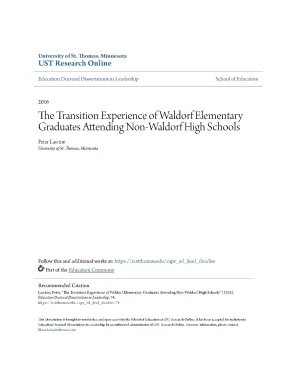
Tải xuống để đọc toàn bộUniversity of St. Thomas, Minnesota UST Research Online Education Doctoral Dissertations in Leadership School of Education 2016 The Transition Experience of Waldorf Elementary Graduates Attending Non-Waldorf High Schools Peter Lawton University of St. Thomas, Minnesota Follow this and additional works at: https://ir.edu/caps_ed_lead_docdiss Part of the Education Commons Recommended Citation Lawton, Peter, "The Transition Experience of Waldorf Elementary Graduates Attending Non-Waldorf High Schools" (2016). Education Doctoral Dissertations in Leadership.edu/caps_ed_lead_docdiss/74 This Dissertation is brought to you for free and open access by the School of Education at UST Research Online.
It has been accepted for inclusion in Education Doctoral Dissertations in Leadership by an authorized administrator of UST Research Online. For more information, please contact libroadmin@stthomas. The Transition Experience of Waldorf Elementary Graduates Attending Non-Waldorf High Schools by Peter Lawton A DISSERTATION SUBMITTED TO THE FACULTY OF THE SCHOOL OF EDUCATION OF THE UNIVERSITY OF ST. THOMAS MINNEAPOLIS, MINNESOTA IN PARTIAL FULFILLMENT OF THE REQUIREMENTS FOR THE DEGREE OF DOCTOR OF EDUCATION 2016 ii © Copyright by Peter Lawton, 2016 iii UNIVERSITY OF ST.
THOMAS, MINNESOTA The Transition Experience of Waldorf Elementary Graduates Attending Non-Waldorf High Schools We certify that we have read this dissertation and approved it as adequate in scope and quality. We have found that it is complete and satisfactory in all respects, and that any and all revisions required by the final examining committee have been made. iv ABSTRACT This study concerned the transition experiences and subsequent adjustment of Waldorf elementary graduates attending non-Waldorf high schools. Utilizing a qualitative and phenomenological approach, this study examined how 13 Waldorf elementary graduates experienced the academic and social challenges inherent in the transition to a non-Waldorf high school.
Participants reported their academic adjustment to high school pertained more to new instructional methods than the academic content itself. New learning styles included a de- emphasis on artistic and experiential modes of learning in favor of a more visual approach. Participants explained the most significant challenge socially across the transition involved breaking into what presented as pre-formed social groups or cliques. Motivational and learning theory was used to interpret the results, including Maslow’s (1943) hierarchy of needs and Bloom’s (1956) cognitive stages of learning.
The transition experience included three distinct phases: (1) establishing competence, (2) analyzing and assessing experience, and (3) achieving personal transformation and self-actualization. After learning the “nuts and bolts” of high school teaching methods and establishing membership in social groups, students analyzed and assessed their initial academic and social experiences in light of their former Waldorf experience. In the third phase, students developed new academic motivation and established new friendships based on their future college and career aspirations and their emerging senses of self. Strategies to address social and academic challenges during the transition experience included an expanded view of pedagogy and the importance of a classroom community.
Keywords: Waldorf, high school, transition experiences, academic and social challenges v ACKNOWLEDGEMENTS Thank you faculty and staff of the School of Education of the University of St. Thomas, in particular my advisor and committee chair Dr. Thank you Dr. Noonan for the care and attention you put into my writing over the past five years and the interest you’ve shone in Waldorf education.
From the very first writing assignment I submitted five years ago, you have patiently helped me hone my writing and thinking skills. Thank you members of my dissertation committee—Dr. David Peterson and Dr. Dana Kelly—for helping me define and refine my study, and for the extra care and attention you contributed to my research.
Thank you Faculty of the Department of Leadership, Policy, and Administration for your guidance and support throughout my doctoral studies. I wish to particularly acknowledge the work and attention you give to promoting and supporting the cohort model in education. Thank you Cohort 25 for your continued love and support. I miss our time together and wish you all my best.
Thank you City of Lakes Waldorf School. Several times you allowed me to miss meetings and forgo other responsibilities to attend classes or complete coursework. Thank you for the freedom and encouragement you give teachers to explore interests and deepen their understanding of education through their exploration of what it means to be human. Finally and most importantly, thank you family.
Thanks kids—Lucy, Ellery, Josie, and Mathilda—for your patience and interest. Thanks Mom and Dad and Sis, for moral (and financial) support. Thank you Craig for the computer. And thank you Jessica, for encouraging, listening, discussing, proofreading, and generally putting-up-with.
vi TABLE OF CONTENTS ABSTRACT .v TABLE OF CONTENTS. vi TABLE OF FIGURES. ix CHAPTER ONE: INTRODUCTION .1 Statement of the Problem .3 History of the Waldorf School Movement .5 Significance of the Problem .7 Purpose of Study. 11 Overview of the Chapters.
11 Definition of Terms .14 CHAPTER TWO: REVIEW OF THE LITERATURE .19 Waldorf Philosophy and Pedagogy .20 The Fundamental Picture of the Human Being.23 Waldorf Pedagogy in Practice .38 The Normative High School Transition Experience .40 Social/Emotional Challenges .50 Gaps and Tensions in the Literature .58 A Comparison of Mainstream Theories of Education, Current Research, and the Waldorf Approach .82 Analytical Theories in the Normative High School Transition Literature .98 CHAPTER THREE: METHODOLOGIES .105 The Institutional Review Board (IRB) Process .108 Role of Researcher .109 Recruitment and Selection of Participants. 116 Summary of Research Quality and Ethical Considerations .120 CHAPTER FOUR: ACADEMIC RESULTS—ADJUSTING TO NEW LEARNING STYLES AND TEACHING METHODS .122 New Methods of Teaching and Learning .158 Lecture/Note-taking .187 Interest and Engagement .200 CHAPTER FIVE: SOCIAL RESULTS—ADJUSTING TO A LARGER SCHOOL COMMUNITY.201 Participating in the School Community .202 Community with Peers .203 Loss of Waldorf Community.207 Increased Diversity and School Schedules .214 Community with Teachers .217 Lack of Care and Personal Connections .218 Styles of Caring.237 viii CHAPTER SIX: ANALYSIS .238 Phase One of the Transition: Establishing Competence .241 Positivist Versus Social Constructivist Educational Approaches .241 Academic Competency and Bloom’s (1956) Cognitive Taxonomy of Learning .245 Academic Competency in the High School Transition Literature .247 Social Competency and Krathwohl's (1964) Affective Taxonomy.247 Social Competence and Maslow's (1943) Belonging and Esteem Stages .249 Smaller Schools Research .251 Phase Two of the Transition: Analyzing and Assessing Experience .253 Analyzing and Assessing Academic Competence and Bloom’s (1956) Cognitive Taxonomy.253 Intrinsic and Extrinsic Motivation and Eccles’ (2005) Subjective Task Value .255 Research on Intrinsic Motivation .257 Analyzing and Assessing Social Experience and Krathwohl’s (1964) Affective Taxonomy.258 Changing Friendships in Later Adolescence.260 Phase Three of the Transition: Transforming and Self-Actualizing .262 The Third High School Transition Phase and Maslow's (1943) Final Self-Actualization Stage .262 Bloom's (1956) Creating Stage, Krathwohl's (1964) Characterization Stage, and Maturity in Adolescence .264 Transforming and Self-Actualizing and Kegan’s (2009) Transformational Learning .266 Research on Meaning and Community in the Classroom .269 CHAPTER SEVEN: SUMMARY, IMPLICATIONS, AND RECOMMENDATIONS .274 Implications for Practice .278 Implications for Waldorf Schools .279 Implications for Comprehensive High Schools .284 Implications for Future Educational Transition Studies .286 Limitations of the Research .287 Recommendations for Further Research .314 ix TABLE OF FIGURES Figure 1. Three Phases of the Transition Experience of Waldorf Elementary Graduates Attending Non-Waldorf High Schools…………………………………………………. The First Three Stages of Bloom's (1956) Cognitive Taxonomy—Remembering, Understanding, and Applying—and Establishing Academic Competence…………….
The First Three Stages of Krathwohl's (1964) Affective Taxonomy—Receiving, Responding, and Valuing—and Establishing Social Competence……………………. Maslow's (1943) Third and Fourth Hierarchies of Need—Belonging and Esteem— and Establishing Social Competence…………………………………………………. The Fourth and Fifth Levels of Bloom's (1956) Cognitive Taxonomy—Analyzing and Evaluating—and Analyzing and Assessing Academic Experiences……………………254 Figure 6. The Fourth Stage of Krathwohl's (1964) Affective Taxonomy—Organizing— and Analyzing and Assessing Social Experiences………………………………….
Maslow's (1943) Final Self-Actualization Stage and the Third Transition Phase— Transforming and Self-Actualizing………………………………………………. The Final Stage of Bloom's (1943) Cognitive Taxonomy—Creating, the Final Stage of Krathwohl's (1964) Affective Taxonomy—Characterizing, and the Third Transition Phase—Transforming and Self-Actualizing…………………265 Figure 9. Steiner's (1996a) Picture of Intelligence……………………………………………. An Alternative, Upside Down Picture of Intelligence…………………………….294 1 CHAPTER ONE: INTRODUCTION My role as a teacher at the Great River Waldorf School (a pseudonym) in a Midwestern state for the past 14 years influenced my selection of a research topic.
Great River serves children from pre-kindergarten through eighth grade. The name Waldorf denotes an educational philosophy offering a “non-traditional” approach to education based on several factors, including the holistic recognition that the human being is three-fold in nature, containing physical body, soul, and spirit (Steiner, 1996a). Just as importantly, Waldorf schools understand human beings undergo stage-like development throughout their lives (Steiner, 1996a). A holistic and developmental approach to learning and teaching serve as the central tenants of Waldorf education.
As a decidedly alternative and artistic approach to education, the Waldorf philosophy opposes grading, testing, and many of the other markers of a more “traditional” elementary education in favor of a more holistic approach acknowledging the socioemotional aspects of learning (Rawson & Richter, 2000). Waldorf practices include a whole-language approach to reading instruction, a phenomenological approach to science, the use of student-created portfolios instead of textbooks, and the use of narrative evaluations instead of grades (Rawson & Richter, 2000). Parents value the more holistic aspects of Waldorf education but are concerned with how students will perform academically in high school and college. Apart from differences in educational approaches, Waldorf schools tend to be very small compared with other elementary schools.
One of the most unique aspects of the Waldorf methodology involves how class teachers “loop” with their class from grades one through eight, and teach all the core academic subjects. I taught my “first” Waldorf class, teaching the same students for eight years, and now teach a “second” class of students. Staying with the same teacher and peers over eight years often creates familial relationships between teachers, students, 2 and families. Waldorf families express concern not only for their students’ academic preparedness for other educational settings; they feel equally concerned about the transition in terms of the social and emotional well-being of their children.
The complete Waldorf curriculum continues through twelfth grade, though no Waldorf high schools exist in my community. Because students lack the option to attend a Waldorf high school, the eighth-grade graduates of my first class attended various public, private, and parochial high schools in the area. The lack of Waldorf high schools around the US may be considered part of a larger challenge of entering high school for Waldorf elementary graduates. However, the more immediate challenge to elementary educators and families concerns the lack of formal data on the transition experiences of Waldorf elementary students attending non- Waldorf high schools.
As my first class' teacher for over half of their formal, K-12 school experience, I felt particularly invested in the question of how prepared my former students were academically for other educational settings, particularly high school. Just as significantly, I was interested in how my former students weathered the transition from such a small school to larger, comprehensive high schools from a socioemotional standpoint. Because the Waldorf philosophy adopts a non-traditional approach to learning and teaching, I wished to learn how students experienced and made meaning of a significant change – moving from a Waldorf to a non-Waldorf school, and entering a school with significant differences in size and pedagogy. This study concerned not only the transition experience, but how students evaluated the Waldorf approach as compared to other educational philosophies, such as the ones they encountered in high school.
Their responses provide immediate value to Waldorf elementary educators as well as the families of students attending Waldorf elementary schools. 3 Not a Waldorf class meeting, enrollment event, or alumni gathering goes by without discussion of the subject of high school and college readiness. Despite the importance of the question of readiness for the community, I found no formal studies in the scholarly literature concerning the high school or college transition experience of Waldorf elementary students. Because Waldorf school personnel lack access to formal studies, they address parent questions and concerns with anecdotal evidence.
Nội dung được bảo vệ bản quyền — Tải xuống đầy đủ
Trích dẫn luận án này
Peter Lawton (2016). The transition experience of waldorf elementary graduates at [Luận án tiến sĩ, University of St. Thomas]. LuanAn.net. https://luanan.net/giao-duc-hoc/the-transition-experience-of-waldorf-elementary-graduates-attendi
Câu hỏi thường gặp
Luận án "The transition experience of waldorf elementary graduates at" nghiên cứu về vấn đề gì?
Trải nghiệm chuyển đổi của cựu học sinh tiểu học Waldorf sang các trường mới.
Luận án "The transition experience of waldorf elementary graduates at" được bảo vệ tại trường nào?
Luận án này được bảo vệ tại University of St. Thomas. Năm bảo vệ: 2016.
Luận án "The transition experience of waldorf elementary graduates at" thuộc chuyên ngành gì?
Luận án "The transition experience of waldorf elementary graduates at" thuộc chuyên ngành Leadership, Policy, and Administration / Education. Danh mục: Giáo Dục Học.
Luận án "The transition experience of waldorf elementary graduates at" có bao nhiêu trang?
Luận án "The transition experience of waldorf elementary graduates at" có 325 trang. Bạn có thể xem trước một phần tài liệu ngay trên trang web trước khi tải về.
Cách tải luận án "The transition experience of waldorf elementary graduates at" về máy như thế nào?
Để tải luận án về máy, bạn nhấn nút "Tải xuống ngay" trên trang này, sau đó hoàn tất thanh toán phí lưu trữ. File sẽ được tải xuống ngay sau khi thanh toán thành công. Hỗ trợ qua Zalo: 0559 297 239.