The effect of a college going intervention on the college going s
Nghiên cứu tác động của can thiệp hỗ trợ sinh viên vào đại học, phân tích các yếu tố ảnh hưởng đến sự thành công.
Năm xuất bản
Số trang
167
Thời gian đọc
26 phút
Lượt xem
0
Lượt tải
0
Phí lưu trữ
50 Point
Tổng quan nhanh
- Chủ đề:
- Evaluating College-Going Intervention Impact on Self-Efficacy
- Số trang:
- 167 trang
- Trường:
- Seattle Pacific University
- Chuyên ngành:
- Education
- Tác giả:
- Kaley D. Mitchell
- Năm:
- 2017
Tóm tắt nội dung luận án
I.Evaluating College Going Intervention Impact on Self Efficacy
This dissertation rigorously investigates the influence of a targeted college-going intervention. The primary objective is to examine its specific effect on the college-going self-efficacy beliefs of middle school students. Understanding these foundational beliefs is crucial for fostering aspirations toward higher education. The study specifically targets adolescents, recognizing this as a critical developmental period for shaping future academic and career pathways. College access programs often initiate efforts earlier to build essential foundational support and awareness. The research seeks to quantify how structured interventions can significantly bolster students' internal convictions regarding college attendance and success. These findings contribute directly to understanding higher education intervention impact and informing effective college access programs.
1.1. Purpose of College Going Intervention Study
The central aim of this research is to assess the efficacy of a dedicated intervention. This intervention is designed to enhance middle school students' self-efficacy concerning college. Self-efficacy represents a student's belief in their capability to navigate the college preparation and enrollment process. The study explores whether such a program can positively shift these crucial beliefs, laying groundwork for future educational attainment strategies. It provides valuable insights into early intervention models.
1.2. Self Efficacy Beliefs in Middle Schoolers
Self-efficacy, within this context, pertains to a student's confidence in their ability to perform college-related tasks and achieve academic goals. For middle school students, these beliefs are formative, often predicting later academic persistence. Low self-efficacy can impede progression towards higher education. The research probes how a well-structured intervention can strengthen these core beliefs, influencing post-secondary enrollment outcomes positively. Strong self-beliefs are vital for navigating academic challenges.
1.3. Measuring Intervention s Effect on Future Goals
The study employs specific methodological tools to measure changes in self-efficacy. Data collection occurs both before and after the intervention period. The objective is to quantify any statistically significant improvements in students' college-going self-efficacy scores. This program evaluation college going approach yields empirical evidence regarding intervention effectiveness. The analysis sheds light on how targeted support can equip students with greater confidence in their college potential, aligning with college readiness initiatives.
II.Boosting Middle School College Readiness Initiatives
Early interventions are paramount for effectively preparing students for higher education pathways. Middle school represents a critically influential stage for shaping academic aspirations and future trajectories. Implementing college access programs at this formative level can significantly influence students' decisions regarding their post-secondary options. These initiatives introduce students to college concepts and environments early, making the entire transition process appear more attainable and less daunting. This proactive approach is fundamental for cultivating robust college readiness initiatives from a young age, ensuring a broader pipeline to higher education. Such programs provide essential exposure and support.
2.1. Importance of Early College Access Programs
Commencing college access programs in middle school is a strategic imperative. This early engagement helps demystify the college process, making it less intimidating for students. Programs can introduce academic expectations, career paths, and financial aid concepts. Such initiatives aim to normalize the idea of college, fostering a 'college-going' identity long before high school. This approach builds a strong foundation for future post-secondary enrollment outcomes, driving broader educational attainment strategies.
2.2. Supporting First Generation College Students Early
A crucial focus of many college-going interventions involves supporting first-generation college students. These students often lack familial experience and guidance concerning higher education processes. Targeted support can effectively bridge critical information gaps and significantly build confidence. Early mentorship programs college access can be particularly transformative, offering guidance and a sense of belonging. The study investigates how interventions specifically benefit this demographic, working to reduce disparities in educational attainment.
2.3. Strategies for Enhancing Educational Attainment
Effective strategies for enhancing overall educational attainment encompass early exposure, comprehensive information dissemination, and practical skill-building workshops. Interventions can focus on both academic preparation and personal development components. Their goal is to cultivate a pervasive college-going culture among all participants. This research contributes valuable insights into which specific strategies yield the greatest higher education intervention impact. Ultimately, the aim is to boost student matriculation rates across diverse populations.
III.Understanding Higher Education Intervention Strategies
The theoretical foundation for this study is rooted in Social Cognitive Career Theory (SCCT). This robust theory proposes that self-efficacy beliefs, outcome expectations, and personal goals are pivotal in shaping an individual's career choices and educational aspirations. SCCT is particularly pertinent for comprehensively understanding college-going behaviors among adolescents. It effectively explains how students' beliefs about their own capabilities directly influence their aspirations and actions regarding higher education pursuits. The specific design of the intervention reflects core principles thoughtfully derived from this established theoretical model, ensuring a coherent and evidence-based approach to fostering college readiness initiatives.
3.1. Overview of Social Cognitive Career Theory
Social Cognitive Career Theory (SCCT) provides the conceptual framework for this research. It highlights the dynamic interplay between personal attributes, environmental factors, and behavioral choices in career development. Central to SCCT are self-efficacy beliefs, which dictate perceived capabilities to succeed. Applying SCCT helps to understand how an intervention can enhance these beliefs, thereby influencing a student's intention and persistence toward higher education. This theory underpins the efficacy of college access programs.
3.2. Mentorship Programs and College Access Impact
Mentorship is a frequently integrated component within many college access programs. The accompanying literature review extensively explores the critical role of mentorship programs college access in fostering student self-efficacy. Mentors provide invaluable vicarious learning experiences, offer crucial social persuasion, and deliver consistent support. These elements are indispensable for building student confidence concerning college enrollment. The study’s intervention may well incorporate similar support mechanisms to amplify its higher education intervention impact.
3.3. Quasi Experimental Design in Intervention Research
The research employs a quasi-experimental non-equivalent group design. This established methodology compares an intervention group with a carefully selected control group. It enables a rigorous investigation of potential cause-and-effect relationships, even without random participant assignment. Pre-test and post-test data collection provides a clear measure of changes over time. This robust design supports a comprehensive program evaluation college going, aiming to isolate the true higher education intervention impact on student outcomes.
IV.Assessing Post Secondary Enrollment Outcomes Research
The results section of this comprehensive dissertation meticulously presents the quantitative findings derived from the study. Data analysis, primarily utilizing ANCOVA, assesses the specific effect of the intervention on the participants. Particular attention is directed towards any statistically significant changes observed in college-going self-efficacy scores. The findings clearly indicate whether the intervention successfully increased students' beliefs in their ability to pursue higher education. This empirical evidence is absolutely crucial for validating the overall higher education intervention impact. Detailed raw data analysis and subsequent follow-up analysis meticulously support these findings, providing a clear picture of the program's effect.
4.1. Key Findings on College Going Self Efficacy
The study's core findings highlight the measurable impact of the intervention on college-going self-efficacy. Statistical analysis reveals changes in self-efficacy scores between the intervention and control groups. These results demonstrate whether the program effectively bolstered students' confidence in their college potential. Understanding these specific findings is essential for refining future college readiness initiatives. The data provides a concrete basis for evaluating program success.
4.2. Implications for Student Matriculation Rates
Increased college-going self-efficacy can directly and positively influence subsequent student matriculation rates. Students who firmly believe in their capacity to attend college are inherently more likely to pursue this path actively. The study discusses how its findings relate to actual post-secondary enrollment outcomes in a broader context. Stronger self-efficacy acts as a significant precursor to successful college applications and eventual attendance. This research underscores a vital psychological factor in encouraging students towards higher education.
4.3. Discussion of Results and Future Research
The discussion chapter critically interprets the results within a broader academic and practical context. It addresses the practical significance of the findings for educators and policymakers. The study also outlines crucial implications for practice, guiding the design of future college readiness initiatives. Recommendations for subsequent research are also presented, including exploring other factors influencing educational attainment strategies. Understanding the long-term, sustained effects of such interventions is a vital area for continued inquiry.
V.Program Evaluation for College Access Success
Effective program evaluation college going is an indispensable process for both accountability and continuous improvement within educational settings. This particular study serves as a robust example of rigorous evaluation methodologies. It systematically employs quantitative methods to precisely assess the efficacy and impact of the college-going intervention. The data collected provides critical insights into whether allocated resources are effectively promoting and enhancing college access programs. A robust evaluation framework ensures that interventions achieve their intended higher education intervention impact, ultimately benefiting student success and aspirations for post-secondary education.
5.1. Effective Program Evaluation in College Access
Effective program evaluation college going ensures resources are wisely invested. This study demonstrates the value of systematic assessment in determining intervention success. It provides a model for how to measure the real impact of college access programs. Such evaluations are critical for making data-driven decisions about future educational attainment strategies. They confirm which interventions genuinely promote college readiness initiatives and student success.
5.2. Practical Implications for College Going Programs
The research offers direct, actionable implications for practitioners. School counselors, educators, and program administrators can utilize these findings to design more effective interventions. The study identifies specific components that successfully foster college-going self-efficacy. These insights help tailor college readiness initiatives to meet diverse student needs. Supporting first-generation college students, in particular, benefits immensely from evidence-based practices derived from such rigorous evaluations.
5.3. Recommendations for Future Educational Attainment
The dissertation concludes with important recommendations for future policy and practice. It emphasizes the continuing need for sustained support for middle school students in their college aspirations. Further research could explore variations in intervention duration, content, or delivery methods. Longitudinal studies are suggested to track long-term post-secondary enrollment outcomes. Developing more comprehensive educational attainment strategies remains a key objective, aiming to ensure equitable access to higher education for all students.
Mục lục chi tiết luận án
Tải xuống file đầy đủ để xem toàn bộ nội dung
Tải đầy đủ (167 trang)Trích đoạn nội dung luận án
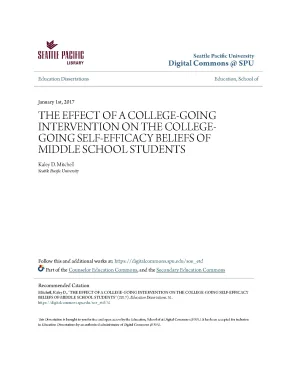
Tải xuống để đọc toàn bộSeattle Pacific University Digital Commons @ SPU Education Dissertations Education, School of January 1st, 2017 THE EFFECT OF A COLLEGE-GOING INTERVENTION ON THE COLLEGE- GOING SELF-EFFICACY BELIEFS OF MIDDLE SCHOOL STUDENTS Kaley D. Mitchell Seattle Pacific University Follow this and additional works at: https://digitalcommons.edu/soe_etd Part of the Counselor Education Commons, and the Secondary Education Commons Recommended Citation Mitchell, Kaley D., "THE EFFECT OF A COLLEGE-GOING INTERVENTION ON THE COLLEGE-GOING SELF-EFFICACY BELIEFS OF MIDDLE SCHOOL STUDENTS" (2017).edu/soe_etd/31 This Dissertation is brought to you for free and open access by the Education, School of at Digital Commons @ SPU. It has been accepted for inclusion in Education Dissertations by an authorized administrator of Digital Commons @ SPU. 1 THE EFFECT OF A COLLEGE-GOING INTERVENTION ON THE COLLEGE- GOING SELF-EFFICACY BELIEFS OF MIDDLE SCHOOL STUDENTS by Kaley D.
Mitchell A dissertation submitted in partial fulfillment Of the requirements for the degree of Doctor of Education Seattle Pacific University 2017 Approval Page Copyright Page Table of Contents Approval Page. ii Copyright Page. iii List of Figures. iv List of Tables.
2 Benefits of Postsecondary Education. 2 Current Disparities in Higher Education. 10 Contributions of the Study. 24 Definition of Terms.
24 Structure of the Dissertation. 25 CHAPTER II: Review of Literature. 27 History of Self-Efficacy and Career Development. 33 Social Cognitive Career Theory: Self-Efficacy Research.
34 Social Cognitive Career Theory: Adolescence and Diversity. 37 Social Cognitive Career Theory Over Time. 39 History: Self-Efficacy, Career Self-Efficacy, and College-Going Self-Efficacy. 40 Self-Efficacy Intervention Research.
42 Career Self-Efficacy Intervention Research. 43 College-Going Self-Efficacy Intervention Research. 53 Mentorship and Self-Efficacy. 62 Summary of Literature.
63 CHAPTER III: Method. 72 Methods and Procedures. 78 CHAPTER IV: Results. 79 Raw Data Analysis.
90 Follow Up Analysis. 95 Chapter V: Discussion and Recommendations for Research and Practice. 97 Summary of Research. 97 Methods and Procedures.
99 Summary of Findings. 100 Discussion of Results. 102 Implications for Practice. 114 Implications for Future Research.
121 Appendix A- College-Going Self-Efficacy Scale. 141 Appendix B- Approval from Mukilteo School District. 144 Appendix C- Approval to Use Data from Mukilteo School District. 146 Appendix D- Parent Survey.
148 Appendix E- IRB Exemption. 149 Appendix F- Participant Survey Instructions (Posttest). 150 Appendix G- Student Consent to Participate. 151 Appendix H- North Star University of Washington, Bothell Recruitment Brochure.
153 Appendix I- North Star Curriculum Outline. 155 iii List of Figures Figure 1. Social Cognitive Career Model. This figure depicts the social cognitive career model proposed by Lent, Brown, and Hackett (1994).
Line graph displaying raw data group means across levels of testing. This figure depicts the difference in mean scores on college-going self-efficacy across pre-test and post-test for the intervention and the control groups. Pre-test and post-test scatterplot. This figure depicts a linear relationship between pre-test and post-test scores on college-going self-efficacy.
87 iv List of Tables Table 1 Quasi-Experimental Non-Equivalent Group Design. 66 Table 2 Percent of Sample and Number of Participants by Race/Ethnicity. 69 Table 3 Percent of Sample and Number of Participants by Gender. 69 Table 4 Percent of Sample and Number of Participants by Free and Reduced Priced Lunch.
70 Table 5 Percent of Sample by Prospective First-Generation College Student Status. 70 Table 6 Number and Percent’s of All Participants Including Intervention and Control Groups by Gender, Race, Low-income Status, and First-generation Status. 81 Table 7 Descriptive Statistics by Group. 82 Table 8 Tests of Normality.
85 Table 9 A Model Summary of Regression Analysis of Pretest and Posttest Scores. 88 Table 10 Test of Homogeneity of Variance: Levene’s Test of Equality Error Variance Based on Mean. 88 Table 11 ANOVA Output of Pretest Scores to Determine Independence of the Covariate and Treatment Effect. 89 Table 12 Tests of Between-Subjects Effects to Determine Homogeneity of Regression Slopes and ANCOVA.
90 Table 13 ANCOVA: Tests of Between-Subjects Effects by Group on Attendance Subscale. 92 Table 14 ANCOVA: Tests of Between-Subjects Effects by Group on Persistence Subscale. 93 Table 15 ANCOVA: Tests of Between-Subjects Effects by Ethnicity of the Intervention Group. 94 v Table 16 Crobach’s Alpha for Total College-Going Self-Efficacy Scale, Attendance Subscale, and Persistence Subscale by Pretest and Posttest.
95 vi Acknowledgments If you know me then you know that my motto in life is to pour my heart into everything that I come across. The path to earning my Ph. has come with a plethora of challenges, tribulations, and hardships as well as many moments of joy and triumph. My heart still beats thanks to those who have provided me academic, emotional, cognitive, and spiritual support along the way.
To my parents Ken and Vicky Mitchell, I am grateful to you both for being the rock in my life, especially your physical and emotional presence during my Ph. To my longtime professor, colleague, mentor and dissertation advisor Dr. Cher Edwards and my two co-chairs Dr. Munyi Shea and Dr.
Mary-Jo Larsen, thank you for your selfless support in pushing me to complete this dissertation in a timely manner. To my colleagues and friends at Seattle Pacific University, specifically Alex Johns, Dana Bailey, Ronak Patel, Nalline Baliram and Kimberly Jensen who in moments of despair picked me up and carried me to the next check point. Finally, to all those who love me including my family and friends and my significant other, thank you for cheering me along the sideline. I would also like to thank Annamarie Jordan and Ayva Thomas, the founders of North Star, as well as Dr.
Janelle Silva, for their vision in designing and implementing college-going interventions that have the potential to be impactful in the lives of underprivileged kids. You inspire students every day and the world is thankful for your passion. I am blessed to have you on my team. I thank God for His continued commitment to helping me develop and grow in academia, my role as a professional school counselor, and as advocate in a world where we must stand against social injustices and where we must stand now! vii Abstract The need for students of all backgrounds to access and persist in postsecondary education informs a need for additional support related to postsecondary attainment for all people.
Social cognitive theory (SCT; Bandura, 1987) and social cognitive career theory (SCCT; Lent, Brown, & Hackett, 1994) both support the design, implementation, and measurement of college-going interventions that work to enhance self-efficacy, a mediator in college interest, choice, and attendance. Thus, the purpose of this study was to investigate the effect of a college-going intervention on the college-going self-efficacy beliefs of a group of diverse middle school students. Specifically, this study examined the effect of an eight-week college-going mentorship program rooted in Bandura’s four sources of self-efficacy on college-going self-efficacy. A quasi-experimental non-equivalent group design was employed in this study.
Participants were seventh-grade students from a large urban school district in the Pacific Northwest. The control group was students who participated in the college-going intervention. The intervention group consisted of a comparable group of students who did not participate in the intervention. The dependent variable was college-going self- efficacy measured on the College-Going Self-Efficacy Scale (Gibbons, 2005) at pretest and posttest.
Descriptive and inferential statistics were computed to respond to the research question. Inferential statistics were derived from a one-way ANCOVA after data were analyzed to confirm the assumptions of an ANCOVA. The pretest scores on the College- Going Self-Efficacy scale were treated as the covariate. Tests of statistical significance were analyzed at the.
A one-way ANCOVA revealed that there was no statistically significant difference between the intervention and the control group on college-going self-efficacy following the college-going intervention and after controlling for the covariate. Thus, the obtained data did not support the findings and hypotheses of recent studies that interventions rooted in sources of self-efficacy have significantly affected self-efficacy. 2 CHAPTER I: Introduction Participation in postsecondary education provides monetary and other individual and societal benefits (Mudge & Higgins, 2011; Rose, 2013; Tate et al. As a result, politicians, researchers, and practitioners have attempted to increase access and success to postsecondary education for all people in a global, competitive, and diversifying economy (Mudge & Higgins, 2011; Tate et al.
In 2009, former President Obama initiated the college completion agenda, setting a goal that by 2020 the United States will have more college degrees earned than anywhere else in the world (White House Office of the Press Secretary, 2009). Theoretically supported by social cognitive theory (SCT) (Bandura, 1986 and social cognitive career theory (SCCT) (Lent, Brown, & Hackett, 1994), research in college-going self-efficacy (Gibbons, 2005), specifically college-going interventions in middle school that promote college-going self- efficacy, may provide some explanations for promoting student access and persistence in postsecondary education. Benefits of Postsecondary Education The rationale for improving degree completion is largely one of economics. Advancements in technology and the expansion of more jobs that require complex skills has led to greater opportunity for those who earn a Bachelor’s degree or higher and less opportunity for students with only a high school diploma (Autor, 2014; Carnevale, Jayasundera, & Gulish, 2016; Mudge & Higgins, 2011).
Today, nearly two out of three jobs require some form of postsecondary education, which has reduced the demand for relatively low-skilled workers and increased the demand for high-skilled workers (Carnevale et al. An advanced economy in technology requires a literate, 3 scientific, numerate, and technically trained workforce, increasing the value of postsecondary degrees and providing an enormous benefit to individuals seeking employment (Autor, 2014; Kelly & Prescott, 2007; Mudge & Higgins, 2011). A postsecondary degree, defined as a degree from a two- or four-year granting institution, has large economic and occupational payoffs for graduates (Carnevale et al. In general, the more education one achieves the more money one earns (Belfield & Bailey, 2017).
The National Center for Education Statistics (NCES, 2015) reported that in 2015 the annual median income of a young person who earned a bachelor’s degree was $50,000, 64% higher than a young person with only a high school diploma who earned a median income of $30,500. This large income gap gives people with bachelor degrees greater earnings across a lifetime, earning over one million dollars more than those with just a high school diploma across the span of a person’s life (Autor, 2014; Boulard, 2004; Carnevale et al. Purcell, Iams, and Shoffner (2015) cited how greater earnings also affect the amount of money earned into retirement, extending the benefits of higher education to life after work. Increasing levels of education has also led to lower levels of unemployment (Boulard, 2004; Tate et al.
According to the U. Bureau of Labor Statistics (2016), 7.4% of people who earned less than a high school diploma were unemployed in 2016 as opposed to only 2.5% of people who earned a bachelor’s degree or higher.9% of 25-64 year olds with only a high school diploma were employed compared to 88.9% of 25-64 year olds who earned a bachelor’s degree (Kena et al. Following the Great Recession of December 2007 to June 2009, the economy added 11.6 million jobs with ninety-nine percent of them going to workers with a college 4 education (Carnevale et al. Jobs barely grew for those who did not hold a postsecondary degree.
Only a small fraction of the 5.6 million jobs lost in the recession for workers with a high school diploma have been recovered by 2016. Thus, a college degree means more accessibility to today’s job market. Overall, a person who earns a bachelor’s degree will more than likely have a stronger monetary safety net than those with only a high school diploma. The benefits of a college diploma for an individual, however, are not limited to increased salary and lower levels of unemployment (Mudge & Higgins, 2011; Rose, 2013).
Nội dung được bảo vệ bản quyền — Tải xuống đầy đủ
Trích dẫn luận án này
Kaley D. Mitchell (2017). The effect of a college going intervention on the college go [Luận án tiến sĩ, Seattle Pacific University]. LuanAn.net. https://luanan.net/giao-duc-hoc/the-effect-of-a-college-going-intervention-on-the-college-going-s
Câu hỏi thường gặp
Luận án "The effect of a college going intervention on the college go" nghiên cứu về vấn đề gì?
Nghiên cứu tác động của can thiệp hỗ trợ sinh viên vào đại học, phân tích các yếu tố ảnh hưởng đến sự thành công.
Luận án "The effect of a college going intervention on the college go" được bảo vệ tại trường nào?
Luận án này được bảo vệ tại Seattle Pacific University. Năm bảo vệ: 2017.
Luận án "The effect of a college going intervention on the college go" thuộc chuyên ngành gì?
Luận án "The effect of a college going intervention on the college go" thuộc chuyên ngành Education. Danh mục: Giáo Dục Học.
Luận án "The effect of a college going intervention on the college go" có bao nhiêu trang?
Luận án "The effect of a college going intervention on the college go" có 167 trang. Bạn có thể xem trước một phần tài liệu ngay trên trang web trước khi tải về.
Cách tải luận án "The effect of a college going intervention on the college go" về máy như thế nào?
Để tải luận án về máy, bạn nhấn nút "Tải xuống ngay" trên trang này, sau đó hoàn tất thanh toán phí lưu trữ. File sẽ được tải xuống ngay sau khi thanh toán thành công. Hỗ trợ qua Zalo: 0559 297 239.