Teachers perceptions on the role of creativity in middle and sec
Khám phá nhận thức của giáo viên về vai trò sáng tạo ở cấp trung học. Nghiên cứu sâu về ảnh hưởng và cách thức giáo viên nhìn nhận sự sáng tạo.
Concordia University - Portland
Giáo dục học (Education / Higher Education)
Luan An
Luận án tiến sĩ
Năm xuất bản
Số trang
155
Thời gian đọc
24 phút
Lượt xem
0
Lượt tải
0
Phí lưu trữ
50 Point
Tổng quan nhanh
- Chủ đề:
- Teacher Perceptions on Creativity in Education's Role
- Số trang:
- 155 trang
- Trường:
- Concordia University - Portland
- Chuyên ngành:
- Giáo dục học (Education / Higher Education)
- Tác giả:
- Melissa Marie Diebel
- Năm:
- 2018
Tóm tắt nội dung luận án
I.Teacher Perceptions on Creativity in Education s Role
Nghiên cứu này khám phá teacher perceptions về creativity in education, đặc biệt ở cấp trung học cơ sở và trung học phổ thông. Giáo dục hiện tại thường tập trung vào chuẩn hóa, chưa phát triển đầy đủ các kỹ năng cần thiết cho thế giới toàn cầu hóa, dựa trên công nghệ. Các nhà giáo dục nhận ra tầm quan trọng của creative thinking để học sinh thành công trong kỷ nguyên hiện đại. Luận văn điều tra cách giáo viên ở các cấp độ này nhìn nhận môi trường sáng tạo và ảnh hưởng của innovative teaching strategies. Kết quả cho thấy niềm tin mạnh mẽ giữa các giáo viên rằng việc thúc đẩy sáng tạo tác động tích cực đến student academic performance. Sự hiểu biết này giúp thu hẹp khoảng cách giữa hướng dẫn truyền thống và pedagogical beliefs tiến bộ. Những hiểu biết sâu sắc này định hình curriculum design tốt hơn và hỗ trợ phát triển student creativity trong mọi môn học. Nghiên cứu nhấn mạnh teacher attitudes là động lực quan trọng để áp dụng các phương pháp sáng tạo.
1.1. Current Teacher Attitudes Towards Creativity
Các giáo viên có teacher attitudes đa dạng nhưng nhìn chung tích cực đối với việc tích hợp sáng tạo. Nhiều người thừa nhận vai trò quan trọng của nó trong việc chuẩn bị cho học sinh đối mặt với những thách thức trong tương lai. Một nhận thức tồn tại rằng sáng tạo không chỉ dành cho các môn nghệ thuật. Nó áp dụng trên toàn bộ curriculum design. Những thái độ này ảnh hưởng đến tương tác hàng ngày trong lớp học.
1.2. Challenges in Integrating Creative Thinking
Việc tích hợp creative thinking đặt ra nhiều thách thức. Áp lực tiêu chuẩn hóa đôi khi hạn chế cơ hội. Những hạn chế về thời gian và chương trình giảng dạy cứng nhắc thường được viện dẫn. Giáo viên cần hỗ trợ và tài nguyên để nhúng innovative teaching một cách hiệu quả. Vượt qua những rào cản này là điều cần thiết cho creativity in education.
1.3. Defining Creativity in Educational Contexts
Sáng tạo trong môi trường giáo dục vượt xa biểu hiện nghệ thuật. Nó liên quan đến giải quyết vấn đề, tư duy phản biện và tạo ra những ý tưởng mới. Giáo viên coi đây là một kỹ năng sống thiết yếu. Hiểu rõ định nghĩa rộng này là chìa khóa để triển khai thành công. Điều này định hình pedagogical beliefs về student creativity.
II.Impact of Creative Teaching on Middle School Achievement
Nghiên cứu khảo sát sâu rộng impact of creative teaching strategies lên student academic performance, đặc biệt tập trung vào middle school creativity. Một mối tương quan trực tiếp đã xuất hiện giữa các phương pháp sư phạm sáng tạo và sự thành công gia tăng của học sinh. Giáo viên nhận thấy sự gắn kết được nâng cao và hiểu biết sâu sắc hơn khi các yếu tố sáng tạo được tích hợp. Các phương pháp innovative teaching vượt ra ngoài việc học thuộc lòng. Chúng khuyến khích học sinh tích cực xây dựng kiến thức. Lăng kính kiến tạo này là nền tảng của nghiên cứu. Giáo viên tin rằng các chiến lược sáng tạo đáp ứng nhu cầu học tập đa dạng. Chúng phục vụ khả năng và sở thích học tập cá nhân của học sinh. Cách tiếp cận phù hợp này thúc đẩy kết quả học tập. Nó cung cấp các mục tiêu học tập rõ ràng trong khi vẫn cho phép sự linh hoạt. Nghiên cứu củng cố ý tưởng rằng một môi trường khuyến khích creative thinking không chỉ là bổ sung. Nó là trung tâm để cải thiện thành tích trong mọi lĩnh vực.
2.1. Linking Creative Strategies to Academic Performance
Các chiến lược sáng tạo liên kết trực tiếp với hiệu suất học tập tốt hơn. Ví dụ bao gồm học tập dựa trên dự án và các hoạt động dựa trên tìm tòi. Những phương pháp này kích thích tư duy bậc cao. Học sinh áp dụng kiến thức theo những cách mới. Ứng dụng sâu sắc này củng cố sự hiểu biết và cải thiện điểm số.
2.2. Enhancing Student Engagement Through Innovation
Innovative teaching thu hút sự quan tâm của học sinh. Sự nhàm chán giảm đi, sự tham gia tăng lên. Khi các bài học sáng tạo, học sinh trở thành người học tích cực. Sự gắn kết cao này chuyển thành khả năng ghi nhớ và động lực tốt hơn. Nó nuôi dưỡng tình yêu học tập.
2.3. Relevance for Middle School Creativity Development
Middle school creativity là một giai đoạn phát triển quan trọng. Học sinh sẵn sàng cho tư duy phức tạp hơn. Các phương pháp sáng tạo khai thác sự sẵn sàng này. Chúng xây dựng sự tự tin trong việc thể hiện ý tưởng. Sự phát triển này rất quan trọng cho thành công trong học tập và cuộc sống trong tương lai.
III.Fostering a Creative Learning Environment for Student Growth
Việc thiết lập một creative learning environment hỗ trợ là điều tối quan trọng cho student creativity và sự phát triển toàn diện. Nghiên cứu kết luận rằng một môi trường như vậy là nền tảng cho student success. Nó không tự nhiên mà có. Nó được xây dựng một cách có chủ ý thông qua các thực hành cụ thể. Sự tin tưởng tạo thành nền tảng của môi trường này. Học sinh phải cảm thấy đủ an toàn để khám phá, đặt câu hỏi và thậm chí thất bại. Các kỳ vọng rõ ràng cung cấp cấu trúc cần thiết. Trong cấu trúc này, việc chấp nhận rủi ro trở nên khả thi. Giáo viên nhận ra rằng sai lầm là cơ hội học hỏi. Cách tiếp cận này phù hợp với pedagogical beliefs tiến bộ. Nó loại bỏ nỗi sợ thất bại. Thay vào đó, nó thúc đẩy khả năng phục hồi và đổi mới. Môi trường này cũng xem xét các phong cách học tập cá nhân. Nó tôn trọng khả năng và sở thích đa dạng. Cuối cùng, nó nuôi dưỡng động lực nội tại và thúc đẩy việc học sâu sắc, có ý nghĩa. Điều này đóng góp đáng kể vào educational psychology.
3.1. Building Trust and Setting Clear Expectations
Sự tin tưởng là điều cần thiết. Học sinh cần cảm thấy an toàn khi chia sẻ ý tưởng. Các kỳ vọng rõ ràng trong lớp học cung cấp ranh giới. Những ranh giới này cho phép tự do trong một khuôn khổ có cấu trúc. Giáo viên liên tục truyền đạt những kỳ vọng này.
3.2. Encouraging Risk Taking and Learning from Mistakes
Một môi trường sáng tạo ủng hộ việc chấp nhận rủi ro. Học sinh được khuyến khích thử những điều mới. Việc mắc lỗi được định nghĩa lại là một phần của quá trình học tập. Nó loại bỏ nỗi sợ thất bại. Điều này thúc đẩy khả năng phục hồi và khuyến khích creative thinking.
3.3. Recognizing Individual Student Needs and Preferences
Môi trường sáng tạo hiệu quả thừa nhận tính cá nhân của học sinh. Các mục tiêu học tập rõ ràng, nhưng có thể thích ứng. Giáo viên điều chỉnh hướng dẫn để đáp ứng các nhu cầu đa dạng. Điều này tôn trọng các sở thích và khả năng học tập khác nhau. Nó tối đa hóa tiềm năng student creativity.
IV.Key Pedagogical Beliefs for Innovative Teaching Strategies
Nghiên cứu nhấn mạnh ảnh hưởng sâu sắc của teacher attitudes và pedagogical beliefs đến việc triển khai các chiến lược innovative teaching. Một thế giới quan kiến tạo đã hướng dẫn nghiên cứu này, nhấn mạnh việc học tập tích cực và xây dựng kiến thức. Giáo viên với niềm tin phù hợp với chủ nghĩa kiến tạo có nhiều khả năng tích hợp các phương pháp sáng tạo. Họ coi học sinh là người tham gia tích cực, không phải là người tiếp nhận thụ động. Sự thay đổi mô hình này ảnh hưởng đến curriculum design và các thực hành hàng ngày trong lớp học. Nó thúc đẩy creative thinking trong tất cả các môn học. Những giáo viên như vậy tin tưởng vào việc cung cấp cơ hội cho học sinh khám phá, thử nghiệm và giải quyết vấn đề. Cách tiếp cận này nuôi dưỡng student creativity đích thực. Nó vượt ra ngoài hướng dẫn truyền thống, giáo điều. Các phát hiện cho thấy việc phát triển chuyên môn tập trung vào việc thay đổi teacher attitudes và nâng cao pedagogical beliefs có thể cải thiện đáng kể creativity in education.
4.1. Teacher Attitudes Shaping Classroom Practices
Teacher attitudes là động lực quan trọng. Niềm tin về tiềm năng của học sinh tác động trực tiếp đến các phương pháp giảng dạy. Thái độ tích cực đối với sáng tạo dẫn đến các lớp học cởi mở và thử nghiệm hơn. Những thái độ này định hình mọi quyết định giảng dạy.
4.2. Shifting Towards Constructivist Learning Approaches
Nghiên cứu ủng hộ các phương pháp tiếp cận kiến tạo. Kiến thức được xây dựng, không chỉ được tiếp nhận. Các chiến lược innovative teaching tạo điều kiện cho quá trình này. Học sinh tích cực tương tác với nội dung. Điều này thúc đẩy sự hiểu biết sâu sắc hơn và kỹ năng giải quyết vấn đề.
4.3. Aligning Curriculum Design with Creative Goals
Curriculum design phải hỗ trợ các mục tiêu sáng tạo. Nó cần sự linh hoạt cho việc khám phá. Các chương trình giảng dạy cứng nhắc, tiêu chuẩn hóa có thể cản trở sự sáng tạo. Tích hợp cơ hội cho creative thinking trong các môn học là chìa khóa. Điều này đảm bảo sự phát triển toàn diện.
V.Research Insights on Creativity and Educational Psychology
Nghiên cứu trường hợp định tính này cung cấp research insights quan trọng về creativity and educational psychology trong giáo dục trung học cơ sở và trung học phổ thông. Sử dụng bảng câu hỏi, quan sát lớp học và phỏng vấn trực tiếp, nghiên cứu đã thu thập dữ liệu phong phú. Nó ghi lại những teacher perceptions tinh tế về vai trò của sự sáng tạo. Phương pháp này đảm bảo sự hiểu biết sâu sắc về teacher attitudes và pedagogical beliefs của họ. Một phát hiện quan trọng là mối tương quan mạnh mẽ giữa một môi trường sáng tạo và việc tăng student academic achievement. Nghiên cứu nhấn mạnh việc xây dựng niềm tin, kỳ vọng rõ ràng và hỗ trợ chấp nhận rủi ro là những yếu tố cốt lõi. Nó kết luận rằng sáng tạo không phải là một phần bổ sung mà là một phần không thể thiếu của việc học tập hiệu quả. Nghiên cứu này cung cấp những quan điểm có giá trị cho curriculum design, phát triển chuyên môn và hoạch định chính sách nhằm thúc đẩy student creativity và kỹ năng creative thinking trong giáo dục đương đại.
5.1. Methodology for Understanding Teacher Perceptions
Một thiết kế nghiên cứu trường hợp định tính đã được sử dụng. Thu thập dữ liệu bao gồm khảo sát, quan sát và phỏng vấn. Cách tiếp cận đa diện này cung cấp những hiểu biết toàn diện. Nó ghi lại chi tiết teacher perceptions và kinh nghiệm.
5.2. Qualitative Findings on Creativity s Academic Impact
Dữ liệu định tính cho thấy một nhận thức rõ ràng. Giáo viên tin rằng sáng tạo thúc đẩy thành tích học tập. Học sinh trong môi trường sáng tạo cho thấy sự gắn kết được cải thiện. Họ cũng thể hiện khả năng giải quyết vấn đề tốt hơn.
5.3. Implications for Future Educational Psychology Practices
Nghiên cứu có ý nghĩa đối với educational psychology. Nó gợi ý nhu cầu đào tạo giáo viên về việc thúc đẩy môi trường sáng tạo. Curriculum design trong tương lai nên ưu tiên student creativity. Các chính sách nên hỗ trợ các phương pháp innovative teaching.
Tải xuống file đầy đủ để xem toàn bộ nội dung
Tải đầy đủ (155 trang)Trích đoạn nội dung luận án
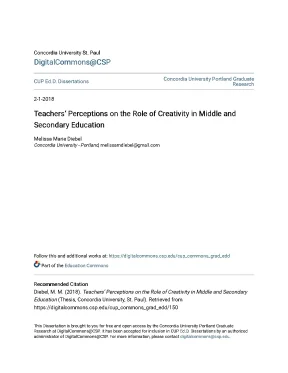
Tải xuống để đọc toàn bộConcordia University St. Paul DigitalCommons@CSP Concordia University Portland Graduate CUP Ed. Dissertations Research 2-1-2018 Teachers’ Perceptions on the Role of Creativity in Middle and Secondary Education Melissa Marie Diebel Concordia University - Portland, melissamdiebel@gmail.com Follow this and additional works at: https://digitalcommons.edu/cup_commons_grad_edd Part of the Education Commons Recommended Citation Diebel, M. Teachers’ Perceptions on the Role of Creativity in Middle and Secondary Education (Thesis, Concordia University, St.
Retrieved from https://digitalcommons.edu/cup_commons_grad_edd/150 This Dissertation is brought to you for free and open access by the Concordia University Portland Graduate Research at DigitalCommons@CSP. It has been accepted for inclusion in CUP Ed. Dissertations by an authorized administrator of DigitalCommons@CSP. For more information, please contact digitalcommons@csp.
Concordia University - Portland CU Commons Ed. Dissertations Graduate Theses & Dissertations 2-2018 Teachers’ Perceptions on the Role of Creativity in Middle and Secondary Education Melissa Marie Diebel Concordia University - Portland Follow this and additional works at: https://commons.edu/edudissertations Part of the Education Commons CU Commons Citation Diebel, Melissa Marie, "Teachers’ Perceptions on the Role of Creativity in Middle and Secondary Education" (2018).edu/edudissertations/110 This Open Access Dissertation is brought to you for free and open access by the Graduate Theses & Dissertations at CU Commons. It has been accepted for inclusion in Ed. Dissertations by an authorized administrator of CU Commons.
For more information, please contact libraryadmin@cu- portland. Concordia University–Portland College of Education Doctorate of Education Program WE, THE UNDERSIGNED MEMBERS OF THE DISSERTATION COMMITTEE CERTIFY THAT WE HAVE READ AND APPROVE THE DISSERTATION OF Melissa Marie Diebel CANDIDATE FOR THE DEGREE OF DOCTOR OF EDUCATION Donna Graham, Ph., Faculty Chair Dissertation Committee Judy Shoemaker, Ed., Content Specialist Greg Aldred, Ed., Content Reader ACCEPTED BY Joe Mannion, Ed. Provost, Concordia University–Portland Sheryl Reinisch, Ed. Dean, College of Education, Concordia University–Portland Marty Bullis, Ph.
Director of Doctoral Studies, Concordia University–Portland Teachers’ Perceptions on the Role of Creativity in Middle and Secondary Education Concordia University–Portland Melissa Marie Diebel Concordia University–Portland College of Education Dissertation submitted to the Faculty of the College of Education in partial fulfillment of the requirements for the degree of Doctor of Education in Higher Education Donna Graham, Ph., Faculty Chair Dissertation Committee Judy Shoemaker, Ed., Content Specialist Greg Aldred, Ed., Content Reader Concordia University–Portland 2018 Abstract While the goal of American education has been to produce workers who are ready to take their place in society, emphasis on standardization has not lead to the skills needed to effectively be a part of the technologically-based, globalized world in which society now functions. In this study, the researcher investigated how middle and secondary teacher perceive a creative environment or how the use of creative teaching strategies was perceived to increase academic performance of middle and secondary students. From the lens of Constructivism, a qualitative case study of middle and secondary teachers allowed for the discussion of creativity and perceived academic impact. Drawing from qualitative data collected using a questionnaire, classroom observations, and one-on-one interviews, this study found a perception among middle and secondary teachers of creativity increasing student academic achievement.
The data revealed that a creative environment was central to student success. The study concluded a creative environment is established through the building of trust, which is done by the setting clear classroom expectations, allowing for questions and risk-taking, as well as making it safe for students to make mistakes or fail. Additionally, the study concluded that creativity aligns with the recognition of individual student needs, abilities, and learning preferences and offers clear learning goals which in turn affected student academic performance. Keywords: creativity, creative environment, creative teaching strategies, middle-level student, secondary student, increased achievement ii Dedication To my husband, John, and my boys, Drew and Jack.
And to my NCPA Students. Thank you for believing in me and supporting me. I love you all. iii Acknowledgments This dissertation would not have been possible without the incredible people who supported me throughout this process: God, who led me through this journey and who has blessed me every day with wonderful friends and family; my incredible and supportive husband, John, who is my best friend and biggest supporter; my children, Drew and Jack, who gave up having a full time mom while I pursued this dream; my dad, Randy, my mom, Cheryl, and my Grandma, Marilyn, and my grandpa, Vernon, all of whom supported me, listened to me, and shaped me into the women I am today; my in-laws, Mark and Beth, for their support and constant encouragement; and to my NCPA Family, who gave me the courage to keep going and the ability to stand back up every time I fell; my committee, who pushed me to be a better writer, researcher, and scholar.
I would not be here today without all of you. I am incredibly blessed to have each of you in my life. I love you all more than you will ever know. iv Table of Contents List of Tables.
viii Chapter 1: Introduction. 1 Statement of Problem. 3 Purpose of Study. 4 Rationale, Relevance, and Significance.
4 Nature of Study. 6 Definition of Terms. 6 Assumptions, Delimitations, and Limitations. 9 Chapter 2: Literature Review.
11 Introduction and Background to the Problem. 11 Conceptual Framework: Social Constructivism. 13 Review of the Research Literature. 35 Introduction to Chapter 3.
35 Statement of the Problem. 36 Research Questions and Hypotheses. 38 v Population and Sample Selection. 38 Sources of Data.
42 Data Analysis Procedures. 44 Limitations of Research Design. 49 Chapter 4: Data Analysis and Results. 53 Data Analysis Procedures.
54 Presentation of Data and Results. 87 Chapter 5: Summary, Conclusions, and Recommendations. 89 Summary of the Study. 90 Summary of Findings and Conclusions.
103 Strengths and Weaknesses. 113 Appendix A Creativity in the Classroom: A Questionnaire. 121 Appendix B Observation Protocol: Diebel Creativity Study. 127 Appendix C District Invitation Letter.
131 vi Appendix D High School Site Permission Letter. 132 Appendix E Middle School Site Permission Letter. 133 Appendix F Participant Invitation Letter. 134 Appendix G Timeline of Study.
135 Appendix H Administrator Directions Letter. 136 Appendix I Consent to Participate. 137 Appendix J Parent Consent Letter. 139 Appendix K Student Assent Letter.
141 Appendix L Creativity in the Classroom: Interview One Questions. 142 Appendix M Creativity in the Classroom: Interview Two Questions. 143 Appendix N Statement of Original Work. 144 vii List of Tables Table 1 Demographic Data for the Participants.
List of Codes (Direct Language). Questionnaire: Environment Responses. Questionnaire: Learning Process Responses. Questionnaire: Creative Assessment Responses.
Questionnaire: Traditional Assessment Responses. Observational Protocol Data. 64 viii Chapter 1: Introduction Historically, the goal of American education was to produce workers who were ready to take their place in Industrial Society (Senge, Cambron-McCabe, Lucas, Smith, & Dutton, 2012). During the Industrial Age, the primary pedagogy centered on memorization of facts, repetitive drills, common assessments, and moving everyone through at the same pace (Senge et al.
However, these skills are no longer as relevant as they once were. The emphasis on standardization, both in classroom experiences and assessment, no longer lead to the skills needed to effectively be a part of the technologically-based, globalized world in which society now functions. Students are no longer asked to merely evaluate data or take part in routine work but instead are asked to use creative, innovative thinking in non-routine work (Robinson, 2011). The purpose of this qualitative case study is to explore teacher perceptions about creative learning environment and the perceived effects of creativity on student academic achievement in middle and secondary education.
Current research has focused on creativity in the classroom at various other levels. However, middle and secondary education research is limited. Understanding the teacher perception at the middle and secondary level is instrumental in finding how creativity is used as students prepare for post-secondary education and career. Chapter 1 includes a brief background of the problem and history.
An overview of the research questions, methods, design, and definition of terms are discussed. Finally, the limitations and delimitations will be noted. Background While there is much disagreement among teachers, administrators, policy-makers, and researchers regarding effective approaches to education, the central purpose of preparing students for life beyond K–12 education is imperative. During the early start of public education 1 businesses needed to ensure people had basic skills that would enable workers to efficiently manage their roles in society, on the assembly line.
Schools emulated the assembly method to prepare students for the workforce, using standard learning goals and assessments. Assembly- line schooling increased the productivity of schools. However, it also did not account for individual student differences and needs. The uniformity of product and process of norms drove teacher-centered instruction.
Students that were unable to learn at the speed that was set by the stakeholders were labeled and either struggled their way through or were entirely pushed out of school (Senge et al. This format created uniformity in the classroom and took away the individual ways that children learn, forcing everyone to learn in the same manner. As the societal needs of the United States shifted, educational pedagogy also shifted. The late sixties and early seventies saw a change that emphasized creativity and recognition of individual student learning needs (Guilford, 1967).
The idea of imparting knowledge was less desirable than nurturing a child’s ability to think, be creative, and problem-solve in a wide-range of situations (Aish, 2014; Bruner, 1996; Fisher, 2013; Rinkevich, 2014). During this shift, several researchers began to define creativity and evaluate its place in the classroom. Torrance (1963) found that teachers claimed to encourage and value characteristics such as creative thinking, determination, curiosity, and a sense of humor. However, while teachers claimed to value those characteristics, they did nothing to nurture them.
Students who exhibited these characteristics were often punished. Torrance (1963) determined that students often lose their sense of creativity about the time they enter fourth grade. While creativity may not be as prevalent in older students, Torrance (1965) noted that teachers could develop creativity if they encouraged creative thinking and valued student’s cultures and behaviors concerning the learning process. Torrance (1976), Gardner (2007), and 2 Csikszentmihalyi (1996) found that it was important for students to experience autonomy in the classroom and that they are given time to explore their interests.
Characteristics of creative people manifest in various kinds of behaviors, such as risk-taking, curiosity, openness, and independence (Csikszentmihalyi, 1996, 2014; Gardner, 2011). Creativity is not a result of working alone, but a social interaction of learning that recognizes student individuality within a culture or a group. Creative people solve problems, fashion products, define new questions in a field that is initially novel but is accepted by the community. Novelty does not mean that the child came up with something new that has never existed before, but that it is new or novel to that individual creator (Beghetto & Kaufman, 2013; Starko, 2013).
Additionally, creativity cannot exist in a vacuum (Csikszentmihalyi, 1996, 2014; Starko, 2013). It is critical to note that all great and innovative ideas have come from the cooperation of many and not only from the mind of a single person (Csikszentmihalyi, 1996; Robinson, 2011). Human organizations are built on a foundation of relationships and energies that are derived from both the individual and the collaboration of individuals working together (Robinson, 2011). Statement of Problem Teacher perceptions of creativity are essential to deciding how teachers respond to creativity in the classroom and whether creativity is being fostered.
The problem is current standards-based educational practices are not enabling students to develop the creative thinking needed to be successful in today’s globalized society. Current research has focused on creativity in the classroom, at the early childhood, elementary, and postsecondary level (Aish, 2014; Daly, Mosyjowski, & Seifert, 2014; Mahdi, Sukarman, & Yok., 2015; Rinkevich, 2014; Susnea & Tataru, 2014).
Nội dung được bảo vệ bản quyền — Tải xuống đầy đủ
Trích dẫn luận án này
Melissa Marie Diebel (2018). Teachers perceptions on the role of creativity in middle and [Luận án tiến sĩ, Concordia University - Portland]. LuanAn.net. https://luanan.net/giao-duc-hoc/teachers-perceptions-on-the-role-of-creativity-in-middle-and-sec
Câu hỏi thường gặp
Luận án "Teachers perceptions on the role of creativity in middle and" nghiên cứu về vấn đề gì?
Khám phá nhận thức của giáo viên về vai trò sáng tạo ở cấp trung học. Nghiên cứu sâu về ảnh hưởng và cách thức giáo viên nhìn nhận sự sáng tạo.
Luận án "Teachers perceptions on the role of creativity in middle and" được bảo vệ tại trường nào?
Luận án này được bảo vệ tại Concordia University - Portland. Năm bảo vệ: 2018.
Luận án "Teachers perceptions on the role of creativity in middle and" thuộc chuyên ngành gì?
Luận án "Teachers perceptions on the role of creativity in middle and" thuộc chuyên ngành Giáo dục học (Education / Higher Education). Danh mục: Giáo Dục Học.
Luận án "Teachers perceptions on the role of creativity in middle and" có bao nhiêu trang?
Luận án "Teachers perceptions on the role of creativity in middle and" có 155 trang. Bạn có thể xem trước một phần tài liệu ngay trên trang web trước khi tải về.
Cách tải luận án "Teachers perceptions on the role of creativity in middle and" về máy như thế nào?
Để tải luận án về máy, bạn nhấn nút "Tải xuống ngay" trên trang này, sau đó hoàn tất thanh toán phí lưu trữ. File sẽ được tải xuống ngay sau khi thanh toán thành công. Hỗ trợ qua Zalo: 0559 297 239.