Repairing the teacher pipeline for people of color three essays
Tái thiết nguồn cung giáo viên cho người da màu: Ba yếu tố then chốt cho sự đa dạng và công bằng trong ngành giáo dục.
University of Connecticut
Doctor of Philosophy (Education / Teacher Education Policy)
Luan An
Luận án tiến sĩ
Năm xuất bản
Số trang
186
Thời gian đọc
28 phút
Lượt xem
0
Lượt tải
0
Phí lưu trữ
50 Point
Tổng quan nhanh
- Chủ đề:
- 1. Repairing Teacher Pipeline: Boosting Diversity in Education
- Số trang:
- 186 trang
- Trường:
- University of Connecticut
- Chuyên ngành:
- Doctor of Philosophy (Education / Teacher Education Policy)
- Tác giả:
- Jeremy Benjamin Landa
- Năm:
- 2020
Tóm tắt nội dung luận án
I. Repairing Teacher Pipeline Boosting Diversity in Education
Increasing the presence of teachers of color in schools represents a critical goal for educational systems. A widespread consensus acknowledges the importance of teacher diversity. Despite this agreement, limited empirical research exists regarding effective public policy solutions. The current educational landscape shows a persistent disparity in educator demographics compared to student populations. This gap impacts student outcomes and perpetuates systemic inequities. Understanding how public policy can meaningfully address this issue remains paramount. This dissertation investigates the potential for Minority Teacher Scholarship (MTS) programs to influence the labor supply of teachers of color. The study leverages extensive federal and university teacher education data. Findings provide suggestive evidence for policy makers. These insights can inform strategic initiatives aimed at strengthening the teacher workforce. Prioritizing racial equity in teaching demands targeted interventions. The document comprises three distinct essays, each exploring a specific facet of MTS efficacy. Collective findings offer a comprehensive view of scholarship program impacts. These programs offer a tangible mechanism for fostering greater representation. Policy makers seek actionable data to guide resource allocation. This research offers valuable insights for decision-makers committed to enhancing educator pipelines for underrepresented teachers. The ultimate goal involves creating a more inclusive and representative teaching profession. This contributes to better educational experiences for all students.
1.1. Addressing Racial Equity in Teacher Pipeline
The imperative for racial equity in teaching forms a core concern for educational leadership. Schools across the nation grapple with a lack of teacher diversity. This absence negatively affects minority students' academic performance and sense of belonging. The teacher pipeline traditionally exhibits challenges in attracting and retaining individuals from diverse backgrounds. Systemic barriers often deter prospective minority educators. Effective strategies are needed to dismantle these obstacles. This research directly confronts these issues by examining a specific policy lever. It explores how financial aid, specifically through Minority Teacher Scholarships, can contribute to a more equitable workforce. The focus is on creating pathways for underrepresented teachers to enter and thrive in the profession. Such initiatives are crucial for strengthening the overall teacher workforce. Addressing this imbalance fosters environments where all students see themselves reflected in their educators. This promotes cultural understanding and improved learning outcomes. The pursuit of racial equity is not merely an ethical consideration; it is an educational necessity. Policy interventions must target the root causes of underrepresentation. Scholarship programs represent one such targeted approach. Their efficacy demands rigorous empirical investigation. This work contributes to that vital research base.
1.2. Minority Teacher Scholarships A Policy Solution
Minority Teacher Scholarships (MTS) emerge as a significant public policy tool in discussions surrounding teacher recruitment strategies. These scholarship programs aim to incentivize individuals from diverse backgrounds to pursue teaching careers. The dissertation specifically evaluates whether MTS can effectively alter the labor supply of teachers of color. This involves analyzing their impact on various stages of the educator pipeline. From initial enrollment in teacher education programs to eventual employment and retention, MTS programs hold potential. The research examines real-world data from multiple states and a university's teacher education program. This empirical approach provides concrete evidence on the effectiveness of financial aid. Scholarship values and institutional contexts play a role in program outcomes. The findings explore differential impacts based on these variables. Understanding the nuances of MTS implementation is key to optimizing future initiatives. Such scholarships represent a direct investment in human capital. They address financial barriers that often prevent talented minority educators from pursuing their aspirations. The long-term goal is to build a robust and diverse teaching profession. This requires sustained commitment to effective teacher recruitment strategies. MTS programs are positioned as a critical component of these broader efforts. Their design and execution require careful consideration to maximize benefits for both individuals and the wider educational system.
II. Minority Teacher Scholarship Impact on Educator Supply
The first essay within this comprehensive dissertation scrutinizes the impact of Minority Teacher Scholarship (MTS) programs on the broader educator supply. This analysis focuses specifically on whether implementing MTS initiatives in various states leads to an increased proportion of candidates of color earning teacher education bachelor’s degrees. The methodology employs rigorous event study and difference-in-differences frameworks. These econometric models allow for a robust comparison between states that implemented MTS programs and those that did not. The objective is to isolate the causal effect of these scholarships on the demographic composition of new teaching graduates. Findings reveal a significant trend. Implementing states successfully stabilized the share of Black teacher candidates. This stabilization occurred relative to non-implementing states, where the proportion might have otherwise declined. This outcome suggests MTS programs can counteract negative trends in minority educator representation. The analysis delves into the underlying mechanisms driving this effect. It identifies particular institutional contexts and financial award structures as influential factors. Understanding these drivers is crucial for replicating successful strategies. Strengthening the teacher workforce depends on effective recruitment strategies. This essay provides critical evidence regarding the efficacy of targeted scholarships. It highlights their role in bolstering the overall supply of underrepresented teachers. The data underscore the importance of financial incentives in shaping the demographic landscape of the teaching profession.
2.1. Stabilizing Black Teacher Candidate Share
A key finding from the first essay indicates that Minority Teacher Scholarship (MTS) programs played a crucial role in stabilizing the proportion of Black teacher candidates. This stabilization occurred specifically in states that implemented these scholarship initiatives. The comparative analysis with non-implementing states demonstrated a clear divergence. Without MTS intervention, the share of Black candidates might have experienced a decline. This suggests MTS acts as a protective factor, preventing further erosion of minority educator representation within the teacher pipeline. The positive impact on Black teacher candidate numbers directly contributes to increasing teacher diversity. It addresses the ongoing challenge of attracting and retaining individuals from underrepresented groups. These findings offer concrete evidence for policy makers seeking to promote racial equity in teaching. The stabilization effect underscores the power of targeted financial aid. Such support can mitigate existing barriers to entry for prospective BIPOC teacher pathways. Ensuring a steady influx of Black educators is vital for creating more culturally responsive schools. This research provides a robust empirical basis for advocating for and sustaining these critical programs. It emphasizes their capacity to strengthen the teacher workforce by supporting specific demographic groups.
2.2. Influence of Private Institutions High Value Awards
Further analysis revealed that the observed stabilization in Black teacher candidate shares was not uniform across all contexts. The effect was significantly driven by changes occurring within private educational institutions. These institutions appeared particularly responsive to the introduction of Minority Teacher Scholarship (MTS) programs. Additionally, states offering the greatest financial value awards demonstrated a more pronounced impact. This suggests that the magnitude of the scholarship award plays a critical role in its effectiveness. Higher financial incentives likely attract a greater number of minority educators. They also potentially alleviate more significant financial burdens, making teaching careers more feasible. Understanding these differential effects is essential for optimizing teacher recruitment strategies. Targeting support towards private institutions or increasing the financial value of awards could yield greater returns. This strategic refinement helps strengthen the teacher workforce by maximizing the appeal of scholarships. It ensures that resources are allocated efficiently to achieve desired outcomes in teacher diversity. The insights gained point towards best practices for future educator pipeline initiatives. Effective scholarship design must consider both institutional context and the attractiveness of the financial offering.
III. Enhancing Teacher Diversity Degree Completion MTS Aid
The second essay within the dissertation shifts focus to a critical stage of the educator pipeline: degree completion. This section investigates whether teacher candidates of color receiving Minority Teacher Scholarship (MTS) aid are more likely to successfully complete their degree programs. Degree completion is a fundamental prerequisite for entering the teaching profession. Financial barriers often represent significant hurdles for underrepresented teachers. Scholarships can directly address these financial pressures, potentially increasing persistence and graduation rates. The study employs robust analytical models, including linear probability and propensity score matching. These methodologies allow for a rigorous comparison between scholarship recipients and non-recipients who are otherwise observably similar. This helps isolate the specific effect of MTS aid. Findings indicate a positive association between MTS receipt and degree completion. This applies to both bachelor's and master's degrees. The evidence suggests that financial support from MTS programs effectively reduces attrition among minority educators. Enhancing teacher diversity relies not only on recruitment but also on ensuring candidates finish their training. These results provide strong evidence for the efficacy of MTS programs as a tool for strengthening the teacher workforce. It underscores their role in supporting individuals through their academic journey. Successful completion translates directly into a larger pool of qualified teachers of color, directly impacting the availability of diverse educators for schools. This stage of the pipeline is crucial for addressing the overall teacher shortage with diverse talent.
3.1. MTS Positive Association with Degree Attainment
A significant finding from the second essay establishes a positive association between receiving Minority Teacher Scholarship (MTS) aid and successful degree attainment. Specifically, teacher candidates of color who received MTS support demonstrated a higher likelihood of completing their bachelor's and master's degrees. This correlation suggests that financial assistance provided through these scholarships directly contributes to academic persistence. Overcoming financial obstacles is often critical for underrepresented teachers navigating higher education. MTS programs offer tangible support, reducing the need for extensive work hours or student loan debt. This allows students to focus more intently on their studies. Such programs act as a vital component in teacher recruitment strategies by ensuring that promising candidates complete their educational journeys. The successful progression from enrollment to graduation is paramount for increasing the number of minority educators. This research highlights the effectiveness of targeted financial aid in strengthening the educator pipeline. It underscores the importance of continued investment in programs like MTS. These initiatives are essential for enhancing teacher diversity and building a more representative teaching profession capable of addressing current and future teacher shortages.
3.2. Supporting Observably Similar Individuals
The analysis in the second essay utilized sophisticated statistical techniques, including propensity score matching. This ensured that comparisons between MTS recipients and non-recipients were made among individuals who were observably similar on a range of individual characteristics. These characteristics included academic background, socioeconomic status, and other relevant factors. By controlling for these variables, the study strengthened the causal inference of MTS effectiveness. The positive association between MTS receipt and degree completion held true even when comparing highly similar individuals. This finding reinforces the conclusion that MTS aid, rather than pre-existing individual advantages, contributes to higher completion rates. It suggests that the scholarships provide a genuine boost to minority educators. This supports the argument for racial equity in teaching by demonstrating a direct impact on individual success within the educator pipeline. The ability to identify and support underrepresented teachers who are otherwise comparable to their peers ensures fairness and impact. This targeted approach helps overcome systemic barriers. It validates MTS programs as an effective mechanism for building a stronger, more diverse teacher workforce. The research provides confidence that MTS programs are not simply selecting already successful candidates, but rather empowering them to succeed.
IV. Retention Employment MTS for Underrepresented Teachers
The third and final essay examines the crucial post-graduation phase of the educator pipeline: labor market outcomes. This section investigates whether Minority Teacher Scholarship (MTS) awards differentially influence employment patterns and retention rates among teacher candidates of color. Securing initial teaching positions and remaining in the profession are vital for addressing the teacher shortage and promoting teacher diversity. The study employs advanced analytical methods, including linear probability and discrete-time survival analysis models. These models allow for a detailed examination of employment entry and exit behaviors. The focus remains on individuals from the same program, ensuring a controlled comparison. Findings reveal a significant positive association between MTS receipt and public school teaching employment. Specifically, MTS recipients were more likely to secure teaching positions within two years of graduation. This indicates the scholarships effectively facilitate entry into the professional workforce for minority educators. Furthermore, the analysis uncovers a negative association between MTS receipt and exiting teaching in a public school. This suggests MTS programs not only aid in recruitment but also contribute to teacher retention programs. These dual benefits are critical for strengthening the teacher workforce. They provide compelling evidence that financial support extends its positive influence beyond academic completion, directly impacting career trajectories and stability for underrepresented teachers. This directly contributes to long-term racial equity in teaching.
4.1. Promoting Public School Teaching Employment
One of the key findings from the third essay highlights the effectiveness of Minority Teacher Scholarship (MTS) programs in promoting public school teaching employment. Teacher candidates of color who received MTS awards demonstrated a significantly higher likelihood of securing employment in public schools within two years of graduating. This positive association underscores the role of MTS as a powerful incentive and facilitator for entering the teaching profession. For underrepresented teachers, the transition from student to employed educator can present unique challenges. Financial aid through scholarships may provide stability, reducing the urgency to pursue alternative, higher-paying careers outside of education. This directly supports teacher recruitment strategies focused on increasing minority educators. Ensuring these graduates find positions where they are most needed, in public schools, is crucial for addressing the teacher shortage. The evidence suggests MTS programs are not just about academic success, but also about successful career placement. This strengthens the teacher workforce by funneling diverse talent into the public education system, where their impact on student diversity and achievement is most profound. The investment in MTS translates into actual teaching positions, fulfilling the promise of a more representative teaching staff.
4.2. Reducing Teacher Exits for People of Color
Beyond initial employment, the third essay also investigates the impact of Minority Teacher Scholarship (MTS) programs on teacher retention. A significant finding reveals a negative association between MTS receipt and exiting teaching in a public school for individuals of color from the same program. This indicates that MTS aid contributes to improved teacher retention programs. Minority educators, like all teachers, face various pressures that can lead to early career exits. Financial stability provided by scholarships may alleviate some of these pressures, encouraging longer tenure in the profession. This is crucial for strengthening the teacher workforce, especially in areas facing high teacher turnover and shortages. By reducing the likelihood of minority teachers leaving public schools, MTS programs foster a more stable and experienced diverse teaching staff. This addresses a critical component of the teacher shortage, not just by bringing new teachers in, but by keeping them in classrooms. The insights gathered suggest that these scholarships are not merely recruitment tools but also effective components of broader retention strategies. Investing in MTS therefore serves a dual purpose: attracting talent and sustaining it within the public education system, thereby enhancing racial equity in teaching and supporting BIPOC teacher pathways effectively.
V. Strategic Initiatives Strengthening BIPOC Teacher Pathways
The collective findings from the three essays provide compelling, suggestive evidence regarding the efficacy of Minority Teacher Scholarship (MTS) programs. These programs consistently demonstrate benefits for individuals and for the largest group of people of color in states where MTS initiatives are implemented. The research underscores the critical role of targeted financial aid in repairing the teacher pipeline for people of color. It highlights the potential for public policy to actively shape the demographic composition of the teaching profession. Strengthening the teacher workforce requires multifaceted approaches. MTS programs represent a proven strategy that impacts recruitment, degree completion, employment, and retention. These stages are all vital components of a robust educator pipeline. The overarching goal involves creating a teaching force that mirrors the diversity of student populations. Achieving racial equity in teaching demands sustained commitment and informed policy decisions. The dissertation offers a strong empirical foundation for further investment in such initiatives. It provides a blueprint for policy makers seeking to address the persistent teacher shortage with diverse talent. The findings have direct implications for federal, state, and institutional level policy development. Continued research and evaluation will further refine these strategic initiatives. The aim remains to build a more inclusive, effective, and representative education system for all. This work serves as a valuable resource for advocates of teacher diversity and equity.
5.1. Benefits of MTS for Diverse Educator Groups
The comprehensive studies confirm that Minority Teacher Scholarship (MTS) programs yield significant benefits for diverse educator groups. Specifically, the research shows positive outcomes for individuals receiving the aid, particularly for people of color. These benefits manifest across several critical junctures of the teacher pipeline. They include increased rates of bachelor's and master's degree completion. Furthermore, MTS recipients demonstrate higher rates of public school employment post-graduation. The scholarships also appear to contribute positively to teacher retention programs, reducing early career exits. These cumulative effects are vital for enhancing teacher diversity. They directly contribute to building a more representative and resilient teaching workforce. The findings provide concrete evidence that financial support can effectively empower minority educators to overcome systemic barriers. The focus on the largest group of people of color in implementing states highlights a broad positive impact. This suggests that MTS programs are not just a theoretical solution but a practical and effective tool. It is an investment that yields returns in terms of qualified and retained minority teachers. This contributes to the broader goal of racial equity in teaching and robust BIPOC teacher pathways.
5.2. Policy Implications for Addressing Teacher Shortage
The findings from this dissertation carry profound policy implications for addressing the persistent teacher shortage, particularly concerning teacher diversity. The evidence strongly suggests that Minority Teacher Scholarship (MTS) programs are an effective public policy lever. They can significantly increase the supply of qualified teachers of color. Policy makers should consider expanding and strengthening existing MTS initiatives. The research highlights the importance of financial award value and institutional context in maximizing program effectiveness. Strategic allocation of resources to support private institutions or increase scholarship amounts could yield greater returns. Furthermore, the dual impact of MTS on both recruitment and retention makes them particularly valuable. These programs offer a holistic solution for educator pipeline initiatives. They help bring new talent into the profession and ensure that talent remains. Addressing the teacher shortage requires innovative and proven strategies. Investing in MTS programs represents a data-driven approach to building a more diverse and stable teacher workforce. These insights can guide federal, state, and local educational agencies in developing more equitable and effective policies. The ultimate goal is to create a sustainable pipeline of underrepresented teachers, benefiting students and communities nationwide.
Mục lục chi tiết luận án
Tải xuống file đầy đủ để xem toàn bộ nội dung
Tải đầy đủ (186 trang)Trích đoạn nội dung luận án
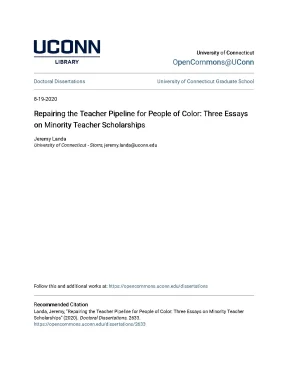
Tải xuống để đọc toàn bộUniversity of Connecticut OpenCommons@UConn Doctoral Dissertations University of Connecticut Graduate School 8-19-2020 Repairing the Teacher Pipeline for People of Color: Three Essays on Minority Teacher Scholarships Jeremy Landa University of Connecticut - Storrs, jeremy.edu Follow this and additional works at: https://opencommons.edu/dissertations Recommended Citation Landa, Jeremy, "Repairing the Teacher Pipeline for People of Color: Three Essays on Minority Teacher Scholarships" (2020).edu/dissertations/2633 Repairing the Teacher Pipeline for People of Color: Three Essays on Minority Teacher Scholarships Jeremy B. University of Connecticut, 2020 Despite near consensus agreement about the importance of increasing the presence of teachers of color in schools, there is limited research on how public policy can solve this problem. Drawing on federal and one university’s teacher education data, this dissertation addresses whether a Minority Teacher Scholarship (MTS) can alter the labor supply of teachers of color. The first essay evaluates whether five states implementing MTS programs increase the proportion of candidates of color earning teacher education bachelor’s degrees.
Using event study and difference-in-differences frameworks, I find that implementing states stabilized the share of Black candidates relative to non-implementing states, a result driven by changes in private institutions and states with the greatest financial value awards. In the second essay, I estimate whether teacher candidates of color in the same program are more likely to complete a degree if receiving MTS aid. Using linear probability and propensity score matching models, I find MTS receipt associated positively with bachelor’s and master’s degree completion for individuals who were observably similar on individual characteristics. The third essay investigates whether teacher candidates of color in the same program university respond MTS awards differentially in the labor market.
Using linear probability and discrete-time survival analysis models, I find that MTS receipt associated positively with public school teaching employment within two years of graduation, and negatively with exiting teaching in a public school for individuals of color from the same program. The three studies provide suggestive evidence that MTS programs benefit individuals and the largest group of people of color in states implementing MTS programs. Repairing the Teacher Pipeline for People of Color: Three Essays on Minority Teacher Scholarships Jeremy B., Wayne State University, 2003 Ed. University of Connecticut, 2017 A Dissertation Submitted in Partial Fulfillment of the Requirements for the Degree of Doctor of Philosophy at the University of Connecticut 2020 ii Copyright by Jeremy Benjamin Landa 2020 iii Approval Page Doctor of Philosophy Dissertation Repairing the Teacher Pipeline for People of Color: Three Essays on Minority Teacher Scholarships Presented by Jeremy B.
Dissertation Chair and Advisor_____________________________________________________ Morgaen L. Dissertation Committee __________________________________________________________ Shaun M. Dissertation Committee __________________________________________________________ Eric J. Dissertation Committee __________________________________________________________ Ann Traynor, Ed.
Kenny Nienhusser, Ed. University of Connecticut 2020 iv Dedication For Shari, who made this possible. For Oscar and George, who kept me grounded while completing work that is ostensibly maddening. For my family, near and far, whose shoulders I stood on to achieve this feat.
And for Elise. As the first-born, I thought you deserved to be the first doctor in our immediate family. v Acknowledgements I am grateful to my committee whose efforts are the reason I produced a dissertation. To Morgaen Donaldson, who made me a better writer, thinker, and was always willing to provide feedback and guidance despite her busy schedule.
To Shaun Dougherty, whose mentorship and investment in my career has persisted through his own job transition. To Eric Brunner, who responded with patience and support to numerous stream of consciousness methodological questions. To Ann Traynor, who has been an eager broker of data access and provider of practitioner insight for this work. And to Kenny Nienhusser, whose detailed and organized feedback and orientation to criticality has always made me pause and think.
Thanks to my colleagues—in particular to Monique Golden, who helped me survive the first three years of classes, and Daron Cyr, who became a regular thought partner and a provider of feedback on my dissertation writings. Thanks to Sam Kamin, whose presence ensured that I know something about statistics and can use Stata fluently. Thanks to Michael Correl, Chelsea Connery, Alex Lamb, Shannon Holder, Britney Jones, Patricia Virella, and Dave Alexandro whose feedback, cheerleading, and camaraderie sustained me when the requirements felt overwhelming. And to Shari, who took on the bulk of the childcare during the pandemic so that I could reach the finish line in this doctoral journey.
I can’t imagine having done any of this without you, and cannot wait for what the future holds. vi Table of Contents Acknowledgements. v Table of Contents. vi List of Tables.
ix List of Figures. x Chapter 1 Repairing the Teacher Pipeline for People of Color: Evidence from States Adopting Minority Teacher Scholarships. 4 The Dysfunctional Teacher Pipeline for Individuals of Color. 6 State Scholarships, Public Service, and Teacher Scholarships.
7 States’ Approaches to Scholarships. 7 State Merit Scholarships. 7 State Financial Need Scholarships. 8 Public Service and Scholarships.
9 The Outcomes of Teaching Scholarships. 12 Program Description and Context. 35 Difference-in-Differences Estimates. 38 Tests of Robustness.
46 Greatest Financial Value Scholarships. 46 Private Higher Education Institutions. 53 Discussion and Implications. 58 Financial Incentives are not Large Enough.
59 Programs are not Scaled Properly. 60 Programs are Substitutes of State Level Financial Aid Based on Merit or Need. 61 Programs are Adopted in States with Specific Racial-Ethnic Structures. Procedures for Identifying “Minority Teacher Scholarship” Program States.
Classification of Instructional Programs (CIP) Code selection for Teachers and Nursing. 72 Chapter 2 Do Minority Teacher Scholarships Lessen Leaks in the Teacher Pipeline? Evidence Flagship University’s Traditional Teacher Education Program. 76 Teachers of Color Matter for Schooling. 78 Entry into the Teacher Pipeline for Individuals of Color.
79 The Challenges of Unobserved Selection for Identifying Causal Impacts. 92 Propensity Score Matching. 93 Alternative Matching Strategies. 96 Propensity Score Matching Estimates.
100 Remove GPA Cut-Off Years. 100 Tests of Differential Associations. 102 Differential Results by Cohort. 102 Differential Results by Pre-Teaching Major or Financial Aid Based on Need.
104 Discussion and Implications. Procedures for identifying “Minority Teacher Scholarship” Program States. Common Support and Covariate Balance. 119 Chapter 3 Minority Teacher Scholarships and Employment: A Case Study of Labor Market Outcomes from Flagship University’s Traditional Teacher Education Program.
124 Financial Aid Incentives for Teaching Service. 126 Differential Access to Teacher Labor Markets by Race/Ethnicity. 135 Data Sources and Sample. 137 Educators or Students of Color.
138 Predictor of Interest. 141 Students or Educators of Color. 149 Discrete Time Survival Analysis Models. 149 Kaplan-Meier Survival Curves.
151 Racial and Ethnic Match in Schools and MTS Status. 153 Students of Color. 153 Educators of Color. 157 Limitations, Discussion, and Implications.
172 ix List of Tables Study 1 Table 1-1. Description of Minority Teacher Scholarships (MTS) 14 Table 1-1 (Continued). Description of Minority Teacher Scholarships (MTS). Proportion of Teacher Education Bachelor's Degrees Conferred by Race/Ethnicity.
Outcomes and Covariates in Baseline Year of Data (1994-1995). Definitions of Variables. Difference-in-Differences Estimates of MTS Program Implementation. Tests of Robustness for Difference-in-Differences Estimates of MTS Program Implementation and the Proportion of Black Teacher Candidates.
Difference-in-Differences Estimates of MTS Programs Association with the Proportion of Black Teacher Candidates. Triple-Difference Estimates of MTS Programs Association with the Proportion of Black Teacher Candidates. Placebo Test for Difference-in-Differences Estimates of MTS Programs Association with the Proportion of Black Teacher or Nursing Candidates. Definitions of Variables for Study of MTS recipients.
Outcomes and Predictors by MTS Recipient Status. Linear Probability Models of MTS Relationship to Degree Attainment. OLS and Propensity Score Matching Estimates of the Relationship Between MTS Award on Recipients’ Degree Attainment. Propensity Score Matching of MTS Award on Recipients Master's Degree Attainment without GPA Selection Cut-off Years.
Differential Test of the Relationship Between MTS Receipt and Degree Attainment by Cohort. Differential Tests for Receiving Financial Aid Based on Need or Pre-Teaching Major by MTS. Propensity Score Balancing of Covariates after matching for Estimating the Relationship Between MTS receipt and Degree Attainment. Hypothesis of the role of Minority Teacher Scholarships in Observed Employment or Exit Activities from the Public Schools.
Outcomes for Teacher Candidates of Color at a Flagship University in a state with an MTS Program. Independent Variables for Teacher Candidates of Color at a Flagship University in a state with an MTS Program. Association Between MTS and Employment within 2 years of Graduation. Discrete Time Survival Analysis of the Association Between MTS and Exit from the Profession.
OLS Regression to Estimate the Association Between Students of Color and MTS Receipt. OLS Regression to Estimate the Association Between Licensed Educators of Color and MTS Receipt. State Level Financial Incentives for Pre- and In-service Teachers. Definitions of Variables for Study of Employment Outcomes for MTS recipients.
174 x List of Figures Study 1 Figure 1-1. States implementing MTS scholarships. Total teacher candidates who completed bachelor’s degrees by year. Total (a) teacher candidates of color, (b) Black, non-Hispanic candidates, (c) Hispanic candidates, and (d) Asian, Native American, Pacific Islander, or multi-race candidates who completed bachelor’s degrees by year.
Proportion of (a) teacher candidates of color, (b) Black, non-Hispanic candidates, (c) Hispanic candidates, and (d) Asian, Native American, Pacific Islander, or multi-race candidates who completed bachelor’s degrees by whether the state ever implemented an MTS program. Event study measuring the proportion of (a) teacher candidates of color, (b) Black, non-Hispanic candidates, (c) Hispanic candidates, and (d) Asian, Native American, Pacific Islander, or multi-race candidates who completed bachelor’s degrees before and after MTS implementation. Event study for the proportion of Black, non-Hispanic candidates who completed bachelor’s degrees in (a) the states with the larger financial value scholarships, and (b) states with smaller financial value scholarship in states implementing an MTS. Event study showing the difference between public and private schooling institutions by the proportion of Black, non-Hispanic candidates who completed bachelor’s degrees in states with MTS programs.
Event study showing the proportion of Black, non-Hispanic candidates who completed (a) teacher education or (b) nursing bachelor’s degrees in states implementing MTS programs. Comparison of Unmatched and Matched Kernel Density Histograms 119 Study 3 Figure 3-1. Kaplan-Meier survival curves for exit by MTS status from the public schools from year 1 to year 12 for all master’s degree earning teacher education majors who are individuals of color from the same university’s teacher education program. 152 1 Chapter 1 Repairing the Teacher Pipeline for People of Color: Evidence from States Adopting Minority Teacher Scholarships Over the last 35 years, each state in the U.
has become more racially and ethnically diverse (Lee et al. The racial and ethnic population changes are mirrored by changes within the public schools. The National Center for Education Statistics Common Core of Data shows that across the 50 states and DC, 10,247 local education agencies served an average of 16.9% more students of color in 2018 than in 1988.1 Despite large shifts in students’ racial and ethnic characteristics, the number of teachers of color increased across the country only 8% over a similar time frame (U. Department of Education, 2016).
This suggests, and research confirms, that the system is inequitably designed resulting in differential recruitment into and retention within the teacher pipeline by race and ethnicity of individuals (Lindsay et al. Governments play a major role in solving the underrepresentation of teachers of color in public schools. State governments regulate which programs become teacher preparation providers and the credentials necessary for individuals to become teachers from within different pathways.
Nội dung được bảo vệ bản quyền — Tải xuống đầy đủ
Trích dẫn luận án này
Jeremy Benjamin Landa (2020). Repairing the teacher pipeline for people of color three ess [Luận án tiến sĩ, University of Connecticut]. LuanAn.net. https://luanan.net/giao-duc-hoc/repairing-the-teacher-pipeline-for-people-of-color-three-essays
Câu hỏi thường gặp
Luận án "Repairing the teacher pipeline for people of color three ess" nghiên cứu về vấn đề gì?
Tái thiết nguồn cung giáo viên cho người da màu: Ba yếu tố then chốt cho sự đa dạng và công bằng trong ngành giáo dục.
Luận án "Repairing the teacher pipeline for people of color three ess" được bảo vệ tại trường nào?
Luận án này được bảo vệ tại University of Connecticut. Năm bảo vệ: 2020.
Luận án "Repairing the teacher pipeline for people of color three ess" thuộc chuyên ngành gì?
Luận án "Repairing the teacher pipeline for people of color three ess" thuộc chuyên ngành Doctor of Philosophy (Education / Teacher Education Policy). Danh mục: Giáo Dục Học.
Luận án "Repairing the teacher pipeline for people of color three ess" có bao nhiêu trang?
Luận án "Repairing the teacher pipeline for people of color three ess" có 186 trang. Bạn có thể xem trước một phần tài liệu ngay trên trang web trước khi tải về.
Cách tải luận án "Repairing the teacher pipeline for people of color three ess" về máy như thế nào?
Để tải luận án về máy, bạn nhấn nút "Tải xuống ngay" trên trang này, sau đó hoàn tất thanh toán phí lưu trữ. File sẽ được tải xuống ngay sau khi thanh toán thành công. Hỗ trợ qua Zalo: 0559 297 239.