Learner Autonomy in EFL: Teachers' & Peers' Roles - TESOL Dissertation
Phân tích tự chủ người học, làm rõ vai trò then chốt của giáo viên và bạn bè. Tìm hiểu cách hỗ trợ học viên phát triển năng lực tự chủ hiệu quả.
Teaching English to Speakers of Other Languages
Luan An
doctoral dissertation
Năm xuất bản
Số trang
297
Thời gian đọc
45 phút
Lượt xem
0
Lượt tải
0
Phí lưu trữ
50 Point
Tổng quan nhanh
- Chủ đề:
- Nâng Cao Tính Tự Chủ Người Học EFL Quan Trọng
- Số trang:
- 297 trang
- Trường:
- Trường Đại học Mở Thành phố Hồ Chí Minh
- Chuyên ngành:
- Teaching English to Speakers of Other Languages
- Tác giả:
- Le Ha To Quyen
- Năm:
- 2023
Tóm tắt nội dung luận án
I.Nâng Cao Tính Tự Chủ Người Học EFL Quan Trọng
Tự chủ người học là mục tiêu giáo dục cốt lõi. Khái niệm này được công nhận rộng rãi. Nó cho phép sinh viên phát triển năng lực tự học và tự định hướng. Khả năng tự điều chỉnh học tập rất cần thiết. Sinh viên trở thành những người học suốt đời thành công. Sự độc lập trong học tập thúc đẩy tiến bộ cá nhân. Thời hiện đại mang lại nhiều cơ hội học tập. Sinh viên có thể học ngoài môi trường lớp học truyền thống. Bối cảnh này lý tưởng cho sự phát triển tự chủ người học. Các hoạt động tự học có vai trò quyết định. Nghiên cứu sâu hơn về tự chủ người học trong bối cảnh ngoài lớp học là cần thiết. Điều này bao gồm khả năng tự định hướng học tập và tự điều chỉnh quá trình học tập. Việc thúc đẩy tính tự chủ giúp cải thiện kỹ năng tiếng Anh (EFL).
1.1. Tầm quan trọng của tự chủ người học
Tự chủ người học được xem là mục tiêu giáo dục trung tâm. Nó đóng vai trò quan trọng trong việc giúp sinh viên trở thành người học suốt đời thành công. Khả năng tự chủ này cần thiết cho quá trình tự định hướng học tập và tự điều chỉnh quá trình học tập. Phát triển self-directed learning là một kỹ năng sống còn.
1.2. Mở rộng tự học ngoài lớp
Ngày nay, sinh viên có nhiều cơ hội học tập bên ngoài lớp học. Đây là môi trường lý tưởng để phát triển tự chủ người học. Nghiên cứu về tự chủ người học trong bối cảnh học ngoài lớp cần được chú trọng hơn. Việc này hỗ trợ phát triển kỹ năng tiếng Anh (EFL) toàn diện.
II.Nghiên Cứu Tự Học EFL Vai Trò Giáo Viên Bạn Bè
Nghiên cứu này áp dụng phương pháp hỗn hợp tuần tự giải thích. Nó khám phá tình hình tự chủ người học của sinh viên đại học EFL. Trọng tâm là bối cảnh học tập ngoài lớp. Nghiên cứu cũng điều tra tiềm năng thúc đẩy tự chủ. Vai trò của giáo viên và bạn bè trong lớp học được phân tích. Lý thuyết văn hóa xã hội cung cấp khung lý thuyết chính. Lý thuyết này nhấn mạnh sự tương tác xã hội trong phát triển nhận thức. Dữ liệu được thu thập từ hai nguồn chính. Một bảng câu hỏi về tự chủ người học đã được phát (N=709). Nó bao gồm vai trò của giáo viên và bạn bè. Ngoài ra, 35 cuộc phỏng vấn nhóm sâu bán cấu trúc được thực hiện. Việc này giúp thu thập thông tin định tính chi tiết. Phương pháp này đảm bảo cái nhìn toàn diện. Nó cung cấp bằng chứng vững chắc về tự chủ và các yếu tố ảnh hưởng.
2.1. Thiết kế nghiên cứu hỗn hợp
Nghiên cứu áp dụng thiết kế phương pháp hỗn hợp tuần tự giải thích. Nó khám phá tự chủ người học của sinh viên đại học EFL trong bối cảnh học ngoài lớp. Tiềm năng thúc đẩy tự chủ thông qua vai trò của giáo viên và bạn bè trong lớp học được phân tích. Khung lý thuyết dựa trên lý thuyết văn hóa xã hội.
2.2. Dữ liệu thu thập toàn diện
Dữ liệu được thu thập từ 709 bảng câu hỏi về tự chủ người học, vai trò giáo viên và bạn bè. Thêm vào đó, 35 cuộc phỏng vấn nhóm sâu bán cấu trúc đã được thực hiện. Việc thu thập dữ liệu này giúp đánh giá toàn diện self-directed learning và self-regulated learning.
III.Phân Tích Vai Trò Giáo Viên Hỗ Trợ Tự Chủ Người Học
Kết quả nghiên cứu chỉ ra mối tương quan tích cực đáng kể. Tự chủ người học có ba chiều: tình huống, hành vi và tâm lý. Các chiều này liên quan đến nhiều vai trò của giáo viên. Giáo viên đóng vai trò là nguồn tài nguyên kiến thức. Họ là người đánh giá tiến độ học tập. Giáo viên cũng là người kiểm soát môi trường lớp học. Họ còn là người hướng dẫn, người hỗ trợ (scaffolding) và người cùng học. Điều này diễn ra hiệu quả trong lớp học ngôn ngữ. Vai trò của giáo viên rất đa diện. Một số yếu tố đóng vai trò trung gian quan trọng. Chúng tác động đến các mối tương quan này. Động lực học tập của sinh viên là một yếu tố. Sự tin tưởng của sinh viên đối với giáo viên cũng rất cần thiết. Giáo viên hoạt động như một hình mẫu. Sự quan tâm của giáo viên cũng là chất xúc tác. Những yếu tố này thúc đẩy sự phát triển tự chủ người học. Vai trò của giáo viên trực tiếp ảnh hưởng đến self-directed learning và self-regulated learning.
3.1. Giáo viên vai trò đa dạng
Các phát hiện chỉ ra mối tương quan tích cực giữa tự chủ người học và vai trò của giáo viên. Các vai trò bao gồm: nguồn tài nguyên, người đánh giá, người kiểm soát, người hướng dẫn, người hỗ trợ và người cùng học. Giáo viên cung cấp scaffolding và định hướng cho sinh viên EFL.
3.2. Yếu tố điều hòa vai trò giáo viên
Các yếu tố trung gian quan trọng bao gồm động lực và sự tin tưởng của sinh viên. Giáo viên là một hình mẫu và sự quan tâm của giáo viên cũng rất cần thiết. Những yếu tố này thúc đẩy quá trình self-directed learning và self-regulated learning hiệu quả.
IV.Khám Phá Vai Trò Đồng Đẳng Thúc Đẩy Tự Chủ Học Viên
Mối tương quan giữa tự chủ người học và vai trò của bạn bè rất có ý nghĩa thống kê. Bốn vai trò đồng đẳng được nhận thức trong lớp học. Chúng bao gồm người cùng học, người khuyến khích, người đánh giá và người hỗ trợ. Các tương tác đồng đẳng này quan trọng cho peer collaboration. Peer feedback cũng là một phần không thể thiếu. Chúng thúc đẩy tinh thần trách nhiệm và tính tự chủ. Các yếu tố điều hòa của những mối tương quan này rất đa dạng. Chúng bao gồm cảm xúc tích cực trong nhóm. Sự phụ thuộc lẫn nhau giữa các sinh viên được nhấn mạnh. Trách nhiệm cá nhân và giá trị thể diện cũng đóng vai trò trung gian. Các yếu tố này góp phần tạo ra môi trường học tập hỗ trợ. Chúng tăng cường self-directed learning và self-regulated learning. Sự hợp tác giữa các bạn đồng đẳng là chìa khóa.
4.1. Các vai trò đồng đẳng chính
Mối tương quan giữa tự chủ người học và bốn vai trò bạn bè trong lớp học có ý nghĩa thống kê. Các vai trò này là: người cùng học, người khuyến khích, người đánh giá và người hỗ trợ. Peer collaboration và peer feedback là các yếu tố thúc đẩy chính.
4.2. Yếu tố trung gian tương tác đồng đẳng
Các yếu tố điều hòa bao gồm cảm xúc tích cực, sự phụ thuộc lẫn nhau, trách nhiệm và giá trị thể diện. Các yếu tố này củng cố tầm quan trọng của tương tác đồng đẳng. Chúng hỗ trợ self-directed learning và self-regulated learning trong môi trường EFL.
V.Kết Luận Ứng Dụng Phát Triển Tự Chủ Học Tập EFL
Kết quả nghiên cứu cung cấp dữ liệu thực nghiệm mới mẻ. Dữ liệu này về tự chủ người học của sinh viên đại học EFL. Nó tập trung vào bối cảnh học tập ngoài lớp. Những phát hiện này có giá trị cao. Chúng đóng góp vào kho kiến thức về self-directed learning trong lĩnh vực EFL. Dữ liệu giúp hiểu rõ hơn về cách sinh viên quản lý việc học của họ. Nghiên cứu làm nổi bật mối liên hệ quan trọng. Mối liên hệ này tồn tại giữa học trong lớp và học ngoài lớp. Sự kết nối này cần thiết để thúc đẩy tự chủ người học hiệu quả. Các phát hiện gợi ý cho việc thiết kế chương trình giảng dạy. Chúng cũng định hướng các chiến lược giảng dạy. Mục tiêu là phát triển kỹ năng tự chủ bền vững cho sinh viên EFL. Điều này hỗ trợ quá trình self-regulated learning liên tục.
5.1. Bằng chứng thực nghiệm giá trị
Các phát hiện cung cấp dữ liệu thực nghiệm quý giá về tự chủ người học. Dữ liệu này tập trung vào sinh viên đại học EFL trong bối cảnh học ngoài lớp. Nó làm sâu sắc thêm hiểu biết về self-directed learning và self-regulated learning.
5.2. Kết nối học tập trong ngoài lớp
Nghiên cứu làm nổi bật mối liên hệ giữa học trong lớp và học ngoài lớp. Mối liên hệ này quan trọng trong việc thúc đẩy tự chủ người học. Các kết quả có ý nghĩa thực tiễn cho việc phát triển chương trình giảng dạy EFL.
Mục lục chi tiết luận án
Tải xuống file đầy đủ để xem toàn bộ nội dung
Tải đầy đủ (297 trang)Nội dung chính
Tổng quan về luận án
Luận án tiến sĩ chuyên ngành Lý luận và Phương pháp dạy học tiếng Anh (TESOL – Teaching English to Speakers of Other Languages, Mã số: 91 40 111) của nghiên cứu sinh Lê Hà Tố Quyên (2023), được bảo vệ tại Trường Đại học Mở Thành phố Hồ Chí Minh dưới sự hướng dẫn khoa học của TS. Bùi Thị Thục Quyên và TS. Đặng Tấn Tín, mang tiêu đề: "Learner Autonomy: The Roles of Teachers and Peers" (Tự chủ của người học: Vai trò của giảng viên và bạn học). Công trình nghiên cứu này đặt trong bối cảnh chuyển đổi căn bản của giáo dục đại học Việt Nam, nơi năng lực tự chủ và tự học suốt đời được quy định là một trong những chuẩn đầu ra cốt lõi của người học theo Khung trình độ quốc gia và các quy chế đào tạo tín chỉ của Bộ Giáo dục và Đào tạo (MoET, 2014, 2021).
Khoảng trống nghiên cứu (research gap) trọng tâm mà luận án giải quyết xuất phát từ thực tiễn: mặc dù tự chủ của người học (Learner Autonomy - LA) đã được nghiên cứu sâu rộng trên thế giới hơn bốn thập kỷ qua (Holec, 1981; Little, 1991; Benson, 2011), các công trình tại Việt Nam (Dang, 2012; Nguyen, 2009; Le, 2019) phần lớn chỉ ra rằng sinh viên đại học vẫn bộc lộ mức độ tự chủ thấp hoặc chỉ mang tính chất "tự chủ phản ứng" (reactive autonomy - Littlewood, 1999) do ảnh hưởng sâu đậm của văn hóa Khổng giáo (Confucian Heritage Culture - CHC). Hơn thế nữa, các nghiên cứu hiện hữu chủ yếu tập trung vào các can thiệp sư phạm cục bộ bên trong lớp học (Duong, 2015; Nguyen, 2018; Phan, 2015), trong khi không gian học tập ngoài lớp học (Learning Beyond the Classroom - LBC / Out-of-class learning) — môi trường tự nhiên và lý tưởng nhất để phát triển tự chủ đích thực — lại chưa được khảo sát một cách toàn diện và có hệ thống (Lai et al., 2018).
Để thu hẹp khoảng trống này, luận án xác lập 4 câu hỏi nghiên cứu (Research Questions - RQs) mang tính liên kết chặt chẽ:
- RQ1: Mức độ tương quan giữa tính tự chủ học tập ngoài lớp học của sinh viên chuyên ngữ và nhận thức về vai trò của giảng viên trong lớp học là gì?
- RQ2: Mức độ tương quan giữa tính tự chủ học tập ngoài lớp học của sinh viên chuyên ngữ và nhận thức về vai trò của bạn học trong lớp học là gì?
- RQ3: Những yếu tố trung gian nào giải thích và điều hòa mối tương quan giữa tính tự chủ học tập ngoài lớp học và nhận thức về vai trò của giảng viên trong lớp học?
- RQ4: Những yếu tố trung gian nào giải thích và điều hòa mối tương quan giữa tính tự chủ học tập ngoài lớp học và nhận thức về vai trò của bạn học trong lớp học?
Luận án vận dụng Lý thuyết Văn hóa - Xã hội (Sociocultural Theory - SCT) làm khung lý thuyết nền tảng (Theoretical Framework), kết hợp mô hình ba chiều kích tự chủ của Benson (2011) nhằm phân tích cấu trúc đa diện của người học. Về quy mô, nghiên cứu được triển khai tại 3 trường đại học đào tạo cử nhân ngành Ngôn ngữ Anh tại TP. Hồ Chí Minh trong năm học 2021–2022, huy động cỡ mẫu khảo sát định lượng gồm $N = 709$ sinh viên chuyên ngữ và mẫu phỏng vấn nhóm sâu định tính gồm $N = 35$ người tham gia. Kết quả nghiên cứu mang lại đóng góp đột phá khi xác lập mô hình thực chứng định lượng hóa mối quan hệ liên không gian (in-class to out-of-class), đồng thời phát hiện các biến trung gian tâm lý - văn hóa độc đáo chi phối hành vi tự chủ của sinh viên Việt Nam.
+-----------------------------------------------------------------------------------+
|               KHUNG KHÁI NIỆM VÀ MÔ HÌNH NGHIÊN CỨU TỔNG THỂ                      |
+-----------------------------------------------------------------------------------+
|  [VAI TRÒ GIẢNG VIÊN (IN-CLASS)]        [VAI TRÒ BẠN HỌC (IN-CLASS)]              |
|  - Resource, Evaluator, Controller      - Co-learner, Encourager                  |
|  - Instructor, Facilitator, Co-learner  - Assessor, Supporter                     |
+------------------------+---------------------------------+------------------------+
                         |                                 |
                         v                                 v
          +-------------------------------+-------------------------------+
          | YẾU TỐ TRUNG GIAN GIẢNG VIÊN  |   YẾU TỐ TRUNG GIAN BẠN HỌC   |
          | - Động lực (Motivation)       | - Cảm xúc tích cực (Emotions) |
          | - Sự tin tưởng (Trust)        | - Phụ thuộc lẫn nhau (Interd.)|
          | - Hình mẫu (Role model)       | - Trách nhiệm (Responsibility)|
          | - Sự quan tâm (Care)          | - Thể diện (Face value)       |
          +-------------------------------+-------------------------------+
                         |                                 |
                         +----------------+----------------+
                                          |
                                          v
          +---------------------------------------------------------------+
          |         TỰ CHỦ HỌC TẬP NGOÀI LỚP HỌC (OUT-OF-CLASS LA)        |
          |  1. Situational (Nhóm ảnh hưởng, Sự tự do quyết định)         |
          |  2. Behavioural (Chuẩn bị, Thực hiện, Giám sát, Đánh giá,...) |
          |  3. Psychological (Sự sẵn sàng tâm lý, Quản trị cảm xúc)      |
          +---------------------------------------------------------------+
Literature Review và Positioning
Khái niệm tự chủ của người học trong tiếp thu ngôn ngữ thứ hai/ngoại ngữ đã trải qua quá trình tiến hóa lý thuyết phức tạp. Henri Holec (1981, tr. 3) — người đặt nền móng cho thuật ngữ này — đã định nghĩa tự chủ là "the ability to take charge of one's learning", thể hiện qua việc người học tự xác định mục tiêu, lựa chọn nội dung, phương pháp, kỹ thuật, giám sát tiến trình và tự đánh giá kết quả. David Little (1991, tr. 4) đã bổ sung và nâng tầm khái niệm khi chuyển trọng tâm từ kỹ năng hành vi thuần túy sang cấu trúc tâm lý - nhận thức, xem tự chủ là "a capacity for detachment, critical reflection, decision-making, and independent action". Phil Benson (2001, 2011, tr. 58) hợp nhất các quan điểm và định nghĩa tự chủ là "the capacity to take control of one's learning", khẳng định năng lực này được cấu thành từ ba yếu tố: khả năng (ability), mong muốn (desire) và sự tự do (freedom).
Trong y văn tồn tại những tranh luận học thuật sâu sắc về bản chất của tự chủ. Một trường phái truyền thống (Dickinson, 1979; Little, 1991) chịu ảnh hưởng của triết học phương Tây xem tự chủ là sự độc lập, cá nhân hóa và tách biệt khỏi sự can thiệp của người khác. Ngược lại, trường phái văn hóa - xã hội (Oxford, 2003; Benson, 2011; Dang, 2012) khẳng định tự chủ là một cấu trúc mang tính xã hội (social construct), phát triển thông qua sự tương tác và phụ thuộc tương hỗ (interdependence). William Littlewood (1999) đã đóng góp một phân biệt lý thuyết quan trọng giữa "tự chủ chủ động" (proactive autonomy — người học tự thiết lập mục tiêu và hướng đi) và "tự chủ phản ứng" (reactive autonomy — người học chỉ phát huy quyền tự chủ trong phạm vi các định hướng đã được định sẵn bởi giáo viên), một đặc trưng rất phổ biến ở các nước châu Á.
Khi đối chiếu với các nghiên cứu quốc tế, công trình của Lê Hà Tố Quyên (2023) có sự tương đồng và mở rộng đáng kể so với nghiên cứu của Ng và Confessore (2010) tại Malaysia về sự tương quan giữa các phong cách học tập (collaborative, dependent, independent) với mức độ tự chủ. Nghiên cứu cũng bổ sung dữ liệu thực chứng cho các phát hiện của Dafei (2007) và Zhao & Qin (2021) tại Trung Quốc về mối quan hệ tỷ lệ thuận giữa năng lực tự chủ và kết quả học tập tiếng Anh. Đặc biệt, luận án đã đi xa hơn nghiên cứu của Lin và Reinders (2018, 2019) khi không chỉ dừng lại ở việc chỉ ra khoảng cách giữa "sự sẵn sàng tâm lý" (psychological readiness) và "sự sẵn sàng hành vi" (behavioural readiness) của sinh viên, mà còn giải mã cơ chế mà các tác nhân xã hội bên trong lớp học (giảng viên và bạn đồng trang lứa) có thể bắc cầu (bridge) và chuyển hóa sự sẵn sàng này thành hành động tự học thực tế ngoài lớp học.
Đóng góp lý thuyết và khung phân tích
Đóng góp cho lý thuyết
Luận án mang lại những đóng góp lý thuyết quan trọng cho ngành giáo dục ngoại ngữ (Applied Linguistics & TESOL):
- Mở rộng Lý thuyết Văn hóa - Xã hội (Sociocultural Theory - SCT) của Vygotsky (1978): Nghiên cứu chứng minh rằng Vùng phát triển gần (Zone of Proximal Development - ZPD) và cơ chế Giàn giáo (Scaffolding) không chỉ vận hành trong tương tác trực tiếp tại lớp học mà còn có tác động chuyển tiếp (spillover effect) mạnh mẽ ra không gian tự học ngoài lớp học. Giảng viên và bạn học cung cấp giàn giáo xã hội ban đầu giúp cá nhân nội tâm hóa (internalize) các chiến lược tự quản trị việc học.
- Chi tiết hóa mô hình ba chiều kích của Benson (2011): Luận án đã cụ thể hóa chiều kích Hành vi (Behavioural dimension) thành một chu trình 5 giai đoạn liên hoàn: (1) Getting ready (Chuẩn bị và lập kế hoạch), (2) Carrying out the plan (Thực thi kế hoạch), (3) Monitoring (Giám sát tiến độ), (4) Self-evaluating (Tự đánh giá kết quả), và (5) Transcending (Mở rộng và tích hợp kiến thức vào ngữ cảnh mới - theo Nunan, 1997; Ruelens, 2019).
- Thiết lập các mệnh đề lý thuyết mới về biến trung gian (Mediating propositions):
- Mệnh đề 1: Mối quan hệ giữa vai trò giảng viên và tính tự chủ ngoài lớp học được trung gian hóa bởi 4 cấu trúc: Động lực (Motivation), Sự tin cậy (Trust), Hình mẫu chuyên môn (Role model), và Sự quan tâm thấu cảm (Care).
- Mệnh đề 2: Mối quan hệ giữa vai trò bạn học và tính tự chủ ngoài lớp học được trung gian hóa bởi 4 cấu trúc: Cảm xúc tích cực (Positive emotions), Sự phụ thuộc lẫn nhau (Interdependence), Tinh thần trách nhiệm nhóm (Responsibilities), và Giá trị thể diện (Face value).
Khung phân tích độc đáo
Khung phân tích của luận án tích hợp ba trụ cột lý thuyết: Lý thuyết Văn hóa - Xã hội (SCT), Thuyết Kiến tạo Xã hội (Social Constructivism), và Cộng đồng Thực hành (Community of Practice - CoP của Lave & Wenger, 1991). Luận án xây dựng ma trận phân tích kết nối 6 vai trò của giảng viên (Resource, Evaluator, Controller, Instructor, Facilitator, Co-learner) và 4 vai trò của bạn học (Co-learner, Encourager, Assessor, Supporter) với 3 chiều kích tự chủ của người học (Situational, Behavioural, Psychological).
Điều kiện biên (Boundary conditions) của khung phân tích này được xác định rõ: mô hình áp dụng tối ưu cho sinh viên đại học chuyên ngành ngôn ngữ trong các bối cảnh xã hội thuộc nền văn hóa có khoảng cách quyền lực trung bình đến cao (High Power Distance) và tính tập thể cao (Collectivism), nơi người học cần cấu trúc hướng dẫn ban đầu trước khi đạt tới trạng thái tự chủ hoàn toàn.
Phương pháp nghiên cứu tiên tiến
Thiết kế nghiên cứu
Luận án theo đuổi lập trường triết học thực dụng (Pragmatism) kết hợp với Thuyết hiện thực phản biện (Critical Realism), xem xét hiện tượng tự chủ như một thực thể tâm lý - xã hội vừa có thể đo lường định lượng vừa cần được giải giải mã định tính sâu sắc. Nghiên cứu sử dụng Thiết kế phương pháp hỗn hợp tuần tự giải thích (Explanatory Sequential Mixed Methods Design: $\text{QUAN} \rightarrow \text{qual}$). Giai đoạn định lượng (QUAN) thu thập dữ liệu diện rộng qua bảng hỏi để xác định các quy luật tương quan thống kê, sau đó giai đoạn định tính (qual) sử dụng phỏng vấn nhóm sâu nhằm giải thích các cơ chế trung gian nằm sau các mối tương quan đó.
Cỡ mẫu định lượng được xác định chính xác với $N = 709$ sinh viên chuyên ngành Ngôn ngữ Anh chính quy tại 3 trường đại học công lập và ngoài công lập tại TP. Hồ Chí Minh. Tiêu chí lựa chọn mẫu (Inclusion criteria) bao gồm: sinh viên từ năm thứ nhất đến năm thứ tư, đang theo học chương trình đào tạo cử nhân tiếng Anh hướng tới chuẩn đầu ra bậc 5 theo Khung năng lực ngoại ngữ 6 bậc Việt Nam (tương đương CEFR C1), và tham gia tự nguyện. Mẫu định tính gồm $N = 35$ sinh viên được lựa chọn có chủ đích (purposive sampling) từ mẫu khảo sát định lượng, phân bổ vào các nhóm phỏng vấn sâu dựa trên mức độ tự chủ và thành tích học tập đa dạng.
Quy trình nghiên cứu rigorous
Quy trình nghiên cứu tuân thủ các chuẩn mực học thuật quốc tế nghiêm ngặt:
- Quy trình chuẩn hóa công cụ: Bảng hỏi khảo sát được chuyển ngữ từ tiếng Anh sang tiếng Việt thông qua quy trình dịch ngược (Forward-Backward Translation) bởi các chuyên gia ngôn ngữ để đảm bảo giá trị tương đương về mặt khái niệm (conceptual equivalence).
- Thử nghiệm sơ bộ (Pilot testing): Bảng hỏi và khung phỏng vấn được thử nghiệm sơ bộ trên nhóm mẫu thử để đánh giá thời gian hoàn thành, tính rõ ràng của câu chữ và độ tin cậy sơ bộ trước khi triển khai chính thức.
- Tam giác hóa dữ liệu (Triangulation): Kết hợp tam giác hóa phương pháp (Methodological triangulation) giữa khảo sát Likert 5 điểm và phỏng vấn bán cấu trúc; tam giác hóa nguồn dữ liệu (Data triangulation) từ 3 cơ sở đào tạo đại học khác nhau.
- Độ tin cậy và giá trị: Thang đo 9 cấu phần của Tự chủ học tập, thang đo 6 vai trò của Giảng viên và thang đo 4 vai trò của Bạn học đều đạt độ nhất quán nội tại rất cao với hệ số Cronbach's Alpha ($\alpha$) dao động từ 0.78 đến 0.92, vượt xa ngưỡng khuyến nghị tiêu chuẩn 0.70.
+-----------------------------------------------------------------------------------+
|               TIẾN TRÌNH THIẾT KẾ PHƯƠNG PHÁP HỖN HỢP TUẦN TỰ                     |
+-----------------------------------------------------------------------------------+
|  [GIAI ĐOẠN 1: ĐỊNH LƯỢNG (QUAN)]                                                 |
|  - Đối tượng: N = 709 sinh viên chuyên ngành tiếng Anh tại 3 trường ĐH            |
|  - Công cụ: Khảo sát bảng hỏi Likert 5 điểm (chuẩn hóa dịch ngược)                |
|  - Phân tích: SPSS / AMOS (Cronbach's Alpha, EFA, Pearson r, Phân tích chính tắc) |
+----------------------------------------+------------------------------------------+
                                         |
                                         v (Kết quả định hướng chọn mẫu & đề mục)
+----------------------------------------+------------------------------------------+
|  [GIAI ĐOẠN 2: ĐỊNH TÍNH (QUAL)]                                                  |
|  - Đối tượng: N = 35 sinh viên (chọn mẫu có chủ đích từ giai đoạn 1)              |
|  - Công cụ: Phỏng vấn nhóm sâu bán cấu trúc (Semi-structured focus group)         |
|  - Phân tích: Phân tích chủ đề (Thematic Analysis) truy tìm cơ chế trung gian     |
+----------------------------------------+------------------------------------------+
                                         |
                                         v
+-----------------------------------------------------------------------------------+
|  [TỔNG HỢP VÀ TÍCH HỢP DỮ LIỆU: BẢN MÔ HÌNH HÓA THỰC CHỨNG CUỐI CÙNG]             |
+-----------------------------------------------------------------------------------+
Data và phân tích
Dữ liệu định lượng được xử lý thông qua phần mềm thống kê chuyên dụng SPSS/AMOS:
- Phân tích nhân tố khám phá (Exploratory Factor Analysis - EFA): Được thực hiện riêng biệt cho thang đo vai trò giảng viên và thang đo vai trò bạn học. Kết quả kiểm định Kaiser-Meyer-Olkin (KMO) đạt giá trị cao ($> 0.85$), kiểm định Bartlett’s Test of Sphericity có ý nghĩa thống kê ($p < .001$), biểu đồ Scree Plot và tiêu chí Eigenvalues $> 1$ xác nhận cấu trúc nhân tố vững chắc giải thích trên 60% tổng phương sai trích.
- Hệ số tương quan Pearson ($r$): Được tính toán chi tiết giữa từng vai trò của giảng viên/bạn học với từng chiều kích tự chủ học tập.
- Phân tích tương quan chính tắc (Canonical Correlation Analysis - CCA): Được sử dụng để kiểm định mối quan hệ đa biến giữa tập biến dự báo (các vai trò giảng viên/bạn học) và tập biến tiêu chí (các chiều kích tự chủ), cho phép xác định biến ngẫu nhiên chính tắc (Canonical Variate 1) và tỷ lệ phương sai giải thích mà không làm tăng sai số loại I (Type I error).
- Phân tích định tính: Dữ liệu phỏng vấn ghi âm được gỡ băng nguyên văn (transcription), mã hóa hai vòng và phân tích chủ đề (Thematic Analysis) để trích xuất các chủ đề chính (themes) và chủ đề phụ (sub-themes).
Phát hiện đột phá và implications
Những phát hiện then chốt
Luận án đã mang lại 4 phát hiện thực chứng mang tính bước ngoặt:
- Mối tương quan đồng biến toàn diện giữa vai trò giảng viên và tự chủ học tập ngoài lớp học: Phân tích Pearson và Canonical Correlation chỉ ra rằng tất cả 6 vai trò của giảng viên (Resource, Evaluator, Controller, Instructor, Facilitator, Co-learner) đều có tương quan thuận có ý nghĩa thống kê ($p < .001$) với cả ba chiều kích Tình huống, Hành vi và Tâm lý của tự chủ học tập ngoài lớp học.
- Nghịch lý mang tính xây dựng của vai trò "Người kiểm soát" (Controller): Khác với các giả định truyền thống phương Tây cho rằng sự kiểm soát của giáo viên sẽ bóp nghẹt tự chủ (Benson, 2011), nghiên cứu chỉ ra rằng trong bối cảnh đại học Việt Nam, vai trò Controller của giảng viên đóng vai trò là "giàn giáo cấu trúc" (structural scaffolding). Việc kiểm tra, đặt ra thời hạn và yêu cầu nhiệm vụ nghiêm ngặt kích hoạt hành vi tự quản lý thời gian và lập kế hoạch tự học ngoài lớp học của sinh viên.
- Tác động thúc đẩy mạnh mẽ từ 4 vai trò của bạn học: Các vai trò của bạn học gồm Co-learner (Bạn đồng học), Encourager (Người khích lệ), Assessor (Người đánh giá) và Supporter (Người hỗ trợ) có tương quan chặt chẽ với chiều kích Hành vi (đặc biệt là giai đoạn Carrying out the plan và Monitoring). Môi trường tương tác bạn bè tạo ra không gian an toàn về mặt tâm lý để sinh viên thử nghiệm các phương pháp tự học mới.
- Nhận diện các yếu tố trung gian tâm lý - văn hóa đặc thù: Phân tích định tính làm sáng tỏ các cơ chế chuyển giao tác động:
- Từ giảng viên sang người học: Được điều hòa bởi Động lực học tập (Motivation), Sự tin tưởng tuyệt đối vào năng lực sư phạm (Trust), Hình mẫu truyền cảm hứng (Role model), và Sự chăm sóc ân cần (Care).
- Từ bạn học sang người học: Được điều hòa bởi Cảm xúc tích cực khi hợp tác (Positive emotions), Nhận thức về sự phụ thuộc tương hỗ (Interdependence), Tinh thần trách nhiệm với nhóm (Responsibilities), và đặc biệt là yếu tố "Thể diện" (Face value) — nỗi sợ mất thể diện trước bạn bè thúc đẩy sinh viên phải nỗ lực tự học và chuẩn bị bài kỹ lưỡng ngoài giờ lên lớp.
| Nhóm tác nhân tương tác | Vai trò được nhận thức trong lớp học | Biến trung gian điều hòa (Mediating Factors) | Chiều kích Tự chủ ngoài lớp học chịu tác động mạnh nhất |
|---|---|---|---|
| Giảng viên (Teachers) | Resource, Evaluator, Controller, Instructor, Facilitator, Co-learner | 1. Động lực (Motivation) 2. Sự tin tưởng (Trust) 3. Hình mẫu (Role model) 4. Sự quan tâm (Care) |
Psychological & Behavioural - Sẵn sàng tâm lý - Lập kế hoạch & Thực thi kế hoạch |
| Bạn học (Peers) | Co-learner, Encourager, Assessor, Supporter | 1. Cảm xúc tích cực (Positive emotions) 2. Phụ thuộc lẫn nhau (Interdependence) 3. Trách nhiệm (Responsibilities) 4. Giữ thể diện (Face value) |
Behavioural & Situational - Giám sát & Tự đánh giá - Tự do lựa chọn phương thức học |
Implications đa chiều
- Ý nghĩa Lý luận (Theoretical Advances): Nghiên cứu mở rộng biên giới của Lý thuyết Văn hóa - Xã hội và mô hình tự chủ ngôn ngữ, chứng minh rằng tính tự chủ không đồng nghĩa với sự cô lập cá nhân mà là một tiến trình xã hội được hòa giải (socially mediated process). Luận án giải thích thành công cách thức các yếu tố văn hóa truyền thống (như Khổng giáo, lòng tôn kính người thầy, ý thức thể diện) có thể được chuyển hóa thành động lực tích cực hỗ trợ tự chủ thay vì chỉ là rào cản tiêu cực.
- Đổi mới Phương pháp luận (Methodological Innovations): Việc kết hợp Phân tích tương quan chính tắc (CCA) với Phân tích chủ đề định tính (Thematic Analysis) thiết lập một quy chuẩn phương pháp luận mẫu mực để khảo sát các mối liên kết đa chiều giữa môi trường học tập trong lớp và hành vi học tập ngoài lớp học.
- Ứng dụng Thực tiễn Sư phạm (Practical Applications): Giảng viên đại học cần thực hiện sự chuyển dịch vai trò linh hoạt: giảm bớt thuyết giảng thụ động, tăng cường vai trò Facilitator và Co-learner, đồng thời sử dụng vai trò Controller và Evaluator một cách sư phạm (pedagogical scaffolding) thông qua các nhiệm vụ học tập đòi hỏi tương tác nhóm ngoài lớp học.
- Khuyến nghị Chính sách (Policy Recommendations): Các cơ sở giáo dục đại học cần tái cấu trúc chương trình đào tạo theo hướng giảm tải giờ học lý thuyết trên lớp, tăng tỷ lượng tín chỉ tự học có hướng dẫn; đồng thời đầu tư nâng cấp các Trung tâm Tự học (Self-Access Centres - SACs) và hệ thống quản lý học tập trực tuyến (LMS) để hỗ trợ không gian học tập ngoài lớp học.
Limitations và Future Research
Luận án thừa nhận 3 giới hạn nghiên cứu chính:
- Phạm vi không gian và đối tượng: Nghiên cứu chỉ tập trung vào sinh viên chuyên ngữ tại 3 trường đại học tại khu vực TP. Hồ Chí Minh. Tính đại diện có thể chưa bao quát hoàn toàn sinh viên các trường đại học ở khu vực nông thôn hoặc sinh viên không chuyên ngữ (Non-English majors).
- Thiết kế nghiên cứu cắt ngang (Cross-sectional design): Dữ liệu được thu thập tại một thời điểm trong năm học 2021–2022, chưa cho phép quan sát sự tiến triển hay thoái trào mang tính tiến trình (longitudinal development) của tính tự chủ qua suốt 4 năm đại học.
- Biến số công nghệ số: Tác động chuyên biệt của các công cụ Trí tuệ nhân tạo (GenAI) và các ứng dụng học tập kỹ thuật số trên thiết bị di động (MALL) ngoài lớp học chưa được tách biệt thành một biến độc lập can thiệp trong mô hình nghiên cứu.
Chương trình nghị sự nghiên cứu tương lai (Future Research Agenda) mở ra 4 định hướng:
- Thực hiện nghiên cứu theo chiều dọc (Longitudinal study) theo dõi sự biến đổi năng lực tự chủ của một đoàn hệ sinh viên từ năm thứ nhất đến khi tốt nghiệp.
- Mở rộng quy mô nghiên cứu sang nhóm đối tượng sinh viên không chuyên tiếng Anh với các chuẩn đầu ra ngoại ngữ thấp hơn (CEFR B1/B2).
- Khảo sát tác động của Trí tuệ nhân tạo tạo sinh (như ChatGPT, AI writing assistants) trong vai trò "bạn học ảo" (virtual peer) đối với tính tự chủ ngoài lớp học.
- Thiết kế các nghiên cứu can thiệp sư phạm (Intervention / Action research) nhằm đánh giá hiệu quả của các mô hình Cộng đồng Thực hành (CoP) trong việc nâng cao năng lực tự chủ.
Tác động và ảnh hưởng
Luận án của Lê Hà Tố Quyên (2023) đóng góp nguồn tài liệu tham khảo học thuật giá trị cao cho cộng đồng nghiên cứu giáo dục ngoại ngữ tại Việt Nam và khu vực Đông Nam Á. Về mặt xã hội và kinh tế, công trình cung cấp cơ sở khoa học vững chắc để các nhà hoạch định chính sách giáo dục nâng cao hiệu quả đào tạo tiếng Anh đại học — một yếu tố then chốt giúp lực lượng lao động trẻ Việt Nam nâng cao năng lực cạnh tranh trong kỷ nguyên hội nhập toàn cầu. Đối với ngành đào tạo ngôn ngữ, mô hình kết nối vai trò giảng viên - bạn học là chìa khóa để giải quyết bài toán nan giải về tình trạng sinh viên thụ động và thiếu kỹ năng tự học khi bước vào thị trường lao động.
Đối tượng hưởng lợi
- Nghiên cứu sinh và Giảng viên nghiên cứu (Doctoral & Academic Researchers): Thụ hưởng một khung khái niệm hoàn chỉnh, bộ thang đo đã được kiểm định độ tin cậy nghiêm ngặt và quy trình ứng dụng phân tích tương quan chính tắc trong nghiên cứu giáo dục.
- Giảng viên tiếng Anh đại học (Tertiary EFL Teachers): Nhận được các chỉ dẫn sư phạm cụ thể để đa dạng hóa vai trò giảng dạy, chuyển hóa các hoạt động trên lớp thành bàn đạp cho sinh viên tự học ngoài lớp học.
- Sinh viên đại học (Tertiary Students): Nâng cao nhận thức siêu nhận thức (metacognitive awareness), biết cách tận dụng nguồn lực từ giảng viên và bạn học để xây dựng kế hoạch học tập cá nhân hóa.
- Nhà quản lý giáo dục và Xây dựng chương trình (Educational Leaders & Curriculum Designers): Có luận cứ thực chứng để thiết kế chuẩn đầu ra và cơ chế kiểm tra đánh giá khuyến khích năng lực học tập suốt đời.
Câu hỏi chuyên sâu
1. Đóng góp lý thuyết độc đáo nhất của luận án là gì?
Đóng góp độc đáo nhất là việc luận án đã mở rộng Lý thuyết Văn hóa - Xã hội (SCT của Vygotsky) và mô hình ba chiều kích của Benson (2011) sang không gian học tập ngoài lớp học (LBC) trong bối cảnh văn hóa Khổng giáo (CHC). Luận án đã chứng minh rằng các yếu tố trung gian văn hóa như "Giá trị thể diện" (Face value) và "Sự phụ thuộc lẫn nhau" (Interdependence) không làm triệt tiêu tính tự chủ mà đóng vai trò là cơ chế kích hoạt hành vi tự chủ học tập.
2. Tính đổi mới trong phương pháp nghiên cứu so với các nghiên cứu trước đây tại Việt Nam?
So với các nghiên cứu đơn phương pháp hoặc chỉ dùng thống kê mô tả trước đây (Dang, 2012; Le, 2013; Phan, 2015), luận án đổi mới toàn diện bằng việc áp dụng thiết kế hỗn hợp giải thích ($\text{QUAN} \rightarrow \text{qual}$) với quy mô mẫu lớn ($N=709$ định lượng và $N=35$ định tính). Đồng thời, việc ứng dụng kỹ thuật Phân tích tương quan chính tắc (Canonical Correlation Analysis) cho phép xử lý đồng thời nhiều biến độc lập và nhiều biến phụ thuộc mà không làm phân mảnh mối quan hệ phức hợp giữa các cấu trúc.
3. Phát hiện bất ngờ nhất từ dữ liệu thực chứng là gì?
Phát hiện bất ngờ nhất là vai trò Controller (Người kiểm soát) của giảng viên có mối tương quan thuận mạnh mẽ với tính tự chủ ngoài lớp học ($p < .001$). Trong khi lý thuyết phương Tây thường coi sự kiểm soát của giáo viên là đối nghịch với tự chủ, thì đối với sinh viên Việt Nam, sự kiểm soát mang tính sư phạm cung cấp cấu trúc giàn giáo thiết yếu giúp họ khắc phục tính trì hoãn và định hướng hoạt động tự học.
4. Giao thức nhân rộng nghiên cứu (Replication protocol) có được cung cấp đầy đủ không?
Luận án cung cấp trọn vẹn và minh bạch toàn bộ giao thức nghiên cứu trong hệ thống Phụ lục (từ Phụ lục 3A đến 4G), bao gồm: Bảng hỏi song ngữ Anh - Việt (Appendices 3F & 3G), nguồn gốc và mã hóa từng biến quan sát (Appendix 3E), đề cương phỏng vấn bán cấu trúc (Appendix 3H), các bảng ma trận xoay nhân tố EFA và trích xuất tương quan chi tiết (Appendices 4A - 4F), cùng bản gỡ băng mẫu phỏng vấn nhóm (Appendix 4G). Điều này cho phép các nhà nghiên cứu khác nhân rộng nghiên cứu một cách chuẩn xác.
5. Chương trình nghị sự nghiên cứu 10 năm tới được phác thảo ra sao?
Chương trình nghị sự định hướng tập trung vào 3 trục chính: (1) Nghiên cứu mô hình hóa phương trình cấu trúc (SEM) kiểm định quan hệ nhân quả đa tầng; (2) Đánh giá tác động của môi trường học tập số thông minh và AI đối với sự tương tác giữa người học - giảng viên ngoài lớp học; và (3) Xây dựng các khóa can thiệp chiến lược tự chủ học tập tích hợp trực tiếp vào chương trình đào tạo đại học quốc gia.
Kết luận
- Luận án đã phân loại và định lượng hóa thành công năng lực tự chủ học tập ngoài lớp học của sinh viên chuyên ngữ qua 3 chiều kích: Tình huống (Situational), Hành vi (Behavioural), và Tâm lý (Psychological).
- Xác lập bằng chứng thực chứng khẳng định 6 vai trò của giảng viên trong lớp học có tương quan thuận có ý nghĩa thống kê sâu sắc với khả năng tự chủ ngoài lớp học của sinh viên.
- Chứng minh 4 vai trò của bạn đồng trang lứa đóng vai trò như một cộng đồng thực hành thu nhỏ, nâng đỡ và thúc đẩy các hành vi tự điều chỉnh của người học.
- Làm sáng tỏ 8 biến trung gian tâm lý - văn hóa (4 thuộc về giảng viên: Motivation, Trust, Role model, Care; 4 thuộc về bạn học: Positive emotions, Interdependence, Responsibilities, Face value).
- Thực hiện một bước chuyển dịch mô hình (Paradigm shift) trong nghiên cứu TESOL tại Việt Nam: chuyển từ việc xem tự chủ như một năng lực cá nhân độc lập sang một quá trình phát triển văn hóa - xã hội mang tính tương hỗ.
- Đóng góp hệ thống khuyến nghị thực tiễn có giá trị ứng dụng cao cho giảng viên, nhà quản trị đại học và các cơ quan quản lý giáo dục nhằm hiện thực hóa mục tiêu đào tạo nguồn nhân lực chất lượng cao và phát triển năng lực học tập suốt đời cho thế hệ trẻ Việt Nam.
Trích đoạn nội dung luận án
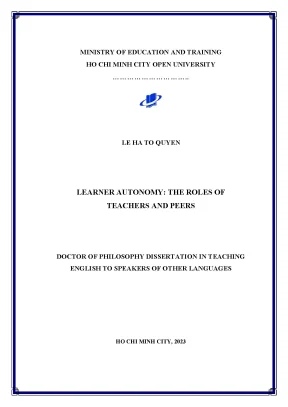
Tải xuống để đọc toàn bộMINISTRY OF EDUCATION AND TRAINING HO CHI MINH CITY OPEN UNIVERSITY …………………………. LE HA TO QUYEN LEARNER AUTONOMY: THE ROLES OF TEACHERS AND PEERS DOCTOR OF PHILOSOPHY DISSERTATION IN TEACHING ENGLISH TO SPEAKERS OF OTHER LANGUAGES HO CHI MINH CITY, 2023 MINISTRY OF EDUCATION AND TRAINING HO CHI MINH CITY OPEN UNIVERSITY …………………………. LE HA TO QUYEN LEARNER AUTONOMY: THE ROLES OF TEACHERS AND PEERS Major: Teaching English to Speakers of Other Languages Code: 91 40 111 DOCTOR OF PHILOSOPHY DISSERTATION IN TEACHING ENGLISH TO SPEAKERS OF OTHER LANGUAGES SUPERVISORS: 1. BUI THI THUC QUYEN, Ph.
DANG TAN TIN, Ph. HO CHI MINH CITY, 2023 ii STATEMENT OF AUTHORSHIP The Doctoral Dissertation titled “Learner Autonomy: The Roles of Teachers and Peers” has been submitted for the degree of Doctor of Philosophy in Teaching English to Speakers of Other Languages. Except for the references cited in this dissertation, I hereby declare that the whole or parts of this dissertation have not been published or used to obtain the degree elsewhere. No other person’s work/research may be used in this dissertation that is not properly cited.
This dissertation has never been submitted for any degree at any other university or training institution. Ho Chi Minh City, 2023 Le Ha To Quyen iii ACKNOWLEDGEMNENTS “Learner Autonomy: The Roles of Teachers and Peers” Doctoral Dissertation has been completed at Ho Chi Minh City Open University. I take this opportunity to extend my heartfelt thanks and deep gratitude to all those who have contributed to the successful completion of this dissertation. Their continuous support, guidance, and encouragement have been instrumental in my academic journey.
First and foremost, I would like to express my sincere gratitude to my scientific supervisors, Ms. Bui Thi Thuc Quyen, Ph. Dang Tan Tin, Ph. Their comprehensive knowledge, unwavering support, and enthusiastic guidance have been the cornerstone of my research.
Their insights and intellectual stimulation have been invaluable to my growth and understanding of the subject matter. I am forever indebted to them for their roles in my achievement. I am also deeply thankful to the Graduate Lecturers at Ho Chi Minh City Open University. Their extensive expertise and generous provision of background knowledge have significantly enriched my study activities.
I must also extend my appreciation to my family, relatives, colleagues, classmates, and friends. Their belief in me and constant encouragement have fortified me during the challenges and pressures of this endeavor. Without their support and love, this journey would have been far more arduous. Finally, I acknowledge all others who have contributed in any way to this project, whether directly or indirectly.
The collaborative spirit I have experienced will stay with me as cherished memories. In closing, I reflect on this journey with profound appreciation for the collective wisdom, guidance, and support that have made this dissertation a reality. It is my hope that the work presented here honors the efforts and contributions of all those mentioned above. Ho Chi Minh City, 2023 Le Ha To Quyen iv ABSTRACT Learner autonomy has been considered the central aim of education because of its significant role in enabling students to develop into successful lifelong learners.
In modern times, students have many opportunities to learn outside the classroom, the ideal context for learner autonomy development. Therefore, research about learner autonomy in the out-of-class learning context needs more focus. Based on sociocultural theory as the theoretical framework, the current research explores the situation of EFL tertiary students’ learner autonomy in out-of-class learning and the potential of promoting it through teachers’ and peers’ roles in the classroom. With the explanatory sequential mixed methods design, the study collected data from answers to a questionnaire on learner autonomy and teachers’ and peers’ roles (N=709) and semi-structured in-depth group interviews (N=35).
The findings pointed out positive correlations between factors of the situational, behavioural, and psychological dimensions of learner autonomy and the roles of teachers as a resource, an evaluator, a controller, an instructor, a facilitator, and a co-learner in the language classroom. The mediating factors of these correlations were the students’ motivation and trust, the teacher as a role model, and the teachers’ care. In addition, the correlations between learner autonomy and the four perceived peers’ roles in the classroom: a co-learner, an encourager, an assessor, and a supporter were also statistically significant. The mediating factors of these correlations were positive emotions, interdependence, responsibilities, and face value.
The research findings have provided empirical data about EFL tertiary students’ learner autonomy in the out-of-class context and the connection between in-class and out-of-class learning in fostering learner autonomy. Key words: learner autonomy, teachers’ roles, peers’ roles, out-of-class learning, in- class learning. v TABLE OF CONTENTS STATEMENT OF AUTHORSHIP. iii TABLE OF CONTENTS.
iv LIST OF ABBREVIATIONS. xi LIST OF FIGURES. xii LIST OF TABLES. xiii LIST OF APPENDICES .xv Chapter 1 – INTRODUCTION.
General context of the study. The history of English teaching and learning in Vietnam. The current situation of English teaching and learning in Vietnam. The vital role of English in Vietnamese education.
English teaching and learning from primary to high school education. English teaching and learning at tertiary level. The challenges of English language teaching and learning in Vietnam. The statement of problem.
Rationale of the research. Research aims, objectives, and research questions. Significance of the research. Scope of the research .16 Chapter 2 – LITERATURE REVIEW.
Conceptualisation of learner autonomy. Concepts of learner autonomy in language learning. Perspectives of learner autonomy. Models of learner autonomy.
Operational definition of learner autonomy. The importance of learner autonomy. Degrees of learner autonomy. Factors that influence the development of learner autonomy.
Approaches to foster learner autonomy. Learner autonomy in out-of-class learning. Perceived teachers’ roles in the language classroom. Perceived peers’ roles in the language classroom.
Constructivism and social constructivism. Community of Practice (CoP). Learner autonomy and perceived teachers’ roles. Perceived teachers’ roles in learner autonomy development.
Mediating factors of learner autonomy and perceived teachers’ roles. Learner autonomy and perceived peers’ roles. Perceived peers’ roles in learner autonomy development. Mediating factors of learner autonomy and perceived peers’ roles.
Related studies and research gap. The conceptual framework of the study. The quantitative research. Rationale for choosing English majors.
Rationale for choosing the questionnaire format. Translating the questionnaire. Piloting the questionnaire. Quantitative data collection procedure.
Quantitative data management. Quantitative data analysis. Issues of reliability and validity of the quantitative research. The qualitative research.
Rationale for adopting semi-structured in-depth group interview. Participants and the recruitment process. Piloting the interview protocol. Qualitative data collection procedure.
Qualitative data analysis. The trustworthiness and authenticity of the qualitative data .104 Chapter 4 – DATA ANALYSIS. Results of the quantitative research. EFL students’ learner autonomy in out-of-class learning.
Internal consistency reliability measure of learner autonomy scale. Descriptive statistics of learner autonomy. Perceived teachers’ roles in the language classroom. Exploratory Factor Analysis of perceived teachers’ roles scale.
Descriptive statistics of perceived teachers’ roles. Perceived peers’ roles in the classroom. Exploratory Factor Analysis of perceived peers’ roles scale. Descriptive statistics of perceived peers’ roles.
Correlations between learner autonomy and perceived teachers’ roles. Pearson correlations between learner autonomy and perceived teachers’ roles. Canonical correlation between learner autonomy and perceived teachers’ roles. Correlations between learner autonomy and perceived peers’ roles.
Pearson correlations between learner autonomy and perceived peers’ roles. Canonical correlation between learner autonomy and perceived peers’ roles. Results of the qualitative research. Mediating factors of learner autonomy and perceived teachers’ roles.
Motivation as a mediating factor. Trust as a mediating factor. Role model as a mediating factor. Care as a mediating factor.
Mediating factors of learner autonomy and perceived peers’ roles. Positive emotions as a mediating factor. Interdependence as a mediating factor. Responsibilities as a mediating factor.
Face value as a mediating factor .149 Chapter 5 – FINDINGS AND DISCUSSIONS. EFL tertiary students’ learner autonomy in out-of-class learning. The situational dimension. The behavioural dimension.
The psychological dimension. Perceived teachers’ roles in the classroom. Perceived peers’ roles in the classroom. Learner autonomy and perceived teachers’ roles.
Correlations between learner autonomy in out-of-class learning and perceived teachers’ roles in the classroom. Mediating factors of correlations between learner autonomy in out-of-class learning and perceived teachers’ roles in the classroom. Learner autonomy and perceived peers’ roles. Correlations between learner autonomy in out-of-class learning and perceived peers’ roles in the classroom.
Mediating factors of correlations between learner autonomy in out-of-class learning and perceived peers’ roles in the classroom. Finalising the research model. Summary of main findings. EFL tertiary students’ learner autonomy in out-of-class learning.
Correlations between learner autonomy and perceived teachers’ roles and their mediating factors. Correlations between learner autonomy and perceived peers’ roles and their mediating factors. Contributions of the study. Directions for further research .186 xi LIST OF ABBREVIATIONS CEFR Common European Framework of Reference for Languages CoP Community of Practice EFL English as a Foreign Language HCMC Ho Chi Minh City IELTS International English Language Testing System L1 First Language LBC Learning Beyond the Classroom LMS Learning Management System MoET Ministry of Education and Training SAC(s) Self-Accessed Centre(s) SCT Sociocultural Theory TOEIC Test of English for International Communication ZPD Zone of Proximal Development xii LIST OF FIGURES Figure 2.
1 The operational definition of learner autonomy. 2 The conceptual framework of the study. 1 Scree plot test with Eigenvalues greater than 1 of the second EFA run on perceived teachers’ roles. 2 Scree plot test with Eigenvalues greater than 1 of second EFA run on perceived peers’ roles.
3 Canonical Correlation Analysis between perceived teachers’ roles and learner autonomy. 4 Canonical Correlation Analysis between perceived peers’ roles and learner autonomy .1 Research final model.172 xiii LIST OF TABLES Table 2. 1 Roles of teachers in the language classroom. 2 Overview of the questionnaire.
3 Detailed information of the scales with the adapted sources. 4 Cronbach’s alpha values in the pilot test. 5 Extract of the descriptive statistics of quantitative data. 6 Description of participants in the qualitative research.
1 Demographic information of the participants. 2 Cronbach’s alpha values of nine constructs of learner autonomy scale. 3 Descriptive statistics of the situational dimension of learner autonomy. 4 Extract of the descriptive statistics of the behavioural dimension.
5 Extract of the descriptive statistics of the psychological dimension. 6 KMO and Bartlett’s Test of the second EFA run on perceived teachers’ roles. 7 Extract of the total variance explained of the second EFA run on perceived teachers’ roles. 8 Extract of factor loadings of the second EFA run on perceived teachers’ roles.
9 Cronbach’s Alpha values of perceived teachers’ roles constructs. 10 Extract of the descriptive statistics of perceived teachers’ roles. 11 KMO and Bartlett’s Test of the second EFA run on perceived peers’ roles. 12 Extract of the total variance explained of second EFA run on perceived peers’ roles.
13 Extract of factor loadings of the second EFA run on perceived peers’ roles. 14 Cronbach’s Alpha values of perceived peers’ roles. 15 Descriptive statistics of perceived peers’ roles. 16 Pearson correlations between factors of learner autonomy in the situational dimension and perceived teachers’ roles.
17 Extract of Pearson correlations between factors of learner autonomy in the behavioural dimension and perceived teachers’ roles. 18 Pearson correlations between factors of learner autonomy in the psychological dimension and perceived teachers’ roles. 19 Canonical correlations between factors of perceived teachers’ roles and learner autonomy .
Nội dung được bảo vệ bản quyền — Tải xuống đầy đủ
Trích dẫn luận án này
Le Ha To Quyen (2023). Learner Autonomy: Teachers' & Peers' Roles in EFL [Luận án tiến sĩ, Ho Chi Minh City Open University]. LuanAn.net. https://luanan.net/giao-duc-hoc/phuong-phap-giang-day/learner-autonomy-teachers-peers-roles-efl
Câu hỏi thường gặp
Luận án "Learner Autonomy: Teachers' & Peers' Roles in EFL" nghiên cứu về vấn đề gì?
Phân tích tự chủ người học, làm rõ vai trò then chốt của giáo viên và bạn bè. Tìm hiểu cách hỗ trợ học viên phát triển năng lực tự chủ hiệu quả.
Luận án "Learner Autonomy: Teachers' & Peers' Roles in EFL" được bảo vệ tại trường nào?
Luận án này được bảo vệ tại Ho Chi Minh City Open University. Năm bảo vệ: 2023.
Luận án "Learner Autonomy: Teachers' & Peers' Roles in EFL" thuộc chuyên ngành gì?
Luận án "Learner Autonomy: Teachers' & Peers' Roles in EFL" thuộc chuyên ngành Teaching English to Speakers of Other Languages. Danh mục: Phương Pháp Giảng Dạy.
Luận án "Learner Autonomy: Teachers' & Peers' Roles in EFL" có bao nhiêu trang?
Luận án "Learner Autonomy: Teachers' & Peers' Roles in EFL" có 297 trang. Bạn có thể xem trước một phần tài liệu ngay trên trang web trước khi tải về.
Cách tải luận án "Learner Autonomy: Teachers' & Peers' Roles in EFL" về máy như thế nào?
Để tải luận án về máy, bạn nhấn nút "Tải xuống ngay" trên trang này, sau đó hoàn tất thanh toán phí lưu trữ. File sẽ được tải xuống ngay sau khi thanh toán thành công. Hỗ trợ qua Zalo: 0559 297 239.